Marcelo Loutfia, Ildeberto Muniz de Almeidab, Rodolfo Andrade Gouveia Vilelaa (2019). Fire Accidents: An Opportunity for Organizational Learning. In: Advances in Safety Management and Human Factors. AHFE Open Access, vol. 5. https://doi.org/10.54941/ahfe100174
The fire incident in Santa Maria, Brazil, where died 242 people, 123 injuries, repeated aspects already found in similar tragedies in other countries and showed the difficulty of learning with these aspects regard to accident prevention. The disaster occurred when a pyrotechnic component used by a music band emitted heat that reached the polyurethane ceiling, which ignited. This study aimed to analyze systemically the Santa Maria nightclub fire to describe different aspects whose interaction led to the accident. The assembled maps allowed us to conclude that there was an insufficient mechanism of action coordination for accident prevention. It was possible to show that besides the nightclub’s design problems, such as a lack of alternative unobstructed rescue routes, emergency signaling, agility in emergency response, other contributing factors were material weaknesses, lack of training of firefighters and first responders responsible for preventing injuries resulting from the burning of the coating material used for soundproofing the club. Accident analysis based on the AcciMap helped reveal the systemic nature of the complex network of causal factors involved in the fire at the club.
For centuries mankind gone through deaths from fire. In the U.S., in 2005, there were 3,677 deaths and 17,925 people injured in these accidents with property losses estimated at U.S. $ 664 million (Gill, et al., 2008, p2). Many of these losses are due to fires in nightclubs such as one in Santa Maria, state of Rio Grande do Sul, Brazil which is addressed in this study . Among the best nightclub disasters which is noteworthy is the one at The Station , Rhode Island on February 20, 2003, which killed 100 people and left 200 injured . There the main problem involved the use of pyrotechnics, burning foam and spread of toxic gases in a place with inadequate emergency exits. In another fire at the Cromangnon Republica Bowling in Buenos Aires / Argentina in April 12, 2004 , 194 people died after the fire reached the ceiling finishing material which released toxic fumes in a house whose emergency exits were blocked. Many other similar occurrences could be listed, but we will mention only the flight RG820, in July 11, 1973 , with 123 deaths and 11 wounded . The Boeing 707 of the Varig company prefix PP-VJZ , departed from the International Airport of Rio de Janeiro / Brazil towards Orly Paris / France airport. During the flight there was a fire in the toilet which produced cyanide gas (the same of the Kiss Nightclub ) that spread throughout the aircraft . The smoke from burning plastic filled the cockpit. The death toll was not higher because the crew managed to land the plane immediately nearby the greenbelt of Paris.
Due to the recurrence and severity of these fires, our study seeks answers through more current and systemic view of the occurrence models. In the famous Stanley Kubrick film 2001 - A Space Odyssey, the opening scene always aroused several reflections. What you see is a fight for a water source. At a given time one of primates recognizes a bone, not as such, but as a weapon that gives him competitive advantage. Indeed, the new use of old tool changes the system configuration from which the struggle for power would become an unacceptable risk to the other group. The subtle change in the use of a tool introduces new relations and changes the system.
Modern society, which is characterized by its dynamic and complex technical features there are numerous possibilities of changes. These changes could be of isolated components, or of the interactions between components or of the environment which, although not separately perceived as associated to risks, can trigger potentially disastrous situation.
In Proactive Risk Management in a Dynamic Society, Jens Rasmussen and Inge Svedung propose a way to understand, even in part, this complexity. They claim "the propagation of an accidental course of events is shaped by the activity of people that can either trigger an accidental flow of events or divert the normal flow. Safety, then, depends on the control of work processes so as to avoid accidental side effects causing harm to people, environment, or investment." (Rasmussen & Svedung 2000, p 10.)
This study deals with in-depth analysis of the fire occurred in early 2013, in Brazil, in a nightclub where two hundred forty-two people died. This in depth research searches for managerial contributions not only in the operational, technical or superficial antecedents or in the isolated human history to trace the origins of the event. "(...) While the inner layers are concern with ways of Avoiding the hazards and with the underlying causes, such as weaknesses in the management system. Very Often only the outer layers and are Considered Thus we fail to use all the information for Which We have paid the high price of an accident "(Kletz, 2001, p. 1).
Systemic approaches criticize the linear accident models : "most accidents accident models view the Resulting from a chain or sequence of events . Such models work well for losses Caused by failures of physical components and for Relatively simple systems . But since World War II , the types of systems we are Attempting to build and the context in Which They are being built has been changing " ( Leveson , 2004, p. 237 ) . The reasons for this change are: Fast technological changes, application of digital technology, the complex relationship between men and automated devices, dangers arising from new energy sources, increasingly high costs of accident consequences which can affect the environment, increased complexity with connections which are not always predictable and changes in regulations. Besides technological components previously cited there are components which are derived from human relationships and decisions, that is, social aspects, which are decisive, usually related to the financial resources management as downsizing , productivity pressures, outsourcing, time pressures, etc., which are related to market competition in the local , national and international levels , making the casual process more unclear and diffuse in time and space.
Rasmussen (1997 ) also mentioned the systemic model , withdrawing from the unilateral understanding or from a single strand of scientific facts , given the increasing complexity and interaction of the various security systems that result in the further development of modern techniques, which are not only focused on the events leading to the incident , but which are also focused on constraints and preconditions that led to these events ( Adams & Johnson , 2004) . " That is , it Should be possible to Characterize the particular work system According to the 'requirement control' of the underlying hazard source in order to focus analysis on the information flow required controlling Within the socio -technical system is adequate risk management . In other words , the taxonomy Should Have a structure and set of categories can that serves to specify the information content required for safety control and proactive Thus to define the ' vertical ' relationships Within the socio -technical system Involved in risk management " ( Rasmussen & Svedung , 2000, p. 29).
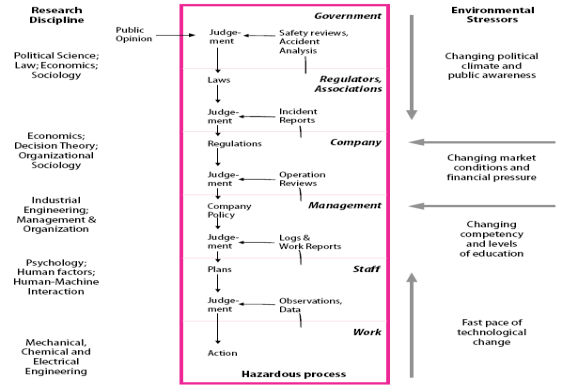
UNDERSTANDING THE ANALYSIS SYSTEM PROPOSED FOR CONTEMPORARY SOCIETIES The starting point for designing system model in (Rasmussen & Svedung, 2000) is represented by the following figure:
Figure 1. Social interaction levels, its stressors and related disciplines.
The author proposes six basic levels, namely: Governmental, regulators, corporation, management, staffing and the activity itself. Figure 1 shows management components involved in each layer. To the left we can see the disciplines that seek to understand the various levels. To the right we can see demands which influence action at every level, and which are called the environmental stressors. The lower layers are strongly influenced by decisions taken in the upper layers that can trigger changes that propagate to the level below, changing or even causing dangerous processes. In other words, preliminary risks of a given situation can be disseminated throughout the decision-making layers and not be just confined to a single actor.
This is due in part to public policies pressures, represented by arrows from top to bottom and technological changes from the bottom up. We also found horizontal pressures, the model demonstrated by arrows from right to left, which are distributed throughout all areas of the system. So the various levels should be comprehensively studied. The usual approach, which decomposes and circumscribes each level or operation layer, results in the disregard of interactions between different levels. Such influences must be taken into account even when assessing behavior under real work situation (Rasmussen & Svedung, 2000, p. 12-13).
Another important aspect in this model is the imbalance in the relationship between the emergence of risks and development of tools for regulation. In societies marked by the speed of the development of new technologies and organizational changes, controlling hazards and risks that are come alongside are left behind. Balancing this development becomes a challenge for those interested in prevention. The representation of the Santa Maria Accident, with the AcciMap has the objective of understanding the accident and consequently also the path to prevention.
METHOD USED FOR THE ACCIPMAP DEVELOPMENT
The ACCIMAP development, proposed here, is based on information from the CREA-RS reports and when appropriate supplemented by news widely publicized by the press. The development encompasses the analysis of existing preconditions, followed by the central critical event, search for correlations and significant influences on various socio-technical levels, and culminates in the rescue mitigating action. We are not "looking for the decision errors which are traditionally considered as causes of accidents, we seek to identify all the organizational bodies that contributed to the development of the accident scenario, whether or not they have violated rules or committed errors" (Rasmussen & Svedung, 2000, p. 17).
RESULTS AND DISCUSSION
Following is a description that will generate the map development. The AcciMap following six levels of decision: 1 - Governmental, 2 - Regulators, 3 - Corporation, 4 - Management, 5 - Labor Process, 6-Activities System The accident took place in a nightclub in the City of Santa Maria, Rio Grande do Sul, 323 km away from the Porto Alegre capital, Brazil. According the Brazilian Institute of Geography and Statistics, IBGE (2013) the local population consists of 261,031 inhabitants, the city area is 1,788,121 km2, GDP per capita of approximately $ 6,000. In the HDI ranking Santa Maria is in 46th place.
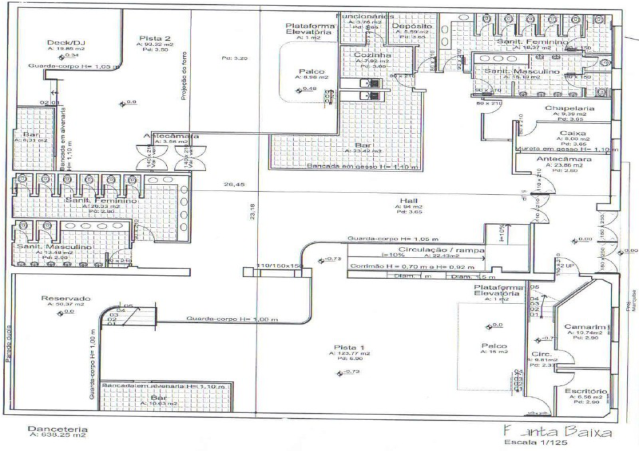
The Disco Kiss is totally surrounded by masonry walls , partitions with plasterboards in the stage and the three bars inside the nightclub , plus bathrooms and a mezzanine . It had only one entrance and exit that consist of two doors one of 1.75 meters and the other 1.60 meter, and between them there was a fixed central divider of 1.0 meter. The lighting was kept low during their activities. The most common activity was entertainment, show sand dance. The public consisted in its majority of youngsters. The city has lots of college students, thanks to the University of Santa Maria. The operating procedure is to attract customers by the media, public relations, using the mesh of relationships including even hired people and promoters, to attract customers. The attraction also occurs by internal and external architecture of the environment. The environment offers dance spaces, environment for socializing, show of several bands and consumption of drinks and cocktails . The site also has internal and external security personnel. These security guards protect the environment, organize queues, and apparently provide some personal security to customers. The bill is paid by the customer to before leaving the nightclub. Productive activities occur in nocturnal period with some aspects of infrastructure also occur during the day, such as accounting, material storage, maintenance and general cleaning. Follows the layout of the site.
Figure 2. layout (CREA-RS, 2013).
Date - Event Sunday, 2:30 a.m., January 27th, 2013. During the presentation of the Gurizada Fandangueira group, the vocalist of the band lit and held a firework artifact so that sparks reached the ceiling above the stage. Initial attempts to fight the fire were unsuccessful due to extinguisher failure. The house was overcrowded by at least 864 people. The polyurethane foam used as acoustic coating released toxic gas, the contention and direction partitions within the club blocked customers exit (GLOBE 2013). The accident caused 242 fatalities, 22 of which were working. The deaths occurred by inhalation of toxic fumes. The accident also injured over 123 people.
Preconditions
1. On April, 20th,2009 the Santo Entretenimento Ltda (Boate Kiss) hired an architect who requires design approval, the objective was to adequate the site which was previously a technical school. 2. On June 26th, 2009 the nightclub presents a generic document which was a Simplified Plan for Prevention and Fire Protection (PPCI), unsigned by the responsible technician. 3. On June 27th, 2009 the reform project with the noyes of Technical Responsibility (ART) was issued by the architect with the (CREA-RS) Regional Council of Engineering and Architecture of Rio Grande do Sul and it was reviewed by professional city hall demanding adequacy of emergency exits. 4. On August 26th, 2009 the club receives an operating permit from the Fire Department. 5. On March 4th, 2010 the company Santo Entretenimento Ltd receives license to open its operation from the city hall having, this license was based on acoustic measurement report, ART No. 5,118,124, neighborhood impact study ART 4,995,627, with an estimated built area of 638.25 m2 and capacity for 691 people. The license had annual renewals according to February 11th, 2011 and January 19th, 2012 newsletters. The operating license, under city hall scope, was in effect on the day of the accident, and it was issued on April 27th, 2012. 6. On December, 21st, 2010 the first warning was issued for renewal of the Fire Department’s authorization. In response, the owners made an application for inspection on February 11th, 2011. The site was inspected on April 11th, 2011, when it was issued a correction notice, which required corrections in fire extinguishers, emergency lighting, emergency exits and gas hoses. 7. On April 14ht 2011 the Kiss Nightclub gets a permanent license to operate from the City Hall. The activity was done at the register office and there is no inspection only paper were examined. 8. On July 25th, 2011 an inspection was made by the Fire Department and which found that the irregularities of December 21st, 2010 (item 6 above) had already been fixed. A new Fire Department authorization was then issued. 9. On November 22nd, 2011 due to several complaints by neighbors with noise nuisance has fired the public Ministry (MP) that caused the intimate Kiss Nightclub, on behalf of its owners to attend and composiçõa a Terms of Adjustment of Conduct (TAC ) between Disco and prosecutors, for execution of works and instalaçõa the drywall, so the noise from the external environment did not affect the sosego neighborhood 10. On January/2012 the renovation work begins, it was regularly recorded by the CREA-RG by a civil engineer being responsible for the for the project and its execution. According to reports it was this during this reform that acoustical lining was installed. The materials suitable for sound absorption should be fibrous or flexible foam provided with flame retardant polyurethane and with a density of 32 Kg/m3 according to Bistafa (2011, p. 247). The analysis found conflicting information about the presence or absence of the engineer responsible for the reform. According to the owners the PU installation was done under the supervision of an engineer. On the other hand, the engineer denied this fact. The police record does not includes information about a person responsible for the use of this material. In Brazil, responsibilities for marketing products like foam and pyrotechnic materials, as well as the supervision of their use are addressed by federal legislation such as the Consumer Protection Code (CDC - Law 8078/90), by state CREAs, by the Ministry of Labor and Employment (MTE) and even by the National Army in a confusing mix of standards and regulatory bodies. 11. On March 22nd,2012, there is a registration of an occurance at the CREA-RS report of measurement of acoustic pressure done by a civil engineer who does not mention the polyurethane that was already intalled and this engeneed also advices the previous prescription of the instalation of plasterboard lining. The Public Ministry issues a certificate affirming that the requested modification requested by TAC were accomplished. 12. In April 19th, 2012, inspector from the city hall inspecte the site and draw attention to the fact that the permit from the fire department was about to expire
13. On May/2012, due to continuing complaints from neighbors, the Pubic Ministry requested noise measurement to the Environmental Battalion (BM), reiterated in July 2012. Such measurements were never taken. 14. On July/2012, the nightclub hires a company to install anti Hidramix panic bars on the doors, but keeps the bars low in order to direct customer flow. 15. On October 19th, 2012, the club hires a company “Prevent Extinguishers” to recharge five extinguishing equipment. The extinguishers handled at the time of theoccurrence did not work.
The Accident
On the night of January 27th, 2013 there was a fire during a concert of the band, the vocalist lit a pyrotechnic device which reacheg the acoustic coating situated above the stage and it began to catch fire. The extinguisher used to control the situation did not work and at the same time there was rapid spread of smoke resulting from the burning lining with formation of dark and toxic fumes. The nightclub had only one entrance and exit door, the place was over crowded, there was not adequately trained staff to guide the ones present that day, and apparently there was a delay in opening the doors given the fact that the managers did not not realize what was going on inside nightclub. The situation was aggravated by the presence of barriers, guardrail type that hindered the free flow of people.
Rescue
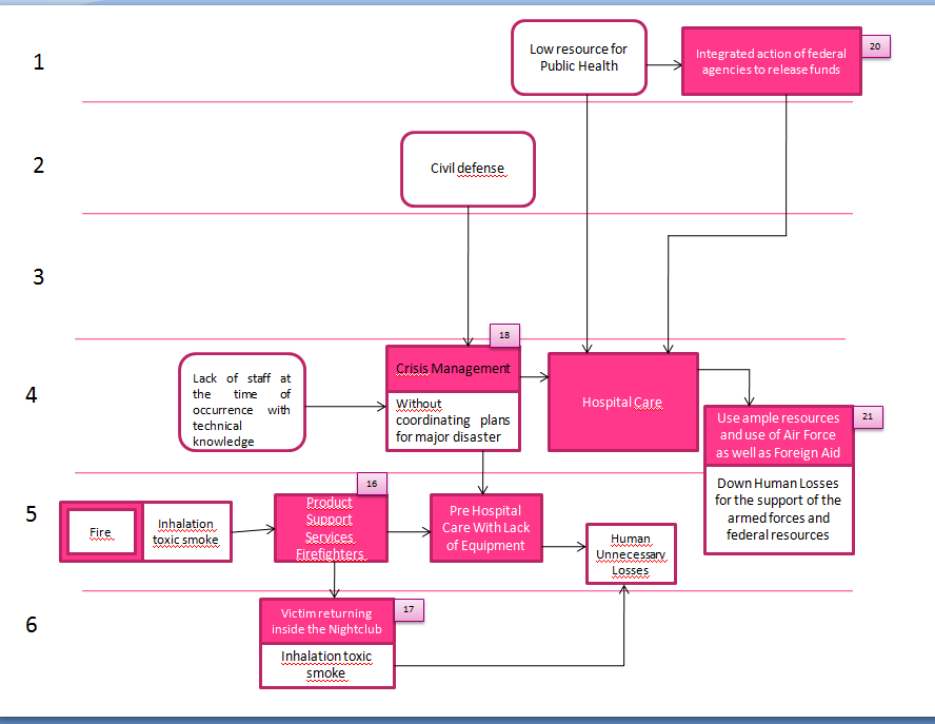
16. The fire department arrive and began its work without realizing that the greatest danger was that of poisoning by the degradation of materials. Although there were similar occurrences of relatively well- publicized disasters in Brazil the marketing of the recommended antidote, injectable hydroxocobalamin was prohibited. Also the fireproofing Brigade of theNightclub was unaware of lessons learned from similar cases and this did not contribute to the recognition of the gravity of the situation 17. Rescue efforts were initiated even before the arrival of firefighters relying on voluntary including customers who had managed to leave the nightclub. These efforts continued after the arrival of firefighters including several of them who returned the nightclub in an attempt to help the wounded 18. The presence of the civil defense is requested, but there was no coordination given the size of desatre. 19. Devida ao local ser afastado e sem muitos recursos o primeiro atendimento sofre algumas limitações da equipe de apoio. Due to the fact that the site is far from major cities and without many resources, the first aid was limited. 20. Following the event there is wide mobilization of the Federal Government and release of resources occurs. 21. Removal of injured to hospitals in the region was done with the support of the Brazilian Air Force (FAB), mobilization to get extra beds, medicines, equipment and professional teams in the county, state, federal government and even from abroad to care for all who needed occured. The federal support was given through the mobilization of the National Power and SUS made it possible to obtain donations of the antidote, hydroxocobalamin injection and about four days later It was at the disposal of the treatment teams. For the first in the history of this country groups were organized to help the victims program with active search for semi-acute and chronic sequelae in survivors and in team members mobilized in assisting victims. The analysis of the information shows that apparently, the contracting for the night of the accident, the team responsible the club and the band would have acted the same way they were used . The contract negotiations have been focused on details of cost , with without security aspects being mentioned by either party despite being - known band that included fireworks in their performances . Apparently, the responsible for the purchase of artifacts to be used in the show indoors did not mention security aspects either. The procedures used were standard. At no point , would have occurred by contractors connected to the club , by the band members or people in charge of the sale of the artifacts any kind of warning about additional precautions when it comes to presentation indoors . None of the actors involved in the process at any time were aware of the danger introduced into the scenario when the polyurethane coating ( PU ) for acoustic treatment was installed at the site .
Also local, state and federal authorities responsible for fire prevention, or those responsible for operating licenses of the nightclub, or earlier, when the works of flooring installation have occurred there was not any initiative to make the actors involved aware of the possible danger. The analysis report of CREA concludes that the "care and respect to Prevention Plans and Fire Protection end up being purely formal," however, there are no records about how this would have happened.
Who defines and how do we define the roles to be fulfilled in the implementation of prevention and fire protection systems? What are the means to perform these actions? How could we ensure that the system would was properly implemented and is effective? By what means and how do we coordinate the actions of multiple actors identified as part of this system? After all, what actors have failed to take on specific obligations?
In seeking answers to these and other questions it is important to explore social constraints that may affect the performance of each of the actors in a given situation. For example , it is worth noting that the disaster of Santa Maria brought to light the fact that Rio Grande do Sul is one of the few states in the country where the Fire Department is not a professionalized organization, it is subordinated to the military police, would not the limitations of political and financial autonomy negatively influence their material conditions and technical training to perform their duties? Would it be possible to identify relationships between those facts and the role of the corporation in the disaster of Santa Maria ? Do these conditions contribute to chronic weaknesses or deterioration in the organization? would such conditions have been reflected in the history of this disaster, for example , creating situations of asymmetric powers capable of weakening the organization in defense of its role especially in stages or negotiations involving political actors defending other interests , such as licenses for the operation of nightclub? The vertical map can help answer such questions.
Presentation of the AcciMap
Figure 3. AcciMap up to the event. Fire.
Figure available in the original PDF paper.
Figure 4. AcciMap após o evento crítico Incêndio.
Discussion about the AcciMap
Figure 3 shows that the disaster of Santa Maria, directly and indirectly involved contributions from many participants many or these are what we call prevention and protection from fire which are spread in different hierarchical levels without the presence of bodies responsible for the coordination of all system and which encourage cooperation between components. In other words, the accimap shows that the proposed devices, structures and processes created (Leveson, 2012) in order to control the hazards associated with fires in nightclubs in Brazil failed their mission.
The logic that prevails is that the isolated operation of each of these members is not satisfactory and it could cause possible disruptions because their decisions and actions may affect the performance of the others. The idealization is evident. We don’t take into consideration the fact that in real life changes in components predominate, and their interactions with each other or with the environment in which they live go through changes, there are differences of interests and asymmetry of power.
Here not only the gaps in the legal framework relating to fire prevention and protection at the federal and state levels are highlighted, but also at the local level. In this area is important to note that the self-extinguishing polyurethane plates as the ones used in the club are not classified "as flammable or hazardous chemicals in Brazil" (Trivelato 2013). This fact allows us to state that, in Brazil, the fire prevention and protection system does not show good performance in the area of learning from past tragedies, such as Rhode Island and Buenos Aires.
With regard to the critical event itself it is first necessary to point out the large number of victims. This is due to the interaction of multiple factors, among which can be highlighted: the rapid spread of fire and toxic smoke produced due to the characteristics of the coating without flame retardants, use of pyrotechnic device that produces flames inside the club and non-functioning fire extinguisher as well as a contribution from the lack of automatic fire- fighting devices, the excess of people in a room with only one escape route which was initially blocked the lack of emergency lighting in the dark without proper exit signaling, the absence of a escape plan and staff adequately trained in its implementation. Anyway, by not identifying the main danger involved in the situation and therefore, lacking a proper response to combat the problem.
The findings show that the management of the nightclub business seems to focus only on the immediate demands for solutions that do not impede the continuity of its operations. Prevention and fire protection can be limited to the alleged PPCI entry into the computerized control system, it does not matter if it does not include a technical officer . Moreover, the system accepts plans that do not include this type of professional. The reforms required due to complaints about the noise caused by the parties can be made without expert design using cheaper means appointed by vendors as frequently used for " acoustic treatment " . The formal documentation of works and actual execution of these works occur independently , ie , in practice there is no one in charge of project management . The person in charge of purchasing materials can opt to buy cheaper material without consulting the person responsible for the project . The person responsible for scheduling of shows can hire the band which announces on the website that it use pyrotechnic articles without introducing potential changes in the system, which could require additional care. Apparently in no time great disasters in nightclubs in other countries served as a warning to those responsible for security in the business or activity as far as potential hazards incubated in everyday Nightclub . Most likely the lack of assimilated lessons from previous cases contributed to the increase in the number or deaths among firefighters , workers and patrons of the nightclub on the day of the fire especially those who had left the site and returned to its interior because they were feeling well .
The accimap also shows that many of the proposed system controls resemble bureaucratic formalities, ie the Engineering Council, which receives copies of the projects checks to see if these projects are signed by qualified professionals to do so. In case of request for a noise appraisal report or acoustic protection installation it checks whether the report was officially submitted and whether or not the acoustic protection was installed.
The activity of the Fire Department is influenced by material and financial resources provided in accordance with public policies of the state budget. According to research the growing demand, the scarcity of resources in terms of the delay releases of permits and licenses led to the adoption of Ordinance 138/02 (item 2 descriptive) that enables the electronic processing of authorizations and their PPCI. The adopted software does not require monitoring or intervention by technician. The control is done at the register Office.
The system does not have the agility to monitor changes: given authorization from the Fire Department in August/2011, four months after the club starts new reform substantially changing the location and inserting toxic finishing material. In summary, the accidmap shows that the prevailing administrative barriers have proven to be inadequate, for the lack of agility, or by ineffectiveness, but the system was not provided with mechanisms that allow the recognition of these chronic shortcomings. The focus was on formalisms The shortcomings mentioned above about the emergency response to the disaster were also influenced by the lack of resources and information. Eight firefighters were among the victims in part by entering the site without the most suitable protection against toxic atmosphere formed by burning polyurethane coating. On the other hand, it was possible to notice that this tragedy mobilized support not only from the local population, but also from neighboring municipalities, from the state capital, and even from the federal government, which provided teams of the National Power and Health System (SUS). This allowed flexibility in opening of ICU beds in mobilizing human resources, materials and medications required in transporting teams and patients who had the support of the Brazilian Air Force and for the first time in the country, offered a monitoring program for victims and participants in the emergency response.
CONCLUSIONS
Ten years have passed since the fire at The Station nightclub in Rhode Island, USA. There, as in Santa Maria, the ignition occurred by use of fireworks which caused the spread of toxic gases of PU foam in the location with restrictions on the outflow of people. In Rhode Island, a hundred young people died. In Santa Maria, there were two hundred forty-two fatalities. In the U.S., after the fire at The Station, the National Fire Protection Association (NFPA) adopted changes, in particular in the NFPA101 Life Safety Code document, including requirements such as the use of sprinklers in nightclubs. In Brazil, what Will be done still seems uncertain. .
The requirement of the presence of this type of environment sprinkler is a measure identified as beneficial for several reasons among which we could include: being able of extinguishing fires at the beginning, reduced toxic fumes, improving visibility in contexts of possible panic (D. Rasbash, 2004: . 111).
However, when seen in the systemic perspective, the accimap allow us to recommend going beyond ad hoc measures that may have their relative importance. The prevention of such accidents requires political efforts that foster cooperation and coordination of actions of all actors involved in the disaster identified such as those in Santa Maria. Beyond their specific roles in the new system their components need to pay attention to the fact that decisions taken under the sole logic of a particular place, whatever it is in the system, will give rise to multiple interactions with those adopted by other actors and thus it can create potentially negative or positive effects and that needs to be considered if the goal is to achieve the mentioned Proactive Management Risk which has been identified as necessary in a dynamic society marked by speedy changes.
“In a dynamic environment, hazard sources, their control requirements, and sources of disturbances change frequently and risk management can no longer be based on responses to past accidents and incidents, but must be increasingly proactive. Control therefore must be based on a continuous monitoring of the actual level of safety, that is, the margin between the present system conditions and preconditions for safe operation. An adequate margin is then to be maintained by means of a closed loop feedback control strategy” (Rasmussen & Svedung, 2000, p. 47).
Like other tragedies, the one in the nightclub Kiss has stimulated debates and distinct initiatives. The fire shocked Santa Maria and its consequences spread throughout the state of Rio Grande do Sul and across the country. Survivors, families and friends of victims created groups that require prevention and protection from fire which are appropriate and active at the same time crying out for justice and they seem to seek new meaning for their lives. Ongoing investigations show that the incident was not and should not be seen as an isolated fact and that weaknesses similar to the one in Santa Maria are present in all major cities of the country.
The unfolding of the Santa Maria disaster seems to go towards the construction of a political agenda for prevention. In our opinion, those interested in this agenda must confront this challenge acting in at least three dimensions identified in this study. The consequences of the immediate and long-term dangers of exposures and risks such as those created in the Nightclub and determinants that enable the creation of such hazards and risks. Reduce our work of recommending specific measures or techniques, stop trying to find criminal and civil liability or improve health care to the victims of these events despite the benefits will represent immense loss of opportunity for learning and real progress in the prevention area.
REFERENCES
Almeida, I. M., & Johnson, C. (21 de Julho de 2004). An Investigation into the loss of the Brasilian space programme's launch vehicle VLS1 V3. ScienceDirect . Bistafa, S. R. (2011). Acústica Aplicada ao Controle do Ruído. São Paulo: Editora Edgar Blücher. CREA-RS. (2013). Análise do Sinistro na Boate Kiss, em Santa Maria, RS, porto Alegre, 04 de Fevereiro de 2013.
Porto Alegre: Conselhor Regional de Engenharia e Agronomia do Rio Grande do Sul. D. Rasbash, G. R. (2004). Evaluation of Fire Safety. Jonh Wily & Sons Ltd. Gill, A. A., Pannoni, F. D., Ono, R., Silvio Bento da Silva, U. D., Silva, V. P., Seito, A. I., et al. (2008). A Segurança Contra Incêndio no Brasil. São Pulo: Projeto Editora.
Instituto Brasileiro de Geografia e Estatística. (2013). IBGE. Acesso em 30 de Janeiro de 2014, disponível em htpp://www.cidades.ibge.gov.br Kletz, T. (2001). Learning from Accidents. London: Gulf Professional Publishing. Leveson, N. (2004). A New Accident Model for Enginnering Safer Systems. Safety Science , 237-270. Leveson, N. (2012). Engeneering a Safer World: System Thinking Applyed to Safety. The MIT Press, Cambridge,
MA. O GLOBO. (9 de Julho de 2013). http://g1.globo.com/rs/rio-grande-do-sul/noticia. Acesso em 9 de Julho de 2013, disponível em Jornal O Globo Rio Grande do Sul: http://g1.globo.com/rs/rio-grande-do-sul/noticia/2013/07/nem-todos-foram-avisados-do-fogo-diz-sobrevivente- da-kiss-em-audiencia.html Rasmussen, J. (1997). Risk Management in a Dynamic Society: A Modelling Problem. Safety Science , 183 - 213. Rasmussen, J., & Svedung, I. (2000). Proactive Risck Management in a Dynamic Society. Swedish: Swedish Rescue
Services Ageny. Trivelato, G. (2013). Comprender para Prevenir. Revista Proteção , 70-76.
LISTED IN THE AHFE DIGITAL BOOKSTORE CATALOGUE
Explore the complete digital volume
Advances in Safety Management and Human Factors
Read this individual research paper free through the original publisher, or explore the full digital proceedings book.
ISBN 978-1-4951-2100-5
Explore this ISBN in the AHFE Bookstore ↗Listed in the July 2026 bookstore catalogue; search by ISBN to confirm current availability · Digital book purchase optional