Michael Kupfer, Joey Mercer, Todd J. Callantine, Vimmy Gujral, Ashley Gomez (2021). Evaluation of an Arrival Coordinator Position in a Terminal Metering Environment. In: Advances in Human Aspects of Transportation: Part II. AHFE Open Access, vol. 16. https://doi.org/10.54941/ahfe100714
A human-in-the-loop (HITL) simulation investigated the performance of an integrated arrival-management solution developed by NASA, called the Interval Management Terminal Area Precision Scheduling System (IM-TAPSS). The focus of this paper is on the operator who, during the simulation, served as both the terminal radar approach control (TRACON) traffic management controller and Arrival Radar Coordinator (ARC), and played an integral part in coordinating, adjusting, and instantiating the arrival schedule computed by the IM-TAPSS system. Analyses of the simulation data highlight the role of the ARC within the terminal metering environment, describe his planning strategies, tool interactions, and coordinations with controllers, and lend insights to the impact of the ARC’s actions on the arrival problem. High levels of comfort and confidence were reported when working with the IM-TAPSS system. Challenges included the sequencing of unscheduled satellite arrival flights during periods of peak demand, in response to which, the ARC had to identify sequence slots while minimizing disruptions to the overall schedule.
During peak traffic periods, the current air transportation system around terminal areas is impaired by flight inefficiencies, such as frequent vectoring maneuvers and extended level- off flight segments; often at low altitudes. This translates into high noise contamination for effected communities, increased fuel consumption and consequently increased emission output. In consideration of forecasted increases in air traffic demand, Europe's Single Euro- pean Sky ATM Research Program (SESAR) and the United States' Next Generation Air Trans- portation System (NextGen) initiative focus on developing new Air Traffic Management (ATM) technologies, systems and procedures, such as optimized profile descents, to mitigate these inefficiencies (SESAR Joint Undertaking, 2013), (Federal Aviation Administration, 2013).
NASA, the FAA, and industry partners are currently working jointly on a multi-year effort, called the ATM Technology Demonstration-1 (ATD-1) (Prevot et al., 2012). The Airspace Opera- tions Laboratory (AOL) and two other research groups at NASA Ames and NASA Langley are supporting the ATD- 1 efforts by conducting HITLs of which the goal is to first integrate the different system components into the labora- tory setting, to refine the system components, tools, procedures and phraseology, and then to study the overall sys- Human Aspects of Transportation II (2021) tem performance and compare it with current day operations (Callantine, Kupfer, Martin and Prevot, 2013; Mur- doch, Wilson, Hubbs and Smail, 2013; Thipphavong et al., 2013). This work focuses on the most recent simulation conducted in the AOL, with particular emphasis on the strategies employed by the operator working a position that combined the roles and responsibilities of a TRACON Traffic Management Controller (TMC) and an Arrival Radar Coordinator (ARC).
BACKGROUND
IM-TAPSS includes three components: a Traffic Management Advisor for Terminal Metering (TMA-TM) scheduling element, Controller-Managed Spacing (CMS) tools, and Flight-Deck In- terval Management (FIM) system. The TMA-TM is an extension to the currently fielded TMA, and provides a timeline graphical user interface (TGUI) to display schedule information to controllers and TMCs. The CMS tools, comprised of slot markers, timelines, early/late indicators and speed advisories, are TRACON decision-support tools that assist controllers in managing delays and delivering aircraft in accordance with the schedule (Kupfer, Callantine, Martin, Mercer and Palmer, (2011). The Airborne Spacing for Terminal Arrival Routes algorithm is used onboard FIM-equipped aircraft to support flight crews during airborne spacing tasks. The simulation discussed in this paper was limited to the first two components. The FIM component will be added in a subsequent simulation. The following description of the operational concept ex- cludes FIM.
The ATD-1 range of operation extends from the TRACON into Center airspace. While still in cruise TMA-TM as- signs runways and computes estimated times of arrival (ETAs) at various scheduling points, such as meter-fixes, ter- minal-area merge points, and runways. Using minimum spacing information, a scheduled time of arrival (STA) is computed for each aircraft at every schedule point. At a particular distance the STAs are frozen, providing con- trollers with a stable control target. Center controllers then begin to reduce schedule delays using speed control and path assignments. After transitioning into the terminal area, controllers use the CMS tools to issue speeds to un- equipped aircraft to ensure correct inter-arrival spacing.
EXPERIMENT A HITL simulation was conducted in September 2013 – referred to as CA5-2 – to investigate terminal metering for fuel-efficient arrival operations during periods of high traffic demand. This section describes the elements of the simulation in detail.
Previous Simulation Studies Preceding the CA5 simulation series the AOL conducted four other HITLs under into the ATD-1 project. The ‘CMS ATD-1’ simulations in January, April, and June 2012 – referred to as ‘CA-1,’ ‘CA-2,’ and ‘CA-3,’ respec- tively – served to: ensure technical and procedural integration of the IM-TAPSS components, allow researchers to identify additional requirements, develop and iteratively refine procedures and new functionalities, and conduct ini- tial investigations on how the controller tools perform in a FIM-equipped/non-FIM-equipped mixed environment (Callantine, Cabrall, Kupfer, Omar, Prevot, 2012). The objectives of the CA-4 simulation, conducted in March 2013, were to continue to explore FIM operations in a mixed-equipage environment, quantify the effect of preconditioning the arrival flows, study CMS tool modifications (Callantine, Kupfer, Martin and Prevot, 2013).
The CA5 simulation series is comprised of three phases serving to compare ATD-1 operations with current-day PHX operations. Traffic scenarios were designed to closely resemble actual PHX traffic and winds data. The CA5-1 simulation was conducted in July 2013 and served as baseline study. Only the TMA-TM component was included. Arrival problems were simulated with the TMA-TM configured to operate like the deployed TMA version. The CA5-2 simulation, conducted in September 2013, examined limited IM-TAPSS operations without FIM. This paper will focus on the CA5-2 simulation and, since data analysis is ongo- ing, a selection of its results. The third phase, CA5-3, which will include FIM, is expected to occur soon.
Airspace, Routes and Scenarios
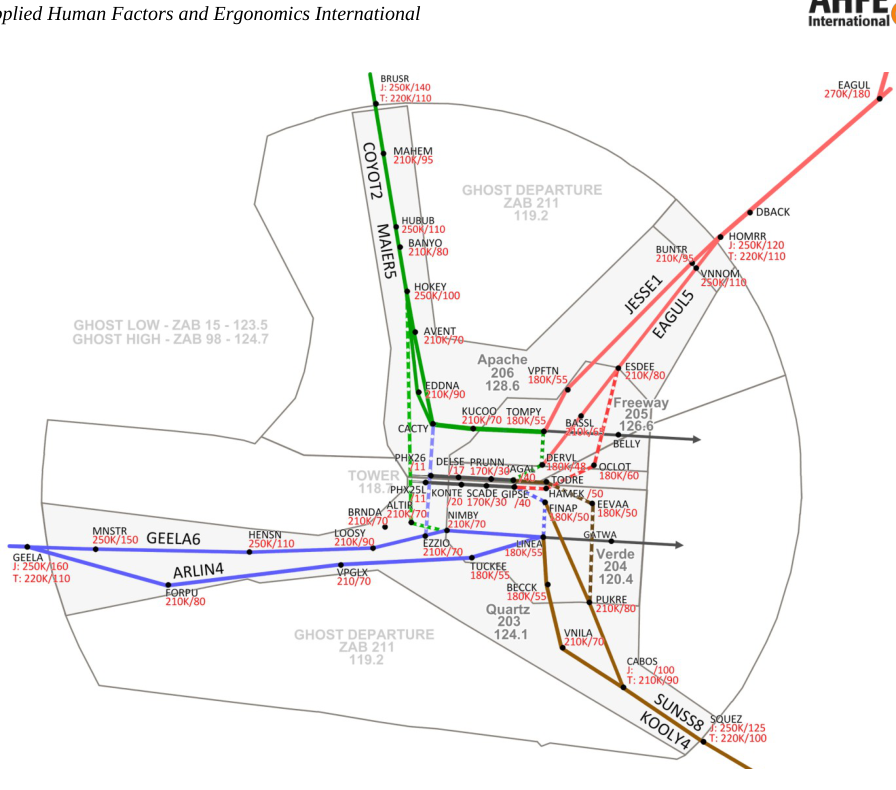
Figure 1 shows the test airspace including the test sectors and the routes, showing the waypoints with altitude and speed restrictions. The simulation’s test airspace was comprised of three high-altitude sectors (sectors 37, 50, and 93) and five low-altitude sectors (43, 39, 38, 46, and 42) from Albuquerque Center (ZAB), four high-altitude sectors (40, 60, 35, and 36) from Los Angeles Center (ZLA), and four Phoenix TRACON (P50) sectors; two feeder sectors (206-Apache, 203-Quartz) and two final sectors (205-Freeway, 204-Verde). Sectors 37 and 43, 40 and 60, and 35 and 36 were combined. The simulation was supported by several confederate ghost controllers: a departure ghost controller handled the departing traffic out of KPHX and the surrounding satellite airports, a satellite ghost con- troller handled the arriving flights into neighboring airports, a tower ghost position controlled KPHX arrivals during the last few miles of the final approach until landing, and two en-route ghost controllers (ghost high, ghost low) worked the substantial amount of remaining traffic in the surrounding airspaces. Real-world sector boundaries and altitude strata were used. Additionally, positions for a ZAB TMC and a P50 ARC, who also doubled as a P50 TMC, were staffed.
The CA5 studies simulated both west- and east-flow airport configurations. Published RNAV OPD routes and non- RNAV routes (see Figure 1), were adapted based on existing Standard Terminal Arrival Routes and Instrument Ap- proach Procedures. The adapted RNAV OPD routes were: MAIER5, EAGUL5, KOOLY4, and GEELA6. The adapted non-RNAV routes were: COYOT2, JESSE1, SUNSS8, and ARLIN4. During west-flow operations the RNAV routes from the east connected to the runway 25L and 26 approach procedures. During east-flow operations the RNAV routes from the west connected to the runway 07R and 08 approach procedures. RNAV routes from the other approach directions included downwind segments that were unconnected. The non-RNAV routes were uncon- nected as well and required vectoring to the final approach course.
Figure 1. Simulation Airspace showing the test sectors and adapted routes for west-flow configuration.
For each airport flow direction, one base scenario was designed. The scenarios mirrored real-world high-demand ar- rival flows under realistic wind conditions, with few differences from the live traffic recordings. These scenario files served as the starting point for the final traffic scenarios. Each traffic scenario is comprised of flights arriving at KPHX (subsequently referred to as arrivals), departures leaving KPHX and over-flight traffic departing and landing from airports other than KPHX. The arrivals consisted of a range of aircraft performance groups (i.e., jets, high- and low-performing turbo-prop aircraft and piston aircraft). Only the west-flow scenario contained low-performing turbo-prop and piston aircraft, which did not follow any of the RNAV and non-RNAV routes used by the jets and higher performing turbo-prop aircraft. These flights approached KPHX under the control of the satellite ghost con- troller’s airspace. Their routes were not adapted in the TMA-TM system. Copies of the two traffic scenarios were created that included additional KPHX arrival flights (six in east flow and five in west flow) in order to create a pe - riod of sustained increased traffic demand.
Participants The Center and TRACON sectors were staffed with recently retired ZAB and P50 controllers, with an average of 26.25 years of experience. CA5-2 also included a ZAB TMC as well as a position combining both theP50 TMC and the P50 ARC (referred to throughout this document as the ARC). The ARC had 29 years of experience as tower/ter- minal controller, nine of those years as the TMC/ARC at P50 TRACON. He was retired since December 2011. The two ZLA controllers, the tower controller, the departure controllers, the two en-route “ghost” controllers responsible for the areas surrounding the test sectors, and the satellite ghost controller responsible for traffic arriving at local air- ports, were staffed with retired confederate controllers. Prior to the CA5-1 simulation, none of the participant controllers had any previous experience with the IM-TAPSS concept and associated tools or the MACS simulation soft- ware. Boeing glass-cockpit type-rated pilots, many of whom had participated in previous CA simulations, worked single-pilot mid-fidelity desktop flight simulators, while local commercial and student pilots who were familiar with MACS, worked pseudo-pilot positions.
During the simulations, operator workstations were arranged such that the ZLA, ghost high, ghost low, departure and tower controllers were located in one room. Located in a separate room, were the satellite ghost TRACON con- trollers, and the ARC. The TRACON controller workstations’ arrangement was such that it replicated the arrange- ment in use in P50. A third room housed the high-altitude ZAB sector 93, and low-altitude ZAB sectors 42 and 46, while located in a fourth room were the low altitude ZAB sectors 50, 39, and 43. The single-aircraft pilots were grouped together in one area, while the pseudo pilots were distributed over two separate areas in the AOL.
ARC Position and Procedures In today’s operations, P50’s ARC position is normally combined with the TRACON TMC. All P50 personnel are expected to fully comply and cooperate with the direction issued by the ARC. The ARC is required to participate in operational briefings, and to provide a plan for: integrating the KPHX arrivals not sequenced by Apache and Quartz feeder sectors (i.e., satellite arrivals), accommodating aircraft approaching from one side of the airport that need to land on the opposite side (i.e., ‘cross-overs’), and changing the landing runway of an aircraft when needed (Federal Aviation Administration, 2011).
The ARC coordinates with the TRACON controllers to identify and create slots in the arrival sequence in which to accommodate the satellite arrivals. Because current-day operations are distance-based, rather than schedule-based, the ARC does not interact with the TMA TGUI to modify STAs or sequences. P50 controllers simply maneuver air- craft as needed to maintain safe separation, while the ARC helps coordinate workable sequences. In contrast, the schedule-based operations of the IM-TAPSS concept require the ARC to find naturally occurring slots in the arrival sequence, or if necessary, create a slot by adjusting the STAs of adjacent flights while minimizing the overall impact to the schedule. In this context, the ARC’s ‘big-picture’ perspective enables him to develop a plan for the unsched- uled arrivals using the various TMA-TM TGUI functions for manipulating STAs: move, swap, change runway, reset (re-computation of ETA and STA), and several types of reschedule (re-computation of STAs). He then coordinates his plan with the Center TMU and the TRACON controllers.
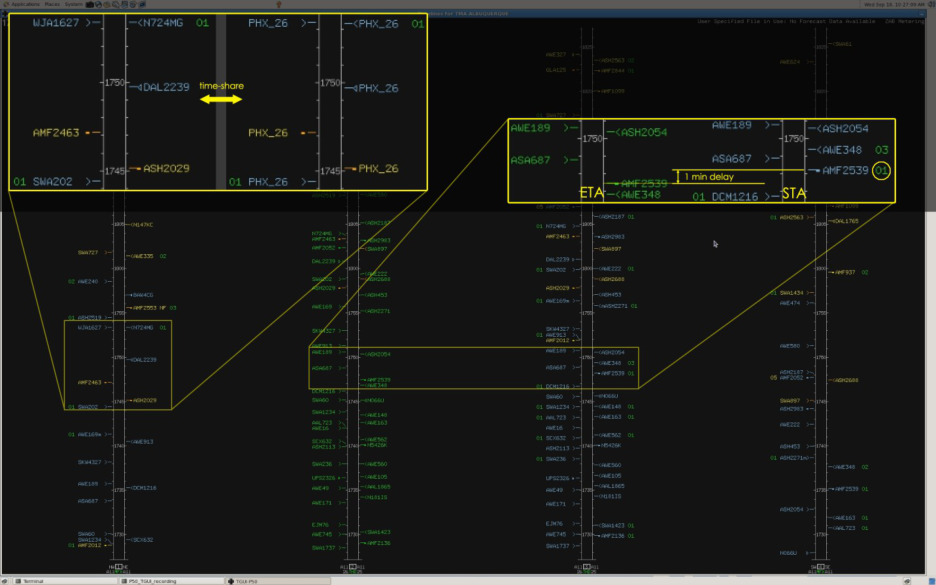
The ARC created a custom timeline layout to help him perform his tasks (see Figure 2). Four timelines were config- ured to show a one-hour time period, with the outer left timeline displaying meter-fix STAs (i.e., TRACON entry times) for aircraft coming over the northern meter-fixes, and the outer right timeline displaying meter-fix STAs for aircraft coming over the southern meter-fixes. More specifically, the outer left timeline’s left-side displayed the northwest meter-fix STAs, while the right-side displayed the northeast meter-fix STAs. Similarly, the outer right timeline’s left- and right-sides displayed the southwest and southeast meter-fix STAs, respectively. The call-signs displayed in these two timelines were time-shared with the aircraft’s assigned runway (left inset in Figure 2); allow- ing the ARC to quickly identify any cross-over flights. Delay values were displayed next to the callsigns in the me- ter-fix and runway STA timelines (right inset in Figure 2).
The TGUI’s two middle timelines provided schedule information for the runways. The center-left timeline dis- played runway ETAs (in green), arranged to show north runway ETAs on the left-side, and south runway ETAs on the right-side. The center-right timeline displayed runway STAs (in blue if frozen, yellow if un-frozen), also with north runway STAs on the left-side, and south runway STAs on the right-side. Because the runway timelines ac- cepted runways PHX08 and PHX26 as north runways, and runways PHX07R and PHX25L as south runways, this custom TGUI configuration worked for both east- and west-flow airport configurations. The separate arrangement of runway ETAs and STAs is based on the TGUI configuration in current use at P50. The ARC explained during one of the runs: “VFR airplanes coming from the Center [airspace], they are never scheduled, but they are always estimated”. The two middle timelines then, help the ARC to easily assess if slots are available on one of the run - ways. Although VFR aircraft were not included in the CA5 series of simulations, this example demonstrates the TGUI’s importance to the ARC’s tasks. Similarly, orange-colored leader-lines on the TGUI gave the ARC addi- tional information to incorporate into his decisions. The orange leader-lines indicated aircraft that either had not yet departed, or were currently flying in a Center airspace that does not feed data to P50.
The simulation environment posed some limitations on the realism of the operations. In current-day operations, satellite arrivals are held on the ground until a ‘call for release’ is approved by the ARC. However, in the CA5-2 simulation, those flights began flying at pre-specified times, without the option to delay their departure until a slot in the KPHX arrival schedule was available. The slots identified for those arrivals by the ARC sometimes required that large amounts of delay be absorbed. In an effort to meet those slots, the satellite ghost controller often had to vector the aircraft. Additionally, the routes of the satellite arrivals were not adapted in the version of TMA-TM used during the simulation, resulting in unreliable STA computations. The ARC consequently suspended the STAs of those flights (removing them from the STA timeline), developed an arrival plan, and coordinated with the TRACON controller team.
Figure 2. TGUI setup used by the TRACON TMC / ARC position. Timelines for meterfix STAs are on the left (northern routes) and on the right (southern routes). Runway ETAs for both runways are shown on the center-left and runway STAs for both runways are shown on the center-right timeline.
Training and Data-Collection Schedule The simulation began with a general introductory briefing, followed by four days of training before the data-collec- tion period. Center and TRACON controllers were first briefed on the airspace, routes, procedures, systems and technologies, then received training in separate, parallel simulations. Pilots flying the mid-fidelity single-pilot simu- lators received a separate initial preparation as well. On the third training day, controllers and pilots participated to- gether in joint training simulations with lighter traffic densities that, by the end of the day, increased to the traffic densities that were simulated in the data collection runs. The training was concluded at the end of the week with a debrief discussion. The data collection period took place over four days during the following week. Experimental trials were conducted in each of the airport flow configurations under four realistic forecast-wind error conditions with current-day and increased-load traffic scenarios, for a total of 16 one-hour data-collection runs. A post-run questionnaire and a 20-minute break followed each trial. The study was concluded with a post-simulation question- naire and an in-depth final debrief discussion.
Recorded simulation data logged various metrics such as trajectory and flight state information, pilot and controller entries, schedule data, etc., collected from every controller, pseudo-pilot and ASTOR workstation. Voice communications between controllers and pilots were recorded using an emulation of the FAA’s Voice Switching and Com- munication System (VSCS). An individual recording was obtained from the ARC using a collar audio reorder. Ad- ditionally, the displays of all workstations, along with the ambient audio, were captured via screen-recording soft- ware. Other logs captured TMA-TM’s schedule calculations. Using the Air Traffic Workload Input Technique (ATWIT) (Stein, 1985), controllers rated their current workload every three minutes, on a scale from 1 (low) - 6 (high). The next section highlights data regarding the role and tasks of the P50 TRACON TMC/ARC.
RESULTS
The CA5-2 simulation provided a wealth of information and insights on how the IM-TAPSS concept would look like if introduced into actual operations at KPHX. The following section provides salient results that highlight how the ARC adapted to new requirements of the IM-TAPSS system. First, objective data lends insights into which TGUI features the ARC used to accomplish his task. Subsequently, subjective data provides details on tool accep- tance and traffic management techniques. To emphasize the complexity of merging flights into an already dense ar- rival stream and to highlight ARC-controller coordination two explicit examples of arrival coordination problems are presented.
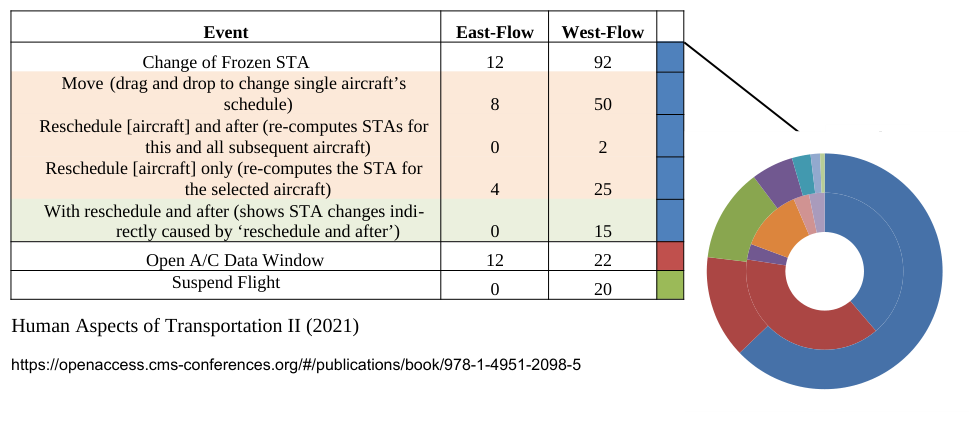
TGUI Interactions The analysis of TGUI log files, cross-referenced with screen recordings, identified the frequency of the ARC’s inter- actions with the TGUI. Due to software-stability issues identified in the first half of the simulation, this analysis only includes data from the last eight runs of the simulation, all of which were increased-load traffic scenarios. Ta- ble 1 shows the frequencies of the ARC’s various interactions with the TGUI. For comparison, in each of the four east- and four west-flow runs an average of 64 flights entered the TRACON.
There was a clear difference between the east- and west-flow conditions, as the unscheduled satellite arrivals were only included in the west-flow scenarios. Of those actions that affected aircraft STAs, the ‘Move’ function, which allows changing an aircraft’s STA by a simple drag-and-drop mechanism, was the most frequently used feature, fol- lowed by the ‘Re-schedule [aircraft] only’ function, which automatically finds another slot for the respective air- craft. The ‘Reschedule [aircraft] and after’ function was used less frequently, since it also changed the STAs of all following aircraft. The ARC’s decision to twice use the ‘Reschedule [aircraft] and after’ function impacted the STAs of 15 other flights. The Aircraft Data Window in the TGUI offers detailed flight plan and schedule data. The ARC frequently took advantage of this information to aid his planning decisions. The ‘Suspend flight’ function ex- cludes the respective flight from being considered by the scheduler, which the ARC often used on the satellite ar- rivals.
Table 1: Total frequencies of ARC TGUI interaction events (for the eight increased-load trial runs).
Questionnaire Responses After the conclusion of each run, the ARC answered questionnaires through which he provided feedback on proce- dures and tool usefulness, and also described his work strategies. In general, the ARC was very confident in using the TMA-TM [7 on Likert scale: 1 Not at all confident – 7 Very Confident]. The ARC rated the initial sequence and schedule provided by the TMA as a very workable starting point [7 on Likert scale: 1 not at all workable – 7 very workable]. Although the ARC felt he had sufficient information to manage his traffic effectively, he identified some clutter on his display [4 on Likert scale: 1 No clutter – 7 Considerable clutter]. Despite this, the ARC gave ratings of ‘not at all frustrated’ by the metering tools or the metering procedures [1 on Likert scale: 1 Not at all frustrated – 7 Very frustrated]. Along with these positive ratings, he provided some suggestions on how to improve, alter, or de- velop his tools to make them better. “A TMA ‘what-if scenario’ feature would be helpful for probing aircraft-pair runway swaps or STA schedule tweaks at the meter-fixes.”
Sequence Coordination The west-flow traffic scenarios contained flights which were departing from airports close to KPHX (typically, small turbo-prop and piston aircraft). They were not following the routes used by large turbo-prop and jet aircraft, but instead were following routes through airspace controlled by the satellite ghost controller. When asked which barriers the ARC saw to being able to use the IM-TAPSS metering concept in real operations, he elaborated on the problem of scheduling satellite arrivals: “In heavier traffic situations, local traffic would have to be scheduled into TMA. [For aircraft without] fixed routings (such as for VFR traffic or traffic from satellite airports), it would be dif- ficult to determine these times. [But] it would be possible to hold slots [for those aircraft] as long as controllers can hit them.” For the traffic densities simulated in the study, the ARC rated incorporating the satellite arrivals into the arrival stream as somewhat easy [5 on Likert scale: 1 very difficult – 7 very easy].
The ARC indicated that the new metering environment and the availability of the metering tools significantly changed the way he coordinated with his controller team [1 on Likert scale: 1 Coordination decreased a lot – 7 Coor- dination increased a lot]. He also reported that the operations demanded a lot of adjustment of his traffic manage- ment strategies to accommodate the schedule [6 on Likert scale: 1 No changes – 7 A lot of changes]. The ARC de- veloped a general strategy for accommodating the satellite arrivals. First, he obtained a detailed picture of the ar- rival situation by coordinating with the TRACON controller team and by studying the TGUI. The ARC explains: “The slot markers dictated [the] scheduled aircraft sequence”. Then, he suspended the STAs of the satellite arrivals. Without TMA-TM tracking the satellite arrivals, no CMS tools (slot markers, timeline ETA/STA information, and speed advisories) were available to guide the controllers. Without the slot markers for example, controllers had to rely on other means to ensure safe spacing. Next, he identified any pre-existing excess spacing (i.e., ‘gaps’) between consecutive flights in the arrival stream to accommodate these suspended (i.e., now unscheduled) arrivals. If the gap was not large enough he tried to extend the gap by modifying the neighboring STAs of other aircraft. Because the goal was to minimize the impact on the overall schedule, the ARC preferred schedule manipulations resulting in only one flight being affected, leading to his often use of the ‘Move STA’ function. To enlarge pre-existing gaps, the ARC tried making room on the schedule for the satellite arrivals by slightly increasing the delay of the adjacent flights. Other tools at his disposal were runway or aircraft swaps. For example, the ARC checked if at the required time period any space in the arrival stream to the other runway was available. If this was the case, assigning one of the neighboring flights in the sequence to the other runway was a valid option to increase a schedule gap. Finally, he then coordinated his schedule/sequence solution with the satellite ghost controller and the TRACON controller team. This work flow was repeated throughout the simulation run.
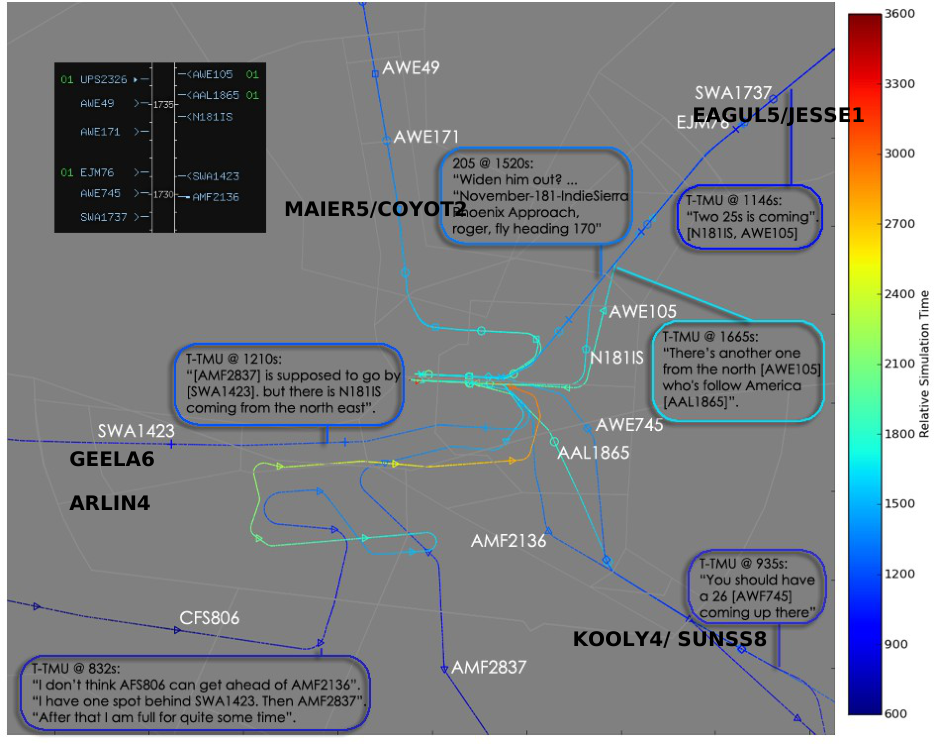
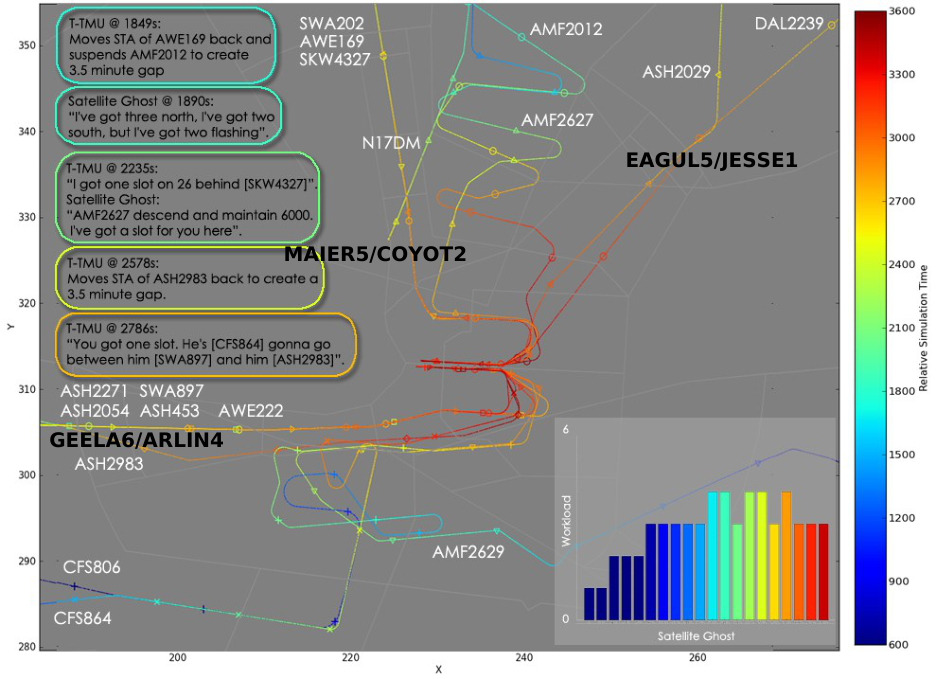
The following two examples were chosen to illustrate these interactions. They are representative of the typical ARC work flow and strategy. Both stem from a west-flow run that includes satellite arrivals. Figures 3 and 4 visually support the communication excerpts used to frame the course of the coordination events. They provide an overview of the track plots of the flights involved in the example problems. The tracks were color-coded by relative simula- tion time, from between 600s after simulation start to the end of the run at 3600s. The information in the two exam - ples is based on data from TGUI and controller screen recordings, as well as audio transcriptions.
Example 1 (Figure 3) emphasizes how the ARC coordinated an arrival sequence, focusing on flights from the south side of the TRACON, where two satellite arrivals need to be fit into the arrival stream. During this period, the TMA-TM assigned cross-over runways to three aircraft.
At 832s the ARC, coordinating the upcoming sequence with the satellite ghost controller, discusses two south-side arrivals: “I don’t think [CFS806] can get ahead of the AMF2136. I have one spot behind the guy on the west side [SWA1423]; the only one. And then [AMF2837 will follow]. And after that, I am full for quite some time.” At 935s he briefed the south feeder controller about a cross-over flight on the KOOLY4 route, coming from the south: “You should have a [runway] 26 [flight] (AWE745) coming up there.” At 1146s he briefed the north feeder con- troller about two other cross-over flights on the EAGUL5 route, coming from the north: “Two [runway] 25's are coming: one [N181IS, (pointing at the screen)] and two [AWE105, (pointing at the timeline)].”
A few minutes later, at 1210s, the ARC coordinates the arrival sequence with the south final controller: “So, the Am-flight [AMF2837] is supposed to go behind Southwest [SWA1423], but there is a Falcon [N181IS] coming from the north-east.” The south final controller then asks for clarification of the sequence: “Where is the Falcon [N181IS] going? Back here?” The ARC responds: “[With] the Falcon [N181IS] just go [behind the] Am-flight [AMF2837].” The south final controller points out: “Well, if [the satellite ghost] doesn't keep him tight it’s not gon- na work.” The ARC then verifies with the satellite ghost controller: “You'll work him right behind Southwest [SWA1423], right?” The ARC and the south final controller agree that AMF2837 will barely fit into the slot. At 1270s, the ARC comments: “Just eyeballing while I watched him appear, I thought this [SWA] 1423 and [AMF] 2136 is gonna be close [...].”
In this first example, the ARC first discusses the arrival sequence with the satellite ghost and later with the final con- troller. He also points out cross over-flights to the controllers. The south final controller and ARC agree that the se- lected slot will be tight fit for the satellite arrival.
Example 1b. Later the ARC is elaborating on the cross-over problem. At 1520 s: “She’s [north feeder controller] got no idea what’s going [on] on the other side, unless I tell her […], and he’s [south final controller] got no idea he [N181IS] is coming to his runway. So unless we widen him [N181IS] out ...” The 205 north final verifies: “Widen him out?” The ARC confirms: “Yea.” The north final controller gives the clearance: “November-181-Indie-Sierra Phoenix Approach, roger, fly heading 170, vector for spacing.” At 1629 s the north final controller points out the cross-over flight to the south final controller: “He's [N181IS] on the 170 heading right now.” The south final con- troller comments: “Seems like he fits better on your runway, but I'll take him.” The ARC confirms his plan to the south final controller and briefs him about AWE105 crossing over from the north to the south runway: “And you don't know this yet, he [AAL1865] goes behind him [N181IS]. There’s another [cross-over] from the north [AWE105] who follows America [AAL1865].” The south final controller clarifies with the ARC: “Who goes be- hind who?” The ARC is re-iterating the sequence: “Indie-Sierra [N181IS] is going behind Am-flight [AMF2837 coming from the south], American [AAL1865] is going behind Sierra [N181IS]. There is another guy coming from the north [AWE105] that goes behind America [AAL1865].” The north final controller: “Oh, he's going to … uh ... Oh! AWE105 reduce speed to 190. ... Alrighty then. ... I see that now.” The embedded TGUI screen snippet in Fig- ure 3 shows the final arrival sequence: for runway PHX26: SWA1737, AWE745, EJM76, AWE171, AWE49; for runway PHX25L: AMF2136, SWA1423, AMF2837 (unscheduled satellite arrival), N181IS, AAL1865, AWE105.
This section highlighted the difficulties the controllers had to recognize the intended arrival sequence on their own. They assessed the situation differently than the ARC, without his broader situational awareness. The excerpt even indicates elements of surprise on behalf of the TRACON controllers regarding the arrival sequence. Controllers veri- fied the order with the ARC, and he then had to clearly state which flight followed which.
EAGUL5/JESSE1
MAIER5/COYOT2
GEELA6 ARLIN4
KOOLY4/ SUNSS8
Figure 3. Overview of the track plots of the flights involved in example problem 1.
Problem 2 (Figure 4, Figure 5) emphasizes specific TGUI interactions by the ARC. The ARC is working with the TGUI trying to open slots to fit in satellite arrivals. In the meantime, the satellite ghost controller has to issue delay vectors to several flights until any arrival slots are available.
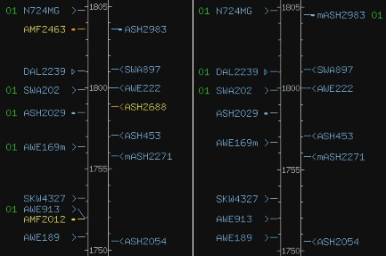
At 1849 s the ARC modifies the arrival schedule via the TGUI interface (Figure 5). He moves the frozen STA of AWE169 from 17:56:20 back to 17:56:50, and suspends the STA of AMF2012 to open up a gap after SKW4327. At 1890 s the ARC discusses the sequencing problem with the satellite ghost controller: “What do you got? Three [flights in the] south and one or two [flights in the] north? Three north?” The satellite ghost responds: “I've got three [flights in the] north, I've got two [flights in the] south, but I've got two flashing [in handoff status].” The ARC replies: “Well, I'm gonna have two slots for you in a little bit.” The satellite ghost answers: “Alright then, I'll bring that guy [N17DM, landing at Phoenix Deer Valley Airport] to the south, and that's probably gonna do it for me for a while. Not a lot of room here.”
At 2235 s the ARC informs the satellite ghost about an open slot: “I got one slot on [runway] 26 behind him [SKW4327].” The satellite ghost controller replies: “Just one, ok. Here's my man.” He clears AMF2627 (from the north) for the descent: “AMF2627 descend and maintain 6000. I've got a slot for you here.” At 2578 s the ARC moves the frozen STA of ASH2983 from 18:03:40 back to 18:04:30 to open up a gap after SWA897. At 2786 s the ARC briefs the satellite ghost about two more gaps available for the satellite arrivals: “He's [CFS864 from the south] gonna go between him [SWA897] and him [ASH2983]. […] and the other one [AMF2012] goes behind him [DAL2239].”
This section illustrated the strategies of the ARC when interacting with the TGUI. He identified and enlarged pre- existing gaps in the schedule by utilizing the allowable STA range and/or adding small amounts of delay to flights. The satellite ghost had more flights to control than there are sequence slots available. The result of this shortage is shown by the drastic delay vectors of the satellite arrivals shown in Figure 4. The workload histogram for the satel- lite ghost position embedded in Figure 4 shows a workload increase at 1800 s. At this time he had six flights, most of them on vectors, in his control (the histogram uses the same color coding as Figure 3 and Figure 4).
EAGUL5/JESSE1
MAIER5/COYOT2
GEELA6/ARLIN4
Figure 4. Overview of the track plots of the flights involved in the example problem 2.
Figure 5 shows the schedule at 17:30:25 UTC / 1825 s on the left, and at 17:43:00 UTC / 2580 s on the right. On the left, shown in yellow, are pre-departures that are not yet frozen (i.e., ASH2688 and AMF2634), and one satellite ar- rival (AMF2012). The pre-departures were scheduled to times past 18:05:00 UTC (not shown in Figure 5) and the AMF2012 was suspended. The STAs of AWE169 and ASH2983 were moved back to slightly later times (indicated by the ‘m’ near the leader line), to create room for the unscheduled satellite arrivals. As indicated by the TGUI screen snippets in Figure 5, the final arrival sequence was as follows: for runway PHX26: SKW4327, AMF2627 (satellite arrival), AWE169, ASH2029, SWA202, DAL2239, AMF2012 (satellite arrival); for runway PHX25L: ASH2054, CFS806 followed by AMF2629 (both satellite arrivals), ASH2271, ASH453, AWE222, SWA897, CFS864 (satellite arrival), and ASH2983.
Figure 5. TGUI runway STA timelines at 17:30:25 UTC (left) and at 17:43:00 UTC (right).
CONCLUSIONS
Future schedule-based arrival operations, such as the IM-TAPSS concept, rely on the integrity of an arrival schedule to provide system benefits (e.g., sustained, high throughput and fuel savings by enabling continuous descent opera- tions). However, even if most of the arrival traffic is accounted for by future scheduling systems, unforeseen events likely will still occur. Unscheduled (VFR) traffic or off-nominal flights (e.g., go-arounds), are examples of such un- expected events. Accommodating those flights then, consequently will impact the arrival schedule.
The simulation described in this paper investigated the role, responsibilities and strategies of an operator who, dur- ing the simulation, served as both the P50 TRACON TMC and ARC. He had, relative to the individual TRACON sector controllers, a more complete picture of the overall arrival operations. Therefore, he was well-suited to develop efficient plans and solutions. The simulation illustrated his function as schedule manager and team strategist, and showed that he played an integral part in coordinating, adjusting, and instantiating the arrival schedule computed by the IM-TAPSS system.
The results underline the importance of such an arrival coordinator position for future schedule-based arrival man- agement solutions. To create room in the arrival sequence, flights in current-day operations are maneuvered as nec- essary to maintain safe separation from other aircraft, with no concern for meeting specific arrival times. In a sched- ule-based environment however, the arrival schedule imposes additional constraints on the possible control actions. The ARC is able to identify natural occurring gaps in the sequence to help accommodate any flight not tracked by the scheduler. If necessary, he has to adjust other aircraft STAs to increase the gaps, while limiting disruptions to the overall schedule. If traffic densities are high, and available gaps are sparse, it is especially difficult to accommodate any unscheduled flights. Vectors have to be issued to delay the flights until a slot is available. This translates to in- creased fuel consumption and emissions, and increased controller workload.
Given the complexity of the arrival problems, clear coordination between the ARC and the controller team about the intended plan is crucial to avoid any misperceptions. In the examples provided in this paper, controllers seemed to be sometimes confused about the intended arrival sequence (e.g., “Where is the Falcon going?”), or even surprised (e.g., “Oh! I see that now.”). Besides the unscheduled arrivals, cross-over flights to other runways also necessitated coordination between the ARC and the controllers: controllers had to check back with the ARC to verify the desired sequence.
Similar to findings from (Martin, Mercer, Callantine, Kupfer, Cabrall, 2012), a ‘what-if-feature’ built into the TGUI would help the ARC to independently play-out several strategies before implementing them into the active schedule. In the current software however, each modification of aircraft STAs by the ARC immediately impacted the CMS tools, leading to artifacts such as slot marker jumps.
The CA5-2 study provided valuable insights on the role of an ARC position within a schedule-based terminal meter- ing environment. Upcoming research will investigate the ARC’s role when FIM operations complement the con- troller managed spacing tools.
REFERENCES
Callantine, T., Cabrall, C., Kupfer, M., Omar, F., & Prevot, T. (2012), “Initial investigations of controller tools and procedures for schedule-based arrival operations with mixed flight-deck interval management equipage”, Proceedings of the 12th AIAA Aviation Technology, Integration, and Operations (ATIO) Conference, Indianapolis, IN, USA. Callantine, T., Kupfer, M., Martin, L., & Prevot, T. (2013), “Simulations of Continuous Descent Operations with Arrival-Man-
agement Automation and mixed Flight-Deck Interval Management Equipage”, Proceedings of the Tenth USA/Europe Air Traffic Management Research and Development Seminar, Chicago, IL, USA. Federal Aviation Administration (2011), “Order P50 TRACON 7110.1A”, Washington, D.C., USA. Federal Aviation Administration (2013), “FAA NextGen implementation plan”, Washington, D.C., USA. Kupfer, M., Callantine, T., Martin, L., Mercer, J., & Palmer, E. (2011), “Controller Support Tools for Schedule-Based Terminal Operations”, Proceedings of the Ninth USA/Europe Air Traffic Management Research and Development Seminar, Berlin, Germany. Martin, L., Mercer, J., Callantine, T., Kupfer, M., & Cabrall, C. (2012), “Air Traffic Controllers’ Control Strategies in the Termi-
nal Area under Off- Nominal Conditions”, Proceedings of the 4th International Conference on Applied Human Factors and Ergonomics, San Francisco, CA., USA. Murdoch J., Wilson, S., Hubbs, C., & Smail, J. (2013), “Acceptability of Flight Deck-Based Interval Management Crew Procedures”, Proceedings of the AIAA Modeling and Simulation Technologies (MST) Conference, Boston, MA, USA. Prevot, T., Baxley, B., Callantine, T., Johnson, W., Quon, L., Robinson, J., & Swenson, H. (2012), “NASA’s ATM Technology
Demonstration-1: Transitioning fuel efficient, high throughput arrival operations from simulation to reality”, Proceedings of the International Conference on Human-Computer Interaction in Aerospace (HCI-Aero), Brussels, Belgium. SESAR Joint Undertaking (2013), “SESAR release 2013”, Brussels, Belgium. Stein, E. (1985), “Air Traffic Controller Workload: An Examination of Workload Probe”, (DOT/FAA/CT-TN84/24), Federal Aviation Administration Technical Center, Atlantic City International Airport, NJ, USA. Thipphavong, J., Jung, J., Swenson, H., Witzberger, K., Lin, M., Nguyen, J., ... Smith, T. (2013), “Evaluation of the Controller-
Managed Spacing Tools, Flight-deck Interval Management and Terminal Area Metering Capabilities for the ATM Technol- ogy Demonstration #1”, Proceedings of the Tenth USA/Europe Air Traffic Management Research and Development Semi- nar, Chicago, IL, USA.
LISTED IN THE AHFE DIGITAL BOOKSTORE CATALOGUE
Explore the complete digital volume
Advances in Human Aspects of Transportation: Part II
Read this individual research paper free through the original publisher, or explore the full digital proceedings book.
ISBN 978-1-4951-2098-5
Explore this ISBN in the AHFE Bookstore ↗Listed in the July 2026 bookstore catalogue; search by ISBN to confirm current availability · Digital book purchase optional