Stewart Birrell, Daniel Wilson, Gunwant Dhadyalla (2021). Parking Behaviors for Inductive Charging. In: Advances in Human Aspects of Transportation: Part II. AHFE Open Access, vol. 16. https://doi.org/10.54941/ahfe100685
It is well established that the efficiency of transfer of electrical energy through induction is highly reliant on accurate alignment of the coils involved – in this case, between a primary coil in the parking bay and a secondary coil mounted on the vehicle. Whist inductive charging technology is market ready, understanding the issue of misalignment is an important human factors question and the focus of this paper. A retrospective assessment of parking behavior was conducted by recording parking orientation and alignment of 100 vehicles, parked in perpendicular bays, in three different car parks at the University of Warwick. Results showed on average vehicles tended to park 3.1 cm to the left of the bay, with an angle of practically zero. Parking was typically towards the rear of the bay; however the presence of a physical barrier led to vehicles being parked more centrally. The orientation of the parked vehicle had little impact on accuracy. Tolerances for misalignment with inductive charging systems are small in comparison to the distribution of parking accuracy observed in this study, at 15-20 cm verses 120 cm respectively. Conclusions were that only 5% of vehicles were parked sufficiently accurately to allow inductive power transfer to commence.
Inductive power transfer (IPT; also known as wireless power transfer (WPT) or inductive charging) has roots in Nikola Tesla’s investigation of wireless transmission of power in the 1890’s using some rather extreme methods. Modern IPT owes its resurgence to Prof’s. André Kurs, Marim Soljačić, and the MIT team that demonstrated transmission of 60W across 2.5 m to illuminate a light bulb1. Many others worked on IPT even before this, notably the team at Auckland University in New Zealand2. The sheer convenience of inductive charging for electric vehicles (EV) coincided with standardization activities of conductive (or wired) charging of EV’s so interest grew rapidly. In 2010, the Society of Automotive Engineers (SAE) has formed the SAE J2954 standard, which covers the static wireless charging on EV. In parallel with the SAE J2954, the IEEE Standard Organization has also established a workforce to define the standard specifically for in-motion (dynamic) charging.
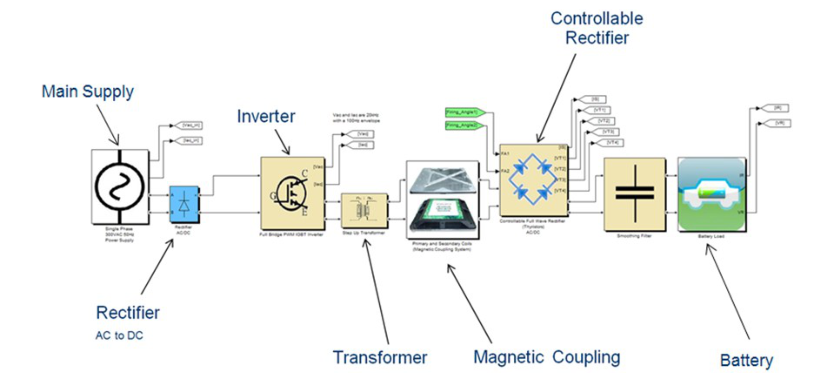
The key area in this application is to transfer power over an air gap at an acceptable level of efficiency whilst meeting any legislative requirements. There has been significant work carried out by various companies on resonant inductive coupling. This is the near field wireless transmission of electrical energy between two coils that are highly resonant at the same frequency. The efficiency of the energy transfer is a function of frequency and alignment of the 1 http://www.sciencecodex.com/mit_demonstrates_wireless_power_transfer 2 http://www.engineering.auckland.ac.nz; http://www.qualcommhalo.com/ Human Aspects of Transportation II (2021) primary and secondary coils. Misalignment can occur across the air gap distance, lateral and longitudinal misalignment, and angular misalignment. The efficiency of energy transfer generally drops rapidly once the misalignment reaches 15 cm, as a result, the system control will cut off the power or the transfer will not start when the efficiency is below 80%. Recent development in coil design (i.e. multiple coils, field shaping etc.) has resulted in marginal improvements in the physical efficiency bandwidth. Figure 1 shows a typical IPT system. The power drawn from the 50Hz supply is first rectified through an AC/DC converter before transformed to a high frequency (kHz) resonant energy by the inverter. This energy is transferred across the air gap to the receiving end through the magnetic coils. At the receiving end, it is once again rectified to charge the battery in the vehicle. However whilst the technology is ready for adoption, the weak link in the chain is the driver and how accurately they can park, or drive over the coil to maximize energy transfer efficiencies.
Figure 1: Single phase wireless IPT charger schematic diagram
A review of the literature reveals that limited research has been conducted looking into parking behavior, which has been primarily focused on parking orientation and preferences (Cullinane et al, 2004; Kobus et al 2012), gender differences (Wolf et al, 2010), desired clearance between vehicles (Gadgil and Green, 2005), parking related crashes and incidences (Green, 2006) or vehicle-to-vehicle gap in real-world parking (Thornton et al, 2014). The most relevant study for this current paper was conducted by Cullinane et al (2004) whose research for the University of Michigan Transportation Research Institute (UMTRI) evaluated parking accuracy of 102 vehicles in three different types of parking bays (angled, parallel and perpendicular). This was a retrospective analysis with participants not being aware that there parking would be assessed. Their research found no difference between the size of the vehicle and lateral parking accuracy, with drivers attempting to keep a constant amount of exit space on the driver’s side of the vehicle in angled and perpendicular parking, and with parallel parking how close drivers parked to the curb. However vehicle size did have an effect on longitudinal clearance of perpendicular parking, with large vehicles more likely to overhang a ground barrier when parking a larger vehicle. The angle of parking tended to be quite small, generally less than 1 degree; however the range of angles was triple that for parallel parking verses angled and perpendicular parking (Cullinane et al, 2004).
As suggested above it is well established that the efficiency of transfer of electrical energy through induction is highly reliant on alignment of the coils involved – in this case, the alignment between a primary coil in the parking space, and a secondary coil mounted on the vehicle. If the integration of inductive charging technology into modern vehicles is to be accepted by drivers, engineers should seek to minimize the amount of disruption to current parking behavior. This raises a question – “Is current parking behavior compatible with inductive charging technology?”
The two main research questions to be answered by this paper are:
1. What correlations exist between the accuracy of parking and other factors?
2. What proportion of drivers currently park within the tolerances of inductive charging systems?
METHODOLOGY
Vehicles and Locations 100 vehicles were randomly selected for measurement from three different car parks on the main campus of the University of Warwick. Vehicles were already parked when measurement was taken, i.e. it was a retrospective analysis of static vehicle rather than a dynamic assessment. This obviously meant that drivers were not aware that their parking alignment was going to be assessed when they originally parked. Assessment took place over a two week period during July, with physical measurements being taken between 10:00 – 12:00 and 14:00 – 16:00.
Ethical approval was granted for the study by the University of Warwick’s Biomedical and Scientific Research Ethics Committee (BESREC). It was agreed that no identifying features of the vehicle would be recorded (e.g. photographs of assessed vehicles, number plates, gender of driver etc.), and in the case of approach by a member of public the researchers would offer a verbal and written explanation of the study, and give the opportunity for the driver of a measured vehicle to have their data removed.
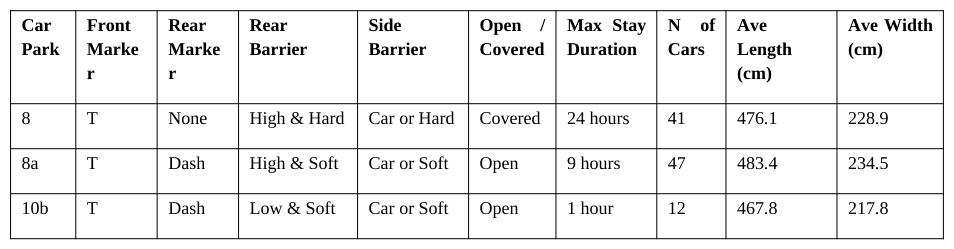
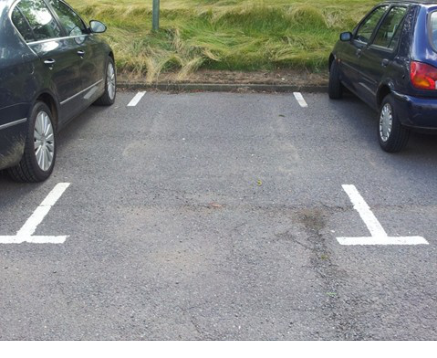
The three car parks selected for the study were all perpendicular bays, with at least white ‘T’’s to identify parking area at the head (or front) of the parking bay. Full car park characteristics are outlined below:
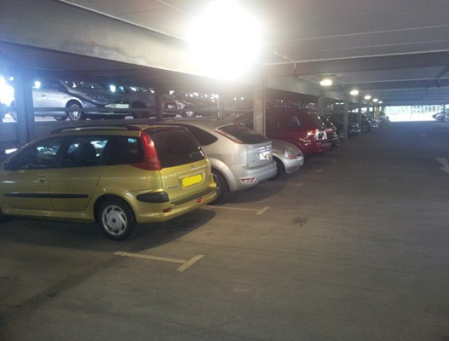
Table 1: Characteristics of the three cars parks from which vehicles were measured.Figure 2: Car Park 8Figure 3: Car Park 8a
Figure available in the original PDF paper.
Figure 4: Car Park 10b
Measured and Derived Variables To measure the actual parking alignment of vehicles they were simply modelled as rectangles located in a rectangular bay. The principle method of data collection for this study was a retrospective analysis of parking accuracy, by determining parking bay and vehicle size by physical measurement and other relevant observations. From this numerous different parameters could be derived, including:
Length and width of parking bay: These were measured by tape measure, from the back of the bay to the front (including line markings), and between the inside of both “T” or parallel marks.
The length, width and wheelbase of the vehicle: These were measured by tape measure, between markers which were set down on the floor at the points at which the corners of the “vehicle” rectangle in the model would be located.
The distance from vehicle to side of bay: Measurement to the markers at the respective corners on one side of the vehicle, using a tape measure.
The closest distance between the vehicle and the rear of the bay: Measured using a tape measure.
The orientation of the vehicle: Rear-parked or forward-parked.
The general category of vehicle: From a pre-provided list of types.
Parking sensors: If applicable.
Location of the center of the vehicle: Derived with respect to a coordinate system with origin in the center of the bay.
Angle of the vehicle to the bay.
Figure 5: Example of the how the derived data was calculated; x represents the center of the blue vehicle ‘rectangle’ and dotted lines within the bold black lines the center of the bay ‘rectangle. The displacement of the center of the vehicle to the center of the bay in both the x (lateral) and y (longitudinal) axis was calculated, as well as the distance from center of vehicle to center of bay.
Figure available in the original PDF paper.
Raw data were collected via physical measurement with a tape measure, collated on a data entry sheet, and then transferred to SPSS for analysis. Data for vehicles who reversed into the parking spaces were reversed only for analysis, but still considered separately, meaning that if the driver parked off-center laterally (i.e. leaving more space either to the drivers or passenger side then this would not be lost in the analysis).
RESULTS
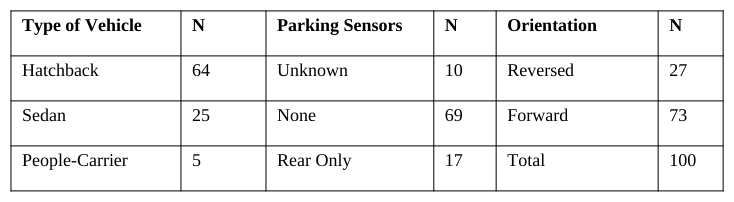
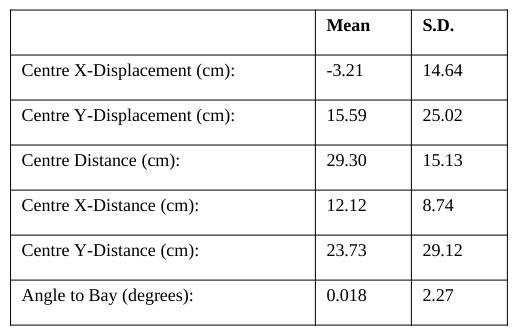
Objective Measures This section shows the results from the more objective measures of vehicle classification. Table 2 shows that the majority of vehicles evaluated were hatchback, with no parking sensors and forward facing into the parking bay. Table 3 shows that vehicles were tended to be parked towards the left-hand side of bay, by 3.1 cm, and 15.6 cm forward in the bay, regardless of orientation. The mean angle of parking was 0.02 degrees.
Table 2: Objective measures of vehicle classification.Table 3: Mean displacement and distance in the x (lateral) and y (longitudinal) axis, and distance away from the center of the vehicle to the center of the bay. Mean distance is simply the absolute value of the “X-Displacement”, and the same in the Y case, i.e. if they were away from the center of the bay how far was it.
Trends and Correlations
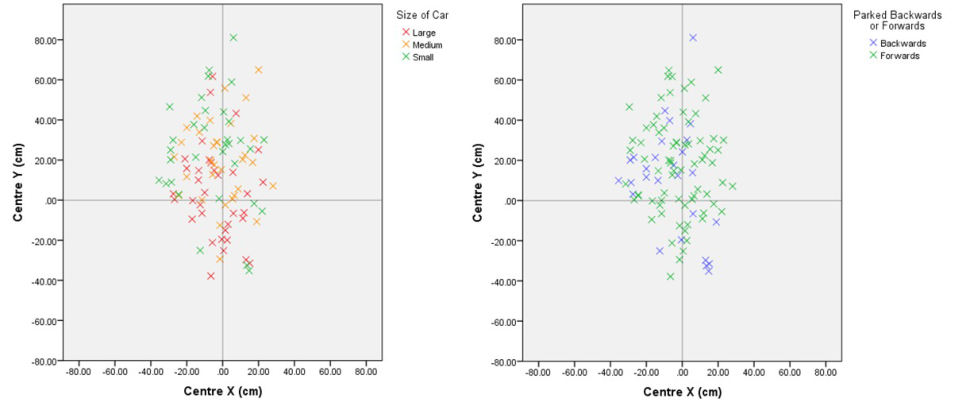
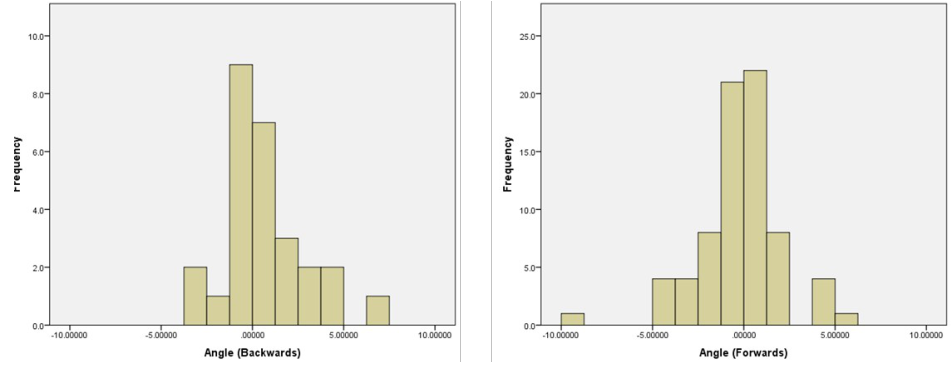
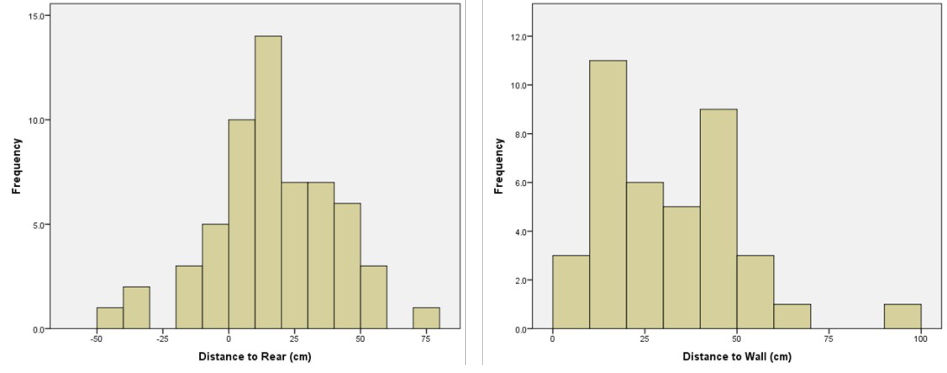
Figure 6 below show the distribution of X and Y coordinates of the center of vehicles in the sample, colored by size of vehicle and rear/forward parking. Size was determined by separating the data equally into three groups, based on the area of the vehicle base, “width x length”. Figure 7 shows the angle of parking from different parking orientations and Figure 8 the distance to the rear of the parking bay for the different car parks.
Figure 6: Distribution of vehicles to the center of the bay. Graph 1 shows alignment by vehicle size, graph 2 by parking orientation.Figure 7: Distribution of the angle of parking for reversed (Backwards; graph 1) and forward (graph 2) parking alignment.Figure 8: Distance from the most distal point of the vehicle to the rear of the parking bay. Data presented in graph 1 from Car Park 8a and 10b (low or soft rear barriers), graph 2 from Car Park 8 (high and hard).
DISCUSSION
Parking Alignment The elliptical nature of the spread of the data in Figure 6, with the x-mean at approximately zero and y-mean at approximately 15 cm, suggest that vehicles were parked more accurately in the lateral (or x) direction compared to the longitudinal (y) direction. The spread in the data also reflects this, with the range of lateral accuracy at around 60 cm which was approximately half that of the longitudinal range. Table 3 shows that the mean distance from the center of the parking bay was 12.1 cm (either to the left or right), with a mean displacement of 3.2 cm to the left of the bay (i.e. more clearance on the driver’s side than the passenger’s side). Research conducted by Cullinane et al (2004) showed that in a comparable study conducted in Ann Arbor, Michigan, US, vehicles were parked with an average of 10.4 cm clearance on the driver’s side (right in this case). This increased lateral offset may be a function of the average bay width in the US study being 47 cm wider than in the current study, or may simply be a cultural preference.
An assumption could have been made before the study was conducted that larger vehicles would be less well aligned in the parking bay in comparison to smaller vehicles. This is based on the fact that they would have less space for movement and correction, or reduced visibility and perception of the front and rear of the vehicle due to the length. This was not born out in the results as Figure 6 shows that the distribution of ‘large’ vehicles is far more evenly spread around the center of the bay. Small vehicles in particular tended to park more towards the rear of the bay compared to large vehicles. The spread of data in the lateral direction is similar for all sizes of vehicles. Possible reasons for the increased ‘accuracy’ of larger vehicles may be that the vehicle to bay ratio is smaller, meaning they have less space allowance to ‘play with’ when parking, not parking centrally within a bay would increase the risk of the vehicle either overhanging the front or rear of the bay, both of which may result in physical damage to the vehicle. It is a generalization (but not unfounded) that larger vehicles are likely to be more expensive than their smaller counterparts. More expensive, premium vehicles are more likely to be fitted with parking aids to assist specifically with the longitudinal aspect of parking; thus making them more accurate. Another explanation could again be the vehicle to bay ratio. Smaller vehicles may choose to position themselves to allow for ease on exiting the vehicle, or choose to give a vehicle parked at the side more clearance and hence reduced risk of damage to their vehicle, but resulting in reduced accuracy. Cullinane et al (2004) also found that vehicle size affected longitudinal accuracy, with drivers of a large vehicle more likely to over hang a ground (low) barrier.
An interesting occurrence was the adaption to parking behaviors with the presence of a ‘hard’ rear barrier, in this case a steel structure in car park 8 (Figure 2). Figure 8 shows that the distribution of distance to rear of the bay for no physical barrier (graph 1) is normal, with the most frequent distance being 10 to 20 cm from the rear barrier. Whilst 10-20 cm is till the most frequent distance for when a hard barrier is present (graph 2), the distribution could not be considered normal, but either chi-squared or bimodal. A second peak at parking distance of 40-50 cm may indicate the difficultly that people have judging the location of the front of their vehicle in comparison to the parking bay. It is at this point that feedback should be given to the driver to encourage more accurate longitudinal alignment.
The mean angle of parking was 0.02 degrees, even in absolute form this was only 1.6 degrees. Whilst this implies that in general vehicles were parked straight on in the bay, the range of the data reveals greater differences being 15.8 degrees (6.7 to -9.1 degrees). Interestingly results from Cullinane et al (2004) showed that whist the mean angle was very small (and similar to the present study) at 0.1 degrees, the range of vehicles they recorded was significantly smaller at just 1.4 degrees. This difference may be a function of the smaller number of vehicles evaluated parking in a bay (or perpendicular) with the Cullinane study (36 verses 100), or again that the average bay with in their study was nearly 50 cm wider than the current study.
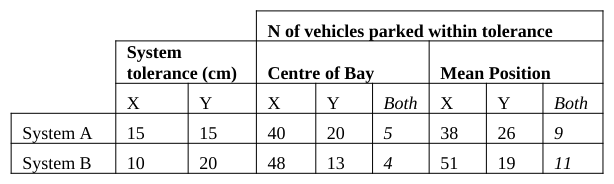
Inductive Charging Compatibility The second research question posed at the beginning of the paper surrounds understanding the proportion of drivers who currently park within the tolerances of inductive charging systems. For this, two hypothetical systems were established; System A has tolerances of 15 cm in both the lateral (x) and longitudinal (y) axis and System B 10 cm in the x and 20 cm in the y axis. The dimensions were selected to reflect two different approaches to coil design and are representative of inductive charging systems currently on the market.
Table 4: System tolerances of two notional inductive charging systems, and number of vehicles parked within these tolerances.
Table 4 shows that in general only 5% of vehicles assessed in this study parked within alignment tolerances for both Human Aspects of Transportation II (2021) systems when the primary coil is located in the center of the parking bay. If the coil was located in the mean position for the center of the vehicle (as per Table 3) then this would double the number of vehicles included, but still only account for approximately 10% of vehicles measured. This is highlighted in Figure 9 which illustrates that only a very small fraction of vehicles would be aligned correctly for power transfers of over 80% efficiency. Also shown is just the sheer range of parking alignment that developers of inductive charging systems for EVs need to contend with.
Figure 9: Distribution of vehicles to the center of the bay, with approximate dimensions of System A (blue) and B (green) tolerances overlaid.
Figure available in the original PDF paper.
How to facilitate users to park within tolerances of inductive charging systems is a difficult challenge. This cannot feasibly be solved by simply making the inductive coils larger, as this is not a cost effective solution also vehicle manufacturers will have packaging difficulties fitting a larger coil to the underside (and exposed aspect) of a vehicle. It may be addressed by technology, and specifically park assist systems. Automated parking is already a feature on many premium vehicles, which could be used to park the vehicle accurately over the primary coil in the bay. However, park assist typically is only available for ‘difficult’ parking maneuvers (i.e. parallel rather than bay parking), and it is still unclear if parking is between two vehicles or in the center of the bay, as this will have an obvious effect on alignment. A feasible solution would be to offer in-vehicle feedback to the driver during the parking maneuver. Results from this study show that whilst parking is more accurate in the lateral axis, between 40 and 50% of vehicles parked were still outside 15-20 cm alignment tolerances of the two systems (table 3). This means that providing only longitudinal feedback address only half of the issue.
Limitations and Future Research
This study adopted a retrospective measurement methodology with drivers being unaware that their parking accuracy was going to be assessed. This type of data collection offers the benefit of naturalistic, real-world data being collected. However, it is unknown to what effect users being aware that their parking accuracy is being assessed will alter actual alignment. It could be assumed that when users know they should be parking as accurately as possible, an improvement in both lateral and longitudinal control will be observed. In addition no context was available as to why the driver chose to park as they did. It is entirely possible that drivers chose to parked ‘misaligned’ either to allow space to exit the vehicle, gain access to the boot, or even park off center to the right to allow the vehicle next to you more space to exit and hence reduce the risk of damage to your own vehicle. Future studies will need to need to address these issues, and also assess parking in a greater range of situations, such as parallel parking and ‘free’ parking which is not restricted by other vehicles and bay boundaries, a situation which would be typical on a driveway.
CONCLUSIONS
Parking accuracy to the center of a perpendicular bay was assessed retrospectively in this study. Results show that on average vehicles tended to be parked 3.1 cm to the left of the parking bay, with an angle of practically zero. Parking was typically further towards the rear of the bay; however the presence of a physical barrier led to vehicle being parked more centrally. The orientation of the parked vehicle had little impact on parking accuracy. However, results from this study showed that larger vehicles parked more accurately in comparison to smaller ones. Tolerances for misalignment with inductive charging systems are small in comparison to the distribution of parking accuracy observed in this study, at 15-20 cm verses 120 cm respectively. This study showed that only 5% of vehicles were parked sufficiently accurately to allow for inductive power transfer to commence.
REFERENCES
Cullinane, B., Smith, D., Green, P. (2004), “Where, when and how well people park: A phone survey and field measurements”, The University of Michigan Transportation Research Institute (UMTRI), US, Technical Report UMTRI-2004-18. Gadgil, S., Green, P. (2005), How much clearance drivers want while parking: Data to guide the design of parking assistance
system”, Proceedings of the Human Factors and Ergonomics Society 49th Annual Meeting, pp. 1935-1939. Green, P. (2006), "Parking Crashes and Parking Assistance System Design: Evidence from Crash Databases, the Literature, and Insurance Agent Interviews", SAE Technical Paper 2006-01-1685, Kobus, M., Gutierrez-i-Puigarnau, E., Rietveld, P., Van Ommeren, J. (2012), “The on-street parking premium and car drivers’
choice between street and garage parking”, Tinbergen Institute, The Netherlands, TI2012-040/3. Thornton, D., Redmill, K., Coifman, B. (2014), “Automated parking surveys from a LIDAR equipped vehicle”, Transportation Research Part C Volume 39 pp. 23-35. Wolf, C., Ocklenburg, S., Oren, B., Becker, C., Hofstatter, A., Bos, C., Popken, M., Thorstensen, T., Gunturkun, O. (2010), “Sex
difference in parking are affected by biological and social factors”, Psychological Research Volume 74 pp 429-435.
LISTED IN THE AHFE DIGITAL BOOKSTORE CATALOGUE
Explore the complete digital volume
Advances in Human Aspects of Transportation: Part II
Read this individual research paper free through the original publisher, or explore the full digital proceedings book.
ISBN 978-1-4951-2098-5
Explore this ISBN in the AHFE Bookstore ↗Listed in the July 2026 bookstore catalogue; search by ISBN to confirm current availability · Digital book purchase optional