Much research on cross-cultural psychology has focused on either culture-level dimensions or individual values as starting points for explaining the influence of culture on individual reasoning and decision-making. Culture is a complex concept, however, determined by the beliefs and behaviors of both individuals and of social systems. To understand how culture predicts the behavior of an individual in a situation requires lower-level descriptors of how individuals and groups interact in different contexts. We investigated the application of Relational Models Theory (Fiske, 1992) as a way both to describe social situations and to distinguish cultures by which relational models their members consider to be the most appropriate in different situations. We presented decision scenarios to participants from different cultural backgrounds through a survey and asked them to rate the appropriateness of several responses to each scenario that were oriented toward different relational models. We observed significant interactions between cultural background, scenario, and the ratings given to options associated with each relational model. We concluded that relational models might provide a valuable tool for understanding cultural differences in individual decision-making, but that the context of the situation itself also has a significant impact on the options people consider to be most appropriate for resolving situations.
One of the challenges in the study of cross-cultural decision-making is to identify factors that directly connect the cultural values to decisions made by individuals in different situations. Culture is manifested in the values, norms, behaviors, and beliefs that are implicitly shared among members of a social system and passed through the generations (Rohner, 1984). Social systems vary in size and formality, including countries, nations, regions, organizations, ethnic groups, genders, families, and teams. Individuals who belong to a culture are shaped by it and contribute to its continuous reshaping. (Casrnir, 1999). The goal of cultural and cross-cultural research is to understand not only culture’s influence on what people think, but also its influence on how they think, through identification of culture features that impact human cognitive processes (Oyserman & Lee, 2007).
Much research has been done at several levels of analysis. Various studies have examined high-level cultural values, such as horizontal vs. vertical individualism and collectivism (HVIC; Triandis & Gelfand, 1998), general human values, that is, principles that motivate cognition, affect, and behaviors (e.g., benevolence, power, security; Schwartz, 1992), and self-construals, which are how people think about themselves in relation to others (e.g., independent vs. interdependent; Markus & Kitayama, 1991). Individualism and collectivism, for example, are culture-level dimensions that describe a culture’s values regarding how people should identify themselves and behave in relation to society. Individualistic societies encourage their members to see themselves as unique and independent from others. Collectivistic societies, in contrast, encourage people to see themselves as interrelated with one another and to prioritize the well-being of the group.
Although the individualism-collectivism distinction should not be used to compare individuals, it is often the starting point for cultural studies (e.g., Hofstede, 1984: Kim & Markus, 1999; Markus & Kitayama, 1991; Triandis, 1989). People in individualistic cultures are more likely to consider themselves in independent terms and people in collectivistic cultures are more likely to consider themselves in interdependent terms (i.e., independent vs. interdependent construals of self). But although the actions of individuals reinforce cultural values and help individuals internalize cultural values as their own, a person’s reasoning processes do mediate the relationships between cultural values and actions. Triandis (1996) noted that culture is too complex to be adequately characterized by one cultural dimension. Just as a person can be described by many personality traits, so are cultures distinguished by many cultural qualities (e.g., Hofstede, 1984; Schwartz , 1992). As such, using general characterizations of culture to explain specific choices in particular contexts may ignore the more immediate influences of the context on actions.
In this study, we examined the constructs of Relational Models Theory (RMT; Fiske, 1992, 2004) as potentially more descriptive and discriminating of cultural differences in how individuals respond to group decision situations. RMT addresses relationship structures by focusing on the interplay between a focal person and others. The relational models characterize an individual’s preferences or expectations surrounding the behaviors of others in one’s social sphere, expressing four ways in which people engage in interpersonal interactions. Equality Matching (EM) refers to a relationship based on tit-for-tat reciprocity, matched contributions, and equally divided distributions. Market Pricing (MP) refers to proportional reciprocity and relationships based on equitable (not equal) distribution. The focal consideration is the utility of others in one’s social sphere. Authority Ranking (AR) refers to status differentials and hierarchical structures. And finally, Communal Sharing (CS) refers to in-group equality, whereby members of in-groups provide and take resources as needed. Each of the four models helps people organize, coordinate, and adapt to relational situations; they likewise contribute to the ways people “construct and construe social action” (Fiske, 2004, p. 21).
We investigate relational models as generalized preferences or tendencies across situations. This study examined whether relational models capture cross-cultural differences in which alternatives are considered to be most appropriate for resolving decision-making scenarios. Prior research on Relational Model Theory (RMT) has established that all four of the models are utilized across different cultures (Fiske, 1992). However, cultures are likely to differ, not only by which models are preferred in general, but also by which models should characterize each type of situation. Despite compelling evidence of the universal features of the models, there have been relatively few empirical studies examining cultural differences in the way the models are represented and used across different situations, actors, and domains (e.g., morality, identity).
Koerner (2006) used the Modes of Relationship Questionnaire (MORQ; Haslam & Fiske, 1999) to contrast North American and Singaporean students regarding both acquaintance and friendship relationships. North Americans were found to give higher ratings to Communal Sharing (CS) oriented responses than Singaporeans did, whereas Singaporeans gave higher ratings to Authority Ranking (AR) oriented strategies than did North Americans. In another study, Woodhull and Louis (2009) constructed a novel scenario-based measure, with four choices that corresponded to each of the four relational models. For example, in one of the scenarios a business division is assigned a complex job to complete and participants had to choose among four relational model-related options for dividing the tasks of the larger project. These scenarios were constructed based on seven contextual “domains” of interaction (reciprocal exchange, distribution, work, moral judgment and ideology, decision-making, social influence, and identity). Woodhull and Louis contrasted US/Canadian and Mexican corporate managers, all of whom worked for US/Canadian multinational companies. They reported that Mexican managers consistently ranked Communal Sharing-oriented options higher than US/Canadian managers did, across all tested domains, whereas preferences for the other relational models differed between domains.
These studies provide evidence that relational model endorsement in any given domain can vary by cultural context. Applications of relationship structures that may be dominant in one society will not necessarily be dominant in another society. Furthermore, even within a given society, it is important to consider the domain that contextualizes a given relationship when interpreting patterns of relational model priority. However, additional research is needed understand the extent to which relational model endorsement differs generally across cultures. In this study, we compared participants of European American background to three other groups living in the USA with different cultural backgrounds: Afghan, Chinese, and Iranian. We chose these three groups for several reasons. First, they represent three kinds of “collectivistic” cultures, even though they may differ in relationship structure emphasis (Dien, Blok, & Glazer, 2011; Hamedani, Purvis, Glazer, & Dien, 2012). Second, there is some research on both Euro-American and Chinese-American cultures that makes them good points of reference for understanding how culturally different Afghan and Iranian culture are from them and each other (e.g., Hong, Morris, Chiu, Benet- Martinez, 2000). Finally, because relational models are a different aspect of culture than has been studied in the past, this study also extends current research in a new direction, and a comparison of multiple groups with respect to these important cultural dimensions allows for a rich interpretation of the findings (Ross, 2003).
METHOD
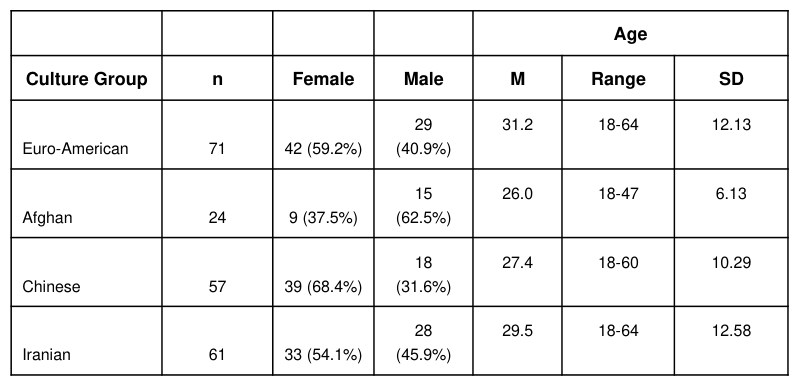
Participants There were 213 participants in this study, including 71 participants of Euro-American background, 57 of Chinese background, 24 of Afghan background, and 61 of Iranian background. It is important to note that, although the cultural background of participants was rigorously verified, participants were neither necessarily native to the countries of their cultural heritage nor living in those countries at the time they participated. Therefore, as a matter of precision, we refer to participants as being of a cultural “background” rather than of a “culture.” Age and sex demographics for the final sample are reported in Table 1.
Table 1: Sample size, sex, and age by culture group Age
In the demographics questionnaire on the online version of the survey, participants were asked to name their birthplace, the birthplace of their primary caretakers, and whether they spoke a language other than English at home. The distribution of participants on these measures is shown in Table 2.
Table 2: Home language and country of birth by cultural background group
Table available in the original PDF paper.
* Out of total including 1 missing value.
Procedure This study was conducted via survey that was administered to participants in either electronic format online or in person using a paper-and-pencil version. Participants were recruited through a variety of channels, and their cultural affiliations were authenticated according to a predefined decision tree in order to reach a diverse population for each cultural group.
Participants for the online version were recruited through online mailing lists and relevant organizations (e.g., University of Maryland message boards, culture-specific professional and social organizations, and foreign language instructors), flyers and handouts posted in libraries, cafes, and restaurants throughout the District of Columbia (DC) metropolitan area, print advertisements placed in DC-area publications, web advertisements, social networking on the part of both the researchers and the contacted participants, and survey service organizations, including Amazon Mechanical Turk (AMT) and Affordable Samples. For the paper-and-pencil version of the survey, project staff set up a booth outside of a main campus center on the University of Maryland campus and administered the survey to Afghan and Iranian students. Project staff also visited DC area Afghan restaurants and recruited Afghan participants to complete the survey while at the restaurant.
In order to be eligible to participate in the study, all potential participants had to pass a pre-screening process before receiving an invitation to take the survey. Eligible participants were assigned to one of two versions of the survey that differed only in the order of question item presentation. Online survey participants were sent an e-mail containing an invitation link to the online survey powered by the LimeSurvey software (version 1.91+), hosted on the University of Maryland’s web server. Paper surveys were generally completed in a single session. However, because of some logistic challenges associated with gaining the participation of people in some groups, a few participants were allowed to complete the survey in two sittings, no more than one day apart.
Measures The entire survey included a demographics questionnaire and a series of scenarios measuring relational model endorsements. The demographic questionnaire replicated items on the pre-screening questionnaire, and also asked about religious observance, marital status, education level, and the location from which the participant took the survey (for the online version).
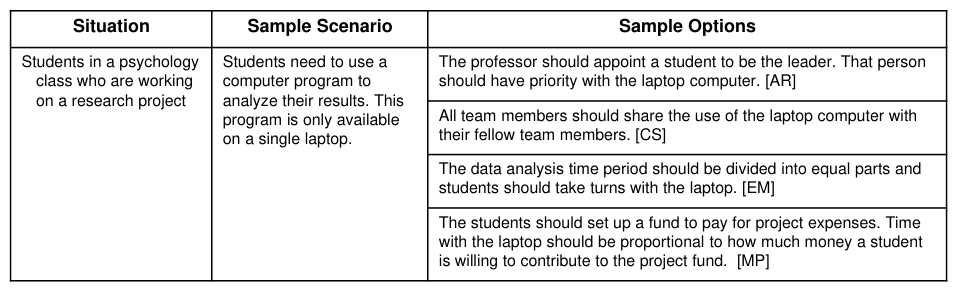
Using Woodhull and Louis’s (2009) measurement approach as a foundation, we expanded their scenarios to cover a larger range of social interaction situations beyond just the business context. A set of 35 scenarios was generated using all possible combinations of seven contextual domains (i.e., collective decision-making, distribution of resources, reciprocal exchanges, identity, influence, morals, and work or labor organization) applied in five different situations (i.e., a psychology class project, a technology convention, a suburban neighborhood, engineers building a bridge, and a student newspaper). These contextual domains were a subset of 15 domains originally presented by Fiske (1992) that were selected by Woodhull (2006). Table 3 presents a sample scenario and response options.
Table 3: Example Scenario Situation Sample Scenario Sample Options
Each scenario had four options to choose from for how to respond to the situation and each option was representative of a different relational model. Participants were asked to rate each response option using a Likert- type scale, with five options, ranging from “Strongly Disagree” (coded as 1) to “Neutral” (coded as 3) to “Strongly Agree” (coded as 5). The ratings reflected the extent to which respondents agreed that each model was appropriate for addressing the problem in the situation. Respondents each rated the options in all of the 35 scenarios and the presentation order of the situations was randomized across participants.
RESULTS
There were 254 surveys submitted by eligible participants, but some participants with missing data or invalid rankings (e.g., double ranked) were eliminated from each of the cultural background groups, leaving a final sample size of 213 participants.
The focal research question for this study was that of the degree to which there are cultural differences in the judged appropriateness of applying each relational model in different circumstances. We employed a Repeated-Measures ANOVA to analyze the rating data. In order to control for differing scale use in the rating data, the rating ANOVA was performed with participants’ overall mean ratings across all items as a covariate. The estimated marginal mean ratings presented below assume an overall mean rating of 3.39, which is the average across all participants. The between-subject factors were cultural background group and sex. The within-subject factors were the ratings by relational model (4 models), the situation of each decision scenario (5), and the domain of each scenario (7).
Effects of situation and domain were used to determine whether the scenarios themselves affected rating outcomes, but of particular interest were the interaction effects between cultural group and response ratings, while controlling for sex and scenario. This analysis unpacks cultural differences in the relative importance of the different relational models. Although post-hoc comparisons among culture groups were examined, there were very few significant differences that did not involve participants of European-America background. As such, unless otherwise noted, all reported comparisons are between the participants of European-American background and those in each of the other cultural background groups.
Differences in Scenario Response Ratings by Relational Model When controlling for culture, sex, and scenario, we observed a significant effect for relational model in the scenario response ratings, F(2.33, 475.61) = 9.96, p < 0.001, [Equation or mathematical symbol available in the original paper PDF] p
2 = .047. In other words, ratings of response options associated with each model were significantly different. Post-hoc comparisons indicated that ratings for MP-related responses were significantly lower than ratings for responses associated with the other three relational models (p < 0.001), none of which differed from each other Interactions of Culture and Relational Model
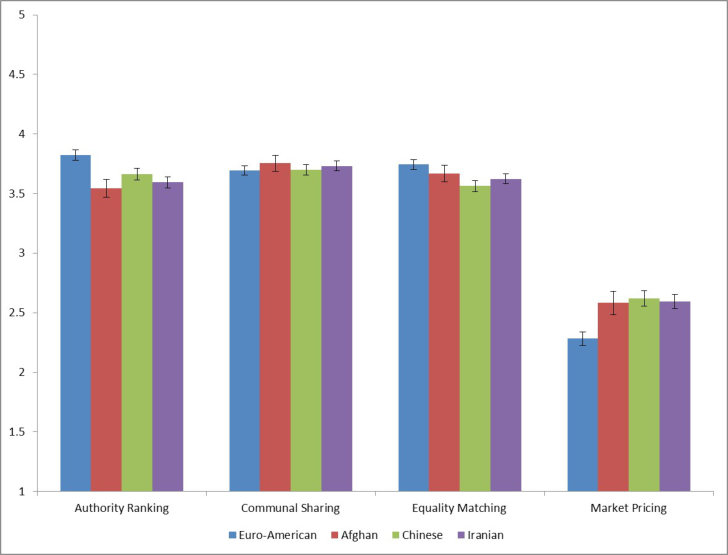
Significant variation in rated appropriateness of different relational models was observed in the interaction between Cross-Cultural Decision Making (2019) cultural background group and response option relational model orientation, indicating that cultural groups differed generally in their relative appropriateness assessments of options associated with each relational model, F(6.99, 475.61) = 4.91, p < .001, [Equation or mathematical symbol available in the original paper PDF] p
2 = 0.067. Estimated marginal means for this interaction are shown in Figure 1.
Post-hoc comparisons between cultural background groups on each relational model indicated that participants of European-American background rated authority ranking oriented options significantly higher (M = 3.82) than participants of both Afghan background (M = 3.54; p < 0.01) and Iranian background (M = 3.40; p < 0.01). Furthermore, those of European-American background rated equality matching oriented options significantly higher (M = 3.74) than those in the Chinese background group (M = 3.56, p < 0.05). With respect to actions framed in terms of market pricing, however, participants in the European-American group had significantly lower ratings (M = 2.28) than those of Afghan (M = 2.58, p <0. 05), Chinese (M = 2.62, p = 0.001), and Iranian (M = 2.59, p = 0.001) background. Cultural background groups did not differ significantly on communal sharing, and all of these effects were observed while controlling for sex and scenario. Further results showed that cultural differences in option ratings themselves differed by sex as well, revealing a significant sex by cultural group interaction, F(6.99, 475.61) = 2.21, p < 0.05, ηp
2 = .032.
Figure 1. Estimated marginal mean ratings for interaction between Culture and Relational Model (with
Standard Error bars) Interactions of Situation, Domain, and Culture
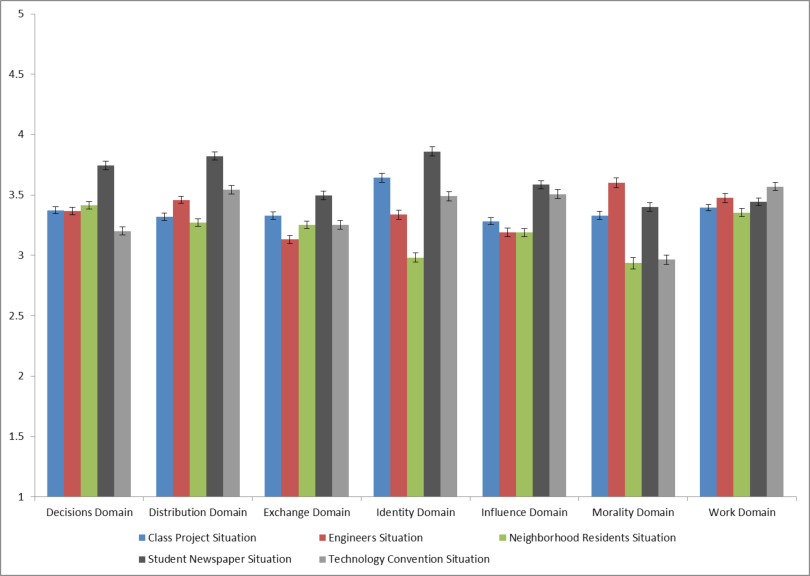
In order to determine whether ratings were related to context, that is, to particular situations, domains, and scenarios, we first examined the interaction between scenario situation and scenario domain, and we found it to be significant, F(19.86, 4052.01)=2.41, p < 0.001, [Equation or mathematical symbol available in the original paper PDF] p
2 = 0.012. Estimated marginal means for this interaction are shown in Figure 2, where each bar represents one of the 35 scenarios in terms of one situation in one domain.
As the graph shows, there was a great deal of variability between the scenarios with respect to the overall average ratings given to the options, regardless of the relational model orientation of the options and across all participants. A large number of post-hoc comparisons between the scenarios were significant, but because no one situation or domain clearly dominated all of the others, we do not describe them all in detail here.
Although Figure 2 does not address differences in ratings relative to cultural background, there was a significant three-way interaction between situation, domain, and cultural background group as well, F(59.59, 4052.01) = 1.84, p < 0.001, [Equation or mathematical symbol available in the original paper PDF] p
2 = 0.026. Post-hoc comparisons revealed additional significant pairwise differences between cultural background groups, even on ratings within scenarios. Both of these interactions illustrate the impact that context by itself has on how people make decisions about the appropriate way to respond to a situation. Individual scenarios led to more positively or negatively rated choice options by participants from different cultural backgrounds.
Figure 2. Estimated marginal mean ratings for interaction between Domain and Situation (with
Standard Error bars) Interactions of Relational Models with Situation, Domain, and Culture
The preceding findings demonstrated the importance of context on social decision-making, both within and across cultures. Taking relational models into consideration, there was a significant interaction between scenario situation, cultural background, and the relational model orientation of response options. Ratings of options associated with particular models, made by participants from different cultural backgrounds, varied significantly depending on the situation of the scenario being presented, F(28.86, 1962.68) = 2.04, p < 0.001, [Equation or mathematical symbol available in the original paper PDF] p
2 = 0.029. For example, although participants of European-American background rated authority ranking oriented actions more highly than did those of Iranian background generally, this pattern was more pronounced for scenarios involving the engineers situation than for those involving the neighborhood residents situation.
A similar result was found in the significant interaction of cultural background, scenario domain, and relational model orientation, F(36.14, 2457.64) = 2.35, p < 0.001, [Equation or mathematical symbol available in the original paper PDF] p
2 = 0.033. As an example, although those of European- American background generally rated market pricing oriented responses significantly lower than did those of Afghan background, the differences were more apparent in the scenarios involving the work domain than in those set in the distribution domain.
Finally, a significant four-way interaction between cultural background, domain, situation, and relational orientation of options, F(116.20, 7901.69) = 1.71, p < 0.001, [Equation or mathematical symbol available in the original paper PDF] p
2 = 0.024, demonstrated that context dependency of social decision-making extended to the level of each individual scenario. One of the largest differences observed (Mdiff = 0.84, SE = 0.15) was with respect to the situation of students in a psychology class working on a research project
(work domain – “This complex project has several different parts. How should the different tasks be assigned?”). Participants of Afghan background rated the market pricing oriented option significantly higher than did participants of European-American background (i.e., “The students should set up a fund to pay for project expenses. Students who contribute more to the fund should get to do less work and vice versa. Overall, the amount of work should be inversely proportional to the contribution to the fund.”).
All of these complex interactions reinforce that social decision-making is very specific to each case at hand and that cultural decision-making paradigms are more complex than the broad patterns distinguished solely on the basis of relational models. Context must be taken into consideration as well.
CONCLUSIONS
Implications of Findings This study set out to answer the research question of whether relational models could capture cross-cultural differences in coordination and decision-making considerations related to a variety of scenarios. Overall, our results showed significant cultural differences in judged appropriateness of scenario response options associated with the authority ranking, equality matching, and market pricing relational models, but not with communal sharing.
European-American participants had significantly lower ratings for market pricing related options, relative to participants of Iranian, Chinese, and Afghan backgrounds; however, all participants within each of the cultural groups rated and ranked the market pricing related options significantly lower than options related to other relational models. It might be that the comparative evaluation of market pricing oriented approaches demonstrates a general indifference for the other relational models, but it could also be a function of a poorly developed set of options for the market pricing oriented choices. In terms of the first consideration, there is research indicating that self- enhancement values, which may be conceptualized as utility-based values, are universally least preferred compared to self-transcendence, conservatism, and openness to change values, though they are also generally preferred more in some cultures compared to others (Glazer, Daniel, & Short, 2004; Roccas & McCauley, 2004; Schwartz & Bardi, 2001). In terms of the latter consideration, the majority of the market pricing related options that were presented in the survey were framed in terms of monetary value and transactions. Numerous comments from participants indicated that they were upset at the idea of applying a dollars-and-cents framework to the social scenarios provided. Corroborating this interpretation is the fact that mean ratings were higher for market pricing related options in the student newspaper scenarios (paired t-test, t(213) = 20.14, p < 0.001), which were generally framed in terms of productivity, than the ratings of options with the same orientation in other situations, which were generally framed in terms of money. It may well be that respondents across the different cultural background groups would respond more positively to market pricing options that emphasized utility without money.
Further, cultural differences were found in ratings for equality matching and authority ranking, with participants of European-American background rating authority ranking oriented options higher than did those of Afghan and Iranian backgrounds, and rating equality matching oriented options higher than did those of Chinese and Iranian backgrounds. Together, these findings suggest that people of European-American background prefer people in authority roles to make decisions, whether the authority is based on status or on merit. The sex of participants was particularly influential on the cultural differences in ratings of authority ranking and market pricing options as well. Among female participants, those of European-American background only showed differences from those of Chinese and Iranian background, whereas males of European-American background only differed from males of Afghan background. These results suggest that patterns of contrast between cultures may be different when the sub- cultural factor of sex is considered. This is not unexpected as men and women, boys and girls, even within cultures, often respond differently to the same situation (Shiraev & Levy, 2004).
Study results also indicated that context (i.e., the combination of situation and decision domain) impacted the degree to which different relational model orientations were considered appropriate, both across and within cultures. Complex interactions of culture, scenario situation, and scenario domain created statistically distinct patterns of relational model ratings. This result is consistent with related findings in other cross-cultural decision-making and performance research (e.g., Earley, 1993; Yates, Lee, Sieck, Choi, & Price, 2002). Although the scenarios assessed were varied enough to point towards broad cultural differences, the prevalence of differences in ratings related to Cross-Cultural Decision Making (2019) individual scenarios suggests that further research is required to obtain a clear understanding of the impact of various situations and contexts on the different relational decisions across cultures. To fully understand the application of relational models, variations need to be analyzed at the level of relevant situation and context for each culture. For example, studies of how decisions are made for resource allocation in specified cultures (e.g., a small village in rural Afghanistan), and the effects of violations of the decision schema on dyadic relationships, would permit comparisons across cultures within particular categories of situations; in this case, resource allocation. Admittedly, the situations presented in this study were only a sample of the full variety of possible contexts in real- world social life. The complexity inherent in determining when and where each relational model is applied means that generalizing about relational models on a culture-wide level should not be done lightly. Still, for the purposes of drawing out culture-general tendencies, the sampling of scenarios and domains used in this study provides important results that can be expanded on in further investigation of how culture might explain why some models were prioritized over others in different circumstances.
Even with nuanced context (situation-by-domain) effects, the culture-by-relational model interaction effects were observed across the contexts. The European-American group did have some usage patterns that were distinct from the other groups examined. These differences were striking considering the makeup of the culture groups in the sample. As scholars of culture know all too well, “culture” is not a clear-cut, monolithic property that can clearly be assigned to individuals or groups. The non-European-American culture groups in our sample mostly represented immigrants to the USA and not residents of their countries of origin. These participants also varied in the extent to which they had been acculturated, with variation in first vs. second generation, ages, and life experiences. Significant differences in ratings across the culture groups in our sample may represent only a small fraction of the possible distinctions between Americans and foreign nationals residing in their countries of origin. Even so, our analysis of the scenario response ratings found significant cultural differences, a testament to the powerful influence that “culture” might have across life experiences.
Challenges and Limitations In this study, we focused on determining whether key variables exhibited expected interactions at a pan-situation and pan-domain level. For the sake of conciseness, however, a number of interesting, more detailed analyses had to be left for later investigation, such as a comparison of male and female ratings within cultures. Similarly, the analysis of how cultural background interacted with context verified that such interactions did occur among different combinations of variables, but further investigation is needed to complete more directed analyses of whether situation or domain was a stronger driver of the rating outcomes, as well as to compare effect sizes for specific combinations of relational model orientation and cultural background.
Future studies would also benefit from developing scenarios that are authentic and establishing an understanding of how people within each of the focal cultures would respond to them. A major challenge to the construction of the scenarios was to avoid biasing the participants towards any one particular relational model based on the content or framing of the option. This precluded the introduction of scenarios that may have served as stronger manipulations of interpersonal closeness. For example, a scenario that describes a family was initially considered but ruled out because even the use of the term ‘family’ is likely to prime communal sharing regardless of culture.
Another potential influence in this study was that, despite the measures taken to verify the authenticity of participants’ cultural backgrounds, subtle population differences between sample groups may have had some impact on the observed effects. Most of the significant effects were differences between participants of European-American background and those of other cultural backgrounds. To be included in the European-American background group, potential participants had to be citizens of the USA or children of citizens, but could be of any unidentified European ethnic heritage. It is possible that some unmeasured demographics among those of European-American background drove some of the significant contrasts. It is notable, based on Table 2, that this group had the lowest rate of multilingualism in the home and that all members of the sample group were born in the USA. Additionally, it was particularly challenging to recruit participants of Afghan background for this study. A replication using larger numbers of participants from different ethnic groups is necessary to increase the generalizability of this study. Regardless, obtaining and verifying “pure” samples of cultural perspective will always be a challenge in empirical work. We adopted a rich decision aid for testing the sample in this study and future work would provide opportunity for further honing of such tools.
Finally, even with pilot testing of realistic decision scenarios, it is always possible for spurious differences in framing of alternatives to lead to differences in ratings. For example, market pricing was least preferred of all relational models across all cultures, suggesting that this might be a universal indifference. However, it is also possible that the market pricing response options were inappropriate (i.e., numerous MP options were framed around money). It may take multiple deployments of a measurement instrument to achieve full validation. However, considering the robustness of the broad effects and the range of significant post-hoc comparisons spanning many condition combinations, there is strong basis for concluding that the scenarios used in this study were diagnostic of real differences in participant response.
REFERENCES
Casrnir, F. L. (1999). Foundations for the study of intercultural communication based on a third-culture building model.
International Journal of Intercultural Relations, 23(1), 91-116. Dien, J., Blok, S., & Glazer, S. (2011). Cultural priming: Adopting the adversary’s mindset to improve analysis. College Park, MD: University of Maryland Center for Advanced Study of Language. Earley, P. C. (1993). East meets West meets MidEast: Further explorations of collectivistic and individualistic work groups.
Academy of Management Journal, 36, 319-348. Fiske, A. P. (1992). The four elementary forms of sociality: Framework for a unified theory of social relations. Psychological Review, 99(4), 689-723. Fiske, A. P. (2004). Relational models theory 2.0. In N. Haslam (Ed.), Relational models theory: A contemporary overview (pp.
3-25). Mahwah, NJ: Lawrence Erlbaum Associates. Glazer, S., Daniel, S. C., & Short, K. M. (2004). A cross-cultural study of the relationship between organizational commitment and human values. Human Relations, 57, 323-345. Hamedani, N. G., Purvis, T. M., Glazer, S., & Dien, J. (2012). Ways of manifesting collectivism: An analysis of Iranian and
African cultures. College Park, MD: University of Maryland Center for Advanced Study of Language. Haslam, N., & Fiske, A. P. (1999). Relational models theory: A confirmatory factor analysis. Personal Relationships, 6(2), 241-
250. Hofstede, G. H. (1984). Culture’s consequences: International differences in work-related values. London: Sage. Hong, Y.-Y., Morris, M. W., Chiu, C.-Y., & Benet-Martinez, V. (2000). Multicultural minds: A dynamic constructivist approach to culture and cognition. American Psychologist, 55, 709-720. Kim, H., & Markus, H. R. (1999). Deviance or uniqueness, harmony or conformity? A cultural analysis. Journal of Personality
and Social Psychology, 77(4), 785-800. Koerner, A. F. (2006). Models of relating-not relationship models: Cognitive representations of relating across interpersonal relationship domains. Journal of Social and Personal Relationships, 23(4), 629-653. Markus, H. R., & Kitayama, S. (1991). Culture and the self: Implications for cognition, emotion, and motivation. Psychological
Review, 98(2), 224-253. Oyserman, D., & Lee, S. W. S. (2007). Priming “Culture”. Handbook of cultural psychology. Roccas, S., & McCauley, C. (2004). Values and emotions in the relational models. Relational models theory: A contemporary overview, 263–285. Rohner, R. P. (1984). Toward a conception of culture for cross-cultural psychology. Journal of Cross-Cultural Psychology, 15,
111-138. Ross, N. (2003). Culture and Cognition: Implications for Theory and Method, SAGE Publications. Schwartz, S. H. (1992). Universals in the content and structure of values: Theoretical advances and empirical tests in 20 countries. In M. P. Zanna (Ed.), Advances in experimental social psychology (Vol. 25, pp. 1-65). New York, NY: Psychology Press. Schwartz, S. H., & Bardi, A. (2001). Value hierarchies across cultures: Taking a similarities perspective. Journal of Cross-
Cultural Psychology, 32, 268–290. Shiraev, E. B., & Levy, D. A. (2004). Cross-cultural psychology: Critical thinking and contemporary applications. Boston: Allyn & Bacon Triandis, H. C. (1989). The self and social behavior in differing cultural contexts. Psychological Review, 96, 506-520. Triandis, H. C. (1996). The psychological measurement of cultural syndromes. American Psychologist, 51(4), 407. Triandis, H. C., & Gelfand, M. (1998). Converging measurement of horizontal and vertical individualism and collectivism.
Journal of Personality and Social Psychology, 74(1), 118-128. Woodhull, M. (2006). Comparing relational models across cultures: Discovering how maquiladora and parent company managers construct their social relationships at work. (Doctoral dissertation). Retrieved from ProQuest Information and Learning Company. (UMI Number 3233975) Woodhull, M. D., & Louis, D. J. (2009). Why did they do THAT??? A cross-cultural study of daily decision-making by Mexican
maquiladoras and US/Canadian managers. Business Journal of Hispanic Research, 3(1), 77-93. Yates, J. F., Lee, J. W., Sieck, W. R., Choi, I., & Price, P. C. (2002). Probability judgment across cultures. In T. Gilovich, D.
Griffin, & D. Kahneman (Eds.), Heuristics and biases: The psychology of intuitive judgment (pp. 271-291). New York: Cambridge University Press. Cross-Cultural Decision Making (2019)
LISTED IN THE AHFE DIGITAL BOOKSTORE CATALOGUE
Explore the complete digital volume
Advances in Cross-Cultural Decision Making
Read this individual research paper free through the original publisher, or explore the full digital proceedings book.
ISBN 978-1-4951-2095-4
Explore this ISBN in the AHFE Bookstore ↗Listed in the July 2026 bookstore catalogue; search by ISBN to confirm current availability · Digital book purchase optional