Yan Luximon, Yan Cong (2020). A Facial Mask Study for Chinese Female. In: Advances in Applied Digital Human Modeling. AHFE Open Access, vol. 11. https://doi.org/10.54941/ahfe100421
Facial mask, an essential product for skincare, has become a part of daily life for female population. Existing facial mask design has a lot of misfits including missing regions, corrugation and misplacement. There is a need to build a relationship between a 3D face shape and a 2D mask template. An accurate 3D face model and anthropometric measurements are initial steps to design of masks. 3D surface flattening is a method to generate 2D patterns and is widely used to trim materials in garment and footwear industry. In this study, a manual generation of 2D flat pattern from a set of 3D Chinese female face models was described. Facial mask templates with different sizes and cuts were produced and evaluated. The results revealed that sizing dimensions mainly differed in the width for different face models. In addition, the location and area for eye and mouth regions had a relatively large deviation and therefore it should be paid more attention in the mask design. This study provided more insights into the relationship between 2D flat pattern and 3D face shape. The results were expected as a reference for facial mask design and improve its quality to fit.
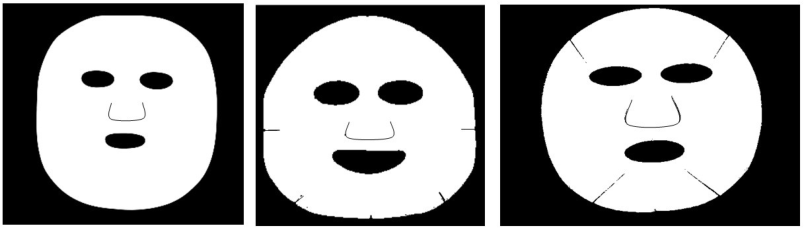
Healthy skin is an important fight sign of aging and has the ability to enhance people’s physical appearance and esthetic appeal. As skincare craze is sweeping the world, markets of facial masks are exuberant. The shapes for existing facial mask products have large variations within and among brands (Figure 1). Manufacturers design the mask shapes without uniform standards or scientific statistical information of the human face. Poor fitting seems to be a common problem for most of facial mask products. Such masks will be unable to be attached firmly onto the face and will inhibit the absorption of the essence by the skin. Therefore the efficiency of masks will be reduced.
Figure 1. Examples of various facial masks
Accurate anthropometric measurement for head and face is the first step to design a high quality of fit mask. Traditional head and face anthropometric measurements are conducted directly on living subjects. More than 200 measurements, including distance, circumference and angles, were indentified based on the landmarks visually on people's faces (Farkas, 1994; Kolar and Salter, 1997; Du et al., 2008). However, these 1D measurements were time- consuming and lack of 3D information. With the advance of 3D scanning techniques, the individualized 3D surface contours of human body shape can be easily captured in a fast, non-invasive and accurate way (Robinette et al., 2002; Azouz et al., 2006; Luximon et al., 2009; Xi and Shu, 2009). A set of software and CAD design tools were further developed to automatically analyze the dimensional data and assist the product design (Luximon et al., 2011). The method based on 3D scanning and CAD techniques provides more information on the 3D shape of human head and was used to develop the head and face product designs such as helmet shells (Liu et al., 2008) and spectacle frames (Kouchi and Mochimaru, 2004). This method therefore provides an opportunity to develop the facial mask design.
While the accurate 3D model of head and face provides an important reference to develop the mask shape, it does not work well to create the texture atlas for the designer and manufacturer. 3D surface flattening is to map a 3D surface onto a 2D plane. This method is critical to create a texture atlas and is widely used to trim the materials in shoe and garment industry (Jing et al., 2005; Liu et al., 2010). The 3D surface flattening will determine the shape, accurate boundaries, and the positions of cutting lines of mask materials in order to fit the contour of the face well. However, this method has not been well documented in facial mask design. The relationship between 2D flattened fabric and 3D face contour has not been understood in detail.
This study aimed to develop a flattening method to improve facial mask design based on 3D Chinese face model. Proper facial mask templates for Chinese female were expected to guide mask manufacture with accurate dimensions and locations of eyes, mouth and nose.
METHODS
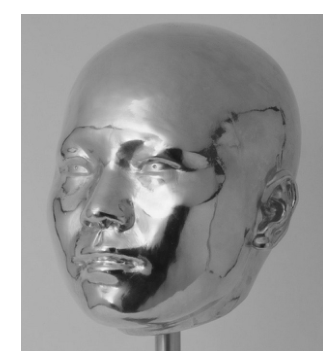
3D Chinese female face models In order to improve the fit of facial mask design for Chinese female, an accurate anthropometric model is needed. SizeChina database has more than 2000 3D head scans collected in China (Ball et al., 2012). A set of FACEFORMs of Chinese female with different sizes have been created using SizeChina database (Luximon and Ball, 2012). A parameterized modeling method was used to create those face models (Luximon et al., 2012). The measure of face breadth was used as a main reference when calculating the face models. All selected scans were set for three categories (5%tile, 50%tile and 95%tile) in terms of face breadth for model creation. Figure 2 shows the models in 5%tile and 95%tile which represent the small and the large sizes of Chinese female’s face. Two physical models were printed by the rapid prototyping machine and were used as the bases to create 2D flattened face templates in this study.
(a) Small size (b) Large size
Figure 2. Faceforms for Chinese female
Template design The traditional process to generate 2D flat patterns in footwear industry was followed to create the 2D patterns from two 3D face models. The paper tape was first attached on the printed face models. The locations of eyes, mouth and nose were marked down carefully. Then, the tapes were manually cut and flatten on the board to get the 2D patterns. The flattened patterns were further corrected to symmetric design considering manufacturing requirements. Several facial masks materials with different thicknesses were also tested for minor correction of templates.
In order to identify the boundaries of the facial mask and the locations of eyes, mouth and nose, dimensions representing these characteristics were defined on the patterns as Figure 3. These dimensions were proposed based on designer’s suggestions and user’s feedbacks. To remove the fabric distortion and obtain a fitting template, different cut patterns were tried including different positions, directions, amounts and lengths of cutting lines.
Figure 3. Dimensions of facial mask
Figure available in the original PDF paper.
RESULTS
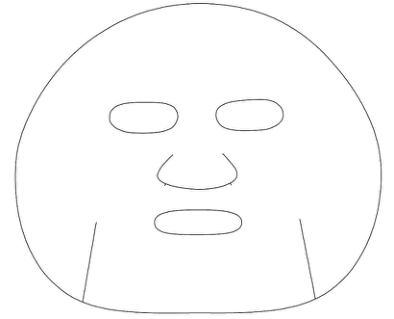
Figure 4 shows preliminary facial mask templates with appropriate cut patterns and dimensions. There are few special features for the new templates. New templates had shorter length especially at chin region, but wider at jaw region. New templates had less cutting lines than the current products in the market, especially at the forehead region. The cutting lines were almost vertical and located at the lower face region. Another difference was of the two small cutting lines which were located at the bottom of ala of nose. This cut pattern can efficiently remove the fabric distortion and make the mask more fit to the face contour. In addition, the nose cutting line was much wider and the distances between eyes were much larger comparing to normal masks. The cutting lines were closely related to the face shapes. The flattened facial masks were corresponding to previous results which found that Chinese female had wider face and interpupillary distance, bigger jaw and smaller chin than Western female (Luximon et al., 2010).
(a) Small size (b) Large size
Figure 4. Facial mask templates for different sizes
Mask dimensions and locations of eyes, nose and mouth in the template were measured as the definitions in Figure 3. It was found that the dimensions were mainly different in the width measures for different face sizes. The template width of the large size was 14.6mm (5.9%) greater than that of the small size. The distance between eyes had a large variation among different face sizes and the distance increased by 5.8mm (8.1%) for the large face template. The variance of eye sockets was also large, especially for its length, which increased by 3.1mm (14.8%) compared with the small face template. Although the designs for eye sockets had a significant difference among different face sizes, the differences of locations and shapes for nose region were small. The difference for eye-nose length was only 0.8%. Another large difference was found at the mouth region. The nose-mouth length of the large face template increased by 0.7mm (3.1%) compared to the small size template. The mouth socket also had a larger area for the large face template. The differences for the mouth socket width and length were 6.3mm (10.7%) and 3.1mm (18.5%), respectively.
CONCLUSIONS
In this study, a manual generation of 2D flat pattern from 3D face model has been described. Based on this method, a set of facial mask templates with different cutting patterns were developed. These templates provided the important references such as the dimensions and cutting line designs for mask manufactories to improve the quality of mask fit, especially for Chinese female. The results can be not only used for facial mask designs, but also further used for medical purpose such as scald treatment. Minor adjustment might be needed for different types of non- woven materials or other materials. Future study could be conducted to find out the allowance when considering material properties.
Although manually designing a 2D pattern can provide more insight into the development of the mask fit, the method is complicated and time-consuming, requiring a specialized craft. Therefore, the method is not suitable for individual design in a faster and more experience-independent way. With the development of computer technology, flattening simulation using CAD allows releasing the heavy dependencies on experience in manual design and is thought as an alternative solution to non-expert users. An automatic generation of 2D flat pattern from 3D human head and face model based on CAD method could be developed in the future work.
ACKNOWLEGEMENT This work was supported by the Departmental General Research Fund (DGRF) from the Hong Kong Polytechnic University (G-UB41).
REFERENCES
Azouz, Z.B., Rioux, M., Shu, C., Lepage, R. (2006), “Characterizing human shape variation using 3D anthropometric data”, THE VISUAL COMPUTER Volume 22 No. 5. pp. 302-314. Ball, R.M., Luximon, Y., Chow, H.C.E. (2012), “Anthropometric Study on Chinese Head”, PROCEEDING OF ASIAN
WORKSHOP ON 3D BODY SCANNING TECHNOLOGIES, April 17-18, Tokyo, Japan. Du, L., Zhuang, Z., Guan, H., Xing, J., Tang, X., Wang, L., Wang, Z., Wang, H., Liu, Y., Su, W., Benson, S., Gallagher, S., Viscusi, D., Chen, W. (2008), “Head-and-Face Anthropometric Survey of Chinese Workers”, ANNALS OF OCCUPATIONAL HYGIENE Volume 52 No. 8. pp. 773-782. Farkas, L.G. (1994), “Anthropometry of the head and face”, 2nd edition. New York: Raven Press. Jing, F., Joneja, A., Tang, K. (2005), “Modeling wrinkles on smooth surfaces for footwear design”, COMPUTER-AIDED
DESIGN Volume 37. pp. 815-823. Kouchi, M., Mochimaru, M. (2004), “Analysis of 3D face forms for proper sizing and CAD of spectacle frames”, ERGONOMICS Volume 47 No. 14. pp. 1499-1516. Kolar, J.C., Salter, E.M. (1997), “Craniofacial anthropometry: practical measurement of the head and face for clinical, surgical
and research use”, Springfield, Illinois, USA: Charles C Thomas. Liu, H., Li, Z., Zheng, L. (2008), “Rapid preliminary helmet shell design based on three-dimensional anthropometric head data”, JOURNAL OF ENGINEERING DESIGN Volume 19 No. 1. pp. 45-54. Liu, Y., Zhang, D., Yuen M.M. (2010), “A survey on CAD methods in 3D garment design”, COMPUTERS IN INDUSTRY
Volume 61. pp. 576-593. Luximon, Y., Ball, R.M., Justice, L. (2010), “The Chinese face: a 3D anthropometric analysis”, PROCEEDING OF TMCE2010, April 12-16, Ancona, Italy. Luximon, Y., Ball, R.M., Chow, H.C.E. (2011), “Facefinder: An online anthropometric tool for Chinese design”. PROCEEDING
OF THE 8TH INTERNATIONAL SHIBORI SYMPOSIUM TECHNOLOGY SHAPED BY CREATIVITY, December 28- 31, Hong Kong. Luximon, Y., Ball, R.M., Justice, L. (2012), “The 3D Chinese head and face modeling”, COMPUTER-AIDED DESIGN Volume 44 No. 1. pp. 40-47. Luximon, Y., Ball, R.M. (2012), “Faceforms: A 3D design tool for Chinese”, PROCEEDING OF THE INTERNATIONAL
TEXTILE & APPAREL SUSTAINABILITY CONFERENCE (ITASC2012), July 16-21, Mauritius. Robinette, K., Blackwell, S., Daanen, H., Fleming, S., Boehmer, M., Brill, T., Hoeferlin, D., Burnsides, D. (2002), “Civilian American and European Surface Anthropometry Resource (CAESAR)”. Final Report. In: SUMMARY, AFRL-HE-WPTR- 2002-0169 vol. I. Air Force Research Laboratory, Human Effectiveness Directorate, Bioscience and Protection Division, 2800 Q Street, Wright-Patterson, AFB OH 45433-7947. Xi, P., Shu, C. (2009), “Consistent parameterization and statistical analysis of human head scans”, THE VISUAL COMPUTER
Volume 25 No. 9. pp. 863-871.
LISTED IN THE AHFE DIGITAL BOOKSTORE CATALOGUE
Explore the complete digital volume
Advances in Applied Digital Human Modeling
Read this individual research paper free through the original publisher, or explore the full digital proceedings book.
ISBN 978-1-4951-2094-7
Explore this ISBN in the AHFE Bookstore ↗Listed in the July 2026 bookstore catalogue; search by ISBN to confirm current availability · Digital book purchase optional