Marco Mazzola, Alessandro Aceti, Giuseppe Gibertini, Giuseppe Andreoni (2021). Aerodynamics and Biomechanical Optimization of the Jump Phase in Skiing, Through a Simulation-Based Predictive Model. In: Advances in Human Aspects of Healthcare. AHFE Open Access, vol. 13. https://doi.org/10.54941/ahfe100494
In this paper, an aerodynamic and biomechanical evaluation of the jump phase in downhill race is presented. The aerodynamic analysis has been conducted in order to develop a predictive model of the lift and drag forces during the different jump phase. The jump time is very short and performed with high speed. The Biomechanical Analysis has been conducted using Santos Digital Human Model to simulate 5 selected postures measured with a motion capture system, in order to verify the reliability of the simulation software. These simulated postures generated data about frontal surfaces that have been used in order to validate the predictive models. The evaluation of the distribution of the joints torques produced on the athletes in the different posture, in response to the dynamical model of the jump in skiing, has been computed. Results demonstrate that the simulation model is effective and the simulated posture are coherent with the real motion measurement. There is a good agreement in Torques results for both the Skiers, in the different postures, with some exceptions. This is probably due to the fact that, even if the analyzed postures are the same for both the athletes, there is a natural variability in the executions, like the motion capture analysis demonstrates.
In downhill ski race, one of the most critical phases is the loss of contact with the ground due to a rapid change in the slope. Aerodynamic and biomechanical factors involved during the jump assume a relevant impact on the whole performance, and a correct characterization, together with specific training session can influence the final result of a specific athlete. The jump time is very short and performed with high speed. As a consequence, it is very important to develop computer-based simulation models that allows the athletes and the trainer to prepare specific training session, in order to optimize the performance on the snow. There are three main domains to be investigated and analyzed to build a successful simulation model. The first one is related to the dynamic of the jump, i.e. the description of the specific equation of motion, and the estimation of the forces acting on the athlete during the flight time. The second one is the evaluation of the aerodynamic load acting on the athlete, that are a fundamental part of the dynamic model. The third one is related to the relation between the athlete’s posture during the jump, and its effect on the aerodynamics load. The dynamic model of ski, and the consequent description of the forces acting on the skier has been descripted in several studies [Barelle et al., 2004; Savolainen, 1989; Remizov, 1980, Maronski,
1990]. Recent studies [Gibertini et a., 2013] described the evolution of the frontal surface and the term of lift area in function of the height of the skier and of the anatomical angles through simulation models. These models seem to be promising in predicting the jump trajectories and time estimation of the jump phase, but they requires more exhaustive evaluation tests. Aim of this study is to evaluate these prediction models with the use of Santos Digital Human Model.
In the first phase of the study, simulated postures have been based on real-motion data acquired with a motion capture system, in order to verify the reliability of the simulation software. In the second phase, five postures (related to 5 different jump strategies) have been simulated with anthropometrical scaled digital avatar (somatotypes, height). These simulated postures generated data about frontal surfaces that have been used in order to validate the predictive models proposed by Gibertini et al. [2013]. The last part of this work has been dedicated to the evaluation of the distribution of the joints torques produced on the athletes in the different posture, in response to the dynamical model of the jump in skiing. These biomechanical evaluation produced data about the relation between the aerodynamic benefits of the single jump strategy and the physical effort to determine the optimal jump assessment.
MATHERIAL AND METHODS Subjects
The Postural analysis of two male professional skiers has been conducted during this study. The two athletes joined the experimental tests voluntarily, and were properly informed about the aim of the study, and the experimental procedures. The postural analysis has been conducted through a 6 Vicon Motion Capture Cameras (Vicon M460, Vicon Motion System Ltd, Oxford Metrics, Oxford, UK). The Vicon PlugIn Gait model has been used for the marker placement and the evaluation of the postural joint angles. Anthropometrical data of the two skiers are presented in Table 1.
Skier
1 Skier
92 82
2 Height 179 167 Weight 77 71 Leg Length
Table 1. Anthropometrical data of the two subjects analysed.
Table available in the original PDF paper.
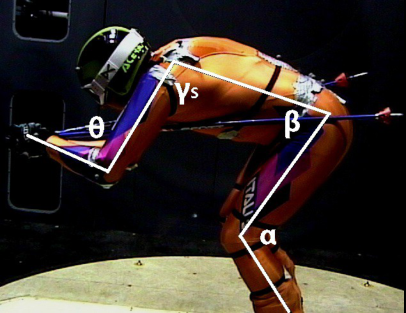
In order to evaluate and characterize the different athletes’ postures, 5 angles have been defined and computed through dedicated software, and are presented in figure 1
Figure 1. Angles used to characterize the Skier's posture In the Aerodynamic analisys. On the left, Angles in the sagittal planes, on the right the Abduction Angle of the Shoulder in the Frontal Plane.
Evaluation of the aerodynamic load on the skier In downhill ski racing, a study on the interaction between the aerodynamics and the posture held by the skier is of great interest for the performance. In fact an optimization on the athletic gesture leads to benefits in terms of speed and consequently of timing, that positively affect the final result.
In this work it was analyzed as the aerodynamic forces are distributed in the different anatomic districts; in particular the human body was divided in five sections:
Leg
Thigh
Trunk and head
Forearm
Arm For the jump phase we considered two force contributions: one directed parallel to the wind direction (drag) and one perpendicular to it (lift). To determine their magnitude the starting point consisted in a precedent activity performed in the wind tunnel of the Politecnico of Milan, where the aerodynamic load on two skiers was evaluated by the use of two strain gauge balances, when they assumed several typical position for the jumping phase.
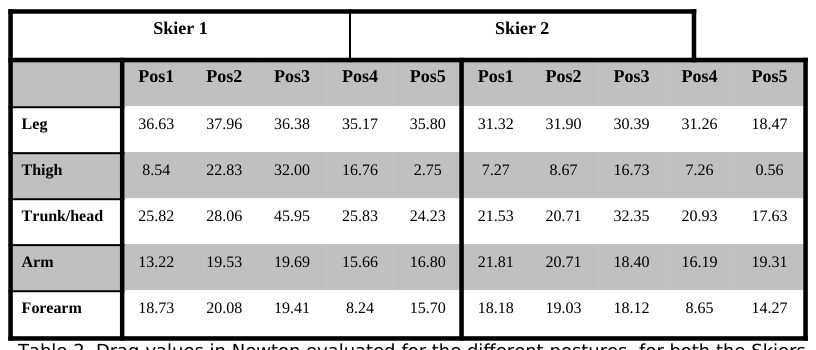
As described by Paps et al. (1996) there is a closed link between the drag force and the frontal surface (perpendicular to the velocity vector). In this way, considering the frontal images taken in the wind tunnel, it is simple to isolate the contribution of each anatomic district respect to the others. Table 2 reports the drag values evaluated for the different postures.
Regarding the lift force, it is not detectable a clear correspondence between the frontal surface and the lift itself, as in the precedent case. Therefore a schematization of the human body using multiple cylinders, as presented by Chowdhury, was adopted, conducting the analysis on a simplified geometry. As shown in the table 3 this schematization is good for the majority of the positions, while for some of them it generates large deviation in defect respect to the wind tunnel data.
Table 2. Drag values in Newton evaluated for the different postures, for both the Skiers Skier 1 Skier 2Table 3. Lift values in Newton evaluated for the different postures, for both the Skiers Postural Analysis
Table available in the original PDF paper.
A general description of the jump derived from direct observation was initially carried out. The execution of a jump can be divided into the following phases:
1. Approach to the jump
2. Initial phase
3. Central phase
4. Re-contact with the ground
During the approach, the athlete leaves the aerodynamic position (egg position) to assume a slightly raised posture, spreading his arms sideways, pose that allows a greater stability (the two ones adopted techniques are described by Barelle et al. (2006)). Then the skier progressively tends to assume a compact position for better cleave the air; finally, a few moments before landing, he/she extends the lower limbs to cushion the impact with the ground.
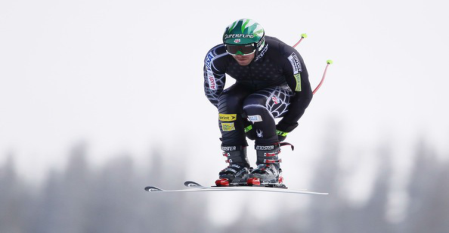
Five postures have been selected and analysed in this study, after the screening of downhill ski races through video and pictures (Figure 2):
Posture 1: Initial phase, with arms extended along the body
Posture 2: Initial Phase, with opened arms
Posture 3: Re-Contact Phase, with opened arms and the body extended
Posture 4: Central Phase, with egg posture and arms behind the legs
Posture 5: Central Phase, egg posture
Figure 2. Top Line represent Posture 1, in two different views. The second line represent on the left Posture 2, and on the rigt Posture 3; The bottomline represents Posture 4 (on the left) and 5 (on the right).
Simulations and Biomechanical evaluation The Biomechanical evaluation of the athletes’ postures has been conducted through the use of Santos Digital Human Model. Santos (Abdel-Malek et al., 2006) is a software for Human Motion Simulation, based on an advanced biomechanical model, that offers specific capabilities for the performance evaluation of the Human performance in a virtual environment. For each athletes, 5 postures have been reproduced in the digital environment, as a consequence of the postural analysis conducted with the motion capture system. The avatar has been anthropometrically scaled, according to the anthropometrical measures. Data from Subject 1 corresponded to the 21st percentile, according the NASA-3000 database, while subject 2 corresponded to the 5th percentile.
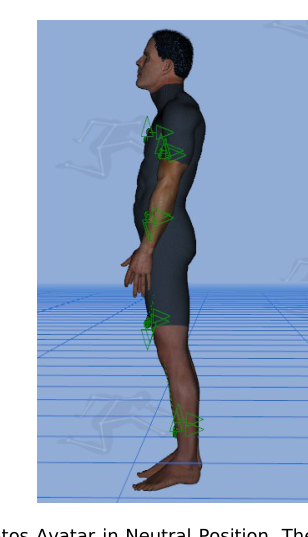
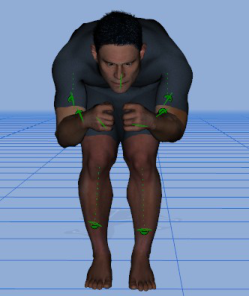
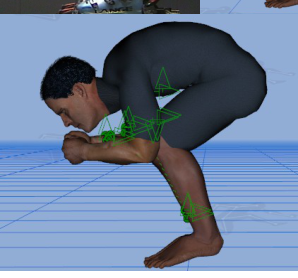
For the Biomechanical evaluation, the Joint Torques Visualizer capability of Santos (Bhatti et al. 2006) has been used. In relation with the aerodynamic data, 18 Point Load for each posture, for each avatars, have been placed in specific anatomical landmarks on the Avatar surface; in particular, they have been placed in correspondence of the center of mass of: left and right arm, left and right forearm, left and right thigh, left and right leg, trunk, for lift and drag forces . Figure 3 represent the frontal and sagittal view of the avatar in Neutral position, and the Point loads.
Figure 3. The Santos Avatar in Neutral Position. The forces (Lift and Drag) are represented with green line.
For each athlete, 5 postures have been reproduced, and the Joint Torques distribution calculated. The Santos DHM provides 47 Joints Torques Values, one for each degree of freedom (excluding Hands and Feet), according to the
Biomechanical model. For these analysis, results are presented only for those Joints that resulted more stressed, and with one single value. For those joints that presented substantial results for more than 1 Degree of Freedom, a mean value has been computed and presented. This is due to the fact that the aim of this study is to evaluate the distribution of the efforts among the selected joints, as a consequence of the aerodynamic loads in the different phase of the Jump.
RESULTS
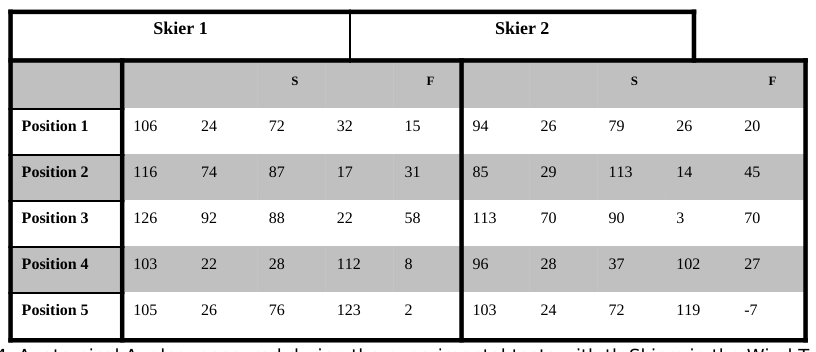
Table 4 presents the Anatomical Angles measured with the Motion Capture System, for the 5 analysed postures, for both the Skiers.
Table 4. Anatomical Angles measured during the experimental tests with th Skiers in the Wind Tunnel.
Figure 4 and 5 represent the measured postures, and results of the simulated Postures with Santos DHM; for Skier 1, results are represented in the frontal plane, while for the Skier 2 they are represented in the sagittal plane.
Figure 4. Postural analysis and simulation for Skier 1, in the frontal plane. On the top Line, Posture 1 and 2 are represented, respectively on the left and on the right. In middle line, Posture 3 and 4 are represented. Posture 5 is presented in the bottom line.Figure 4. Postural analysis and simulation for Skier 2, in the sagittal plane. On the top Line, Posture 1 and 2 are represented, respectively on the left and on the right. In middle line, Posture 3 and 4 are represented. Posture 5 is presented in the bottom line.
Results of the Joint Torques Evaluation are presented in Table 5 and demonstrate that:
At the spine level, the Torques are relevant only for the flexion/extension, and are well distributed at different level, with no localized overloads
At the Clavicle level, the aerodynamic forces produce significant torques In the Abdo/Adduction degree of freedom.
Shoulder and Knee present results in the Sagittal plane of motion, i.e flexion/extension movement
At the Hip and at the Ankle level, all the Degrees of Freedom proposed by the biomechanical model present Torques values S1_PO
Table 5. Joint Torques are presented as a percentage of the Maximum Torque Values for each degree of freedom, as offered by the Santos Software capability.
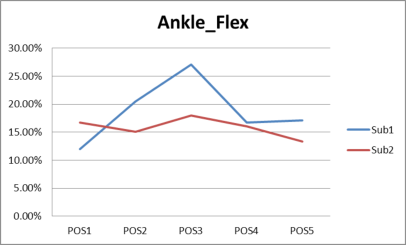
Figure 6 presents a graphical comparison between the two athletes. Results seem to be coherent for both athletes, with some exceptions. As an example, Posture 5 for the Torques at the Knee and Ankle (Abduction) level.
Figure 6. Graphical representation of the Joints torques values for each posture, for each skier, at the different Joints level.
CONCLUSIONS
In this paper, an aerodynamic and biomechanical evaluation of the jump phase in downhill race is presented. The aerodynamic analysis has been conducted in order to develop a predictive model of the lift and drag forces during the different jump phase. Data acquired in the Wind Tunnel have been decomposed in single element, in relation with the different body segment of the human body, in particular, arms, forearms, thighs, legs and trunk. This allowed a focused analysis of the Joints Torques distribution during the Jump phases. This approach seems to be promising, because this analysis, at the joint level, allows the understanding of the relation between the aerodynamic factors of the Jump Phase in skiing, and the Biomechanics. To reach this goal, an Advanced Digital Human Model has been used. Simulated Postures have been based on real data analysis, through a Vicon Motion Capture Systems. 5 Postures, characterizing the different Jump phases have been considered for both the athletes. As a conclusion, results demonstrate that the simulation model is effective and the simulated posture are coherent with the real motion measurement. There is a good agreement in Torques results for both the Skiers, in the different postures, with some exceptions. This is probably due to the fact that, even if the analyzed postures are the same for both the athletes, there is a natural variability in the executions, like the motion capture analysis demonstrates. In addition, the whole model propose a comprehensive method for trainers to develop personalized training session in order to optimize the aerodynamic and the biomechanical performance of the athlete.
REFERENCES
Abdel-Malek, K., Arora, J., Yang, J., Marler, T., Beck, S., Swan, S., Frey-law, L., Mathai, A., Rahmatalla, S., & Patrick, A.
(2006). Santos: A Physics-based Digital Human Simulation Environment. Paper presented at the 50th Annual Meeting of the Human Factors and Ergonomics Society, San Francisco, CA. Abdel-Malek, K., Yang, J., Marler, T., Beck, S., Mathai, A., Zhou, X., Patrick, A., & Arora, J. (2006). Towards a new generation of virtual humans. International Journal of Human Factors Modelling and Simulation, 1(1), 2-39. Barelle, C., Ruby, A., Tavernier, M., 2006. Analyse cinematique de la performance à partir de simulations des stratégies
gestuelles mises en oeuere par les skieurs alpins. Science et motricitè 59, 99 – 111. Barelle, C., Ruby, A., Tavernier, M., 2004. Experimental model of the aerodynamic drag coefficient in alpine skiing. Journal of applied biomechanics 20, 167 – 176. Bhatti, M., Vignes, R., & Han, R. (2005). Muscle forces and fatigue in a digital human environment (SAE Paper No. 05DHM-
73). Warrendale, PA: SAE International. Chowdhury, H. (2012). Aerodynamic design of sports garments. Applied aerodynamics, 22-40. Gibertini, G., Andreoni, G., Fusca, M., Mazzola, M., Grassi, D., Scarpellini, N., Trovato, D., 2013. Aerodynamics of jump in downhill ski racing. In: Clanet, C. (Ed.), Sport Physics, Palaiseau, pp. 302 – 313. Paps, P., Nachbauer, W., Mossner, M., 1996. Determination of kinetic friction and drag area in alpine skiing. In Mote, C. D.,
Johnson, R. L., Hauser, W., Schaff, P.S. (Ed.), Ski Trauma and Skiing Safety, Philadelphia, 165 – 177.
LISTED IN THE AHFE DIGITAL BOOKSTORE CATALOGUE
Explore the complete digital volume
Advances in Human Aspects of Healthcare
Read this individual research paper free through the original publisher, or explore the full digital proceedings book.
ISBN 978-1-4951-2093-0
Explore this ISBN in the AHFE Bookstore ↗Listed in the July 2026 bookstore catalogue; search by ISBN to confirm current availability · Digital book purchase optional