Luis Rubalcaba, Faiz Gallouj, Paul Windrum, Marja Toivonen (2019). Service Innovation and Social Innovation: an Analytical Framework and its Application to Health Services. In: Advances in The Human Side of Service Engineering. AHFE Open Access, vol. 8. https://doi.org/10.54941/ahfe100301
The research fields of service innovation and social innovation have been largely disconnected. Even though they deal with somewhat similar socioeconomic issues and both are studied in a multidisciplinary way, the research trajectories have been rarely crossed. This paper proposes a comprehensive framework to set up a bridge between the two research fields. The paper defines the concept of social innovation and approaches it from a service innovation perspective. Inter-linkages between service and social innovation are shown by identifying research areas in which both find a joint heuristic field. Finding these kinds of fields is particularly possible when services in multi-agent frameworks are revisited from a social innovation perspective, leading to place citizens and organizations and/or the third sector in a prominent position in the innovation process. This approach has been illustrated in a set of case studies in the health sector in Europe. Finally, the paper aims to identify the value added that social innovation can bring to service innovation research and vice-versa.
Current societies face major social needs and challenges in the areas of health due to an aging society, transport due to new mobility schemes, communication due to new social media, and sustainability due to the progress of green technologies and climate change. Due to the magnitude of these needs and challenges, services and social innovation are required as part of the solution. The ability to innovate in ways that deliver better services and social welfare coincide with a growing demand by citizens to be actors in their lives and to be enabled to find collective solutions to some of the social issues which they encounter. Of course, the involvement of society in innovation processes is not new. However the modes and levels of potential engagement have drastically evolved during the last two decades. Globalization and digitalization have had a major impact on society, allowing consumers, producers, innovators and investors the possibility to connect and act, empowering individuals to participate more actively in society.
In this shift towards great social interactivity, service innovations and social innovations have come to share more and more in common. There are two factors here. First, there has been the rapid growth in service sectors both developed and developing economies – around 67% of global value added is in services (WB data) - and the majority of social innovations are occurring in service sectors. Second, and more importantly, social innovations generally produce new or improved services for society. Consequently, it is the service quality that is the primary focus of innovation for the various stakeholders involved in health care, education and training, energy and environment, workforce development, etc.. Equally, the collaborative nature of creativity and innovation in services has been highlighted in the multi-agent framework used to study service innovations (Gallouj, 2002, Gallouj and Weinstein, 1997; Windrum, 2013, Windrum and García-Goñi 2008),. This collaborative aspect within health, social service, and transport sectors naturally lends itself to social innovation (Gallouj et al., 2013).
It is somewhat surprising, given the overlap, that services innovation research and social innovation research have evolved in parallel, rarely crossing (Djellal and Gallouj, 2011). This is partly explained by the different origins of the researchers involved in services and social innovation research rather than by differences in the content. Another contributing factor is the technological bias in innovation studies, which tends to neglect non-technological aspects of innovation in services, including its social characteristics. Innovation in services has been assimilated by industrial innovation, not social innovation. Publications that include both topics are rare and anecdotal (Van der Have and Rubalcaba, 2013), even though each has received major contributions from management and businesses disciplines, economics and economic geography. Finally, the fuzzy concept of social innovation (Paul and Ville, 2009) has not helped.
This paper contributes to building a bridge between service innovation research and social innovation research. As the interest in social innovation grows, it is imperative that we define its theoretical core in a precise manner so that the synergies with services innovation research are identified, and a future research agenda designed. Building on a review of the existing literature in section 2 of this paper, we discuss the interactions, similarities and differences between service innovation and social innovation in section 3, and provide a theoretical framework with which to understand social innovation from a service innovation perspective in section 4. The paper applies the framework to 10 case studies of public-private innovation networks in health services. Third sector organizations play a key role in these innovation networks. This is elaborated in section 5. We conclude with an agenda for future research in the field.
A BRIEF LITERATURE REVIEW Despite the generally parallel development of service innovation and social innovation literatures, there are some limited interconnections between them. Djellal and Gallouj (2011) provide an overview of the most important examples. First, they mention Gershuny’s vision (1978, 1983) of social innovation – the transition from formal to informal satisfaction for which services are replaced by technology goods in a self-service society. This conception is very technologically emphasized. Second, they refer to a wider social view of service innovation by Normann (1984): innovation that creates new types of social behavior, use social or human energy more efficiently and link social contexts in a new way. Finally they point out the characteristics based approaches that we will be discuss in more detail in the next section.
Harrison et al. (2010) make a more explicit linkage between service and social innovations. They consider that the perspective of social innovation contributes to the analysis of service innovation in four ways. First, it helps to identify the type of service associated to a particular innovation (they mention the case of the service can be a collaborative effort between a group of members of the community and public bodies). Second, “social” can refer to a service benefiting the whole community, or a specific target group, as demonstrated by the home help services for the elderly (Ducharme, Charpentier and Vaillancourt, 2004). Third, the term refers to the non-economic aspect of economic interventions (in this case, they state services deriving from social innovation that are necessary but not highly lucrative as shown by the activities involving the social integration of disadvantaged people). Fourth, the mere inclusion of employees, user or partners deserves the term “social”.
Mendell (2006) views social innovation in terms of governance, participation and empowerment, what can be distinguished through the processes of emergence and consolidation. Social innovation involves the creation of a particular type of services but pertains above all to a specific process involving both the key role of social entrepreneurs and the forming of alliances and networks. The result is the creation of an innovation system giving rise to a proliferation of social innovations whose effects on one another consolidate the basis.
Other authors have explored the relationship between social innovation and service innovation in particular services areas. Greenhalgh et al. (2004) provide a systematic overview of the state of the art in health care. They define service innovations in this context "as a novel set of behaviors, routines, and ways of working that are directed at improving health outcomes, administrative efficiency, cost effectiveness or user's experience and that are implemented by planned and coordinated action" (ibid., 1).
As seen above, most research approaches focus on the social aspects of services innovations. The service dimension of social innovations has sometimes been pointed out by international policy organizations. The EU Commission (2011) has highlighted that social innovators seek new services that improve the quality of life of individuals and communities in labour market integration, social inclusion, health care, education, resource efficiency and environmental challenges. In the similar vein, the OECD Forum on Social Innovation (2000) emphasized the improvement of quality of life via new services resulting from social innovations. This forum mentioned the emergence of new competencies, jobs, and forms of participation in particular. The EU and OECD cases are, however, exceptional – in general, services are not included in the analysis of social innovations or they are seen just a part of them together with other outputs (goods, practices, etc.). This view is apparent in the extensive survey on social innovation by the Tepsie (2012) project, the social change and systemic approach by Howalt and Schwarz (2010) and in the evolutionary perspective by Reinstaller (2013).
A factor that at least partially explains the difference between the views of researchers and policy makers is the fuzzy and ambiguous character of the concept of social innovation (Pol and Vil, 2009), and the novelty of social innovation as a research area. Even though it is difficult to find a detailed and generally accepted definition for the concept, researchers have quite unanimously stated that the distinctive feature of social innovations is not their content but the nature of the innovation process: the goals and actors involved. It has been highlighted that innovative solutions in this context are sought for a wide range of issues, representing different realms of society: labor market, education, health, housing, etc. (Moulaert et al., 2005). A common characteristic is that the innovations concern complex economic and social problems. The outcomes usually arise in the form of a service innovation which benefits the members of a community or the whole community (Harrison et al., 2010). In a broader sense, also the outcomes in the form of products, practices or behaviors may also “serve” the community as new resources (Vargo and Lusch, 2004, 2008).
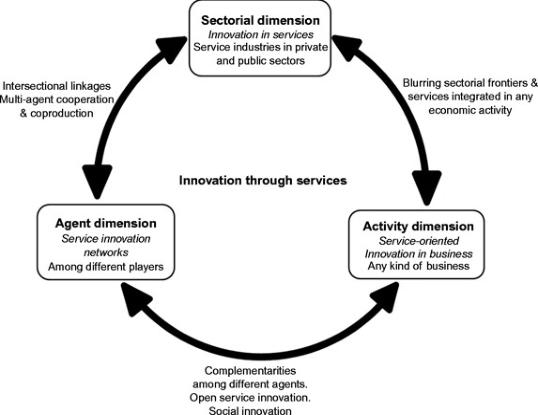
It is also possible to argue that social innovation is a particular case of service innovations – a viewpoint that has rarely been discussed. This view is included in the three-dimensional framework of service innovation proposed by Rubalcaba et al. (2012). Figure 1 presents this framework whose dimensions are innovation in services sectors, service innovation in any kind of business and services as multi-agent co-productions. The first dimension is widely discussed in sector-based service literature, whereas the second dimension represents the views of services marketing and management. Here, the service experience is on the focus and the novelty included may mean a new service concept, a new customer interaction, a new value system/business partners, a new revenue model, or a new organizational or technological service delivery system (Den Hertog, 2010). The third dimension is based on the development of multi-agent framework for service innovation (Gallouj, 2002, Windrum and Garcia Goñi, 2008). It is this dimension that can be considered social innovation when the link between the agent dimension and the activity dimension is created. The activity dimension in the multi-agent framework highlights the importance of the non-technological aspects of innovation (Gallouj, 2002, Gallouj and Djellal, 2010), leading to the inclusion of social issues and social actors in new services processes.
Figure 1: The three dimensions of innovation through services (Rubalcaba, 2012)
SHAPING SOCIAL INNOVATION FROM A SERVICE PERSPECTIVE The service dimension of social innovation
Summarizing the discussion in the previous sections, social innovation can be defined as new innovative solutions or new innovative practices as response to societal challenges (social goals), based on new ways of participatory and citizens empowering systems (social means). Services and service innovation can be identified in four areas of social innovation: the challenges tackled are often in the area of services, the innovative outcomes are often new or improved services, the participatory processes often include service co-innovation, and the inputs are often based on the use of knowledge intensive services and service intangibles. These aspects of social innovation can be opened up as follows:
Services as areas where social innovations take place. Social innovations include new or modified services that improve the quality of life of individuals and communities. Examples are improvements in health care, education, housing, labor markets, and increasingly solutions to the issues of sustainability.
(New or improved) services as outcomes of social innovation. Most prominent examples of social innovations are services in nature or combine technology and services: prevention and treatment of diseases, new pedagogic techniques, new rural tourism initiatives, smart cities initiatives etc.
Service coproduction as the means for social innovation. The participatory processes characterizing social innovation require a certain level of service co-production and co-innovation. The users may be involved in the development innovation process and the outcomes are modified in the use context.
Services as inputs for social innovation. Service innovation can be considered a dimension of what is behind any social innovation process. Service dynamics are those creating service transformations, considering services as a dimension of economic and social life which takes place in any kind of economic and social sector (within agriculture, manufacturing, market services or non-market services sectors). From the many services acting as inputs for social innovation, a particular role is given by knowledge-intensive business services (KIBS) and the intermediaries from the public or the third sector to facilitate innovation processes.
This categorization highlights that social innovations may be identified as novel services-based solutions to social problems. They are more effective, efficient, sustainable, or fair than existing solutions, and provide value that accrues to society as a whole; the society’s capacity to act properly grows. Figure 2 presents the interrelations included in social innovations on the basis of the role played by citizens and organizations.
SOCIETAL ISSUES AND
NEEDS FOR SERVICES Social needs Social challenges
Citizens and Organizations as Beneficiaries
Citizens and organizations as Entrepreneurs and
Civil Society, Third Sector Business - private sectors Public sector
agents
SOCIAL PROCESSING & SERVICE
NEW SERVICES AS OUTCOMES
COINNOVATION
OF SOCIAL INNOVATION Within goods (agric. /manuf.) Within services (market and public) Within cross-sectoral activities
Networking Value co-productions Knowledge co-creations Ecosystems and service constellations
Citizens and organizations as innovation co-producers, mediators
Figure 2: Services in social innovation In the first phase of the cycle presented by Figure 2, citizens and organizations are recognized as a subject of action, causing a social innovation in event in an object within the surrounding environment. These social innovations (occurring in the form of a service) can take place within governments, within the business sector, or within the third sector (non-profit). As the subject of action, citizens play a fundamental role as producers of innovation – social agents or social entrepreneurs – working at the crossroad of market, state and civil society, often with considerable input from the public sector and the third sector. As a new answer to unsolved societal issues, social entrepreneurs and social agents aim at identifying and delivering new solutions within the system. Furthermore, while meeting social needs and tackling societal challenges, social innovations empower people and create new social relationships and models of collaboration. Approaches that favor cooperation between the public, private and third sectors often facilitate an effective respond to social needs and challenges.
Figure available in the original PDF paper.
Sooner or later in the process of social innovation, civil society becomes integrated via the role of users. Earlier, citizens have often been regarded as mainly the consumers of new services. Recently, the concept of co-innovation has emphasized the importance of customer-producer interactions for creative activities. Thus, citizens and organizations are becoming principal social innovators for the benefit of civil society, contributing directly to welfare. They serve as a medium (mediator) for causing a result (social processing) or for transferring information in order to improve existing services or organizational forms. In social innovation, citizens and organizations typically participate without profit as the main motive.
Finally, in the last phase of the cycle, citizens and organization become the beneficiaries of the innovative solutions. Their wellbeing become the object of their own innovation developments, as service innovations address the overcoming of societal issues that civil society is and will be facing in future. Therefore, the improvement of future standard of living is considered the result of service innovation itself.
In this context, the activities and actors involved also show the multifaceted nature of social innovations, but first and foremost they reveal the specificities of these innovations: the interactions taking place comprise much more than a traditional service relationship. The sources and goals of innovation are more diverse, and the participation of actors often includes some voluntary elements (combined with commitment). Social innovations may 1) emerge at the grassroots level among individual citizens who respond to pressing social problems, 2) be produced by private, public and third sector organizations separately or in cooperation, or 3) result in fundamental changes at the societal and policy level. Research in these three areas has focused on the following topics respectively: the empowerment of citizens and stakeholders, public-private partnerships and the so-called ‘social economy’, and the governance and management of social and system innovations.
The discussion on empowerment highlights that social innovations combine two aspects of social life: the economic aspect and the social aspect. Thus, the aim is not only the production of services and the creation of wealth, but also the promotion of values and initiatives involving individual and collective empowerment and the development of democracy and responsible citizenship. (Harrisson et al., 2010) The process of creation and implementation of social innovations relies on participatory dynamics, which requires active input from the various stakeholders and results in fostering and utilizing the citizens’ social capital in life and work (Nahapiet and Ghostal, 1998). As a research field, studies on participatory practices and empowerment are linked to studies on user- and employee-driven innovation.
Social innovation is also changing the notions on more traditional innovation activities – those taking place within and between firms and public organizations. This point of view has focused on new types of organizations and on the integration of initiatives in existing organizations (Moulaert et al., 2005). Research has been active concerning the third sector (the so-called social economy) in particular. Here, the non-economic aspects of economic interventions – e.g. the social integration of disadvantaged people – have been emphasized as an important aspect of the concept ‘social’. Innovations in this context are sometimes called ‘pure social innovations’, because they address needs that are not satisfied through the market mechanism due to the lack profit potential. The social economy consists of non-profit organizations (NPOs), cooperatives and associations, social entrepreneurs, and of partnerships between the public and third sectors. Social innovations may be produced either autonomously by the third sector, with the state support, or in a partnership with it. In the partnerships, the role of the actors of the third sector may vary from that of a sub-contractor to common design and implementation of social policies with the public stakeholders (Harrisson et al., 2010). Public-private innovation networks as such can be considered social innovation to some extent (Gallouj et al., 2013).
Also private firms are entering the field of social innovation; corporate social responsibility and concern on sustainability are increasingly a part of their strategies (Lapointe and Gendron, 2004). The way in which the striving for social innovations changes innovation processes concerns all types of organizations – both public and private. Unlike innovations in the market sector, which traditionally have been kept outside competition as long as possible, social innovations call for imitation and diffusion. In them, open innovation is not an alternative strategy but the primary strategy, i.e. forming alliances and networks is essential. The governance and management of these networks have to support both the creation and dissemination of innovations. Dissemination is a challenging task due to two characteristics of social innovations: local nature and the lack of codification. The contribution of social innovations is typically manifested as the density of local networks and as local vitality that may result in new jobs and market activities. Scaling up innovations from this limited context requires the strengthening of their systemic features. It also may require new types of R&D practices that can facilitate the codification of social innovations and the procedures applied. (Harrisson et al., 2010)
Similarities and dissimilarities between service innovation and social innovation The previous sections have revealed a plenty of similarities between service innovation and social innovation, regarding both the goals (due to the social dimension of services) and the means (multiplicity of agents and co- production). There are also similarities in the nature of innovation, since both areas share intangibility, invisibility and interactivity. Further, both of them include policy issues (appropriation issues beyond the traditional patents system and the lack of adequacy of public support policies). However, the most important similarity is the process (practice). This is illustrated in Figure 3, which is a model constructed on the basis of an empirical study in the health sector (Hyytinen et al, 2013). Social and service innovation coincide when discussing about co-creation and co-innovation among different actors, although both can have different means to contribute to the systemic change in health organizations.
SYSTEM Social goals
Innovativeness and
Dissemination
adaptiveness
Institutionalisation
Experimentation New or improved
Engagement of multiple actors (esp. NGO’s and civil society)
services Multi-agent framework
SOCIAL INNOVATION
SERVICE INNOVATION
Co-creation and coinnovation Implementation Implementation
Organisation
Organisation
Tools
Tools
PRACTISE MAKING
Figure 3: Service innovation and social innovation in the health sector (Hyytinen et al, 2013)
Figure available in the original PDF paper.
However, not every service innovation is a social innovation and vice versa. Most service innovations take place in firms seeking business profit regardless the social component. They do not engage citizens, but some customers in the most interactive cases. On the other hand, there are social innovations based on technological development (affordable technologies for inclusive innovation) that cannot be considered service innovations but which are goods-based innovations. It is also possible that social innovation includes new social practices that do not lead to any new or improved service. However, in evolutionary terms, service innovations are moving towards social innovations: they are increasingly multi-agent and multilateral, and take into account a wider spectrum of society and social goals. Correspondingly, social innovations seek to be increasingly professionally oriented, developing a wider range of services as an outcome. As showed in Figure 3, there is a trend towards a wider joint area where service innovations can be named social innovations and vice versa: social service innovation are more and more frequent in our society.
Towards a definition of social innovation from the service perspective Given the previous analysis, social innovation can be redefined from a service perspective. To do this, some service elements have to be taken into account. First, the societal challenges can be addressed by social goals to be achieved via new or improved services and social goals address a target community in such a way that social innovation can be considered a service itself. Second, services have a role in the social means dimensions of social innovation, and since service co-innovation and networking is an essential component, services are also linked to collective co- creation of knowledge and new social values in new innovation and customer co-creation. Third, empowerment is a key issue to reinforce service capabilities, and a systemic change perspective is needed based on new interactions between institutions and stakeholders that can be partly linked to new service management and culture. From these service elements, and taking into account the need for simplicity in the definitions, social innovation can be defined as “new service solutions to societal challenges, aiming to increase welfare by coproducing the creation and implementation of new knowledge and capabilities among a multiplicity of empowered actors”. This definition covers the above-mentioned services elements, summarizes the different social challenges in the welfare objective, and conveys the idea that different social innovation types (behaviours, practices, products) lead to new or improved services in one way or another.
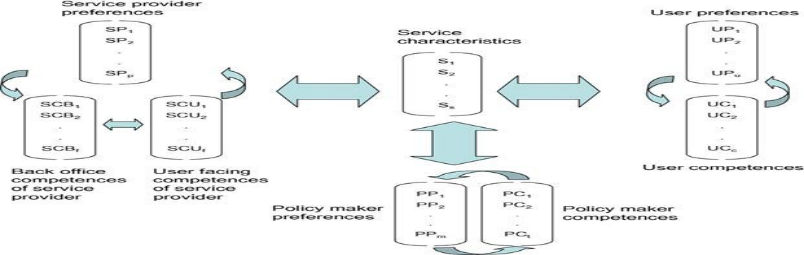
A MULTI-AGENT FRAMEWORK FOR UNDERSTANDING SOCIAL INNOVATION IN SERVICES The multi-agent framework presented below is a development of prior work by Gallouj and Windrum together with their colleagues (Gallouj and Weinstein, 1997; Gallouj, 2002; Windrum and García-Goñi, 2008; Windrum, 2013). It provides a comprehensive framework for understanding the processes and outcomes of service and social innovation: it enables an explicit consideration of the competences and preferences of citizens, organizations, and policy makers and of their interaction in the processes of co-creation and diffusion of innovations. The approach is rooted in the work of Kelvin Lancaster (1966) on product characteristics and consumer demand. Over time, services scholars have developed the framework, from an its initial focus on provider-customer interactions, to a more general model to includes the roles of government, third sector and other agents on the innovation process.. Figure 4 illustrates the Windrum-García Goñi version of the model. Compared to the Gallouj-Weinstein (1997) services model, this includes policy makers as a key actor group whose preferences and competences play a significant role in shaping innovation.
Figure 4: A multi-agent framework for understanding service innovation (Windrum and García Goñi, 2008) In this paper, we propose a further step in the evolution of the multi-agent model for understanding better the social- service innovations. The main point is deepening the transfer from the provider-customer dyad into a genuinely multi-agent framework where different agents can take different roles. Along with the emphasis on empowerment (supported by the advancement of ICT and social media), the users are all the more often also providers. For example, new co-innovations in health are increasingly outcomes from interactions between hospitals, patients, voluntary associations and policy makers. Therefore the focus of understanding the interaction should be placed on the different roles played by different partners in different times.
Another important element is the many roles played by citizens in social innovation. They can be promoters, enablers or facilitators of new innovations, or they can be key mediators, co-producers and/or the final beneficiaries. In providing a new solution to unsolved societal issues, citizens engage in social processing and networking that underpins collective creation and diffusion. The diffusion of these new solutions may be driven by citizens in the role of lead users. Here citizens are not ‘passive consumers’ but active agents – the designers, champions and users of innovations – and key protagonists for change. Their actions transfer information about new possibilities and opportunities for services and organizational forms that better address societal issues. The impacts of social innovations are judged on their capacity to improve wellbeing, living standards, and sustainability. The empowerment of individuals, and the broadening of their choices, is a core dimension of social progress, well-being, and welfare (Sen 1999, Stiglitz et al. 2009). Individual citizens, and citizen groups, must have sufficient social capital, knowledge and skills to fully engage with organizations and policy-makers in the social innovation process. Increasing citizens’ socio-political capabilities, and their access to resources often requires supporting policies and may imply potential conflicts with existing interests, beliefs, and actions of established organizations (Moulaert et al. 2005, Phills et al 2010). How these are mediated and altered is a key issue because it determines the extent to which citizens can actively become key players in social innovation. The multi-agent framework makes explicit the competences and social capital of citizens, and highlights conflicting areas of interest between citizens and other stakeholders.
In this context, the third sector deserves a particular mention in the model, since they are key actors within collective creation and diffusion of social innovation and they act as interfaces between citizens, business and policy makers. The third sector organizations often act as interfaces between the citizens and the rest of actors (firms, institutions) to coproduce and participate in the innovation processes. They identify and deliver new solutions that improve the quality of life of individuals and communities. Grassroots initiatives are commonly promoted by social entrepreneurs and other third sector agents. Innovative processes are used to establish new forms of labour market integration, improve social inclusion, and to identify and implement new ways of addressing health care, education delivery, resource efficiency and environmental challenges. Employment in Third Sector organizations has grown faster than in private and public sector organizations over the last two decades. Thousands of new foundations, social ventures and NGOs are growing around the world (Bornstein, 2004) and they are playing a more and more significant role of social change and innovation.
A great advantage of the multi-agent framework is that it enables modelling of the interactions of stakeholders who develop and diffuse social innovations, and how these interactions shape the features of new goods and services. The development and diffusion of social innovations requires both (a) the direct implementation of knowledge and competences of citizens and organizations (public, private and third sector), and (b) the mobilization of material and/or immaterial factors. Interactions between key stakeholders facilitate/inhibit the development of social innovations, shape the features and characteristics of innovations, and determine the extent to which innovations successfully diffuse. This explains why ‘co-creation and co-innovation’ is related to the ‘empowerment’ of citizens and organizations.
A key development of the multi-agent framework is its explicit inclusion of the government policy-makers within the social innovation process. Governmental organizations may themselves be designers and producers of public services, or the purchasers of services produced by citizens or other organizations, and publicly delivered. Public standards bodies may be needed to define the quality of new services and their delivery, thereby unleashing social entrepreneurship and innovation. Innovation may require the development of new practices within public sector organizations (such as New Public Management practices, and more recently Public Value Management approaches). Governments may need to experiment with market and non-market provision. This can take the form of privatisation or the nationalisation of organizations and industries (as in the current banking crisis) or propose new forms beyond the public-private dichotomy. Government may seek to stimulate organizations for the development and provision of services, such as third sector / non-governmental organizations, social entrepreneurs and citizen groups, and work together as effective partnerships for large-scale community change.
Equations and mathematical formulas are available in the original paper PDF.
1
1
CP CC
2
2
Citizens preferences & capabilities
. .
. .
Enterprises and business organizations preferences
Equations and mathematical formulas are available in the original paper PDF.
1
Third sector and communities service preferences
Equations and mathematical formulas are available in the original paper PDF.
1
Equations and mathematical formulas are available in the original paper PDF.
SP
2
EP
2
. .
. .
Service characteristics
Equations and mathematical formulas are available in the original paper PDF.
[Equation or mathematical symbol available in the original paper PDF]
Equations and mathematical formulas are available in the original paper PDF.
2
SC
EC
Equations and mathematical formulas are available in the original paper PDF.
1
1
. .
SC
EC
Equations and mathematical formulas are available in the original paper PDF.
2
2
Equations and mathematical formulas are available in the original paper PDF.
. .
. .
Enterprises and business organizations capabilities
Equations and mathematical formulas are available in the original paper PDF.
c SC
d EC
Equations and mathematical formulas are available in the original paper PDF.
Third sector and communities service capabilities
Equations and mathematical formulas are available in the original paper PDF.
1
1
PP PC
2
2
. .
. .
Equations and mathematical formulas are available in the original paper PDF.
Public administration and institutional capabilities
Public administration and institutional preferences
Figure 5: A multi-agent and multi-role framework for social innovation in services Based on these elements in the multi-agent framework, Figure 5 represents the Lancasterian diagram. Here, the interactions between the provider and users have been replaced by interactions between different organization types (private, public, third sector). The third sector represents the interests of citizens and target communities in specific innovations and can be a partner in public-private innovation networks. The business organizations and firms represent the interests of the markets, and the policy makers represent the interests of the overall population in as given country, region or municipality. The targeted citizens of an innovation can be the ones providing inputs to the third sector or communities representatives. Figure 5 comprises two cases. The first one represents the case in which the third sector has a prominent role in the relationship with the target communities, and the second one represents the case in which the role of citizens is driven more by an individual participation (e.g., social innovation through on-line platforms), and the role of the third sector is not so relevant.
Figure available in the original PDF paper.
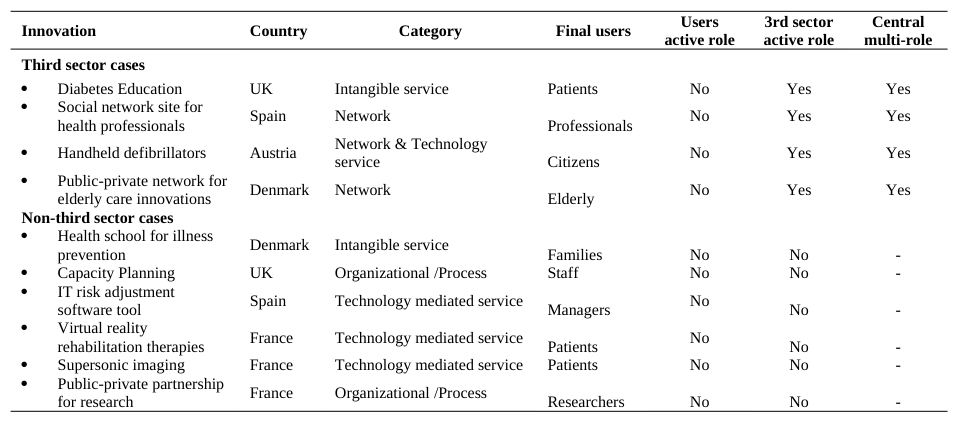
AN ILUSTRATION: THE ROLE OF THIRD SECTOR IN PUBLIC- PRIVATE INNOVATION NETWORKS IN HEALTH The presented framework has been preliminary tested in a set of 16 case studies carried out in the Servppin project on public-private innovation networks (Gallouj et al., 2013). These case studies provide a micro-perspective on the emergence of innovation networks over their life cycles and can give insight into drivers, actor configurations and critical events of their evolution over time. The case studies were carried out in seven different countries. A common research framework was developed for the selection and implementation of the case studies (Weber et al., 2008). Another major feature of the project has been the development of a common set of Operational Research Questions for all case studies (Green, 2008). The case studies in Health particularly focused on the role of the third sector organization in public-private innovation networks, so this is useful to illustrate the multi agent framework in which third sector takes a relevant role. However some of the selected case studies do not involve a direct participation of the third sector. This is useful, as “control sample”, to compare those service innovations with a third sector role against those service innovations with no third sector role. Table 1 provides information, for each case study, of the country in which the innovation network is located, the category of innovation produced and role of users and third sectors. In particular, it shows whether the network contains third sector organizations, and whether a third sector organization played a central role in the formation and management of the network as both beneficiaries and active co-producers (multi-role). It also shows the final users of the innovations and the role played by the final users.
Table1: Description of cases by country, innovation category and roles of final users and third sector Innovation Country Category Final users Users active role 3rd sector active role Central multi-role
The case studies can be briefly described as follows (for more details see Windrum, 2013). The UK study of capacity planning concerns the implementation and embedding of a capacity planning process within a primary care trust. The trust brought in expertise from a private sector business and together they co-produced an IT-based planning system. This provides the information needed to cost services, which is essential for higher level managers in their negotiations with NHS groups that purchase services. The information is also useful for line managers to more effectively structure their resources and services. The Danish case study of a health school for illness prevention involves collaboration between a private sector healthcare and a local municipality. The health school is dedicated to the prevention of illnesses through the development of patient-centred health. The French public-private partnership for research is an organizational innovation between a private sector pharmaceutical company, CNRS (National Centre for Scientific Research), and a public sector research laboratory. It addresses the complex rules that demarcate public and private sector funding and research activities in France, in order to develop research programmes that are of mutual interest and benefit to the partners. The remaining three case studies involve information and communication technologies. A Spanish IT risk adjustment software tool is designed to manage budgets for pharmaceutical expenditure. This promises to better support regional health authorities to allocate budget resources for pharmaceutical expenditure. The French case study of rehabilitation therapies involves the development and application of new therapies using interactive 3D technology (Virtual Reality). The key to their clinical success is the service innovation - the way to approach the therapy for the patient – rather than the software and peripherals that are used. Finally, the supersonic imaging case study involves the application of waves and acoustic technology to the development of new, non-destructive testing and medical imaging. This has great potential benefits in areas such as cancer.
All case studies could have been potentially useful to analyse the role of third sector, since all innovations address target communities of final users most of which are well organised through patients, professional associations or trade unions, but only four of the ten cases included third sector members. Six of the case studies do not contain a third sector member as the promoters did not consider them essential for developing the innovations. However, what is important, it was a third sector organization that played a central role in the formation and management of the network in all four third sector cases: when third sector was involved, it was really engaged.
A striking feature is the absence of end users (i.e. patients) in the health case studies. This is despite the fact that health policies in many of the countries which we studied have been encouraging greater direct patient participation in health. It is also striking given the growing academic and policy literature on the importance of user engagement in innovation. This does not appear to affect the functioning of our health ServPPINs, or be a critical factor affecting success or failure of their innovations. It may be that health practitioners’ knowledge of patients’ clinical needs and long-standing interactions with patients, plus the trialling of innovations and the advocacy role played by Third Sector partners in these ServPPINs may explain this. Therefore, the role of end-user in the model is somewhat replaced by the role of third sector organizations: they play a key role in the construction, management and leadership of health sector ServPPINs. Around half of the case studied involved a third sector organization. These are very diverse organizations, ranging from charities to not-for-profit businesses to NGOs. This level of participation was unexpected. Just as unexpected was the leadership role which these organizations take. Where present, the third sector organization was invariably the leading organization in the invention network. This result implicitly suggests that third sector can be empowered enough to undertaking innovation processes and they may be ready to also lead the process as they capitalize a major bulk communication with the final users, whether getting information from the final users members of the third sector organizations, whether disseminating the results of the innovation in a later stage.
The case studies offer additional interesting results. The majority of case studies were invention networks. These are organisational and professional networks, not social networks. They are alliances between public, private and third sector organisations and – importantly - typically contain a small number of these organisations (between 2 and 5). The presence of third sector does not make them less professional. These are goal orientated networks, with no significant distinction between third sector cases and non-third sector cases. They typically come together to develop a particular research project and, once completed, may well disband. One should therefore not mistake the ending of a ServPPIN as an indicator of a network failure. It may well be that the diffusion process requires a different set of institutional arrangements in different European countries. For example, diffusion may require enactment in law, or be embodies in the minimum specification of services by health insurance companies.
This research also highlights the importance of the composition of members belonging to a ServPPINs. There needs to be complementarities between the competences of partner organisations, and with regards to access to finance and other resources. Further, commensurability and non-rivalry is found to be a key factor where more than one partner is from the private sector or third sector. Besides, the role of public and private entrepreneurs has highlighted as a key success factor. Entrepreneurs need to hold key positions within their own organisations. This enables them to ensure long term commitment of resources and the support needed to develop the ServPPIN innovations. Furthermore, entrepreneurs need to be able to understand the different contexts and backgrounds of their partners in order to overcome the so-called ‘binary divide’ between public and private sectors. Actually, this supposed divide is really not in evidence in health. Many key participants have moved between public and private sector organizations within health, and have personal contacts in a range of public, private and third sector organizations. In this sense, social innovation in services can be considered in the framework of the multi-agent framework previously described, but also considering the mobility of people and actions between the different agents, so the multi-agent framework is also an inter-agent framework to some extent.
Finally, trust is a distinguishing feature of the health ServPPINs. In only around half of the case studies are formal contracts drawn up between partners. In part this reflects good understandings of partners and previous connections between key members. It is also due to the non-rivalrous composition of the members. Each member has different needs and interests. One may be interested in the commercial exploitation of the innovation, while another gains from the clinical benefits of using the innovation in practice. The importance of trust underlines the need of a pro- trust environment in the interactions among the different actors supporting service innovation. A certain social innovation may be required to make this service-oriented trust possible. This trust is not always possible through the involvement neither of third sector (no necessarily needed in the non-third sector cases) nor from the direct (often rare, difficult or none, as in all the analysed cases) involvement of ends users. Lack of trust towards final users and third sector can explain how many service innovation network limits the type and number of agents involved, and can become successful with no need of becoming large-multi-agent social innovations. In summary, these results suggest that i) certain substitution effects can exist between the role of third sector and final users, so the multi-agent framework can be scalable/sizable depending on the particular innovation requirements –more agents, less agents-; the professional character of innovation networks may lead to work with professional organizations representing the society more than with the direct users themselves, ii) social innovation may happen more and be more effective in professional networks than in social networks with the involvement of a large number of final users; the case studies did not consider this as an alternative option, iii) the multirole of the third sector, representing both the user coproduction and the user beneficiary role, is a way to develop social innovation in services beyond the traditional supplier-client service co-productions, so in this way the theoretical framework presented in previous section is confirmed and iv) the professional nature of innovation in services does not depend on the inclusion or not of third sector and there are not significant differences between the case studies with and without third sector: a large number of agents is not necessary for all kinds of service innovations; however once the third sector is engaged, its role become really essential.
CONCLUSIONS
Despite the research fields of service innovation and social innovation have been largely disconnected and the research trajectories have been rarely crossed, both areas deal with somewhat similar socioeconomic issues and there are multiple interconnections. This paper has proposed a comprehensive framework to set up a bridge between the two research fields. In particular, the paper has defined the concept of social innovation from a service perspective, identifying the role of services in the social innovation outcomes, inputs, processes, and areas-sectors. Services can be considered essential to develop social innovation, as has already been recognised by some scholars (Gallouj and Djellal, 2011) and international organizations such as the OECD or the EU Commission. The particular role of citizens and organizations in service oriented social innovation are outstanding. Citizens and organizations can be actors and entrepreneurs, beneficiaries and mediators of social innovations in such a way that the frontiers between suppliers and users become blurred to some extent. Service co-productions are translated into social innovation co-productions where plurilateral interactions become possible beyond the more traditional way of services co-productions between one client and one provider.
Besides, this paper has showed the inter-linkages between service and social innovation by identifying similarities and dissimilarities and the areas in which both find a joint heuristic field. The proposed field has been built on the multi-agent frameworks developed by Gallouj and Windrum, among others. A new version of this framework is proposed to cope with the social innovation. This is identified by the new role of agents being both co-producers and co-consumers of service oriented social innovation, the role of a plurality of agents, including public administrations and third sectors, and the role of citizens and organizations able to fully participate as far a certain empowerment is given. This exercise allows us to identify the value added that social innovation can bring to service innovation research, by enriching the multi-agent perspective with different social goals and actors and with a more systemic view, and vice-versa, enriching social innovation thinking by focusing social innovation on its services contents and services co-productions means for which multi-agents framework like the ones presented in the paper can be particularly useful, as the application in the health sector, in public-private innovation networks, have shown. When third sector plays a role this can be a leading role, assuming/replacing to some extent the role of citizens since the representative organizations can provide more professional behaviors and trust. This does not mean that all service innovations need to become large multi-agent social innovations: the direct engagement of citizens or third sector should not be considered the panacea of any service innovation. In any case, the future of many service innovations will be more and more linked to an active role from their side, being co-producers and the same time as beneficiaries. The extended Lancasterian model proposed in this paper deems to be appropriate to capture both the multi-role and the multi-agent dimensions of social innovations in services.
With this line of research, we want to contribute to perform a further step in theory building in social innovation and services innovation by linking the two of them, and by providing elements for the foundations of the evolutionary view of innovation, in which service innovation and social innovation are two changing interconnected elements of economic and social change. Further work in this direction is needed, to connect the evolutionary perspective of social innovation (Reinstaller 2013) with the results obtained from this research on services and social innovation.
The paper results expect to endeavour to establish a certain dialogue between these two fields of research, with mutually rewarding results for both. The fact that social innovation is often a service innovation, but also just as often (and increasingly) an innovation in services, makes this dialogue all the more desirable. In fact, the services sector is a particularly fertile ground for social innovation. This is true of market services, taking into account the density of social interactions (particularly with customers) that characterise them. It is even more evident in the case of public administrations, in which the density of these social interactions is formed in a ‘public service spirit’ based on the principles of fairness, equality of treatment and continuity. This is also true to an even greater degree for the rapidly expanding conglomeration of tertiary activities in developed economies, which are grouped under the term ‘third sector’ (social and solidarity economy).
The areas for dialogue which will be raised are the theoretical perspectives favoured, the nature of innovation and the question of its identification and measurement, its modes of organisation, its appropriation regimes and the evaluation of its impacts. However, other areas would also merit attention, in particular public policies to support social innovation and service innovation. A better understanding of social innovation in the light of service innovation and vice versa is likely to help reduce even further the hidden or invisible innovation (the innovation gap) in our economies and enable us to advance towards a new comprehensive innovation paradigm.
REFERENCES
Bornstein, D. (2004) “How To Change The World, Oxford”: Oxford University Press. Braungart, M. and McDonough, W. (2006) Cradle to Cradle: Remaking the Way We Make Things, North Point Press. den Hertog, P. (2010): Managing service innovation. Firm-level dynamic capabilities and policy options, Doctotal thesis, University of Amsterdam, The Netherlands European Commission (2011), FP7 Cooperation Work programme 2011, theme 8, Socio-economic sciences and humanities. Fontan, J .-M., Klein, J .-L., & Tremblay, D.-G. (2004). Collective action in local development. Canadian Journal of Urban
Research, 13(2), 317—36. Fontan, J.-M., J.-L. Klein and D.-G. Tremblay (2005) Innovation socioterritoriale et reconversion économique. Le cas de Montréal, Paris: L'Harmattan Gallouj F. (1994), Economie de l'innovation dans les services, Editions L'Harmattan, Logiques économiques, Paris. Gallouj F. (2002), Innovation in the service economy: the new wealth of nations, Edward Elgar Publishing, Cheltenham. Gallouj F. and Weinstein O. (1997), Innovation in Services, Research Policy, Vol. 26, n°4-5, p. 537-556. Gallouj F., Djellal F. (eds) (2010), The Handbook of Innovation and Services: a multidisciplinary perspective, Edward Elgar. Gallouj F., Rubalcaba L. Windrum P. (2013), Public Private Innovation Networks in Services, Edward Elgar. Gershuny J. (1978), After industrial society? the emerging self-service economy, Mac Millan. Gershuny J. (1983), Social innovation and the division of labour, Oxford University Press. Greenhalgh, T., Glenn, R., MacFarlane, F., Bate, P., & Kyriakidou, O. 2004, "Diffusion of innovations in service organisations:
systematic review of recommendations", Millbank Quarterly, vol. 82, no. 4, pp. 581-629. Harrisson, D., Klein, J-L. and Browne, P.L. (2010): Social innovation, social enterprise and services, in Gallouj, F. and Djellal, F. (eds.): The Handbook of Innovation and Services, Cheltenham and Northampton: Edward Elgar. Hyytinen, K., Määttä, H., Väisänen, L. & Rubalcaba, L. (2013) 'Innovation in Health Care Systems: a service and social
innovation approach', RESER Conference, Aix-en-Provence, France, September 2013 Lancaster, K.J. (1966), A new approach to consumer theory. Journal of Political Economy, 74 (2), 132–157. Moulaert F., Martinelli F., Swyngedouw E. and Gonzalez S. (2005), Toward Alternative Model(s) of Local Innovation, Urban Studies, 42 (11), 1969-1990. Mulgan G., Tucker S., Rushanara A., Sanders B. (2007), Social innovation: what it is, why it matters and how it can be
accelerated, Skoll centre for social entrepreneurship, Oxford Said Business school, The Young Foundation. Normann R. (1984), Service management: strategy and leadership in service business, John Wiley and sons. OECD LEED Forum on Social Innovations (2000) http://www.oecd.org/cfe/leed/leedforumonsocialinnovations.htm Pol, E. and Ville, S. (2009) Social innovation: Buzz word or enduring term? Journal of Socio-Economics 38, 878–885. Rubalcaba, L., Michel, S., Sundbo, J., Brown, S.W., Reynoso, J. (2012) "Shaping, organizing, and rethinking service innovation: a multidimensional framework", Journal of Service Management, Vol. 23 Iss: 5, pp.696 - 715 Sen, A. (1999) Development as Freedom, Oxford: Oxford University Press. Stiglitz, J.E., Sen, A. and Fitoussi J.P. (2009) Report by the Commission on the Measurement of Economic Performance and
Social Progress, Available at: http://www.stiglitz-sen-fitoussi.fr/documents/rapport_anglais.pdf Tepsie (2013) Theoretical, Empirical and Policy Foundations for Social Innovation in Europe (TEPSIE) http://www.tepsie.eu/ Toivonen, M. (2010): ‘Different types of innovation processes in services and their organisational implications’, in Gallouj, F.
and Djellal, F. (eds.): The Handbook of Innovation and Services, Cheltenham and Northampton: Edward Elgar. Van der Have, R. and Rubalcaba, L. (2013) Social innovation: a bibliometric approach. RESER Conference, Aix-en-Provence, France, September 2013 Vargo S. and Lusch R.. (2004): ‘Evolving to a new dominant logic for marketing’, Journal of Marketing, 68 (1), 1-17. Vargo, S. and Lusch, R. (2008): ‘Service-dominant logic: continuing the evolution’, Journal of the Academy of Marketing
Science, 36 (1), 1–10. Windrum P., Garçia-Goni M. (2008), A neo-Schumpeterian model of health services innovation, Research Policy, 37 (4), 649-
672. Windrum P., Koch P. (ed.) (2007), Innovation in Public Sector Services – Entrepreneurship, Creativity and Management, Cheltenham UK, Northhampton MA, USA, Edward Elgar. Windrum, P. (2013) The co-production of health innovations. In Gallouj, Rubalcaba and Windrum (Eds) Public-private
innovation in services. Edward Elgar.
LISTED IN THE AHFE DIGITAL BOOKSTORE CATALOGUE
Explore the complete digital volume
Advances in The Human Side of Service Engineering
Read this individual research paper free through the original publisher, or explore the full digital proceedings book.
ISBN 978-1-4951-2091-6
Explore this ISBN in the AHFE Bookstore ↗Listed in the July 2026 bookstore catalogue; search by ISBN to confirm current availability · Digital book purchase optional