Hannamaija Määttä, Sampsa Ruutu, Marja Toivonen (2019). Revealing the Complexities of Health Care Renewal: a System Dynamics Approach. In: Advances in The Human Side of Service Engineering. AHFE Open Access, vol. 8. https://doi.org/10.54941/ahfe100300
Health care systems are under significant development pressure due to the ageing of population and the problems of public financing. As an answer, a new model of chronic care, and integrated care programs based on it, has been applied in several countries. These renewals have a systemic focus: they aim at simultaneously developing organizations, technologies, services, and partner relationships. Empowerment of citizens and multidisciplinary collaboration among professionals play central roles in them. This paper examines the challenge of combining the system view with the multiple operational improvements that are needed at the practical level when the chronic care model is implemented. Using an empirical case from Finland and the method of system dynamics modeling, we show that established routines are not easy to break down even though the organization is committed to change, set clear goals and concretized their content. Paying attention to the complex causal relations and feedback s typical of human systems is necessary in order to make the multiple changes to strengthen each other. Recognizing the most crucial points that foster either “a vicious or a virtuous circle” in care processes, and analyzing them in terms of influential factors, supports the raising of awareness and facilitates changes.
The health care sector in Western countries is facing significant challenges. Along with the ageing of population, there is a growing demand for health services while the public resources to maintain and develop these services are diminishing (Dunston et al., 2009). On the other hand, the development of technologies provides new opportunities, not only for the solution of medical issues, but also for the introduction of new collaboration practices that increase the efficiency and effectiveness in healthcare, i.e. reduce the costs and improve the results. These practices include both the professional – patient interaction and the inter-organizational and cross-functional interaction among service providers.
In addition to the changes in population structure and the advancements of technology, two other factors drive the development in healthcare. One is the discourse on the role of professions and the other is the paradigm which forms the framework for the public service provision. These two factors are interrelated in the current strivings for the renewal of healthcare. The paradigm behind public services is important because in most countries the state and local authorities are more or less the organizers and funders of healthcare. The role of professions has traditionally been very strong in healthcare: interaction has been based on knowledge asymmetry highlighting the position of doctors (and to some extent nurses) over patients (Alvesson, 2004; Löwendahl et al., 2001). Also the renewal of healthcare was for long understood as the adoption of new medical tools and drugs (Djellal and Gallouj, 2008). These views, together with the paradigm that understood public sector in terms of top-down policy activities, were dominant until the so-called ‘New Public Management (NPM)’ gained influence in the 1980s (Hartley, 2005; Hess and Adams, 2007; Windrum, 2008). NPM has introduced market mechanisms to the public context: business-type management, lean processes, performance focus, and contracting-out. One of the most important ideas has been handling the patients as customers who have the right to require high service quality (Langergaard, 2011).
The benefits of NPM are indisputable compared to the earlier bureaucratic view that provided users with very restricted opportunities of influencing. On the other hand, the limits of NPM have become apparent along with the development towards increasingly complex issues, multiple actors and need for open dialogue (Sørensen, 2002). Consequently, while NPM is still the dominant public paradigm, there is a new paradigm emerging: so-called ‘network governance’. It highlights relationships and partnerships, and co-production as the service model (Newman and Clarke, 2009). For the professional practice in public services, it means additional challenges because efficient in-house processes are no more sufficient but the crucial issue is the empowerment of citizens.
Within the health care sector, the current renewal of chronic care reflects a transition from NPM to network governance. So-called integrated care programs have brought to the fore patient support and education, combined with structured clinical follow-up and case management; a multidisciplinary patient care team; multidisciplinary clinical pathways and feedback, reminders, and education for professionals (Ouwens et al., 2005).These programs, carried out in various countries, are based on the chronic care model (CCM) developed to improve the management of chronic illnesses through six cornerstones: utilizing community resources, developing health organizations, investing in self-management support, redesigning service delivery, employing decision support for professionals and utilizing clinical information systems. Segmenting the chronic patients according to the intensity of care needs is a part of the model. A three-group division – so-called Kaiser Permanente Triangle – is typical and consists of patients with multiple diseases, patients with high risks, and patients with a self-manageable disease (Bodenheimer et al., 2002).
CCM, together with the integrated care programs based on it, differs in several respects from the models of acute care and the expert -led health systems that have been dominant earlier: they are patient-centered (not sickness- centered), their focus is on planned, proactive care (not only on the acute, reactive care) and they provide support to the patient (not only diagnostic information). Patients are empowered by treating them as experts of their own health and as partners in healthcare, and this is eventually expected to ease economic constrains in the health care sector (Coulter, 1999). An important insight in the circumstances of ageing population is that the quality of life can be high even when a person has a chronic disease. Health does not only mean the absence of disease, but it includes capability to cope and function with everyday physical, emotional and social challenges (Huber et al., 2011).
Based on the above-described views, several studies have examined how the health systems could be rebalanced from addressing the treatment of acute illness to promoting health, and how the citizens themselves could be engaged in the latter task. Traditionally, studies on health services have focused on hospitals and specialized care, but the new integrated care programs have stimulated interest in the systems of primary care (Dunston et al., 2009). There is also active research focusing on the micro-level interactions in healthcare: service encounters and prerequisites for success in them. However, these two approaches have usually developed apart from each other. Systemic renewals are analyzed at quite a general level and their practical implementation as a series of individual improvements without a link to the whole. Thus, we have recognized a need for research that would integrate the system level and practice level analyses in the healthcare renewal – more specifically, in the adoption of CCM and the new integrated programs. We aim to contribute to the fulfillment of this need in the present paper.
From the theoretical standpoint, our approach requires a combination of innovation theories, system views and a framework on service development. We apply the central arguments and findings of social innovation which is closely linked to the idea of system innovation. For a more detailed understanding of the activities and relationships in healthcare, we apply the propositions of service-dominant logic (SDL). This framework is particularly suitable to our purposes because it highlights the role of customer as the co-creator of value and takes into account the broader actor network surrounding the provider-customer dyad (Vargo and Lusch, 2011). In the empirical part of the paper, we examine the application of the chronic care model in a middle-sized city in Finland. The context of transformation is the whole primary care system in this city. The methodology with which we examine the implementation of the transformation is system dynamics modelling.
We have structured our paper as follows. In the second section, we discuss the theoretical frameworks that form the starting point in our study: social and system innovations, and service-dominant logic (SDL). The third section presents our empirical research context and the methods of data collection; here we also describe the dynamic modelling technique. The fourth section summarizes the results and the final section includes concluding discussion.
THEORETICAL BACKGROUND System innovations as answers to broad social problems
In the introduction, we argued that the new chronic care model and the integrated care programs reflect a broader paradigmatic change: transition towards Network Governance. This new paradigm highlights the growing role of self-organizing networks that involve different stakeholders from private, public and voluntary sectors. Partnerships and networks – which can also involve individual citizens – are increasingly the locus for innovation, because they provide evolutionary advantages for learning in a complex and changing environment (Hartley, 2005; Langergaard, 2011). These arguments are very near to the ideas of the nature of social innovation, which is a new topic gaining ground in service innovation literature.
In this context, the concept ’social’ includes two aspects. First, complex economic and social problems form the starting point for innovation endeavors (Rubalcaba et al., 2013). Social innovations are sought for a wide range of issues in different realms of society: community infrastructures, housing, healthcare, education etc. (Moulaert et al. 2005). The outcomes usually include service innovations, but the sources, goals, actors and activities extend outside the provider-customer dyad. New ways of interacting are an important ingredient in the novelties created (Harrison et al., 2010). The second aspect of ‘social’ is the participatory processes which are necessary for the creation of innovations in a multi-agent environment. Social innovations may emerge at the grassroots level among users and employees; be produced by private, public and third sector organizations; or be initiated by policy and regulatory bodies. In all cases, it is essential to integrate bottom-up and top-down processes (Rubalcaba et al., 2013).
Bottom-up grassroots activities constitute an ‘engine of social innovations’ and are linked to user-driven and employee-driven approaches in innovation (cf. Sundbo and Toivonen, 2011). The creation and implementation of social innovations highlights empowerment: citizens are not passive recipients, but active co-developers (Harrison et al., 2010). On the other hand, also top-down activities are necessary for the materialization and dissemination of social innovations. They are needed both at the organizational and community levels and at the level of policies and regulations. Decision makers and managers have to support and organize bottom-up processes in order to make ideas implementable and scalable (Høyrup, 2010).
Social innovations are often systemic in nature. A system innovation is based on the simultaneous development of organizations, technologies, services, and multiple network and partner relationships. Systemic problems cannot be identified directly because systems involve several characteristics that make them counter-intuitive. The following features are important to take into account in particular (Sterman, 2001):
- Systems are tightly coupled, i.e. the actors interact with another and with the outside world. Feedback is a central characteristic of systems: decisions of the actors trigger others to act, which again alters the next decisions of the original actors. - The central position of feedback makes systems history-dependent: taking one path precludes many others. - Systems are non-linear, i.e. effect is not proportional to cause. It is also difficult to identify immediate cause- effect relationships – instead of that cause and effect are often distant in space and time. - Systems are constantly changing at many scales that interact. They are also self-organizing and adapting: small, random perturbations are often amplified by feedback, and capabilities of actors change as a result of learning. - Systems are policy-resistant: the complexity makes it difficult to understand the system and as a result many seemingly obvious solutions to problems fail. Time delays in feedback often mean that long-run response of the system is different from the short-run.
Even though systemic problems cannot be observed directly, they manifest themselves in various practical problems that can be analyzed in order to understand the underlying dynamic complexities. Figure 1 illustrates how the interaction between practical and conceptual levels can be used in the search for solutions to systemic problems. The first task is to identify obvious problems (quadrant 1), and then to move to the conceptual level in order to uncover the invisible systemic contradictions that give rise to the problems (quadrant 2). Thereafter new forms of activities can be designed at the conceptual level (quadrant 3), and finally they can be tested and implemented in the form of new concrete actions (quadrant 4).
Figure 1: Solving systemic problems via the interaction between practical and conceptual levels (source: Hill et al., 2007; adapted from Seppänen, 2000; Botha et al., 2002)
Figure available in the original PDF paper.
This kind of a renewal process requires – in addition to awareness raising – efficient analysis tools with which the complex issues can be illustrated holistically enough (Kivisaari et al., 2013). Before presenting the methodology of system dynamics modelling, which we believe to be a suitable tool in this context, we briefly explain why we consider it important to supplement the systemic view with the basic principles of service-dominant logic (SDL).
Service-dominant logic as an approach to highlight the co-creation of value The need for moving from observable problems to the conceptual, systemic contradictions is increasingly accepted today. The way in which the transfer is carried out in practice depends, however, on the basic assumptions concerning the nature of the system. In the healthcare context, this means that we have to make explicit our theoretical understanding about the nature of service relationships and service processes. In this paper, we argue that a service system applying the principles of network governance and integrated care can be most successfully developed on the basis of service-dominant logic (SDL). This approach developed by Vargo and Lusch (2004, 2011) defines ‘service’ as the process of using one’s competences (knowledge and skills) for the benefit of another party. Individual services, as well goods, are conveyors of competences, i.e. vehicles for service provision. They represent temporal cross-sections in more complex and timeless value-creation that is a core phenomenon in society.
SDL highlights that value is collaboratively co-created between the provider and the beneficiary (user). It is not inherent in goods and individual services – not created by the provider and distributed to users. The active role of users comes clearly out when the necessity of resource integration is brought to the fore. Before value can be realized, the input from a single provider has to be integrated with other resources, some of which are obtained through the market and others based on private or public sources. The importance of this integration extends the conceptualization of value creation from the focal actors – the provider and the user – to the broader context of actor network (Vargo, 2009).
SDL includes several implications for the development of healthcare systems. The reciprocal nature of the interaction between providers and users implies that patients are not targets but function as active agents and a resource in service provision. A central task of the provider is to support the users in their own value-creation process (resource integration). This process does not take place in isolation, but the social context plays an important role in the determination of service value. The phenomenological side of value is essential: actors make sense and determine the value experientially and the experience is holistic in nature: the service and its tangible elements together create the overall experience.
Co-creation of value is linked to co-production that has been a common observation among service researchers and refers to the customer’s participation in the production process of a service through the conduct of some specific tasks (e.g. Sundbo and Gallouj, 2000). Co-production is also an important phenomenon, but is more optional and depends on the conditions of the provider and the customer. Deviating from that, value co-creation is ubiquitous: the user is always involved through resource integration and contextual experience. It is important to point out that the value focus does not mean the neglect of the design of individual services (Ramaswamy, 2011) – as mentioned before, even the broad social and system innovations usually manifest themselves as new or improved services.
CONTEXT, SCOPE AND METHODOLOGY OF THE STUDY Context and scope of the study
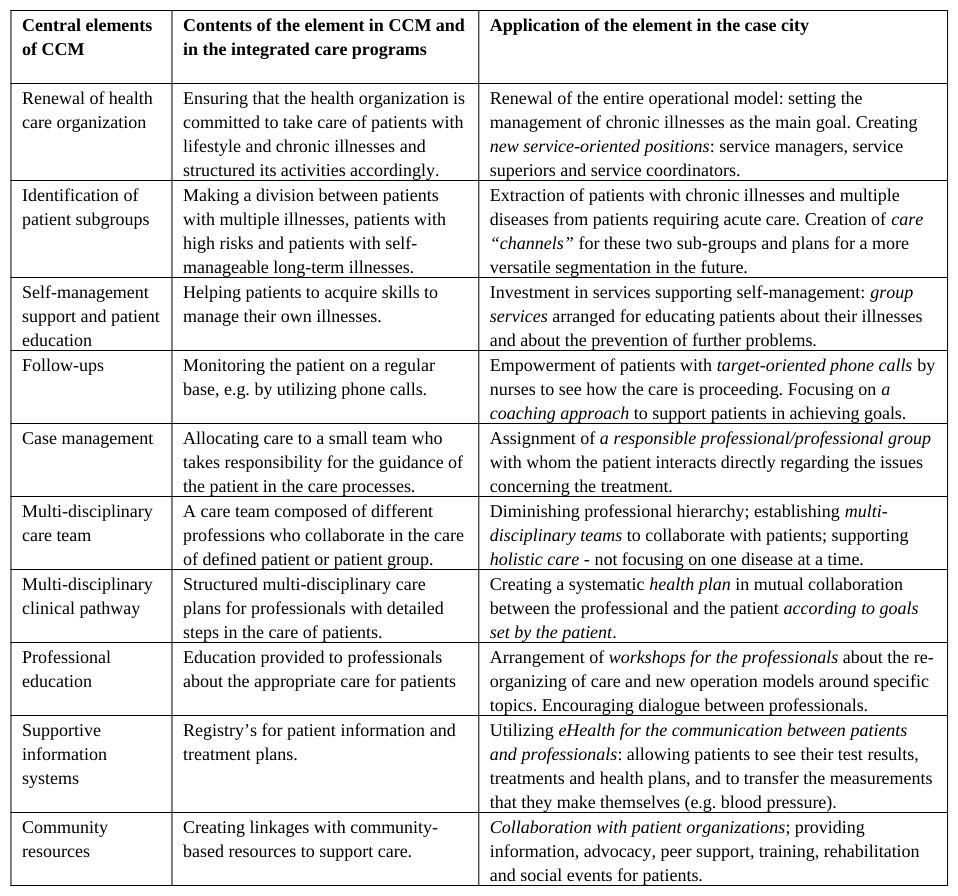
The empirical study analyzed in this paper has been carried out in Finland, where the biggest provider of health services is the public sector (the private sector accounts for roughly 10% of these services). Primary services are provided by health care centers owned by municipalities and specialized services by regional hospital districts owned by municipality associations. The public system is guided by laws. (Kivisaari et al., 2013) Our study focuses on the renewal of primary health care system in a middle-sized city of approximately 67 000 inhabitants. The renewal has been going on since 2010 and is linked to a broader national exercise for social welfare and health care. However, the city’s health organization has been exceptionally active in learning about the newest developments of the CCM model and integrated care programs and in testing them in practice. Table 1 summarizes the way in which the central elements of CCM have been applied and concretized in this city.
Table 1: The application of CCM in our case (CCM based on Bodenheimer et al., 2002 and Ouwens et al., 2005)
The table shows that our case city is applying the idea of interaction between practical and system levels in their renewal exercise (cf. Figure 1). After the identification of the visible problems of the long queues, multiple patient visits, dispersed information and high costs, they have moved to analyze the systemic contradictions included. In line with the background problems identified in CCM, they have found out that also their own operational model has been characterized by the reactive way of working, sickness-centered view and the lack of cross-professional interaction. Based on this observation, they have started to develop a new conceptual model that relies on integrated care programs applied in other countries. Three goals for the transformation have been set: 1) improving the availability of services to citizens, 2) providing better health impact, and 3) improving productivity by reducing resources used per patient. These goals guide the change of the operational model: the organization, the delivery of services, the management model, ICT systems and partner relationships. In the implementation, central focus is on the empowerment of citizens and on the replacement of hierarchical processes with user-based service practices. As the table shows, our case organization has been able to concretize their goals in a way, which not only reflects the basic ideas of CCM, but also includes new creative applications.
Data collection and analysis – system dynamics modelling Our empirical material has been gathered via three methods: observation, action research and interviews. The observations and action research took place in the meetings of two management teams responsible for the renewal. Three researchers working in pairs observed these meetings weekly between February and June 2013. The meetings lasted for three hours. During the first two months, observation was conducted without any participatory actions to get an overall view of the on-going process. Thereafter an action research approach was adopted: the researchers participated in the teams’ conversations and asked specifying questions related to the systemic change and to the search for solutions (cf. Berg, 2004). The material was further supported by thematic face-to-face interviews with the team members; these interviews (16 in total) were conducted in June and July 2013. The interviews were recorded and transcribed, whereas the observations were collected in hand-written field notes.
In the analysis of data, we first used traditional qualitative methodologies to sum up our central findings. Thereafter we moved to system dynamics modeling, and it is this part of our analysis which we report in the present paper. System dynamics models are formal and structural models, which incorporate hypotheses about causal connections between phenomena. The behavior of a particular system is explained endogenously as a manifestation of the structure of the system. The emphasis is on understanding the dynamics of the system (behavior over time) that results from interactions between the parts of the system – including reinforcing and balancing feedback loops. In November 2013, we presented the modeling method to the representatives of our case city and discussed about a suitable focus for its application. Instead of trying to model the entire renewal process, we decided to start from more specific questions. A crucial question identified together with our case representatives was how the work practices in the system influence patient flows, i.e. how the long queues can be shortened and the availability of services improved in practice. Thus, we set two research questions for the modeling:
1) What kinds of systemic problems do the reactive and expert-centered work practices cause in a primary health care system regarding the aim to foster efficient and effective patient flows? 2) What factors promote and prevent the adoption of interactive and empowering work practices in critical points of the service system?
In December we organized a modelling workshop with the case organization (about 20 participants). Because of the tight schedule in the workshop, we used as the starting point a preliminary stock and flow model that was prepared in advance with a smaller group (three people) of the organization. The results of the modeling workshop were summarized in a model workbook (Vennix, 1996). Three further workshops within a smaller group were held in January and February 2014, which focused on specific questions identified in the modeling workshop.
RESEARCH RESULTS Our case organization has recognized that moving away from the traditional expert-led health system and creating a system that supports the empowerment of patients is a necessity. It has adopted the principles of CCM and integrated care and concretized them at the practical level. However, the advancement has not been straightforward. The most central problem is the slow generalization of planned care that also includes new types of solutions.
Guiding the patients to visit a doctor still dominate. The patients usually ask for an appointment and because there is constant hurry, the personnel very often react as before: fix a visit date without considering whether this is the service that answers the need of the patient in the best possible way. This means that waiting times in the queue before the appointment continue to be quite long. Further, because the number of appointments does not diminish, the time devoted to an individual patient in the face-to-face contact is too short to allow planned care that could take into account the patient’s situation holistically enough. As a result, the problems of patients recur and many patients even contact the system again during the waiting time, i.e. the same basic group of patients circulates in the system.
Our case organization is well aware of these problems and has implemented several concrete practices aiming to cut down “the vicious circle”. The first contact to the health center usually takes place via phone call and in order to manage the high number of calls and reduce the patient’s waiting time on the phone, a call center and the “call- back” system have been adopted. However, these centralized systems do not mean routinizing the contacts with patients, but the purpose is to assess the patient’s care needs systematically (this assessment is also carried out when a patient comes to the reception). If the assessment is successful, a considerable part of patients should find their way to lighter service forms: self-management supported with eHealth and target-oriented phone calls from professionals, and/or group services. Adopting this approach has begun, but it is not yet an established way of working. Also the systematic use of health plans on the basis of goals set by the patient is at an early stage.
Figure 2 illustrates the above described problems with a system dynamics model. The model depicts the flow of patients and shows different feedback loops in the system: the longer the appointment queues are, the more pressure there is to shorten the average length of appointments (balancing feedback B1). However, shortening the appointment time affects negatively the quality of care, and patients may develop new symptoms faster after the appointment (reinforcing feedback R2). Shortening appointment lengths also affects negatively the degree of planning of follow-up care. Due to this, too few patients are guided to lighter services after the appointments and more are given a traditional appointment time (reinforcing feedback R2).
New symptoms after
- R1 appointments New symptoms Average length of -
+ appointments
B1 -
Degree of planning of
Change in appointment duration
follow-up care People who have
People waiting for
People waiting for need-of-care
appointments Guiding wew patients
been to an appointment Appointments
assessment to appointments
R2 + Planning
New symptoms while in lighter service forms People who get a new
Guiding patients to lighter
appointment time
service forms after appointments
People in lighter service forms Guiding new patients to non-appointment services
Figure 2: Model of patient flows in the primary care system of the case organization The model is not exhaustive but shows how different parts of the system are interlinked and influence each other. Currently, the reinforcing feedback loops (R1 and R2) operate as vicious circles, but it is possible to turn them into virtuous cycles. Based on our study, we argue that this change requires paying attention to two occasions in particular: the need-of-care-assessment point and the actual appointment to doctors or nurses. These two situations are critical from the viewpoint of the promotion of lighter services and the creation of systematic health plans. The former is the first contact point with the patient and the latter is important due to its traditionally central role. To understand how the system could be developed further, we open up the factors affecting these points. In Figure 3, we first model the need-of-care assessment point, where we have identified two main groups of crucial factors: 1) the quality of the assessment and 2) the willingness of personnel and patients to utilize lighter services.
Figure available in the original PDF paper.
(A) Quality of need-of-care assessment Clarity of information
Clarity of earlier patient information
Solution to patients' problems during phone
from patient
conversations -
Directing patients
Pressure to finish need-of-care assessment
+ + +
appointments
rapidly Doctor consultations in
+
-
+
difficult situations
+
+
Old habits
Quality of need-of-care assessment
Identification of patients requiring systematic health plans
Average time per + -
+
phone call Patient queue to
Guidance to lighter
-
service forms
need-of-care assessment + Telling customers to call again after appointments
(B) Personnel’s willingness to guide patient to lighter services and the patients’ willingness to use them Marketing of new
Traditional views services of health
Old habits
- +
-
Visibility of systematic health plans to customers Customer knowledge +
+
Short term work
of earlier plans + Patient willingness to use lighter service forms + Guidance to lighter
Availability of previous systematic health plans pressure -
service forms +
-
Personnel willingness to
Reactive mindset
+ guide patients to lighter Personnel willingness to service forms + open systematic health + +
plans New guidelines
Information about the importance and benefits of lighter service forms
Figure 3: Factors affecting guidance to lighter services from the point of need-of-care assessment
Figure available in the original PDF paper.
The quality of need-of-care assessment is influenced by the clarity of information given by the patients about their conditions, the clarity of documented patient information (e.g. previous health plans and notes made on the basis of earlier patient visits), and the possibility to consult a specialist in the situations where a care path is difficult to determine. Old habits and the feeling of pressure to finish the assessment rapidly instead of a more thorough evaluation of the situation affect the quality of the assessment negatively. Guiding customers to call back after appointments increases the patient queues to the need-of-care assessment, and reduces the time available for making target-oriented phone calls and thorough assessment of care needs. The willingness of personnel to guide patients to utilize lighter service forms is influenced by the availability of information about the importance and benefits of these services, new and clear guidelines and the personnel’s willingness to examine previous health plans of patients as a starting point for determining the suitable care path. The willingness of patients to use lighter service forms is also a relevant factor. It is influenced by traditional views of health care, meaning that many patients expect to get an appointment to a doctor, even if their service need would not require it.
Failing to guide patients to lighter services at the need-of-care assessment point can still be corrected during the appointments to doctors or nurses. Move to lighter service forms can also be suggested and decided at this stage. This, however, requires changes in various factors affecting the appointment practices. The main factors that were identified in our study are the personnel’s and patients’ preparation for appointments, the quality of communication and interaction during the appointment and the support provided to patients in defining future targets (a systematic health plan). Figure 4 presents these factors in more detail.
(A) Personnel preparation for appointments
+
+
Availability of previous systematic health plans
Adequacy of length of Resource availability for
+ Opportunity to use short
+
appointments in routine
appointments longer consultations
situations Personnel preparation
Availability of information for
+
personnel before
Time to interact
for appointments + appointments
with patients +
+
Availability of measurement results in e-health service
(B) Patient preparation for appointments Availability of measurement results in
e-health service Opportunity for patients to use information in advance +
Patient preparations
+
for appointments +
Corrrect specification of targets for appointments +
Visibility of health plans to customers +
Availability of previous systematic health plans
+ Patients' attitudes towards preparing for appointments Prejudices based
- on rumors
(C) Quality of communication and interaction
Availability of information for personnel before appointments Time to interact
+
with patients
Correct indentification
+
+ Correct specification of targets for appointments
of service need
-
+
Quality of communication and
Prejudices based
Emergence of common interaction
on rumors
understanding + +
+ Personnel readiness to
Personnel prejudices
use patients' initiative -
towards laypeople + Personnel knowledge of
Personnel capability to use the language of the
customer process New guidelines +
customer
(D) Support for patients in defining future targets in systematic health plan Adequacy of length of
appointments
Correct identification
Patients whose acute +
of service need
problems have been treated +
- -
Emergence of common +
Need for new appointments
understanding + Support for patients in defining
-
Patients in coordinated care +
+
New guidelines
future targets in systematic
Patients using lighter health plan
+
+ service forms
+ Personnel solution-centred + Personnel knowledge of approach
+
customer process
Patient readiness to use lighter service forms
Clear information for patients of next steps
Figure 4: Factors affecting the degree of planning of coordinated care after appointments
Figure available in the original PDF paper.
The way in which the doctors and nurses are prepared for the face-to-face interaction with the patient is the first factor that influences the success of appointment from the viewpoint of the new goals of care. The availability of relevant patient information is a prerequisite for a good preparation, but it is also important that there is time for this task and the task is seen as a significant stage in the care process. Along with the new empowering practices, the preparation of the patient becomes increasingly important. The experts’ attitude towards the active role of the patient is crucial and is “a test” of their ability to give up part of the power that has earlier been linked to their position. For instance, the use of eHealth systems by the patients should be noted in an appreciative way. Prejudices of both parties have thus great effect on the quality of communication and interaction during the appointment. The limited time during appointments sets additional challenges for facilitation, negotiation and shared decision making, and having a solution-centered approach to care and the ability to use the language of the patient are crucial in creating a mutual understanding of the service need and care paths. Providing information and expertise is not enough; it is also important to ensure that doctors and nurses have sufficient knowledge on customer processes in order to engage patients in the planning of the care. New guidelines are needed to support this patient – doctor/nurse interaction, which should result in coordinated care and patients with systematic health plans supported by lighter service forms.
Opening up the two critical points in the care process shows that the move of emphasis towards new forms of care is highly dependent on factors linked to human behavior and interaction. The roles and responsibilities of patients and the health care professionals need to be rethought, which requires a cultural change of mindset towards the entire health care provision. Prejudices, prevailing attitudes, routines and the power of professions are aspects that change slowly, which needs to be taken into consideration in developing the health systems. Informational aspects become increasingly important as well, and the development of ICT systems brings solutions to the changing nature of interaction and availability of information in health care.
CONCLUSIONS
This paper has examined the challenge of combining the system view with the multiple operational improvements that are needed at the practical level when the chronic care model (CCM) is implemented in primary health care. CCM and integrated care programs based on it have been adopted in several countries as an answer to the challenge of ageing population and the problems of public financing. These models and programs also reflect a broader transition from the paradigm of New Public Management (NPM) to network governance. Central elements in the renewals are the empowerment of patients, increasing cross-disciplinary collaboration among professionals and effective use of the new information technology systems.
Traditionally, studies on health services have focused on hospitals and specialized care, but the new integrated care programs have stimulated interest in the systems of primary care (Dunston et al., 2009). There has also been active research focusing on the micro-level interactions in healthcare: service encounters and prerequisites for success in them. However, these two approaches have usually developed apart from each other; systemic renewals have been analyzed at a quite general level and their practical implementation as a series of individual improvements without a link to the whole. Thus, we recognized a need for research that would integrate the system level and practice level analyses in the healthcare renewal – more specifically, in the adoption of CCM and the new integrated programs, which have been the starting point of our paper.
The theoretical background in our study consists of three perspectives: social innovation, system innovation and service-dominant logic (SDL). The concept of social innovation is relevant for our study because it highlights participatory processes, empowerment of citizens and the integration of bottom-up and top-down processes. The concept of system innovation is in the core of our interest due to its multi-agent approach, analysis on complexities of human systems and emphasis on the simultaneous development of organizations, technologies, services, and partner relationships. Our contribution is in combining these perspectives, and particularly in linking them to SDL that as a marketing oriented approach has developed apart from innovation theories. However, SDL is tightly linked to the strivings that characterize the current development of healthcare: it has brought to the fore reciprocal nature of value creation between the providers and users, which in the health context implies that patients are not targets but function as active agents and a resource in service provision.
We have carried out an empirical case study in Finland to gain more insight on the challenges in implementing integrated care models based on the principals of CCM. We examined the renewal of primary care in a middle-sized city and its applications of the models. With the method of system dynamics modeling, we have shown that established routines are not easy to break down even though the organization has committed to change, set clear goals and concretized their content. Paying attention to the complex causal relations and feedbacks typical of human systems is necessary in order to make the multiple changes to strengthen each other. Recognizing the most crucial points that foster either “a vicious or a virtuous circle” in care processes, and analyzing them in terms of influential factors, supports the raising of awareness and facilitates changes. With the system dynamics models we created, we were able to illustrate the interconnections and feedbacks of two points critical in managing patient flows in a service system. Our results show how a traditional reactive and expert-centered approach to customer processes creates a vicious circle within the primary care overburdened by the increasing numbers of new patients and patients returning to the system. Our model was complemented with a more detailed level of causal diagrams of specific factors affecting the critical points in the system. Guiding patients to utilize lighter service forms that support self- management and investing in planning and coordination of care after appointments are concrete actions expected to solve the challenges. Our results highlight that factors linked to human behavior and interaction are at the center of adopting these new forms of care and care processes. One of the major challenges is the cultural mindset change in patient – doctor/nurse relationship, which requires a reformation of power distribution in the care process. This requires a shift in the professional identity from being a nurturing expert to becoming a coaching partner. The willingness and attitudes of both the patients and the health professionals are crucial factors in adopting new practices, and greatly influenced by prevailing attitudes and values that are not easily changed. The results indicate that adopting new practices also requires new skills of facilitation, negotiation, synthesizing information and utilization of patients’ own initiatives in creating systematic health plans that form the basis for the care. The availability of information and the possibility to prepare for the care is a significant development, as the patients have the possibility to access and utilize their own health information. Our results thus implicate the importance of support, guidelines and education for health professionals as well as for patients in adopting the new forms of care.
Our study has served as a starting point for unveiling the complexities within service systems, and will support managerial decision-making on subsequent steps for the transformation and critical points for development. We limited the modelling method we used to illustrate the interconnections within a complex health care system and but did not examine how the system would behave if certain factors were changed. Thus, further research should focus on developing the models by utilizing simulation, which can help in understanding potential leverage points, that is, the areas of the system in which even small changes generate sustainable benefits in efficient and effective way. Dynamic modeling can also be used in a future-oriented way, which is important in the innovation context. It is possible to ask ‘what if’ questions, whereas most other methods in organizational science provide answers to questions ‘what happened, how, and why’ (Dooley, 2002). Simulation can be used when experimentation with social systems is not possible because it would be too slow, costly, or unethical (Sterman, 2002). While accurate prediction is not possible in social sciences, simulation can increase understanding of organizational systems, their relationships and principles. Experimentation with a simulation model, such as varying assumptions or adding new features, are good opportunities to build new theory (Davis et al., 2007). Future research should also focus on impact evaluation to further discover what kind of effects the implemented practices in the system of primary care can have.
REFERENCES
Alvesson, M. (2004), “Knowledge Work and Knowledge-Intensive Firms”, Oxford: Oxford University Press. Berg, B.L. (2004), “Qualitative research methods”, 5th edition. California State University: Pearson. Botha, N., Hill, R. and Tarbotton, I. (2002),“The use of the concepts ‘expansive learning’ and ‘situated learning’ for change management”, Unpublished paper, AgResearch, Hamilton. Bodenheimer, T., Wagner, E.H. and Grumbach, K. (2002), “Improving Primary Care for Patients with Chronic Illness”, JAMA,
288 (14), 1775–1779. Coulter A. (1999), “Paternalism or partnership? Patients have grown up-and there’s no going back.”, British Medical Journal, 319 (7212), 719–720. Davis, J. P., K. M. Eisenhardt, and Bingham, C. B. (2007), “Developing Theory Through Simulation Methods”, Academy of
Management Review, 32 (2), 480–499. Djellal, F. and Gallouj, F. (2008), “Innovation dynamics in hospitals: Applied case studies in French hospitals”, in Windrum, P.
and Koch, P. (Eds), Innovation in public sector services: Entrepreneurship, creativity and management, Cheltenham and Northampton: Edward Elgar. Dooley, K. (2002), “Simulation Research Methods”, in: The Blackwell Companion to Organizations, Baum, J. A. C. (Ed.). pp.
830–848. Dunston, R., Lee, A., Boud, D., Brodie, P. and Chiarella, M. (2009), “Co-production and Health System Reform – From Re-
Imagining To Re-Making”, The Australian Journal of Public Administration, 68 (1), 39–52. Harrison, D., Klein, J-L. and Browne, P.L. (2010), “Social innovation, social enterprise and services”, in: The Handbook of Innovation and Services, Gallouj, F. and Djellal, F. (Eds.). pp. 197–218. Hartley, J. (2005), “Innovation in governance and public services: past and present”, Public Money and Management, 25 (1),
27-34. Hess, M. and Adams, D. (2007), “Innovation in Public Management: The role and function of community knowledge”, The Innovation Journal: The Public Sector Innovation Journal, 12 (1), 1–20. Hill, R., Capper, P., Wilson, K., Whatman, R. and Wong, K. (2007), “Workplace learning in the New Zealand apple industry
network: A new co-design method for government practice making”, Journal of Workplace Learning, 19 (6), 359–376. Holman, H. and Lorig, K. (2000), “Patients as partners in managing chronic disease”, British Medical Journal, 320 (7234), 526–527. Huber, M., Knottnerus, J.A., Green, L., van der Horst, H., Jadad, A.R., Kromhout, D., Leonard, B., Lorig, K., Loureiro, M.I., van
der Meer, J.W.M., Schnabel, P., Smith, R., van Weel, C. and Smid, H. (2011), “Health. How should we define it?”, British Medical Journal, 30, 343–237. Høyrup, S. (2012), “Employee-driven innovation: A new phenomenon, concept and mode of innovation”, in: Employee-driven innovation: A new approach, Høyrup, S., Bonnafous-Boucher, M., Hasse, C., Lotz, M. and Moller, K. (Eds.), pp. 3–33. Kivisaari S., Saari, E., Lehto, J., Kokkinen, L. and Saranummi, N. (2013), “System innovations in the making: hybrid actors and
the challenge of up-scaling”, Technology Analysis & Strategic Management, 25 (2), 187–201. Langergaard, L. L. (2011), “Understandings of ‘users’ and ‘innovation’ in a public sector context”, in: User-based innovation in services, Sundbo, J. and Toivonen, M. (Eds.), pp. 203–226. Löwendahl, B.R., Revang, O. and Fosstenlokken, S.M. (2001), “Knowledge and value creation in professional service firms: a
framework for analysis”, Human Relations, 54 (7), 911–931. Moulaert F.F., Martinelli, F., Swyngedouw, E and Gonzalez, S. (2005), “Towards Alternative model(s) of Local Innovation”, Urban Studies, 42 (11), 1969–1990. Newman, J. and Clarke, J. (2009), “Public, Politics and Power – Remaking the Public in Public Services”, London: Sage
Publications. Ouwens, M., Wollersheim, H., Hermens, R., Hulscher, M. and Grol, R. (2005), “Integrated care programs for chronically ill patients: a review of systematic reviews”, International Journal of Quality in Health Care, 17 (2), 141–146. Ramaswamy, V. (2011), “It's about human experiences and beyond, to co-creation”, Industrial Marketing Management, 40,
195–196. Read, S., Dew, N., Sarasvathy, S.D., Song, M. and Wiltbank, R. (2009), “Marketing Under Uncertainty: The Logic of an Effectual Approach”, Journal of Marketing, 73 (May), 1–18. Rhodes, R.A.W. (1990),”The New Governance: Governing without Government”, Political Studies, XLIV, 652-667? Rubalcaba, L., Di Meglio, G. and Gallego, J. (2013), “Public-private innovation networks and social innovation in the service
economy”, in: Social innovation: New forms of organization in Knowledge-based societies, Viñals, C.R. and Rodríguez, C.P. (Eds.), pp. 188–205. New York: Routledge Seppänen, L. (2000), “Creating tools for farmers’ learning: an application of developmental work research in organic vegetable farming”, Agricultural Systems, 73 (1), 129–145. Sundbo, J. and Gallouj, F. (2000), “Innovation as a Loosely Coupled System in Services”, in: Innovation Systems in the Service
Economy: Measurement and Case Study Analysis, Metcalfe, J.S. and Miles, I. (Eds.), Boston, Dordrecht and London: Kluwer Academic Publishers. Sundbo, J. and Toivonen, M. (2011), “Introduction”, in: User-based innovation in services, Sundbo, J. and Toivonen, M. (Eds.), Cheltenham and Northampton: Edward Elgar, pp. 1–24. Sterman, John D. (2001), “System Dynamics Modeling: Tools for Learning in a Complex World” California Management
Review 43 (4): 8–25. Sterman, John D. (2002), “All Models Are Wrong: Reflections on Becoming a Systems Scientist”, System Dynamics Review, 18 (4), 501–531. doi:10.1002/sdr.261. http://doi.wiley.com/10.1002/sdr.261. Sørensen, E. (2002), “Democratic Theory and Network Governance”, Administrative Theory and Praxis, 24 (4), 693–720. Vargo, S. and Lusch, R. (2004), “Evolving to a New Dominant Logic for Marketing”, Journal of Marketing, 68 (1), 1–17. Vargo, S. (2009), “Toward a transcending conceptualization of relationship: a service-dominant logic perspective”, Journal of
Business & Industrial Marketing, 24 (5/6), 373–379. Vargo, S, and Lusch, R. (2011), “It's all B2B…and beyond: Toward a systems perspective of the market”, Industrial marketing Management, 40, 181–187. Vennix, J. (1996), “Group Model Building: Facilitating Team Learning Using System Dynamics”, Wiley. Windrum, P. (2008), “Innovation and entrepreneurship in public services”, in: Innovation in public sector services:
Entrepreneurship, creativity and management, Windrum, P. and Koch, P. (Eds.), Cheltenham and Northampton: Edward Elgar.
LISTED IN THE AHFE DIGITAL BOOKSTORE CATALOGUE
Explore the complete digital volume
Advances in The Human Side of Service Engineering
Read this individual research paper free through the original publisher, or explore the full digital proceedings book.
ISBN 978-1-4951-2091-6
Explore this ISBN in the AHFE Bookstore ↗Listed in the July 2026 bookstore catalogue; search by ISBN to confirm current availability · Digital book purchase optional