Hiroaki Okawai, Tadashi Yajima, Jun’ya.Wada, Mitsuru Takashima (2019). Detection of Satisfaction for the Services by Body Motion Wave Revealing Unconscious Responses Reflecting Activities of Autonomic Nervous System. In: Advances in The Human Side of Service Engineering. AHFE Open Access, vol. 8. https://doi.org/10.54941/ahfe100283
For suppliers it is significant theme to know how much their service satisfied customers. Questionnaire survey, for example, is often adopted, however, the reply from customers obtained by such a way is not always accurate to express honest mental activity. This paper describes a detecting method of a more accurate reply by entrusting mental and physical activities for the services to unconscious responses reflecting activities of autonomic nervous system during sleep. This was performed on the idea that there is some relationship between satisfaction and conditions of both mental and physical activities. As a result of some experiments using services for healing, the unconscious responses reflecting the above nervous system such as respiration and pulse rate shifts beyond several hours at night showed satisfaction instead of conscious responses reflecting mental activities.
It is well known that the music or aroma heals us mentally and physically. This healing makes us relaxed or comfortable state, in another word, it makes us induce satisfaction. Satisfaction is induced also by exiting matters due to such as favorite sports or success in an examination, for example. While in daily life we accept various services such as articles, information, friend and circumstances, etc. The suppliers of them usually want to know how much the service satisfied customers. Though questionnaire survey is often adopted, the reply is usually distorted by some reasons, so that it is not always accurate to express honest mental activity.
The theme for the suppliers is how to know honest replies for the services. Therefore, the question here is do we know the degree of satisfaction turning out the honest reply. If we know it, we would make better services by considering the honest reply. In this respect, we have studied entrusting the reply of satisfaction for services to unconscious responses reflecting activities of autonomic nervous system (Okawai et al., 2011; 2012). In the series of these studies, we have an assumption that such unconscious responses reflecting activities of autonomic nervous system mean the degree of satisfaction, because the music or aroma to heal mentally and physically is already approved by some other way throughout the world as adopted in aromatherapy. At the present study, the phenomena of relaxation detected by our measurement system were further investigated to know fluctuation of instantaneous pulse rate.
METHOD FOR TAKING DATA OF UNCONSCIOUS RESPONSES Instrumentation
In the state of relaxed during sleep, it is understood that both respiration and pulse are controlled by autonomic nervous system and the rates of those are become less (Hori,2008;Kaniusas,2012) and that the vital activities such as respiration and pulse appeal unconscious responses free from reason, et al.(Okawai et al., 2012;2013). Then, and our measurement system to detect the vital activities during natural sleep was described in Fig.1. A pressure sensor, named “dynamic air pressure sensor” (M.I.Lab) was adopted in order to fabricate a non-restraint, non-attachment measurement system. In principle, it was set on a bed to detect dynamic air pressure arises between the sensor and a subject’s body at lying. The pressure variation detected with the sensor was converted to electric signals, “body motion wave” as mentioned later, sampled at the rate 400 Hz, 16 bit and stored in a personal computer. The signal was processed with Chart v4.2.2 (AD Instrument) and programmable software VEE Pro ver6.0 (Agilent Technologies). The reproducibility of this system was confirmed (Okawai et al., 2011; 2012).
BMW: Body Motion wave
Dynamic air-pressure sensor 1s
PC
Air pad
Sampling frequency 400 Hz A/D converter
Detector
Figure 1. Measurement system for body motion wave (BMW) having components of respiration-origin
Figure available in the original PDF paper.
BMW (R-BMW) and pulse-origin BMW (P-BMW)
Body motion waves detected As reported by Okawai et al. (Okawai et al., 2011-2013), in subject’s body during sleep some continuous motions are generated resulting in respiration and pulse, so that thus motions can be detected as pressure waves named “body motion wave (BMW)”, “respiration-origin BMW(R-BMW)” and “pulse-origin BMW (P-BMW)”. In addition during sleep, some frequent extra motions are generated resulting in unconscious actions et al., these can be detected as pressure waves also. For these extra waves, approximately two types of waves appear. The one was named Tremble-origin BMW (T-BMW) having a small magnitude and short duration of wave due to a slight action of a portion of a body. The other was named Action-origin BMW (A-BMW) having a large magnitude and wide duration of wave. Accuracy of the present method for detecting rates of respiration and pulse was already confirmed by comparing with the data taken from a thermistor and an electrocardiogram (Kuno et al.2004).
Basic concept for a human system and its reply to input such as service In general idea, a system has a mechanism to produce an output modulated by its characteristics for an input. This idea was applied to following human system (Okawai et al, 2011:2012). A human is an elaborate system. The services are input to the system both intentionally or unintentionally. Then, the system is influenced and makes a response, viz., an output. Such phenomena were shown in Fig.2 suggesting a mechanism of resulting a conscious response and an unconscious response for an input of a service to the human system.
Here, article, information, energy and labor were listed for example for input. The output of speech or action, for example, is a conscious response, on the other hand, the variation in physical condition is an unconscious response. At first, the flow to conscious response is as follows. A biological signal, produced as sensing stimuli, i.e. service by, for example, sense of sight at channel 1 (circled 1), flows into two channels. The one, channel 2, processes it as mental activity, and the other, channels 3, does it as physical activity. Then, these mental and physical activities interact through channel 4. Mental activity, such as satisfaction or emotion, probably makes physical activity better. Also good physical activity will make mental activity better.
Thus, the mental activity will reply to the service by satisfying for a conscious response through channels 5 and 6. However, there would be possible to reply not satisfying, because a signal of mental activity was sometimes distorted by reason or consideration et al, as shown in the bracket between channels 5 and 6. This output is a conscious response also. Thus, the reply from here is not always accurate because of above distort.
On the contrary, there are two lines in the physical activity as a physical condition to express an unconscious response. The one is direct channel 3 and the other is channel 4 via a mental activity. The signals from such two pass ways are combined and then sent by channel 7 for output. This unconscious response might be an honest answer because it was not distorted by above reason.
Physical condition generating unconscious response as shown in Fig.2 (a) was determined by a factor c. A new sensitive surroundings or service is input under health maintained, the output will mainly occurs as delta c=delta s. When delta c varied with no sensitive matter, the fraction of health condition, delta h , must have changed.
Daily life is roughly classified into two situations of in awake and in sleep as shown in Fig. 2(b). In the former, mental activities produced in cerebrum will generate a conscious response. On the contrary, in the latter, because of unconscious state, autonomic nervous system activity is superior so that physical activities will generate an unconscious response. This is why the answer is put into unconscious response.
Then, service input can be classified into three types as shown also in Fig. 2(b). Articles and food are examples of type I having channels 2 and 3. Information is an example input of type II not having channel 3. Unconscious responses would be accumulated in the body and, therefore, would appear during sleep. During sleep we are in unconscious state, therefore, the output through several hours is free from reason, consideration, et al. Some bedding materials, input to human system without awareness during sleep, are examples of type III which having neither channels 2 nor 4.
Experiment Consecutive four days were set to perform one set of experiment. In the first and second days for normal days as usual, physical reproducibility for a subject was checked, and then, in third and fourth days for receiving service days, i.e., stimulated days, he/she was checked in the same way. At the present study, (a) healing music and (b) aroma were adopted for the service of healing, relaxing or improving circumstances.
For healing music, subjects who did not hear healing music in daily living were selected. The subject hear any music chosen by himself/herself for approximately 30 min (minutes) to 1 h (hour) in the time of 2 h to 0.5 h before going Human Side of Service Engineering (2019) to bed. For aroma, subjects who do not use aroma in daily living were selected also. The subject spent time with any aroma he or she chose for 1-2 h before going bed. The aroma was available for approximately 3h after going bed.
A subject accepted a stimuli at awake. Subjects, 22 -30 normal males and females, 4 to 20 for each stimulus participated.
・ Article ・ Informati on ・ Energy, ・Labor, ・・・・ ・etc.
⊿C≒⊿S ⊿C≒⊿S ⊿C≒⊿h
(Satisf action) (Health)
Surrou ndings Servi ce
(Satisf action) (Not hing)
Figure 2(a). Hypothetic model revealing flow of a service for a human system from sensing to response (Okawai et al., 2012)
SLEEP
Reflection of mainly mental activity AWAKE [ ] Ⅰ
Satis
Reflection of mainly autonomic nervous system
Human(Syst em)
⑤
⑥
Men. activ. reason etc. ・・
②
Con
① ④ Sens.
⑦ Sati
③
s.
Phys. cond.
Uncon.
Phys. activ.
[ ] Ⅱ
Sati
Satis.
s.
Phys. activ.
⑤
⑦ Phys. cond. Uncons.
⑥
Men. activ. reason etc. ・・
②
Con.
① ④ Sens.
⑦ Sati s.
Phys. cond.
Uncon.
①
Phys. activ.
Human Side of Service Engineering (2019) [ ] Ⅲ
③ Sens.
Sati s. https://openaccess.cms-conferences.org/#/publications/book/978-1-4951-2091-6 Phys. activ.
⑦ Phys. cond. Uncons.
Figure 2(b). Hypothetic model revealing three types of flow of service: I, II, and III
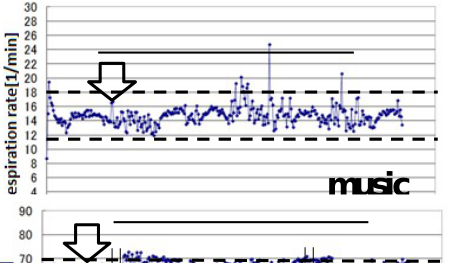
RESULT AND DISCUSION In Fig. 3, example transitions for a subject of pulse rate in the upper and of respiration rate in the lower through one night were shown. Left two are for the normal, i.e., no particular stimulus for the first and second nights, and then right two are for healing music stimulus for the third and fourth nights. As shown by arrow in the left trace for pulse showed a clear decrease pattern, while that of respiration also showed rather decrease pattern but not clear or flat pattern. On the contrary, the transit patterns for music stimulus showed flat pattern. The reason why the shape changed is decrease of above two rates especially in three hours from the beginning of sleep as shown by downward wide arrows in the right trace. Such distinct decreasing patterns were seen in 3 of 4 subjects. As for aroma stimulus, as shown in Fig.4, pulse rate decreased especially in one hour, while respiration rate did not decrease in 3 of 3 subjects.
It has been understood fundamentally that pulse rate and respiration rate decrease by relaxation (Hori,2008; Kaniusas,2012). This means actions of parasympathetic nerves become superior to that of sympathetic nerves in principle. However, from the result, it is clear that the stimulus did produce some variation in autonomic nervous systems with a difference between controls of pulse rate and respiration rate. It was also found that the effect of music and aroma appeared at the early time portion especially in three hours. This seems to show that such healing stimulus made a subject sleep easily because of low rate in the early period. By the way, music was input to human system by type II, while aroma was done by type I as shown in Fig. 2, so that, the difference in input way maybe made a little different effect.
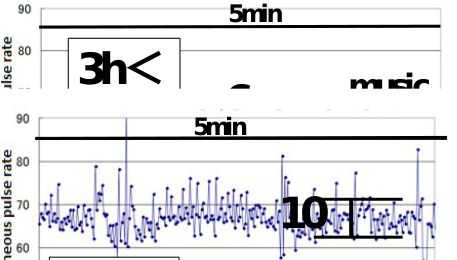
At the present study, in order to further investigate what the decrease in the rate of pulse or respiration due to healing stimulus, i.e., services, we detected instantaneous pulse rate for example. Two portions of five minute in the neighborhood of 90 minute and 230 minute, i.e., earlier than and later than three hours from the beginning of lying on a bed, respectively, were selected and then instantaneous pulse rate were investigated as shown in Figs.5 and 6. In figures, fluctuation appeared with large magnitude of approximately 25 for the left, normal day, however, it became less, approximately seven, for the right, music stimulus day, though the fluctuation for later three hours showed almost same value of six between for “normal” and “music”.
For also aroma as shown in Fig.6, the fluctuation appeared with large magnitude of approximately 15 before three hours for the normal day, however, it did with less magnitude of approximately 10 for the stimulus day. On the contrary, fluctuation did not varied by aroma after three hours. Here, a time period value of three hours was determined temporary at present study.
Therefore it can be considered that healing stimulus made human decrease in the rate of pulse and/or respiration. This decrease produced, or was produced by, relaxation. The relaxation means comfortable state in mental and physiological factors. Then autonomic nervous system permitted such a human systems to control the rates of pulse and respiration to relax. A large scale of fluctuation in pulse rate for “normal” maybe means relatively rather uncomfortable state because of the usual state. The word “relatively rather uncomfortable” here means that the healthy young students who usually sleep well participated for the subject at the present study and then they slept better than usual at the day of healing stimulus just in case.
It can also be confirmed that the information of satisfaction for response to a service in awake was accumulated in autonomic nervous system and then appealed unconsciously during sleep at night as shown in Fig2 (b) at least by music.
<3h 3h< <3h 3h< music normal
normal music
75
Figure 3. Rates of pulse, upper, and respiration, lower, during sleep through a night. The left shows for "normal" with no particular service (stimulus) and the right shows for "music" with service (music stimulus).
<3h <3h 3h< 3h< aroma normal
normal aroma
Figure 4. Rates of pulse, upper, and respiration, lower, during sleep through a night. The left shows for "normal" with no particular service (stimulus) and the right shows for "aroma" with service (aroma stimulus).
Figure available in the original PDF paper.
5min
5min normal music <3h
25 7
5min 5min 3h< normal music
6 6
5min 5min
15 10
aroma normal
<3h
Figure 5. Variation in the instantaneous pulse rate due to music stimulus. The trace is for in 5 min of the time portions determined by arrows facing each other in Fig.4: upper for earlier and lower for later than 3 hours from the beginning of lying
5min 5min
18 18
aroma normal
3h<
Figure 6. Variation in the instantaneous pulse rate due to aroma stimulus. The trace is for in 5 min of the time portions determined by arrows facing each other in Fig.4: upper for earlier and lower for later than 3 hours from the beginning of lying
Figure available in the original PDF paper.
CONCLUSIONS
Autonomic nervous system answered satisfaction to services in awake by unconscious responses of varying rates of pulse and respiration during sleep. The responses were, in concrete terms, decrease in above two rates and decrease in the magnitude of fluctuation. It was also confirmed that the information of satisfaction for response to a service in awake was accumulated in autonomic nervous system and then appealed unconsciously during sleep at night.
ACKNOWLEDGMENT
Authors would like to acknowledge subjects for data producing and companies, Toyo Feather Industry Co. Ltd, Real Design Co. Ltd, and Nwic Co. Ltd for joint studies and for supplying materials for experiment. We also would like to acknowledge Research Institute of Science and Technology for Science, Japan for NEXER project, 2009.
REFERENCES
Hori T (2008),” Sleep psychology”. Kitaoji Shobou, Kyoto, Japan (in Japanese) Kuno H, Takashima M, Okawai H (2004) Measurement of Respiration, heart beat and body movement on a bed using dynamic air-pressure sensor. IEEJ Trans. EIS.vol.124, No.4, pp 935-940 (in Japanese). Kaniusas E, (2012)"Sleep.” Biomedical signals and Sensors1, Springer, pp 270-282. Okawai H, Ichisawa S, Numata K (2011), ”Detection of influence of stimuli or services on the physical condition and satisfaction
with unconscious response reflecting activities of autonomic nervous system”. N.A.Abu Osman et al. (Eds.); BIOMED2011, IFMBE Proceedings35, MALAYSIA, pp.420-423. Okawai H, Kato K, Baya D (2012),” Entrusting the reply of satisfaction or physical condition for services to unconscious responses reflecting activities of autonomic nervous system”. 4th International Conference on Applied Human Factors and Ergonomics (AHFE), San Francisco, pp.911-920, 21-25 July 2012. Okawai H, Yajima T, Imamatsu T (2012),”Transition of Rates of Respiration and Pulse, and Sleeping Posture During Night
Detected by Body Motion Wave”. 2012 IEEE international Conference on Biomedical Engineering and Sciences, MALAYSIA, pp.129-133, 17th-19th DEC 2012. Okawai H, Yajima T, Imamatsu T, Wada J (2013), ”Sophisticated Rate Control of Respiration and Pulse during Sleep Studied by Body Motion Wave. L.M. Roa Romero (ed.), XIII Mediterranean Conference on Medical and Biological Engineering and Computing 2013, IFMBE Proceedings 41, pp. 1895-1898,MEDICON 2013, 25-28 September 2013, Seville, Spain Wada J, Yajima T, Imamatsu T, Okawai H (2013), ”Relation among Breathing Pattern, Sleep Posture and BMI during Sleep
Detected by Body Motion Wave. L.M. Roa Romero (ed.), XIII Mediterranean Conference on Medical and Biological Engineering and Computing 2013, IFMBE Proceedings 41, pp. 1891-1894, MEDICON 2013, 25-28 September 2013, Seville, Spain.
LISTED IN THE AHFE DIGITAL BOOKSTORE CATALOGUE
Explore the complete digital volume
Advances in The Human Side of Service Engineering
Read this individual research paper free through the original publisher, or explore the full digital proceedings book.
ISBN 978-1-4951-2091-6
Explore this ISBN in the AHFE Bookstore ↗Listed in the July 2026 bookstore catalogue; search by ISBN to confirm current availability · Digital book purchase optional