Carola Stryja, Peter Hottum, Hansjörg Fromm (2019). Service Networks in the Area of E-Mobility. In: Advances in The Human Side of Service Engineering. AHFE Open Access, vol. 8. https://doi.org/10.54941/ahfe100260
E-mobility (e-mobility) systems experience a growing interest in politics and economy. However, establishing this new technology in the market is a huge challenge since both, customer and supplier, have to think about mobility in a new way. To attract e-mobility to customers, new service offerings are an important channel. For creating such service offerings, various actors have to interact in new relationships and networks, focusing on current and future customer needs. To give a first understanding of such service networks and how far they can be described as “service networks” in a common theoretical sense is the goal of the paper. Based on a literature review in the fields of network and service network theory, general characteristics with which (service) networks can be described are elaborated. The different players on the e-mobility market are introduced and the network they form is classified using the characteristics from (service) network theory.
Due to the increasing importance of renewable energy systems for addressing the problem of climate change and limited oil reserves, e-mobility seems to be one part of the solution. As energy conversion and transport activities are two of the main contributors to the CO2 emissions, fostering the large-scale use of battery electric vehicles (BEV) is one important way to reduce the emissions according to the Inter-governmental Panel on Climate Change (IPCC) targets. In 2011, they set the reduction target of CO2 emissions for developed countries to 80%–95% by 2050 (EU, 2011). To achieve this, actions have to be taken in several areas.
E-mobility offers a twofold solution for the problem. First, the fact that BEVs are much more energy-efficient than traditional internal combustion engines (ICEV). The efficiency factor of ICEVs varies around 35 percent in contrast to over 90 percent offered by BEVs with the result that less fuel is needed for the same driving range and hence less emissions are generated (BMBF, 2013). The second aspect is the easier integration of renewable energy sources in the transport sector when using batteries of electric cars as distributed energy storage systems (Budde Christensen et al., 2012). To reach the ambitious goals for CO2 reduction, renewable energy sources have to be introduced in a large scale to the energy system. However, natural power sources are difficult to exploit due to their high fluctua- tions in electricity production. Appropriate energy storage devices are still lacking. That is the point where BEVs come into play. Their battery can be used to balance fluctuations in electricity production by intelligent charging (smart grid) i.e. the electricity amount with which the vehicle is charged depends directly on actual energy produc- tion patterns (ibid.). These valuable aspects make it necessary for governments to cope with the challenges aligned with e-mobility and to further engage in the issues of technology and infrastructure development.
The governmental initiatives have on the one hand side led to an improved public perception and growing interest in e-mobility issues. On the other side, though, are high capital costs and restricted driving range still resulting in the fact that most BEVs are still part of professional business fleets i.e. private owners are the minority (Ried et al., 2013). Established automotive manufacturers try to minimize risks by integrating the BEV production and distribu- tion in their current ICEV production lines to exploit scale effects (Müller et al., 2014). To establish e-mobility in society, however, innovative business models are needed to attract customers. According to (Capgemini, 2012), the most important characteristics of an e-mobility leader are flexibility and innovation capability. Both aspects tend to be rather found at small and medium companies e.g. start-ups and niche players than at large organizations. That makes it difficult for large automotive manufacturers to meet this challenge alone (Hewitt-Dundas, 2006). That is why the European governments emphasize the importance of these actors to address changing mobility habits and make e-mobility more popular to a larger customer base (Müller et al. 2014). One key is the early anticipation of changes in customer mindsets to be able to develop solutions that really matches the ravages of time. E-mobility with its unestablished market structures offers a huge potential for new businesses to anticipate latest customer trends and offering appropriate services.
One of these trends is the concept of “using instead of owning”. The paradigm is getting more and more popular not only among younger generations. The success of businesses that address these trends such as car sharing services prove the change in customer behavior right. (Thompson and Weissmann, 2012) explain this phenomenon with the rise of mobile technology. As a way for transcending time and space, smartphones offer a new way towards a “shar- ing economy” i.e. the use of services as platforms for the share of goods or other things in a professional form.
To put the sharing economy concept on a professional stage is the challenge and opportunity for new business mod- els also in the field of e-mobility. The business of car sharing, for example, has been growing over 500 percent in Germany since 2012 (Bay 2013). The concept is attractive to customers since raising gas prices makes the owning of cars less attractive and second, smartphones have become ubiquitous which makes application-based services easy to share and promote (Thompson and Weissmann, 2012). By offering the German car-sharing service “DriveNow”, BMW is one of the traditional automotive manufacturers which are already shifting from just selling the product BEV to selling the mobility service which is provided by using the car, a trend also identified by (Giordano and Fulli, 2012). Since BMW had no experience and capabilities in the business of rental services they set up an alliance with SIXT, a large car rental service provider. DriveNow is now part of the BMW mobility concept “360° Electric” which is promoted as comprehensive service solution for the use of their EV “BMW i3”. A network of different ser- vice offerings strives to satisfy all needs a customer might have when using their BEV. Navigation services for charging infrastructure or parking slots but also for optimized city ways in rush hours are offered (BMW, 2014). With further partners in the network like Vodafone, ADAC, airbnb and the US web service start-up Life360, BWM uses the expertise of different industries to provide a completely new and innovative mobility experience to their customers.
Offering a BEV is no longer just the production and distribution of the car but far more than this. E-mobility tends to become a disruptive technology, i.e. a technology which breaks up established market structures and enables the for- mation of new actors and alliances (Müller et al., 2014). The BEV customer expects at least the same convenience as with a traditional ICEV. These customer expectations can only be served with new ways of business interaction. The information and knowledge required for this, however, are distributed among various players, partly with a completely different industry background. To get access to them, collaboration in newly emerging business net- works will be necessary (Müller et al., 2014). The analysis of collaboration in networks has been subject of numer- ous studies e.g. in the fields of business and economics, social studies or computational science. However, analyzing and accompanying the development of an emerging market such as e-mobility raises new questions that cannot be answered appropriately with current literature. These are topics concerning e.g. the capabilities required in such ser- vice networks, the selection of appropriate partners and the role of ICT as fundamental enabler.
To set the scientific foundation for further research in this field is the goal of this paper. To achieve this, the paper is divided into three parts. First, the concept of e-mobility service and e-mobility service network is elaborated and de- fined to provide a common understanding of the research topic. Second, to prepare the analysis of the networks ob- served in e-mobility, a collection of indicators which are commonly used in literature to describe (service) networks are proposed. In the last part, the different players in the e-mobility network are presented. Furthermore, the network they build up is analyzed and described by the help of the indicators introduced in part 2.
TOWARDS A DEFINITION OF E-MOBILITY SERVICE NET- WORKS
When analyzing e-mobility service networks a clear definition is necessary to ensure a common understanding of the topic. The term “e-mobility” consists of electric and mobility. The Oxford Dictionary defines “mobility “as the “ability to move or be moved freely and easily”. Common means of mobility are bicycles, cars, trains, ships, and aircrafts, while most of today’s cars are powered by internal combustion engines (ICEVs). E-mobility as understood by the majority of authors in this field is the use of battery electric vehicles (BEVs) such as battery and fuel cell EVs. Hybrid and plug-in-hybrid vehicles use both, an electric and internal combustion engine, to optimize both range and the driving experience (Lopes et al., 2011). Although some authors consider them as being a part of e-mobility, this paper only focuses on BEVs without fuel cell EV. This is since the building of new service networks is most likely to occur in this field of e-mobility. In this work, the following definition will be used to describe e-mobility.
Definition [e-mobility]: E-mobility encompasses all activities, goods and services concerning BEVs and which are provided and used to satisfy the mobility need of the customer.
The characteristics and definitions of a service are strongly depending on the perspective the authors take and the scientific background they represent. The discussion of what can be considered as a service is filling several works such as of (Maglio and Spohrer, 2008, O’Sullivan et al., 2002, Spohrer et al., 2007, Vargo and Lusch, 2004). Since the scope of this paper is the introduction of a new domain of service interest, this work builds on the following defi- nition of (Mele and Polese, 2011).
Definition [service]: A service implies an activity (or series of activities) in which various resources are utilized by a supplier in interaction with a customer in order to develop a solution to certain needs (Mele and Polese, 2011) When combining the terms, e-mobility and service, the following definition covers the various aspects of the domain adequately namely the relevance of customer interaction when using e-mobility services such as navigation, charg- ing or vehicle-to-grid integration (in the context of B2C services). But also when considering B2B services such as roaming or services for business fleets, the service customer is always in charge to provide some kind of information or activity to achieve its goal. Hence, the definition used in this paper is covering these aspects.
Definition [e-mobility service]: An e-mobility service is an activity (or series of activities) in which various resources are utilized by a supplier in interaction with a customer in order to satisfy the mobility need of the customer.
Based on a literature review in the areas of service network and service system theory as well as service supply chain theory, a sample of 43 paper were identified as being relevant for the purpose of the study. Depending on the area, different aspects turned out to be characteristically for specific concepts and more important for the under- standing of a service network than others.
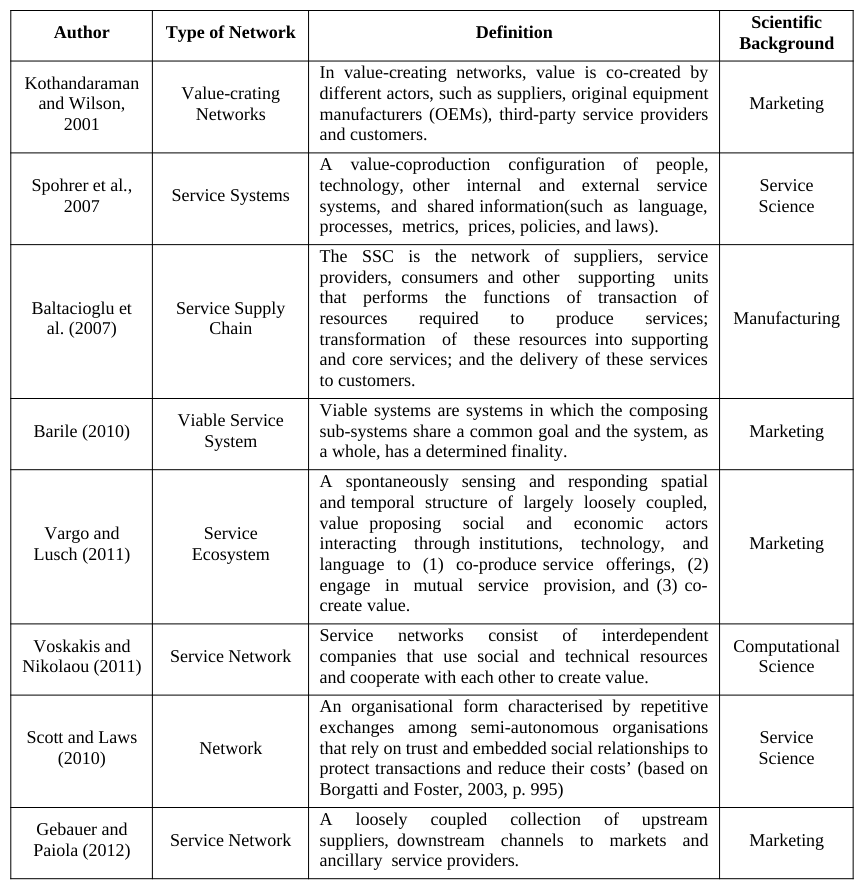
For a better understanding, a selection of definitions which are either the most prominent ones in their domain (e.g. Spohrer et al., 2007, Vargo and Lusch, 2004, Baltacioglu et al, 2007) or which offer a dedicated definition for a ser- vice network are shortly presented in Table 1 together with their scientific foundation. Service supply chain (SSC) publications offer a stronger focus on the linearity of the service process and have a tendency towards searching for similarities to traditional manufacturing supply chains to apply their established models (like the supply chain opera- tions reference model (SCOR)) on services. Although several authors acknowledge the differences between both concepts the strict thinking in producer/consumer lines is still obvious (e.g. Youngdahl and Loomba, 2000, Gian- nakis, 2011). One of the scarce publications which try to define the SSC concept with a network approach is (Balta- cioglu et al., 2007). According to their understanding, services are the result of “a network of suppliers, service providers, consumers and other supporting units that performs the functions of transaction of resources re - quired to produce services…”. In this work the understanding of services as a kind of product is still dominating which appears in phrases like “transaction of resources required to produce services“. Hence, the approach of ser- vice supply chain seems to be inappropriate for the development of a service network definition that fits the scope of the paper. A domain that seems to be more suitable for this purpose is the field of marketing. Being one of the parental sciences, marketing scholars have early tried to define services and hence the collaboration in service net- works.
Table 1: Concepts for Service Network collected from various scientific domains
Being one of the parental sciences, marketing scholars have early tried to define services and hence the collaboration in service networks. A remarkable observation when analyzing the literature in this area is the existence of a variety of terms such as “viable service systems” (Barile, 2010), “value-creating networks” (Kothandaraman and Wilson, 2001), just “service systems” (Spohrer et al., 2007) or, when referring to commonalities with biological ecosystems, using the term “service ecosystem” as (Vargo and Lusch, 2011) are proposing. All terms seem to mean more or less the same however the inconsistent collection of different definitions makes it difficult to extract the core of the con- cepts. What can be summarized is the dominance of value co-creation as the main perspective on the exchange be- tween the members of the network and especially between service provider and service customer. The customer is now considered as an active part of the service process and not just the recipient of a service delivery as described by (Baltacioglu et al., 2007). For this paper, the following definition will be used to describe an e-mobility service network. The emphasis lies on the satisfaction of customer mobility needs and the organization in a kind of business network.
Definition [e-mobility service network ]: A business network of service providers that offer solutions concerning the use of BEVs which satisfy the mobility needs of the customers.
For a further analysis of e-mobility service networks, the knowledge of features that characterize service networks in a common sense are necessary. For this, publications from network, business network and service system theory have been examined and commonalities were elaborated.
SERVICE NETWORK CHARACTERISTICS
The collaboration between organizations in networks has been subject of numerous publications over the last decades covering different disciplines such as transaction cost or resource-based theory (e.g. Pfeffer and Salancik, 1978, Williamson, 1991, Kilduff and Tsai, 2003, Borgatti and Foster, 2003, Brass et al. 2004). Application domains of network theory including e.g. organizational theory and behavior, strategic management, business studies, health care services, sociology, communications, computer science, physics and psychology (Provan et al., 2007). Over the last decades, several characteristics have been emerged as being appropriate parameters for the description and analysis of networks in various fields. Formal network analysis is a central element mathematical based research domains such as operations research, computational science or social network studies. Established parameters for general network analyses are density indicators (i.e. the strength of relationship), centralization (i.e. who is the most powerful member) and clustering values (i.e. which parts of the network are more or less active) (e.g. Goodwin, 2004, Brandes and Erlebach, 2005, Provan et al., 2007, Scott and Laws, 2010). For this study, such “formal” parameters have been considered as well as parameters with a more business-oriented focus. In summary, five main characteristics have been identified:
1. Internal Structure (Centralization, Cliques): this comprises questions like how far the network is domi- nated by a few members or the strength of the relationships between them. A further point of interest is the occurrence of similarities in the structure of such relationships (i.e. isomorphism) or the degree of cluster- ing or the existence of holes in the network (Goodwin, 2004, Provan et al., 2007), Haythornthwaite, 1996, Möller et al., 2005).
2. Governance: this comprises questions like the mechanism which is used to manage the network and the content that is exchanged within the network relationships. Also questions concerning the quality of busi- ness relationships such as informal mechanisms are influencer of network dynamics (Provan et al., 2007, Hakansson and Ford, 1995, Goodwin et al., 2004).
3. Drivers: this comprises questions about the motivation factors for organizations to enter a network. Exam- ples may be a volatile environment, i.e. global competition and changing markets or the provision of ac- cess to valuable resources (Nordin et al., 2013, Brass et al., 2004, de Man, 2004).
4. Enablers: this comprises questions concerning the factors that enable the collaboration in networks. Exam- ples may be a common language, social institutions (e.g. monetary systems, laws, etc.) and information and technology (Iakovaki and Srai, 2009, Drzymalski, 2012), Nordin et al., 2013).
5. Outcomes: this comprises questions concerning the (long-term) consequences for an organization when en- gaging in the network. Examples may be simply surviving and innovation or an increased stability and re- sistance to change (Nordin et al., 2013, Goodwin et al., 2004, Brass et al., 2004).
These parameters will be used to characterize the e-mobility network in a more detailed way than just presenting the actors involved. Issues such as the distribution of power within the network, dynamics and changes in relationships that can be observed when analyzing the network over a longer period of time may be topics of interest to better un- derstand the network as a whole.
E-MOBILITY - A SYSTEM OF SERVICE NETWORKS?
The market of e-mobility is currently suffering from different problems. (Giordano and Fulli, 2012) describe them as a “deadlock situation where all stakeholders are waiting for a breakthrough to ignite the process”. According to them, the customers are waiting for cheaper BEVs with a longer range limited by the battery while car manufacturers are afraid to invest in the development of new BEV models without the perspective of a market potential. Battery suppliers in turn await the commitment of the car manufacturers to engage in the e-mobility market to increase their research and production facilities. In order to understand the complex interaction dependencies in the market, rele- vant players involved in today’s e-mobility market are introduced and explained in the following section.
Player within the E-mobility Network
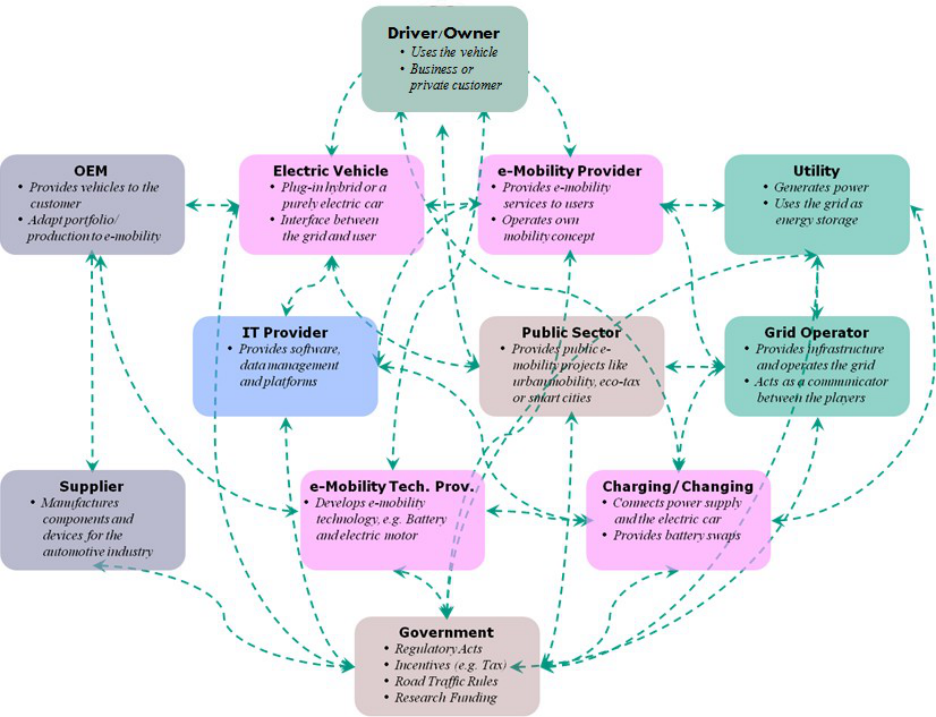
The players in the e-mobility market have the common goal to provide e-mobility in a technically and economically attractive manner. Based on a comprehensive market research, main players have been identified and characterized in Figure 1.
Figure 1: E-Mobility players (based on Capgemini (2012))
OEMs (Original Equipment Manufacturer). OEMs develop, build and distribute the BEVs. Beside the producers of cars, also the manufacturers of electric motorcycles and electric panel trucks are count to the group of e-mobility OEMs. Most of the providers are traditional car manufacturers which mainly offer internal combustion engine vehi- cles (ICEV) and subsequently extend their product portfolio with electric or hybrid vehicle offerings. Examples are Nissan (“Nissan Leaf”), BMW (“i3”) or Toyota (“Prius”). Only Tesla (“Model S”) offers a pure electric vehicle portfolio.
Suppliers. BEVs contain several components which are completely different than those used in ICEVs. Those are in particular the battery, the electric motor and the power electronics (Basshuysen and Schäfer, 2011). Some OEMs produce the parts by themselves, others buy them from suppliers. As already observed among the OEMs, there are established supplier companies which already produce parts for the ICEVs and which are now enlarging their port- folio with an e-mobility segment. However, there are also suppliers which have not been involved in the car segment since e-mobility came up. Provider of lithium batteries or electric engines are examples where knowledge from other industries is now used for e-mobility. BEVs depend on electricity. Stored as chemical energy, the electricity is made available to the engine if needed. Suppliers of charging infrastructure are developers of software components as re- quired interfaces as well as producers of hardware such as parts for the charging stations or recharger cables. Exam- ples therefor are the German manufacturers Mennekes as a worldwide leader for charging plug systems or Bosch which offers an open IT-system for the connection and management of charging stations.
Utilities and Grid Operators. With the provision of electricity, energy providers play a significant role in the e-mo- bility network. Usually they collaborate with public charging station providers. In this case, the customer typically has a contract with the charging station provider with monthly or yearly payments. The charging station provider in turn is bounded by contract to the energy provider to whom it has to pay a beforehand defined reward margin. Hence, to evade such reward sharing, many energy providers already offer their own charging station services. Sev- eral energy providers also offer special charging tariffs for end customers who prefer loading their BEVs at home, including charging infrastructure or as additional service package when buying a BEV.
Charging/Changing Provider. Charging the battery is one of the essential requirements when using a BEV. The process of refueling can be conducted either by charging the battery with electricity or by changing the empty bat- tery with a fully loaded one. The customer is charged either for the loaded electricity or the charging duration. An important aspect for the charging process is the difference in charging voltages in private and public charging sta- tions since they significantly affect the charging duration (Honsel, Gregor, 2009). In BEVs several components are less stressed than in ICVEs. Examples are engine cylinders, clutch and gearbox. Due to this, the maintenance effort is lower than for ICEVs. However, also BEVs have to be maintained and, in case of accidents and wearout, repaired. For this, a comprehensive knowledge about high voltage systems is required to avoid accidents (Hunt, 1998).
E-mobility Service Provider. Services play an important role for the functionality of e-mobility and offer are high potential for new business models in this area (Kley et al., 2011). There are services which already exist for ICEVs such as workshop or leasing services and which are now adapted to e-mobility and then those which are closely re- lated to e-mobility. Because of the limited battery range and still inappropriate developed charging infrastructure, e- mobility users need special navigation and mapping services. Based on ICT, such services either showing available charging stations close to the current BEV location, assisting by finding e-mobility-friendly urban infrastructure or they calculate an optimized route between two locations in advance. Such services are offered e.g. by established navigation system providers as external devices or are directly built in the BEV (Back, 2005). Beside navigation sys- tems, other ICT-based applications have been developed to support the user. Examples are applications for smart- phones (apps) which assist the charging and payment process or functionalities which offers the participation to car sharing communities. E-mobility requires a lot of new knowledge about cars and mobility in general. Driving schools have to be taught how to drive BEVs properly, car service workers need to learn how to handle the cars in the case of an accident. Similar to ICEVs, financial services assist the potential owner to handle the high investment costs while other service providers are specializing on technical consultancy such as e.g. the implementation of a private charging infrastructure at home (“wallbox”). A large-scale establishment of e-mobility mainly depends on the acceptance of (inter)national standards. A pioneering example for this group is the German eRoaming provider “Hubject”. By offering a de facto charging standard interface, Hubject has the function of a clearing house which enables transregional e-mobility. The user perceives a maximum of convenience since the authorization and pay- ment process is completely handled by Hubject. All partners in the network can to use the same infrastructure given that the Hubject interface OICP (Open Intercharge Protocol) has been implemented (Ried et al., 2013). For being al- lowed to participate to the road traffic, cars usually have to gain a MOT certificate. MOT tests check the general road suitability as well as, in the case of BEVs, specific battery tests like lifecycle and abuse testing. Accredited providers which are confronted with new technologies are now offering specific testing procedures e.g. for battery safety or temperature effects on electric engines (TÜV Süd AG, 2013). Since many EVs are used in business fleets, services for this group are a promising business field. Providers like “alphaElectric” offer a bundle of customized services concerning the selection of appropriate EVs, implementation of charging infrastructures and fleet manage- ment.
Governments. E-mobility as a new technology is currently strongly depending on federal subsidiess and public funded projects. Since the infrastructure is still underdeveloped, the governmental entity is an important stimulus for companies to take the risk and involve themselves in e-mobility. Most of the national and international e-mobility projects that are currently running are federal funded projects, most of them conducted by a mix of research institu- tions and companies (Bundesregierung Deutschland, 2010). In the field of e-mobility, several national and interna- tional associations have been founded in the last years. Typically they consist of private persons, representatives of the corporate sector and research institutions and further public sector entities. Some associations focus on single players such as the new “UK Electric Vehicle Supply Equipment Association (UK EVSE)” launched in 2013 which focuses on the interests of electric vehicle equipment suppliers (EV Fleet World, 2013). Others such as the “Bun- desverband Elektromobilität BEM” in Germany strive for a general establishment of e-mobility in society and busi- ness. Research institutions play an important role for the development of e-mobility. The electric engine research has been mainly forced by research institutions and engineering schools all over the world way before car manufac- turers started to engage in the field (Ehsani, M. et al., 2009). Today, a lot of research is done in different areas con- cerning improved charging infrastructure systems, standardization initiatives, vehicle to grid technologies, business aspects of e-mobility, legal frameworks etc. (Kampker et al., 2013).
Private Customers. Only a small amount of private customers are already own a BEV since high investment costs and limited battery range are still high barriers (Giordano and Fulli, 2012). However, many private customers are already involved in e-mobility when using services that integrate BEVs in their offering. Examples are leasing and rental services or car sharing offerings. If considering also public transport services as e-mobility, in a broader sense, all users of trains and electric buses are part of this group.
Business Fleets. Most of the EVs are used within business fleets. Although electric cars are still much more cost-in- tensive in terms of capital and infrastructure, their operating costs are lower. Hence, extending the user base helps to spread the high initial costs over a larger amount of heads (Kley et al., 2011).
Commercial Service Fleets. Beside private and business customers who use BEVs just for private or business mobil- ity aspects, there are providers which integrate electric cars in their service offerings. Examples are the German lo- gistics supplier DHL which partly delivers its shipments in urban areas with BEVs or public/private transport provider which use buses or BEVs for their chauffer services.
Characterizing an E-Mobility Service Network
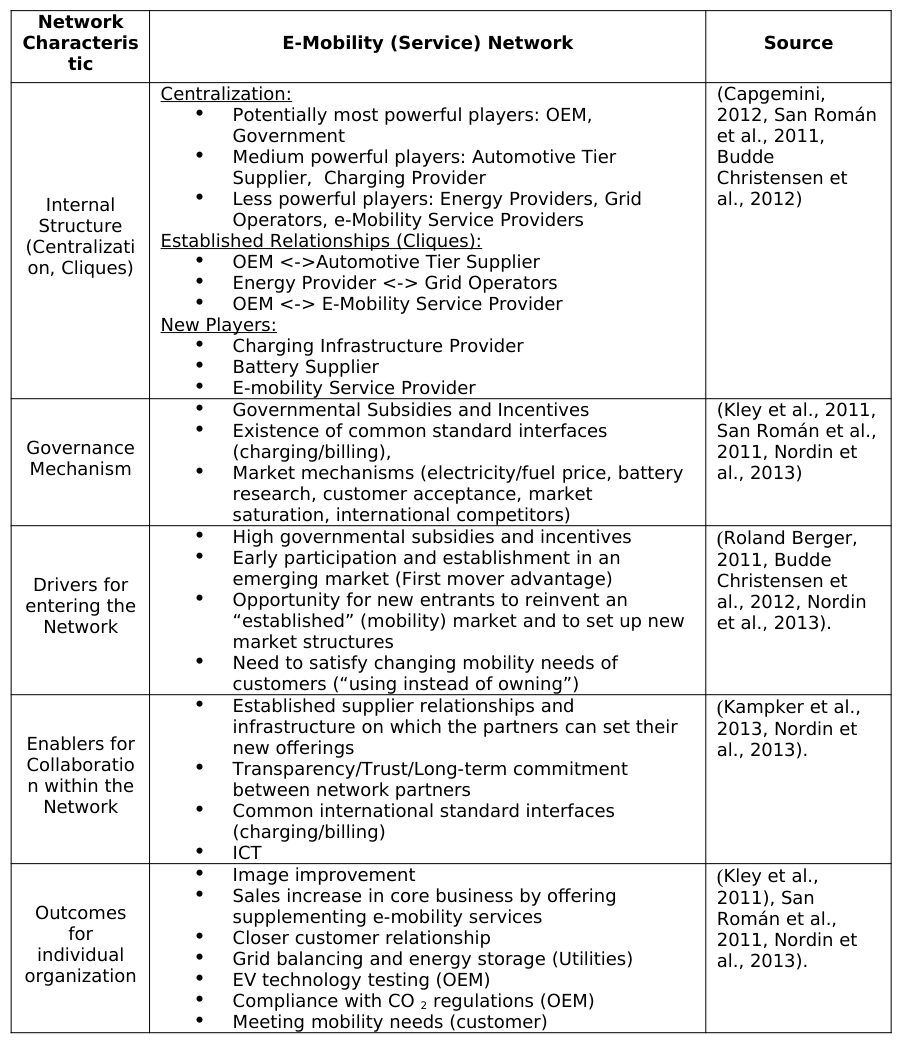
The overall question which aims to be addressed by this paper is how far e-mobility can be considered as a system that consists of service networks. Analyzing emerging service constellations in this so far product-shaped mobility market promises interesting insights into how large and established organizations have to think about their business and customers in a completely different way. To better understand the network, the five network parameters intro- duced in the section before are now used to describe the e-mobility network in further detail as just by introducing the actors involved.
The current market shows several patterns of centralization. According to the study of (Capgemini, 2012), the po- tentially most important and hence most powerful players in the emerging network will be the automotive manufac- turers and the governmental entities followed by the automotive tier suppliers and charging providers. While subsi- dizing e-mobility with a vast amount of research funds to promote the concept, the government is inevitable and cru- cial for the success of the numerous e-mobility activities undertaken so far. The high influence of governmental sub- sidies on success or failure of e-mobility can be observed in Norway where the possession of a BEV is rewarded with several benefits regarding convenience (e.g. free parking slots, driving on bus lines) and monetary aspects (e.g. luxury tax-exemption of BEVs). As a result, e-mobility enjoys a higher public acceptance than e.g. in Germany. Es- tablished relationships accelerate the establishment of new business ecosystem. Interesting relationships can be ob- served between car manufacturers and tier suppliers but also between energy providers and grid operators. Both are valuable cliques that might be used for e-mobility. New players in the field are battery suppliers and charging infra- structure provider. Both are typically closely collaborating with car manufacturers to strengthen their competencies in this new domain such as e.g. the business relationship of Tesla and Panasonic shows (Capgemini, 2012, San Román et al., 2011, Budde Christensen et al., 2012).
The government is still the most important influencer (governance mechanism) in most countries where e-mobility is promoted. The use of subsidies is still the most powerful tool to make companies invest in e-mobility. But also the existence of common standards for the charging and billing processes as well as unsolved issues concerning data se- curity are the important aspects that influence the dynamics into the network. Market mechanism such as raising gas prices, improved battery technologies that ensure longer driving ranges as well as the emergence of strong interna- tional competitors such as Tesla are influencing factors of the market development (Kley et al., 2011, San Román et al., 2011, Nordin et al., 2013).
Table 2: Characteristics of an E-Mobility (Service) Network
The drivers for entering the e-mobility network are divers. Beside high governmental subsidies and incentives, an early participation in an emerging market to be one of the first movers in this field is one driver. New entrants such as battery suppliers perceive the opportunity to reinvent the “established” automotive market. In a different situation are e.g. the car manufacturers that have to react on changed mobility needs of the customers and hence are more forced to engage in e-mobility to avoid being outperformed by international competitors (Roland Berger, 2011, Budde Christensen et al., 2012, Nordin et al., 2013).
Important factors that make the network work, i.e. network enablers, are e.g. the above mentioned international standards for charging infrastructure interfaces. Without an agreement on common technological guidelines it is difficult especially for small provider to manage the risk of investing in a new technology with the insecurity that the system will be finally compatible with the rest of the environment. Another important aspect is the reliability of business partners. In such a volatile market like e-mobility, providers appear and others disappear, leaving the problem of missing responsibilities regarding e.g. spare parts in charging infrastructure which cannot be delivered anymore due to the disappearance of the provider (Kampker et al., 2013, Nordin et al., 2013).
For most of the organizations engaging in e-mobility, potential outcomes such as an image improvement or an increase in sales due to the development of new market opportunities. For car manufacturers e.g., e-mobility is an essential key to satisfy the CO2 emission regulations. And finally it has to emphasized that e-mobility is offering a new way for car manufacturers to tighten their relationship to their customers (Kley et al., 2011), San Román et al., 2011, Nordin et al., 2013).
CONCLUSIONS
In this paper, the scientific foundation for further research in the field of service networks in the domain of e-mobil- ity was set. The contribution of the work is twofold. On the one hand side, e-mobility as a key for addressing global ecological and economic problems was introduced. The necessity of services in this context was presented and fur- ther research in this motivated. On the other side, a literature analysis was conducted on the concept of service net- work in different scientific domains. Based on insights from network theory, five characteristics for service net- works were elaborated and adapted to the field of service networks. Finally, the current players in the e-mobility net- work were presented and their relationships analyzed by using those network characteristics. The results presented in this paper have not been validated within an empirical study which will be the next step in further research activi- ties. In addition, a further characteristic of service networks, which is not yet covered sufficiently in literature, is the interaction between customers und the providers and the alignment of value propositions on which the service gen- eration is based. The topic has been identified as important aspect for further research since “the success of such ser- vice system networks depends on the alignment of value propositions between the service provider and its partners so that the service obligations are delivered to the customers as promised” (Kwan and Hottum, 2013). Hence, in fur- ther research it is planned to apply customer roles (see i.a. Sampson and Spring, 2012) to the service network model to understand motivation factors, collaboration and dynamics between, as well as risks for the involved parties. Fur- thermore it will be interesting to examine, how new arising service networks are able to change an established mar- ket structure.
REFERENCES
Baltacioglu, T., E. Ada, M.D. Kaplan, O. Yurt, Y.C. Kaplan (2007), “A New Framework for Service Supply Chains”, The Service Industries Journal, Volume 27 No.2, pp. 105–124. Barkenbus, J. (2009), “Our electric automotive future: CO2 savings through a disruptive technology,” Policy and Society Vol-
ume 27 No. 4. Basshuysen, R., Schäfer, F. (2011), “Handbuch Verbrennungsmotor: Grundlagen, Komponenten, Systeme, Perspektiven,“ Berlin: Vieweg+Teubner Verlag. Bay, L. (2013), Carsharing soll aus den roten Zahlen rasen, Handelsblatt Website:
http://www.handelsblatt.com/unternehmen/industrie/preiserhoehungen-carsharing-soll-aus-den-roten-zahlen-rasen/ 7989600.html. BMBF (2013), „Elektromobilität - Das Auto neu denken”, Publication of the Federal Ministry of Education and Research, May 2013 . BMW, (2014), BMW Website:http://www.bmw.com/com/de/insights/corporation/bmwi/mobility_services.html#bmwiventures Borgatti, S. P., Foster, P. C. (2003), “The network paradigm in organizational research: A review and typology”,
Journal of Management, Volume 29 No.6, pp. 991-1013. Brandes, U., Erlebach, T. (2005), “Network analysis: methodological foundations”, Vol. 3418, Springer.
Brass, D. J., Galaskiewicz, J., Greve, H. R., Tsai, W. (2004), “Taking stock of networks and organizations: A multilevel perspective”. Academy of Management Journal, Volume 47 No.6, pp. 795-817. Budde Christensen, T., Wells, P., Cipcigan, L. (2012), “Can innovative business models overcome resistance to electric vehicles?
Better Place and battery electric cars in Denmark”. Energy Policy Volume 48, pp. 498-505. de Man, A.-P. (2004), “The network economy. Strategy, structure and management”, Cheltenham, UK: Edward Elgar. pp. 19-36. Ehsani, M., Gao, Y., Emadi, A. (2009). “Modern electric, hybrid electric, and fuel cell vehicles: fundamentals, theory, and design. CRC press.
EU. (2011), “Communication from the Commission to the European Parliament, The Council, the European Economic and Social Committee and the Committee of Regions, A Roadmap for Moving to a Competitive Low Carbon Economy in 2050”, Brussels, 8.3.2011. EV Fleet World, 2013. http://evfleetworld.co.uk/news/2013/Sep/Trade-association-launched-at-LCV2013-to-support-UK-e-mo-
bility/0438010630. Giordano, V., Fulli, G. (2012), “A business case for Smart Grid technologies: A systemic perspective”, Energy Policy Volume 40, pp. 252-259. Institut für Automobilwirtschaft (2012), “Auswirkungen der Elektromobilität auf das Servicegeschäft vertragsgebundener
Autohäuser”, Study. Hewitt-Dundas, N. (2006). “Resource and capability constraints to innovation in small and large plants”, Small Business Economics, Volume 26 No.3, pp. 257-277. Honsel, G. (2009), „Das Stromnetz kommt ins Rollen,“ Technology Review Volume 3, pp. 30-35. Hunt, G. L. (1998),“The great battery search [electric vehicles]”, Spectrum, IEEE Volume 35 No. 11), pp. 21-28. Kampker, A., Vallée, D. ,Schnettler, A. (2013), „Elektromobilität: Grundlagen einer Zukunftstechnologie“, Heidelberg:
Springer. Kilduff, M.,Tsai, W. (2003), “Social networks and organizations”, Thousand Oaks, CA: Sage.
Kley, F., Lerch, C.,Dallinger, D. (2011), “New business models for electric cars—A holistic approach”, Energy Policy Volume 39 No. 6, pp. 3392-3403. Kothandaraman, P., Wilson, D. T. (2001), “The future of competition: value-creating networks”, Industrial Marketing Manage-
ment, Volume 30 No.4, pp. 379-389. Kwan, S.K., Hottum, P. (2013), “Maintaining Consistent Customer Experience in Service System Networks”, Proceedings of the 2013 Naples Forum on Service. Lopes, J. A. P., Soares, F. J., Almeida, P. M. R. (2011), “Integration of electric vehicles in the electric power system”, Proceed-
ings of the IEEE Volume 99 No.1, pp. 168-183. Maglio, P. P., Spohrer, J. (2008), „Fundamentals of service science”, Journal of the Academy of Marketing Science Volume 36 No.1, pp. 18-20. Mele, C., F. Polese (2011),“Key Dimensions of Service Systems in Value-Creating Networks” in: The Science of Service Sys-
tems, H. Demirkan, J. C. Spohrer, Krishna V. (Eds), pp. 37–59. Müller, P., Kasperk, G., Kampker, I. A. (2014), „Radikale Innovation durch effiziente Netzwerke“, in: Radikale Innovationen in der Mobilität (pp. 25-48). O'Sullivan, J., Edmond, D., Ter Hofstede, A. (2002), “What's in a Service?”, Distributed and Parallel Databases, Volume 12
No.2-3, pp.117-133. Parkhe, A. (1993), “Strategic Alliance Structuring: A Game Theoretic and Transaction Cost Examination of Interfirm Cooperation”, The Academy of Management Journal Volume 36 No.4, pp.794-829. Pfeffer, J., Salancik, G. R. (1978), “The external control of organizations: A resource dependence perspective”, New York:
Harper & Row. Ried, S., Jochem, P., Fichtner, W. (2013), „Chancen für IKT durch zukünftige Dienstleistungs-Geschäftsmodelle für Flotten mit Elektrofahrzeugen“, Proceedings of the 43th Annual Meeting of the Gesellschaft für Informatik 2013, pp. 1548-1562. Roland Berger (2011), “E-mobility in Central and Eastern Europe - Maturity and potential of electric vehicle markets in CEE”,
Study. San Román, T. G., Momber, I., Abbad, M. R.,Sánchez Miralles, Á. (2011), “Regulatory framework and business models for charging plug-in electric vehicles: Infrastructure, agents, and commercial relationships”, Energy policy, Volume 39 No.10, pp. 6360-6375. Sampson, S. E., Spring, M. (2012), “Customer roles in service supply chains and opportunities for innovation”, Journal of Sup-
ply Chain Management, Volume 48 No.4, pp. 30-50. Snehota, I., Hakansson, H. (1995), “Developing relationships in business networks”. London: Routledge.
Spohrer, J., P. P. Maglio, J. Bailey, Gruhl, D. (2007),” Steps toward a science of service systems”, Computer Vol. 40 No. 1, pp.
71-77. TÜV Süd AG (2013), “Realise the potential of e-mobility”, Technical Report. Thompson, D; Weissmann, J. (2012), “The Cheapest Generation- Why Millennials aren’t buying cars or houses, and what that means for the economy”, The Atlantic Website. http://www.theatlantic.com/magazine/archive/2012/09/the-cheapest- generation/309060/. Vargo, S. L., R. F. Lusch. (2004), “Evolving to a New Dominant Logic for Marketing”, Journal of Marketing Volume 68 No.1,
pp.1–17. Voskakis, M., C. Nikolaou, W.-J. van den Heuvel, Bitsaki.M. (2011), “Service Network Modeling and Performance Analysis” in: ICIW 2011, The Sixth International Conference on Internet and Web Applications and Services, pp. 58–63. Williamson, O. E. (1991), “Comparative economic organization: the analysis of discrete structural alternatives”, Admin-
istrative Science Quarterly, Volume 36 No.2, pp. 269-296.
LISTED IN THE AHFE DIGITAL BOOKSTORE CATALOGUE
Explore the complete digital volume
Advances in The Human Side of Service Engineering
Read this individual research paper free through the original publisher, or explore the full digital proceedings book.
ISBN 978-1-4951-2091-6
Explore this ISBN in the AHFE Bookstore ↗Listed in the July 2026 bookstore catalogue; search by ISBN to confirm current availability · Digital book purchase optional