Masaki Suwaa, Hideyuki Nakashimab, Haruyuki Fujiic (2019). Co-creation of Values in Designing Service through a Custom of Meta-cognition. In: Advances in The Human Side of Service Engineering. AHFE Open Access, vol. 8. https://doi.org/10.54941/ahfe100279
“Co-creation of values” is a new common notion of analyzing and producing services. The first objective of the present paper is to provide an underlying theory. Introducing what we call FNS diagram, we have theorized that both a service provider and customers, respectively, create their own values out of situated interactions between both. We argue that the notion of “service” is the whole process in which a provider and the customers create their own values out of communication with each other. This is a paradigm shift from the old “provide and consume” model to “communicate and co-creation”.What cognition is needed, then, in order for “communication and co-creation” to work? We argue that sharing meta-cognition between a provider and customers is a driving force for promotion of communication and co-creation. Meta-cognitive verbalization makes one’s problem-finding attitude active, and thus encourages eagerness to communicate and find something significant in others’ meta-cognition.
“Co-creation of values” is a new common notion of analyzing and producing services (Vargo, 2008). Its main thrust is that service is a whole process that new values are co-created through interactions between a provider and a customer. This makes a contrast against the old sense of service, in which a provider of service designs something that he or she evaluates as good, and provides it to customers as a service so that they enjoy consuming it. This is a paradigm shift from “design, provide and consume” model to “communicate and co- create”.
Similar paradigm shifts are beginning to occur in other research fields, too. In cognitive science, especially research fields studying on how people learn, the “provide and consume” model is becoming less popular; the role of a teacher is not to just provide what he or she wants to teach to students, but rather a coordinator who designs a learning environment that encourages communication between a teacher and students and thereby facilitates students to create their own interpretations of the topic to learn. From the viewpoint of students, learning is not to store what the teacher has said or taught in memory as it is, but to create interpretations that are rooted in their own life. Learning is a process of sense-making. From the viewpoint of a teacher, he or she should keep a watchful eye on what students do and do not understand, and what kind of issues, questions and hypotheses they are cultivating and when, and thereby decide the way of communicating with them and designing the environment. There are no manuals or rulebooks available that teachers can follow. He or she has to make “situated responses” according to the degree and the manner of students’ sense-making. The teacher, too, makes trials and errors and learns about how to communicate with students as he or she does so. In this respect, what occurs in a learning situation is “communication and co-creation of senses”.
This paper addresses the following issue, “What cognition is needed for sound communication and co-creation of values?” Our hypothesis is that both provider and customer need to do “meta-cognition” to make that happen. Meta-cognition is an act of looking back on and verbalizing what one has thought and/or acted. It has been studied mainly in social and educational psychology, and regarded as an effective method for acquisition of social behaviors and improvement of educational performance (e.g. Hacker et.al, 1998).
The main purpose of this paper is to argue that it is because a provider and customers share each other’s meta- cognition that sound communication takes place between them and thereby new values are created out of it. We will show an episode, as an example, in which two persons ate a cake together, shared each other’s meta- cognitive verbalization of what each one felt about the taste of the cake, and thereby came to co-create their own values about tastes in general.
SITUATEDNESS IN CREATION OF VALUES The defect of the “design, provide and consume” model of services is as follows; it has an underlying assumption that an excellent designer of a service would be able to presume situations that the service will be applied to, and design a service that works well. We argue that the form and values of a service is not something that is prefixed before customers’ usage, but a product of situated interactions between the provider and the customers. The thing is not that there is a set of predefined values that are generally applicable to any situations. Further, values that were created before are not necessarily regarded as valuable by the customers in the current situation.
In the domain of learning, too, a similar argument has been actively discussed. In the domain of athletic coaching, coaching based on the “provide and consume” model does not work. An athletes’ skills are embodied; how he/she feels and perceives from the surroundings including the opponents, pays meta-cognitive attention to parts of the body, and moves the entire body are situated in the particular body of the athlete. Some of them are, of course, general and thus applicable to other athletes. Past literature has not yet clarified whether or not there is a boundary of something generalizable and something situated, and where the boundary is if any. Therefore, an athlete should refrain from a mental attitude to straightforwardly apply what the coach said to his or her body. The coach should be aware of the embodied aspects of skills, although coaches, generally speaking, tend to think that the way of perceiving and moving body parts that constituted the basis of his skills when he was an athlete in old days is general and thus applicable to the current athlete whose coach is him.
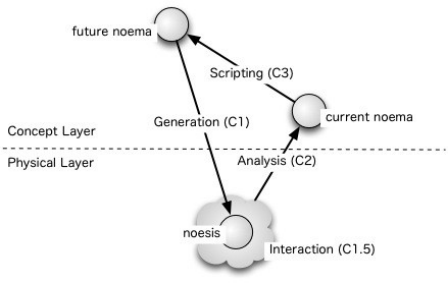
In order to formalize our argument that service is a product of situated interactions between the provider and the customers, we use FNS-diagram (Fig.1) developed by us (Nakashima et. al, 2006). FNS-diagram is an abstract formalization of a synthesis cycle. In Fig.1, future noema (Kimura, 1988) corresponds to the concept of a goal to be achieved. Generation process (C1) creates some physical entity (object, system, or phenemonon), called noesis, in order to aim at achieving the goal. The noesis necessarily interacts with the environment (C1.5). What we mean by environment includes people, products, society, its culture and so on in the current time. The interaction is only partially predictable, and therefore may produce some unpredicted consequences. So if the result of the interaction is analyzed (C2) to find out the actual consequences, current noema, those are usually different from the original goal. That is, the current noema may differ from the original future noema, containing new values, variables, aspects, viewpoints, or evaluation criteria. The difference may trigger revision of the original goal or generation of a completely new one (future noema again). This is the C3 process and we call it scripting.
Figure 1. FNS diagram: An abstract formalization of a synthesis loop Suppose that the loop shown in Fig.1 is a provider’s. Service does not end with a one-time provision of a service. A one-time provision merely corresponds to C1. When a service is provided to the real world, customers use it. Customers constitute the cloud shape of interaction (C1.5). Since the service provider does not assume minds of customers, some of them may use the service in a manner that differs from the original intention of the provider. Some social situations may happen to affect customers’ use of the service. Those are examples of what we call interaction (C1.5). What we call values in this paper is a product of analysis (C2). Although, in Fig.1, the subject of the analysis (C2) is a provider, it may not be correct to say that the provider has discovered the new value by himself. It is better to say that the new value has been co-created, being affected by interaction C1, of which the significant constituent are customers who have used the provided service.Figure 2. FNS twin loops
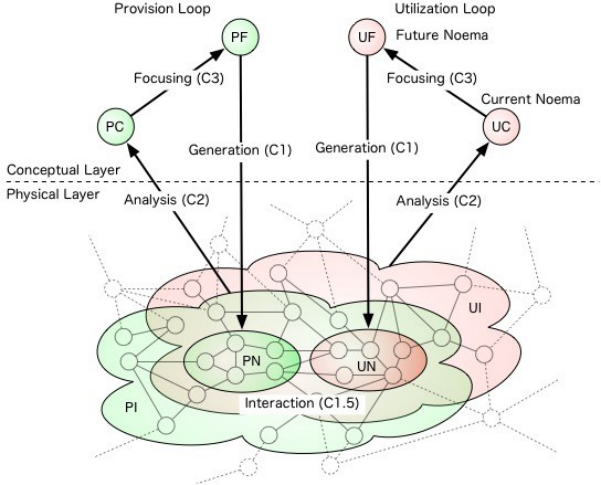
In order to formalize the relation between a provider and customers in a more precise manner, we have Human Side of Service Engineering (2019) extended the FNS diagram into a diagram of twin loops, shown in Fig.2. The loop on the left side is a provider’s, and the loop on the right side is customers’. The customers’ loop is a process of exploration of how to use the services provided. So, UN, noesis as a result of customers’ generation (C1), represents several ways of usage that have become salient in the society. Customers may use it in many different purposes, which are not necessarily the same as the original intention of the provider (PF). The way one group of users uses it may become the basis for the way another group uses it. UN includes all of them.
Important is that UN is a part of the interactions (C1.5) for the left provider’s loop, i.e. within the cloud for the provider. Out of these interactions, the provider may find new aspects, values and issues (PC), which in turn becomes seeds for generation of new ideas (PF) about service. Also important is that every time a new service is put into the world (PN), it becomes part of the interactions for the customers’ loop. Since the range of interactions is determined by the first-person’s perspective of a provider or customers, both interaction clouds for the provider and customers overlap but are not the same. From those interactions, the customers may find new values, aspects, and issues in using the provided service (UC), which may trigger generation of new ideas about how to use it in the next cycle (UF). Customers are, in a way, designers who devise how to use a service.
Further significant is that values found by the provider (PC) and values found by customers (UC) are not necessarily the same. The provider finds new values in the context of providing a service as a professional designer, whereas customers find new values in the context of using services to enjoy their lives. Values on both parties could differ. So, when we discuss “co-creation of values”, it does not mean that some shared values are created in collaboration of both parties. Each party creates its own values that are rooted in the context and intentions of each, its creation being affected by each other’s noesis, generation (C1). This is the most significant remark of this paper, which will be highlighted in the episode of “co-creation of values” to be shown later.
META-COGNITION We have argued in the earlier sections that interaction between one’s own noesis, the result of generation (C1), and other factors in the surroundings is the platform on which a provider and customers find new values in providing service and in using it. This means that fruitful creation of new values is dependent on whether or not one is able to have interactions with so-far unheeded factors in the surroundings. If one does not have open eyes to unheeded factors, being fixated to one’s own original intention, the range of interaction cloud (C1.5) becomes small. Then, new values will not be created and the loop will stop. In other words, whether or not a provider and customers are able to communicate well and each party is able to co-create values for oneself depends on open eyes without fixation to one’s own intentions.
Then, what cognition is needed for having open eyes? Our hypothesis is that meta-cognition promotes an open attitude. Meta-cognition is an act of looking back on and verbalizing what one has thought and/or acted. Being studied mainly in social and educational psychology, it has been regarded as an effective method for acquisition of social behaviors and improvement of educational performance. What mental attitude does meta- cognition bring about? Referring to past literature related to meta-cognition, we will discuss the answers of this issue.
Verbalization: the Essence of Meta-cognition The most significant aspect of meta-cognition is verbalization. Merely looking back on and having a second thought in mind without verbalization does not work well. This is similar to the phenomena that externalization such as writing or drawing sketches serves as an effective tool for thinking. The positive effects of externalization on development of thoughts have been actively studied in cognitive science (e.g. Larkin, 1987) and in design cognition (e.g. Schon, 1983; Suwa et.al, 1997). For example, why designers draw sketches was an active research issue in 80 and 90’s. Most theorists have agreed that sketches are not just a record of what a designer has in mind as a memory aid. Drawn elements on a paper will necessarily take some physical forms, i.e. sizes and shapes, and make new spatial relations happen among the other existing elements, regardless of whether or not the designer is aware of those. Those physical features and spatial relations are the cause of a new attention and discovery. The designer may be able to find some spatial relations or shapes unexpectedly (Suwa et al., 2000; Schon, 1983) and generate new interpretations of them (Goel, 1997). An unexpected attention to perceptual features and generation of new interpretations enable the designers to create new design issues, i.e. the very driving-force for pushing the design process forward.
Being self-aware of and verbalizing one’s own cognition, i.e. thoughts, action and perception, is a kind of externalization. Just as sketches serve as a tool for development of ideas, verbalization makes various aspects and variables more salient, and thus relationships among them are easier to consider. Gibson and Gibson (1955) discussed that attention to new variables in the surroundings is the essence of learning. Suwa (2008) argued that learning is an act of weaving a network of variables by exploring what variables are to be linked to each other.
Another advantage of verbalization is that selective attention to particular variables as a consequence of verbalization provides a new viewpoint to the surroundings and thus changes a way of perception. A picture of Darmesian whose resolution is quite coarse is hard to recognize, but once asked “where is a dog?”, it becomes remarkably easier to recognize a dog in the picture. The only difference between before and after the question is provision of the word, “dog”. The word, even though it is just a single word, provides a particular viewpoint to look at the picture, and affects the way of perception. Similarly, meta-cognitive verbalization of the relation between one’s own body and the surroundings may change the way of perceiving the surroundings. Verbalization itself is a trigger for new attention to so-far unheeded variables and aspects. Since increased attention to variables and aspects means enlargement of the range of the interaction cloud (C1.5), it may have a positive effect on the creation of new values in the analysis (C2).
Meta-cognition Drives a Problem-Finding Attitude and thereby a FNS Loop Getzels et. al (1976), conducting a longitudinal study of artists, argued that problem-finding attitude is indispensable in order to be a creative artist. Finding problems, not solving given problems, is the key for creative works. There seem to be many types of problem-finding attitude. Generating an idea of what to do next, making a hypothesis, creating an issue to be addressed, asking a question, finding a problem, and verbalization of that something feels different are all different types. The first three are relatively easier to be connected to next actual moves, whereas the latter three has the nature of analysis of the current situation. The latter three seem to serve as a basis on which ideas are generated, hypotheses are made and issues are created. We conjecture that the first three corresponds to scripting a new goal (C3) and the latter to analysis (C2), although there is no clear-cut boundary between both.
We discussed in the previous section that meta-cognitive verbalization promotes enlargement of interaction (C1.5), which in turn encourages analysis (C2) and then scripting of new goals (C3). This means, in other words, meta-cognitive verbalization drives a problem-finding attitude, e.g. the six types. Once ideas are generated, hypotheses are made or issues are addressed, that may trigger generation (C1). This way, meta- cognitive verbalization may drive a synthesis loop represented by the FNS diagram.
Driving Own FNS Loop Actively Let People Eager to Communicate Talking back about the relation between provision and usage represented in Fig.2, we discussed that a provider of a service should have a watchful eye on how customers use it, and on the other hand customers should have a watchful eye on provision of a new service. A problem-finding attitude makes people eager to do that. It is because people generate ideas, make hypotheses, create issues, ask questions, find problems and be self-aware of something that feels different that they become interested in each other’s meta-cognition, voraciously searching if each other’s noesis provides themselves with variables which are so far unheeded but could be relevant to their own meta-cognition. In other words, driving one’s own FNS loop through meta-cognitive verbalization encourages people to communicate with others. If they communicate with other, the range of interaction (C1.5) will be enlarged, which in turn drives each other’s FNS loop actively. An active drive of FNS loop and enlargement of the range of interactions promotes each other.
AN EPISODE OF CO-CREATION OF VALUES: A CASE OF METACOGNITION ABOUT TASTES In this section, we will show an episode of co-creation of values that occurred between two persons as they conversed with each other, eating the same cake and sharing each meta-cognitive verbalization about its tastes. Although the episode is not necessarily an example of service, it includes a key notion about how service should be.
Embodied Meta-cognition Meta-cognition about tastes is verbalization of how one’s own body feels, and therefore it is beyond the scope of the conventional meta-cognition in psychology. In the conventional meta-cognition, the target of verbalization has been mostly limited to one’s own thoughts verbalized in mind and overt actions observable objectively. Tastes are in the realm of perception, and therefore seem to be tacit; it is expected that tastes are relatively hard to verbalize. That sommeliers are regarded as professional is supportive to this. The conventional sense of meta-cognition has never dealt with verbalization of tastes. Without studies on verbalization of realms that have embodied aspects and thus are tacit, however, embodied knowledge would never be demystified. Extending meta-cognition into embodied realm, Suwa (2008) advocated the notion of embodied meta-cognition, in which not just thoughts and overt actions but also perception and movements of body parts are targets of verbalization. Of course, they are embodied and therefore relatively hard to describe verbally. But, as we explained in the previous section, meta-cognitive verbalization is a tool for augmenting attention to so far unheeded variables and furthering thoughts. One does not necessarily have to correctly describe all that happen in one’s own body. Correctness of descriptions is not sought after in embodied meta- cognition. Embodied meta-cognition is a tool for enhancing attention to interactions between one’s own body and the surroundings, driving a FNS loop involving one’s own embodied knowledge, and thereby making it improve.
Experiment of Meta-cognitive Verbalization about Tastes The aim of this experiment was to examine how a daily custom of meta-cognitive verbalization about tastes changes cognition of tastes for a long period. An undergraduate student and the first author of this paper participated in this experiment, and this examination turned out to the student’s graduation thesis (Ikuma, 2005). The duration of the experiment was about one year, lasting from November 2004 through October 2005. The frequency of the experiment was once in two weeks. One day the two participants ate a cake, the same kind for both, and had a conversation, each meta-cognitively verbalizing what one’s own body feels in tasting it. The behaviors and facial expressions of the student and the area her face was directed including the table, the dish, and the cake as she was eating it were videotaped. The voice of the first author of this paper was also recorded in the video. Since communication with others enhances one’s meta-cognition as we discussed in the previous section, the experimental design in which the first author also meta-cognitively verbalized and conversed with the student was expected to promote the student’s FNS loop. Approximately two weeks later, the student watched the videotape of the immediately previous experiment, remembered what she had thought and felt about the tastes of the cake as she ate the cake and verbalized what she thought. The first author of this paper was also there as a partner of conversation, sometimes talking by being inspired by what she said and asking her questions. Then, about two weeks later, the experiment of meta-cognitive verbalization in eating a cake was conducted again. Every time the kind of cake was renewed, according to the hypotheses, issues, goals and questions the students possessed then.
Cakes are one of the student’s and the first author’s favorites. That is one of the reasons why cakes were selected as the material for the experiment; if the material were something that the participants were not interested in, that would not give incentives to continue the experiment for a long period, which would be fatal for the experiment.
A Custom of Meta-cognition Brings Drastic Change of Cognition The student disliked oily or fatty food, although oily and fatty materials are often used in cakes. For example, Human Side of Service Engineering (2019) cream is typical. At the beginning of the first experiment in November 2004, she disliked cream. She said, “When I take something oily or fatty, I feel that the inner of the mouth is covered with membrane of oil. That is no good. I have not had fried pork and tempura for the past ten years or so!”. Therefore, for the relatively beginning periods of the experiment, we had to select the kind of cakes that do not contain cream.
Interesting was that her cognition about something oily drastically changed in the late 2005. One day toward the end of 2005, the first author was surprised to hear that she had eaten “kakuni”, a Japanese recipe of simmering fatty pork loaf in soy sauce based stock, and also to hear about her impression about it. Kakuni is a pronoun of oily food. She said, “Professor, I thought that the fatty part of kakuni must be the key for the whole taste of kakuni. Flavor and sweetness and delicious taste of pork are all sealed in it”. Although she had not overcome all of oily food, it seemed true that her cognition about something fatty or oily had changed after the 1-year experiment. The custom of meta-cognitive verbalization requested in the experiment must have had a positive effect on her cognition about tastes.
An Episode of Co-creation of Values Here, we will show an episode in which a conversation of the two persons who meta-cognitively verbalized about the tastes of a cake ended with co-creation of values. More precisely speaking, each person found a new value about tastes for each, respectively, with both values relating to each other. The key to the occurrence of co-creation of values was that sharing meta-cognitive verbalization between both caused them to find some variables and aspects in what each other said relevant to one’s own purposes. This brought about a rich interaction phase (C1.5) for each of them, and led to co-creation of values.
St1: The sourness of lemon in general is strong, but this tart is not so strong. Ms1: The mouth is not necessarily filled with sourness, is it? St2: I guess its sweetness makes sourness coated and hidden nicely. Ms2: Oh! It is like honey lemon! St3: Yes, this is similar to the sweetness of honey. Sugar stands out, saying “I am sugar!”, but honey has a soft sweetness. Ms3: Sugar stands out in sukiyaki!1
St4: Honey tastes like “Ha~chi~mi~mitsu~~2” Ms4: Honey smells a little, doesn’t it? St5: Ah, I eat hotcake with honey. Ms5: I do not paste honey on hotcake. Of course, I paste butter. Butter is a kind of oil, but I paste it much! And a kind of jam I paste on hotcake is not strawberry, but a little bit of blackberry with some sourness. St6: Butter is indispensable, isn’t it? I like hotcake with berry jam. St7: Oil plus sourness! Is it that its combination makes good harmony? That is true to this tart. Ms6: The combination of oil and sweetness is not very good, is it? St8: Yes, may become sickly sweet. Ms7: Oh, lemon sauce used in French cuisine is the combination of butter and lemon. I like it! St9: Ah! Mayonnaise! Ms8 & St10: Ohhh, this is the same combination as mayonnaise, isn’t it?
Excerpt 1. An episode of co-creation of values in meta-cognitive verbalization about lemon tart
1 “Sukiyaki” is a popular Japanese cuisine. The way of cooking it is to put sliced beef with vegetables and tofu in a frying pan and stewboil them in soy-sauce plus sugar based stock.
2 “Hachimitsu” is a Japanese word corresponding to honey. Using pronunciation extending each syllable, she wanted to express that honey has a soft sweetness, in contrast to sugar that has a strong “standing out” taste. Human Side of Service Engineering (2019)
On that day the two ate lemon tart, the fifth cake since the experiment had begun two months earlier. The first author of this paper tended to hesitate something sour if it has strong sourness. The student disliked something oily or fatty. Lemon tart has a touch of sourness and is shaped and covered with crusty parts like baked cookie, which has a little oily taste. In other words, lemon tart was a food material about which both had issues. The student thought that, although she felt a little too fatty in the tart part, she did not dislike that. The first author of this paper thought that he did not dislike its sourness. Each recognized that the tart had an aspect each tends to dislike, but it was never no good. Both began to question why. Excerpt 1 shows a sequence of conversation in which co-creation of values occurred. ‘St’ represents the utterances of the student and ‘Ms’ those of the first author of this paper. The subsequent number represents n-th utterance of the person. At the moment of this conversation, both had already questioned why this tart is never no good.
The beginning of this excerpt is exactly when both began to conjecture why the first author of this paper did not dislike the sourness of this tart and the student did not dislike its oil. St2 is the verbalization of the first hypothesis. Subsequently, both presented several recipes, products and food materials with an aspect of sweetness or sourness, i.e. honey lemon, sukiyaki, hotcake, jam and butter to be pasted on hotcake. By recognizing what is good and what is no good, both intended to reach the most feasible hypothesis. St7 is the hypothesis adopted as the final answer to the question. Then, in order to prove its feasibility, both searched for something, i.e. lemon sauce and mayonnaise, that the same hypothesis is applicable to.
The first author of this paper came to notice that he does not necessarily dislike sourness. He had thought that he does not like sourness in general, but came to recognize at this moment that he actually had selected something sour in some cases, especially when sourness co-exists with oiliness. When he said that he often pastes blackberry jam on hotcake (Ms5), he began to question if he really does not like something sour. This is the very example of a change of values about one’s own favorites. Similarly, the student came to recognize that she usually uses butter on hotcake, although butter is a kind of fat. Noticing the fact that she loves mayonnaise made her persuaded that reorganization of her original presumption about favorites is needed. This is the example of creation of values, too. Now it is easy to guess that reorganization of this sort would happen to her several times in the subsequent experiments, and accumulation of those would lead her to talk about the fatty part of kakuni one year later.
Finding some variables and aspects in what the conversation partner said relevant to one’s own purposes is the key action. Without the conversation partner, similar cases of creation of values might not have been possible. Since what the partner is going to say is basically unpredictable, the boundary between what is relevant and irrelevant is recognized on the fly in the conversation. That recognition determines the range of interactions (C1.5) from which to find values in analysis (C2). It is in this respect that values of each person were “co”- created, and further significantly the values created by both are not necessarily the same.
DISCUSSION
The episode discussed in the previous section, although it is evidence suggesting that sharing each other’s meta-cognitive verbalization promotes co-creation of values about each other’s tastes, is not necessarily an example of service. But, we want to stress that this evidence includes a key notion about how service should be. That is, first, both a service provider and customers should meta-cognitively verbalize about what the service provides to the lives of people, and share and converse about it with each other. That communication, then, encourages each to find some variables, aspects and viewpoints in the partner’s verbalization relevant to one’s own exploration, and to weave them with so far attended ones by oneself and thereby to reorganize one’s own values.
Let’s think of a Japanese sake restaurant as an example. Suppose that a customer’s recognition of sake taste is only along the axis of sweetness-bitterness. Many customers still believe without a doubt that this is the only and correct way of classifying sakes, although the tastes of Japanese sakes nowadays have a variety of facets and aspects. The owner of the restaurant knows better and recognizes that Japanese sakes have various facets and aspects of tastes. Here, a form of service that the authors find ideal is not to directly tell the owner’s recognition to the customer, saying “this is the way of enjoying sake”. Important is that, first, the owner should make a series of opportunities for long months or years for conversing with each customer about what each meta-cognitively feels and thinks about sake, food and other relevant issues, and thereby help the customer find his /her own values of tasting sakes. The owner should always have a watchful eye on each customer in conversation sessions. Does he/she want to enjoy the sweetness of rice, the raw material of Japanese sakes? Does he/she want to feel the flowery aroma of rice malt, which emits an enzyme necessary for fermentation of rice? It is said that there are various ways of marriage between sake and food. One kind of sake that forms a perfect marriage with a vegetable, e.g. cabbage, tomato, and etc., could be fatal when it is eaten with grilled chicken, and vice versa.
Further, the owner should think that “helping customer find values” may be a consequence. A mental attitude required is that the owner himself or herself is a learner, too. He/she should be eager to find some variables, aspects and viewpoints in a customer’s meta-cognitive verbalization relevant and thereby reorganize his or her own values. Awareness of “help” may be even unnecessary. If one of the conversation pair has a mental attitude of helping, the other may not be encouraged to be an eager learner.
We expect that service providers who recognizes the significance of “communication and co-creation of values” in service will increase.
CONCLUSIONS
Based on what we call FNS diagram, we have theorized that values on both parties, a service provider and customers, are created in a situated manner out of interactions between both. This means that values are co- created. Customers, too, are designers to create ideas about how to use services. A service provider, too, is a learner to have a watchful eye on how customers use services and re-script a new service. A service is the whole process in which a provider and the customers create their own values out of communication with each other.
Further, we have argued that, in order for communication to work well, meta-cognition is needed on both parties. The essence of meta-cognition is verbalization. Meta-cognitive verbalization makes one’s problem- finding attitude active, and thus encourages one to be eager to find something significant in others’ meta- cognition. Its eagerness enlarges the range of interactions (C1.5) in one’s FNS loop, which in turn promotes problem-finding attitudes in the FNS loop. Out of these processes co-creation of values is easier to occur.
REFERENCES
Gibson, J.J., Gibson, E.J. (1955), “Perceptual Learning: Differentiation or Enrichment?”, Psychological Review, Volume 62, pp.32-41. Getzels, J.W., Csikszentmihalyi, M. (1976), “The Creative Vision: Longitudinal Study of Problem Finding in Art”, John
Wiley & Sons Inc. Goel, V. (1995), “Sketches of Thought”, MIT Press, Cambridge. Hacker, D.J., Dunlosky, J., Graesser, A.C. (1998), Metacognition in Educational Theory and Practice, Hacker, Dunlosky, Graesser (Ed.), Lawrence Erlbaum Associates, Publishers. Ikuma, H. (2005), “Feel and Verbalize Tastes of Cakes! – Enrichment of Kansei about Tastes for a Year”, Graduation
Thesis, School of Computer and Cognitive Sciences, Chukyo University. Kimura, B. (1988), “Aida (in-between, in Japanese)”, Kobundo. Larkin, J., Simon, H.A. (1987), “Why a Diagram is (Sometimes) Worth Ten Thousand Words”, Cognitive Science, Volume 11, pp.65-99. Nakashima, H., Suwa, M., Fujii, H. (2006), “Endo-system View as a Method for Constructive Science”, Proc. Of the 5th
International Conference on Cognitive Science, pp.63-71. Schon, D.A. (1983), “The Reflective Practitioner”, Basic Books, New York. Suwa, M. (2008), “A Cognitive Model of Acquiring Embodied Expertise Through Meta-cognitive Verbalization”, Transactions of the Japanese Society for Artificial Intelligence, Volume 23 No.3, pp.141-150. Suwa, M., Gero, J., Purcell, T. (2000), “Unexpected Discoveries and S-invention of Design Requirements: Important
Vehicles for a Design Process”. Design Studies, Volume 21, pp.539-567. Suwa, M., Tversky, B. (1997), “What Do Architects and Students Perceive in Their Design Sketches?: A Protocol Analysis”, Design Studies, Volume18 No.4, pp.385-403.
Vargo, S.L., Maglio, P.P., Akaka, M.A. (2008), “On Value and Value Co-creation: A Service Systems and Service Logic Perspective”, European Management Journal, Volume 26 No.3, pp.145–152.
LISTED IN THE AHFE DIGITAL BOOKSTORE CATALOGUE
Explore the complete digital volume
Advances in The Human Side of Service Engineering
Read this individual research paper free through the original publisher, or explore the full digital proceedings book.
ISBN 978-1-4951-2091-6
Explore this ISBN in the AHFE Bookstore ↗Listed in the July 2026 bookstore catalogue; search by ISBN to confirm current availability · Digital book purchase optional