Tetsuro Chinoa, Kentaro Toriia, Naoshi Uchihirab, Kunihiko Hiraishib (2019). Discourse Analysis of Voice-Based Computer-Mediated Communication in Distributed Work. In: Advances in The Human Side of Service Engineering. AHFE Open Access, vol. 8. https://doi.org/10.54941/ahfe100276
Computer-mediated remote voice communication among care providers is analyzed by a newly proposed discourse model. Nursing and care are central to healthcare services, and improvements in the quality and efficiency of healthcare processes are important issues. Effective communication support that does not interfere with normal operations is an urgent need. Here we examined a “smart voice tweet system” intended to overcome this problem by supporting collaboration across different sites. We field-tested this system at an elderly care facility in Japan for 5 days in 2013. We observed the activities of groups of care workers during residents’ lunch and dinner and collected data on use of the system. By discourse analysis based on the proposed model, we confirm the validity of the voice tweet system as a support for remote voice communication among staff collaborating to achieve tasks. The findings can be used to design rules for estimating the ongoing status of collaborations and classifying voice tweets by purpose to decide whether they should be sent or just recorded. This research is based on joint research conducted by the Toshiba Corporation, the Shimizu Corporation, and the Japan Institute of Science and Technology with support from the Japan Science and Technology Agency.
The aging of Japan’s population is a major issue, one urgent aspect of which is caring for elderly persons with disabilities. At present, care services are often provided through the devoted efforts of care staff at long-term care facilities. Care services are characterized by what we call “action-oriented intellectual services.” Care staff makes many decisions regarding medical care that require specialized knowledge. They also assist elderly persons with disabilities in many activities of daily living. The care service staff is made up of many professions and specialties, and care services must operate at all hours all year round. Successfully doing so requires a high degree of information sharing among staff, such as ensuring that proper records of care are kept.
Lemonidou C., Plati, C., Brokalaki, H., Mantas, J., and Lanara, V. (1996) pointed out that medical staff spends a significant amount of time on indirect care, including recordkeeping and information sharing. Conventional IT systems are fundamentally designed for deskwork, however, and do not support hands-free and eyes-free operation suitable for action-oriented intellectual services.
Uchihira, N., Torii, K., Uchihira, N., Chino, T., and Iwata, K. (2011) and Torii, K., Uchihira, N., Chino, T., and Iwata, K. (2012) have proposed a “voice tweet system,” which is being developed to overcome these problems. In that system, “voice tweets” spoken by a staff member are tagged with the staff member’s location and motion, spoken keywords, and associations with background knowledge. On the basis of these tags, the tweets are automatically delivered to an appropriate staff member. This system provides semi-hands-free and eyes-free communication among medical and care staff. Developing such a system requires knowing what kind of speech communication will support cooperative work in the medical and care domains. We therefore performed field studies at an elderly care home in Japan to analyze cooperative work and speech interaction among care staff.
Chino, T., Torii, K., Uchihira, N., and Hirabayashi, Y. (2013a, b) reported on field studies in which the voice tweet system was used to support staff assisting with bathing tasks at an elderly care facility in Japan.
In this paper, we report the results of another field study and an analysis at the same site on another task, feeding assistance. A new discourse model is proposed to clarify the validity of the voice tweet system from the point of view of supporting computer-mediated remote voice communication among the staff.
The remainder of this paper is organized as follows. The second section gives an overview of the voice tweet system, and the third section proposes a discourse model. The fourth section describes the field study site and the tasks examined. The fifth section discusses the results of the field studies. Finally, the sixth section gives our conclusions and proposes some areas for future study.
VOICE TWEET SYSTEM Overview
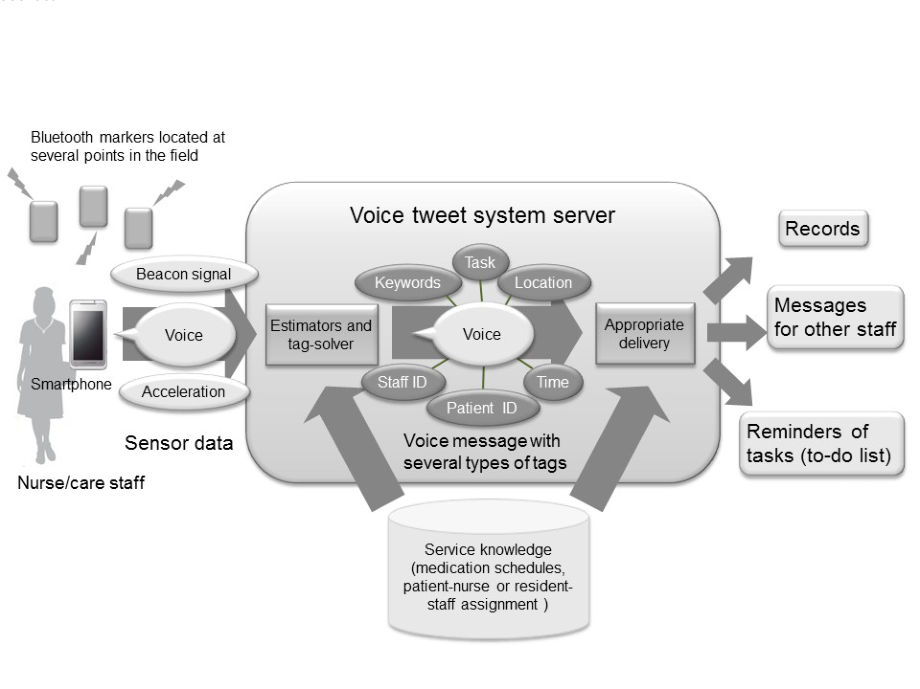
The voice tweet system consists of a smartphone application, which is run on smartphones carried by nurses and care staff, and additionally a supporting application running on a smart voice tweet server. This voice tweet system allows nurses and care staff to input care records, make memos for themselves, and compose voice messages to other staff.
Figure 1 shows an outline of the system architecture, which consists of a smartphone application and a server application. The voice interface of the smartphone application enables hands-free or semi-hands-free message composition. Several sensors on the smartphone continuously collect data around the nurse or care staff as a background process, and the application periodically sends the data to the system server. Several estimator processes on the server estimate the state (context) of each staff member who is carrying a smartphone. The states estimated by each estimator are called “tags.” Tags include, for example, keywords included in utterances, the location where the staff member composed a voice tweet, the task the staff member was executing at the moment the voice tweet was made, the time, and the staff member’s identity. Tags have two important functions. First, they improve comprehensibility of voice tweets, so that nurses and care staff need not vocalize everything in a voice tweet. For example, the staff member can leave out contextual information (who, when, and where). The system also uses tags to decide the type of delivery of voice tweets and to automatically deliver them to an appropriate destination according to whether they are a message for other staff, a reminder for oneself, or input to a database of nursing records.
Figure 1. Architecture of the voice tweet system (Adapted from Torii et al., 2012)
Typical use cases
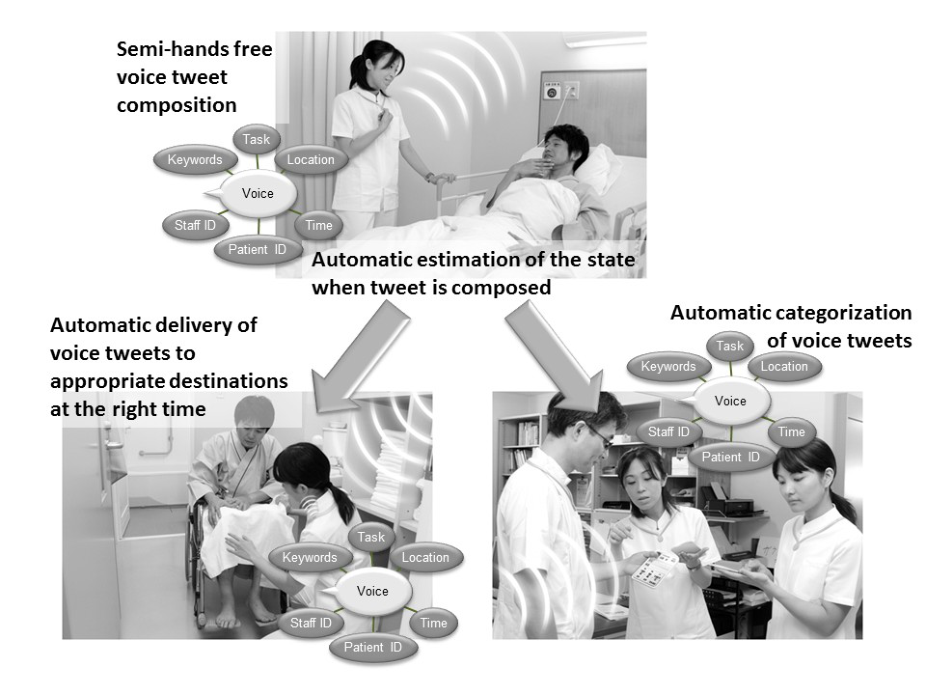
Figure 2 illustrates typical use cases for the voice tweet system. Nurses and care staff can compose voice tweets regarding topics such as patient pain complaints or patient questions about care processes by using a single hand at the bedside. Tags are automatically attached to the voice tweets. For example, a resident’s question regarding bathing can be delivered to the care staff member who bathes the patient, allowing staff to easily provide appropriate assistance. Since tweets are automatically categorized according to tags, nurses and care staff can efficiently deliver the required information.
The aim of the voice tweet system is to support the work of staff in the medical and care domains. Because the system is used by staff, not by patients or care recipients, problems such as developing a computer–human interface for elderly persons are beyond the scope of this research.
Figure 2. Typical use cases of the voice tweet system (Adapted from Torii, Uchihira et al. 2012)
DISCOURSE MODEL Exchange structure
Sinclair and Coulthard (1975, 1991) proposed a discourse model called exchange structure to investigate the structure of classroom interactions. In this model, discourse in the classroom is analyzed by using multiple layers (lesson, transaction, exchange, move, and act). Although it can be regarded as a powerful descriptive tool for discourse analysis, as Coulthard and Brazil, (1981, 1991) pointed out, the original model was too specific to pedagogy and too complex for wider use. For example, the model introduced 26 acts, some of which are difficult to distinguish among because of ambiguities in the original definitions. Coulthard et al. (1981, 1991) proposed a revised and simplified model to address these problems.
Based on the work of Sinclair et al. (1975, 1991) and Coulthard et al. (1981, 1991), we propose a new discourse model for analyzing computer-mediated remote communication among multiple staff (participants) in action- oriented intellectual services work distributed across multiple work fields.
In our model, there are only three elements of discourse: exchange, move, and discourse act. Exchange is the basic unit of interaction among participants (here, staff). An exchange consists of a sequence of more than one moves by participants. A move corresponds to one utterance in a face-to-face communication or one computer-mediated voice message in a remote communication. A discourse act corresponds to one intention, or speech-act. Therefore, multiple discourse acts can be realized in one move. In the following subsections, the details of these elements are described.
Moves Moves are classified into 3 types: Initiation (I), Response (R), and Feedback (F) in our model with some extensions. An exchange is defined as a sequence of moves of the types, in order, Initiation–Response(s)–Feedback(s). We also introduce subtypes of each type of move. All moves are also classified as one of two subtypes according to whether a response is required (rq) or optional (op). Therefore, the following six combinations of types and subtypes are possible.
• Initiation (I): A move spoken by a speaker (an initiator speaker, Si) to initiate a communication with the others in an exchange.
I(rq): an initiation move, with response(s) required.
I(op): an initiation move, with a response(s) optional.
• Response (R): Arbitrary numbers of move(s) by speakers other than Si (So(s)) in response to the initiation move from Si.
R(rq): a response move that was requested by the corresponding initiation move.
R(op): a response move that was not requested by the corresponding initiation move.
• Feedback (F): Arbitrary numbers of move(s) spoken by Si to give feedback to the responses from So(s).
F(rq): a feedback move in reply to a corresponding response move that was requested by the initiation move.
F(op): a feedback move in reply to a corresponding response move that was not requested by the initiation move.
Discourse act Each move can contain (or realize) an arbitrary number of discourse acts. We define the following four discourse acts:
• Eliciting (elc): to request verbal responses; to seek information from the intended hearer(s).
• Directing (dir): to request non-verbal responses; to affect actions of the intended hearer(s).
• Informing (inf): to provide new information to intended hearer(s).
• Acknowledging (ack): to confirm, deny, or evaluate the corresponding move spoken by the intended hearer(s).
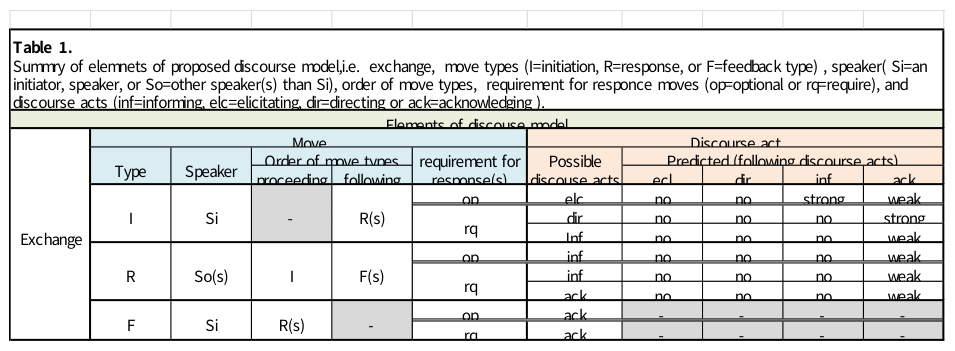
As summarized in Table 1, an exchange always starts from a single initiation move spoken by an initiator speaker (Si), followed by arbitrary numbers of response moves from other speakers (So(s)).
Each response move may be followed by arbitrary numbers of feedback moves by Si. No feedback moves need to be followed by any moves in the exchange. Only limited combinations of the move types, subtypes, requirement for responses and discourse acts specified in Table 1 are possible. Given a combination of move type, subtype, requirement for responses, and discourse act, there is a prediction preference (no: not permitted;, weak: possible; or strong: likely) for the next discourse act,
as shown in Table 1.
Table 1: Summary of proposed discourse modelTable 1. Summry of elemnets of proposed discourse model,i.e. exchange, move types (I=initiation, R=response, or F=feedback type) , speaker( Si=an initiator, speaker, or So=other speaker(s) than Si), order of move types, requirement for responce moves (op=optional or rq=require), and discourse acts (inf=informing, elc=elicitating, dir=directing or ack=acknowledging ).
Table available in the original PDF paper.
STUDY LOCATION Care facility
We performed field studies at a Japanese elderly care home over 5 days during May 2013. The building has four stories, about 40 private resident rooms, 1 common living room, and 2 dining rooms (one is on the first (i.e., ground) floor and the other is on the second floor), 1 care station, 1 bath area, and various other rooms and spaces. Corridors, elevators, and stairways connect the rooms. About 35 residents were living in this building during our field study. We selected feeding assistance as the task to study.
Residents with disabilities We classify residents into the following groups.
• Residents with slight disability are independently mobile with the aid of a device such as a cane, walker, or wheelchair, and can eat without assistance. They eat lunch and dinner in the first-floor dining room.
• Residents with moderate disability require a wheelchair and staff assistance to move around, but can eat without assistance. They eat lunch and dinner in the first-floor dining room.
• Residents with severe disability require a wheelchair and staff assistance to move around and cannot eat without assistance; they therefore require full assistance from a staff member. They eat lunch and dinner in the second-floor dining room.
• Bedridden residents cannot eat ordinary meals and receive individual care in their own rooms.
Care teams and target tasks A team of 5 to 8 care staff members, including a staff leader, performs the following routine around lunch time and dinner time.
1. Residents with slight disability come to the first-floor dining room without assistance.
2. One care staff member goes to the room of each resident with moderate disability to help them to the first-floor dining room.
3. One or more care staff members go to the room of each resident with severe disability to help them to the second-floor dining room.
4. Two or more care staff members provide mealtime assistance to residents with slight or moderate disabilities in the first-floor dining room.
5. Three or more care staff members, including the staff leader, provide feeding assistance to residents with severe disabilities in the second-floor dining room.
6. One or more care staff members take individualized meals to the room of each bedridden resident and provide individualized care.
7. Two or more staff members assist residents with slight or moderate disability as they move from the first-floor dining room to the second-floor living room for relaxation after the meal.
8. All staff members assist any resident who requires movement help from either of the dining rooms or the living room to their own private rooms after their meal or relaxation, and staff members assist with oral health care after lunch and dinner, and with night care (e.g., changing into sleepwear) after dinner.
METHODOLOGY
Data collection We asked all participating staff to carry a smartphone with a voice-tweet-system client application and a headset device during feeding assistance. All voice tweet inputs and estimated location data with participant identifier and time information are automatically recorded by the server application of the voice tweet system. Human observers were also monitoring the activities of the participants.
Instructions and system settings We asked the participating staff to use the voice tweet system to communicate with other staff members during tasks. We did not restrict conventional communication among staff (face-to-face conversation, phone calls, memos, mail, etc.). We instructed participants on a small number of key phrases to control distribution of their voice tweets to other staff members. For example, if a participant says “please” at the last part of their voice tweet input, then the voice tweet will be distributed to other staff members. Almost all linguistic variations of the underlying key phrases are automatically categorized into the appropriate key phrases.
Topologies of communication network Two topologies of communication network, shown in Figure 3, were tested. In the star topology, all voice tweets of staff members are distributed to only the staff leader, and voice tweets uttered by only the staff leader are distributed to other staff members. In the fully connected topology, all voice tweets are distributed to all staff.
Figure 3. Topologies of communication networks
Figure available in the original PDF paper.
DISCUSSION
Collected voice tweets
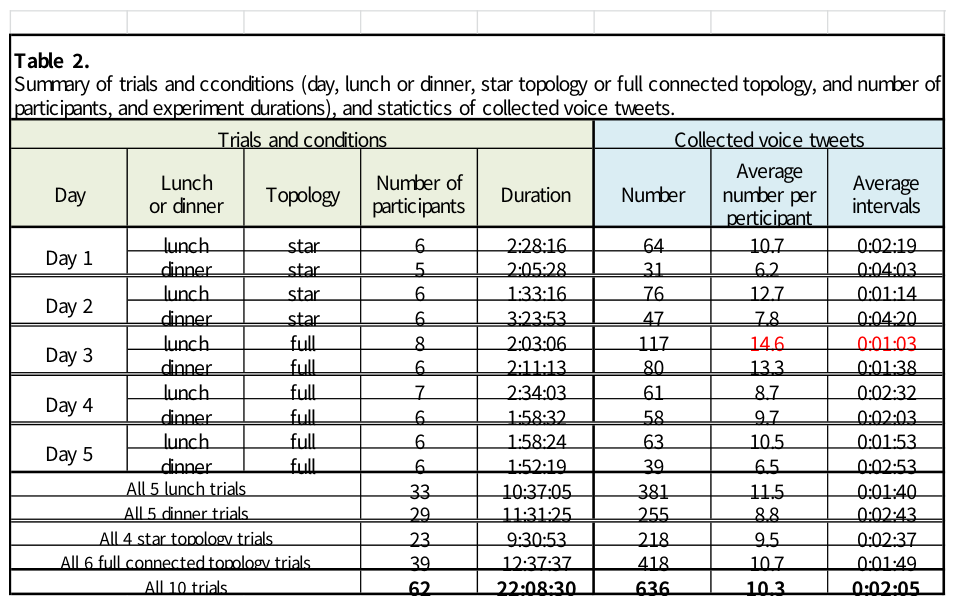
Table 2 summarizes the trials and conditions. During our field studies at the care facility, 10 trials of more than 22 hours by 62 participants (1,267 person-hours in total) were performed: 5 trials during lunch time and 5 trials during dinner time. The star topology was used for 4 trials, and the fully connected topology was used for 6 trials. Each trial involved 5 to 8 participants. In all, 62 participants took part in the experiment. The elapsed times of trials vary from just over 1.5 hours to nearly 3.5 hours, depending on how busy each meal was. Table 2 also summarizes the collected voice tweets, with 636 voice tweets automatically collected by the tested voice tweet system. The average number of voice tweets per person during a meal time was 10.3. The average interval between voice tweets was about 2 min. The computer-mediated remote communication by the voice tweet system during the lunch time trial on the day 3 can be regarded as the most active, since it had the highest average number of voice tweets per participant (14.6) and the shortest average intervals (1 min 3 s). The influence of topology on the collected voice tweets was relatively smaller than the difference between lunch time and dinner time. We conclude that the fully connected topology is better suited to the tested situations (i.e., tasks, physical environment, number of users, duties and distribution of staff, etc.).
Table 2: Summary of trials, conditions, and collected voice tweetsTable 2. Summary of trials and cconditions (day, lunch or dinner, star topology or full connected topology, and number of participants, and experiment durations), and statictics of collected voice tweets.
Table available in the original PDF paper.
Extracted elements of exchange structures
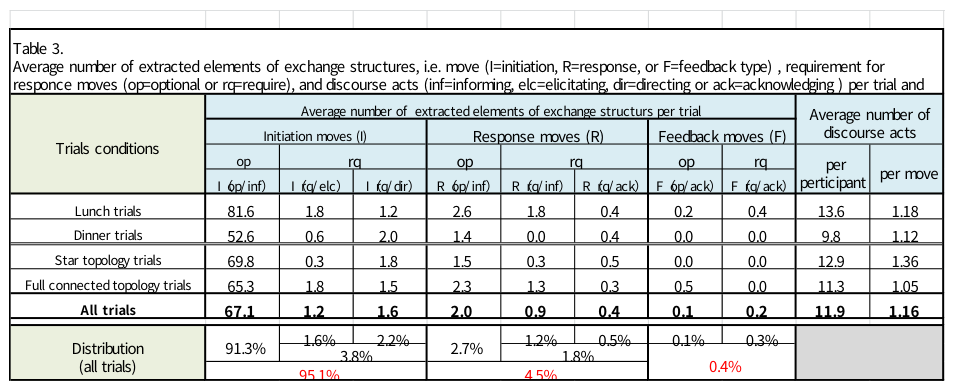
Table 3 summarizes the elements of exchange structures extracted from the 636 collected voice tweets. Because each voice tweet corresponds to a move in our model, 636 moves were extracted, as well as 735 discourse acts. Thus, each move contains 1.16 discourse acts on average. Almost all moves (95.1%) were classified as initiation. Most of the other moves (4.5% of total) were classified as response, and feedback was rare (0.4% of total). Although only a few (3%) of initiation moves without response required received one or more responses, almost half (46.4%) of initiation moves with response required received at least one response. This can be regarded as evidence for the validity of the voice tweet system in this task situation (i.e., computer-mediated remote voice communication among staff performing feeding assisting tasks at an elderly care facility). Almost all feedback moves appear as replies to response moves when no response was required, or as replies to additional (2nd or later) response moves for an initiation move. This may mean that the feedback move was used to express appreciation for the extra effort by the voluntary responders. In addition, all feedback moves were from a staff leader. Some of them may be positive rewards for extra efforts by responders.
Table 3: Summary of extracted exchange structures, moves, and dialogue actsTable 3. Average number of extracted elements of exchange structures, i.e. move (I=initiation, R=response, or F=feedback type) , requirement for responce moves (op=optional or rq=require), and discourse acts (inf=informing, elc=elicitating, dir=directing or ack=acknowledging ) per trial and
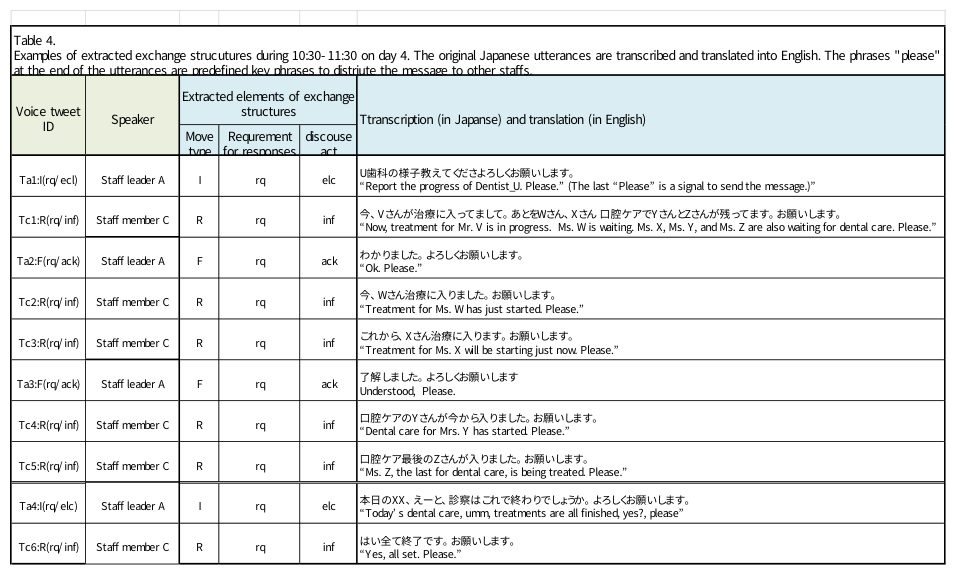
Examples of extracted exchange structures are shown in Table 4. Ten voice tweets (moves) uttered by two participants (staff leader A and staff member C) during 1 hour of lunch on day 4 are extracted. There are two initiation moves from A, 6 Response moves from C, and 2 feedback moves from A. Two sequences of initiation– response–feedback, and four sequences of initiation–response are formed by these 10 moves.
Table 4: Examples of extracted exchange structures.
Table available in the original PDF paper.
Table 4. Examples of extracted exchange strucutures during 10:30- 11:30 on day 4. The original Japanese utterances are transcribed and translated into English. The phrases "please" at the end of the utterances are predefined key phrases to distriute the message to other staffs.
Table available in the original PDF paper.
Figure 4 describes the same example of extracted exchange structures with the estimated physical movements of each staff member in the study field. The horizontal axis represents time of day, and the vertical axis represents the estimated location of each staff member. Short dotted lines denote physical movement of each staff member during the displayed time. Large red triangles denote initiation moves, large red circles denote response moves, and large red squares denote feedback moves. Long red dotted lines denote each sequence of moves that forms an exchange structure. As can be seen, in some included cases, the effect of one initiation move may persist for a relatively long time and initiate multiple exchanges. Especially in such cases, the positions of participants in one exchange structure may change during the course of the exchange. The voice tweet system is designed as a semi-real-time (i.e., asynchronous) communication system because the network connection quality between the server and each staff member may vary by location. In these examples, however, 2 feedback moves are sent almost immediately after a response move (within about 1 min).
Extracted exchange structures and estimated movements of staffers 3F Residents' rooms ->
Staff leader A Staff member B Staff member C Movement of staff Staff member D Staff member E Staff member F Ex1(Ta1:I(rq/elc)-Tc1:R(rq/inf)-Ta2:F(rq/ack)) Ex2(Ta1:I(rq/elc)-Tc2:R(rq/inf)) Ex3(Ta1:I(rq/elc)-Tc3:R(rq/inf)-Ta3:F(rq/ack)) Exchange structure
Ex4(Ta1:I(rq/elc)-Tc4:R(rq/inf)) Ex5(Ta1:I(rq/elc)-Tc5:R(rq/inf)) Ex6(Ta4:I(rq/elc)-Tc6:R(rq/inf)) Type of moves Initiation (I) Response (R) Fdeedback (F)
Figure 4. Example of extracted exchange structures and estimated movements of staff
Figure available in the original PDF paper.
CONCLUSIONS
This paper is one in a series about field studies at an elderly care facility in Japan. In this study, our voice tweet system was tested as a computer-mediated remote voice communication support system for staff. During the trials, the staff assisted with feeding tasks and sent voice tweets via the system to communicate with other staff members. During 10 trials at lunch and dinner times, 636 voice tweets were automatically collected by the system.
A new discourse model based on exchange structures is also proposed for use in analyzing the computer-mediated remote voice communication among the staff. The following insights were found by using the proposed model to analyze the collected voice tweets. Almost all moves (voice tweets) initiated an exchange. Most other moves served as responses. Moves were only rarely used for feedback. Some portion of responses and feedback may have been given in the usual face-to-face manner, rather than through the computer-mediated voice message system, because the staff members moved around the work site and had chances to meet. While only a few initiation moves without a response required received at least one response, almost half of initiation moves with a response required received responses. This can be regarded as evidence for the validity of the voice tweet system in this task situation (i.e., computer-mediated remote voice communication among staff performing feeding assistance at an elderly care facility). The usability of the proposed discourse model is also confirmed by finding complex sequences of computer-mediated remote voice communication that allowed achieving collaborative activities among the staff participants in the study.
FUTURE WORK
An integrated analysis to gain other insights and collect data such as staff interviews may be a useful project for future work. Application of the proposed discourse model to data acquired from other tasks, in this domain and in other domains, is another candidate for enlightening future work.
ACKNOWLEDGEMENTS
This study was conducted as part of joint research between the Toshiba Corporation, the Shimizu Corporation, and the Japan Advanced Institute of Science and Technology, and was supported by the Service Science, Solutions and Foundation Integrated Research Project Program of the Japan Science and Technology Agency under the Ministry of Education, Culture, Sports, Science and Technology, Japan.
REFERENCES
Alsos, O. A. (2010), “Awareness and usability issues in clinical CSCW systems”. In Proceedings of the 2010 ACM Computer Supported Cooperative Work (CSCW), pp. 501-502, Savannah, Georgia, USA. Bardram, J. E., & Bossen, C. (2005), “Mobility work: The spatial dimension of collaboration at a hospital”, Computer Supported
Cooperative Work (CSCW), Vol. 14, No. 2, pp. 131-160, Springer. Black, A. D., Car, J., Pagliari, C., Anandan, C., Cresswell, K., Bokun, & T, Sheikh, A.. (2011), “The impact of eHealth on the quality and safety of health care: A systemic overview”, PLoS Mecicine, Vol. 8, No. 1, e1000387. Chino, T., Torii, K., Uchihira, N., & Hirabayashi, Y. (2013), “Supporting Human Collaborative Works by Monitoring Everyday
Conversations”, In Clemmensen, T., Sandblad, B, Lopes, & A., Nocera, J., A. (Eds.), Proceedings of Workshop at INTERACT2013 - 14th IFIP TC13 Conference on Human-Computer Interaction, Past History and Future Challenge of Human Work Interaction Design (HWID): Generating Cross-domain Knowledge and Connecting Work Analysis and Interaction Design, ISBN: 978-0-620-58037-3, pp.22-27, INTERACT 2013, Cape Town, South Africa. Chino, T., Torii, K., Uchihira, N., & Hirabayashi, Y. (2013a), “Work and Speech Interactions among Staff at an Elderly Care Facility”, in: Campos, P., Clemmensen, T., et al. (Eds.)., Human Work Interaction Design, Work Analysis and HCI, pp. 35-45, Springer. Chino, T., Torii, K., Uchihira, N., & Hirabayashi, Y. (2013b), “Speech Interaction Analysis on Collaborative Work at an Elderly
Care Facility”, International Journal of Sociotechnology and Knowledge Development (IJSKD), Vol. 5, No. 2, pp. 18-32, IGI-Global. Coulthard, M., & Brazil, D. (1981), “Exchange Structure”, in: Coulthard, R., M., & Montogomery, M., M. (Eds.), Studies in Discourse Analysis, pp. 82-106, Routledge. Coulthard, M., & Brazil, D. (1992), “Exchange Structure”, in: Coulthard (Ed.), Advances in Spoken Discourse Analysis, pp. 50-
78, Routledge. Hendrich A., Chow, M., Skierczynski, B., & Lu, Z. (2008), “A 36-hospital time and motion study: How do medical-surgical nurses spend their time?”, The Permanente Journal, Vol. 12, No. 3, pp. 25-34. Hiraishi, K., Choe, S., et al. (2012), “Modeling of complex processes in nursing and caregiving services”, In IEEE International
Conference on Systems, Man, and Cybernetics, pp. 1449-1454, IEEE, Seoul Korea. Hollingsworth J., Chisholm, C., Giles, B., Cordell, W., & Nelson, D. (1998)., “How do physicians and nurses spend their time in the emergency department?”, Annals of Emergency Medicine, Vol. 31, No. 1, pp. 87-91. Isaacs, E., Walendowski, A., & Ranganthan, D. (2002), “Hubbub: A sound-enhanced mobile instant messenger that supports
awareness and opportunistic interactions”, In Proceedings of ACM Computer Human Interaction 2002, pp. 179-186. Lakshmipathy, V., & Schmandt, C. (2004), “SimPhony – a voice communication tool for distributed workgroups”, BT Technology Journal, Vol. 22, No. 4, pp. 52-61. Lee S., Tang, S., Park S. Y., & Chen, Y. (2012), “Loosely formed patient care teams: Communication challenges and technology
design”, In Proceedings of ACM Computer Supported Cooperative Work 2012, pp. 867-876. Lemonidou C., Plati, C., Brokalaki, H., Mantas, J., & Lanara, V. (1996). “Allocation of nursing time”, Scandinavian Journal of Caring Science, Vol. 10, No. 3, pp. 131-6. Richardson, J. E. (2008), “The effects of hand free communication devices on clinical communication: Balancing communication
access needs with user control”, In Proceedings of AIMA2008, pp. 621-625. Sinclair, J., & Coulthard, M. (1975), “Towards an Analysis of Discourse: the English Used by Teachers and Pupils”, Oxford University Press. Sinclair, J., & Coulthard, M. (1992), “Towards an Analysis of Discourse”, in: Coulthard (Ed.), Advances in Spoken Discourse
Analysis, pp. 1-34, Routledge. Tang, C., & Carpendale, S. (2009), “A mobile voice communication system in medical setting: Love it or hate it?”, In Proceedings of ACM Computer Human Interaction 2009, pp. 2041-2050. Tang, C., Carpendale, S., & Scott, S. (2010). “InfoFlow framework for evaluating information flow and new health care
technologies”., International Journal of Human-Computer Interaction, Vol. 26, No. 4, pp. 477-505, Tayler & Francis. Torii, K., Uchihira, N., Chino, T., & Iwata, K. (2012), “Service space communication by voice tweets in nursing”, in: Spohrer, C., J., Freund, E., L. (Eds.),Advances in the Human Side of Service Engineering, CRC Press. Uchihira, N., Torii, K., Uchihira, N., Chino, T., & Iwata, K. (2011), “Innovation for service space communication by voice tweets
in nursing and caring: Concept and approach in Japanese national project”, In Proceedings of 20th Annual Frontiers in Service Conference. Uchihira, N., Choe, S., Hiraishi, K., Torii, K., Chino, T., Hirabayashi Y., & Sugihara T. (2013), “Collaboration management by smart voice messaging for physical and adaptive intelligent services”, In Proceedings of PICMET2013, Technology Management in the IT-Driven Services.
LISTED IN THE AHFE DIGITAL BOOKSTORE CATALOGUE
Explore the complete digital volume
Advances in The Human Side of Service Engineering
Read this individual research paper free through the original publisher, or explore the full digital proceedings book.
ISBN 978-1-4951-2091-6
Explore this ISBN in the AHFE Bookstore ↗Listed in the July 2026 bookstore catalogue; search by ISBN to confirm current availability · Digital book purchase optional