Jung-Joo Lee, Tuuli Mattelmäki, Jaana Hyvärinen (2019). Bringing Empathy in Service Network. In: Advances in The Human Side of Service Engineering. AHFE Open Access, vol. 8. https://doi.org/10.54941/ahfe100255
In this paper we present recent cases where human-centered designers apply empathic design approaches for public service development. The public service development nowadays involves a complex network in which multiple organizations from different sector need to collaborate in order to provide more holistic and effective solutions for citizens. Collaboration in this complex network, however, is yet very challenging. In this paper, we explore the mindset and tools of empathic design as a potential approach to overcome this challenge. Based on two pilot projects carried out with a large municipality in Finland, we shed light on opportunities of empathic design in three aspects: firstly, in helping service developers see a holistic picture of the complex service structure and at the same time view it from individual actors’ perspectives; secondly, in engaging various actors in face-to-face dialogues and achieving a mutual understanding; lastly, in envisioning new ways of working in organizations through the small-scale experiments. These findings indicate new roles of empathic design for creating collaborative relationships in service networks. Discussions in this paper also include challenges of doing empathic design in public organizations.
We see more and more cases in which public organizations apply design thinking and service design in public service innovation. Design has been indeed recognized as a potential discipline to enhance citizen’s experiences with public service offerings and at the same time to ensure cost-efficiency of service development. Although both concepts being somewhat blurry, the core of design thinking and service design lie in human-centeredness, a holistic perspective to problem and an iterative process (for example, see Brown, 2009; Lockwood, 2010; Kimbell, 2011; Meroni and Sangiorgi 2011).
The situation, however, is not easy. Despite public organizations’ interests, design is not recognized in a strategic level, and thus the impact remains in a small scale. In addition, human-centred and co-creation approaches of design are not easily embedded in existing practices in public organizations (Bason, 2010). At the same time, designers are also lack of competences needed to work with public sector (TEM, 2013). Nowadays the public service development involves a complex network that constitutes of various organizations and individuals, including experts in various functional departments, partners from different sectors and citizens. The object of service design is extending from customers’ experiences at service encounters to a collaborative platform and service system where various actors could co-create new service concepts (Meroni and Sangiorgi, 2011; Patricio et al., 2011). Designer’s Human Side of Service Engineering (2019) challenges in this situation are then to understand a complexity of a service network, identify relationships of various actors and supporting their mutual understanding, and create a collaborative platform for the that is effective and citizen-oriented.
In this paper, we explore potentials of ‘empathic design’ for dealing with the abovementioned challenges. Empathic design was originally developed to enhance designer’s understanding of users in user-centered design, especially with the notion of ‘design for experiences’ in early 2000s (Fulton Suri, 2003b; Koskinen et al., 2003; Leonard and Rayport, 1997). Designers unfold the empathic design process where users could reflect on and express their personal experiences through visual, narrative and creative tools. Designers closely follow this process, in order to get access to how users feel and make sense of the world. In this paper, we introduce two cases where the empathic design approach was applied for public service development in Finland, expanding their role into bringing empathic understanding in a complex service network, beyond a dyadic relationship between users and designers. We will firstly review key principles and tools of empathic design that have original roots in design for experiences. Then we will look into current challenges of public service development in its complex network reported from earlier studies. The case studies will follow to illustrate how various empathic design tools can be applied to collaborative settings of public service development. We then discuss opportunities and challenges of doing empathic design in public service network based on the follow-up interviews with the project participants.
EMPATHIC DESIGN In late 90s, people’s emotions, subjective experiences and dreams and their links to design were addressed as key design topics (for example, Fulton Suri, 2003a; Jordan, 2000; Sanders and Dandavate, 1999). These human qualities are challenging to capture or pin down, and strongly bounded in contexts that are heterogeneous and dynamically changing. The cognitive, rational approach to users provides little support for that: A more holistic, embodied, social and interpretive approach was required. Empathic design emerged from this need, foregrounding human’s empathic ability to understand another person’s feelings and experiences as central for design. In contrast to ‘scientism’ and a cognitive approach in user-centered design, empathic design builds on an interpretive approach for making sense of how other human beings experience the world, with their bodies (not just the mind) situated in their own socio- cultural context (Koskinen and Battarbee, 2003).
One of the early writings on empathic design comes from the field of marketing. Leonard and Rayport (1997) framed empathic design as gathering ideas through observing users in situ. Very recently, Edvardsson et al.’s (2012) provided a good review on methods for customer integration in the service development, describing users as “a potential goldmine of information for service development, not only in the idea generation phase but throughout the development process (p.439).” While emphasizing the importance of customer integration, their view on empathic design is yet narrow in comparison to the contemporary empathic design practice and mindset. Although observation has been one of the key methods for understanding users in context, the array of methods is wide and collaborative approaches with empathic twist are gaining ground.
Having a shared ground with ethnography, empathic design goes beyond that. The empathic design mindset and activities are design-oriented, aiming to envision ‘what is possible’ in the future based on the understanding of ‘what it is now’. Tools used in empathic design thus often involve visual, tactile and creative components that help users project their experiences, imagine ‘what if’ questions, and envision the desired future. A core belief is that human experiences and emotions are not something that can be ‘mined’ and represented as bullet-point lists of user specification. Instead, they can be reflected through the process of visual, narrative or tangible creations (Sanders and Dandavate, 1999). Designers closely follow users’ creation process and build iterative dialogues with users to interpret their creations and responses together. The method of empathic probes, for example, unfolds a continuous dialogic process between designers and users: designers create tangible probe kits and deliver them to users, and users respond to them in a self-documenting manner (Mattelmäki and Battarbee, 2002). The process often continues with designers and users meeting again and interpreting the probe returns together. In so doing, designers accept their subjective position as human beings and balance their subjective interpretations of users with the objective reasoning (Koskinen et al., 2003). This helps to reduce the scientific gap between users and designers and to avoid the risk of user abstraction (Gaver et al., 1999; Gaver et al., 2003).
As co-design becomes popular in many business and organizations (Mattelmäki and Sleeswijk Visser, 2011; Sanders and Stappers, 2008; Steen et al., 2011), empathic design has also evolved towards co-design, providing tools and mindsets for diverse experts, beyond and in addition to users, to come together and collaborate creatively. While there are many variations of co-design (Mattelmäki and Sleeswijk Visser, 2011), the core belief is that people with no design training must contribute to design activities, be they users or stakeholders. Co-design processes support people with no design training to have empathic understanding of the existing situation and create ideas for the future – i.e. to become empathic designers on their own-, and the task of professional designers is to facilitate this process (Mattelmäki et al., 2014).
Co-design built heavily on collaborative workshops that brought together many kinds of stakeholders in different stages of the processes. This shift from users to a wider set of stakeholders and partners beyond product development context broadened the array of research topics from products to systems, to organizations, and to networks behind organizations. One of the main research programmes has been in exploring how to achieve a shared understanding among different stakeholders in networks and how could tools and mindsets of empathic design be found useful and applied in co-design and it applications. For example empathic design also explored design games (for example, Vaajakallio, 2012) and designerly approaches in the public sector (for example, Keinonen et al., 2013).
RECENT CHALLENGES IN PUBLIC SERVICE NETWORK Recently public organizations are recognizing that the bureaucracy is no longer a steering wheel that can solve complex problems in a current society (Winhall, 2011). They seek alternative approaches that can provide a solution-oriented platform for multi-disciplinary professions’ collaboration and place everyday people’s experiences at the center. Design is recognized as a potential discipline to meet these needs. Public organizations increasingly collaborate with design consultancies or universities to incorporate design thinking and service design in their internal systems and processes (for example, Bason, 2010; World Design Capital Helsinki, 2012; European Commission’s Innovation Policy).
Service development in a municipal context is characterized by multiple actors from different departments, and constraints and drivers that are political and organizational (Hakio and Mattelmäki, 2011). Coordinating their collaboration and making sense of such complexity are important. However, public organizations often have isolated departments (‘silos’), in which employees tend to focus on only a part of the service or an internal process (Steen et al., 2011). Different departments of a public body are used to function within their own silos rather than contribute to cross-functional collaboration projects. Furthermore, service systems are typically constructed with a number of organizations and individuals in a network, from various public service providers to private and third sector ones, from the ones who make decisions on service offerings to frontline staff members and end-users. The end-users can be regarded as a group of several people, such as a family with members having different needs. This isolated organizational practice and complexity of the service network make it very challenging to achieve an effective collaboration.
In this situation, we see empathy as a potential element to tackle these challenges for following reasons: Firstly, the empathic tools could bring end-users’ experiences to service developers and providers, for example, policy makers and various experts in organizations. As Wright and McCarthy (2008) explain, this can be achieved in two ways: a dialogue-based approach and a narrative approach. How these two approaches are taken can be explained with an example of different settings of co-design workshop. In a dialogue approach, empathic designers organize co-design gatherings, typically in a form of workshop, where service developers, partners and end-users meet face-to-face and are engaged in direct dialogues through visual and creative activities. In a narrative approach, empathic designers facilitate indirect user involvement guided through various kinds of tools such as representations, narratives or role-playing (Wright and McCarthy, 2008).
Secondly, it unfolds a creative collaboration setting for various experts from different departments in public sector to meet and build a shared understanding. In existing ways of developing public service, they do not necessarily meet Human Side of Service Engineering (2019) together. In the empathic design process guided through visualization, three-dimensional modeling or role-playing, they come to realize different perspectives and conflicts. And by going through the identified conflicts, they could achieve a mutual understanding of each other and a shared goal. In the context of public service development, end- users’ experiences can provide a ground for the service developers and providers to focus on and build a shared goal.
Lastly, in line with the abovementioned potentials, empathic design could bring changes into organizational practices and culture. Empathic design aims to resonate with people’s feelings and attitudes, rather than addressing only rational thinking. Visual and tactile components involved in empathic design tools could help employees in public organizations and partners realize their existing ways of working and assumptions so that they can reflect on them.
The organizational change through empathic design is a long-term process, though. Junginger and Sangiorgi (2009) explain that changing work patterns and mindset, and organizational norms and culture involves resistance and requires a long-term plan that consists of small-scale experiments and pilot projects. According to them, small-scale pilot projects can have a fundamental role to open the way to transformative changes, in a similar way to prototypes in a design process.
In following sections, we describe a series of small-scale design experiments as part of a bigger development project carried out with a municipality in Finland. Through these case studies, we unpack benefits of empathic design in public service network, especially in terms of the above-reviewed challenges.
DOING EMPATHIC DESIGN WITH A MUNICIPALITY Case 1: Orchestrating Different Perspectives through Design Games
Case 1 is one of pilot projects of a large municipality in Finland (later refereed as the City). The umbrella aim of the City is to create internal and external networks, which could support innovation driven by users at service encounters, including service partners in companies, frontline staff members and end-users. Public organizations more and more outsource to, and collaborate with, companies or community organizations for developing and offering services in a more effective and customized way. Thus it is very important to create a collaborative service system among public organizations, private companies, other relevant partners and end-user citizens.
The Case 1 describes the first pilot project for achieving the City’s goal. The focus of this pilot project, titled as the ‘Service Journey’, was to improve the service offerings and systems for small and medium-sized entrepreneurs in a social and healthcare area. The City was interested in design thinking and innovative methods for planning and facilitating collaboration with various stakeholders in the area. The ‘Service Journey’ project was launched as a joint effort with university research teams. The university research teams introduced co-design approaches with the empathic design mindset to challenge the conventional work culture of the City departments. Three co-design workshops were conducted, involving social and healthcare business entrepreneurs (customers), employees in the City departments (developers and providers), and other relevant partners such as service design consultancies to which the City has outsourced design work.
The goal of the first two workshops was to gather information and experiences from the current situation and to map out the expectations towards the new Service Journey project. The first workshop focused on social and healthcare entrepreneurs and there were fourteen entrepreneurs attending the session. The second workshop was organized for the employees of the City and ten officers participated in the workshop. In the third workshop, both parties, ten officers and fourteen entrepreneurs, were brought together to discuss and negotiate current issues raised from the previous workshops and to envision an ideal collaborative model and a service system and journey.
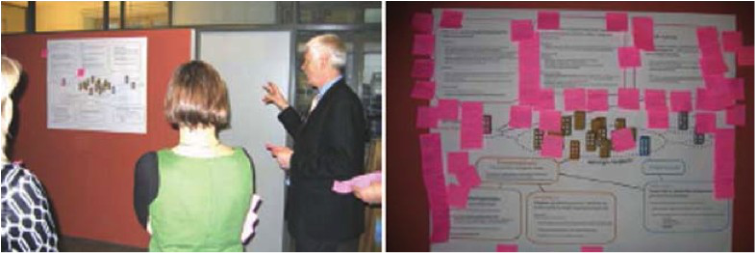
The biggest challenges appeared even before the workshops. The project team realized that there was a lack of communication among the project participants, not only service stakeholders but also the project researchers. In addition, unfamiliar terminologies used in the administration or in the design approach caused communication Human Side of Service Engineering (2019) problems. It was thus imperative to understand each other’s status of knowledge and expectations and build a mutual goal in the project. Therefore, the university design research team created a big poster of a stakeholder map, and different parties in the project team wrote time their expectations on the map. Through this exercise, the project team was able to understand each other’s expectations and roles much better, which led to set main objectives and scope of the project. This stakeholder map, visualizing the whole network and relationships, also helped the City employees realize missing parties who should be involved in the project.
Figure 1. Stakeholder map created by the project members for a mutual understanding before the project
(photo courtesy: Hakio and Mattelmäki 2011)
Another big challenge was to introduce empathic design tools to the project participants, especially the City employees. The City employees were not familiar with visual and generative tools, which could look far from a serious job. They had difficulties to draw a clear picture of the procedure and expected outcomes from the empathic design process, as they are used to take actions when the procedure and the expected outcomes are clearly defined. This gave them insecurity and skepticism towards the design tools. When co-design sessions were introduced through pictures and powerpoint presentations, the City employees had impressions that they look like a childish kindergarten play rather than professional and productive working. Issues related to trust towards facilitator’s competence, risk of losing individual’s credibility and face in the eyes of fellow co-workers, and fear towards unfamiliar methods emerged, too. The design research team then decided to organize a small exercise for the City employees to have hands-on experiences of those methods. The exercise partly clarified what would be done but the feeling of uncertainty was still present until the actual workshops were started.
All three co-design workshops were designed based on the design game structure (Brandt, 2006; Vaajakallio, 2012). Structure of rules of the design game, such as turn-taking rules or random effects, could challenge the norms of traditional meetings in the City organizations and encourage equal participation. In addition, the physical setting and interactions of design game were to encourage a playful and out-of-routine atmosphere, which could help the participants think and act out-of-box (Vaajakallio, 2012). As Sanders and Stappers (2008) framed design components as a ‘shared language’ in co-creation setting, the visual representations and tangible props used in the workshop could provide a shared language for various experts to express their perspectives and knowledge.
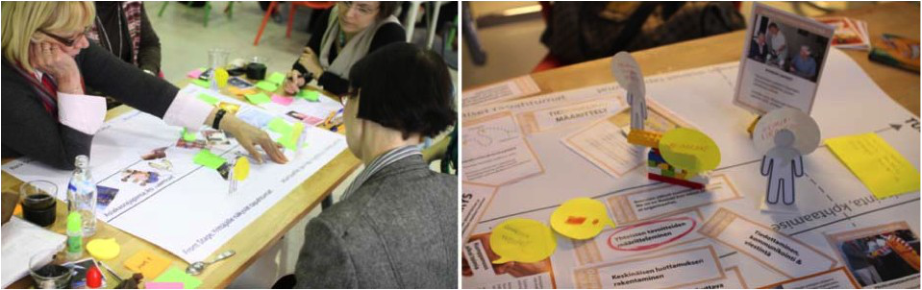
In the co-design workshop where the City employees and service customers gather together, the university design research team created a ‘Service Journey’ game. The game board was made based on the service structure, divided into three areas of the front stage, the encounters, and the back stage. The game board itself can be seen as a simplified application of the service blueprinting (Bitner et al., 2008). This was to help the participants deal with a complex service structure by walking through the game board with tangible props, such as cardboard human figurettes or image cards.
Figure 2. Service Journey game in co-design workshop (photo courtesy: Hakio and Mattelmäki 2011) The cardboard was to represent various actors in the service network. The workshop participants gave the figurettes names and personas like “Ollie the Officer” or “Ellie the Entrepreneur”. They placed the ‘character’ on different sections of the game board, while discussing various topics together. The game also included visual props in forms of photo cards that could be used as placeholders of metaphors for the service development e.g. lighthouse. They also made notes on cards about various actors’ experiences, perspectives and concerns and place them on the game board. We found that this service journey game helped the participants have a holistic view to the complex service structure, otherwise hard to grasp. At the same time, walking through the service structure with the persona figurettes together with other participants helped them understand the service structure and the journey from individual actors’ perspectives.
Case 2: User’s Experiences as a Shared Ground through Empathic Probes Our second case is another small-scale experiment with the City, which continued after the first case. This project, titled ‘Client-centred Service Network’, had three aims; firstly, to develop an individual-centred care managing system that aims to shift the focus to the client’s perspective: secondly, to experiment personal budget planning that would give more freedom for citizens to choose relevant services; lastly, to create a new kind of service network at the local environment that would support both aims above and at the same time create synergies between the local entrepreneurs and other actors.
The project focused on senior citizens services, especially in care families in which one needs care, for example, has dementia, and the other is officially named as a caregiver. These families are entitled to financial support for particular services that have been decided by the municipal care manager. The aim of this project was to create a system in which various services can be more flexibly offered from the network of public and private sector as well as third sector. It was to help families find a relevant service from the complex ‘jungle of service’. In the long run, the project aimed to empower families to better manage their own wellbeing, being introduced with multiple options and flexible systems.
In the beginning of the project, the external service design consultancies provided written persona descriptions and video clips of families for the project participants to understand needs of service customers. However, the university design research team found that these kind of representations have limitations to bring family’s everyday experiences, concerns and dreams to the service providers, especially when a system and a context of service offerings are complex. For example, the development of social and healthcare services for seniors can also consider their easy access to transportation such as taxi services. The university design research team introduced empathic probes (Mattelmäki and Battarbee, 2002) for more intimate and personal dialogues with them. The City employees from various departments were involved to design the probe tasks and questions. In this making process of empathic probes, the project teams were able to coordinate their objectives and interests, too. The probes kits consisted of a diary, workbooks with mapping exercises, drawings and writing stories to open-ended questions, such as;
I am exhausted. From where could I get support for my wellbeing?
The ground for wellbeing, what is it made of? Human Side of Service Engineering (2019)
Things that keep my spirit lively
Things I want to do in my life
I miss from my past…
Our hobbies and interests before and now The probes kits were filled by volunteering care families. The families expressed their everyday routines, joys, opinions and challenges in a surprisingly honest and touching way through the empathic probes. For example, some family carers even revealed issues that were difficult to speak aloud such as feeling of being a ‘prisoner’ at home, or the sadness of seeing the character of a spouse transforming into unfamiliar. The probe returns revealed that the service network appeared to the families quite fragmented.
In addition to the abovementioned tasks for collecting users’ everyday lives, the probes workbook also contained short stories that describe ideas for future services, which have been discussed within the City. The stories presented service ideas such as the digital service platform, new service interactions with care managers and the service card. The service card was actually prototyped with cardboard paper and included in the probe kits to help the care families imagine how it would be like to use the service card like a credit card. In this sense, the empathic probes in this project served as a vehicle to introduce possible service ideas to the customers and collect their responses to them early on.
To share the insights from the probes returns and generate future ideas based on them, a co-design workshop was organized by the university design research team. The care managers and various stakeholders in the service network participated in this workshop. For the co-design workshop, the university design researcher made drawings of the everyday life of the families to communicate emotional aspects of the care families in a more vivid and empathic way. The drawings aroused emotional responses from the City participants and made them rethink what were the real needs of the families. These drawings and other visualizations made out of the probe returns functioned as shared grounds and languages for different parties to set a shared goal and generate ideas together.
Through the collaboration with the families through the probes, twofold roles of the empathic probes were identified: Firstly, the process of probing helped the families to open up both more general and specific challenges and to prioritize and point out the kind of services they needed; Secondly, the probing also supported the municipal care manager to see the reality beyond the official and professional viewpoint and adjust the service offering accordingly. In the evaluation report of the project, the probes were seen as the most innovative opening towards new practices in service development. Currently, based on the probes experiment, the tool and the process, named as service probes have been adjusted according to the feedback. The tools have been used in 33 families and the aim is to spread this practice wider in the future. While the probing activities as such did not support the whole network, it concretised the human-centeredness in the large service network and the potentials of design approaches for rethinking what is meaningful (Fulton Suri, 2003b).
OPPORTUNITIES AND CHALLENGES OF EMPATHIC DESIGN IN PUBLIC SERVICE NETWORK After these two projects, the follow-up interviews were conducted to investigate how the project participants, especially the City employees, evaluated the project and what kinds of influences the projects created. In this section, we discuss opportunities and challenges of doing empathic design in public service network based on our observations during the projects and the interview results. The interview quotes presented in this paper were originally in Finnish but translated in English by authors.
Holistic and Tangible Understanding of the Complex Service Network In the Case 1, we found that the design game structure with visualizations of the service structure, the persona figurettes, and interaction rules helped service developers see an overall picture of the complex structure of the public service. What is more important, they were able to understand the service structure not just through rational Human Side of Service Engineering (2019) reasoning from the bureaucratic perspective, but rather through immersed experience from various individuals’ perspective. This immersed, empathic understanding in a make-believe setting of the design games and props has been reported in recent studies on empathic design (for example, see Mattelmäki et al. 2014, Vaajakallio 201). On one hand, the visualization of the service structure as a game board enabled the service developers to make sense of how the current service system functions and various actors interact in the system. On another hand, their actions of touching and moving tangible human figurettes around the make-believe setting while discussing roles of various actors and their experiences, allowed them to indirectly experience the service structure through individual humans’ point of view.
Bringing Customers’ Experiences in the Network as Glue In the Case 2, the City employees were able to have a better understanding of what actually matters for the care families and how they experience the existing services. In the follow-up interview, one City employee talked about the strengths of the probes kits and his motivation to use it in his future work.
“In these probes kits I found several issues from familiar customers, which I did not know before, even though I have worked with the customers. The probes kits helped to better understand the customers’ real situations. When the social department of the City offers services that the customer does not want, a tool like the probes can help in understanding the reasons why. (an employee from social services department of the City)” In the further process that followed the probes in the project, customers’ stories and experiences brought by the probes provided a shared ground for the City employees and other stakeholders to make decisions together. For example, in the co-design workshop after the probes, idea generation and elaboration oriented to customers’ experiences. In other words, this shared understanding of customers worked as glue for collaboration in the service network.
Towards a Creative Collaboration Platform In the development of public service network and offerings, it is crucial to bring the ‘backstage’ components for planning. In the two case studies, the empathic design tools proved useful to bring people from different organizations together, challenging the organizational boundaries and breaking the existing professional conventions. As one of the most meaningful benefits, according to the interviews, the co-design workshops created a collaborative platform that engages various people in face-to-face dialogues. It brings people together. These people had not necessarily met during the decision-making processes in their traditional practices. One manager from the City expressed her wish for more face-to-face meetings with other departments.
“We should gather more often with the other departments. There have been only a couple of sessions of management’s education (with the aim of developing the cross-functionality). Already before it was seen problematic that the middle management does not meet each other. Middle management, however, is the unit that operates things in the city…There does not exist a forum for departments’ middle managers to socialize, where they could exchange experiences and familiarize with the practices of other units. Many things could have been done in a more agile way if we knew what the others were doing (a service manager from Social Services Department of the City).”
In the Case 1, the design game provided an opportunity for various people from different organizations and status, with different knowledge, to meet together and bring their voices to the table. The service users – i.e. entrepreneurs, and the employees of the City were given a chance to express their opinions and created shared goals. The structure, rules and props of the design game encouraged an equal participation among project managers, the City employees and business entrepreneurs. The open and creative atmosphere of the workshop setting faded the formal roles and built informal roles (Hakio et al., 2011). When the participants from different departments of the City became familiar with each other, they were able to start discussing the concrete proposals for improvements rather than concentrating on accusing different parties about the problems of the current situation. As a result of these discussions, the participants identified other missing parties that should be involved in the project, such as politicians and higher-level decision-makers.
Resistance and Skepticism Human Side of Service Engineering (2019)
While seeing potentials and interests, the two case studies revealed the resistance towards empathic design approaches in public organizations and their skepticism of applying them in their everyday work. The mindset of empathic design that is experiential, human-scale, experimental and iterative is still foreign to most people working at public organizations. This observation also resonates with the challenges recently reported from collaborative design projects with public sector (for example, see Vaajakallio et al., 2013).
Time pressure also challenged people’s ability and willingness to participate. Furthermore what is once experienced as fresh and innovative does not cause similar reflections if used routinely. The issues of how to motivate the employees to participate in such collaborative activities from the first place and whom to involve were also addressed in the interviews; “A system where official invitations are sent from the upper level does not work any more. Then it leads to having people involved that are not interested in the project, but they come to sit in the meetings because of their position. Position does not lead to engagement but interests in doing together and making changes do. People who are enthusiastic and bring their own competences are needed (a project manager from Social Services Department of the City).”
In everyday practices in organizations, it is easy to go back to the conventional way of working to deal with tasks at hand, as one of the City employees well puts it;
“I have felt that people would like to do more but they face some self created guideline or regulation that prohibits doing it. People would like to be involved but then you face that we cannot do this or this is not our basic objective. Or, that there are no resources.”
CONCLUSION
In this paper, we discussed how empathic design tools could be applied to the development of public service network through two case studies. Extending from their original aim to enhance designers’ understanding of users experiences in a dyadic relationship, the potentials of empathic design tools for enhancing mutual understanding and solution-oriented collaboration among different parties in the service network were discussed. In the two case studies carried out with the municipality in Finland, empathic design in form of a co-design workshop could unfold a physical setting that different parties meet and have face-to-face interactions. Empathic design tools like the empathic probes brought users’ experiences and stories to the collaboration setting so that the service developers and partners could have a better, ‘empathic’ understanding of their customers and use this understanding for collaboration.
In addition, we also aim to explore empathic designer’s new role as a facilitator for empathic and creative collaboration in complex service networks. Although we see potentials and opportunities, doing empathic design in public sector and networks around it is still very challenging as our observations indicated. To enable a change in public sector and its collaboration with other partners to a more human-centered and creative way, designers should have better strategies and knowledge of how to bring changes to organizations. Collaborative projects with public sector, like the two case studies presented in this paper, can be considered as experimentation for designers (Sangiorgi, 2011; Junginger and Sangiorgi, 2009).
As Junginger and Sangiorgi (2009) suggest, the changes can start from artifacts level. Adopting tools might be a small change in a peripheral level, but as the experiences accumulate, it can also continue to bring more fundamental changes in their ways of working and mindsets, and in the long run, organizational culture. In addition, it was not only for the public sector to try out service design, but for the designers to become familiar with the organizational process in public sector, gain trust and become part of a network.
REFERENCES
Bason, C. (2010), Leading public sector innovation. Co-creating for a better society. Bristol, UK: Policy press. Bitner, M.J., Ostrom, A., L., and Morgan, F.,N. (2008), Service blueprinting: A practical technique for service innovation, California Management Review. 50(2). Brandt, E. (2006), Designing exploratory design games: A framework for participation in participatory design, In Proceedings of
the ninth Participatory Design Conference 2006, ACM Press. Brown, T. (2009), Change by Design. How Design Thinking Transforms Organizations and Inspires Innovation. New York: Harper Collins Publishers. Edvardsson, B., Kristensson, P., Magnusson, P., and Sundström, E. (2012), Customer integration within service development—A
review of methods and an analysis of insitu and exsitu contributions. Technovation, 32, 419-429. European Commission’s Innovation Policy http://ec.europa.eu/enterprise/policies/innovation/policy/design-creativity/ index_en.htm Fulton Suri, J. (2003a), The experience of evolution: developments in design practice. The Design Journal, 6(2), 39-48. Fulton Suri, J. (2003b), Empathic design: Informed and inspired by other people’s experience. In: Koskinen, I. et al. (eds.)
Empathic Design. IT-press. Helsinki, 51-59. Gaver, B., Dunne, T., and Pacenti, E. (1999), Cultural probes. Interactions, January–February: 21-29. Gaver, B., Boucher, A., Pennington, S., and Walker, B. (2003), Subjective approaches to design for everyday life, CHI Tutorial, London, England. Hakio, K., Jyrämä, A., and Mattelmäki, T. (2011), Public Service Journeys – the introductions of networks and co-design, In
conference of Naples Forum on Service. Hakio, K., and Mattelmäki, T. (2011), Towards customer centric services: Suspension of expectations and trust. experience narrative. In Proceedings of Participatory Innovation Conference (PINC’11). Jordan, P. W. (2000). Designing pleasurable products : An introduction to the new human factors. London: Taylor & Francis. Junginger, S., and Sangiorgi, D. (2009). Service design and organizational change: Bridging the gap between rigour and
relevance. In Proceedings of IASDR 2009. Keinonen, T., Vaajakallio, K., and Honkonen, J. (2013), Designing for wellbeing. Helsinki: Aalto Arts Books. Koskinen, I., and Battarbee, K. (2003), Introduction to user experience and empathic design. In: Koskinen, I. et al. (eds.)
Empathic Design. Helsinki: IT-press, 37-50. Kimbell, L. (2011), Designing for service as one way of designing services. International Journal of Design, 5(2), 41-52. Koskinen, I., Battarbee, K., and Mattelmäki, T (2003). Empathic Design. Finland: IT Press. Leonard, D., and Rayport, J.F. (1997), Spark innovation through emphatic design. Harvard Business Review, Nov-Dec, 102-113. Lockwood, T. (2010), Design thinking: Integrating innovation, customer experience and brand value. New York, NY: Allworth Press. Mattelmäki, T., and Battarbee, K (2002). Empathy probes. In Proceedings of PDC 2002, 266-271. Mattelmäki, T., Vaajakallio, K., and Koskinen, I. (2014), What happened to empathic design? Design issues 30(1), 67-77. Mattelmäki, T., and Sleeswijk Visser, F. (2011), Lost in co-x: Interpretations of co-design and co-creation, In Proceedings of
IASDR 2011. Meroni, A., and Sangiorgi, D. (2011), Design for services, Surrey: Gower Publishing Ltd. Patricio, L., R. P. Fisk, J. Falcao e Cunha., and L. Constantine. (2011), Multilevel service design: From customer value constellation to service experience blueprinting, Journal of Service Research, 14 (2), 180–200. Postma, C. E., Zwartkruis-Pelgrim, E., Daemen, E., and Du, J. (2012), Challenges of doing empathic design: Experiences from
industry. International Journal of Design, 6(1), 59-70. Sanders, E. B.-N., and Dandavate, U. (1999), Design for experiencing : New tools. In Proceedings of the first international conference on design and emotion, 87–92. Sanders, E.B.-N., and Stappers, P.J. (2008), Co-creation and the new landscapes of design. CoDesign, 4(1), 5-18. Sangiorgi, D. (2011), Transformative services and transformation design, International Journal of Design, 5(2), 29-40. Steen, M., Manschot, M., De Koning, N. (2011), Benefits of co-design in service design projects. International Journal of
Design, 5(2), 53-60. TEM Ministry of Employment and the Economy report 2013 (2013) Vaajakallio, K. (2012), Design games as a tool, a mindset and a structure. Doctoral dissertation, Aalto University, School of Arts, Design and Architecture. Vaajakallio, K., Lee, J.J., Kronqvist, J., and Mattelmäki, T. (2013), Service co-design with the public sector: Challenges and
opportunities in a healthcare context. In Proceeding from the Include Asia 2013. Winhall, J. (2011), Designing the next generation of public services. In: Meroni, A., Sangiorgi, D. (eds.) Design for Services, Gower, UK, 131-138. World Design Capital Helsinki 2012 http://wdchelsinki2012.fi/en/wdc-helsinki-2012 Wright, P., and McCarthy, J. (2008), Empathy and experience in HCI. In Proceedings of CHI 2008, New York, NY: ACM Press,
637-646.
LISTED IN THE AHFE DIGITAL BOOKSTORE CATALOGUE
Explore the complete digital volume
Advances in The Human Side of Service Engineering
Read this individual research paper free through the original publisher, or explore the full digital proceedings book.
ISBN 978-1-4951-2091-6
Explore this ISBN in the AHFE Bookstore ↗Listed in the July 2026 bookstore catalogue; search by ISBN to confirm current availability · Digital book purchase optional