Chen-Fu Yang, Chih-Shiang Wu, Yin Gong, Tung-Jung Sung (2019). Transformative Service Design: From Technology to Dechnology. In: Advances in The Human Side of Service Engineering. AHFE Open Access, vol. 8. https://doi.org/10.54941/ahfe100262
In recent years, the development of service design has increasingly focused on the issue of “transformation.” Design can not only be treated as a driver of user-centered and demand-oriented innovation, but also plays a key role in the business innovation process, value co-creation by multi-functional teams, and the derived business transformation. This study focused on Taiwan’s largest R&D organization – the Industrial Technology Research Institute (ITRI). Since 2010, the ITRI has adopted “design” in innovation processes through the Dechnology (Design + Technology) project, gradually transforming the R&D process revolved around technology, into a value co-creation model through design, technology, and business. Meanwhile, during the transformation process, ITRI has strived to make changes in knowledge transfer and behavior patterns so that organizational capabilities can be enhanced. Through in-depth interviews, non-participant observation, and literature reviews, this study explores the critical success factors for multidisciplinary value co-creation during the process of change. Finally, this study proposes a Dechnology conceptual framework integrated with service design to serve as an important reference for businesses that undergo similar innovation projects and transformation management in the future.
In response to the rapidly changing market and global environment, most businesses generally recognize the important role of "innovation" in creating customer value and improving organization competitiveness (Rowley, Baregheh, and Sambrook, 2011), while some businesses are committed to finding a model that can maximize innovation management effectiveness (Christiansen and Overdorf, 2000). Past research indicates that in order to obtain more opportunities for commercialization, the era when companies solely rely on technology push (Schumpeter, 1934) or market pull (Schnookler, 1966) to carry out innovation has gradually receded; instead, different stakeholder engagement (Gummesson, 2008; Mele, Spena and Colurcio, 2010; Rothwell, 1994), user- oriented design thinking, and taking the standpoint of open innovation (Chesbrough, 2003; Schenker-Wicki, 2012) are required. However, how to effectively attract shareholders to participate in value co-creation during the process of change is a major challenge for businesses in terms of organization operation and management (Gould, 2012).
In general, the main objectives of service design are not only to consider user-centered design, but also explore how different stakeholders can co-create value in the service process (Frow and Payne, 2011; Sangiorgi, 2010). Service design has increasingly focused on the key issue of "transformation" in recent years (Sangiorgi, 2010); however, when carrying out change in innovation models, there is not much exploration regarding what challenges might arise or the key success factors the organization should have. For this reason, this study will focus on Taiwan's largest R&D organization - the Industrial Technology Research Institute (ITRI). Due to the rapid changes in industry structure and market demand, ITRI faced the “technological valley of death” that many other R&D organizations have currently encountered. In 2010, with the support of Taiwan’s government, ITRI imported the notions of "multidisciplinary design" and "value co-creating" in the R&D process through the Dechnology (Design + Technology) project. Therefore, ITRI’s R&D strategies, which were originally mostly technology orientated, went from value up technology (T) through design (D) in the first stage (2010 -2012) to the second stage (2012-2013) transformation process where stakeholders from multiple-forces – the technical aspect (T), design aspect (D), and business aspect (B) participate in value co-creation.
Based on past research, this study will explore the challenges faced by R&D organizations when they progress toward open innovation. Furthermore, it will also focus on the two innovation models developed in the second stage (2012 - 2013) of the Dechnology project, including: 1) multidisciplinary commercialization design workshops and 2) thematic user-oriented design. Through in-depth interviews, non-participant observation, and data analyses, this study will analyze the challenges faced during implementation of the two types of innovation models. Finally, as for design (D), technical (T), and business (B) stakeholders in the value co-creation process this study will present the key success factors that include: 1) breakthrough ideas searching and importing, 2) technology screening and translation, 3) concrete incentives for multidisciplinary stakeholders, 4) multidisciplinary communication, and 5) continuing thematic exploration of innovative ideas. Moreover, as for technology-orientated businesses or businesses that want to advance from an OEM model, this study proposes a conceptual Dechnology innovation model as important references for businesses that undergo similar projects in the future.
LITERATURE REVIEW
Three Forces of Innovation Some studies (Schumpeter, 1934; Trott, 2005) highlighted that innovation is the process of transforming ideas into commercial value, and is an important means for businesses to create customer value and improve competitiveness as well. Yet, how to drive innovation to create market value remains in question that the academic field and businesses are concerned with. Past studies (Khilji, Mroczkowski, and Bernstein 2006; Rothwell, 1994; Saidi, 2011) advocated a transformation from a linear model to a non-linear model; simply put, innovation does not rely on a single resource and direction, it relies on the mutual stimulation of "technology push" and "market pull" to search for future possibilities.
However, past research (Verganti, 2009) indicated that technology substitution through technology push, or innovation purely from the point of view of customer demand is often incremental, and rarely results in radical innovation. Meanwhile, with the advent of the knowledge economy and experience economy eras, consumers are increasingly focused on emotional and socio-cultural products (Verganti, 2009). Therefore, more and more companies focus on semantic dimensions and employ design, symbols and emotional messages to guide the new meaning of things (Battistella et al., 2012; Dell'Era & Verganti, 2009). And, Verganti (2003) proposed a third innovation model called "design-driven innovation" that stresses that design is making sense of things. In order to create new meaning or radical innovation, businesses should not only use market/technology research, but also deeply observe social context and people's needs from design viewpoint to obtain innovation knowledge design ideas.
In terms of the innovative drive created by technology, market and design, it is consistent with the Design Thinking proposed by the famous design consultancy company IDEO. Brown (2009) considers that innovation should emphasize technology feasibility, business viability, as well as human value and desirability. Therefore, this study believes that when organizations are undergoing innovation, they should also consider technology push, market pull, and design drive, and create usable, desirable, and feasible products or services through multidisciplinary interaction. Nonetheless, especially for R&D (technology-oriented) organizations, what management methods should be imported to successfully introduce different external innovative resources and create multidisciplinary cooperation possibilities are the main challenges (Brem and Voigt, 2009; Panne, Beers, & Kleinknecht, 2003).
The Challenges of Open Innovation and Value Co-Creation In general, most technology-oriented companies usually focus on technical units or related expertise and lack market and design energy. Therefore, it is crucial for them to effectively use technology push, market pull, or design-driven forces to improve innovation performance is to import "open innovation" in the R&D process (Inauen and Schenker- Wicki, 2012). Chesbrough (2003) defined open innovation as a model that companies should utilize internal and external ideas or resources to search for ways to enter the market. He further proposed two main models, including: 1) "outside-in" – where businesses search for new ideas, technology, or knowledge from outside, and; 2 ) "inside- out" – where businesses take internal ideas and technology and go out to find opportunities for commercialization (Chesbrough, 2003; Inauen and Schenker-Wicki, 2012).
Inauen and Schenker-Wicki (2012) argued that the open innovation model is based on an assumption that innovation does not have to occur at the same location or organization. Binder, Löwgren, and Malmborg (2008) highlighted that businesses must break organizational boundaries to pursue multidisciplinary or cross-organization value co-creation. In addition, Sander and Stappers (2008) emphasized that "value co-creation" means any two value co-creation members undergoing co-creation activities, and members may include experts with relevant experience, such as customers, designers, and other stakeholders, etc. Finally, past studies (Hoyer, Chandy, Dorotic, Krafft, and Singh, 2010; Kristensson, Matthing, and Magnusson ,2002) suggested that value co-creation can not only enhance the value contributions of customers or other stakeholders, but also improve business implementation efficiency and effectiveness and plays an important role in the process of business product and service innovation.
Generally speaking, now value co-creation through open innovation is an important issue in transformation management. In the same time, open innovation might also bring challenges and potential risks (Gould, 2012). First, because value co-creation is built through multiple network relationships, how to construct appropriate co-creation relationships, cooperation models, and incentives to satisfy the needs of different stakeholders is very crucial (Prahalad and Ramaswamy, 2004). Moreover, Hoyer et al. (2010) proposed other risks of co-creation including weakened project control due to the introduction of external forces or heightened project complexity. The above may all increase additional communication costs when organizations are undergoing innovation, and requires new management skills and methods to respond. Therefore, in open innovation and multidisciplinary value co-creation, whether there are other corresponding key success factors is an important issue this study hopes to explore.
CASE STUDY ITRI with the Dechnology Project
The Industrial Technology Research Institute (ITRI) was founded in 1973, and is not only Taiwan's largest R&D organization; it is a pioneer in building Taiwan's semiconductor industry as well. It has spawned world leading semiconductor manufacturers including UMC, TSMC, and Taiwan Mask, etc., and has laid the foundation for Taiwan's IC industry. Since its foundation (40 years), it has cultivated 70 CEOs of large enterprises, 225 companies, and has accumulated more than 19,000 patents. It is without saying that ITRI is one of the business representatives in technological innovation in the world. However, in recent years due to rapid changes in external market demand, and the desire to put behind the traditional manufacturing and the OEM way of thinking, the innovation demands of businesses have started to lean toward demand-orientated application innovations instead of simply considering technology, efficiency, and low costs. The ITRI’s past methods of supporting innovative energy with "technical push" has reached a bottleneck, including the lack of patent commercialization and misplaced human and organizational resources, so it began to seek for change through innovative thinking and strategies.
Figure 1 ITRI's three stages of innovative transformation through the Dechnology project Since 2010, ITRI initiated the “Dechnology" project with the support of Department of Industrial Technology. This project aims to combine Taiwan's abundant local design and the advanced technology of ITRI (total eight R&D institutes) to develop products and services. The term "Dechnology" was created to represent this project. During 4 years, over 120 technologies have been included in this plan and it has cooperated with over 300 designers and 40 businesses. Moreover, it also won 23 iF International Design Competition awards, and produced numerous innovative designs successfully commercialized. However, in a traditional technology orientated R&D institution like ITRI, the technical aspect often controls resources and the right to speak, and it is difficult for non-technical fields to influence R&D or to lead innovative directions. Therefore, in the implementation of Dechnology’s first two stages, ITRI has tried different multidisciplinary and co-creation models (as Figure 1) to find possible answers to improve open innovation or value creation efficiency.
The Dechnology Project - the first stage In the implementation process during the first stage of the Dechnology project (2010~2012), through value up ITRI technology (T) by design (D), it established three innovation models including: 1) open competition; 2) collaborative design; 3) design outsourcing. Related content is described as below:
Open Competition As for the technologies in ITRI with low maturity or those still searching for innovative application possibilities, these types of technologies were arranged into the “IP
id – open competition" of Dechnology project. Through the competition, the ITRI technology teams were asked to openly explain technical content and provide related information online. In addition, by cooperating with local design organizations, external designers could understand specific technology projects and propose design concepts, and finally, multidisciplinary specialists selected the proposal with the most development potential. ITRI technology teams then collaborate with these competition winners.
On one hand, the advantage of open competition is that a lot of different innovative concepts could be collected in a short time, and even new ideas for R&D could be provided (Surowiechi, 2004). On the other hand, because designers and the R&D teams lacked in-depth and two-way communication, even if the designers read the technical information, they sometimes were unable to fully understand the technical application limitations and content. Consequently, in the design process, they only depended on their own interpretation of technical knowledge and contents, and often resulting in technical misuse or misunderstanding. Furthermore, the competitions’ judges could only make assessments from images and brief explanations by designers, and frequently lacked market validation or user’s feedback. Therefore, even if concepts won awards, the probability of success in follow-up commercialization was still not high.
Collaborative Design Furthermore, the "collaborative design" of Dechnology recruited external designers to ITRI to participate in a new product development projects. The project provided a longer project cooperation time (around six months), similar to "stationing" in R&D teams, and was aimed at providing an in-depth co-creation environment to search for technology innovation design opportunities. Thus, designers could work together with the technical units to select suitable technology topics and have adequate discussions and exchange in the process with their respective design and technical knowledge. Therefore, the R&D team could better understand the innovative thinking of designers, and similarly the designers could also deeper understand the core technical content and application limitations. This kind of arrangement didn’t only overcome many difficulties in multidisciplinary collaboration, but increase the opportunity of finding innovative possibilities as well. To sum up, the success rate of commercialization after transferring to businesses was higher than the open competition.
However, when designers entered into R&D teams, some technical specialists often already established certain technology development ideas or direction, and the designers were limited in selecting technology or undergoing creative thinking (such as only positioning designers as working on exterior design); or when the designers had innovative ideas, technology maturity was not high enough, or more resources and time were required to conduct corresponding research and development, leading to the inability to further implementation of good ideas. Finally, under this model, whether the innovative ideas could be commercialized was dependent on if it could be combined with business and market considerations.
Design Outsourcing Due to the lack of internal design resources and manpower in ITRI; therefore, for the technology aspect, if there were types of technology with clear development direction, they would conduct "design outsourcing." According to Venkatraman's argument (2005), when investigating the reasons general companies use design companies for development, they found that reasons mainly include: 1) design prototypes to demonstrate technology; 2) enhance product value through design; 3) understand if there are new product application possibilities from the perspective of design through outsourcing design. However, for R&D units, how to choose suitable design companies to cooperate with among the large number of design companies with different expertise and services, and to play out the true value of design in innovation (not just the exterior or packaging design) is the challenge of this model.
The Transformation of the Dechnology Project With the implementation and verification during the first stage of the Dechnology project, there was an output of over 300 innovative design concepts in 2 years, but it also faced the challenges of further "commercializing" creativity and how to attract different stakeholders to continue participation. Furthermore, through another internal study (Hung & Huang, 2013) we had discovered that technical screening and translation, importing business perspectives, user-oriented design, and incentive plan were important keys in the sustainable development of the projects and the success in commercializing results. Based on this, through importing Design Thinking and Service Design’s 4Ds Process (Discover, Define, Develop, and Deliver) in 2013, Dechnology project further advanced from the original interaction between external designers (D) and internal technology teams (T), and added external business teams (B) to the ranks of co-creation. That led to the second stage of Dechnology project (2012 to 2013), establishing: 1) multidisciplinary commercialization design workshops; and 2) thematic user-oriented design models.
The Dechnology Project - the second stage Multidisciplinary Commercialization Design Workshops
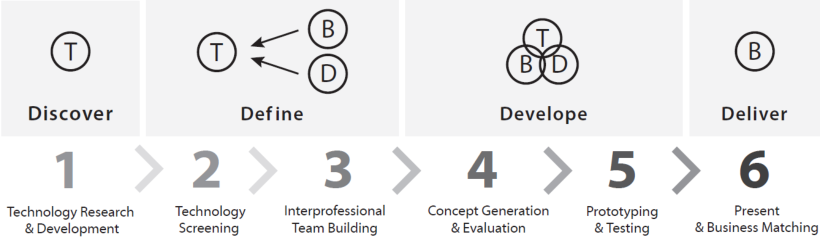
To improve the lack of understanding and close communication between designers and the technology teams, as well as the essential combination of business/commercialization knowledge in the innovation process, in the second stage of Dechnology project, Design Thinking was imported into multidisciplinary commercialization design workshops (the process is as Figure 2) .
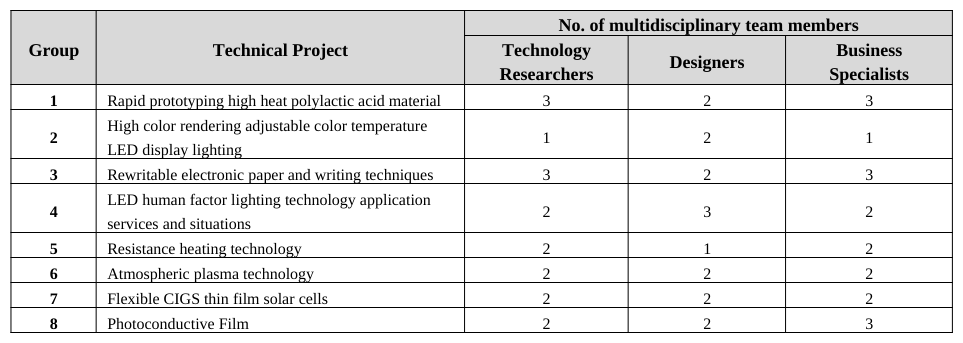
Figure 2: the conceptual model of multidisciplinary commercialization design workshops The workshops started from the technology (T) with high readiness level, and aimed at seeking most innovative and valuable applications. Besides, Compared to the previous models in stage 1, the workshop introduced the business aspect of knowledge (B). So in the co-creation process, not only was technical feasibility (T) or user-centered thinking (D) in design considered, a broader exploration from a business aspect (such as marketing, cost, etc.) could be implemented. In addition, direction could be established according to financial analysis and market positioning to create a complete business plan. Finally, the technology researchers (T), designers (D), and business specialists (B) had four months of intense discussions and close interactions in the workshops. In 2013, a total of eight groups entered this model for trials, and the relevant implementation content is as table 1.Table 1: Implementation content of multidisciplinary commercialization design workshops
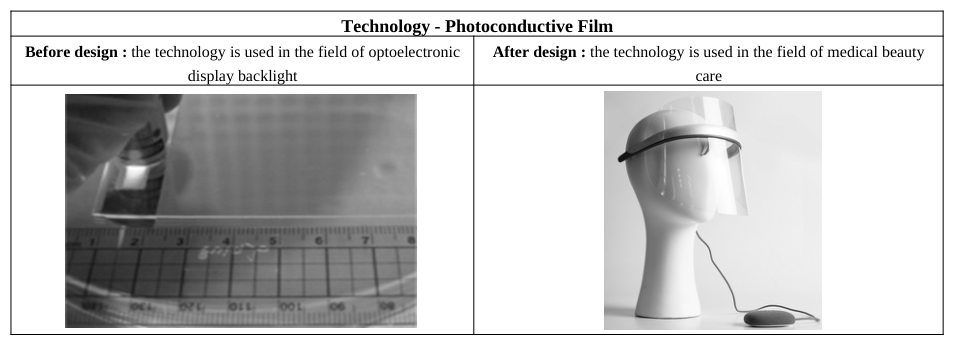
Case: Alluring Lighting Mask For the "Alluring Lighting Mask" case, the technology originates from the ITRI Material and Chemical Research Laboratory's technology - photoconductive film. Including the ITRI technical team, a 7-person multidisciplinary team that covered technology, design, and business was established by the workshop. In the concept generation stage, every team member proposed various conceptual ideas according to the technology. After numerous divergence and convergence processes, the team members finally focused on the concept of "facial mask" via technical feasibility, commercial viability, as well as design-oriented attractiveness, etc. Because among the many design concepts, the team believed that they should focus on the areas those consumers willing to proceed with high consumption, such as in health, beauty and so on. After focusing on medical skin care, the team members started to discuss and evaluate possible facial mask design.
In the co-creation process in the workshops, because designers and business specialists joined together, that could lead the team to face the market viability and consumer behavior early on. The business specialists said, "We found from market information that 25 to 35 -year-old women are willing to spend money to invest in beauty care." On the other hand, the designers of this project said, "in the use of this product, you need to consider three major characteristics, including comfort, breathability and mobility." For this reason, the design used the eyeglass structure concept that most consumers are familiar with so the product could be more accepted by the market and consumers. Finally, the multidisciplinary team offered a final product concept as well as a precise business model and market strategy. Consequently, after the project was produced, it quickly found a business willing to cooperate. Now this product will be launched in 2014, and successfully took technology originally used in the optoelectronics industry and applied it in medical beauty care, finding an innovative application business opportunity for photoconductive thin film technology (as below Table).
Table 2: Comparison of photoconductive film before and after design by workshops Technology - Photoconductive Film
However, because this innovation model was still highly based on technology, how to select suitable technology for development so that co-creation value can be optimized is the main challenge. Secondly, in order to promote long- term multidisciplinary project cooperation, this research discovered that designing “incentives” according to the needs of different stakeholders and finding appropriate participants for the multidisciplinary team were another challenges. Finally, how to input new ideas in the innovation process and find an appropriate business to continue promotion, are important factors in allowing this model to be successful.
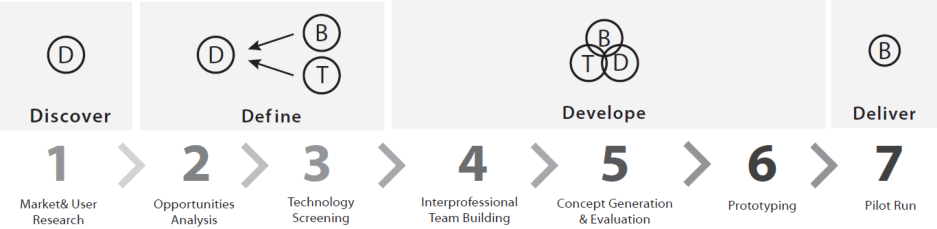
Thematic User-Oriented Design Unlike multidisciplinary commercialization design workshops, the Dechnology project in stage 2 also attempts to drive innovation through design force and market push. It differs from the aforementioned technology driven innovation model; thematic user-oriented design used service design methods and the 4Ds process (as Figure 3).
Figure 3: the conceptual model of thematic user-oriented design
Thematic user-oriented design firstly focused on specific service field themes and the potential users. Designers (D) undergo design and research and find innovation opportunities that can offer people new meaning and experiences through trend analysis, field research, user research, and expert seminars. In addition, Designers also constructed development blueprints and usage scenarios for various fields through visualization. Secondly, in order to matching innovation opportunities with interested businesses (B), design teams then published innovation opportunities by the open platform and seminars. Through considering core strategies of the business, the design aspect (D) and business aspects (B) can have deeper discussions about the concrete proposals, required technical specifications, and then return to the ITRI or external companies to find necessary technical solutions (T). In 2013, the thematic user- oriented design model chose four themes for trials, including: 1) future living; 2) future traveling; 3) future health caring; 4) future learning, and relevant Implementation information is as the following table:
Table 3: Implementation content of thematic user-oriented design
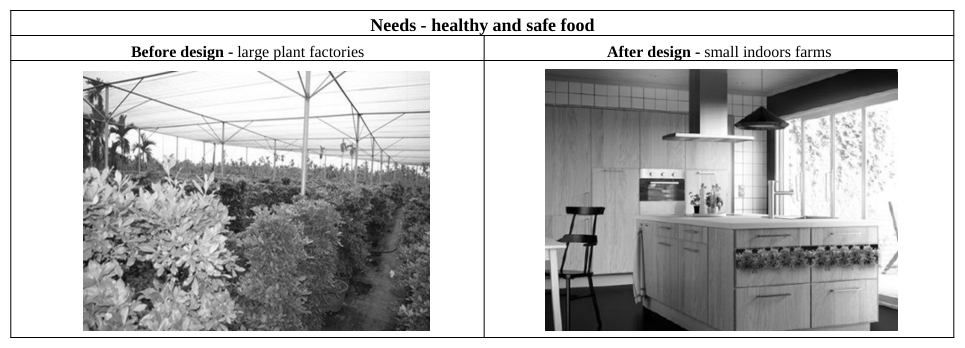
Case: Green Kitchen In the "Green Kitchen" case, because the designers discovered people's demand for healthy and safe food in the field of future living, they proposed the innovative opportunity of a small-scale indoor plant factory, so that people can plant and harvest plants in their future living environment and recreate household food experiences. After the open platform and seminar announced this innovation opportunity, it successfully matched the design aspect and a company that mainly produces kitchen appliances. After in-depth discussions, a concrete design direction and the required technical specifications for a "Green Kitchen" opportunity was gradually developed. When the external designer completed concept sketches, he began to communicate the technology behind this opportunity with the ITRI technical team, and the technical team followed by technical screening. After finding matching technologies (plant factory and LED technology), the business internal co-creation workshop was initiated so that the business representative, designers, and technical team could design together. One business representative said, "In the past, the company's internal staff also proposed similar ideas but because we totally do not understand plant factory technology, and we lack related mechanical and electrical integration technology, it was impossible to implement." Currently, through this mechanism, the "Green Kitchen" prototype has been completed. Next, a concrete implementation plan will be drawn out, and the commercialization stage in the company will begin in 2014.
However, although the business aspect joined the innovation process early on, it could bring the perspective of future service providers in advance and propose precise technical requirements. On the other hand, businesses often pursue concrete and feasible design options and hope they can be implemented in the short term, so it sometimes hinders the possibility of breakthrough innovation. Therefore, how to select the appropriate innovation direction/ goal; establish long-term relationships and trust of the multidisciplinary team are the key challenges of this model, especially the companies join the co-creation process. Secondly, since the related technology used to integrate the innovative proposals by this model may not be from ITRI, so it requires an efficient technology matching mechanism to integrate internal and external technology to improve the possibility of implementation.
Table 4: Green kitchen design concept Needs - healthy and safe food
DISCUSSION
This study mainly introduced two innovation models during the second stage of the Dechnology project: 1) multidisciplinary commercialization design workshops; and 2) thematic user-oriented design. Although adjustments have been made in response to the practical difficulties in the three main models in stage 1, certain challenges still exist. Through this study we found five key factors that would affect the innovation performance, including: 1) breakthrough ideas searching and importing, 2) technology screening and translation, 3) concrete incentives for multidisciplinary stakeholders, 4) multidisciplinary communication, and 5) continuing thematic exploration of innovative ideas.
Key Factor 1: Breakthrough ideas searching and importing The first challenge of the Dechnology project is "breakthrough ideas searching and importing." In the past, ITRI employed technical R&D as its main innovation direction, but because it lacked connection with the inner desires of users or market demand, it gradually encountered a bottleneck. Through the Dechnology project co-creation model combining the technical aspect, design aspect, and business aspects, although there is an improvement from insufficient technical push; how to input more factors in the innovation process so that the three teams can have more breakthrough and innovative ideas is still a major point. Past research pointed out that innovative breakthrough should have high style, high tech, and high value, and the new opportunities/ideas should be found from society, the economy, or technology (Cagan & Vogel, 2003). Similarly, Verganti (2009) also mentioned that technological innovation can create new user behavior. However, if the companies want to maintain the leadership position of innovation, they should propose innovative and valuable new meaning of things by analyzing socio- cultural development, lifestyles, and user behavior. For this reason, Dechnology project in the following phase (stage 3) will keep introducing external design research resources, and to search for breakthrough and innovative opportunities through trends and socio-cultural context.
Key Factor 2: Technology screening and translation
Because ITRI is a highly R&D-orientated organization, "technology screening and translation" has always been a challenge in the co-creation process. The designers that participated in the Alluring Lighting Mask mentioned: "selecting suitable technology has key influence on the output of co-creation. If the technology has a specific application direction; it is difficult for the multidisciplinary team to be effective. In addition, if technology maturity is not high, then the prototype cannot be built later on, causing many design concepts to fail and co-creation value to decrease." In terms of the understandability of technology for non-technical team members, this study discovered that for the two innovation models at the second stage of the Dechnology project, because the formal mechanisms for discussion were established (Sung & Wu, 2011), all the team members could undergo face to face in-depth interaction. Furthermore, the project cooperation time was extended, so the knowledge of the team members was fully exchanged and transferred, reducing the risk caused by misunderstand about high technology contents. In addition, another internal study (Hung & Huang, 2013) also pointed out that if the technology can use metaphors or visualization to convey technology characteristics and limitations, it would promote the transfer of technical knowledge. In summary, this study suggests that technical screening can be allocated according to technology maturity and if the R&D teams desires to find an innovative application opportunity. In terms of the understandability of technology, relying on metaphors or visualization to provide preliminary knowledge would reduce probability of misuse. For more in-depth knowledge, a interaction mechanism needs to be set up to provide a longer period for face to face discussions.
Key factor 3: Concrete incentives for multidisciplinary stakeholders First, past research pointed out that "people" are the core source of innovation (Cagan & Vogel, 2003). Besides, when team members are more willing to try to think from different perspectives, they could not only learn and use multidisciplinary professional knowledge in their work, but also could enhance the team's creativity and productivity (Seelig, 2012). In this study, we discovered the dedication level of the multidisciplinary team members is closely related to the quality of the resulting innovation. Therefore, when the design, technology, and business teams participated in the Dechnology project, how to establish “concrete incentives” to satisfy the demands of different stakeholders are key factors in the innovation process. As said by the Dechnology project coordinator: "in order to allow the multidisciplinary team to interact closely, it is necessary to establish performance reward mechanisms in the original organization. Then high-quality talents would be attracted and truly implement multidisciplinary innovative thinking without related concerns (including intellectual property rights and the future distribution of benefits). In addition, past research also pointed out a "value alignment mechanism" could also help stakeholders cooperate and co-create together. The stakeholders would establish core value and goals, and come to a consensus and have stable cooperative relationships (Frow and Payne. 2011).Therefore, this study suggests that innovation models in the future should focus on different needs of stakeholders, and provide different value propositions and service design in the co-creation process.
Key Factor 4: Multidisciplinary communication In the Dechnology innovation models, we found the “Multidisciplinary Communication” is an important factor that leads to project results having varied quality. Moreover, past study also points out that a multidisciplinary team is not a panacea in every innovation project (Ainamo, 2007). A lot of literature mentions that the multidisciplinary cooperation process requires formal and informal interaction, or visual tools to assist multidisciplinary co-creation (Citworthy, 2011), reducing the difficulties caused by expertise and terminology, and to help the team quickly exchange opinions (Adderio, 2001; Cagan and Vogel, 2003; Griffin and Hauser, 1996; Sung & Wu, 2011; Webber, 2001). For example, in the two types of models in Dechnology stage 2, they all create opportunities for the technical team, designers, and business team to have more in-depth and longer face to face discussions. Team members could have more opportunities to use different methods to enhance communication, such as drawing or fast prototyping. Compared to the models of stage 1, the projects in stage 2 have better results for commercialization (Seelig, 2012, p.73-91), and the quality is more likely to fulfill expectations. Therefore, this study points out that besides formal interactive mechanisms, informal interactive mechanisms should also be established. Furthermore, the innovation resources should also be systematized and developed into physical or visual tools for multidisciplinary co-creation.
Key Factor 5: Continue thematic exploration of innovative ideas Finally, because the Dechnology project is an annual project, and did not lock into a certain theme to continue development, it resulted in ideas being too scattered. Consequently, the ideas produced each year often stop in the initial stages of development and are unable to continue development in different dimensions for commercialization.
For instance, a designer who participated in Alluring Lighting Mask project mentioned: "In the beginning, introducing different professional knowledge could provide a lot of help; however, innovation requires digging continuously. There should an opportunity to take design concepts form last year with good potentials to different models instead of restarting topics every year.” The literature (Verganti, 2009) also emphasizes that a breakthrough product concepts with innovative meaning and new technology should continue focusing on different professional fields to create usable, useful, and desirable products. Therefore, his study recommends that when initiating the Dechnology project in the future, it could connect with the outcomes of “thematic user-oriented design” model. Then the team member could accumulate innovative know-how through systematic exploration of demand and opportunities. Besides, the concepts which generated in the innovation process should be appropriately arranged according to its maturity and quality. The concepts that can be immediately commercialized can be transferred to related businesses. On the contrary, other concepts with potential but need more refinement can go an "idea pool" mechanism (Bream & Voigt, 2009), to serve as reference for innovative topics or technological R&D improvement direction in the next stage.
The Dechnology Project - the third stage Finally, based on the implementation experience from the past two stages of the Dechnology project, this study proposed a conceptual Dechnology innovation model (as Figure 4). Now the model is also implemented during the third stage (2013~) of the Dechnology project.
Figure 4: The conceptual Dechnology innovation model
Figure available in the original PDF paper.
CONCLUSIONS
Innovation plays an important role in creating customer value and enhancing the competitiveness of the organization. Because of changes in the market and industry, the resources required for innovation have become increasingly diverse. For traditional technology-oriented companies, it is very crucial to breakthrough original thinking and culture, and then integrate related multidisciplinary knowledge and resources externally. That is the one of main challenges in current innovation practice and organization transformation. Therefore, how to adapt open innovation in the R&D process and sustainably bring multidisciplinary stakeholders co-create value together is the major issue of this study. Though focusing on the Dechnology project in ITRI, the study introduced on the two types of innovation models, including: 1) multidisciplinary commercialization design workshops; and 2) thematic user- oriented design models, and then compiled the five key success factors, including: 1) breakthrough ideas searching and importing, 2) technology screening and translation, 3) concrete incentives for multidisciplinary stakeholders, 4) multidisciplinary communication, and 5) continuing thematic exploration of innovative ideas. Furthermore, the research also proposed a conceptual Dechnology innovation model integrated with service design to serve as an important reference for businesses that undergo similar innovation projects and transformation management in the future. Finally, in terms of future research direction recommendations, the conceptual model should be further verified or come up with additional key success factors by other related multidisciplinary and cross-nationality cases.
ACKNOWLEDGEMENTS
Our deepest respect and gratitude go to all participants of the Dechnology project and the support from Department of Industrial Technology, Ministry of Economic Affairs of the Republic of China.
REFERENCE Adderio, L.D. (2001), “Crafting the virtual prototype: how firms integrate knowledge and capabilities across organizational
boundaries,” Research Policy, Volume 30, pp. 1409–1424. Ainamo, A. (2007), “Coordination mechanisms in cross-functional teams: a product design perspective,” Journal of Marketing Management, Volume 23, pp. 841–860. Battistella, C., Biotto, G. and Toni, A. (2012), “From design driven innovation to meaning strategy,” Management Decision,
Volume 50 No.4, pp. 718-743. Binder, T., Löwgren, J., Malmborg, L. (2008), “(Re) searching the Digital Bauhaus,” London: Springer. Boztepe, S. (2007), “User value: competing theories and models,” International Journal of Design, Volume 1 No. 2, pp.55-63. Brem, A. and Voigt, K.I. (2009), “Integration of market pull and technology push in the corporate front end and innovation management- Insights fromo the German software industry,” Technovation, Volume 29. pp. 351-367. Brown, T. (2009), “Change By Design: How Design Thinking Transforms Organizations and Inspires Innovation,” New York,
NY: HarperCollins Publishers. Cagan, J. and Vogel, C.M. (2002), “Creating Breakthrough Products: Innovation from product planning to program approval,” New Jersey: Prentice-Hall. Chesbrough, H.W. (2003), “The era of open innovation,” Sloan Management Review, Volume 44 No. 3, pp.35-41. Chesbrough, H.W. and Garman, A.R. (2009), “How Open Innovation Can Help You Cope in Lean Times?” Harvard Business
Review, Volume December, pp.1-9. Christensen, C.M. and Overdorf, M. (2000), “Meeting the challenge of disruptive change,” Harvard Business Review, Volume March-April, pp. 1-11 Clark, J. (1979), “A Model of Embodied Technical Change and Employment,” Mimeo. Science Policy Research Unit, Sussex
University, Falmer Press, Sussex. Clatworthy, S. (2011), “Service innovation through touch-points: Development of an innovation toolkit for the first stages of new service development,” International Journal of Design, Volume 5 No. 2, pp.15-28. Dell’Era, C. and Verganti, R. (2009), “Design-driven laboratories: organization and strategy of laboratories specialized in the
development of radical design-driven innovations,” R&D Management, Volume 39 No. 1, pp.1-20. Desmet, P. M. A., & Hekkert, P. (2007), “Framework of product experience,” International Journal of Design, Volume 1 No.1, pp. 57-66. Frow, P. and Payne, A. (2011), “A stakeholder perspective of the value proposition concept,” European Journal of Marketing,
Volume 45 No. 1/2, pp. 223-240. Gobbo Jr., J.A. and Olsson, A. (2010), “The transformation between exploration and exploitation applied to inventors of packaging innovations,” Technovation, Volume 30 No. 5-6, pp. 322-331. Gould, R.W. (2012), “Open Innovation and Stakeholder Engagement,” Journal of Technology Management & Innovation,
Volume 7 No.3, pp. 1-11. Griffin, A. and Hauser, J.R. (1996), “Integrating R&D and marketing: a review and analysis of the literature,” Journal of Product Innovation Management, Volume 13, pp.191–215. Gummesson, E. (2008), "Customer centricity: reality or a wild goose chase?" European Business Review, Volume 20 No. 4,
pp.315 – 330. Heskett, J. L. (2002), “Beyond Customer Loyalty”, Managing Service Quality, Volume 12, No. 6, pp. 355-357. Hoyer, W.D., Chandy, R., Dorotic, M., Krafft, M., and Singh, S. (2010), “Consumer co-creation in new product development,” Journal of Service Research, Volume 13, pp. 283-296. Hung, W.K. and Huang, W. (2013), “Creating value for technology by design: A case study of Dechnology Project,” Journal of
Design, Volume 18 No. 1, pp. 41-64. Inauen, M. and Schenker-Wicki, A. (2012), “Fostering radical innovations with open innovation,” European Journal of Innovation Management, Volume 15 No. 2, pp.212-31. Khilji, S. E., Mroczkowski, T. and Bernstein, B. (2006), “From invention to innovation: toward developing an integrated
innovation model for biotech firms,” The Journal of Product Innovation Management, Volume 23, pp. 528-540. Mele, C., Russo Spena, T., and Colurcio, M. (2010), “Co-creating value innovation through resource integration,” International Journal of Quality and Service Sciences, Volume 2 No. 1, pp. 60- 78. Kristensson, P., Matthing, J. and Magnusson, P. (2002), “Users as a hidden resource: findings from an experimental study on
user involvement,” Creativity and Innovation Management, Volume 11 No. 1, pp. 55-61. Panne, V.D.G., Beers, V.C., and Kleinknecht, A. (2003), “Success and failure of innovation: A literature review,” International Journal of Innovation Management, Volume 3, pp.309–338. Prahalad, C. K., & Ramaswamy, V. (2004), “Co-creation experiences: The next practice in value creation,” Journal of
Interactive Marketing, Volume 18 No.3, pp. 5-14. Rothwell, R. (1994). “Towards the fifth-generation innovation process,” International Marketing Review. Volume 11 No.1, pp.7-31. Rowley, J., Baregheh, A. and Sambrook, S. (2011), “Towards an innovation-type mapping tool,” Management Decision.
Volume 49 No. 1, pp. 73-86. Sanders, E.B.-N. & Stappers, P.J. (2008), “Co-creation and the new landscapes of design,” CoDesign, Volume 4 No. 1, pp.5-18. Sangiorgi, D. (2011), “Transformative services and transformation design,” International Journal of Design, Volume 5 No. 2, pp.29-40. Schmookler, J. (1966), “Invention and economic growth.”, Harvard University Press, Cambridge Schumpeter, J.A. (1934), “The Theory of Economic Development: An Inquiry into Profits, Capital, Credit, Interest and the
Business Cycle,” New Brunswick (U.S.A): Transaction Publishers. Seelig, T. (2011), “in Genius A Crash Course on Creativity”, New York, NY: Happer Collins. Sung T.J. and Wu C.S. (2011), “The effects of design integration mechanism on the maturity levels of a collaborative design team,” International Journal of Networking and Virtual Organisations, Volume 9 No. 4, pp. 367-381. Surowiecki, J. (2004), “The Wisdom of Crowds”, New York: Random House. Trott, P. (2008), “Innovation management and new product Development”, Financial Times Prentice Hall, Harlow. Venkatraman, R. (2005), “Role of design service firms in product innovation,”(Unpublished master's thesis), Worcester
Polytechnic Institute, Worcester, MA Verganti, R. (2003), “Design as brokering of languages: Innovation strategies in Italian firms,” Design Management Journal, Summer, p.34-42. Verganti, R. (2008), “Design, Meanings, and Radical Innovation: A meta-model and a research agenda,” The Journal of Product
Innovation Management, Volume 25, pp. 436-456. Verganti, R. (2009), “Design-driven innovation: changing the rules of competition by radically innovating what things mean,” Harvard Business Press, Boston, MA Webber, S.S. (2001), “Leadership and trust facilitating cross-functional team success,” Journal of Management Development,
Volume 21 No. 3, pp. 201–214.
LISTED IN THE AHFE DIGITAL BOOKSTORE CATALOGUE
Explore the complete digital volume
Advances in The Human Side of Service Engineering
Read this individual research paper free through the original publisher, or explore the full digital proceedings book.
ISBN 978-1-4951-2091-6
Explore this ISBN in the AHFE Bookstore ↗Listed in the July 2026 bookstore catalogue; search by ISBN to confirm current availability · Digital book purchase optional