Jona Karg, Janine Jäger, Petra Maria Asprion (2026). Trust in AI Revisited – The Enduring Role of Propensity to Trust. In: Human Interaction and Emerging Technologies (IHIET 2026). AHFE Open Access, vol. 236, pp. 279–289. https://doi.org/10.54941/ahfe1008103
The importance of trust in artificial intelligence (AI) continues to grow, as trust is widely regarded as a critical prerequisite for organizational AI adoption. In this context, intention to use AI can be understood as a consequence of the decision to trust AI and is therefore strongly influenced by trust. Moreover, trust is regarded as essential for understanding the impact of increasing interaction with AI systems on both individuals and society. Much of the discussion on trust in AI relies on frameworks derived from trust in automation, but these approaches remain largely theoretical and insufficiently validated. One important empirical contribution addressing this gap is the path model developed by Karg, Ritz and Asprion (2025), which examined trust in ChatGPT using a student sample. This model conceptualizes perceived trustworthiness through performance, process, and purpose. Together with a user’s propensity to trust, these factors are assumed to determine trust in AI. Karg, Ritz and Asprion (2025) demonstrated that perceived trustworthiness is significantly shaped by users’ inherent propensity to trust, in turn, influences the intention to use AI. The present study replicates this path model using a business sample to assess the robustness of the original findings and to advance theory building. An online survey was conducted among 97 employees of a major Swiss bank, employing identical items and methodologies as in the original study. The replication largely supports the original findings. However, in contrast to the original study, performance did not significantly predict trust in AI in the business sample. The findings further reinforce the argument that users’ dispositional characteristics may play a more decisive role in shaping perceived trustworthiness of and trust in AI systems.
The integration of artificial intelligence (AI), particularly large language models (LLM) such as ChatGPT, into organizational processes has become increasingly pervasive (Dwivedi et al., 2023). This has profound implications for how information is accessed, processed, and applied within organizations, including the banking sector. According to a survey conducted by the Swiss Financial Market Supervisory Authority (FINMA, 2025) approximately half of the Swiss banking institutions have already adopted AI technologies, including the use of chatbots for tasks such as optimization of processes and text generation. As AI adoption proliferates, its growing presence in the
financial sector gives rise to necessary inquiries concerning trust (Vuković et al., 2025), which is considered a key factor in the acceptance of AI (Hoffman et al., 2023).
Accordingly, research has increasingly focused on enhancing AI reliability and fostering user trust (Lewis & Marsh, 2022), accompanied by the development of numerous guidelines aimed at strengthening AI trustworthiness (Jäger et al., 2025). Trust in AI has thus emerged as a central research topic (Bedué & Fritzsche, 2022), given its importance for understanding the implications of intensified human-AI interaction (Montag et al., 2023). Trust in AI builds upon the foundation principles of trust in automation (Solberg et al., 2022). However, the extent of the transferability of this established trust concept to AI remains contested (Shin, 2021). The debate stems from the fact that AI systems exhibit capabilities that surpass those of conventional technologies (Langer et al., 2023), leading to the argument that the concept of trust in AI differs fundamentally (Chi et al., 2021). Supporting this perspective, Karg, Ritz and Asprion (2025) show that, contrary to prevailing assumptions (Choung et al., 2022), transparency and explainability do not significantly affect trust in AI. Moreover, the empirical path model by Karg, Ritz and Asprion (2025) indicates that trust predicts the intention to use ChatGPT.
AI Relevance in Banking AI refers to computational systems capable of performing tasks associated with human cognitive functions, including perception, reasoning, decision- making, and language processing (Xu et al., 2021). Although the conceptual roots of AI extend back several decades, its practical significance has expanded considerably due to advances in algorithms, data availability, and computing power (Siau & Wang, 2018). Current AI systems remain limited to domain-specific applications, commonly described as narrow AI, which restricts their generalizability (Lewis & Marsh, 2022). AI is widely applied across domains such as logistics, finance, and healthcare, where it supports decision automation, process optimization, fraud detection, and customer interaction (Frank et al., 2023). However, levels of autonomy vary across applications, and reduced human oversight in some systems introduces additional uncertainties and risks (Choung et al., 2022).
The adoption of AI in business has evolved to a strategic priority across industries (Olutimehin et al., 2024). Organizations increasingly leverage AI not only to improve operational efficiency but also to support data-driven decision-making and gain competitive advantages. AI chatbots have become integral to customer service strategies by enabling scalable, efficient, and personalized interactions (Ciesla, 2024). These developments are largely driven by advances in natural language processing (NLP), which allow machines to understand and generate human language (Jurafsky & Martin, 2024). In the Swiss financial sector, the growing reliance on AI is reflected in the early and widespread adoption of tools such as ChatGPT (FINMA, 2025), delivering benefits such as improved fraud detection, faster response times, and more efficient compliance checks. Nonetheless, the maturity of current
Trust in AI Revisited – The Enduring Role of Propensity to Trust 281 AI systems remains limited, as many applications are highly specialized and require substantial human oversight.
AI and Trust Trust is a central construct in human–machine interaction and can be defined as the attitude that a system (trustee) will support a user (trustor) in achieving goals under conditions of uncertainty and vulnerability (Lee & See, 2004). The decision to trust is often conceptualized as intentions to use a system (Razin & Feigh, 2023) and are therefore critical for the successful adoption and use of AI technologies (Hoffman et al., 2023). Trust is dynamic and evolves depending on system performance and intended purpose (Choung et al., 2022), with trust grounded in perceived intentions of the trustee being more stable than trust based solely on observed reliability and performance (Lee & See, 2004). In this sense, trust functions as a heuristic (Lewis & Marsh, 2022) enabling users to judge the trustworthiness of a system (Hoff & Bashir, 2015).
Perceived trustworthiness is a key antecedent of affective trust in AI systems and is traditionally conceptualized along three dimensions: performance, process, and purpose (Solberg et al., 2022). Performance refers to attributes such as reliability, predictability, and competence, thereby reflecting the system’s robustness in achieving user goals (Hoff & Bashir, 2015). Process captures perceptions of whether underlying algorithms are appropriate, effective, and comprehensible, although increasing system complexity can limit user understanding (Lee & See, 2004). Thereby, expectations of and understanding regarding the capabilities of the AI system are low at the initial trust-formation (Langer et al., 2023). Purpose relates to trust in system developers and their perceived benevolence toward users, reflecting beliefs about aligned intentions and ethical design (Körber, 2019). Accordingly, trust is influenced by both the system’s task performance and its ability to communicate relevant information effectively (Gebru et al., 2022).
Beyond system characteristics, trust depends on an individual’s general willingness to rely on technology, referred to as propensity to trust, which varies across individuals and is influenced by personality traits (Karg, Jäger & Asprion, 2025). While purpose and propensity are particularly influential in early trust formation, performance and process gain importance over time through experience-based trust calibration (Razin & Feigh, 2023).
METHOD
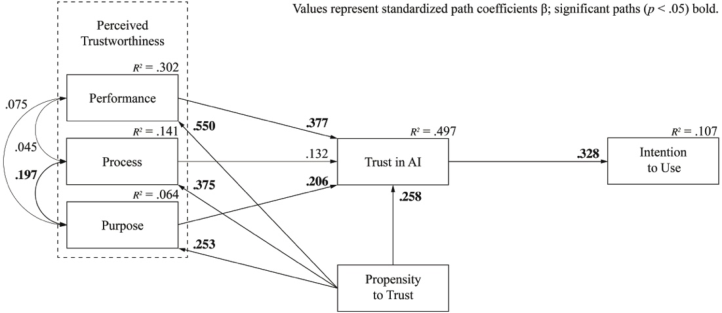
This study replicates the empirical path model by Karg, Ritz and Asprion (2025, see Figure 1) and examines whether the direction, significance, and magnitude of the reported relationships can be reproduced within a business- minded sample. Specifically, the study examines whether (H1) performance has a medium-sized effect, (H2) process has no significant effect, (H3) and whether purpose and (H4) propensity to trust have small effects on the mediator trust in AI. Subsequentially, this study investigates whether propensity to trust has (H5) a large effect on performance, (H6) a medium-sized effect on process, and
(H7) a small effect on purpose. Finally, the present study evaluates whether (H8) the mediator trust in AI has a medium effect on the endogenous variable intention to use.
Even though ChatGPT is not used for job-related tasks at the selected banking institution, this widely-adopted AI tool (Conte, 2024) was chosen as unit of analysis to ensure comparability with the original study and thereby support replication validity (Albertoni et al., 2023). For the same reason, the original measurement instruments were used without modification. Accordingly, wording, structure, scale, format, and response options of the items in the anonymous online survey remained identical to those used by Karg, Ritz and Asprion (2025).
Figure 1: Original path model on trust in AI and its effect on the intention to use by Karg, Ritz and Asprion (2025); N = 105.
A convenience sample was drawn from employees of a major Swiss bank. This sampling approach was considered appropriate for evaluating the original path model within a professionally oriented business context. However, because ChatGPT is not used operationally within the selected institution and the sample was non-random, the generalizability of the findings is limited. Of the initial sample of N = 98 bank employees, one participant was removed since all items remained unanswered, resulting in N = 97 participants for the data analysis of the cross-sectional study. Participants had a mean age of M = 31.15 years (SD = 12.71), with one subject not reporting their age.
The items assessing the variables of the path model were unaltered from the original study, in which they had been adapted to the context of ChatGPT based on the Trust in Automation Questionnaire (Körber, 2019) and the TAM-2 (Choung et al., 2022). In total, the questionnaire comprised 21 items, with six items measuring performance, four items each assessing process and intention to use, three items measuring propensity to trust, and two items each measuring the variables purpose and trust in AI. All items were rated using a five-point Likert scale. Prior to the main analysis missing values at the item level were handled using median imputation. Subsequently, mean scores were computed for each scale and used in the analyses.
Trust in AI Revisited – The Enduring Role of Propensity to Trust 283 All statistical analyses were conducted using R (R Core Team, 2022). The significance level for the data analysis was set at p = .05 in accordance with the conventions of Cohen (1992). The same applies for the assessment of the effect sizes. Whereby β > .1 considered to be a small, β > .3 a medium and β > .5 a large effect. Path analysis was performed using the r-package lavaan (Rosseel, 2012) to test the hypotheses. Here, based on the thresholds stipulated by Hu and Bentler (1999), the fit indices (CFI = .944, SRMR = .154, RMSEA = .074) suggest that the data may not fit the path model accordingly.
RESULTS
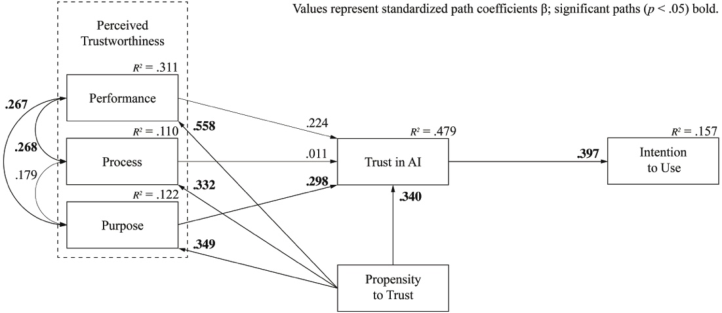
The complete results of the replicated path model are presented in Figure 2 and Table 1. The predictors performance, process, purpose, and propensity to trust jointly explained 47.9% of the variance in the mediator trust in AI. In turn, trust in AI accounted for 15.7% of the variance in the endogenous variable intention to use. Furthermore, propensity to trust explained 31.1% of the variance in performance, 11.0% in process, and 12.2% in purpose.
Figure 2: Replicated path model on trust in AI and its effect on the intention to use (N = 97).
The paths from purpose (β = .298, p = .021), and propensity to trust (β = .340, p < .001) to the mediator trust in AI were statistically significant, indicating small and medium effect sizes, respectively. In contrast, there are no significant correlations from performance (β = .224, p = .083), and process (β = .011, p = .898) on trust in AI. Trust in AI, however, exerted a significant medium-sized effect on intention to use (β = .397, p < .001).
The paths from propensity to trust to the three variables of the perceived trustworthiness were all statistically significant. Specifically, propensity to trust showed a large effect on performance (β = .558, p < .001) and medium effects on purpose (β = .332, p < .001) and process (β = .349, p < .001). Regarding the covariances among the perceived trustworthiness dimensions, the coefficient between process and purpose was not statistically significant (β = .179, p = .056). On the other hand, performance was significantly associated with process (β = .268, p = .001) and purpose (β = .267, p = .006).
The descriptive comparison with the path model from Karg, Ritz and Asprion (2025) listed in Table 2 indicates that the present replication study largely supports the findings from the original study. Overall, the observed relationships followed similar patterns, although differences emerged in the magnitude of the effects. In addition, several notable deviations from the original model were identified.
The most prominent deviation from the original study was for the path from performance to trust in AI. In the present replication study the effect was no longer statistically significant. In contrast, the significant paths from propensity to trust to trust in AI (Δ β + .082) respectively to purpose (Δ β + .096), were stronger in the present replication study, increasing from small to medium effect sizes.
Notably, the relationships between the perceived trustworthiness dimensions differed from those reported in the original study. Specifically, previously significant effects were no longer significant, and vice versa.
Table 1: Path coefficients and explained variance of the replicated path model (N = 97).
Table available in the original PDF paper.
β p 95 % CI R2 Trust in AI .479 ← Performance .224 .083 [−.029, .478]
Table 2: Comparison of the path coefficients and explained variance of the original path model by Karg, Ritz and Asprion (2025) and the replication in this study.
Table available in the original PDF paper.
Original Replication Δ Trust in AI R2 .497 .479 − .018 ← Performance .377 * .224 − .153
This study replicated the path model proposed by Karg, Ritz and Asprion (2025). Specifically, the study examined the factors influencing trust in AI and the subsequent effect of trust on the intention to use ChatGPT.
Contrary to hypothesis 1 and the findings of the original path model by Karg, Ritz and Asprion (2025) performance did not have a significant effect on trust in AI. This finding is particularly noteworthy since performance reflects characteristics that users can directly evaluate through everyday interactions with ChatGPT and was identified as the strongest predictor of trust in the original study. One possible explanation is that bank employees in the present study may still be in an early stage of trust-formation, characterized by limited experience with AI systems (Langer et al., 2023), since the bank employees operated in an environment in which the use of ChatGPT was restricted or not permitted for work-related tasks. Consequently, participants may have had fewer opportunities to evaluate the system’s performance in a professional context. As a result, trust in AI may have depended less on perceived performance and more on dispositional factors and perceived purpose.
This interpretation is further substantiated by the findings related to hypotheses 2 through 4. Consistent with expectations and the original path model, process did not significantly predict trust in AI, whereas purpose showed a small but significant positive effect. However, in contrast to expectations, the effect of propensity to trust on trust in AI was not only small but medium. This findings align with the understanding of Lee and See (2004), who posited that in the initial stages of trust formation, perceptions of purpose and dispositional factors such as propensity to trust are particularly important, while evaluations of performance and process become more relevant at later stages of trust calibration. At the same time, the present results remain compatible with the findings of Karg, Ritz and
Asprion (2025), who emphasized the importance of the trustor’s disposition as a central determinant of trust in AI.
Moreover, the outcomes related to hypotheses 5 through 7 provide further support for this interpretation. Propensity to trust not only had a direct effect on trust in AI, but also indirect effects through its influence on the three dimensions of the perceived trustworthiness. In particular, the effect on purpose was stronger than anticipated, reaching a medium effect size. This suggests that dispositional trust does not only influence trust in AI, but also how users perceive the system’s purpose.
In line with the original study by Karg, Ritz and Asprion (2025), the results for hypothesis 8 demonstrated that trust in AI had a significant medium- sized effect on intention to use ChatGPT. This finding further underscores the significance of trust as a predictor of AI utilization. Nevertheless, the relatively modest proportion of explained variance in intention to use indicates that additional factors may also play an important role, such as perceived usefulness, ease of use, predictability, or organizational norms.
Taken together, the findings call into question the applicability of a uniform conceptualization of trust in AI across contexts and user groups. Instead, trust in AI appears to be dynamic and dependent on factors such as the specific AI system, the task context, organizational constraints, and the user’s stage of trust development. Future research should therefore adopt a more differentiated perspective on trust in AI by considering contextual influences, longitudinal changes in trust formation, and the interplay between dispositional and system-related determinants of trust.
LIMITATIONS In addition to the limitations of the original study, such as the lack of associated risks and the unspecified task, several limitations of the presents study should be considered. First, the fit indices indicated that the proposed path model did not fully fit the present data, suggesting that the findings should be interpreted with caution. Secondly, the results of this study are not generalizable due to its reliance on a convenience sample drawn from a single bank. Finally, although the sample consisted of working professionals rather than students, ChatGPT was not used within the participants’ professional environment, which employs their own internal AI tools. As a result, participants’ evaluations of ChatGPT were likely shaped primarily by private rather than professional experiences. This limits the generalizability of the findings to organizational contexts where ChatGPT is actively used in the workplace.
CONCLUSION
The findings of this replication study largely support the path model proposed by Karg, Ritz and Asprion (2025). At the same time, the results further suggest that established constructs of trust cannot be fully applied to trust in AI (Chi et al., 2021). However, contrary to the original study’s findings, users’ perception of ChatGPT’s performance did not significantly
Trust in AI Revisited – The Enduring Role of Propensity to Trust 287 influence their trust in AI. Instead, the results indicate that trust in AI is a dynamic construct, in which perceived purpose and the users’ propensity to trust are of high importance in the initial trust-formation stages. By contrast, evaluations of performance and process may be relevant in subsequent stages of trust calibration, although this assumption cannot be demonstrated in the results of the present study. Nevertheless, both trust and the users’ disposition to trust, remain important factors influencing the intention to use AI systems such as ChatGPT.
ACKNOWLEDGMENT
This study is based on the bachelor’s thesis survey of Advije Hasani and Pernille Melberg and did not receive any funding. The bachelor’s thesis was supervised by Jona S. Karg in cooperation with Janine Jäger and the Digital Trust Competence Center (digitaltrust-competence.ch).
REFERENCES
Albertoni, R., Colantonio, S., Skrzypczyński, P., & Stefanowski, J. (2023, February).
Reproducibility of Machine Learning: Terminology, Recommendations and Open Issues. Bedué, P., & Fritzsche, A. (2022). Can we trust AI? An empirical investigation of trust requirements and guide to successful AI adoption. Journal of Enterprise Information Management, 35(2), 530–549. Chi, O. H., Jia, S., Li, Y., & Gürsoy, D. (2021). Developing a formative scale to
measure consumers’ trust toward interaction with artificially intelligent (AI) social robots in service delivery. Comput. Hum. Behav., 118, 106700. Choung, H., David, P., & Ross, A. (2022). Trust in AI and Its Role in the Acceptance of AI Technologies. International Journal of Human–Computer Interaction, 39(9), 1727–1739. Ciesla, R. (2024). The Book of Chatbots. https://doi.org/10.1007/978-3-031-51004-5 Cohen, J. (1992). A power primer. Psychological Bulletin, 112(1), 155–159. Conte, N. (2024, January 24). Ranked: The Most Popular AI Tools. Visual Capitalist.
https://www.visualcapitalist.com/ranked-the-most-popular-ai-tools/ Dwivedi, Y. K., Kshetri, N., Hughes, L., Slade, E. L., Jeyaraj, A., Kar, A. K., Baabdullah, A. M., Koohang, A., Raghavan, V., Ahuja, M., Albanna, H., et al. (2023). “So what if ChatGPT wrote it?” Multidisciplinary perspectives on opportunities, challenges and implications of generative conversational AI for research, practice and policy. International Journal of Information Management, 71, 102642. Frank, D.-A., Jacobsen, L. F., Søndergaard, H. A., & Otterbring, T. (2023). In
companies we trust: Consumer adoption of artificial intelligence services and the role of trust in companies and AI autonomy. Information Technology and People, 36(8), 155–173. Gebru, B., Zeleke, L., Blankson, D., Nabil, M., Nateghi, S., Homaifar, A., & Tunstel, E. (2022). A Review on Human–Machine Trust Evaluation: Human-Centric and Machine-Centric Perspectives. IEEE Transactions on Human-Machine Systems, 52(5), 952–962. Hoff, K. A., & Bashir, M. (2015). Trust in Automation: Integrating Empirical
Evidence on Factors That Influence Trust. Human Factors, 57(3), 407–434.
Hoffman, R. R., Mueller, S. T., Klein, G., & Litman, J. (2023). Measures for explainable AI: Explanation goodness, user satisfaction, mental models, curiosity, trust, and human-AI performance. Frontiers in Computer Science, 5. Hu, L., & Bentler, P. M. (1999). Cutoff criteria for fit indexes in covariance
structure analysis: Conventional criteria versus new alternatives. Structural Equation Modeling A Multidisciplinary Journal, 6(1), 1–55. https://doi. org/10.1080/10705519909540118 Jäger, J., Karg, J., Asprion, P. M., & Misyura, I. (2025). The Digital Trust Radar – A structured collection and analysis of global AI guidelines. 13th International Conference on Human Interaction & Emerging Technologies: Artificial Intelligence & Future Applications. Jurafsky, D., & Martin, J. H. (2024). Speech and Language Processing: An
Introduction to Natural Language Processing, Computational Linguistics, and Speech Recognition (3rd ed.). Karg, J., Jäger, J., & Asprion, P. M. (2025). Trusting the Machine – The Role of Gender and Personality in Shaping the Propensity to Trust Artificial Intelligence. Human Interaction and Emerging Technologies (IHIET 2025). Karg, J., Ritz, F., & Asprion, P. M. (2025). Propensity Matters – An Empirical Analysis
on the Importance of Trust for the Intention to Use Artificial Intelligence. Human Interaction and Emerging Technologies (IHIET 2025). Körber, M. (2019). Theoretical Considerations and Development of a Questionnaire to Measure Trust in Automation. In S. Bagnara, R. Tartaglia, S. Albolino, T. Alexander, & Y. Fujita (Eds.), Proceedings of the 20th Congress of the International Ergonomics Association (IEA 2018) (pp. 13–30). Springer International Publishing. Langer, M., König, C. J., Back, C., & Hemsing, V. (2023). Trust in Artificial Intelligence:
Comparing Trust Processes Between Human and Automated Trustees in Light of Unfair Bias. Journal of Business and Psychology, 38(3), 493–508. Lee, J. D., & See, K. A. (2004). Trust in Automation: Designing for Appropriate Reliance. Human Factors, 46(1), 50–80. Lewis, P. R., & Marsh, S. (2022). What is it like to trust a rock? A functionalist
perspective on trust and trustworthiness in artificial intelligence. Cognitive Systems Research, 72, 33–49. Montag, C., Kraus, J., Baumann, M., & Rozgonjuk, D. (2023). The propensity to trust in (automated) technology mediates the links between technology self- efficacy and fear and acceptance of artificial intelligence. Computers in Human Behavior Reports, 11, 100315. Olutimehin, D. O., Ofodile, O. C., Ejibe, I., Odunaiya, O. G., & Soyombo, O. T.
(2024). Implementing AI in Business Models: Strategies for Efficiency and Innovation. International Journal Of Management & Entrepreneurship Research, 6(3), 863–877. R Core Team. (2022). R: A Language and Environment for Statistical Computing [Computer software]. R Foundation for Statistical Computing, Vienna. https:// www.r-project.org/ Razin, Y. S., & Feigh, K. M. (2023). Converging Measures and an Emergent Model:
A Meta-Analysis of Human-Automation Trust Questionnaires. Rosseel, Y. (2012). lavaan: An R Package for Structural Equation Modeling. Journal of Statistical Software, 48(2), 1–36. Shin, D. (2021). The effects of explainability and causability on perception, trust,
and acceptance: Implications for explainable AI. International Journal of Human- Computer Studies, 146, 102551.
Trust in AI Revisited – The Enduring Role of Propensity to Trust 289 Siau, K., & Wang, W. (2018). Building Trust in Artificial Intelligence, Machine
Learning, and Robotics. Cutter Business Technology Journal, 31(2), 47–53. Solberg, E., Kaarstad, M., Eitrheim, M. H. R., Bisio, R., Reegård, K., & Bloch, M.
(2022). A Conceptual Model of Trust, Perceived Risk, and Reliance on AI Decision Aids. Group & Organization Management, 47(2), 187–222. Swiss Financial Market Supervisory Authority FINMA. (2025). FINMA survey: Artificial intelligence gaining traction at Swiss financial institutions. https://www. finma.ch/en/news/2025/04/20250424-mm-umfrage-ki/ Vuković, D., Dekpo-Adza, S., & Matović, S. (2025). AI integration in financial
services: A systematic review of trends and regulatory challenges. Humanities and Social Sciences Communications, 12. Xu, Y., Liu, X., Cao, X., Huang, C., Liu, E., Qian, S., Liu, X., Wu, Y., Dong, F., Qiu, C.-W., et al. (2021). Artificial intelligence: A powerful paradigm for scientific research. The Innovation, 2(4), 100179.
SEARCH THE AHFE DIGITAL BOOKSTORE BY ISBN
Explore the complete digital volume
Human Interaction and Emerging Technologies (IHIET 2026)
Read this individual research paper free through the original publisher, or explore the full digital proceedings book.