Marina Klostermann, Lina Kluy (2025). Privacy Concerns in Recommender Systems for Personalized Learning at the Workplace: The Mediating Role of Perceived Trustworthiness. In: Human Interaction and Emerging Technologies (IHIET-AI 2025): Artificial Intelligence and Future Applications. AHFE Open Access, vol. 161, pp. 151–161. https://doi.org/10.54941/ahfe1005906
Artificial intelligence (AI) is capable of reconfiguring activities in Human Resource Management (HRM), including talent acquisition, performance management and learning and development (Minbaeva, 2021). The integration of AI into HRM systems can optimize processes, such as comprehensive needs assessments for learning and development, which would otherwise be lengthy and time-consuming. Moreover, the integration of AI in HRM has the potential to enhance decision-making processes and employee experience (Strohmeier, 2020). The use of big data and personal information in AI-based HRM systems to provide employees with personalized learning recommendations gives rise to privacy concerns. These concerns must be addressed in order to guarantee a responsible and calibrated use of these technologies. In the event that users express concerns regarding the adequate protection of their personal information by the system, they may perceive the system as untrustworthy and, consequently, refrain from using the system. In the context of privacy concerns, trust(worthiness) is assumed to be one of the most crucial predictors of behavior (e.g., intention to use a system). However, the explicit role of perceived trustworthiness in the relationship between privacy concerns and the intention to use an AI-based system has yet to be demonstrated. The aim of the present study was to investigate whether there exists a mediating effect of perceived trustworthiness on the relation between privacy concerns and the intention to use an AI-based recommender system for workplace learning. An online experiment was developed to simulate such a system. The analysis of this study is based on data of 69 participants (employees, 29 female, age M = 33.28 years, SD = 10.49) from one of the two experimental conditions, in which they were permitted to determine which personal information to provide for a personalized learning recommendation. The mean interaction time with the recommender system was 43.23 minutes (SD = 18.64). The participants completed questionnaires addressing a range of different constructs, including perceived trustworthiness, privacy concerns and intention to use. Contrary to previous studies postulating privacy concerns as a predictor of privacy behavior, the analysis showed no direct effect of privacy concerns on intention to use the system (B = -0.001, p > .05). However, the results indicated that privacy concerns significantly predicted perceived trustworthiness (B = -0.170, p < .05), which in turn significantly predicted the intention to use the system (B = 0.936, p < .01). Therefore, privacy concerns exert an indirect influence on the intention to use the system through perceived trustworthiness. The results underscore the significance of perceived trustworthiness in the context of privacy concerns and the intention to use an AI-based recommender system for workplace learning. This study represents a preliminary step towards addressing the research gap on the role of trust(worthiness) in the context of privacy concerns, as proposed by previous studies. Implications can be derived for the design of human-centered recommender systems for workplace learning, taking into account increasing perceived trustworthiness and reducing privacy concerns. Future research should continue to investigate additional factors in the relationship of privacy concerns, attitudes and behavior, for instance, perceived control over personal information.
The advent of the new future of work has the potential to significantly impact the development of human resources (HR). The rapid evolvement and implementation of AI leads to a change of known tasks and responsibilities (e.g., in complexity and scope) but also provides new opportunities (e.g., support in decision-making). AI applications are primarily used to automate and optimize processes in order to achieve the goals of organizations in an efficient manner and to meet the demands of global hyper-competition
(Pozzi et al., 2023). The disruptions caused by the implementation of new technologies demonstrate an upward trend of increasing job complexity (Li, 2022). Thus, life-long learning at the workplace becomes a necessity as new skills and the appropriate use of new technologies have been introduced faster than a decade ago (Li, 2022). However, the steps that must be undertaken by HR professionals to identify those employees in need for training and development and the design of such programs are lengthy and time-consuming. Therefore, AI is utilized more widespread as a supportive tool to combat the lengthy and time-consuming processes in HR (Maity, 2019). Subsequently, the term “training”is used to describe all organizational measures for developing the knowledge, skills and attitudes of employees.
AI for training can be implemented in the form of learning recommender systems. In general, recommender systems are a type of decision support system that is designed to understand individual needs of its users and provide personalized products and services (e.g., a personalized recommendation of movies, songs, learning opportunities) (Xiao, 2007). Learning recommender systems for training need extensive data about learner characteristics, preferences and behaviour (e.g., demographic information, interests, learning history). This information can be related to a content management system to provide the user with a personalized learning recommendation (Wesche et al., 2023). Personalization is at the core of recommender systems and is perceived as highly significant for users regarding the user experience (Zhang and Wang, 2014). The opportunity to personalize training for employees through learning recommender systems safes time and effort and can promote an optimal learning experience (Zhang and Sundar, 2019). Although there are benefits in using and implementing learning recommender systems for training of employees, employees can be hesitant in using it. The hesitance is caused by the extensive amount and use of (personal) data, which raises privacy concerns. Consequently, employees weigh up the advantages of the system personalization against their privacy concerns. This phenomenon is called the privacy-personalization trade-off (Awad, 2006; Chellappa and Sin, 2005). A key factor for the adoption and intention to use such a recommender system is the users’ perception of the degree to which the recommender system understands and personalizes itself to the users (Xiao, 2007). Furthermore, there is an agency relationship between recommender systems and their users. Users cannot be sure whether the recommender system is working for them alone or for another party (e.g., the HR manager) who provided it (Xiao, 2007). If individuals perceive the system is going beyond what is appropriate in their social context and collecting unnecessary data, this may raise even more concerns about the integrity and benevolence (i.e., trustworthiness) of the recommender system (Xiao, 2007; Wisniewski et al., 2010). The exact role of perceived trustworthiness in the context of recommender systems is still unclear, as trustworthiness has been conceptualized as an antecedent, an outcome, and an independent factor alongside privacy concerns that influence individual behaviour (Kehr et al., 2015). Therefore, the aim of this study is to investigate the role of perceived trustworthiness and privacy
Privacy Concerns in Recommender Systems for Personalized Learning 153
concerns on the intention to use an AI-based learning recommender system for training.
Privacy concerns negatively influence the intention to use a system (Brill et al., 2019; Gerber et al., 2018). These concerns arise from users’ apprehensions about how their data is collected, processed, stored, and potentially shared with third parties. When privacy concerns are high, users are more likely to perceive the system more negatively, leading to decreased trust and reduced willingness to use the system. Thus, it is hypothesized that privacy concerns have a negative impact on intention to use the learning recommender system (H1).
The Role of Trustworthiness Trust and perceived trustworthiness play a vital role in shaping attitudes and behaviour such as the use of technology including recommender systems (Buck et al., 2022; Maida et al., 2012). The terms trust and trustworthiness are often used interchangeably (Duenser and Douglas, 2023). However, there are notable differences between the two concepts. Trust is defined as a personal characteristic, incorporating the propensity to trust, as well as a behavioural and attitudinal dimension. In contrast, perceived trustworthiness is an underlying assessment of the system’s characteristics and expectations regarding its functioning (Kaplan et al., 2020; Hancock et al., 2023; Mayer and Schoorman, 1995). In this study, the focus is on perceived trustworthiness as this is a fundamental aspect in forming trust towards a system.
Perceived trustworthiness is particularly critical in the context of HRM systems involving sensitive personal data, where users need assurance that their information is handled responsibly. Perceived trustworthiness refers to an individual’s belief that a system carries out an action in accordance with their own wishes and includes facets of ability, benevolence and integrity (Mayer and Schoorman, 1995). As mentioned above, the exact role of trust and perceived trustworthiness in the context of system use is still unclear (Kehr et al., 2015; Buck et al., 2022). Additionally, to the best of our knowledge the role of perceived trustworthiness in privacy concerns and on intention to use has not yet been researched in learning recommender systems.
Based on research conceptualizing trust as an outcome of privacy concerns it has been found that privacy concerns affect trust and perceived trustworthiness negatively (Vilmakumar et al., 2021; Bansal, 2010). Perceived trustworthiness, in turn, influences the likelihood to use the system positively. Users are more likely to use systems that they perceive as trustworthy (Gerber et al., 2018). Consequently, perceived trustworthiness can act as a mediating factor between privacy concerns and behavioural intentions. To illustrate, Büttner and Göritz (2007) discovered that the impact of perceived risks on intention is partially mediated by perceived trustworthiness. In line with this, Vilmakumar et al. (2021) found an indirect influence of perceived privacy risk on adoption intentions through trust. Thus, it is hypothesized that perceived trustworthiness mediates the effect of privacy concerns on the intention to use the learning recommender system (H2).
154 Klostermann and Kluy
METHOD
To test the hypotheses and investigate beliefs and perceptions of employees regarding the implementation of an AI-based learning recommender system for training and development an online experiment was conducted in Germany from September until November 2024. Participants were randomly assigned to one out of two experimental groups. The experimental group, which is the focus of this paper, had the opportunity to decide which data they would like to disclose to the recommender system for further analyses and personalization of their learning recommendation. The control group did not have the opportunity to decide which data they disclose. In this case, participants had to disclose (personal) data, and they were told, that the recommender system decided which data was needed for further analyses. Data from the control group were also gathered during this study and will be examined further in relation to other research questions. Therefore, they are not reported here.
Ethical approval for this study was obtained from the review board at Ruhr University Bochum under the No. 862, ensuring compliance with all guidelines for research involving human participants. The participants gave informed consent, were compensated with 15€ and had the opportunity to discontinue the study at any time without any disadvantages.
Participants In total, 124 employees participated in this study until October 2024 and were recruited with the online data collection platform Prolific. A statistical power analysis conducted with G*Power revealed that for a linear multiple regression analysis with two predictors, α-level at .05 and a medium effect size f2 = .15 a total sample size of 43 participants is required. In this study, N = 69 employees (29 female, 40 male) participated in the experimental group and are included for the investigation of the role of perceived trustworthiness and privacy concerns on the intention to use an AI-based learning recommender system. The mean age for participants was 33.28 years (SD = 10.49) and the majority of participants had a university degree (53.6%) or a university entrance qualification (31.9%). The majority of participants worked in knowledge-based tasks (49.3%) or leadership and managerial-based tasks (23.2%). Other participants worked in object-based tasks (17.4%) and person-based tasks (10.1%).
Materials
Data in this study was collected in German. All scales were measured on a five-point Likert-Scale from 1 meaning “not at all” to 5 meaning “strongly agree” and were adapted to the learning recommender context. Privacy concerns were measured based on a scale from Xu et al. (2011) and an example item was “I am concerned that the information I have provided to the learning recommender system could be misused.” Perceived trustworthiness was measured based on three scales: benevolence, integrity and competence that were based on Benbasat and Wang (2005), translated and adapted to the German language from Langer et al. (2023). An example
Privacy Concerns in Recommender Systems for Personalized Learning 155
item for the trustworthiness benevolence scale was “I believe that the learning recommender system prioritizes my interests.” For the trustworthiness integrity scale an example item was “I believe that the learning recommender system makes unbiased decisions” and for the trustworthiness competence scale an example item was “I believe that the learning recommender system can take into account all the necessary data in the decision-making process.” The intention to use was measured based on a scale from Zhang and Sundar (2019) and adapted to the training context. An example item was “I intend to use the learning recommender system as a recommendation platform for my individual (career) development as often as possible as soon as it is available.” All scales had good to very good reliability coefficients with Cronbach’s α = .95 for privacy concerns, α = .81 for trustworthiness and α = .91 for use intention.
Procedure For the experiment, a simulated AI-based learning recommender system for the training of employees was built and provided via a website. The landing page was an information-site on which participants were introduced to the fictive organization behind the system and the potential of AI-based learning recommendation platforms for training. Further, they were informed that the learning recommendation platform was in its beta-version and had to be tested. After participants gave their informed consent to participate in this study, they were asked to provide demographic information and fill out a pre-questionnaire. Then, participants were introduced to the scenario of the experimental condition, that the recommender system requires data to best possible personalize their learning recommendation. In the experimental group, participants could decide which data they would like to provide to the system for their personalized learning recommendation (e.g., social media profile, browser history, last attended trainings). In the control group participants had to deliver all required data to the system and were informed, that the system decides which data is required for their personalized learning recommendation. To guarantee the anonymity of study participants, only the fact that data was provided and the type of data was recorded; the specific content of the data was not stored. Next, a business game was introduced with the aim to increase the interaction time with the system and to provide a training offer based on the actions in the business game. After receiving a personalized learning recommendation, participants filled out a post-questionnaire regarding privacy concerns, trustworthiness and the intention to use the system. Additional variables were collected, which will be analysed in the context of other research questions. At last, a detailed explication of the study was delivered. The participation in this study took M = 43.23 minutes (SD = 18.64).
Linear regression analyses were conducted to test whether there is a mediation of perceived trustworthiness on privacy concerns and intention to use a learning recommendation system. The steps to test a mediation are based on Baron and Kenny (1986). Further separate analyses were conducted to test which facets of trustworthiness (benevolence, integrity, competence) had an influence on privacy concerns and the intention to use the system.
156 Klostermann and Kluy
RESULTS
To test whether perceived trustworthiness mediated the relationship between privacy concerns and intention to use a learning recommender system several regression analyses were conducted. Overall, privacy concerns had a mean value of M = 2.95 (SD = 1.22) and perceived trustworthiness showed a mean of M = 3.50 (SD = 0.70), with competence (M = 3.57, SD = 0.96), benevolence (M = 3.59, SD = 0.78) and integrity (M = 3.35, SD = 0.83). The mean value of intention to use was M = 3.00 (SD = 1.01).
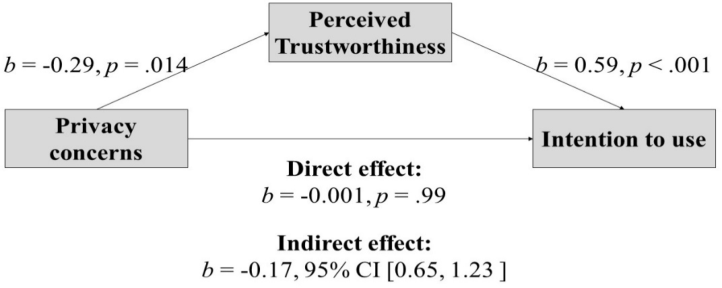
Results reveal that privacy concerns predicted perceived trustworthiness negatively, b = −0.29, p = .014, R2 = .09, and that perceived trustworthiness predicted intention to use the recommender system positively, b = 0.59, p <.001, R2 = .35. Further, perceived trustworthiness mediated the relation between privacy concerns and intention to use the learning recommender system partially b = −0.17, 95% CI [0.65, 1.23] (Figure 1). Consequently, both hypotheses could be confirmed.
Figure 1: Results from the mediation model of perceived trustworthiness on privacy concerns and intention to use.
Considering the facets of trustworthiness, privacy concerns significantly predicted benevolence (F(1,67) = 8.42, p = .005, R2 = .11). The predictions of the facets competence and integrity were not significant. Further, all facets of trustworthiness predicted intention to use the recommender system, whereas a greater effect was found for benevolence, F(1,67) = 34.29, p < .001, R2 = .34 (integrity: F(1,67) = 19.87, p < .001, R2 = .23, competence: F(1,67) = 14.02, p < .001, R2 = .17). Thus, perceived trustworthiness is an important predictor not only for the indirect effect of privacy concerns on intention to use but also as single predictor for intention to use a learning recommender system for training.
DISCUSSION
To reduce time and resources for HR professionals and remain hyper- competitive, organizations and HR departments rely increasingly on AI support systems including learning recommender systems for training. Despite the benefits of personalized workplace learning, privacy concerns
Privacy Concerns in Recommender Systems for Personalized Learning 157
regarding the necessary amount of (personal) data of employees are raised. This, in turn, raises questions of design principles and factors that influence the perception and use of such systems.
Based on previous research regarding privacy concerns and trustworthy recommender systems, this study explored the role of perceived trustworthiness in the context of AI-driven environments. More detailed, it was investigated whether perceived trustworthiness mediated the relationship between privacy concerns and the intention to use an AI-based system for workplace learning. We postulated that privacy concerns negatively predict perceived trustworthiness and that perceived trustworthiness positively predicts intention to use an AI-based learning recommender system.
The perception of privacy including privacy concerns is a complex phenomenon for users. Previous research demonstrated that there can be discrepancies between increased privacy concerns and behaviour (e.g., amount of information disclosure, intention to use a system) (Gerber et al., 2018). In this study, privacy concerns did not have a significant direct influence on behaviour but an indirect influence was shown through perceived trustworthiness, which had a significant influence on behavioural intention. There are competing explanations for this phenomenon. One possible explanation could be that the risk and trustworthiness perception of a system influence the behaviour of the user (Gerber et al., 2018). Research has demonstrated that the affect of perceived risks leading to increased privacy concerns is not strong enough to influence actual privacy behaviour (e.g., intention to use an AI-based system after experiencing it) (Norberg et al., 2007). Further, when considering trustworthiness facets separately, there is a pronounced negative relationship between privacy concerns and benevolence, the perceived extent to which a system does good to its user (Mayer et al., 1995). Interestingly, privacy concerns had no influence on the other facets of perceived trustworthiness (the perception of the systems competence and integrity). These results demonstrate that privacy concerns can be alleviated, particularly when users perceive specific system characteristics, namely that a system does good to its user.
We found a significant relationship between perceived trustworthiness and intention to use a learning recommender system which is in line with several previous studies. In their meta-analysis, Gerber et al. (2018) demonstrated the major significance of trust in the prediction of the intention to use a system. Further, Kelly et al. (2023) confirmed that trust in an AI system is a relevant factor for system use and acceptance. The result of the present study goes one step further. It adds the significance of perceived trustworthiness including its facets benevolence, integrity and competence. We could add the significance of benevolence as facet of perceived trustworthiness in the context of privacy concerns and the intention to use a learning recommender system. In sum, increasing the perceived trustworthiness of a learning recommender system could result in a greater intention to use the system for training.
Accordingly, the results highlight the importance of designing and implementing trustworthy AI-based learning recommender systems for the workplace especially with regard to the privacy-personalization trade-off (Awad, 2006; Chellappa and Sin, 2005). A design of trustworthy AI-based
158 Klostermann and Kluy
learning recommender systems is possible through transparent data handling practices in line with Data Protection Regulations and user-centred features that enhance perceived trustworthiness (e.g., Ge et al., 2024). For example, providing users with control over their data, such as allowing them to decide what personal information to share, can foster both trustworthiness and intention to use such a system. Future research should explore additional mediators and moderators, such as perceived control, system transparency, and user experience, to fully understand the dynamics between privacy concerns, perceived trustworthiness, and system use. These insights can inform the development of AI-based learning recommender systems that balance personalization with robust privacy safeguards, ultimately driving user trust and engagement for training.
Like other research, this study has limitations. First, the research data was collected online with an online data collection platform. Online data collection platforms are increasingly common, but concerns have been raised about the quality of data. Although attention questions and an interactive system for the participants were implemented and Douglas et al. (2023) corroborate the quality of Prolific compared to other online data collection platforms, we cannot fully guarantee that participants in the study took part and completed the questionnaires in good conscience. Future studies could validate the findings in more realistic work settings.
Second, this research followed a quantitative approach only. For complex phenomena it can be beneficial to make use of qualitative approaches including interviews and open questions. An additional qualitative approach could add to the understanding of the complex phenomenon of privacy concerns, perceived trustworthiness and intention to use a system. Future studies could implement a mixed-methods study approach to gain a deeper understanding of complex phenomena including privacy concerns in the context of AI-based systems.
Third, in this study we specifically limited our focus on privacy concerns, perceived trustworthiness and intention to use a learning recommender system. However, according to the privacy calculus, privacy risks and benefits, which we only considered indirectly, are additional relevant direct predictors of behaviour (Gerber et al., 2018). Given that the links between factors in the context of privacy concerns have not yet been clearly defined (Kehr et al., 2015; Buck et al., 2022), future studies should consider to add additional factors to their research model. This will add to a more comprehensive picture of the interrelationships of privacy concerns, trustworthiness, acceptance, use and additional antecedents and outcomes in the context of AI-based learning recommender systems.
CONCLUSION
To the best of our knowledge, this study is the first that investigated the role of perceived trustworthiness in the context of privacy concerns and system use of AI-based learning recommender systems for training and development. To shed light into the dynamics of privacy concerns, it was investigated whether perceived trustworthiness has a mediating role
Privacy Concerns in Recommender Systems for Personalized Learning 159
in the relation between privacy concerns and intention to use a learning recommender system. As expected, the results show that privacy concerns and perceived trustworthiness have a significant negative relationship and that perceived trustworthiness significantly predicts intention to use the learning recommender system. Further, results demonstrate that especially the perceived extent to which a system is believed to do good to its user has a buffering effect on privacy concerns. The results underline the significant role of perceived trustworthiness in the context of privacy, acceptance and use for learning recommender systems at the workplace.
ACKNOWLEDGMENT
We would like to thank Arn Baudzus and Dr. Martin Brenzke from the Federal Institute for Occupational Safety and Health in the group “Artificial Intelligence in Work Systems” for their help in building the simulated web-based learning recommender system for the experimental study.
REFERENCES
Awad, K. (2006): The Personalization Privacy Paradox: An Empirical Evaluation of Information Transparency and the Willingness to Be Profiled Online for Personalization, MIS Quarterly Volume 30, No. 1. Bansal, G., Zahedi, F., Gefen, D. (2010). The impact of personal dispositions on
information sensitivity, privacy concern and trust in disclosing health information online, Decision Support Systems Volume 49, No. 2. Baron, R. M., Kenny, D. A. (1986). The moderator–mediator variable distinction in social psychological research: Conceptual, strategic, and statistical considerations, Journal of Personality and Social Psychology Volume 51, No. 6. Benbasat, I., Wang, W. (2005). Trust in and adoption of online recommendation
agents, Journal of the association for information systems Volume 6, No. 3. Brill, T. M., Munoz, L., Miller, R. J. (2019). Siri, Alexa, and other digital assistants: A study of customer satisfaction with artificial intelligence applications, Journal of Marketing Management Volume 35. Buck, C., Dinev, T., Anaraky, R. G. (2022) “Revisiting APCO” in: Modern Socio-
Technical Perspectives on Privacy, Knijnenburg, B. P., Page, X., Wisniewski, P. Richter Lipford, H., Proferes, N., Romano, J. (Ed.). pp. 43–60. Büttner, O. B., Göritz, A. S. (2008). Perceived trustworthiness of online shops, Journal of Consumer Behaviour Volume 7, No. 1. Chellappa, R. K., Sin, R. G. (2005): Personalization versus Privacy: An Empirical
Examination of the Online Consumer’s Dilemma, Inf Technol Manage Volume 6, Nos. 2–3. Douglas, B. D., Ewell, P. J., Brauer, M. (2023). Data quality in online human-subjects research: Comparisons between MTurk, Prolific, CloudResearch, Qualtrics, and SONA, PloS one Volume 18, No. 3. Duenser, A., Douglas, D. M. (2023). Whom to Trust, How and Why: Untangling
(2022). A survey on trustworthy recommender systems, ACM Transactions on Recommender Systems Volume 3, No. 2.
160 Klostermann and Kluy
Gerber, N., Gerber, P., Volkamer, M. (2018). Explaining the privacy paradox: A systematic review of literature investigating privacy attitude and behavior, Computers & Security Volume 77. Hancock, P. A., Kessler, T. T., Kaplan, A. D., Stowers, K., Brill, J. C., Billings, D. R.,
Schaefer, K. E., Szalma, J. L. (2023). How and why humans trust: A meta-analysis and elaborated model, Frontiers in psychology Volume 14. Kaplan, A. D.; Kessler, T. T.; Hancock, P. A. (2020). How Trust is Defined and its use in Human-Human and Human-Machine Interaction, Proceedings of the Human Factors and Ergonomics Society Annual Meeting Volume 64, No. 1. Kehr, F., Kowatsch, T., Wentzel, D., Fleisch, E. (2015). Blissfully ignorant: The effects
of general privacy concerns, general institutional trust, and affect in the privacy calculus, Information Systems Journal Volume 25, No. 6. Langer, M., König, C. J., Back, C., Hemsing, V. (2023). Trust in Artificial Intelligence: Comparing trust processes between human and automated trustees in light of unfair bias, Journal of Business and Psychology Volume 38, No. 3. Li, L. (2022). Reskilling and Upskilling the Future-ready Workforce for Industry 4.0
and Beyond, Information systems frontiers: A journal of research and innovation Volume 26. Maity, S. (2019). Identifying opportunities for artificial intelligence in the evolution of training and development practices, Journal of Management Development Volume 38, No. 8. Mayer, R. C., Davis, J. H., Schoorman, F. D. (1995). An Integrative Model of
Organizational Trust, The Academy of Management Review Volume 20 No. 3. Norberg P. A., Horne D. R., Horne D. A (2007). The privacy paradox: Personal information disclosure intentions versus behaviors, Journal of Consumer Affairs Volume 41, No. 1. Pozzi, R., Rossi, T., Secchi, R. (2021). Industry 4.0 technologies: Critical success
factors for implementation and improvements in manufacturing companies, Production Planning & Control Volume 34, No. 2. Schlicker, N., Baum, K., Uhde, A., Sterz, S., Hirsch, M. C., and Langer, M., (September, 2022). How Do We Assess the Trustworthiness of AI? Introducing the Trustworthiness Assessment Model (TrAM) [online]. Available from: osf.io/preprints/psyarxiv/qhwvx. Vimalkumar, M., Sharma, S. K., Singh, J. B., Dwivedi, Y. K. (2021). ‘Okay google,
what about my privacy?’: User’s privacy perceptions and acceptance of voice based digital assistants, Computers in Human Behavior Volume 120. Wesche, J. S., Handke, L., Pahl, B., Diering, L. E., Junger, A. J., Gieselmann, L. R. L. (2023). Digitalisierung und Automatisierung der Weiterbildung in Organisationen: Chancen, Herausforderungen und Praxisbeispiele [Digitization and automation of training and development in organizations: chances, challenges, and application examples], Gruppe. Interaktion. Organisation. [Group. Interaction. Organization. ] Volume 54, No. 3. Wisniewski, P. J., Page, X. (2022) “Privacy Theories and Frameworks” in: Modern Socio-Technical Perspectives on Privacy, Knijnenburg, B. P., Page, X., Wisniewski, P., Richter Lipford, H., Proferes, N., Romano, J. (Ed.). pp. 15–42. Xiao, B., Benbasat, I. (2007). E-Commerce Product Recommendation Agents: Use,
Characteristics, and Impact, MIS Quarterly Volume 31, No. 1. Xu, H., Dinev, T., Smith, J., & Hart, P. (2011). Information privacy concerns: Linking individual perceptions with institutional privacy assurances, Journal of the Association for Information Systems Volume 12, No. 12.
Privacy Concerns in Recommender Systems for Personalized Learning 161
Zhang, B., Wang, N. (2014) “Privacy Concerns in Online Recommender Systems”, proceedings of the 10th Symposium On Usable Privacy and Security (SOUPS 2014), Menlo Park, CA. Zhang, B., Sundar, S. S. (2019). Proactive vs. reactive personalization: Can
customization of privacy enhance user experience? International Journal of Human-Computer Studies Volume 128.
LISTED IN THE AHFE DIGITAL BOOKSTORE CATALOGUE
Explore the complete digital volume
Human Interaction and Emerging Technologies (IHIET-AI 2025): Artificial Intelligence and Future Applications
Read this individual research paper free through the original publisher, or explore the full digital proceedings book.
ISBN 978-1-964867-37-3
Explore this ISBN in the AHFE Bookstore ↗Listed in the July 2026 bookstore catalogue; search by ISBN to confirm current availability · Digital book purchase optional