Kitty Kioskli, Laura Bishop, Nineta Polemi, Antonis Ramfos (2024). Towards a Human-Centric AI Trustworthiness Risk Management Framework. In: Human Factors in Cybersecurity. AHFE Open Access, vol. 127, pp. 63–73. https://doi.org/10.54941/ahfe1004766
University of Essex, School of Computer Science and Electronic Engineering, Institute, of Analytics and Data Science (IADS), Colchester CO4 3SQ, United Kingdom ↗
Artificial Intelligence (AI) aims to replicate human behavior in socio-technical systems, with a strong focus on AI engineering to replace human decision-making. However, an overemphasis on AI system autonomy can lead to bias, unfair, non-ethical decisions, and thus a lack of trust, resulting in decreased performance, motivation, and competitiveness. To mitigate these AI threats, developers are incorporating ethical considerations, often with input from ethicists, and using technical tools like IBM's Fairness 360 and Google's What-If tool to assess and improve fairness in AI systems. These efforts aim to create more trustworthy and equitable AI technologies. Building trustworthiness in AI technology does not necessarily imply that the human user will fundamentally trust it. For humans to use technology trust must be present, something challenging when AI lacks a permanent/stable physical embodiment. It is also important to ensure humans do not over-trust resulting in AI misuse. Trustworthiness should be assessed in relation to human acceptance, performance, satisfaction, and empowerment to make design choices that grant them ultimate control over AI systems, and the extent to which the technology meets the business context of the socio-technical system where it's used. For AI to be perceived as trustworthy, it must also align with the legal, moral, ethical principles, and behavioral patterns of its human users, whilst also considering the organizational responsibility and liability associated with the socio-technical system's business objectives. Commitment to incorporating these principles to create secure and effective decision support AI systems will offer a competitive advantage to organizations that integrate them.Based on this need, the proposed framework is a synthesis of research from diverse disciplines (cybersecurity, social and behavioral sciences, ethics) designed to ensure the trustworthiness of AI-driven hybrid decision support while accommodating the specific decision support needs and trust of human users. Additionally, it aims to align with the key performance indicators of the socio-technical environment where it operates. This framework serves to empower AI system developers, business leaders offering AI-based services, as well as AI system users, such as educators, professionals, and policymakers, in achieving a more absolute form of human-AI trustworthiness. It can also be used by security defenders to make fair decisions during AI incident handling. Our framework extends the proposed NIST AI Risk Management Framework (AI-RFM) since at all stages of the trustworthiness risk management dynamic cycle (threat assessment, impact assessment, risk assessment, risk mitigation), human users are considered (e.g., their morals, ethics, behavior, IT maturity) as well as the primary business objectives of the AI socio-technical system under assessment. Co-creation and human experiment processes must accompany all stages of system management and are therefore part of the proposed framework. This interaction facilitates the execution of continuous trustworthiness improvement processes. During each cycle of trustworthiness risk mitigation, human user assessment will take place, leading to the identification of corrective actions and additional mitigation activities to be implemented before the next improvement cycle. Thus, the main objective of this framework is to help build ‘trustworthy’ AI systems that are ultimately trusted by their users.
An Artificial Intelligence (AI) system is a machine-based system that, for explicit or implicit objectives, infers, from the input it receives, how to gener- ate outputs such as predictions, content, recommendations, or decisions that can influence physical or virtual environments (Russell & Norvig, 2020). Different AI systems vary in their levels of autonomy and adaptiveness after deployment (OECD).
AI research is primarily focused on replicating and/or enhancing human behaviour within socio-technical systems. AI engineering endeavours to cre- ate systems that practically replace human decision-making, yet an overem- phasis on machine autonomy can lead to biased and non-objective outcomes, making the systems susceptible to bias. Such distrust in AI systems not only results in potentially injurious decision-making but also diminishes user per- formance, autonomy, and job satisfaction. Should AI processes not fully represent an organisation’s policies, people and culture, not only can it ham- per the establishment of a safe environment, but challenges the ability to spot anomalies in output that may suggest security threat is present (Stevens, 2020). To address these issues, developers integrate ethical reflection pro- cesses, often engaging with ethicists, and employ technical tools like IBM’s Fairness 360 and Google’s What-If tool to enhance fairness in AI systems. However, achieving trustworthiness in AI technology goes beyond such tech- nical measures, requiring a focus on empowering human users with design choices that grant them control and transparency over AI they need to remain productive, safe and secure (Floridi et al., 2018). Concerning the links between the properties of trustworthiness and the risks within the AI lifecycle, is published by UC Berkeley Centre for Long-Term Cybersecurity (Newman, 2023). Trustworthiness in AI refers to the reliability, safety, transparency, fairness, and accountability of AI systems, ensuring they operate ethically, without bias, and in a manner that safeguards user privacy and rights (European Commission, 2019). The evaluation of trustworthiness should include human performance, satisfaction metrics, and an understanding of human deci- sion support needs within the business context of the socio-technical system (Zhang et al., 2020). Thus, for an AI system to be trustworthy, it must align with the legal, moral, and ethical principles of its human users, considering organizational responsibility and liability in relation to business objectives (Jobin et al., 2019, AI Act).
In response to the societal imperative of democratizing AI amidst the digital transition and the impending wave of ‘deep tech’ innovation, the proposed framework introduces an innovative approach for assessing, and managing risks (technical and social) related to all dimensions of trustwor- thiness. The primary aims of this paper are: to adopt an AI risk manage- ment view engaging all users (e.g., developers, operators, integrators, etc.) of the AI system under assessment through interactive co-creation social experiments, interventions, and dialogues; to lead our adopted human- engaging approach to adequate, human-interpretable explanations of the AI system’s decision-making process but also intelligently extract knowl- edge related to users’ decision support needs, moral values, and the key business objectives of the AI system viewed as a socio-technical system. This dynamic interaction forms the basis for continuous trustworthiness improvement processes, where each cycle involves a human-centric assess- ment and the identification of corrective actions before the next improvement phase.
Towards a Human-Centric AI Trustworthiness Risk Management Framework 65
RISK-BASED METHODOLOGY FOR ENSURING TRUSTWORTHINESS Before we propose the Trustworthiness Risk Management Framework (AI-TMF), our initial focus is on refining the definition of trustworthiness in AI hybrid decision support. This theoretical conceptual framework has been developed with the use of data found in the literature. It proposes sug- gestions on how data could potentially enhance and refine this framework. This includes the need for AI to be transparent in its reasoning, and adapt- able and secure in its behaviour (Hou, 2021; Jacovi, 2021). Additionally, we explore the impact of the AI decision support system on the broader socio-technical system, considering it a significant factor in trustworthiness. A methodology for assessment, rooted in the Decision Intelligence disci- pline, will be developed. Concurrently, our multi-disciplinary research and co-creation practices aim to identify human characteristics influencing the perceived trustworthiness of an AI system.
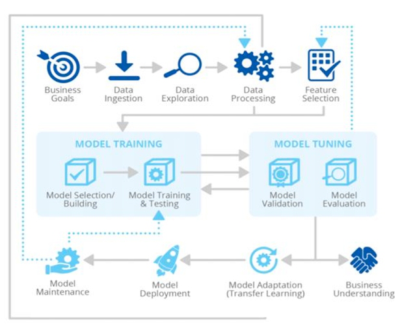
AI systems are dynamic (main difference with ICT systems) with AI system lifecycle phases involving: i) ‘design, data and models’; which is a context- dependent sequence encompassing planning and design, data collection and processing, as well as model building; ii) ‘verification and validation’; iii) ‘deployment’; and iv) ‘operation and monitoring’. These phases often take place in an iterative manner and are not necessarily sequential. The decision to retire an AI system from operation may occur at any point during the operation and monitoring phase (OECD, ENISA 2022).
Figure 1: AI-lifecycle according to ENISA (ENISA, 2020).
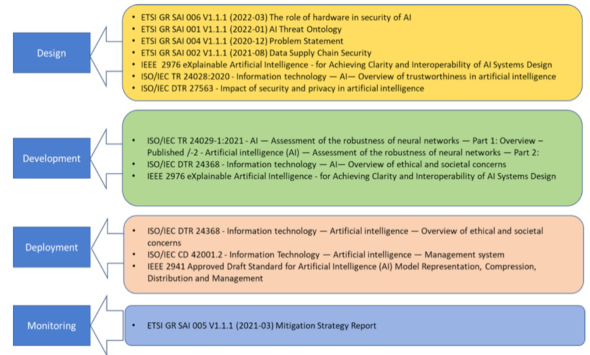
The Human-Centric AI Trustworthiness Risk Management Framework is set to enhance the evaluation of trustworthiness in decision-supporting AI systems, introducing an innovative and human-centered methodological approach essential for assessing social and technical risks. This evaluation methodology takes a dynamic risk management perspective, aligning with established frameworks and standards (Fig. 2) in the entire lifecycle of the AI systems.
Figure 2: Guidelines associated with the lifecycle implementation of AI systems (ENISA, 2023).
The envisaged trustworthiness evaluation methodology shall go beyond the conventional approach by incorporating considerations for vulnerabili- ties related to fairness, technical accuracy, robustness, and adherence to the EU legal framework for trusted AI. What sets the trustworthiness evalua- tion methodology apart is its novel integration of the human perspective and a broader socio-technical systems outlook in the risk management-based assessment of trustworthiness. Helping predict not just system behaviour, but human behaviour and how they co-exist.
THE AI TRUSTWORTHINESS MANAGEMENT FRAMEWORK (AI-TMF) Our proposed AI-TMF is dynamic theoretical framework that empowers human recipients of AI-based decision support by enabling:
A dynamic risk management perspective, aligning with established frame- works such as the AI Risk Management Framework proposed by NIST (NIST_AI_RMF), NIST Special Publication 1270, risk management stan- dards (e.g., ISO31000, ISO27001, ISO27005), and specific standards within the AI systems lifecycle according to ENISA 2022 (refer to Figure 2) in order to estimate the technical driven risks.
Effective elicitation of users’ decision support needs, moral values, and key success factors based on human psychological, ethical, and behavioural analysis, along with advanced organizational and decision theory approaches. Social co-design experiments, behavioural interven- tions, and dialogs with the users (administrators, developers, operators etc) of the AI system under assessment are the instruments used to measure the social driven risks.
Human-centric evaluation (i.e., usability testing) and optimization of trustworthiness in terms of fairness, technical accuracy, and robustness, implementing dynamic, inherently transparent risk-assessment approaches.
Towards a Human-Centric AI Trustworthiness Risk Management Framework 67
Enhanced explainability regarding the trustworthiness of AI-based deci- sion support through anomaly detection indicators related to fairness, technical accuracy, robustness, and the socio-technical environment.
Human-centric actions for optimizing trustworthiness based on risk mit- igation approaches concerning fairness, technical accuracy, robustness, and the socio-technical environment. Mitigation actions include not only technical controls but also non-technical mitigation actions including awareness, behaviour change interventions, and trainings.
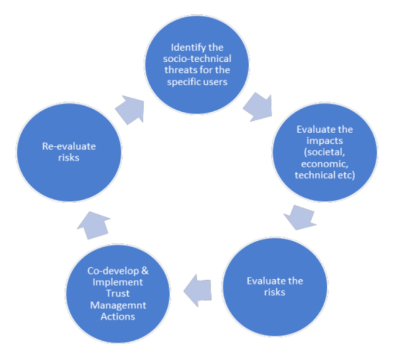
The AI-TMF framework diligently executes a series of steps (risk manage- ment based) outlined in Figure 3 for every AI system implementation cycle. This iterative process ensures ongoing improvements, adaptation, and align- ment with evolving socio-technical dynamics, reinforcing the commitment to establishing and maintaining appropriate trustworthiness in AI systems to maintain use and avoid abuse or misuse. Each step adopts technical driven Risk Assessment methodologies (e.g., NIST, ENISA to estimate the techni- cal risks and social experiments, behavioural interventions and dialogs are used to estimate the social risks in the social environment that the AI systems under assessment operate (Figure 3).
Figure 3: The AI trustworthiness management framework (AI-TMF).
Recognizing the pivotal role of the human perspective, the framework engages in research to implement intelligent human-AI dialogues to estimate the social-driven risks. This involves providing comprehensive explanations for AI system decisions, including details on the employed AI approaches, models, algorithms, and training data sets in a language appropriate to the people, culture and objectives of the organisation. Simultaneously, the framework aims to optimize human trust in the AI system, aligning with user expectations and values. This approach is pivotal for establishing trans- parency and fostering confidence in AI decision-making processes as well as aid detection of anomalies and potential threat.
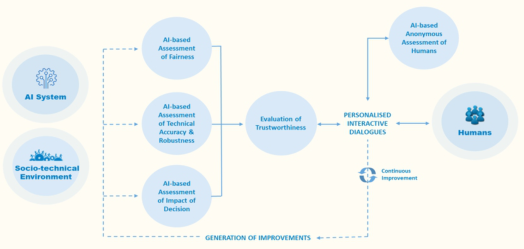
THE AI-TFM CONCEPTUAL ARCHITECTURE The proposed AI-TFM conceptual architecture, is illustrated in Figure 4 where we provide detailed design considerations for each module within the conceptual architecture. For example, the notion of fairness in AI encom- passes concerns for equality and equity, addressing issues such as bias and discrimination. The framework recognizes that perceptions such as fair- ness vary among AI users and may shift depending on the system’s usage. For instance, even AI systems deemed non-biased may lack fairness, as demonstrated when training data sets eliminate demographic bias but remain inaccessible to disabled individuals. Bias can be introduced at any phase of the AI system implementation lifecycle, from design to validation. The frame- work assesses fairness using indicators defined by NIST, covering systemic bias, computational bias, and human bias. The ‘AI-based Assessment of Fair- ness’ module computes metrics for these three major categories of AI bias, employing the principles of an AI-driven anomaly detection system.
Figure 4: Socio-technical approach in the AI-TMF.
Co-creation sessions with citizens and stakeholders would ensure that the ‘AI-based Assessment of Fairness’ module meets their functional expectations and aids in creating initial training data sets for the developed AI models. Co-creation practices involve fostering collaboration among diverse stake- holders to collectively identify, assess, and mitigate risks associated with a system or process. This includes conducting cross-functional workshops, facilitating threat modelling sessions, and engaging in iterative risk assess- ments with continuous feedback loops. Joint scenario planning allows teams to simulate and evaluate responses to potential risks, refining strategies based on collective insights. Establishing a security champions program and maintaining collaborative documentation further ensures a culture of shared responsibility and transparency. Through these co-creation practices, orga- nizations can tap into the collective expertise of their teams, proactively addressing potential vulnerabilities and embedding trustworthiness into the core of their systems.
The output of this module contributes to the ‘Evaluation of Trustworthi- ness’ module, as depicted in Figure 4. The assessment of technical accuracy
Towards a Human-Centric AI Trustworthiness Risk Management Framework 69
and robustness in the ‘AI-based Assessment of Technical Accuracy & Robust- ness’ module is implemented based on the principles of an AI-driven anomaly detection system. Reliability and validity, understood in terms of accuracy and robustness, may be assessed through audits or monitoring. The frame- work leverages AI for assessing accuracy and robustness through activation analysis, examining patterns in deep neural network classifiers. Activation analysis serves as an evaluation of both robustness and accuracy, comple- menting other approaches such as Bayesian neural networks. Additionally, it facilitates enriched explanations beneficial to domain experts involved in the development and use of hybrid decision systems. Co-creation sessions model relevant user, task, and contextual characteristics, aligning them with the required levels of robustness and accuracy detailed through activation pattern analysis in deep neural networks. This alignment enables sliding decision-making, and assessments for accuracy and robustness in human- AI decision-making feeding into the ‘Evaluation of Trustworthiness’ module, allowing for a dynamic assignment of decision-making agency between human and machine actors in the AI system.
To include the impact of decisions on the relevant socio-technical system in the trustworthiness optimization process, an “AI-based Assessment of Impact of Decision” module will be constructed. First, the human user will use the developed Decision Intelligence (DI) methodology (Pratt et al., 2023) and supporting graphics to create a qualitative model of the socio-technical envi- ronment, considering possible actions, key performance indicators (KPIs), external factors, and their pairwise relations. Second, using co-created data-driven approaches, a DI AI simulation will be trained to generate a quan- titative simulated model of the socio-technical system, potentially learning pairwise interactions quantitatively from co-created data sets. The simulated model provides scenarios related to the AI system’s decision support and the projected effects on the KPIs of the overall socio-technical system, con- tributing to the ‘Evaluation of Trustworthiness’ module. The socio-technical environment model and AI-based simulation inherently bring risks, necessi- tating iterative trustworthiness assessment by the user. Evaluation of trust in the DI simulation results is crucial, and user feedback highlighting issues in the DI model or simulation is addressed by correcting the socio-technical environment model or the generated AI-based DI simulation. This user feed- back is gathered by “Personalized Interactive Dialogues” and acted upon in the “Generation of Improvements,” as shown in Figure 4.
The ‘AI-based Anonymous Assessment of Human’ module aims to enhance the evaluation of trustworthiness by incorporating the human perspective and assessing both behavioural and moral value aspects. Whilst a succinct definition of trust is still to be determined, it is noted that an artefact is con- sidered trustworthy should it be perceived as (a) capable, (b) honest, and (c) kind (Gefen et al., 2008; Viklund, 2002). With such views believed to be influenced by not just the output of the artefact, but end-user individ- ual differences such as personality, perceptions and beliefs (e.g., Riedl, 2022; Sharan et Romano, 2020). An analysis of these aspects at both the individ- ual and cultural levels in relation to AI are therefore imperative, should a
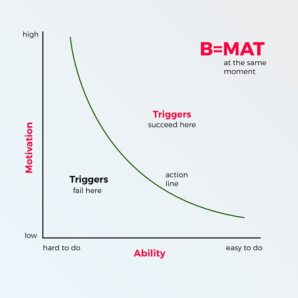
universal picture be painted in relation to trustworthiness across both tech- nical and human layers. For this particular aspect of the framework, we draw upon investigative psychology research and behavioral science utilis- ing frameworks such as Fogg’s behavioral model (Fogg, 2009), that posits that the likelihood of a behavior occurring is influenced by Motivation (M), Ability (A), and an appropriate Trigger (T), as depicted in Figure 5. In addi- tion, consideration will be given to the Unified Theory of Acceptance and Use of Technology Model (UTAUT) that is now shifting focus towards the adoption and use of AI tools and techniques with trust an important factor (Venkatest, 2022).
Figure 5: Fogg’s model, 2009 (Ray, 2021).
Human profiles can be proposed based on five distinct categories of traits with specific attributes and measurement scales: personality, social- behavioural factors, technical awareness and efficacy, motivation, and an appropriate trigger. Notably, studies have shown that people tend to trust inhuman-generated profiles more than AI-generated ones (Kioskli & Polemi, 2022). In our framework, we share this perspective and plan co-creation ses- sions, including workshops and living labs with stakeholders and pilot users, to build user categories and capture their profiles. Anonymous protocols and mechanisms will be employed during development, storage, and shar- ing phases to ensure the anonymity of the profiling process. The moral value evaluation of the human factor within the framework will involve a criti- cal exploration of moral judgment and a self-reflective dialogical awareness. Specifically, the development of the moral values evaluation will consider applied ethical theories (Kim et al., 2019), essential for motivating agents to behave morally. Not least, investigations will consider the impacts such trust profiles may have on the abuse, misuse and disuse of AI tools and techniques to aid vulnerability identification.
TRUSTWORTHINESS ASSESSMENT USING AI Our approach to assessing trustworthiness revolves around the fundamental concept of risk assessment accompanied with social co-creation experi- ments, interventions, living labs and dialogs. This choice is rooted in the acknowledgment that the majority of human decisions inherently involve
Towards a Human-Centric AI Trustworthiness Risk Management Framework 71
varying degrees of risk evaluation. Whether done consciously and explic- itly or unconsciously, decision-makers routinely engage in weighing the pros and cons associated with their choices. The implementation of the ‘AI-based Evaluation of Trustworthiness’ module is anchored in well-established Risk Assessment (RA) frameworks. The module generates outputs that feed into the system-under-test model, manifesting as distinct vulnerabilities that trig- ger an automatic recalculation of risks. The recalculated risks yield altered risk levels and propose controls to mitigate any elevated risk levels identi- fied. Human operators can select based on the business objectives, use of the systems, technical and social attributes and apply these controls to the actual system (technical controls) and its users, (social controls will also be included e.g., awareness, behaviour change interventions) thereby reducing the likelihood of increased unfairness or diminished accuracy.
Our deliberate choice of a knowledge-based approach enhances trans- parency, a critical factor in achieving advanced explainability levels for any AI decision support provided to humans. Previous work in the Systems Trust Model (STM) has led to the development of a “threat path explorer,” allow- ing users to navigate from identified risks to their root causes, exploring the impact of controls on systemic risk (Phillips et al., 2022). While AI and machine learning tools may drive the STM, the path from events like height- ened unfairness to risks affecting trustworthiness remains clear and evident to the user.
In particular, our methodology involves a step-by-step co-design process that offers comprehensive guidance for developing user-centric interventions. We provide a detailed outline for modifying these interventions into practical and acceptable prototype behavioral control mechanisms. Engaging users in this process allows them to contribute suggestions and propose solutions, ensuring greater acceptance within the broader target audience. This user- centric approach aims to foster a collaborative environment for refining and optimizing trustworthiness interventions in AI decision support systems, in turn improving not only system productivity, but its safety and security.
CONCLUSION
In conclusion, our research underscores the significance of incorporating an AI risk assessment-based approach enriched with social experiments, behavioural interventions, and dialogs in evaluating the trustworthiness of AI systems. By aligning our proposed AI-TMF with existing Risk Assess- ment (RA) frameworks, we leverage the well-established principles of risk analysis to identify vulnerabilities and recalibrate technical and social risks within the system-under-test. The automatic recalculation process, coupled with suggested controls, empowers human operators to intervene effec- tively, mitigating potential risks such as unfairness or accuracy issues. This knowledge-based approach not only prioritizes transparency but also ensures an advanced level of explainability, crucial for building user trust in AI deci- sion support. Our work within the Systems Trust Model (STM) framework has resulted in practical tools like the “threat path explorer,” providing users with a clear understanding of the causal relationships between identified risks
and potential threats, further enhancing the user’s ability to manage and improve system trustworthiness.
Furthermore, our proposed AI-TMF enriches the existing RA methodolo- gies with social experiments. AI-TFM introduces a step-by-step co-design process that promotes user-centric interventions for enhancing trustwor- thiness assessments estimating not only technical but also social risks. By involving users in the development and modification of behavioral interven- tions, we tap into their insights and preferences, ensuring a more tailored and widely accepted approach. This collaborative model fosters a dynamic feed- back loop, empowering users to make suggestions and propose solutions that resonate with the broader target audience. Our continuous research aims to advance the understanding in assessing the social and technical dimensions of trustworthiness in AI systems, paving the way for more responsible and user- friendly decision support solutions serving the people and their democratic, ethical values and morals.
ACKNOWLEDGMENT
The authors would like to acknowledge the ‘Human-centered Trustwor- thiness Optimisation in Hybrid Decision Support’ (THEMIS 5.0) project under grant agreement No. 101121042 and the ‘Fostering Artificial Intelli- gence Trust for Humans towards the optimization of trustworthiness through large-scale pilots in critical domains’ (FAITH) project under grant agreement No. 101135932. The views expressed in this paper represent only the views of the authors.
REFERENCES
AI Act: https://eur-lex.europa.eu/legalcontent/EN/TXT/DOC/?uri=CELEX:52021P C0206. Benson, H. (2000). Socratic Wisdom. Oxford: Oxford University Press. ENISA (2020) https://www.enisa.europa.eu/publications/artificial-intelligence-cyber
security-challenges. ENISA (2023) https://www.enisa.europa.eu/publications/multilayer-framework-forgood-cybersecurity-practices-for-ai Floridi, L., Cowls, J., Beltrametti, M., Chatila, R., Chazerand, P., Dignum, V. &
Valeriani, A. (2018). AI4 People—An Ethical Framework for a Good AI Society: Opportunities, Risks, Principles, and Recommendations. Minds and Machines, 28(4), 689–707. High-Level Expert Group on Artificial Intelligence - European Commission. (2019).
https://digital-strategy.ec.europa.eu/en/library/ethics-guidelines-trustworthy-ai. Hou, Y. et al. (2021). Artificial Intelligence is a promising prospect for the detection of prostate cancer extracapsular extension with MP-MRI: A Two-center comparative study [Preprint]. doi: 10.21203/rs.3.rs-298296/v1. Jacovi, A. et al. (2021). ‘Formalizing trust in artificial intelligence’, Proceedings of the
2021 ACM Conference on Fairness, Accountability, and Transparency [Preprint]. doi: 10.1145/3442188.3445923. Jobin, A., Ienca, M., & Vayena, E. (2019). The Global Landscape of AI Ethics Guidelines. Nature Machine Intelligence, 1(9), 389–399.
Towards a Human-Centric AI Trustworthiness Risk Management Framework 73
Kim, T. W. and Mejia, S. (2019). “From Artificial Intelligence to Artificial Wisdom: What Socrates Teaches Us,” in Computer, vol. 52, no. 10, pp. 70–74. Kioskli K., & Polemi N. Estimating attackers’ profiles results in more realistic vul-
nerability severity scores. Proceedings of the AHFE2022, July 24–July 28, 2022, New York, New York, USA, 53 (1), 138–150. Springer, Elsevier, CRC. Newman, J. (2023). A taxonomy of trustworthiness for Artificial Intelli- gence. https://cltc.berkeley.edu/wpcontent/uploads/2023/12/Taxonomy_of_AI_T rustworthiness_tables.pdf OECD: https://legalinstruments.oecd.org/en/instruments/oecd-legal-0449 Phillips, Taylor, et al. (2022). System Security Modeller. Zenodo. Pratt, L., Bisson, C. and Warin, T. (2023). ‘Bringing advanced technology to strategic decision-making: The Decision Intelligence/Data Science (DI/DS) integration framework’, Futures, 152, p. 103217. doi: 10.1016/j.futures.2023.103217. Ray, D. (2021). https://bootcamp.uxdesign.cc/foggs-behaviour-model-a-framework-
for behaviour-change-fd6ce4b0a1f2 Russell, S. J., & Norvig, P. (2020). Artificial Intelligence: A Modern Approach (4th ed.). Pearson. Stevens, R. et al. (2020). AI for science: Report on the Department of Energy (DOE)
town halls on artificial intelligence (AI) for Science [Preprint]. Zhang, B., Liao, Q., & Zhu, T. (2020). Explainable AI: A Survey of Black Box Deep Learning Models Interpretability. IEEE Access, 8, 17958–17975.
LISTED IN THE AHFE DIGITAL BOOKSTORE CATALOGUE
Explore the complete digital volume
Human Factors in Cybersecurity
Read this individual research paper free through the original publisher, or explore the full digital proceedings book.
ISBN 978-1-964867-03-8
Explore this ISBN in the AHFE Bookstore ↗Listed in the July 2026 bookstore catalogue; search by ISBN to confirm current availability · Digital book purchase optional