Ian Gonsher, Changfeng Wang, Bozhou Pang, Liu Hu, Shuyi Mao (2026). Augmented Intelligence and Creative Dialectics: Developing Tools for Enhanced Creativity. In: Human Interaction and Emerging Technologies (IHIET 2026). AHFE Open Access, vol. 236, pp. 180–190. https://doi.org/10.54941/ahfe1008094
The creative process can be characterized as a creative dialectic. Creative dialectics can be understood in terms of the development of novel and useful products that emerge through a process of contradiction and synthesis. In this paper, we present and evaluate a pilot prototype for a tool that allows users to navigate this dialectical process in order to enhance their creative process. The development of such a tool also offers a model for AI alignment, eschewing Agentic AI in favor of augmented intelligence; a paradigm that emphasizes collaboration between machine and human in order to generate new ideas and implement them in ways that are relevant to the appropriate context. The prototype is implemented as a node-based ideation system that helps designers to generate, connect, and refine ideas through modular interactions. Key features include a critique mode that embeds systematic frictions into the creative process, a synthesis engine that supports the combination and development of ideas, and a design log that saves and keeps track of users’ reflections and iterative thinking. To evaluate the system, we conducted a workshop-based user study (n=12) in which participants completed an open-ended design task and were evaluated based on their creative process and design outcomes using the system. The findings suggest that the system primarily supports creativity through the development of and reflection on ideas, rather than directly generating novel outputs.
The rise of agentic AI promises the arrival of machines capable of generating creative outputs independent of humans. But with the emergence of these new technologies, it is also important to consider non-agentic AI tools that might be used by human agents. The development of new tools for thinking has always been a crucial part of technological evolution. From the earliest writing systems to the printing press to the internet, these technologies have enabled humans to extend, concretize, and share their thoughts. Tools like these have allowed people to think more deeply and achieve more than they could on their own. The development of tools that augment human intelligence tends to enhance creativity.
Augmented Intelligence and Creative Dialectics 181 This project offers an important critique, and offers alternatives to, the emerging enthusiasm around fully Agentic AI in favor of an augmented intelligence paradigm that complements and aligns with human intelligence, not replacing it. The prototype we have been developing - which we are calling an Augmented Intelligence Engine (a play on a Search Engine) - is a tool for augmented intelligence (AugI). AugI is characterized as the partnership between technology and human experience, and not as an alternative to human agency. These tools are focused on augmenting intelligence, and in particular, that part of general intelligence that manifests itself in the creative process.
Creativity can be characterized in terms of novelty and usefulness (Sternberg, 1999). Creativity is often situated within human experience, centered on the ways we interact with the world and meet our needs. When creativity is divorced from these kinds of embodied, lived experiences, we risk getting stuck in irrelevance or abstraction. We risk outcomes that are not aligned with our values, an appropriate context, or actual needs.
The creative process is much like a conversation. In all its myriad forms, the creative process is an exploration that helps us evaluate and understand this against that, and that against this, in order to better understand what possibilities are available in relation to the given constraints. Throughout our design process, we explored the question of how we might develop an AugI tool that can help human users navigate this conversation, which can be characterized as a creative dialectic. Creative dialectics describes a generative process in which the interaction of opposing perspectives or internal tensions serves to catalyze the development of new ideas (Gonsher, 2023; Bergson, 1911; Hegel, 1977). Rather than immediately resolving contradictions through the elimination of one position over another, creative dialectics emphasizes engagement with differences and tensions, allowing competing viewpoints to inform and reshape one another. Within this framework, creativity is understood as an emergent outcome of iterative dialogue between contrasting or opposing elements, producing increasingly complex and nuanced understandings of the initial terms.
But creative dialectics is not just a critique that opposes or negates a given question, problem, or set of terms. That negation is complemented by a synthesis of terms that are differentiated through negation or opposition. The synthesis of opposing ideas (although not always equally) allows for new combinations to emerge. The play between antithesis and synthesis can expand the conditions of possibility and offer new territories to explore. This creative dialectic can be seen at the scale of politics and history, but also in the domain of artists, designers, and engineers. These frictions and harmonies are what move progress forward.
Negation and synthesis - the two vectors of creative dialectics - are analogous to the concepts of divergent thinking and convergent thinking. Divergent thinking is the cognitive process for developing many different possibilities to a given situation. Convergent thinking is the cognitive process of moving towards the most optimal or “best” solution. (Guilford, 1956) When one negates an idea, many new possibilities can be imagined. When one synthesizes ideas, new solutions can emerge in the combination of disparate ideas. Additionally, when mapping out the relationships between these ideas, one can apply different models for how these networks of knowledge are expressed. Some might be hierarchical, centering certain categories at the expense of others. Some might be non-hierarchical, allowing for a free play of concepts without any dominating
one over the other. Our prototype also explores how the creative dialectics that emerge from an iterative process can be represented. In developing strategies for representing the relationships between ideas, we draw on the distinction between arborescent (tree-like) and rhizomatic structures.
This mapping draws on the work of Gilles Deleuze and Félix Guattari, who contrasted the arborescent and rhizomatic as two models of thought and organization: the arborescent model is hierarchical, linear, and structured like a tree, with clear roots, branches, and centralized order. In contrast, the rhizomatic model is non-hierarchical, decentralized, and networked, allowing for multiple, non-linear connections and pathways that resist fixed structure and promote fluid, open-ended multiplicity (Deleuze and Félix, 1987).
LITERATURE REVIEW
AI Creativity Support Tools and Human-AI Co-Creation Generative AI systems are increasingly positioned as collaborators in creative workflows rather than purely automated tools (Davis et al., 2015). Within HCI, Creativity Support Tools (CSTs) are designed to augment human ideation and exploration rather than replace human agency (Lubart, 2005; Shneiderman, 2007a). However, recent work on human-AI co-creation suggests that model- led systems may reduce perceived ownership and encourage passive acceptance of AI-generated ideas (Maier et al., 2026). Research on AI-assisted ideation further shows that exposure to generated outputs can contribute to design fixation and reduced diversity during early ideation stages (Wadinambiarachchi et al., 2024). These findings suggest that increased generative capability does not necessarily support deeper or more diverse creative exploration.
Dialectical Creativity and Productive Friction Creativity is commonly understood as the interaction between divergent and convergent thinking processes (Guilford, 1967). Divergent thinking supports the generation of multiple possibilities, while convergent thinking involves refinement and selection of optimal solutions. The Torrance Tests of Creative Thinking operationalize creativity through fluency, flexibility, originality, and elaboration (Torrance, 2012). However, existing CSTs frequently prioritize divergent idea generation while under-supporting critique, evaluation, and iterative refinement (Lubart, 2005; Amabile, 1996), limiting full creative cycles in which ideas are re-examined, refined, and recombined.
From an HCI perspective, creative design is increasingly understood as an iterative process of reflection, evaluation, and reframing rather than linear problem solving (Schön, 1983). Research on design environments further frames critique as a generative mechanism that supports reinterpretation and conceptual change rather than merely corrective evaluation (Fischer et al., 1993). Recent human-AI co-creative systems extend this perspective by introducing structured feedback, alternative viewpoints, and reflective prompts that support iterative refinement rather than immediate solution generation (Maier et al., 2026). Together, these perspectives frame creativity as a dialectical process in which ideas are expanded, challenged, and restructured through the interplay of divergence, critique, and synthesis.
Augmented Intelligence and Creative Dialectics 183 Spatial Ideation and Research Gap
Beyond linear conversational interfaces, recent research explores spatial and material paradigms for supporting ideation with AI systems. The Texterial research introduces a text-as-material approach in which generated text is treated as a malleable substance that can be reorganized and iteratively transformed rather than consumed as fixed output (Shen et al., 2026). This material framing aligns with broader HCI research on external cognition and spatial organization, suggesting that manipulable idea structures better support exploratory and non-linear reasoning processes common in design practice. Despite these advances, most AI creativity systems remain optimized for rapid generation within sequential conversational interfaces, with limited support for integrating exploration, critique, synthesis, and relational ideation within a unified workflow. This motivates the development of augmented intelligence systems that scaffold dialectical creative processes through structured interaction rather than generation alone.
PROTOTYPE FEATURES The prototype featured here is built upon the principles of creative dialectics - where the creative process advances by means of tensions and harmonies that are derived from emerging relationships between ideas. It provides users with the ability to explore creative dialectics through the dialectical features of negation and synthesis, divergent thinking and convergent thinking, friction and harmony, and map them against arborescent and rhizomatic territories. A demo is available here: https://asset-manager-crystalwcf.replit.app/
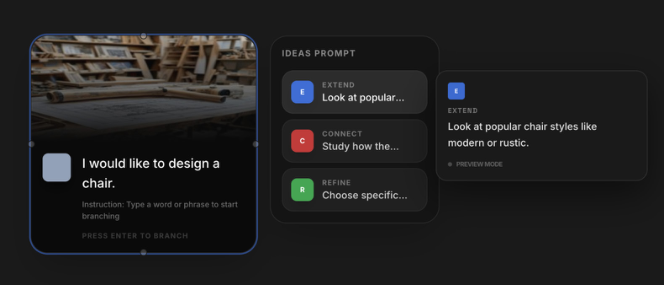
The interface invites the user to generate novel concepts and questions, critique and synthesize those ideas, and to map and navigate the interrelationships between those different nodes (i.e., rhizomatic or arborescent). The user begins by entering an initial idea or question (e.g., “I would like to design a chair.”), and is then offered three options (see Figure 1): 1) Extend – This is a prompt for divergent thinking, or developing many different possibilities related to the initial prompt. 2) Refine – This is a prompt for convergent thinking, or moving towards an optimal or refined solution. 3) Connect - This is a prompt for lateral thinking, offering related adjacent categories or concepts to consider.
Figure 1: Where users branch ideas through “Extend”, “Connect”, and “Refine” prompts to support divergent, lateral, and convergent thinking correspondingly.
These generated outputs are presented as modular idea cards that can be dragged and compared by the user across the canvas. In this sense, the system does not simply return an answer in a linear chat format but instead externalizes the design thinking process into a spatial field of rhizomic possibilities. This allows the user to see ideas not only as individual outputs, but also as relational entities that can support, challenge, or transform one another. Through the combination of modular ideation, synthesis, critique, and reflective logging, the system attempts to support a more iterative and dialectical creative workflow rather than a one-directional linear output.
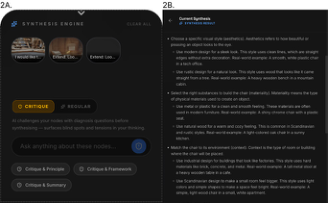
Once a set of idea cards has been generated, the user can select and drag them into the synthesis engine (see Figure 2A). More specifically, synthesis does not function as a replacement for human judgment but as a stage in which the user actively frames and reinterprets the terms of combination by prompting the system to generate a design plan, concept direction, or other structured synthesis based on the selected principles of cards (see Figure 2B). The resulting output is presented through text-based synthesis and further suggestions, which allow the user to understand how different conceptual inputs are being brought together and what are the actions to take next.
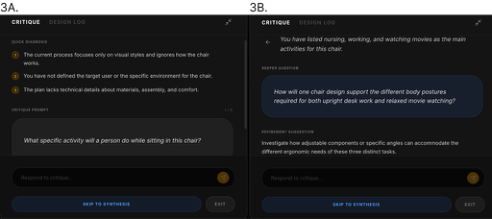
Another key feature is the critique mode (see Figure 3A), which introduces productive friction into the creative process. Rather than allowing the user to move directly from ideation to synthesis without resistance, critique mode works as an intermediate checkpoint between idea generation and synthesis. At this stage, the system responds to the user’s selected cards with feedback that challenges and points out redundancy, identifies weakness, or introduces constraints that require reinterpretation (see Figure 3B). In this way, the tool begins to mimic an important part of studio-based creative pedagogy, where ideas are strengthened by challenge, reflection, and iteration.
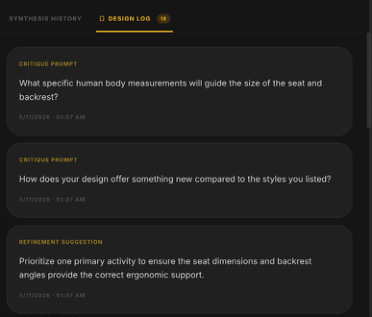
This critique process is designed to remain collaborative rather than prescriptive. After receiving critique feedback, the user can respond to the prompt, revise the selected nodes, save useful feedback into a design log, proceed into synthesis, or exit critique mode altogether. The design log allows users to capture moments of useful insight, critique throughout the process (see Figure 4). Rather than being one-time critiques, these reflections can be saved and accumulated, allowing users to trace how their ideas evolve over time and revisit them as needed. In this sense, the log supports not only the generation of ideas, but also the development of a reflective and iterative design practice.
Figure 2: (A) Users drag selected idea cards into the synthesis engine to combine generated concepts. (B) Text-based synthesis output generated from selected idea cards within the synthesis workflow.Figure 3: (A) Critique mode introduces reflective feedback between ideation and synthesis. (B) Example critique interaction prompting reinterpretation of selected ideas.Figure 4: Design log interface for saving critique prompts, reflections, and refinement suggestions throughout the creative process.
USER EVALUATION: METHODOLOGY Evaluation Criteria
In order to evaluate and validate the concept, we give workshop participants a design problem that they must solve using the prototype. We rank these results against the Torrance Test of Creative Thinking against the following categories (Torrance, 2012): 1) Fluency - the total number of interpretable, meaningful, and relevant ideas generated in response to the stimulus. 2) Flexibility - the number of different categories of relevant responses. 3) Originality - the statistical rarity of the responses. 4) Elaboration - the amount of detail in the responses.
Task-Based Workshop To conduct the experiment, we recruit 12 participants with backgrounds in design, HCI, and creative technology. Participants are asked to complete an open-ended design task using the Augmented Intelligence prototype: 1) The task prompt asks participants to develop a tool, service, or experience addressing stress management for first-year college students during high-pressure academic periods. While all participants receive the same design prompt, they begin the
ideation process by entering their own initial interpretations and conceptual starting points based on their individual understanding of the problem. 2) During the session, participants use the system to explore ideas, refine them, and develop a final concept. 3) At the end of the activity, participants provide a short description of their final idea, including what it is, who it is for, and how it works. Participants are given 30 minutes to complete the design activity, allowing time for iterative exploration, critique, synthesis, and reflection.
Following the design activity, participants complete a post-task survey and a semi-structured interview. The survey collects both quantitative and qualitative feedback regarding participants’ perceptions of idea generation, flexibility, originality, elaboration, reflection, and creative agency while using the system. Example survey questions include: “The system helped me rethink my assumptions”, and “I explored ideas that were meaningfully different from each other.” Semi-structured interviews further ask about how participants experience the critique and synthesis features, how their ideas evolve throughout the process, and whether the system supports or disrupts their sense of creative ownership. Example interview prompts include: “Can you walk me through how your idea changed from your initial input to your final concept?” and “How did the critique and reflection features affect your thinking process?”
USER EVALUATION: RESULTS The evaluation results suggest that the Augmented Intelligence system primarily supports creativity through reflection, reinterpretation, and iterative ideation rather than directly generating final solutions. Across quantitative and qualitative responses, participants frequently describe the system as encouraging exploration, necessary challenge, and conceptual transformation throughout the ideation process.
Divergent Thinking in Idea Exploration In the survey, there is a strong indication that the system supports divergent thinking and idea exploration. 69.3% of participants rate 5 or higher (7-point Likert scale) when asked whether they are able to generate many different ideas during the task, while 92.3% rate 5 or higher for not feeling constrained to a single conceptual direction during ideation. Additionally, 76.9% of participants rate 5 or higher on perspective shifting, suggesting support for flexibility across different conceptual categories.
Lateral Thinking and Unexpected Associations Qualitative interviews further reveal that the branching structure frequently leads to unexpected conceptual directions. One participant describes how the “Connect” branch offers unexpected references and conceptual connections, gradually shifting their idea from a scheduling application toward an active noise-cancellation framework. This might suggest that the branching structure supports lateral thinking by exposing users to whole different conceptual directions that may not emerge through conventional linear prompting (de Bono, 1970). While another participant reports that the system helps bridge
Augmented Intelligence and Creative Dialectics 187 unrelated concepts such as homework management and treadmill gaming mechanics into the stress-relief experience.
Critique as Productive Friction Furthermore, the critique feature emerges as one of the strongest contributors to reflection and iterative refinement. 69.3% of participants rate 5 or higher when asked whether critique mode helps them reflect on their ideas, while 69.3% also describe critique mode as a useful challenge. Participants frequently describe critique as helping expose blind spots, identify missing contextual details, and strengthen conceptual coherence. One participant states that critique “helps me think more deeply, makes my line of reasoning more coherent, and connects my previously fragmented thoughts”.
Creative Agency Reflection and creative agency also emerge as recurring themes throughout the study. 83.3% of participants rate 5 or higher on actively reflecting during the design process, while participants consistently emphasize that the system supports rather than replaces their thinking. The design log feature further contributes to reflective iteration, with 75% of participants rating 5 or higher on the statement that the log helps track their thinking process.
Limitations Despite these strengths, several limitations are also observed throughout the evaluation. Some participants report difficulty seeing relationships between nodes during longer exploration sessions, occasionally losing track of generated information and conceptual connections. Others note that certain branching paths remain within similar conceptual territories rather than expanding into substantially different perspectives, resulting in inconsistent support for idea diversity across users and ideation scenarios (participants’ initial input). Participants additionally suggest improvements such as stronger relational visualization between nodes, support for combining multiple nodes directly on the canvas, and more flexible editing of generated concepts.
DISCUSSION
Overall, the findings suggest that the modular interaction structure supports an exploratory and iterative ideation process by allowing participants to branch, compare, and diverge ideas across the canvas throughout the workshop. More specifically, the findings demonstrate alignment with several dimensions of the TTCT (Torrance, 2012). The “Extend”, “Connect”, and “Refine” features appear to support fluency and flexibility by encouraging continuous idea generation and movement across different conceptual directions. The “Connect” feature particularly supports originality through unexpected conceptual relationships and non-obvious combinations, while critique and synthesis contribute to elaboration by helping participants identify blind spots and transform fragmented ideas into more coherent
frameworks. The design log further supports reflective iteration by allowing users to externalize and revisit their thinking process.
At the same time, several participants report difficulty keeping track of branching ideas and relationships during longer exploration sessions, while others describe some generated outputs as overly ambiguous or difficult to apply within their own design process. More broadly, this work contributes to ongoing discussions surrounding augmented intelligence and AI alignment by positioning AI not as a replacement for creativity, but as a collaborative thinking partner that supports reflection and iteration while preserving human agency throughout the design process.
CONCLUSION
Creative dialectics can be described in terms of two vectors of development towards novel and useful outcomes. One direction can be characterized in terms of opposition, negation, and contradiction as a mode of critique. In the other direction, creative dialectics can be described in terms of synthesis, affinity, and unity. The creative process is worked out over time through both the tensions and contradictions inherent in the process on the one hand, as well as through the harmonies and affinities of the evolving ideas on the other. The goal for this pilot prototype is to validate the development of a tool for the creative process that allows users to organize, map, and navigate that dialectical process. And while this pilot prototype is only an initial iteration of the project, it does validate the development of creative dialectics towards practical applications.
It is beyond the scope of this immediate project, but an important area of inquiry for subsequent work, to explore the foundational questions of creative dialectics; questions that are grounded on whether splitting the world into comparable, opposing things, as well as in their novel combinations into new syntheses, serves as an effective metaprocess for creativity. We might ask whether dialectical reasoning is an inherent feature of consciousness, or a part of the natural, mind-independent world as a thing in itself…or both. This question becomes important when considering if such a tool would be profitable in both the natural sciences and the humanities for the development of new and useful concepts. The further development of these kinds of tools requires a more robust analysis of the conceptual framework of creative dialectics, which has also been explored elsewhere in greater detail (Gonsher, 2023).
Creativity can be understood dialectically, as two sides of the same coin, in the unity of opposites, and as both an artificial and natural phenomenon. Creativity is artificial in so far as it is human-made and can represent things humans can do, as language, within culture, for example. But the creative process, writ large, also describes the creative evolution of species and the mechanics of the universe that establish the conditions for novel and useful things. Both can be considered when understanding the emergence of new forms of creativity and intelligence. It can be argued that Artificial Intelligence is an aspect of Natural Intelligence, or rationality expressed in the world, which is manifest not just in the human mind but anywhere else the rational deep structure of the universe can be recognized.
Augmented Intelligence and Creative Dialectics 189 In addition to initiating a discussion about the kinds of critical frameworks necessary for developing new tools for the creative process, and exploring alternatives to agentic AI, this pilot prototype offers an initial collection of opposing but related vectors for the creative process. We’ve explored divergent thinking and convergent thinking, against critique and synthesis, mapped out against rhizomatic and arborescent fields of possibility. Future iterations of the project might imagine many more examples of these creative dialectics. This kind of dialectical analysis can be applied to any set of concepts that mutually define and inform each other.
REFERENCES
Amabile, T. M. (1996). Creativity in context: Update to “The Social Psychology of Creativity.” Boulder, CO: Westview Press. Bergson, H. (1911). Creative evolution (A. Mitchell, Trans.). New York: Henry Holt
and Company. Davis, N., Hsiao, C.-P., Popova, Y., & Magerko, B. (2015). An enactive model of creativity for computational collaboration and co-creation. Springer Series on Cultural Computing. 109–133. DOI: https://doi.org/10.1007/978-1-4471-6681- 8_7\ de Bono, E. (1970). Lateral thinking: Creativity step by step. New York: Harper &
Row. Deleuze, G., & Guattari, F. (1987). A thousand plateaus: Capitalism and schizophrenia (B. Massumi, Trans.). Minneapolis: University of Minnesota Press. Fischer, G., Nakakoji, K., Ostwald, J., Stahl, G., & Sumner, T. (1993). Embedding
critics in design environments. The Knowledge Engineering Review, 8(4), 285–307. DOI: https://doi.org/10.1017/S026988890000031X Gonsher, I. (2023). The dialectics of creativity: The abstract and the concrete. In D.
Jones, N. Borekci, V. Clemente, J. Corazzo, N. Lotz, L. M. Nielsen, & L.-A. Noel (Eds.), Proceedings of the 7th International Conference for Design Education Researchers. London, United Kingdom. DOI: https://doi.org/10.21606/ drslxd.2024.042 Guilford, J. P. (1956). The structure of intellect. Psychological Bulletin, 53(4), 267–293. DOI: https://doi.org/10.1037/h0040755 Guilford, J. P. (1967). The nature of human intelligence. New York: McGraw-Hill. Hegel, G. W. F. (1977). Phenomenology of spirit (A. V. Miller, Trans.). Oxford:
Oxford University Press. Lubart, T. (2005). How can computers be partners in the creative process: Classification and commentary on the special issue. International Journal of Human-Computer Studies, 63(4–5), 365–369. DOI: https://doi.org/10.1016/j. ijhcs.2005.04.002 Maier, S., Schneider, M., & Feuerriegel, S. (2026). Partnering with Generative AI:
Experimental evaluation of model-led and human-led interaction in human-AI co-creation. Proceedings of the 2026 CHI Conference on Human Factors in Computing Systems. 1–28. DOI: https://doi.org/10.1145/3772318.3791185 Schön, D. A. (1983). The reflective practitioner: How professionals think in action.
New York: Basic Books. Shen, J., Marquardt, N., Romat, H., Hinckley, K., Riche, N., & Chevalier, F. (2026).
Texterial: A text-as-material interaction paradigm for LLM-mediated writing. Proceedings of the 2026 CHI Conference on Human Factors in Computing Systems. 1–18. DOI: https://doi.org/10.1145/3772318.3790330
Shneiderman, B. (2007a). Creativity support tools: Accelerating discovery and innovation. Communications of the ACM, 50(12), 20–32. DOI: https://doi. org/10.1145/1323688.1323689 Sternberg, R. J. (Ed.). (1999). Handbook of creativity. Cambridge: Cambridge
University Press. Torrance, E. P. (2012). Torrance Tests of Creative Thinking. PsycTESTS Dataset.
DOI: https://doi.org/10.1037/t05532-000 Wadinambiarachchi, S., Kelly, R. M., Pareek, S., Zhou, Q., & Velloso, E. (2024). The effects of generative AI on design fixation and divergent thinking. Proceedings of the CHI Conference on Human Factors in Computing Systems. 1–18. DOI: https://doi.org/10.1145/3613904.3642919
SEARCH THE AHFE DIGITAL BOOKSTORE BY ISBN
Explore the complete digital volume
Human Interaction and Emerging Technologies (IHIET 2026)
Read this individual research paper free through the original publisher, or explore the full digital proceedings book.