Chunshih Cheng, Chia Chen Kuo, Chien-hsin YANG, YUJIE TSAI (2026). Human Performance Modeling in Virtual Factories: A Simulation-Driven Ergonomics Approach. In: Human Factors in Simulation, Software and Systems Engineering. AHFE Open Access, vol. 220, pp. 89–99. https://doi.org/10.54941/ahfe1007697
Manual workstation operations in manufacturing are traditionally evaluated based on cycle time and task completion, while ergonomic risks and detailed execution behaviors are rarely assessed within the same study. During early workstation planning, this disconnect leaves factors such as sequence deviations, tool use rhythm, shoulder loading, and excessive reach unquantified, hindering the alignment between engineering objectives and human factors requirements. This study proposes a multi view, vision based framework that captures both performance and ergonomic indicators during manual workstation tasks. A precision assembly workstation equipped with three synchronized cameras—one overhead and two lateral cameras—was used to observe three representative tasks: (T1) part picking and placement, (T2) tool-assisted fastening, and (T3) visual inspection. Video data from 18 operators across 324 trials (approximately 10 hours) were processed using RT-DETRv2 for object detection, OCSort for identity tracking, and a pose estimation module for upper-body kinematics. An ROI-based classifier was used to enhance fine-grained component recognition, while multi-view consistency enabled robust event-log generation. The proposed pipeline achieved stable event extraction with an event-level F1 score of approximately 0.88 at near-real-time processing speed. Derived indicators included sequence compliance, cycle time, tool-use rhythm, reach distance, and posture exposure. The results revealed distinct task characteristics: T1 exhibited the highest reach demand, T2 showed the highest shoulder-loading exposure, and T3 involved extended decision-making during inspection. Mixed-effects models confirmed significant task effects on both time-based and posture-related metrics (p < 0.01). Furthermore, a workstation redesign reduced excessive reach by 28%, arm elevation exposure by 19%, and mean cycle time by approximately 9%, demonstrating the value of multi-view vision sensing for ergonomics-informed workstation design.
Human Systems Integration (HSI) and Human Factors Engineering (HFE) systematically align human capabilities with system interfaces to optimize life-cycle performance. While Industry 4.0 leverages Digital Twin (DT) technologies to integrate physical and human processes , traditional Industrial Engineering often overlooks ergonomic risks and behavioral factors in manual assembly. This fragmented analysis persists due to three limitations in current vision-based systems: (1) a focus on task classification over ergonomic quantification; (2) single-camera occlusion; and (3) the lack of integrated productivity-ergonomics evaluation. To address this, we propose a multi-view framework for the simultaneous modeling of operational performance and ergonomic risks.
Condensed Research Contributions: This study proposes a multi-view vision-based framework for simultaneous modeling of operational performance and ergonomic risks in precision assembly. The main contributions include:
1. Integrated Sensing Framework: A multi-view system combining object detection, tracking, pose estimation, and action recognition for manual task analysis. 2. Event-Driven Pipeline: An automated perception pipeline that converts continuous visual data into structured, interpretable assembly event logs. 3. Ergonomics-Aware Metrics: A novel set of kinematic metrics derived from multi-view data, including reach distance, excessive reach, and arm elevation exposure. 4. Experimental Validation: A large-scale validation involving 18 participants and 324 trials, demonstrating the framework’s efficacy in dual-indicator evaluation and workstation redesign.
RELATED WORK
Assembly Action Recognition in Industrial Environments Fine-grained assembly recognition has transitioned from simple monitoring to complex behavioral understanding. The Assembly101 dataset established a benchmark for modeling hand–object interactions via multi-view observations. Building on this, frameworks like Praxis and systems by Papoutsakis et al. (2026) integrated object detection and pose estimation to monitor worker behaviors in realistic settings. Furthermore, Gao et al. (2026) enhanced recognition robustness through multimodal frameworks. However, most existing approaches prioritize action classification over the quantification of ergonomic workload and physical risks. This study addresses this gap by bridging operational performance and ergonomics within a unified vision-based pipeline.
Vision-Based Ergonomic Risk Assessment Traditional ergonomic tools like RULA and REBA are often limited by manual scoring and subjectivity. To overcome these challenges, OpenPose (Cao et al., 2017) has enabled automated joint-angle estimation from RGB images. Recent studies in manufacturing have validated these AI-driven assessments: Agostinelli et al. (2024) demonstrated their efficacy in real production, while Zhao et al. (2024) improved estimation accuracy under industrial conditions using multi-scale frameworks.
The precision of these systems depends heavily on configuration; Murugan et al. (2025) found that camera viewpoint is critical for measurement reliability. While Deshpande et al. (2025) highlight rapid progress in machine-learning-based monitoring, most current systems focus solely on posture scores. A significant gap remains in integrating task context and operational performance—a limitation this study addresses through a unified measurement pipeline.
Multi-View Perception for Human Motion Analysis Industrial assembly presents significant visual challenges, such as occlusion and limited workspace visibility. To address these, multi-camera sensing has been adopted to enhance the reliability of human motion analysis. Papoutsakis
Human Performance Modelling in Virtual Factories: A Simulation-Driven 91 et al. (2026) demonstrated that multi-view systems significantly improve behavior understanding through three-dimensional pose reconstruction, while Murugan et al. (2025) confirmed that viewpoint configuration is critical for ergonomic assessment accuracy. In parallel, spatial-temporal graph neural networks have become essential for capturing dependencies between body joints and motion dynamics, enabling robust recognition of complex industrial actions. However, a gap remains: most multi-view studies focus on pose reconstruction or activity classification, rather than generating structured event logs that link human behavior directly to workstation-level performance analysis.
Human-Centered Digital Twins in Manufacturing The transition to Industry 5.0 emphasizes human-centered manufacturing, where workers remain central to production systems. Digital Twin (DT) technology (Grieves and Vickers, 2017) serves as a key enabler by integrating real-time sensor data with simulation models for process optimization. Recently, research has pivoted toward incorporating human behavior into these systems. Wang et al. (2025) proposed a high-fidelity human-centric DT framework for collaborative cells, stressing the integration of operator motion and ergonomic analysis. Similarly, Zhu and Yang (2025) highlighted the necessity of accurate sensing technologies to capture physical and behavioral states within the “Human Digital Twin” concept. However, a significant gap remains: while DT research focuses on architectures and assembly research on activity recognition, few studies integrate these perspectives into a unified framework capable of simultaneously analyzing task performance, ergonomic risk, and workstation design.
METHODOLOGY
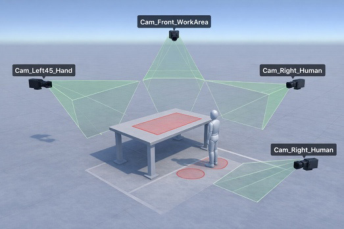
Experimental Setup A simulated precision-assembly workstation was constructed using a three- camera system to resolve occlusion and capture multi-angle postures. This multi-view configuration—comprising an overhead camera for hand trajectories and two lateral cameras (positioned at 45° left and right)— ensures reliable observation of hand–object interactions and upper-body kinematics during tasks. (See Figure 1 for the setup).
Figure 1: Experimental setup.
The multi-view configuration allows reliable observation of hand–object interactions and upper-body kinematics during assembly tasks.
Participants and Dataset A total of 18 participants (9 male, 9 female), with a mean age of 24.5 ± 3.2 years and a mean height of 168.4 ± 8.6 cm, participated in the experiment. The study was conducted in a controlled environment featuring a fixed bench height of 95 cm. Each participant performed three representative precision assembly tasks, each repeated six times, resulting in a dataset of 324 total trials and approximately 10.5 hours of synchronized video data. To ensure comprehensive motion capture and resolve occlusion, three camera views were synchronized: Top-down (90°), Left-Lateral (45°), and Right-Lateral (45°).
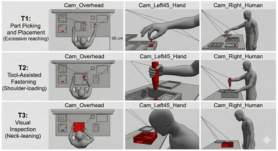
The three tasks were designed to represent common assembly activities: (1) Part Picking and Placement (T1): Frequent reaching and precise
positioning of small electronic components. (2) Tool-Assisted Fastening (T2): Use of an electric screwdriver for fastening, requiring sustained posture and downward force. (3) Visual Inspection and Quality Verification (T3): Cognitive decision-
making involving careful observation of assembly quality.
To analyze human–robot collaboration (HRC) behaviors, ten standardized action categories were defined.
Table 1: Standard HRC action categories and definitions.
Table available in the original PDF paper.
Action Class Description Interaction Type Human active Reach & Grasp Extension of the arm to seize a part or tool.
Human active
Move Translation of an object to the assembly focal point.
Human active
Position/ Align
Fine-grained adjustment of a part relative to a target.
Screw Rotational fastening (high occlusion risk).
Human active(Tool) Insert Axial pressure to seat a component. Human active
Handover to Robot
Intentional transfer of an item to the cobot.
Human-robot interactive
Receive from Robot
Waiting and receiving an item from the cobot.
Human-robot interactive Human active
Operate Button
Interaction with control interfaces (Start/ Stop).
Inspect Static observation for quality assurance. Human cognitive Human passive Wait/Idle Hands-off period during robot-only tasks.
Figure 2: Standard HRC assembly action categories.
Visual Analysis and Action Recognition Pipeline To address the challenges posed by skeletal occlusion, complex hand–object interactions, and long temporal dependencies in precision assembly tasks, this study implements a multi-stage visual analysis and action recognition pipeline. The proposed pipeline integrates: Skeleton restoration 、Graph- based action recognition 、Transformer-based object detection 、Multi- object tracking and Event extraction. The objective is to convert raw video observations into structured event logs for human-robot collaboration analysis.
1. Bi-LSTM Skeleton Restoration (BSR) Precision assembly tasks frequently involve partial occlusion of the operator’s upper limbs. To address missing or corrupted keypoints, a Bi-directional Long Short-Term Memory (Bi-LSTM) skeleton restoration module is introduced. Let the skeletal motion sequence be defined as { } 1 2 , ,..., T X x x x =
Where 2 K tx × ∈[Equation or mathematical symbol available in the original paper PDF]
represents the 2D coordinates of K body joints at frame t. The Bi-LSTM processes the sequence in both forward and backward temporal directions to infer missing joint coordinates. The restoration model is trained using a composite loss: where Reconstruction Loss
1 T
Equations and mathematical formulas are available in the original paper PDF.
minimizes prediction error.
Bone-Length Consistency
( ) i j ij bone
i j E L p p l , ( ) maintains anatomical constraints.
Temporal Smoothness T
t t smooth
2 1 2
encourages temporal continuity.
2. ST-GCN for Action Classification After skeleton restoration, human actions are classified using a Spatial- Temporal Graph Convolutional Network (ST-GCN). The human skeleton is represented as a graph ( ) , G V E =
Where, V denotes body joints, Edenotes anatomical connections. The skeleton sequence is defined as C T V X × × ∈[Equation or mathematical symbol available in the original paper PDF]
Where, C = coordinate dimension, T= number of frames, V = number of joints. The graph convolution operation is expressed as ( ) ˆ out in f Af W σ =
Where, ˆA = normalized adjacency matrix, W = learnable weights, σ = activation function. The trained model classifies assembly actions into eight primitive action classes.
3. Object Detection with RT-DETRv2 To detect small components and tools, RT-DETRv2 was implemented using a ResNet-50 backbone with a hybrid transformer encoder. The model was fine-tuned on 15,000 annotated frames with an input resolution of 640 × 640, employing a detection loss. The detection loss function is defined as cls cls bbox bbox L L L λ λ = +
Where, Lcls= classification loss, Lbbox= bounding-box regression loss. Training was performed over 100 epochs using the AdamW optimizer with a learning rate of 1×10⁻⁴ and a batch size of 16. Post-processing utilized a confidence threshold of 0.45 and an NMS threshold of 0.65. Deployed on an NVIDIA RTX 4090 platform, the system achieved a near-real-time inference latency of 38 ms/frame. Training was performed on a workstation equipped with 64 GB RAM. Data augmentation strategies including horizontal flipping and mosaic augmentation were applied to improve robustness in detecting small components.
4. Multi-Object Tracking via OCSort To generate reliable assembly event logs, it is necessary to maintain consistent identity (ID) tracking for hands and parts across frames. For this purpose, we implemented OCSort (Observation-Centric SORT). OCSort extends the classical Kalman-filter tracking framework by incorporating velocity compensation and observation centric association strategies. When temporary occlusions occur such as when a hand covers
Human Performance Modelling in Virtual Factories: A Simulation-Driven 95 a small part—the tracker predicts object trajectories based on historical motion patterns and re-associates identities once the object reappears. In our experiments, OCSort reduced ID switch errors by 35% compared to ByteTrack, significantly improving the stability of interaction tracking.
5. Pose Estimation and Camera Calibration A checkerboard calibration procedure was applied to estimate both intrinsic and extrinsic camera parameters. The coordinate transformation between camera views is expressed as r lr l X T X =
where Tlr denotes the transformation matrix between the left and right cameras. Human pose estimation was performed using a heatmap-based ResNet-50 pose model, which detects 17 body keypoints. For ergonomic analysis, the following joints were used: Shoulders, Elbows, Wrists, Head; 3D wrist positions were reconstructed through triangulation between the two lateral cameras. The reconstruction error was below 1.5 cm, enabling accurate motion analysis.
Event Extraction Continuous perception outputs were converted into structured events using a Finite State Machine (FSM). A Pick event is triggered when the following conditions are satisfied:
1. Distance between hand and object bounding boxes
d Hand Part τ − < || ||
Object velocity
part v v τ >
Object enters the assembly zone. This rule-based mechanism transforms low-level perception outputs into high-level assembly process logs.
Ergonomic Metrics Definition Several kinematic indicators were derived from multi-view motion data to quantitatively evaluate operator performance and ergonomic risks. Grounded in international standards—including ISO 11228, ISO 11226, and RULA these metrics enable objective evaluation of posture, motion efficiency, and musculoskeletal risks in human–robot collaborative assembly.
1. Cycle Time (CT) Cycle Time represents the duration required to complete a single assembly operation cycle. It is defined as the time difference between the first detected Pick event and the final Place or Inspection event extracted from the finite- state machine (FSM):
start end CT t t = − where tstart denotes the timestamp of the first Pick event, tend denotes the timestamp of the final assembly-related event. Cycle Time is widely used in industrial engineering and is consistent with Methods-Time Measurement (MTM-1) principles for analyzing manual assembly operations.
2. Reach Distance (RD) Reach Distance measures the horizontal displacement between the worker’s shoulder joint and wrist joint during reaching movements. The distance is computed on the horizontal plane using the Euclidean distance: ( ) ( ) ( ) ( ) ( ) 2 2 ( ) ( ) wrist wrist shoulder shoulder RD t x t x t y t y t = − + −
where
( ) ( ) ( ) , wrist wrist x t y t denotes the wrist joint position,
( ) ( ) ( ) , shoulder shoulder x t y t denotes the shoulder joint position.
This metric reflects the spatial extent of reaching actions during part picking or placement.
3. Excessive Reach Exposure (ERE) According to ISO 11228-3, repetitive reaching beyond the worker’s comfortable reach zone significantly increases the risk of musculoskeletal disorders. Ergonomic studies indicate that the comfortable reach distance for seated or standing assembly tasks typically ranges between 40–55 cm. In this study, Excessive Reach Exposure (ERE) is defined as the cumulative duration during which the reach distance exceeds 55 cm:
1 ( 55 cm)
t ERE I RD t t
where ( ) I ⋅ denotes the indicator function, RD t( ) represents the horizontal reach distance at time t,
t ∆ represents the frame duration. This measure captures both the frequency and duration of ergonomically unfavorable reaching movements.
4. Arm Elevation Exposure (AEE) Prolonged elevation of the upper arm is recognized as a major risk factor for Occupational Shoulder Disorders (OSDs). According to RULA and ISO 11226, arm elevation angles exceeding 60° are considered high-risk postures during repetitive work.
To compute the arm elevation angle, the following vectors are defined. Upper arm vector: arm wrist shoulder v p p = − [Equation or mathematical symbol available in the original paper PDF]
Human Performance Modelling in Virtual Factories: A Simulation-Driven 97 Vertical reference vector:
[Equation or mathematical symbol available in the original paper PDF][Equation or mathematical symbol available in the original paper PDF] arm vert
( ) ( ) ( ) arm vert
[Equation or mathematical symbol available in the original paper PDF][Equation or mathematical symbol available in the original paper PDF] | || | The Arm Elevation Exposure (AEE) is then defined as the cumulative duration during which the arm elevation angle exceeds the ergonomic threshold:
1 ( 60 )
t AEE I t t θ
This metric quantifies the extent of shoulder loading caused by elevated arm postures.
RESULTS
1. Task Performance and Participant Variability The analysis of 324 trials (18 participants × 3 tasks × 6 repetitions) characterized manual assembly performance across experimental conditions. Notable variability was observed in T3 (Inspection), reflecting a higher cognitive load compared to motor-dominated tasks.
(1) T1 – Picking Task The mean cycle time for the T1 (Picking) task was 72.4 s (SD = 4.1 s). Correlation analysis indicated that participant height exhibited a weak but statistically significant relationship with task performance
0.32, 0.05 r p = − < Taller participants completed tasks faster, likely due to a larger functional reach envelope that minimized posture adjustments.
(2) T2 – Fastening Task T2 recorded a mean cycle time of 95.2 s (SD = 6.8 s). A 15% decrease in cycle time between the first and sixth repetitions indicated progressive motor adaptation. The vision-based system revealed improved consistency, with the variance of Fastening Duration decreasing from 2.4 s to 0.8 s across trials.
(3) T3 – Inspection Task T3 (Inspection) exhibited the longest completion time (mean = 140 s, SD = 12.5 s) and the highest inter-subject variability. Unlike T1 and T2, this task required extensive visual inspection and decision- making, leading to significant performance fluctuations among participants.Motion tracking identified a Decision Latency pattern— defined as visual inspection without hand movement. Participants with longer latency achieved 5% higher accuracy, confirming that visual verification enhances task reliability. This identifies T3 as a cognitively intensive task, contrasting with the motor-execution focus of T1 and T2.
2. Detailed Ergonomic Risk Mapping The integration of multi-view 3D pose reconstruction enabled the mapping of physical workload directly onto the spatial layout of the workstation. This allowed ergonomic risk indicators to be analyzed in relation to the operator’s working zones.
(1) Reach Distance and Workspace Zone Utilization In the baseline configuration, Zone C (distance > 55 cm from the shoulder) accounted for 100% of excessive reach events. Anthropometric analysis showed that female participants (mean height 162 cm) experienced 18% longer durations of excessive reach exposure than males (mean height 175 cm) during the T1 task. These findings underscore the necessity of anthropometric adaptability— such as height-adjustable surfaces or compact bin arrangements—to reduce physical strain and ensure ergonomic equity.
(2) Shoulder Loading and Tool-Use Posture During the T2 fastening task, the upper-arm elevation angle $\theta$ remained consistently high due to electric screwdriver operation. Posture analysis revealed that 12 out of 18 participants adopted shoulder abduction, likely to gain mechanical leverage during tool manipulation. The system automatically detected High-Risk Events (HREs) defined as periods where 75 θ > [Equation or mathematical symbol available in the original paper PDF]
High-risk posture events—defined by durations exceeding 3 seconds— strongly correlated with subjective shoulder fatigue reported in post- experiment questionnaires. This aligns with ergonomic guidelines indicating that prolonged arm elevation above 60° significantly increases the risk of musculoskeletal disorders (MSDs).
(3) Statistical Model Analysis To evaluate the statistical significance of task-related differences, we employed linear mixed-effects models, treating the participant as a random factor and the task type as a fixed factor. The results confirmed that task type significantly influenced both performance time and ergonomic risk indicators, with
indicating strong statistical significance. This analysis demonstrates that different assembly tasks impose distinct biomechanical and cognitive demands, which should be considered when designing collaborative human–robot assembly systems.
CONCLUSION
This study presents a multi-view vision-based framework integrating RT-DETRv2, OCSort, and pose estimation to simultaneously evaluate operational performance and ergonomic risks. Validated through 324 trials, the system achieved an F1 score of 0.88 at near-real-time speeds. Results
Human Performance Modelling in Virtual Factories: A Simulation-Driven 99 identified task-specific risks, such as high reach in T1 and shoulder loading in T2, providing actionable evidence for workstation redesign. The resulting optimization led to a 28% reduction in excessive reach, a 19% decrease in arm elevation, and a 9% improvement in cycle time. Future research will focus on enhancing 3D pose reconstruction under occlusion and integrating event logs with digital twins for predictive ergonomics.
REFERENCES
Cao, Z., Simon, T., Wei, S., and Sheikh, Y. (2017). Realtime multi-person 2D pose estimation using part affinity fields. Proceedings of the IEEE Conference on Computer Vision and Pattern Recognition. Deshpande, U., Araujo, S., Deshpande, S., Kangralkar, V., Patil, R., and
Arjunwadkar, S. (2025). Machine learning techniques for ergonomic risk assessment based on human pose estimation. Discover Artificial Intelligence. Gao, Q., Liu, Z., Hou, M., Sa, G., and Tan, J. (2026). Multimodal action recognition in human-robot collaborative assembly. Robotics and Computer-Integrated Manufacturing. Gkournelos, C., Konstantinou, C., Angelakis, P., Tzavara, E., and Makris, S. (2024).
Praxis: A framework for AI-driven human action recognition in assembly. Journal of Intelligent Manufacturing. Grieves, M., and Vickers, J. (2017). Digital twin: Mitigating unpredictable emergent behavior in complex systems. Murugan, A., Noh, G., Jung, H., Kim, E., Kim, K., You, H., and Boufama, B. (2025).
Optimising computer vision-based ergonomic assessments. Ergonomics. Papoutsakis, K., Bakalos, N., Zacharia, A., Fragkoulis, K., Kapetadimitri, G., and Pateraki, M. (2026). A vision-based framework and dataset for human behavior understanding in industrial assembly lines. Computer Vision and Image Understanding. Sener, F., Singhania, A., Yao, A., and Ikizler-Cinbis, N. (2022). Assembly101: A large-
scale multi-view video dataset for understanding procedural activities. Proceedings of the IEEE/CVF Conference on Computer Vision and Pattern Recognition. Wang, T., Liu, Z., Wang, L., Li, M., and Wang, X. (2025). Human-centric digital twin framework for collaborative manufacturing cells. Journal of Manufacturing Systems. Zhao, W., Wang, L., Li, Y., Liu, X., Zhang, Y., Yan, B., and Li, H. (2024). Multi-scale
human pose recognition for ergonomic evaluation. Processes. Zhu, E., and Yang, S. (2025). Human digital twin: modelling and simulation. Journal of Industrial Information Integration.
LISTED IN THE AHFE DIGITAL BOOKSTORE CATALOGUE
Explore the complete digital volume
Human Factors in Simulation, Software and Systems Engineering
Read this individual research paper free through the original publisher, or explore the full digital proceedings book.
ISBN 978-1-964867-96-0
Explore this ISBN in the AHFE Bookstore ↗Listed in the July 2026 bookstore catalogue; search by ISBN to confirm current availability · Digital book purchase optional