Meichen Lin, Pengcheng Guo, Qianyu Yao (2026). New Translation of Journey to the West: AR Tabletop Game System Design and Cultural Translation Based on Cultural Translation Theory. In: Metaverse, Virtual Environments and Game Design. AHFE Open Access, vol. 217, pp. 240–250. https://doi.org/10.54941/ahfe1007671
Journey to the West is a nationally recognized classic literary IP deeply rooted in the traditional Chinese cultural system, possessing outstanding literary, artistic, and communicative value with a profound and enduring cultural influence. However, under today's fast-paced lifestyle, young audiences' exposure to Journey to the West culture is mostly limited to passive viewing, lacking channels for immersive experiences and carriers for emotional resonance, leading to a disconnect in traditional cultural transmission. Tabletop games, as a popular form of entertainment among contemporary youth, can serve as an effective medium for revitalizing classical culture. However, existing culturally themed tabletop games often suffer from homogenized gameplay mechanics, fragmented narratives, and superficial cultural expression, with insufficient immersion and cultural engagement, making it difficult to achieve the in-depth dissemination of classical cultural connotations.This study takes tabletop games as the primary medium and focuses on the practical issue of insufficient awareness among young local audiences of their own traditional culture. Using Journey to the West as the cultural theme, the research systematically introduces Cultural Translation Theory as the design framework and constructs a three-dimensional cultural translation model consisting of the material, organizational, and spiritual levels. By integrating AR technology, the tabletop gameplay is deeply combined with cross-media social platforms. Players can trigger AR interactive scenarios by scanning game cards, thereby achieving an immersive cultural experience. Interactive tasks incorporating classic storylines, core values, and profound philosophical concepts are embedded into the game mechanics, enabling players to gradually perceive and internalize cultural values throughout the gameplay process, effectively reducing the risk of cultural concepts being understood only at a superficial level.In terms of design practice, the study clarifies the three-level analytical dimensions through theoretical analysis and field investigation, completing the full design process from symbolic extraction and mechanism design to AR interaction development. At the material level, through symbolic extraction, AR coordination, and cognitive guidance, the cultural symbols of Journey to the West are made perceptible and accessible at a low threshold. At the organizational level, team cohesion systems, task-driven mechanisms, random knowledge infusion, and AR story-based levels translate collectivism and spiritual cultivation concepts into actionable behavioral guidelines, facilitating a shift from passive observation to active participation. At the spiritual level, through the coordination of the previous two levels, values such as team spirit and self-cultivation are internalized into players' emotional identification, completing a closed-loop process of value transmission from cognition to internalization. This approach effectively promotes the transition of Journey to the West from superficial dissemination to deep cultural internalization, providing a valuable theoretical and practical reference for the innovative transformation of classical literature.To verify the effectiveness of the design, this study recruited 30 young participants aged 18 to 35 for user experience testing, comprehensively employing the System Usability Scale (SUS), a five-point Likert scale, and semi-structured interviews to assess three dimensions: cultural cognition, gameplay experience, and emotional identification. Preliminary results indicate that 86.7% of participants reported a significant improvement in their understanding of the cultural connotations of Journey to the West after gameplay, while the AR interaction segments substantially enhanced users' sense of immersion and emotional engagement. Further interview analysis confirmed that the integration of AR interactivity and cultural translation mechanisms significantly improved players' depth of understanding and emotional identification with the cultural essence of Journey to the West. This study provides a systematic design approach for the digital revitalization of classical literary IPs and offers practical references for the broader application of Cultural Translation Theory in the field of cultural and creative product design.
Journey to the West, written by Wu Cheng’en, is the first full-length mythological novel in China. As one of the Four Great Classical Novels of Chinese literature, it not only demonstrates the charm of excellent traditional Chinese culture, but also carries the cultural memory of generations. (Song Received June 4, 2026; Revised June 22, 2026; Accepted June 29, 2026; Available online July 20, 2026
New Translation of Journey to the West 241 and Quan, 2026). The novel tells the story of Tang Monk, who is entrusted by the Tang emperor, and his three disciples—Sun Wukong, Zhu Bajie, and Sha Seng—as they subdue demons and overcome numerous hardships on their westward journey to obtain Buddhist scriptures. The narrative is rich in fantasy and profound in meaning. Among the many treasures of traditional Chinese culture, Journey to the West has remained timeless and has continued to be revitalized. This is not only because of its fantastical and fascinating plot, but also because it profoundly embodies Eastern philosophy and life wisdom concerning self-cultivation, growth, teamwork, remaining true to one’s original aspiration, and overcoming adversity. It contains a distinct conception of good and evil as well as spiritual pursuits, making it a cultural treasure worthy of continuous exploration.
According to the 2025–2031 China Board Game Industry Development Status and Investment Potential Forecast Report published by the Huajing Industry Research Institute, China’s board game market reached a scale of 27.38 billion RMB in 2024. The report predicts that by the end of 2025, the market will surpass 32.5 billion RMB. The board game player base shows a trend of youthfulness, with players aged 25–30 accounting for 39.2% and the 18–35 age group contributing over 60% of total consumption. At the same time, theme board games co-branded with IPs are even more popular among players (Wang, Yang and Yan, 2025).
Although Journey to the West possesses extremely high cultural value, its dissemination among young audiences faces significant challenges. On one hand, the original text presents a high reading threshold, which conflicts with contemporary habits of fragmented reading. On the other hand, the characters of Journey to the West have undergone centuries of cross-media adaptations, forming a rich visual spectrum (Yang, 2026). Young people often learn about the story through secondary adaptations, which can lead to superficial understanding, fragmented plots, and hollowed-out meanings. This results in a lack of deep comprehension of the original spirit and cultural references, placing Journey to the West culture in an awkward situation of being “well-known but not truly understood.”
Although many Journey to the West-themed board games are available, they generally emphasize the IP appearance while neglecting the cultural core. Most products merely use characters and scene symbols from the novel, with gameplay mainly based on card battles, dice movement, and simple tasks, resulting in homogenized mechanics and limited innovation. Their narratives are often fragmented, lacking systematic representation of the original plot, character development, and deeper meanings. Weak immersion and interaction also make it difficult to guide players from entertainment to cultural reflection or to deepen their understanding of the spirit of Journey to the West.
Therefore, promoting a deeper understanding of Journey to the West among young people is of practical significance. Its Eastern philosophies and spiritual values, such as teamwork and the courage to confront hardships, are important components of China’s outstanding traditional culture. Guiding young people to systematically perceive these ideas can strengthen cultural identity and confidence, while also supporting the creative transformation, innovative development, and spiritual growth of traditional culture among youth.
Therefore, to address the challenges of conveying the deeper spiritual core of Journey to the West to the younger generation, this study proposes three core research questions as follows:
1. How can cultural translation theory be leveraged to facilitate the effective dissemination and in-depth popularization of Journey to the West culture among young audiences? 2. How can narrative levels and gameplay modes be reasonably designed to deeply integrate Journey to the West culture into board games, removing the reading and comprehension barriers of the classic novel, and guiding young people to fully experience its spiritual connotations? 3. How can AR technology be utilized to overcome the limitations of traditional board games, deeply integrate game content, enhance immersive experiences, and help players gain a profound understanding of Journey to the West’s cultural essence?
To address the above issues, this study adopts cultural translation theory as its core framework, aiming to systematically transform the cultural elements and spiritual essence of Journey to the West into an AR board game experience tailored for young audiences. Specifically, the study guides design transformations across three dimensions—narrative, behavioral, and spiritual—under this theoretical framework: at the narrative level, the plot and characters are reconstructed; at the behavioral level, core cooperative gameplay and AR interactions are designed; and at the spiritual level, the experiential internalization of core values is pursued. Ultimately, through this design practice, the study seeks to explore a pathway that can break communication barriers, enable deep cultural experiences, and achieve innovative inheritance of traditional culture.
RELATED WORK
Research on the Integrated Design of Board Games and Traditional Culture Researchers have made progress in integrating board games with traditional culture. Wu Zihui designed a serious board game for non-Chinese players, and testing showed that it significantly enhanced cultural interest and cognition, with the accuracy rate increasing from 35% to 67%, thereby verifying the feasibility of board games as a medium for cross-cultural communication (Wu, 2018). Feng Jinliang and Wang Qianxue incorporated elements such as characters from Journey to the West, the Five Elements, and traditional costumes, as well as core values such as “life redemption,” into a card game, and promoted it both online and offline through a social media matrix (Feng and Wang, 2023). Zhang Meng extracted the cultural characteristics of Liangzhu culture and proposed an “IP–game–cultural creative product” design process, developing the board game Liangzhu Adventure Travel Notes and its derivative products (Zhang, 2022). Based on the regional culture of Guangxi, Meng Jiaxin et al. designed the board game Chasing Bagui, which promotes cultural cognition through ethnically differentiated characters and mechanisms (Meng, Zhang and Wang, 2023). Jiang Meixue,
New Translation of Journey to the West 243 taking Confucian culture as the theme, achieved the creative transformation of Confucian thought through role-playing and knowledge quizzes in the board game Journey of the Wise (Jiang, 2024).
The above practices indicate that board games can effectively facilitate edutainment-based cultural communication. However, existing designs generally lack systematic guidance from cultural translation theory. Their research focus tends to emphasize international communication while overlooking the inward-oriented need to address insufficient understanding of local culture among young people in China. Meanwhile, the integration of AR technology remains almost absent, resulting in relatively superficial cultural presentation and limited interactive experience.
Application of Cultural Translation Theory in Design Translation Based on cultural translation theory,Li Ma extracted intangible cultural heritage elements from three levels: the material level, including explicit visual elements; the behavioral level, involving user habits; and the spiritual level, referring to philosophical ideas. These elements were translated into app interface visuals, interaction design, and environmental imagery through an “outside-in” strategy, thereby promoting the revitalized dissemination of traditional culture on mobile platforms and enhancing user experience and product value (Ma, 2022). Liu, Xie, and others examined the English translation of architectural culture in Dream of the Red Chamber and The Book of Songs from the perspective of cultural translation theory. They argued that culture should be treated as the unit of translation, with foreignization as the primary strategy and domestication as a supplement, so as to preserve distinctive architectural forms and cultural meanings, such as the “chuī huā mén” or hanging flower gate. They also noted that excessive domestication may cause cultural information loss, and that cultural functional equivalence should be achieved while retaining rhetoric and imagery (Liu and Xie, 2022).
These studies offer useful insights into the application of cultural translation in design communication. However, this theory has rarely been extended to AR board game systems. For texts such as Journey to the West, which feature complete narrative structures and profound philosophical meanings, a systematic cultural translation model integrating “material symbols, behavioral interaction, and spiritual values” remains lacking.
Augmented Reality Technology: Empowering Cultural Heritage Displays and Gamified Interactions Wu examined the value of AR and VR technologies in empowering intangible cultural heritage (ICH) creative products, proposing strategies such as optimizing interaction logic, innovating physical forms, and expanding everyday-life scenarios to enhance immersion and cultural identification among young audiences (Wu, 2026). Tong and Kim used shadow puppetry as a case study and found that AR significantly improved the clarity, color expression, and interactivity of ICH displays, with 97% of respondents willing to experience it again. They also proposed design principles such as simplicity, user language, and flexibility, and constructed a three-layer
technical architecture of “application layer–intermediate layer–platform layer” (Tong and Kim, 2021).
These studies provide design strategies and empirical support for integrating AR/VR with ICH. However, existing applications mainly focus on one-way display and observational experiences, with limited extension to participatory and interactive gamified systems. They also lack multi-level immersive cultural translation and interaction design for culturally rich texts with narrative logic and philosophical meanings, such as Journey to the West.
In summary, while current research has made progress in three areas— board game-based cultural dissemination, cultural translation in design, and AR technology applications—it has yet to form a systematic design pathway integrating all three. Constructing an AR board game system based on cultural translation theory, which systematically translates the material symbols, behavioral rules, and spiritual values of Journey to the West into an immersive interactive experience, addresses a critical research gap and constitutes the core focus of this study.
THREE-LAYER DESIGN STRATEGY BASED ON CULTURAL TRANSLATION THEORY Taking cultural translation theory as the core framework, this study systematically translates the cultural content of Journey to the West into the design language of an AR board game through three progressive dimensions: the material layer, the organizational layer, and the spiritual layer. These three layers are not parallel to one another, but rather form a progressive supporting structure. The material layer establishes a perceptual entry point for players to enter the world of Journey to the West; the organizational layer guides players to actively participate in the behavioral logic of Journey to the West through rules; and the spiritual layer enables the core values of Journey to the West to be truly internalized into players’ cognition through immersive moral experiences.
Material Layer: Cultural Symbol Extraction and Visual Carrier Design The core task of the material layer is to transform the cultural symbols in the original Journey to the West into a design language that players can perceive and interact with, establishing a perceptual foundation for cultural transmission in the subsequent two layers.
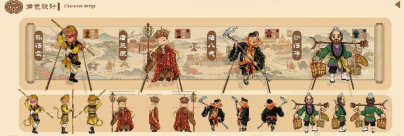
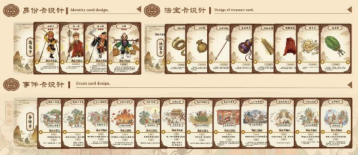
The most successful visual symbolization in Journey to the West lies in its character depictions. From Sun Wukong’s Ruyi Jingu Bang (Golden Cudgel), Tight-Fillet Spell, and Somersault Cloud, to Zhu Bajie’s rotund head and ears and his Nine-Tooth Rake, each distinctive character collectively forms a mythological ensemble (Sun, Xu and Gao, 2026). In this design, highly recognizable visual symbols are systematically extracted from the original text, including the four disciples, the Golden Cudgel, Banana Fan, Tight- Fillet Spell, Flaming Mountain, and Flower-Fruit Mountain. These symbols are categorized into three levels: core characters, iconic magical tools, and representative scenes. Following a translation path of prototype → simplification → stylization, the design preserves the original features while
applying modern aesthetic adjustments, forming a unified visual language system. This symbol system is implemented across physical components such as character cards, maps, magic-item cards, and event cards, as well as derivative products including phone cases, stationery, and puzzles, enabling the cultural symbols to extend from specific entertainment contexts into everyday life. Furthermore, to address young users’ potential unfamiliarity with traditional culture, all visual elements maintain high readability and intuitiveness, ensuring that players can quickly establish a cultural perception connection without prior deep knowledge of Journey to the West.
Organizational Layer: Behavioral Rule Guidance and Translation of Cooperative Mechanisms In this design, the organizational layer translates the deep cultural values of Journey to the West into concrete game rules, enabling players to experience and internalize its spirit through gameplay and shifting them from passive observers to active participants.
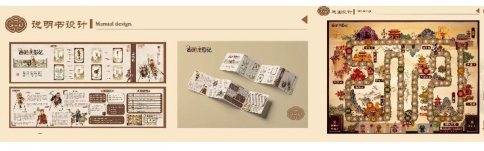
This is achieved through the integration of rules, quizzes, parameter systems, and narrative choices. First, the team cohesion system replaces individual competition with cooperative completion by the four disciples as the only victory condition. The idea that obtaining the scriptures is not an individual effort is encoded into mandatory rules, making cooperation essential for progression. Second, the task-driven mechanism uses the “eighty-one trials” as the narrative framework, transforming classic storylines into level-based tasks. Players advance the plot through card combinations, character skill coordination, and quizzes, while cultural knowledge is embedded throughout, turning the linear narrative into an operable gameplay structure. Third, quiz cards are randomly embedded in level triggers, requiring players to make choices consistent with the values of Journey to the West. This forms a learning loop of random embedding, voluntary acquisition, and feedback, avoiding direct cultural indoctrination.
Figure 3: Mechanics overview and map design.
Spiritual Layer: Internalization of Values and AR Immersive Experience As the ultimate goal of cultural communication, the spiritual layer carries the core values and philosophical ideas of Journey to the West. By incorporating four classic AR levels, this design immerses players in the game experience and promotes a shift from surface-level cultural symbols to deeper value understanding.
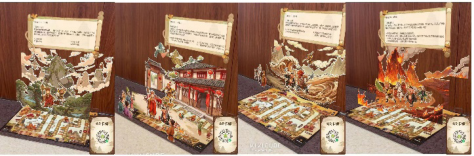
The AR levels select representative narrative nodes from the original work, including the Five Elements Mountain, Gao Village, the Flowing Sand River, and the Flaming Mountain. In these scenarios, players make value judgments based on their character identities and narrative contexts, and choose actions aligned with the value orientation of Journey to the West. This creates a learning loop of random embedding, voluntary acquisition, and feedback, avoiding dogmatic cultural indoctrination. It also encourages players to understand the story’s core meaning and reflect on the spiritual concepts and moral will conveyed by the game. Through AR-based narrative presentation and other emotional triggers, this design awakens players’ shared cultural memory, strengthens their immersion in and sense of belonging to the world of Journey to the West, and further builds cultural identity. As a result, players experience a spiritual journey centered on the spirit of Journey to the West, ultimately achieving the deep cultural communication goal pursued by cultural translation theory.
Figure4: AR special level scenes.
AR BOARD GAME EXPERIENCE WORKFLOW AND INTERACTION IMOLEMENTATION Based on the three-layer design strategy established in Section 4.1, this section describes the actual player experience path, explaining how material-layer perception, organizational-layer behavior, and spiritual-layer internalization
New Translation of Journey to the West 247 unfold sequentially within the specific gameplay process, thereby forming a complete cultural experience loop that progresses from the surface to the deeper level.
Initial Stage: Role Immersion and Establishment of Cultural Perception At the start of the game, players draw identity cards representing the four disciples of the pilgrimage. The back of each card contains the character’s cultural background and unique skill description. This design is not merely a rule assignment but serves as the first activation of cultural symbols at the material layer—while confirming their character identities, players also engage in an initial cognitive encounter with the archetypes of Journey to the West characters and the team philosophy in which each member performs a distinct role. The differentiated abilities of the four characters—Tang Monk enhancing team willpower, Sun Wukong focusing on combat, Zhu Bajie acquiring resources, and Sha Seng providing logistical support—translate the cultural archetypes of the disciples into players’ behavioral roles. In this way, role-playing becomes an entry point for cultural understanding rather than a simple functional division of game tasks.
Exploration Stage: Rule-Driven Play and Internalization of Cultural Behavior The map exploration mechanism, multi-parameter coordination system, and level progression rules systematically translate the cultural concepts of Journey to the West into player behavior. The team-survival binding mechanism treats the four disciples as an inseparable community of shared fate. Throughout the game, players must jointly manage three parameters: individual health, individual will to obtain the scriptures, and team will to obtain the scriptures. In this way, the idea that “obtaining the scriptures is not an individual effort” is encoded into mandatory survival rules, turning cooperation from a moral appeal into a necessary condition for game continuation. The adversity-driven progression structure uses the eighty- one trials as its narrative framework. Through dice-driven map exploration, classic storylines are transformed into operable level tasks. Players roll dice, move pieces, and trigger cultural narrative events when landing on event, magic-item, or opportunity spaces, such as restoring health at Flower-Fruit Mountain, gaining fire immunity through the Banana Fan, or receiving an auspicious cloud bonus. This converts the linear narrative into a process involving randomness and strategic choice, enhancing players’ sense of participation in the pilgrimage.When all preset levels are completed and the three parameters meet the required conditions, the team obtains the scriptures and wins. This confirms the core value of Journey to the West—that the scriptures can only be obtained through trials—at the level of game rules.
Sublimation Stage: Value Judgment and Deep Cultural Core Upon entering the AR level segment, players make critical choices at four classic narrative nodes: the Five Elements Mountain, Gao Village, the Flowing Sand River, and the Flaming Mountain. Rather than serving as a technical
gimmick or decorative checkpoint, this design implements the spiritual-layer strategy by guiding players to make value judgments based on their character identities and narrative contexts. This process transforms the core values of Journey to the West from surface-level symbol recognition into deeper cultural identification.The moral choice mechanism is framed by classic episodes from the original text. Key decision points are embedded in the AR levels, requiring players to make value-based trade-offs, such as weighing risk against benevolence when rescuing Sun Wukong at the Five Elements Mountain, or choosing between wisdom and force when borrowing the Banana Fan at the Flaming Mountain. Based on their understanding of the narrative core, players must make decisions aligned with the value orientation of Journey to the West. AR storytelling functions as an emotional trigger, overlaying the fictional world onto real physical space and creating culturally ritualized scenes with a strong sense of presence.This design awakens players’ collective cultural memory, such as the scorching imagery of the Flaming Mountain and the oppressive atmosphere of the Five Elements Mountain, thereby enhancing immersion, belonging, and cultural identity. Through value-based decisions in AR scenarios, players gain emotional resonance and moral reflection, allowing the experience to move beyond information acquisition toward a spiritual journey centered on the essence of Journey to the West. Ultimately, the cultural identity and emotional connection formed after completing the AR levels indicate the realization of deep cultural communication pursued by cultural translation theory.
DISCUSSION AND LIMITATIONS To validate the design, this study recruited 30 young players aged 18–35 for user experience testing, using the System Usability Scale (SUS), five-point Likert scales, and semi-structured interviews to evaluate cultural cognition, gameplay experience, and emotional identification. Results show that 86.7% of participants reported improved understanding of the cultural connotations of Journey to the West, while AR interactions significantly enhanced immersion and emotional engagement. These findings support the feasibility of the “material–behavior–spiritual” three-layer translation model based on cultural translation theory. The AR board game’s narrative mechanisms, role immersion, collaborative problem-solving, and AR scene interaction effectively stimulated players’ interest, reduced reading and comprehension barriers, and guided them to perceive the spiritual connotations of the classic. Interviews further confirmed that the integration of AR technology and cultural translation mechanisms enhanced cultural cognition and emotional identification, promoting the experiential internalization of core values during cooperative tasks and verifying the effectiveness of AR board games as vehicles for traditional culture education.
However, this study has several limitations. The sample was small and homogeneous, as all 30 participants came from university communities, limiting cross-group analysis and generalizability. Only immediate post-gameplay data were collected, so the long-term effect of cultural internalization remains unverified. Technically, AR functions depend on
New Translation of Journey to the West 249 specific mobile devices, and performance differences may affect experience smoothness. Due to development constraints, AR scenes currently cover only core narrative nodes rather than all chapters, and stability in offline or weak- network environments still requires further optimization.
CONCLUSION AND FUTURE OUTLOOK This study addresses the in-depth dissemination of Journey to the West culture among young audiences by proposing and implementing an AR board game system based on cultural translation theory. It constructs a three-layer progressive cultural translation model: material-layer symbol extraction, organizational-layer rule translation, and spiritual-layer AR value internalization. User testing with 30 young players verified the design’s effectiveness: 86.7% of participants showed improved cultural understanding, while the forced-cooperation mechanism and AR immersive decision-making promoted experiential internalization of the core spirit of Journey to the West. Theoretically, this study extends cultural translation theory to AR board game systems and provides a reusable framework for the gamified transformation of traditional cultural IP. Practically, it explores the deep integration of physical board games and AR technology, offering a design paradigm and technical reference for the digital revitalization and innovative dissemination of classic literature.
Future research will focus on sample expansion, long-term tracking, and technical optimization. Subsequent studies will include participants from more diverse ages, occupations, and regions to improve representativeness and generalizability. Longitudinal follow-up will be conducted to further verify the sustained influence of AR board games on cultural identity and internalization. Technically, future work will optimize device compatibility and system stability, expand AR scenes to cover all chapters, and improve performance in weak-network and offline environments, thereby enhancing immersion, interactivity, and the broader application of AR board games in cultural communication.
REFERENCES
Feng, J. and Wang, Q. (2023) “Three-point Journey to the West”: an analysis of the cultural creative board game design of Journey to the West and its international promotion, Popular Literature and Art, (10), pp. 39–41. Jiang, M. (2024) Research on the design of board game cultural and creative
products based on Confucius culture, unpublished Master’s dissertation, Anhui Jianzhu University. Liu, B. and Xie, J. (2022) On the translation of architectural culture in Chinese classics from the perspective of cultural translation theory, Transactions on Comparative Education, 4(1). Ma, L. (2022) Design and application of intangible cultural heritage APP based on
cultural translation theory, Art and Design, 5(4). Meng, J., Zhang, Q. and Wang, J. (2023) Innovative design of Bagui educational board games under regional culture, Screen Printing, (19), pp. 81–83.
Song, H. and Quan, W. (2026) Continuation and reinvention of Journey to the West culture in Black Myth: Wukong, Jin Chuan Mei, 34(3), pp. 106–109. Sun, M., Xu, J. and Gao, K. (2026) Innovative application of visual symbols
from Journey to the West in digital media art, Footwear Technology and Design, 6(8), pp. 51–54. Tong, C. and Kim, H.-G. (2021) Intangible cultural heritage based on AR technology, Academic Journal of Humanities & Social Sciences, 4(12). Wang, X., Yang, A. and Yan, H. (2025) Board game cultural and creative design
based on the theme of Classic of Mountains and Seas, Toy World, (12), pp. 80–82. Wu, F. (19 March 2026) Research on design strategies of AR/VR empowering intangible cultural heritage creative products from the perspective of technology integration, Zhongwei Daily, p. 004. Wu, Z. (2018) A brief analysis of the design of Journey to the West: Board Game and
the demand for Chinese cultural communication, Journal of Hulunbuir University, 26(4), pp. 78–81, 118. Yang, D. (2026) Innovative transformation of character images in Black Myth: Wukong and Journey to the West, Literature & Art Weekly, (5), pp. 77–82. Zhang, M. (2022) Research and practice on the design of cultural and creative
products based on Liangzhu culture, unpublished Master’s dissertation, Zhejiang Sci-Tech University.
LISTED IN THE AHFE DIGITAL BOOKSTORE CATALOGUE
Explore the complete digital volume
Metaverse, Virtual Environments and Game Design
Read this individual research paper free through the original publisher, or explore the full digital proceedings book.
ISBN 978-1-964867-93-9
Explore this ISBN in the AHFE Bookstore ↗Listed in the July 2026 bookstore catalogue; search by ISBN to confirm current availability · Digital book purchase optional