Bruno Giesteira, Tiago Alves (2026). VR Aesthetic Contributions in Transformative Experience Design (TED). In: Metaverse, Virtual Environments and Game Design. AHFE Open Access, vol. 217, pp. 213–222. https://doi.org/10.54941/ahfe1007668
Within the field of Virtual Reality (VR), Transformative Experience Design (TED) has emerged as a design-oriented research trajectory concerned with understanding how immersive technologies can be intentionally shaped to support transformative human experiences. This paper explores VR as a future-facing design medium for eliciting such experiences, foregrounding conceptual and experiential contributions rather than technical optimization. The study first articulates the theoretical underpinnings of the TED framework, drawing on design-relevant constructs including the sublime, self-transcendence, and awe as lenses for shaping interaction and experience. Building on this framing, the paper presents the initial design exploration of a prototype that investigates a range of experiential valences proposed by TED, with particular attention to aesthetic intensification and embodied engagement. The research adopts a somaesthetic design perspective, examining how bodily awareness and sensory coupling can be leveraged to support meaningful interaction within immersive environments. Empirical exploration is conducted through an experimental VR ecosystem that integrates somatic input as a design material, enabling reflective and affective modes of interaction rather than focusing on technical performance. The paper discusses how these design decisions contribute to the cultivation of transformative potential, particularly through their aesthetic, symbolic, and experiential implications. By positioning VR as a medium for speculative and experiential design inquiry, this work contributes design knowledge and future-oriented insights relevant to human–technology interaction in emerging immersive systems.
In consideration of the matter of personal well-being as designated as a United Nations Global Goal for 2030 (ONU, 2019), technologies, with a particular emphasis on those designed to augment and advance this domain, are theorized to possess an intrinsic capacity to furnish suitable solutions to this issue. To this end, we pose an approach that aims to recognize human emotion as a critical component in the development of personal well-being (Alves & Giesteira, 2025), and that can be further amplified through the employment of interactive technologies, namely, within the domain of Interaction Design and Human-centred design.
Thus, the present work focuses on the deepening of aesthetic valences within Transformative Experience Design (TED): an interaction design research field Received February 20, 2026; Revised March 28, 2026; Accepted April 17, 2026; Available online July 20, 2026
214 Giesteira and Alves whose goal is to develop experiences which foster self-actualization and self- transcendence. Introduced by Gaggioli (2016), this framework is predicated on the premise that specific experiences have the capacity to induce enduring changes in an individual’s self-perception, personality, beliefs, and values. These transformative experiences, defined as unique and extraordinary events that provoke both emotional and epistemic expansion (Chirico et al., 2021, 2022; Gaggioli, 2016; Kitson et al., 2020), involve the implementation of a “perturbation experiment” (Gaggioli, 2016), a term denoting a deliberate intervention designed to disrupt the users’ established cognitive frameworks. The objective of this disruption is to prompt a transformation in the meanings and beliefs that the users hold, thereby fostering a process of cognitive reorganization.
Within this context, Virtual Reality (VR) is highlighted as a particularly promising medium for facilitating transformative experiences (Gaggioli, 2016), since its unique phenomenological characteristics - such as the ability to engender a profound sense of presence (Berkman & Akan, 2019; Kilteni et al., 2012), to allow users to adopt alternative embodied perspectives, and to create environments that defy the conventional laws of reality (Gaggioli 2016). This, in turn, can provoke significant emotional and epistemic shifts as users adjust to new, unfamiliar paradigms, with positive consequences for personal well-being (Gaggioli, 2016).
As such, awe, a multifaceted emotion interwoven with amazement, admiration (and, at times, fear or humility), stands as a pivotal component of TED’s discourse (Chirico et al., 2018; Gaggioli, 2016; Keltner, 2024; Keltner & Haidt, 2003; Yaden et al., 2017). In fact, this concept is inherently associated with the philosophical notion of the sublime, which was extensively elaborated by Kant (1790) and Burke (1767) in the domain of aesthetics. According to Kant (1790), the distinction between these experiences can be found in the philosophical conception of the “mathematical sublime”, characterized by the experience of vastness that exceeds our perceptual capacities, as observed through the vista of the vast sea and the infinite stars. Contrasting this, the “dynamic sublime” is defined by experiences that challenge our cognitive limits and elicit a need for accommodation. Exemplary concepts within this dynamic sublime include the notions of God and death.
Conversely, Edmund Burke (1767) placed greater emphasis on the somatic aspects of the sublime, associating it with visceral responses such as terror, pain, or (quite literally) bodily paralysis when confronted with overwhelming stimuli (Burke, 1767; Shusterman, 2012). Indeed, Burke evokes the body, in his philosophical works regarding aesthetics, as a primordial element in the experience of sublime experiences, which led Richard Shusterman (2012) to argue that Burke’s thought around the body’s role could actually be framed within the research branch of somaesthetics and, more concretely, to the concept of soma: a fusion of body and mind; a living, perceptive, conscious and dynamic totality that is distinct from our mere corporeal composition (Shusterman, 2012).
However, a recent review applied towards TED’s literature (Giesteira & Alves, 2025) revealed that there was an evident lack of consideration on
VR Aesthetic Contributions in Transformative Experience Design (TED) 215 Edmund Burke’s (1767) founding thought on the sublime. Here, little depth is given to Burke’s implications around this concept, which are based on the core dimensions of the body as the main piece of sublime manifestations. Because of this and other adjacent reasons, a somaesthetic (Shusterman, 2012) approach towards the development of sublime experiences within the TED framework must be here considered.
AESTHETIC PRINCIPLES OF THE SUBLIME Burke’s (1767) theorization on the sublime goes beyond a unilateral perspective conceptualization of the topic. In fact, Burke develops his understanding of the sublime across different aesthetic dimensions, which expand across various ontological perspectives.
Firstly, it is worth highlighting his work on the consideration of space as a fundamental element in the experience of the sublime, namely in what could possibly be framed within a spatial phenomenology. According to Burke, this is evidenced by stimuli of such magnitude and grandeur present in certain architectural works, natural settings, and more general spatial configurations that manifest vast, magnanimous, and imposing structural characteristics.
Interestingly, Burke’s thinking about the sublime demonstrates such depth that it encompasses a type of conceptualization on the subject that, moving from an eminently material pole such as the spatial dimension, also explores the implications of the sublime at the heart of the imagination (that is, in an undoubtedly more abstract context). In this regard, the concept of obscurity becomes central. Extending his phenomenological perspective, Burke reviews the unknown, mysterious and uncertain phenomena as catalysts for an expansive exercise of the imagination, which, when faced with stimuli that it does not properly understand, is affected in such a way as to explore what the experienced phenomenon might be about – especially when taking into account the survival of the individual, Burke’s fundamental driving force behind human motivation.
However, even in light of the multiple considerations surrounding the sublime, an underlying theoretical commonality can be observed in Burke’s thinking, particularly, in what manifests itself as an evidently somatic framework of this concept. According to Burke (1767), when we are faced with something awe-inducing, we tend to feel the consequences of this type of sensation through our body: as when, before something that heightens our senses, terrifies us or that we are completely unaware of, our body tends to (literally) paralyze as an immediate somatic response. Although basing his conceptualization on ideas such as infinity, vastness, magnificence, or (more prevalently) obscurity, Burke defends that all these concepts have an inherently somatic origin, arguing that sensations such as terror, pain or danger in the face of something that exceeds us (either perceptually or cognitively) are presented as manifestations of the sublime through, in these cases, a series of somatic sensations, such as muscle contraction, increased attention or increased heart rate (Shusterman, 2012).
216 Giesteira and Alves As such, we may consider that the realm of spatial interaction initially put forward by Burke also presupposes, within the human condition, our embodied reality and the way in which a dialectic is established between it and the spatial form that surrounds us (Shusterman, 2012). This somaesthetic interaction doesn’t need to be limited to the body’s simple wandering through space, but rather to an awareness of the wandering itself as a total experience of space in the different dynamics, ambiences, relationships and feelings it establishes with our soma: it’s a dialectic structure that implies the existence of both elements, soma and space, in order to adequately manifest itself and trigger a proper sublime appreciation. Not only that, as the body must, therefore, be thought out not as a means to interact with a particular object/ space, but as an end in itself: in which it is used in order to consciously affect itself within an aesthetic experience. This, in turn, encourages a self- transcendence exercise in the user, in which they become more aware of their bodily reality through the fostering of an inherently somaesthetic sense of the sublime. Thus, a preliminary prototype using a VR system coupled with a variety of biosensors has been developed with the goal to explore these different aesthetic dimensions.
PROTOTYPE DEVELOPMENT Taking into account the theoretical assumptions here outlined and discussed, this chapter presents the technical, interactive and aesthetic developments that have taken place in the elaboration of this preliminary VR prototype that aims to empirically implement some somaesthetic valences considered relevant in fostering transcendent experiences, according to the TED framework. This was put forward through the implementation of a VR-centered system technological corpus that also incorporated a set of embodied Arduino sensors, in order to foster and potentiate a stronger somaesthetic and transformative dimension on the user.
Technical Specifications In terms of technical specifications, the present prototype is based on the Unity game engine, which is developed by Unity Technologies (2025). This decision was mainly informed by the proficiency cultivated by the team in relation to this particular software, its capabilities within a virtual reality workflow, and, notably, the incorporation of Arduino-based resources.
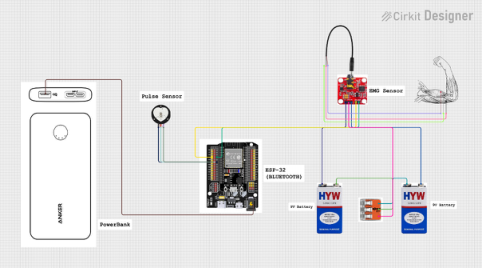
Here, the Arduino system structure is composed by various elements. The first is the microcontroller itself, the ESP-32, which possesses wireless connections (Wi-Fi and Bluetooth) that facilitate its incorporation into wearable contexts, thus maximizing this system’s somaesthetic potential. Subsequently, two sensors were incorporated to elicit the previously delineated somaesthetic aspects: the heartbeat and muscle contraction.
Figure 1: Arduino system schematization.
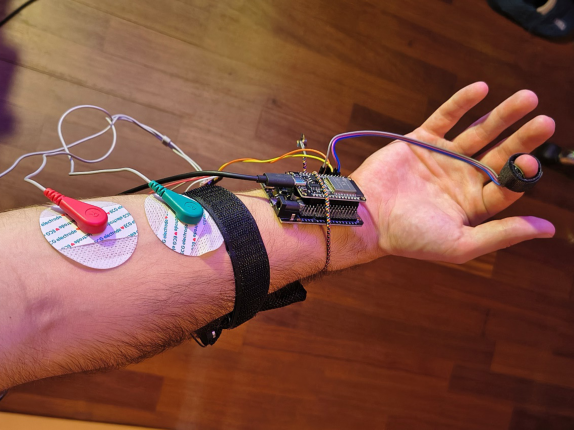
For the first feature, an optical heart rate sensor associated with a Velcro strap was used, which aims to be attached around the index finger.
The second, more complex aspect, has as its main component an AD8226-based EMG sensor which, powered by 2 × 9v batteries, requires the connection of its three electrodes in specific positions in the muscle area to be worked on. In this case, we chose to target the forearm, as it is a part of the body that provides a natural, recurring area of interaction and has obvious somaesthetic potential, which will be explored further on.
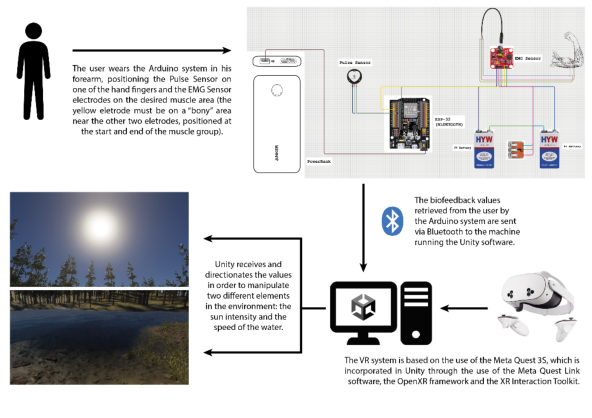
Finally, we should mention the use of the Meta Quest 3S as the VR headset selected to incorporate this ecosystem. This is justified by the ability of this equipment to do hand tracking, relegating the need to use its controllers, thereby allowing for a less invasive and mediated somatic experience.
As such, the system works by coupling the Arduino ESP-32 board to both heartbeat and muscle contraction sensors, in a wearable way, whose values are then communicated in Serial, via Bluetooth, to Unity. These are then associated with certain elements of the Virtual Reality environment, allowing their parameters to be manipulated by somatic means.
Figure 2: Overall system architecture.
As such, we now come to detail the Virtual Reality experience hereby proposed. The first dimension to be addressed is related to the construction of the 3D environment itself, which follows some spatial and aesthetic configurations that, at this stage, are still preliminary. From an eminently spatial point of view, it was decided to create a simple scenario, based on a plain forest with a lake, with no terrain or any other property that makes it stand out phenomenologically. This is due to the fact that this prototype aims to deepen, in an ideally isolated way, one of the gaps identified in the literature applied to TED: the lack of a somaesthetic weighting in transformative experiences, particular, within a Burkean perspective.
Consequently, the aesthetic dimension is worked on using two different components. The first is grounded in one of the elements that makes up the forest itself, where the user has the opportunity to manipulate a specific component of this scenario: the lake’s water speed using their heartbeat. Here, the metaphorical transposition is clear: that of the “agitation of the environment” with the “somatic agitation” of the user, encouraging the latter to apply an introspective exercise of somatic self-perception in order to be able to manipulate the environment according to their intentions. The symbolism of this interaction is thus built on that same equivalence between realities, where the water is presented in this metaphorical structuring as a complex ecosystem that, like the user, manifests its inner turmoil to the outside: the water and the user are inextricably linked. Faced with the phenomenon experienced, this transposition of realities is understood and employed in the virtual space by the user thanks to the fact that the feedback is both simultaneous and analogous to their own somatic condition, thereby underlining a coherence between phenomena (the user’s heartbeat and the water’s speed in the environment).
In the context of interaction design, it is expected that this perception of simultaneity between phenomena will itself serve as an affordance for the user, in order to push them to adapt their behavior (i.e. the conscious somatic manipulation of their heartbeat) to their intentions of controlling the environment. Hence, the experimental conditions implemented here may trigger a mysterious character found not only in the scenario, but also on the unusual nature of the interaction itself, which reveal the potential to explore, in the same way, a Burkean obscure dimension of the sublime.
Figure 3: The developed virtual environment in unity.
VR Aesthetic Contributions in Transformative Experience Design (TED) 219 In addition, the environment has another particularly relevant aesthetic element: the sun. This component, in turn, distinguishes itself from the forest both phenomenologically and symbolically. On a phenomenological level, we should highlight its spatial configuration in the scene, where it assumes not only an elevated position (exacerbating this top-bottom, earth-sky axis), but also a series of other contrasting properties with the rest of the scene, namely its distinctive luminous and chromatic character, contributing to its natural perceptual prominence in this environment.
Furthermore, its aesthetic dimension should also be underlined. The sun shows its archetypal value thanks to its multitude of cross-cultural meanings, which come together in the consideration of the sun as an inherently divine element, not only through phenomenologically supported aspects (such as the fact that it is the primordial source of light, heat and, consequently, life), but precisely because it shows an undoubtedly mysterious and obscure nature: it is an element to which we have no empirical or embodied access, whose origins and properties we are largely unaware of, and which rises above us on a daily basis without us having any real control over it. We inferiorize ourselves to it, not only because we are incapable of manipulating it, but because we are controlled by it, we are dependent on it and, above all, because we don’t know it.
This allows for a direct correlation between the theoretical precepts with Burke’s thought on the sublime, from two complementary perspectives. The first is rooted in the manifested feelings of impotence and powerlessness in the face of something that is superior to us (either because it is an element that effectively regulates our lives, or because of our inability to reverse that same submission towards the sun). And a second that, starting from the framing of this element in a Burkean context of obscurity, allows for a somaesthetic exploration through the incorporation of an interactive dialectic between soma and the sun, whose aesthetic derivations are created not only from the symbolic nature of the sun, but also from the interaction itself with that obscure element. In this way, the interaction takes place on undoubtedly somaesthetic precepts, where the sun stands out as an affordance both for its formal configurations and for its aesthetic weighting, impelling the user to adopt a somaesthetic dialog by directing their arm towards it.
Figure 4: Somaesthetic interaction between user and sun.
220 Giesteira and Alves Here, another somatic valence is explored: that of muscle contraction. The choice of this somatic dimension as an interactive factor aims to deepen some of the theoretical considerations previously mentioned. Firstly, by exploring how this type of interaction materializes not only in technical terms, but also in order to assess its somatic opportunism. This action of muscle contraction of the forearm is characterized by its different degrees of intensity and the effort that each requires of the user – an intense contraction of this muscle group requires an increased effort on the part of the user. Consequently, and working on the aesthetic valence that the sun assumes, the user is here invited to subvert this prevailing logic: by pointing at the sun, the user is now able to control the intensity of the latter’s light by using the muscular contraction of his forearm. Here, the same analogous and simultaneous relationship between the user’s action and the environment’s response can be seen as in the dialectic between forest and heartbeat: as the values resulting from muscle contraction grow, the sun’s light intensity increases.
Figure 5: Embodied arduino system.
From a somaesthetic point of view, this analogous evidence exposes new symbolic nuances that deem to be here explored. Firstly, the movement of the user’s arm towards the sun is justified both from the interactional logic standpoint (which allows the interaction modalities to be discerned in a more granular way, preventing the light intensity from changing when it is not the user’s intention to do so) but above all, because of the somaesthetic character it here plays: it is an somatically-based attempt by the user to control something that is not controllable. More than that, it’s an effort to control something that usually controls him, thus, working upon a sense of aesthetical obscurity developed by Burke.
Therefore, this interaction not only foments an evident somatic self- perception in the user, but also explores, through this dialog between soma
VR Aesthetic Contributions in Transformative Experience Design (TED) 221 and object, a particular somaesthetic dimension, where are the gestures and interactions that ultimately create this aesthetic relationship with an element that already has a substantial obscure character: where body, gesture and imagination, encompassed within Burke’s aesthetics thought, “feed off each other”.
REFLECTIONS AND FUTURE DEVELOPMENTS Within the scope of the Transformative Experience Design research line, this study aimed to address and implement, through a preliminary VR prototype, different somaesthetic properties in order to promote the creation of sublime experiences.
In subsequent stages of this research, the prospect is to test this initial prototype with participants. This pilot testing is particularly important to not only evaluate the implemented aesthetic factors, but to assure initial framework validation and overall system usability, mainly through phenomenological observations and interviews, user behavior analysis and biofeedback recordings.
Following this, the intention is to deepen the experience itself by exploring other aesthetic dimensions. While the somaesthetic configurations explored in this study are based on a type of interaction that is undoubtedly more direct and active, it is also considered a form of inverted somatic interaction, i.e. one that subverts the common feeling of agency on the part of the user: an inversion of the user’s conscious somatic reality, which involves fostering a feeling of powerlessness (Burke, 1767) through a set of actuators and EMS (Electrical Muscle Stimulation) modules, which aim to manipulate the user’s body movements. This implementation thus fulfills another dimension of the sublime proposed by Burke – a subjugation of the individual to a force that surpasses them and that they cannot overcome, consequently creating the aforementioned feeling of impotence in the face of something that is superior to them, and, consequently, of the sublime.
As such, this study contributes with the deepening of the TED framework through the exploration of different aesthetic considerations, embracing this field’s leitmotif to ensure the promotion of self-transcendence, self- actualization, and, ultimately, personal well-being within the individual.
REFERENCES
Alves, T., & Giesteira, B. (2025). Somatic Indicators on the Visceral, Behavioral and Reflective Dimensions of Emotional Design. In N. Martins & D. Brandão (Eds), Advances in Design and Digital Communication V (pp. 512–525). Springer Nature Switzerland. Berkman, M. I., & Akan, E. (2019). Presence and Immersion in Virtual Reality. In N.
Lee (Ed.), Encyclopedia of Computer Graphics and Games (pp. 1–10). Springer International Publishing. https://doi.org/10.1007/978-3-319-08234-9_162-1 Burke, E. (1767). A Philosophical Enquiry Into the Origin of Our Ideas of the Sublime and Beautiful. Chirico, A., Clewis, R. R., Yaden, D. B., & Gaggioli, A. (2021). Nature versus art
as elicitors of the sublime: A virtual reality study. PLOS ONE, 16(3), e0233628. https://doi.org/10.1371/journal.pone.0233628
222 Giesteira and Alves Chirico, A., Ferrise, F., Cordella, L., & Gaggioli, A. (2018). Designing Awe in
Virtual Reality: An Experimental Study. Frontiers in Psychology, 8. https://doi. org/10.3389/fpsyg.2017.02351 Chirico, A., Serafini, F., Pizzolante, M., Malvezzi, R., Gianotti, E., Micucci, C., Manduca, E., Carvelli, C., Vago, F., Renda, M., Cascio, E., & Gaggioli, A. (2022). Inspiring awe in high school teachers: Design and preliminary test of a virtual training on AltspaceVR. Annual Review of CyberTherapy and Telemedicine, 20, 31–35. Scopus. Gaggioli, A. (2016). Transformative experience design. In Human Computer
Confluence: Transforming Human Experience Through Symbiotic Technologies. https://www.scopus.com/inward/record.uri?eid=2-s2.0-85127937656&partnerI D=40&md5=e12126616c40d558b02db30a2a3c9ea5 Giesteira, B., & Alves, T. (2025, August 25). Towards the Design of Transformation: A review of transformative VR experiences. 15th International Conference on Human Interaction and Emerging Technologies (IHIET 2025). Kant, I. (1790). Critique of the power of judgment. Cambridge University Press. Keltner, D. (2024). Awe. Penguin. Keltner, D., & Haidt, J. (2003). Approaching awe, a moral, spiritual, and
aesthetic emotion. Cognition and Emotion, 17(2), 297–314. https://doi. org/10.1080/02699930302297 Kilteni, K., Groten, R., & Slater, M. (2012). The Sense of Embodiment in Virtual Reality. Presence, 21(4), 373–387. https://doi.org/10.1162/PRES_a_00124 Kitson, A., Stepanova, E. R., Aguilar, I. A., Wainwright, N., & Riecke, B. E. (2020).
Designing mind(set) and setting for profound emotional experiences in virtual reality. 655–668. Scopus. https://doi.org/10.1145/3357236.3395560 ONU. (2019, January 30). Objetivo 3: Saúde de qualidade. Nações Unidas - ONU Portugal. https://unric.org/pt/objetivo-3-saude-de-qualidade-2/ Shusterman, R. (2012). Thinking through the body. Cambridge University Press. Unity Real-Time Development Platform | 3D, 2D, VR & AR Engine. (2025). Unity.
https://unity.com Yaden, D. B., Haidt, J., Hood, R. W., Vago, D. R., & Newberg, A. B. (2017). The varieties of self-transcendent experience. In Review of General Psychology (Vol. 21, Issue 2, pp. 143–160). https://doi.org/10.1037/gpr0000102
LISTED IN THE AHFE DIGITAL BOOKSTORE CATALOGUE
Explore the complete digital volume
Metaverse, Virtual Environments and Game Design
Read this individual research paper free through the original publisher, or explore the full digital proceedings book.
ISBN 978-1-964867-93-9
Explore this ISBN in the AHFE Bookstore ↗Listed in the July 2026 bookstore catalogue; search by ISBN to confirm current availability · Digital book purchase optional