Jin Xie, Guan Jingyan, Yu Peng (2026). Will Time Pressure Stimulate Shared Leadership In Temporary Teams? — An Explanation Based On Social Exchange Theory. In: Human Factors, Business Management and Society. AHFE Open Access, vol. 215, pp. 221–230. https://doi.org/10.54941/ahfe1007603
Temporary teams are increasingly prevalent in modern organizations, yet the mechanisms driving their shared leadership formation remain under-explored. Framed by Social Exchange Theory, this study investigates the influence of time pressure and individual political skill on the emergence of shared leadership. Empirical data were collected from 28 temporary teams (N = 95) and analyzed using Latent Moderated Structural Equations (LMS) in Mplus 8.3. The results demonstrate that: (1) time pressure significantly and positively predicts swift trust; (2) swift trust serves as a critical mediator between time pressure and shared leadership; and (3) political skill positively moderates the relationship between time pressure and swift trust. These findings reveal the adaptive mechanisms of shared leadership in time-constrained environments and provide managerial recommendations for optimizing temporary team performance through swift trust-building and the development of members' social competencies.
With the increasing use of temporary teams in modern organizations, shared leadership has gained attention due to its positive impact on team dynamics (Wang et al., 2013; Zhu et al., 2018; Wang & Wan, 2020). In the event industry, temporary teams are frequently utilized; however, research on the antecedents of shared leadership remains limited, particularly in temporary teams (Zhu et al., 2018). To date, less study has examined shared leadership in the context of event management (Abson & Schofield, 2022). While previous studies have explored factors such as team characteristics, team climate, and organizational context (Abson & Schofield, 2022), little is known about the mechanisms behind shared leadership in temporary teams (Wu et al., 2020). This study, based on Social Exchange Theory, investigates the key role of swift trust in the emergence of shared leadership. Additionally, the study Received February 5, 2026; Revised April 15, 2026; Accepted April 30, 2026; Available online July 20, 2026
examines how time pressure, as an external stimulus, influences both swift trust and shared leadership, while also considering the moderating role of political skills. This research explores the formation mechanisms of shared leadership in the context of event management, offering guidance for the management of temporary teams.
LITERATURE REVIEW
Social Exchange Theory Social Exchange Theory (SET) posits that relationships are essentially value exchanges driven by mutual support and the pursuit of goals (Blau, 1956; Lawler & Thye, 1999). During this exchange, one party provides help and support to the other but cannot confirm whether or when the other party will reciprocate, resulting in risks and uncertainties in the exchange process (Xu, Han, & Yu, 2016). This uncertainty is particularly prominent in temporary teams. Since team members in temporary organizations typically work together for short periods, their ability to assess others’ risks is limited, which may hinder social exchange among organizational members. However, empirical research by Xu et al. (2016) supports the applicability of Social Exchange Theory in temporary teams (Xu et al., 2016), introducing the concept of swift trust as a key variable to explain social exchange within such teams. Therefore, this study will build on Social Exchange Theory, using the perspective of swift trust to investigate the formation mechanisms of shared leadership under the influence of external stimuli such as time pressure in temporary team contexts.
Time Pressure and Swift Trust Team time pressure refers to the stress experienced by team members when required to complete tasks within a limited timeframe set by clients or leaders, typically measured by the extent to which team members feel they lack sufficient time to accomplish their work (Maruping et al., 2014). Current research largely follows Chong et al.’s perspective, categorizing time pressure into challenge-related (which stimulates motivation and growth) and hindrance-related time pressure(which induces fatigue) (Chong et al., 2011; Sacramento et al., 2013; Ford & Jin, 2015). In the context of this study, temporary teams typically have clear work goals and task deadlines, with members usually having a strong sense of purpose. The relationship between pressure and work content is high, and thus, the team time pressure discussed in this research primarily refers to challenge-related time pressure.
Swift trust is a special form of trust that enables temporary organizations to manage instability, uncertainty, risks, and expectations through collective understanding and associations (Meyerson et al., 1996). Unlike traditional trust, swift trust does not rely on the cognitive judgments developed through long-term interpersonal interactions (Xu et al., 2016); instead, it is a short- term, rapid process of establishment (Qi et al., 2015), making it well-suited to explain the development and manifestation of trust in temporary teams.
Will Time Pressure Stimulate Shared Leadership in Temporary Teams? 223 From a Social Exchange Theory perspective, challenge-related time pressure acts as a motivator (Halbesleben et al., 2014; Crawford et al., 2010), prompting members to prioritize resource exchange and autonomous cooperation to achieve shared goals (Xu et al., 2016). Such environments facilitate rapid communication and goal alignment, thereby accelerating the formation of swift trust. Consequently, we propose: H1: Time pressure in temporary teams has a positive impact on swift trust.
The Mediating Role of Swift Trust From the perspective of Social Exchange Theory, temporary teams facing high time pressure are more likely to strengthen internal communication and relationships, thereby actively establishing swift trust. On the other hand, time pressure also leads employees to place more trust in each other, resulting in passive swift trust (Xiao & Li, 2014). In teams where trust has been established, employees are more willing to invest their leadership as a resource, as they believe in the possibility of exchange in such a context. Existing research also highlights that the trust-based context is critical for employees to exert influence over others and form shared leadership (Dirks & Ferrin, 2002; Li et al., 2019). Therefore, the challenging time pressure faced by temporary teams drives the formation of swift trust within the team, and swift trust, in turn, actively promotes the development of shared leadership. Consequently, we propose: H3: Swift trust in temporary teams mediates the relationship between time pressure and shared leadership.
The Moderating Role of Political Skill The Moderating Role of Political Skill Pfeffer (1981) introduced the concept of “political skill” within the context of organizational power struggles, arguing that it is vital for securing and leveraging scarce resources—a cornerstone of professional success. Building on this, Ferris et al. (2005) defined political skill as an individual’s ability to blend a distinct interpersonal style with social effectiveness. Individuals with high political skill read others accurately and use that insight to exert influence, helping them achieve both personal and organizational objectives. This construct comprises four core dimensions: social astuteness, interpersonal influence, networking ability, and apparent sincerity. Research indicates that politically skilled employees are better equipped to navigate high-stress environments and manage personal pressure. When faced with challenge-related time pressure, their adeptness at stress management allows them to remain productive and focused. Moreover, these individuals often possess higher intrinsic motivation, making them more likely to lean into, rather than retreat from, task-related challenges. Beyond mere coping, politically skilled members are generally perceived as more trustworthy by their peers. Challenge-related pressure acts as a catalyst for these individuals, activating their ability to adapt to situational demands and, consequently, earn the confidence of both team members and formal leaders. In time-sensitive settings, they leverage their social effectiveness to build trust—specifically swift trust—by tailoring their behaviour to the
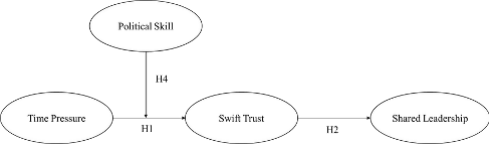
immediate needs of the group. This behavioural flexibility facilitates trust even under duress, which in turn fosters the emergence of shared leadership. We therefore propose: H4: Political skill positively moderates the relationship between time pressure and swift trust. Specifically, the positive impact of time pressure on swift trust is more pronounced for employees with high political skill. The research model for this study is proposed as shown in Figure 1.
Figure 1: Research model.
METHODOLOGY
Data were collected through snowball sampling from 28 student-led temporary teams (N = 95) engaged in academic projects. The sample comprised 22 males (23.2%) and 73 females (76.8%), with all participants aged between 18 and 25 years. To mitigate common method bias, the survey ensured respondent anonymity and utilized randomized item sequences. All variables were assessed using validated 5-point Likert scales that underwent standard back-translation procedures: Time Pressure was measured using a 3-item scale (Maruping et al., 2014); Political Skill utilized an 18-item scale (Ferris et al., 2005); Swift Trust was assessed with 6 items (Yang, 2006; Xu et al., 2016); and Shared Leadership employed a 7-item scale (Muethel et al., 2012).
The statistical analysis followed a multi-stage approach: SPSS 20 was used for descriptive statistics and common method bias testing; the SPSSAU platform verified the feasibility of team-level data aggregation; and Amos 22 was employed for confirmatory factor analysis (CFA). Finally, mediation and moderated mediation effects were analyzed in Mplus 8.3 using Latent Moderated Structural Equations (LMS). The LMS method was selected for its superior accuracy in controlling measurement errors and providing robust estimates compared to traditional product-indicator approaches (Cheung and Lau, 2017; Sardeshmukh and Vandenberg, 2017; Fang and Wen, 2018).
RESULTS AND HYPOTHESIS TESTING Revised Measurement Quality Analysis
Common method bias was assessed via Harman’s single-factor test, with the first factor explaining 33.27% of the variance (Podsakoff et al., 2003). Reliability was robust, as Cronbach’s $\alpha$ ranged from 0.845 to 0.912 (Hair et al., 2014). Confirmatory factor analysis (CFA) performed in Amos 22 demonstrated good model fit: χ²/df = 1.715 < 3, TLI = 0.911 >
Will Time Pressure Stimulate Shared Leadership in Temporary Teams? 225 0.9, CFI = 0.940 > 0.9, and RMSEA = 0.073 < 0.8—reflect a good overall model fit (Qiu and Lin, 2009). The factor loadings of each item on its respective construct in the measurement model, along with the composite reliability and average variance extracted for each construct, are presented in Table 1.
Table 1: Results of confirmatory factor analysis.
Table available in the original PDF paper.
Composite
AVE
Variable Item Factor Loading
Reliability Political Skill 0.884 0.657
0.775
PS1 In my work, I have encountered many key figures and developed an extensive network.
0.882
PS2 I am skilled at leveraging my network to facilitate work-related matters.
0.803
PS3 I seem to have an instinctive ability to know what to say and do to influence others.
0.777
PS4 I have a natural talent and insight when it comes to presenting myself to others.
Time Pressure 0.846 0.650
0.772
TS1 Our team usually does not have enough time to complete our tasks.
0.927
TS2 The time given to our team to complete tasks is very short.
TS3 The duration of tasks is usually very short. 0.704 Swift Trust 0.772 0.537
ST1 You quickly sense the harmony within the team. 0.887
0.638
ST2 You and the other members quickly feel that there is no need for mutual supervision.
0.645
ST3 You and the other members quickly believe that each other will cooperate with the progress and work attentively.
Shared Leadership 0.821 0.607
0.698
SL1 You make efforts to ensure the collaboration among everyone is more effective.
SL2 You seek advice from other team members. 0.760
0.870
SL3 You ask other team members for information related to your own work outcomes, and this information may impact your work.
Item quality was robust, with all 13 factor loadings exceeding the “very good” threshold of 0.63, and nine items surpassing 0.71 (Tabachnick & Fidell, 2006). Convergent validity was confirmed as all constructs met the criteria suggested by Hair et al. (2014): composite reliability (CR) > 0.7, average variance extracted (AVE) > 0.5, and Cronbach’s α > 0.7. Finally, discriminant validity was established using the AVE comparison method; as
shown in Table 2, the square root of the AVE for each construct exceeded its correlations with other constructs (Qiu & Lin, 2009).
Table 2: Discriminant validity.
Table available in the original PDF paper.
Political Skill Time Pressure Swift Trust Shared Leadership
Political Skill 0.810 Time Pressure −0.341 0.806 Swift Trust −0.366 0.675 0.733
Shared Leadership −0.178 0.131 0.459 0.779 Team-Level Data Aggregation
To justify aggregating individual responses to the team level, we calculated the rwg $ICC(1)$, and Intraclass Correlation Coefficient (ICC) for Shared Leadership. Upon calculation, the rwg for shared leadership was 0.845 (> 0.7), ICC(1) was 0.201 (> 0.12), and ICC(2) was 0.761 (> 0.7), all of which satisfied the requirements for statistical aggregation standards (LeBreton and Senter, 2008; Bliese, 2000; James et al., 1984; James et al., 1993), supporting the use of team-level mean scores for subsequent analysis.
Hypothesis Testing First, the direct paths and the mediating role of swift trust between time pressure and shared leadership were examined. Based on the model constructed in Mplus 8.3 and standardized estimates obtained after 5000 Bootstrap re-samplings, results indicated that all direct paths reached significance levels. Group time pressure significantly and positively predicted swift trust among members (β = 0.675, p < 0.001), and swift trust among group members significantly and positively predicted shared leadership of the group (β = 0.679, p < 0.001). Thus, Hypothesis 1 and Hypothesis 2 were supported. The standardized effect value of the mediating effect of time pressure on shared leadership was 0.455 (p = 0.001 < 0.05), with a 95% confidence interval of [0.209, 0.835], which excludes zero, indicating that swift trust plays a positive mediating role between time pressure and shared leadership (Hayes et al., 2011). Therefore, Hypothesis 3 was supported.
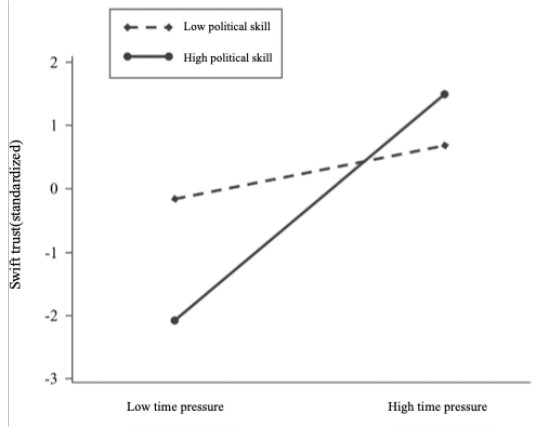
Next, the moderating effect of political skill between time pressure and swift trust was examined. The interaction term between time pressure and political skill had a significant positive impact on swift trust (p = 0.002), where for every one-unit increase in members’ political skill, the impact of time pressure on swift trust increased by 0.275 units. Thus, Hypothesis 4 was supported. Figure 2 illustrates the impact of time pressure on swift trust at high and low levels of political skill. Regardless of whether political skill was at a low or high level, higher time pressure led to a higher degree of swift trust among members. However, compared to low levels, the positive impact of time pressure on swift trust was further enhanced when members’ political skill was at a high level.
Figure 2: The moderating effect of political skill on the relationship between time pressure and swift trust.
CONCLUSION AND DISCUSSION Drawing on Social Exchange Theory (SET), this study examines how time pressure drives shared leadership in temporary teams. Results indicate that time pressure positively impacts swift trust , which mediates the link to shared leadership. Additionally, political skill positively moderates the relationship between pressure and trust.
The research offers three theoretical contributions. First, it shifts focus toward unique trust dynamics under temporary constraints, clarifying how teams foster collective leadership. Second, it extends SET to high-velocity environments by framing swift trust as a system-based expectation rather than a result of historical risk assessment. Third, it identifies political skill as a catalyst for trust; while socially adept members build exchange networks, those lacking these skills define the boundary for leadership emergence.
Practically, managers should leverage challenge-related pressure to incentivize trust and shared leadership. Establishing efficient communication is vital to mitigate uncertainty in short-term settings where traditional risk assessment is unfeasible.
Despite these insights, the study has limitations. First, using student teams may introduce prior familiarity; future work should isolate purely temporary settings. Second, the current model focuses on specific variables; future research could incorporate other predictors, such as empathy or leader authorization.
ACKNOWLEDGMENT
The authors would like to acknowledge Professor Hui Zhang from Sun Yat-sen University for his invaluable guidance and insightful support throughout the development of this research.
REFERENCES
Abson, E. and Schofield, P. (2022). “Exploring the antecedents of shared leadership in event organisations”, Journal of Hospitality and Tourism Management, Vol. 52, pp. 439–51. Avolio, B., Sivasubramaniam, N., Murry, W. D. et al. (2003). “Assessing Shared
Leadership: Development and Preliminary Validation of a Team Multifactor Leadership Questionnaire”, Proceedings of the Academy of Management. Blau, P. M. (1956). “Social Mobility and Interpersonal Relations”, American Sociological Review, Vol. 21, p. 290. Bliese, P. D. (2000). “Within-group agreement, non-independence, and reliability:
Implications for data aggregation and analysis”, in: Multilevel theory, research, and methods in organizations: Foundations, extensions, and new directions, Hoboken, NJ, US: Jossey-Bass/Wiley, pp. 349–81. Cheung, G. W. and Lau, R. S. (2017). “Accuracy of Parameter Estimates and Confidence Intervals in Moderated Mediation Models: A Comparison of Regression and Latent Moderated Structural Equations”, Organizational Research Methods, Vol. 20, No. 4, pp. 746–69. Chong, D., Eerde, W., Chai, K-H. et al. (2011). “A Double-Edged Sword: The Effects
of Challenge and Hindrance Time Pressure on New Product Development Teams”, Engineering Management, IEEE Transactions on, Vol. 58, pp. 71–86. Crawford, E., Lepine, J. and Rich, B. (2010). “Linking Job Demands and Resources to Employee Engagement and Burnout: A Theoretical Extension and Meta-Analytic Test”, The Journal of Applied Psychology, Vol. 95, pp. 834–48. Dirks, K. T. and Ferrin, D. L. (2002). “Trust in leadership: Meta-analytic findings and
implications for research and practice”, Journal of Applied Psychology, Vol. 87, pp. 611–28. Fang, J. and Wen, Z. (2018). “Moderated Mediation Effects Based on Structural Equation Modeling”, Psychological Science, Vol. 41, No. 2, pp. 453–8. (in Chinese) Ferris, G. R., Treadway, D. C., Kolodinsky, R. W. et al. (2005). “Development and
Validation of the Political Skill Inventory”, Journal of Management, Vol. 31, No. 1, pp. 126–52. Ferris, G. R., Treadway, D. C., Perrewé, P. L. et al. (2007). “Political Skill in Organizations”, Journal of Management, Vol. 33, No. 3, pp. 290–320. Ford, M. T. and Jin, J. (2015). “Incongruence between workload and occupational
norms for time pressure predicts depressive symptoms”, European Journal of Work and Organizational Psychology, Vol. 24, No. 1, pp. 88–100. Hair, J. F., Black, W. C., Babin, B. J. et al. (2014). Multivariate Data Analysis (7th Edition), Harlow: Pearson Education Limited. Halbesleben, J. R. B., Neveu, J-P., Paustian-Underdahl, S. C. et al. (2014). “Getting
to the ‘COR’: Understanding the Role of Resources in Conservation of Resources Theory”, Journal of Management, Vol. 40, No. 5, pp. 1334–64. Hao, P. and Long, L. (2017). “The Concept, Measurement and Mechanism of Shared Leadership”, Management Review, Vol. 29, No. 5, pp. 87–101. (in Chinese) Hao, P., Long, L. and He, W. (2015). “When and Why Shared Leadership Influences
Team Outputs? The Pivotal Roles of Information Exchange, Passionate Tone and Environmental Uncertainty”, Acta Psychologica Sinica, Vol. 47, No. 10, pp. 1288–99. (in Chinese) Hao, P., Tan, L. and Wang, Z. (2021). “Research on the Characteristics and Antecedents of Shared Leadership in Service Teams Based on Case Study”, Journal of Management, Vol. 18, No. 10, pp. 1443–52. (in Chinese) Hayes, A. F., J P K. and A M T. (2011). “Mediation and the estimation of indirect
effects in political communication research”, in: Bucy, E. P. and Holbert, R. L. (Eds.), Sourcebook for Political Communication Research: Methods, Measures, and Analytical Techniques, New York: Routledge.
Will Time Pressure Stimulate Shared Leadership in Temporary Teams? 229 James, L. R., Demaree, R. G. and Wolf, G. (1984). “Estimating within-group interrater
reliability with and without response bias”, Journal of Applied Psychology, Vol. 69, pp. 85–98. James, L. R., Demaree, R. G. and Wolf, G. (1993). “rwg: An assessment of withingroup interrater agreement”, Journal of Applied Psychology, Vol. 78, pp. 306–9. Lawler, E. J. and Thye, S. R. (1999). “Bringing Emotions into Social Exchange
Theory”, Annual Review of Sociology, Vol. 25, No. 1, pp. 217–44. LeBreton, J. M. and Senter, J. L. (2008). “Answers to 20 Questions About Interrater Reliability and Interrater Agreement”, Organizational Research Methods, Vol. 11, No. 4, pp. 815–52. Li, Q., Jiang, X. and Sheng, Z. (2019). “The Relationship among Team Trust, Shared
Leadership and New Product Development Innovation Performance”, Science Research Management, Vol. 40, No. 12, pp. 292–300. (in Chinese) Liao, H., Huang, L. and Hu, B. (2022). “Conservation of resources theory in the organizational behavior context: Theoretical evolution and challenges”, Advances in Psychological Science, Vol. 30, No. 2, pp. 449–63. (in Chinese) Liu, C. (2020). “Research on the Influence Mechanism of Challenge and Hindrance
Stress on Team Creativity”, Shanghai Management Science, Vol. 42, No. 3, pp. 104-8. (in Chinese) Liu, J., Wu, L. and Xu, J. (2010). “The antecedents and consequences of the political skills: A longitudinal case study”, Management World, No. 11, pp. 94–104. (in Chinese) Maruping, L., Venkatesh, V., Thatcher, S. et al. (2014). “Folding Under Pressure or
Rising to the Occasion? Perceived Time Pressure and the Moderating Role of Team Temporal Leadership”, Academy of Management Journal, Vol. 58. Meyerson, D., Weick, K. E. and Kramer, R. M. (1996). “Swift trust and temporary groups”, in: Trust in organizations: Frontiers of theory and research, Thousand Oaks, CA, US: Sage Publications, Inc., pp. 166–95. Muethel, M., Gehrlein, S. and Hoegl, M. (2012). “Socio-demographic factors and
shared leadership behaviors in dispersed teams: Implications for human resource management”, Human Resource Management, Vol. 51, No. 4, pp. 525–48. Pfeffer, J. (1981). Power in Organizations, Boston: Pitman. Podsakoff, P., MacKenzie, S., Lee, J-Y. et al. (2003). “Common Method Biases in Behavioral Research: A Critical Review of the Literature and Recommended Remedies”, The Journal of Applied Psychology, Vol. 88, pp. 879–903. Qi, H., Wang, S. and Fan, Q. (2015). “An empirical study on intellectual property
risk and innovation alliance formation performance: The moderating effecting effects of swift trust”, Science Research Management, Vol. 36, No. 1, pp. 135–42. (in Chinese) Qin, K., Du, R. and Li, Y. (2010). “Regulating Effect of Knowledge Sharing on Relationship between Swift Trust and Performance of Temporary Group”, Journal of Management, Vol. 7, No. 1, pp. 98–102. (in Chinese) Qiu, H. and Lin, B. (2009). Principles and Applications of Structural Equation
Modeling, Beijing: China Light Industry Press. (in Chinese) Sacramento, C. A., Fay, D. and West, M. A. (2013). “Workplace duties or opportunities?
Challenge stressors, regulatory focus, and creativity”, Organizational Behavior and Human Decision Processes, Vol. 121, pp. 141–57. Sardeshmukh, S. R. and Vandenberg, R. J. (2017). “Integrating Moderation and Mediation: A Structural Equation Modeling Approach”, Organizational Research Methods, Vol. 20, No. 4, pp. 721–45. Sun, L., Ling, W. and Fang, L. (2009). “Shared Leadership in Teams: The New
Perspective of Leadership Research”, Soft Science, Vol. 23, No. 11, pp. 83–6. (in Chinese)
Tabachnick, B. G. and Fidell, L. S. (2006). Using Multivariate Statistics (5th Edition).
Boston: Pearson. Tillmann, S., Huettermann, H., Sparr, J. L. et al. (2022). “When Do Team Members Share the Lead? A Social Network Analysis”, Frontiers in Psychology, Vol. 13. Wang, D., Waldman, D. and Zhang, Z. (2013). “A Meta-Analysis of Shared Leadership
and Team Effectiveness”, The Journal of Applied Psychology, Vol. 99. Wang, H. and Wan, P. (2020). “The Effects of Shared Leadership and Bootleg on Innovation Performance: A Creative Self-efficacy Perspective”, Modern Finance and Economics, Vol. 40, No. 1, pp. 84–97. (in Chinese) Wang, Y. (2015). “Regulating Effect of Knowledge Sharing on Relationship among
Group Emotional Intelligence, Swift Trust and Team Performance of Temporary Group”, Forecasting, Vol. 34, No. 6, pp. 8–13. (in Chinese) Wu, L. and Yang, F. (2019). “Political skill: Consequences and theoretical explanation”, Advances in Psychological Science, Vol. 27, No. 12, pp. 2109–21. (in Chinese) Wu, Q., Cormican, K. and Chen, G. (2020). “A Meta-Analysis of Shared Leadership:
Antecedents, Consequences, and Moderators”, Journal of Leadership & Organizational Studies, Vol. 27, No. 1, pp. 49–64. (in Chinese) Wu, Y., Hua, R. and Fu, J. (2019). “Commitment through Participation: Research on the Formation Mechanism of Thriving at Work from the Perspective of Self- determination Theory”, China Human Resource Development, Vol. 36, No. 11, pp. 110–23. Xiao, Y. and Li, W. (2014). “Swift Trust in Temporary Organizations:
Conceptualization, Antecedents and Consequences”, Advances in Psychological Science, Vol. 22, No. 8, pp. 1282–93. (in Chinese) Xu, K., Han, Y., Yu, X. et al. (2016). “Swift Trust and Temporary Team Performance: The Role of Shared Mental Models and Team Interdependence”, Management Review, Vol. 28, No. 9, pp. 238–49. (in Chinese) Yang, Z. (2006). “Team’s Swift Trust, Interactive Behavior and Team Creativity”
Dissertation, Zhejiang University. (in Chinese) Yao, Z., Luo, J., Zhang, X. et al. (2021). “Impact of Team Time Pressure on Team Tacit Knowledge Sharing”, R&D Management, Vol. 33, No. 2, pp. 83–96. Zellars, K., Perrewé, P., Rossi, A. et al. (2008). “Moderating effects of political
skill, perceived control, and job-related self-efficacy on the relationship between negative affectivity and physiological strain”, Journal of Organizational Behavior, Vol. 29, pp. 549–71. Zhao, H., Xia, Q., Wang, Y. et al. (2018). “How Shared Leadership Influence New-Generation Employees’ Voice? —The Effect of Positive Reciprocity and Felt Obligation”, China Human Resource Development, Vol. 35, No. 3, pp. 29–40. (in Chinese) Zhao, H. and Xia, Q. (2017). “An examination of the curvilinear relationship
between workplace ostracism and knowledge hoarding”, Management Decision, Vol. 55, No. 2, pp. 331–46. Zhou, Z. and Sun, X. (2018). “A Research of the Impact of Swift Trust on Team Performance in Temporary Teams, Science & Technology Progress and Policy”, Vol. 35, No. 5, pp. 154–60. (in Chinese) Zhu, J., Liao, Z., Yam, K. C. et al. (2018). “Shared leadership: A state-of-the-art
review and
LISTED IN THE AHFE DIGITAL BOOKSTORE CATALOGUE
Explore the complete digital volume
Human Factors, Business Management and Society
Read this individual research paper free through the original publisher, or explore the full digital proceedings book.
ISBN 978-1-964867-91-5
Explore this ISBN in the AHFE Bookstore ↗Listed in the July 2026 bookstore catalogue; search by ISBN to confirm current availability · Digital book purchase optional