Helmut Wittenzellner, Kevin Wollert (2026). Mapping Sustainability: Developing a Socio-Technical Matrix for the Classification of Sustainable Business Models. In: Human Factors, Business Management and Society. AHFE Open Access, vol. 215, pp. 171–181. https://doi.org/10.54941/ahfe1007598
Circular business models play a central role in shaping how sustainability-oriented innovations are designed, implemented, and scaled across organizations and markets. While a wide range of sustainable and circular business model frameworks exists, they address socio-technical interactions only implicitly and offer limited support for systematic comparison. This paper develops a socio-technical classification matrix grounded in a qualitative analysis of established business model and circular economy frameworks. Two core dimensions are identified: the primary driver of change (internal versus external) and the orientation of change (technology/operational versus market/user-oriented). The resulting matrix provides a parsimonious analytical tool for comparing sustainable business models by revealing their underlying socio-technical logic, coordination demands, and transformation pathways, thereby supporting human-centered analysis and decision-making in complex sustainability transitions.
A wide range of sustainability and circular business model frameworks has been proposed in the literature, with Kraft et al. (2022) providing a structured overview of selected models that highlights their purposes and conceptual differences. While these frameworks are conceptually mature, they are not designed to make the socio-technical nature of business model innovation explicit or operationalize it as a systematic basis for classification and comparison. Drawing on Bidmon and Knab (2014), who conceptualize business models as socio-technical mechanisms for diffusion, stabilization, and transformation within transitions, this gap motivates the development of a socio-technical classification matrix for the systematic classification and comparison of sustainable business models across innovation drivers and orientations.
THEORETICAL BACKGROUND At its core, a business model represents a system of interconnected activities that explains how a firm, together with its partners, conducts business and creates value by coordinating and linking key activities (Amit & Zott, 2001). This approach requires an extension to explicitly incorporate sustainability considerations. Nosratabadi et al. (2019) describe sustainable business models as innovative components of business strategy that simultaneously address economic, environmental, and social goals through sustainable value propositions, value creation, and delivery. The archetypes of sustainable business models by Bocken et al. (2014) comprise maximizing material and energy efficiency, creating value from waste, substituting with renewables and natural processes, delivering functionality rather than ownership, adopting a stewardship role, encouraging sufficiency, re-purposing the business for society and/or the environment, and developing scale-up solutions.
The socio-technical perspective extends the analysis by conceptualizing organizations and innovations as systems in which social and technical elements must be designed and aligned with equal importance (Mumford, 2000). Socio-technical systems do not operate autonomously but emerge from the coordinated activities of heterogeneous social groups (firms, users, public authorities, and research institutions) characterized by specific roles, norms, and shared interpretations (Geels, 2004). The key analytical contribution of this approach lies in its focus on the co-evolution of technology and society, emphasizing mutual adaptations and feedback loops between technological developments and their social contexts of use (Geels, 2004). From a design perspective, socio-technical approaches explicitly advocate the active participation of end users and frame human–technology interaction as an integral component of system performance, in contrast to purely technology-centered engineering paradigms (Scacchi, 2004). Pasmore (1995) emphasizes that system performance emerges from the interaction between technology, human actors, and their contextual environment, implying that business model innovation must account for both internal design choices and external socio-institutional conditions. Increasing system complexity and limited top-down controllability further highlight the relevance of market-, user-, and stakeholder-oriented coordination mechanisms alongside technical and operational logics. Drawing on Pasmore’s perspective, sustainable business models can be understood as configurations that require the joint optimization of technical and social elements rather than isolated technological or organizational solutions.
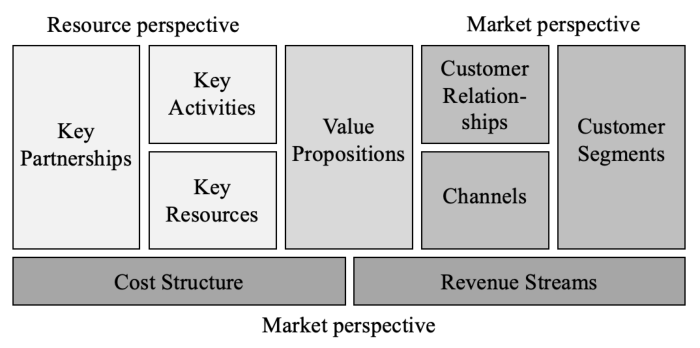
Building on this socio-technical understanding of sustainable business models, the Business Model Canvas serves as a foundational reference point, as it provides a widely accepted and structured representation of how organizations create and capture value. As a widely used frameworks in business model research, it conceptualizes value creation through the alignment of value propositions, market-facing elements, internal resources and activities, and financial structures (Osterwalder & Pigneur, 2011).
Mapping Sustainability: Developing a Socio-Technical Matrix 173 Despite its theoretical indispensability, the Business Model Canvas lacks an explicit sustainability orientation and therefore requires extension to adequately capture ecological and social dimensions, particularly in the context of circular economy and sustainable business models.
Figure 1: Business model canvas. (illustration based on Osterwalder & Pigneur, 2011).
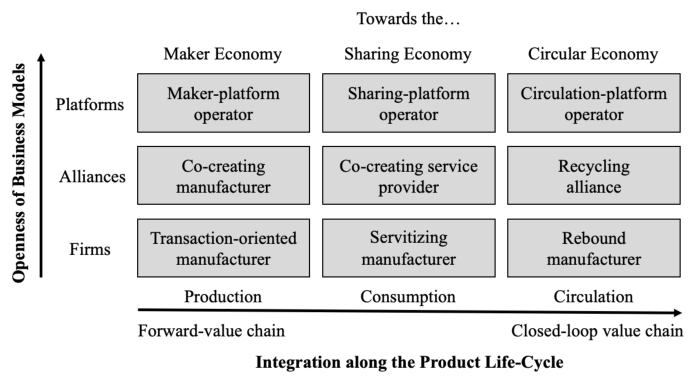
The Nine Archetypes of Business Models incorporating the entire product life cycle and varying degrees of collaboration with external partners. The framework is structured along the dimensions Integration along the product life cycle and Openness of Business Models. Their combination results in nine archetypal configurations that illustrate different ways of organizing and capturing value across increasingly open and circular business models. (Kortmann & Piller, 2016).
Figure 2: Open business models in extended product life cycles. (illustration based on Kortmann & Piller, 2016).
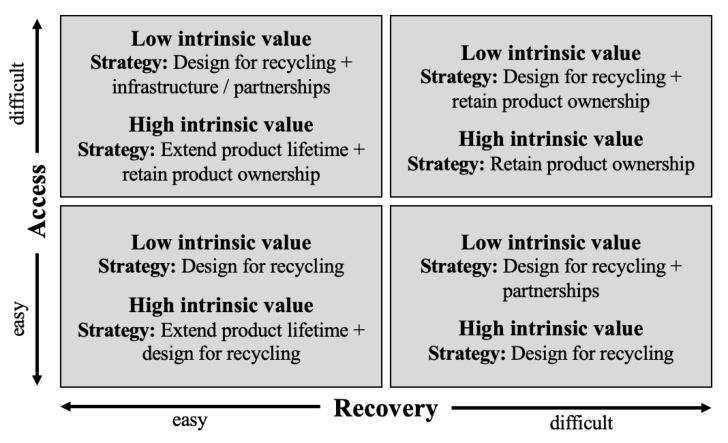
174 Wittenzellner and Wollert The Circularity Matrix by Atasu et al. (2021) approaches circular business model design from a strategic perspective, focusing on how firms align circular strategies with their resources, capabilities, and competitive conditions. The authors identify three fundamental circular strategies and develop the Circularity Matrix, which classifies business models along two dimensions: product access and ease of recovery. By combining these dimensions with the product’s intrinsic value, the matrix links different product characteristics to appropriate circular strategies. Depending on combinations of access, recovery complexity, and intrinsic product value, the matrix indicates whether firms should retain product ownership, extend product lifetimes, design for recycling, or combine these strategies (Atasu et al. (2021), as cited in Kraft et al. (2022)).
Figure 3: Circularity matrix. (own illustration based on Atasu et al. (2021), as cited in Kraft et al. (2022).
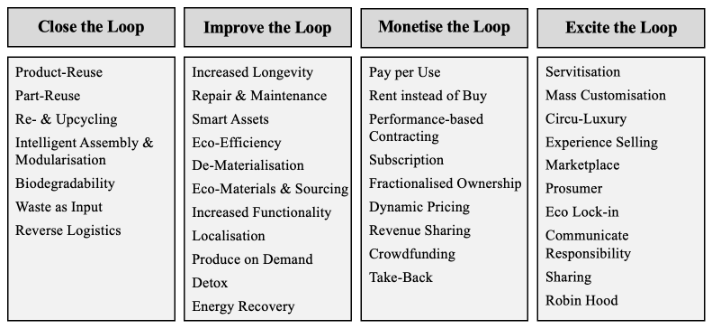
The Circular Ecosystem Patterns by Takacs et al. (2020) distinguishes four pattern groups that support the development of circular business ecosystems. Close the Loop comprises patterns that enable the recovery of products, components, or materials. Improve the Loop focuses on enhancing environmental performance through design and process innovations. Monetise the Loop addresses patterns that allow firms to capture economic value from circular solutions by decoupling revenue generation from material consumption. Excite the Loop emphasizes user- oriented patterns that promote engagement, awareness, and long-term customer relationships by creating additional value beyond sustainability aspects (Takacs et al., 2020).
Figure 4: Circular ecosystem patterns. (Illustration based on Takacs et al., 2020).
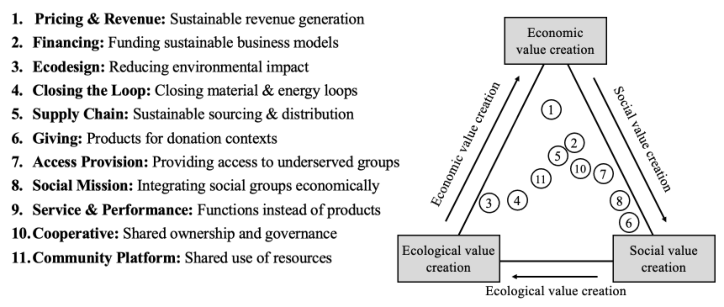
The Sustainable Business Model Design by Lüdeke-Freund, et al. (2020) conceptualizes sustainable business models as combinations of design patterns that jointly create ecological, social, and economic value. It comprises 45 business model patterns, organized into 11 pattern groups, which address key challenges in sustainability-oriented business model innovation. The patterns function as modular building blocks that can be flexibly combined to form context-specific business model configurations. A central element of the framework is the Pattern Triangle, which positions pattern groups and individual patterns according to their dominant contribution to ecological, social, and economic value creation. Their spatial arrangement highlights trade-offs and synergies between sustainability dimensions and supports informed pattern selection. (Lüdeke-Freund, et al., 2020).
Figure 5: Sustainable Business Model Design. (Illustration based on Lüdeke-Freund, et al., 2020).
Taken together, the reviewed frameworks vary systematically in how they define system boundaries, locate drivers of change, and conceptualize the role of actors, which provides the analytical foundation for the criteria applied in the subsequent analysis.
ANALYTICAL APPROACH The analysis applies a criteria-based qualitative evaluation focused on dimensions directly relevant to the derivation of the proposed socio-technical classification matrix. (1) The socio-technical system scope examines how each framework defines system boundaries, levels of abstraction, and lifecycle coverage, including the extent to which dynamic interactions across technological and social elements are represented. (2) Innovation drivers and orientation assess the primary sources of change, distinguishing between internally and externally driven innovation as well as between technology- and market/user-oriented approaches to value creation. (3) The integration of sustainability dimensions analyzes how ecological, economic, and social aspects are explicitly or implicitly addressed within each framework. (4) The role of human actors and stakeholders examines how users, partners, and other actors are conceptualized within value creation processes, including assumptions about behavior, participation, and agency.
The qualitative synthesis of these four criteria forms the basis for deriving both the two dimensions and the four quadrants of the proposed socio- technical classification matrix. While the Business Model Canvas serves as a conceptual baseline in the theoretical background, it is not included in the comparative evaluation, as it does not provide an explicit sustainability orientation.
RESULTS
The Open Business Models in Extended Product Life Cycles framework by Kortmann and Piller (2016) adopts a broad socio-technical scope across firm, value chain, and ecosystem levels, explicitly incorporating product lifecycles and circular transitions (1). Innovation is both internally and externally driven, combining technological interventions with market- and service-oriented logics (2). Ecological and economic sustainability are well integrated, while social sustainability remains implicit (3). Human actors and stakeholders are not explicitly addressed and remain implicit within functional value creation roles (4).
The Circularity Matrix by Atasu et al. (2021) focuses narrowly on the product lifecycle, with limited consideration of organizational and ecosystem dynamics (1). Innovation is primarily externally driven and technology- oriented, responding to regulatory and market constraints (2). Ecological sustainability is strongly embedded, economic sustainability is moderately addressed, and social sustainability is largely absent (3). Human actors are not explicitly conceptualized; they remain implicit as users or organizational actors within product access and recovery systems (4).
The Circular Ecosystem framework by Takács et al. adopts a broad ecosystem-level socio-technical scope, integrating firms, users, and infrastructures (1). Innovation spans internal and external drivers and combines technological, operational, market, and user-oriented mechanisms (2). Ecological and economic sustainability are explicit, while social sustainability is addressed mainly indirectly through user engagement (3). Human actors
Mapping Sustainability: Developing a Socio-Technical Matrix 177 are prominently featured as active participants in circular value creation, primarily through user engagement and participation mechanisms (4).
The Sustainable Business Model Design framework by Lüdeke-Freund et al. (2020) conceptualizes sustainable business models as modular socio-technical configurations spanning organizational, technological, market, and societal elements (1). Innovation is highly integrative, encompassing a wide range of technology-, operation-, and market-oriented patterns (2). All three sustainability dimensions are explicitly embedded and systematically related through the Pattern Triangle (3). Human actors are incorporated as elements of value creation, governance, and societal impact, although the framework’s breadth may limit its suitability for concise classification (4).
MATRIX DEVELOPMENT Building on the qualitative evaluation of the reviewed frameworks, the axes and quadrants of the proposed matrix are derived from recurring structural and conceptual patterns across the analyzed models. The criteria- based analysis identifies two cross-cutting distinctions: whether sustainable business model innovation is primarily driven by internal organizational design choices or by external market, regulatory, and ecosystem conditions, and whether innovation mainly targets technological and operational system components or market-facing and user-oriented value creation logics. Other differences, such as the degree of sustainability integration or the role of human actors, do not constitute independent classification dimensions but but are observed to co-vary systematically with specific combinations of these two distinctions. Accordingly, sustainability outcomes and actor configurations are treated as consequences of socio-technical change patterns rather than autonomous dimensions, supporting the analytical clarity of the proposed socio-technical classification matrix.
Derivation of the Axes Axis 1: Primary Driver of Change (Internal vs. External): The first axis distinguishes between business model change driven by internal firm- level levers such as resource configuration, design, and process decisions, and change driven by external conditions including stakeholder demands, market and societal developments, regulation, collaboration structures, and infrastructure. This distinction is reflected across the reviewed frameworks. Across the reviewed literature, business model innovation is conceptualized as being driven either by internally controllable firm-level design choices or by conditions shaped through external actors and system contexts. Kortmann and Piller (2016) describe a continuum from firm-centric configurations toward alliance- and platform-based models in which value creation increasingly depends on external partners. Similarly, Takacs et al. (2020) frame circular business model innovation as an ecosystem-level phenomenon that requires coordination across multiple organizations. The Sustainable Business Model Design framework further distinguishes internally configurable design
178 Wittenzellner and Wollert patterns from those that rely on stakeholder integration and shared value creation (Lüdeke-Freund et al., 2020). Atasu et al. (2021) reinforce this distinction by linking circular strategies to externally given infrastructural and regulatory conditions.
Axis 2: Orientation of Change (Technology/Operational vs. Market/User- Oriented) captures whether sustainable business model innovation primarily targets technological and operational system components such as product design, materials, processes, and reverse logistics or market-facing and user- related elements including value propositions, usage models, service design, monetization mechanisms, and user relationships. The reviewed frameworks consistently differentiate sustainable business model innovation according to its primary orientation toward technological and operational systems or toward market-facing and user-related elements. Atasu et al. (2021) emphasize strategies centered on product design, recovery processes, and operational feasibility, while Takacs et al. (2020) contrast technically oriented circular mechanisms with approaches focused on user engagement and value propositions. This distinction is further reflected in the SBMD framework, which differentiates technology- and operation-focused configurations from market-, service-, and access-oriented patterns (Lüdeke-Freund et al., 2020). Kortmann and Piller (2016) similarly distinguish lifecycle-oriented models from usage- and service-oriented business models.
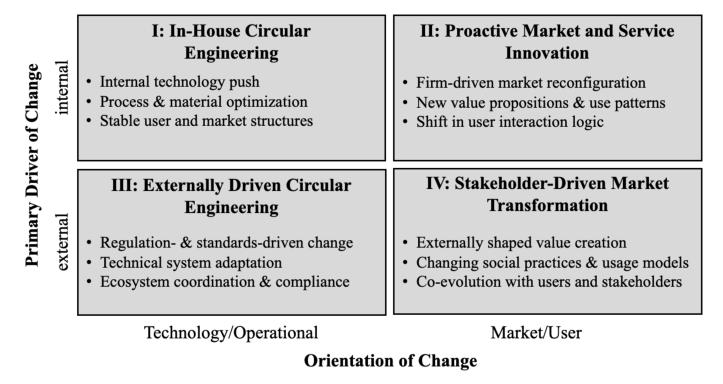
Figure 6: Socio-Technical matrix for the classification of sustainable business models.
The Four Quadrants Quadrant I (In-House Circular Engineering) captures sustainable business model innovations driven by internal organizational decisions and focused on technological and operational change. These models emphasize in-house design, process optimization, and material efficiency through ecodesign, efficiency improvements, and closed-loop engineering. From a socio-technical perspective, sustainability is embedded through technical system redesign,
Mapping Sustainability: Developing a Socio-Technical Matrix 179 while social elements, including user practices and stakeholder interactions, remain largely stable and are only indirectly affected. Innovation follows a technology-push logic, with alignment to the social context occurring mainly through gradual adaptation rather than deliberate reconfiguration.
Quadrant II (Proactive Market and Service Innovation) represents sustainable business model innovations that are internally initiated but primarily target market-facing and user-related elements. Sustainability- driven change arises from deliberate internal decisions to redesign value propositions, service concepts, and revenue models, thereby reshaping patterns of use, ownership, and customer interaction. In socio-technical terms, these models reconfigure the social system of exchange and consumption while largely relying on existing technological infrastructures. The technical system remains stable, but its role and meaning are transformed through human-centered design choices.
Quadrant III (Externally Driven Circular Engineering) captures sustainable business model innovations in which technological and operational change is triggered by external socio-institutional conditions such as regulation, market standards, or recovery infrastructures. Circular strategies are adopted as responses to external constraints, requiring firms to adapt their technical systems to broader regulatory, infrastructural, or ecosystem requirements. From a socio-technical perspective, innovation reflects adaptation to externally defined system conditions, with technological change shaped by coordination with public authorities, partners, and infrastructures, while social dynamics primarily define boundary conditions for feasibility and compliance.
Quadrant IV (Stakeholder-Driven Market Transformation) represents sustainable business model innovations in which market-facing change is shaped by external stakeholders, societal expectations, and collective dynamics. Sustainability-oriented transformation emerges through shifts in value propositions, access models, and usage practices driven by users, communities, and socio-cultural trends rather than firm-internal strategy alone. In socio-technical terms, these models emphasize the co-evolution of social practices and business logic, with users and stakeholder groups acting as active contributors to system change. Technological elements play a supporting role, while participation, collaboration, and social diffusion are central to scaling and stabilizing sustainable business models within broader ecosystems.
CONCLUSION
This paper set out to address the conceptual fragmentation of sustainable and circular business model frameworks by developing a socio-technical classification matrix that enables systematic comparison and analysis. Building on a qualitative review of established frameworks from business model and circular economy research, the study demonstrates that differences between these approaches can be consistently traced back to two cross-cutting distinctions: whether innovation is primarily driven by internal organizational design choices or by external socio-institutional conditions, and whether change targets technological–operational systems or market- and user-oriented value creation logics. Grounded in socio-technical
180 Wittenzellner and Wollert systems theory (Mumford, 2000; Pasmore, 1995) and the co-evolutionary perspective on transitions (Geels, 2004), the proposed matrix conceptualizes sustainable business models as dynamic configurations in which technical systems, human actors, and contextual forces interact. By operationalizing these interactions, the matrix provides a theoretically grounded structure that captures coordination requirements, actor involvement, and transformation potential across different business model types. Rather than replacing existing frameworks, the matrix offers a unifying interpretive lens that situates these models within a shared socio-technical space. This enhances their comparability and clarifies why certain business models function as incremental optimizations, while others act as leverage points for broader socio-technical transitions, in line with the roles of business models identified by Bidmon and Knab (2014). Overall, the contribution of this paper lies in translating abstract socio-technical theory into a practically applicable classification tool for sustainable business model research. The matrix supports analytical clarity and structured reflection on innovation pathways in sustainability contexts. Future research should empirically apply and refine the matrix through comparative case studies and longitudinal analyses to assess its explanatory power and relevance for managing transitions toward more sustainable patterns of production and consumption.
REFERENCES
Amit, R., & Zott, C. (2010). Business model innovation: Creating value in times of change. Bidmon, C. & Knab, S. (2014) The Three Roles of Business Models for Socio-technical
Transitions, in: Huizingh, K.; Conn, S.; Torkkeli, M. & Bitran, I. (Eds.): The Proceedings of XXV ISPIM Conference – Innovation for Sustainable Economy and Society, 8–11 June 2014, Dublin, Ireland. Bocken, N. M., Short, S. W., Rana, P., & Evans, S. (2014). A literature and practice review to develop sustainable business model archetypes. Journal of cleaner production, 65, 42–56. Geels, F. W. (2004). From sectoral systems of innovation to socio-technical systems:
Insights about dynamics and change from sociology and institutional theory. Research policy, 33(6–7), 897–920. Kortmann, S., & Piller, F. (2016). Open business models and closed-loop value chains: Redefining the firm consumer relationship. California Management Review, 58(3), 88–108. https://doi.org/10.1525/cmr.2016.58.3.88. Kraft, M. H. G., Christ, O., & Scherer, L. (2022). Management der Kreislaufwirtschaft.
Springer Fachmedien Wiesbaden. https://doi. org/10.1007/978-3-658-39225-3. Lüdeke-Freund, F., Breuer, H., & Massa, L. (2020). Sustainable business model design. In Workshop Thursday (Vol. 14, pp. 1–15). Mumford, E. (2000). A socio-technical approach to systems design. Requirements
engineering, 5(2), 125–133. Nosratabadi, S., Mosavi, A., Shamshirband, S., Kazimieras Zavadskas, E., Rakotonirainy, A., & Chau, K. W. (2019). Sustainable Business Models: A Review. Sustainability, 11(6), 1663. https://doi.org/10.3390/su11061663 Osterwalder, A., & Pigneur, Y. (2011). Business Model Generation: Ein Handbuch
für Visionäre, Spielveränderer und Herausforderer. Campus Verlag.
Mapping Sustainability: Developing a Socio-Technical Matrix 181 Pasmore, W. A. (1995). Social science transformed: the socio-technical
perspective. Human relations, 48(1), 1–21. Scacchi, W. (2004). Socio-technical design. The encyclopedia of human-computer interaction, 1, 656–659. Takacs, F., Frankenberger, K., & Stechow, R. (2020). Circular ecosystems: business
model innovation for the circular economy.
LISTED IN THE AHFE DIGITAL BOOKSTORE CATALOGUE
Explore the complete digital volume
Human Factors, Business Management and Society
Read this individual research paper free through the original publisher, or explore the full digital proceedings book.
ISBN 978-1-964867-91-5
Explore this ISBN in the AHFE Bookstore ↗Listed in the July 2026 bookstore catalogue; search by ISBN to confirm current availability · Digital book purchase optional