Chenhui Yang, Yanli Huang (2026). AI-driven art therapy: A domestic interactive platform for children with high-functioning autism. In: Human Factors in Aging and Special Needs. AHFE Open Access, vol. 214, pp. 73–84. https://doi.org/10.54941/ahfe1007575
Art therapy is widely applied in interventions for children with autism to promote emotional regulation and communication, yet it remains challenging to implement within daily home environments. Parent-Child Interactive Therapy (PCIT) and generative artificial intelligence (AI) technology offer new pathways for delivering art-based healing within family settings. This study aims to develop a home-based interactive platform integrating art therapy, PCIT, and generative AI technology for children with high-functioning autism (HFA).This study employs Design Science Research. First, semi-structured interviews with parents and experts of HFA children were conducted to analyze their interaction patterns and identify pain points. Design strategies were then formulated based on PCIT's core principles, leading to the development of a product prototype and initial testing. Iterative refinements based on feedback resulted in the final product, which underwent evaluation.The design features an integrated interactive platform that combines art creation, AI story generation, and parent-child interaction prompts, comprising a drawing tablet and app. Children create artwork on the tablet surface, which AI analyzes to generate corresponding stories presented to users. During this interaction, the product guides parents via prompts displayed on their app, encouraging them to respond to and guide their child's creations. This extends human-machine interaction into high-quality parent-child engagement.The study confirmed the feasibility of integrating PCIT, AI technology, and art therapy within home settings. Preliminary evidence indicates this prototype reduces parental guidance pressure while effectively enhancing parent-child interaction quality. It offers innovative insights for traditional art therapy and provides a viable model for AI technology to strengthen human emotional connections.
Autism Spectrum Disorder (ASD) is a neurodevelopmental disorder characterized by core deficits in social communication and restricted, repetitive motor behaviors. It exhibits significant heterogeneity and often requires lifelong support, though functional improvements may occur in some individuals with intervention (Lord et al., 2024). Within the spectrum, High-Functioning Autism (HFA) represents a distinct subtype. Individuals typically possess near- or above-average intellectual and language abilities
74 Yang and Huang (Gillberg, 1998), yet struggle with emotional expression and recognition, making normal communication and social relationship-building challenging (Stichter et al., 2012). Parents of HFA children face multifaceted pressures due to their children’s social skill deficits and inappropriate behavioral traits (Bundy & Kunce, 2009). For HFA children, addressing emotional challenges and facilitating integration into typical social life is crucial.
Art therapy is recognized as an effective therapeutic and intervention tool for children with autism and is now widely applied in autism intervention. However, traditional art therapy interventions heavily rely on specialized therapists and dedicated treatment settings, making them impractical for daily family life and unable to meet routine home-based intervention needs. Parent- Child Interaction Therapy (PCIT) improves parent-child relationships and interaction patterns by guiding parent-child interactions, thereby reducing parenting stress (Thomas et al., 2017). Integrating its core principles with art therapy offers new perspectives for applying art-based healing in home settings. Advances in artificial intelligence (AI) have led to the widespread application of generative AI in educational and rehabilitation contexts (Mennella et al. 2023., Zhai et al., 2021), providing technical support for integrating PCIT-guided individualized instruction with art therapy within home settings.
Based on this, this paper aims to explore how AI technology can be leveraged in home contexts to fuse art therapy principles with PCIT concepts into a usable interactive prototype, thereby supporting therapeutic interventions for HFA children.
RELATED RESEARCH Art Therapy for ASD
Art therapy has established a solid theoretical and practical foundation in ASD intervention, aiding individuals in regulating emotions, expressing experiences, and enhancing parent-child activities to support the development of normal social relationships (Vogel et al., 2025). Melinda J. Emer employed art therapy through painting with an ASD boy, helping him reduce anxiety, learn to interact with others, and simultaneously develop language and social skills (Emery, 2004). For HFA children facing challenges in language and social communication, artistic creation offers a relatively safe and accessible “alternative language.” This allows them to bypass direct verbal exchange for emotional release and self-expression (Vogel et al., 2025).
Social story interventions can also serve as social and emotional support measures for HFA children. These involve designing short stories specifically for children with ASD to help them understand social scenarios, improve behaviors, or enhance social skills (Kokina & Kern, 2010).
While these interventions have demonstrated efficacy in treating children with ASD in prior studies, they are predominantly therapist-led in specialized settings. Implementing them effectively in home environments poses significant challenges for families without professional guidance, as parents
AI-Driven Art Therapy 75 often struggle to guide or interpret their child’s creative expressions. How to deliver effective art therapy within the home setting remains a critical issue.
Parent-Child Interaction Therapy Parent-Child Interaction Therapy (PCIT) is a behavior-oriented parent-child training intervention. Through real-time therapist coaching, it enhances parental parenting skills and reinforces positive interactions with children. This reduces children’s externalizing behaviors, alleviates parental stress, and repairs parent-child relationships(Thomas et al., 2017). PCIT is also applied in ASD intervention, effectively improving children’s compliance, reducing disruptive behaviors, and showing some improvement in social skills (Masse et al., 2016).
PCIT centers on a two-phase progressive intervention: (1) Child-Directed Interaction (CDI) phase employs descriptive comments and modeling to enhance children’s self-esteem and compliance. (2) Parent-Directed Interaction (PDI) phase uses clear, consistent commands and consequences to establish rules, achieving the dual goals of reducing externalizing behaviors and repairing parent-child relationships. During the CDI phase, therapists train parents to employ “CDI Do skills” such as behavioral descriptions and labeling praise, while reducing “CDI Don’t skills” like directives and criticism. This fosters positive parent-child relationships and builds mutual trust. In the PDI phase, therapists teach parents to issue “clear, specific instructions” and enforce “agreed-upon consequences,” equipping them with behavioral management skills and enhancing children’s compliance with reasonable directives (McNeil & Hembree-Kigin, 2010).
However, PCIT requires therapists to provide real-time guidance, making it equally inaccessible for ordinary families. Furthermore, PCIT’s interactive training typically focuses on play and daily instruction scenarios. How to embed its principles into art therapy—a treatment approach for children with ASD—remains an under-explored area.
Applications of Generative Artificial Intelligence Generative AI is a deep learning-based paradigm that uses probabilistic models to learn data distributions and generate novel synthetic content consistent with the original data’s statistical features (Feuerriegel et al., 2024). Generative AI has found applications in special education, aiding in meeting socio-emotional needs through diverse content formats and assistive technology adaptations for special learners (Huang et al., 2025).
Generative AI offers promising solutions for ASD interventions by delivering personalized services tailored to individual differences (Sohn et al., 2025). Tang Yilin designed EmoEden, an emotional learning tool applying generative AI to HFA children, training them to effectively recognize and express emotions through personalized dialogues (Tang et al., 2024). Lyu et al. developed EMooly, a tablet game integrating generative AI with augmented reality, encouraging parental engagement in interactive activities to enhance social-emotional learning in children with ASD (Lyu et al., 2024).
76 Yang and Huang These studies demonstrate that generative AI can yield positive outcomes in ASD intervention, serving as a therapeutic adjunct. However, deeper exploration remains warranted on how to integrate it with art therapy and PCIT principles to systematically enhance parent-child interaction quality.
RESEARCH METHODOLOGY Design Science Research Methodology
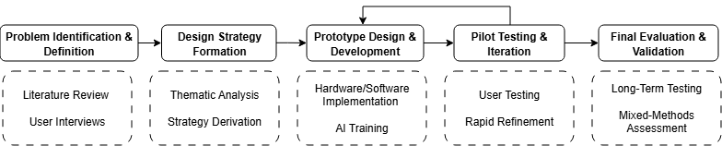
This study employs Design Science Research (DSR) as its core research paradigm, aiming to create and validate a home-based interactive platform integrating AI-generated technology with PCIT methodology through iterative design and evaluation. DSR is a research paradigm centered on solving real-world problems (Vom Brocke et al., 2020). This study follows the design science research process model proposed by Peffers et al. (Peffers et al., 2007), with moderate adjustments made to the workflow based on the research content to ensure rigor and practicality (see Figure 1).
Figure 1: Research process flowchart.
Research Process Phase 1: Through reviewing relevant literature, we systematically examined the application of art therapy, PCIT, and generative AI in interventions for children with autism, identifying key design elements. Semi-structured interviews were conducted with 8 parents of children aged 6–12 with HFA from a specialized treatment center and 5 experts in related fields to summarize pain points in parent-child interactions and design opportunities within art therapy.
Phase 2: Thematic analysis of interview transcripts identified user needs and design opportunities. Design strategies were derived based on art therapy and PCIT principles. These concepts were further discussed with experts to finalize the preliminary product design.
Phase 3: Design and develop an intelligent interactive platform comprising a smart therapeutic drawing table and a parent-facing app. The research implemented an AI-based story and prompt generation engine. This engine integrates image recognition and natural language generation capabilities, taking children’s visual creations as input to output narrative content aligned with their artwork and PCIT interaction suggestions. Experts evaluated these outputs to ensure they align with the cognitive level of HFA children and do not cause distress.
AI-Driven Art Therapy 77 Phase 4: Three HFA children and their parents participated in a 5-day trial for product optimization and iteration. Usage patterns of HFA children and parents were documented. Post-use, parents completed questionnaires and semi-structured interviews, while expert feedback was also solicited. Based on feedback, product improvements were implemented, including adjusting AI generation speed, story length, and optimizing app interface design.
Phase 5: Finally, the eight HFA families initially interviewed were invited for a two-week product trial. Post-testing interviews and questionnaires validated product effectiveness and informed research conclusions.
DESIGN STRATEGY AND RESEARCH PROCESS To explore design opportunities for children’s art therapy products and users’ perceptions of AI, the study recruited eight families of HFA children and relevant domain experts for semi-structured interviews (see Table 1). All participating HFA children possessed normal intellectual and language abilities.
Table 1: Interview participant information Experts Participating in Interviews
Table available in the original PDF paper.
Code Age Gender Field of Study E01 35 Female Art Therapy
E02 32 Male Art Therapy E03 45 Female Art Therapy
E04 38 Female Psychotherapy E05 40 Male Psychotherapy
Households Participating in Interviews Code Child’s age Child’s Gender
A01 10 Female A02 9 Male
A03 7 Male A04 12 Female
A05 11 Male A06 8 Male
A07 9 Male A08 10 Female
Theme Analysis Through systematic coding and analysis of eight parent interview transcripts, the following core themes were identified (see Table 2).
Table 2: Transcript theme coding table.
Table available in the original PDF paper.
Theme Subtheme Sample Quote A1: Outlets for Emotions and Self-Expression A: Art Therapy in the Family Context
“Painting helped her become the narrator of her own story.” A01 “Art therapy makes emotions observable.” E04 “ We sometimes discuss his paintings.” A02 “Art therapy provides an emotional foundation for social cognitive training.” E05
A2: The Bridge Between Social-Emotional Cognition and Development A3: Facing Uncertainty of Outcomes and Resource Constraints
“Our county lacks professional resources. We have to consider transportation costs and lesson fees every time we come to the city.” A06 “Cost-effectiveness became my main hesitation later on.” A03
B1: Intrusive Anxiety and Over-Guidance
B: Core Conflicts in Parent-Child Interaction
“I struggle to find the right approach—I’m afraid one wrong word could ruin everything.” A01 “Parents commonly face ‘anxiety-driven over- guidance’.” E02 “ I want to help him, but I just can’t give him pure support.” A03
B2: The Dilemma of “Guiding” and “Following” B3: Parents Trapped in Their Own Anxiety and Expectations
“Ask too superficially... she feels it’s dismissive; ask too deeply... it makes her anxious.” A01 “Interactions often cycle through ‘reasoning → refusal → threats → breakdown.’” E04
C1: Anticipation and affirmation
“If we turned his drawings into a story, he’d probably be completely engrossed.” A06
C: Ambivalent Attitudes Toward AI C2: Concerns about misinterpretation of content
“What I fear most is AI misinterpretation.” A01 “AI can’t grasp those nonverbal cues.” E01
D1: Safe, Reliable, and Stress-Free Creation
D: Experience- Driven Design in Product Development
“ It is best to avoid unnecessary distractions.” A01 “Create a creative environment free from evaluation and preconceptions, emphasizing the experience of the process.” E01
D2: A Medium for Fostering Positive Relationships and Family Collaboration
“We envision it as shared, relaxed family time—like reading together.” A04 “The point isn’t what you draw, but feeling connected to family.” E03
D3: Simple and easy to operate
“It must be simple—I can’t handle overly complex things.” A06
AI-Driven Art Therapy 79 The core findings can be summarized as follows: Families primarily view art therapy as a safe emotional outlet for children and a potential bridge for social learning. However, they commonly face challenges such as uncertain effectiveness, resource scarcity, and parents experiencing anxiety during interactions, leading to either “over-guidance” or “feeling overwhelmed.” In response, parents express hope that AI-assisted tools could serve as bridges for emotional expression and social cognition. Yet underlying this is a profound concern about potential content misinterpretation, emotional misdirection, and the risk of weakening authentic parent-child bonds.
Design Strategy Based on the above interview content and previous literature on art therapy and PCIT principles, the following product design guidelines can be distilled to provide direction for product development.
Safeguarding Children’s Artistic Expression: Both AI and parent-child interactions should serve children’s artistic creation. Guided by PCIT principles, parents should act as “observers” and ‘empathizers’ during interactions, not “controllers.” Experts indicate that “AI can process information and generate responses, but cannot understand ‘emotion’” (E03). Therefore, the focus of parent-AI interaction should be on accurately describing and conveying the child’s expressions to provide an absolutely safe, non-judgmental, creative environment.
Parent-Child Relationship at the Core: All product features must serve the parent-child relationship, not replace or weaken it. The core of art therapy lies in “authentic interpersonal relationships” (E01), particularly parent-child bonds. Technology or products should be supplementary, not substitutes. Parents require control and security assurances, while children’s creative expression demands an uninterrupted, immersive space (E01). The product should adopt a dual-user design with separate child and parent interfaces, offering parents moderate, non-intrusive structured support.
Personalized AI Support: Parents’ primary concern regarding AI-generated content is its unpredictability and suitability for children (A01, A06). Successful intervention hinges on personalized AI adaptation— generated content must align with the child’s creative output, interests, and comprehension level.
Adaptability to Everyday Family Settings: Parents consistently expressed a desire for natural, seamless interactions (A04). Experts recommend “fostering a sense of connection through creation” (E03) and suggest incorporating positive interactions and collaborative creation (E02). Design should prioritize relaxed family interactions rather than introducing additional stressful tasks.
PRODUCT INTRODUCTION
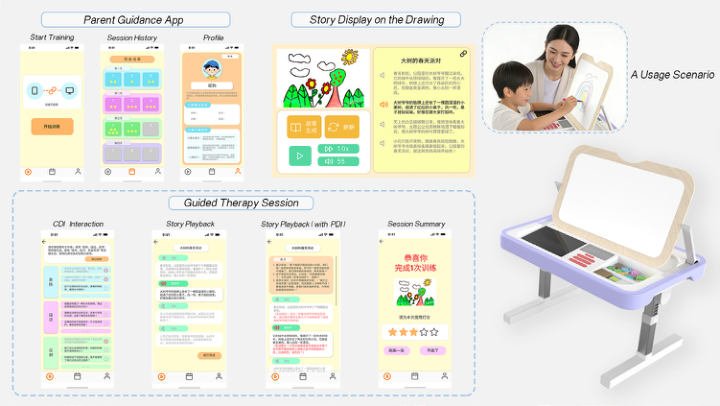
Figure 2: Drawing table and parent app introduction diagram.
Drawing Table The drawing table serves as an operational platform for children’s artistic creation. Its appropriately sized, height-adjustable design accommodates children aged 6 to 12, making it suitable for various home settings. The tabletop features a reversible panel: one side boasts a wood-grain finish. When this side faces up, the table functions as a standard desk for daily writing and reading activities. The other side is a whiteboard for drawing and doodling. When flipped and propped upright on the table, children can create artwork on the panel. Hidden cameras beneath the panel scan the artwork, which is then analyzed by an AI model to generate stories. When the panel is flipped, a smart interactive zone and storage area are revealed beneath the tabletop. The interactive zone features a display screen showing the AI-generated story’s interface, where children can view scanned drawings and the generated narrative. The storage area includes compartments for organizing items like art supplies.
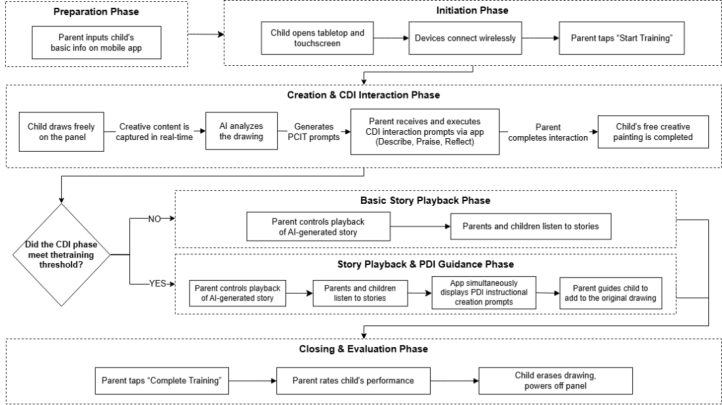
Parent App The parent app design comprises three sections: Training Interface, History, and Personal Information. It facilitates parent-child interaction through prompts while children engage in artistic creation. When children draw at the drawing table, parents receive interactive prompts via the app’s Training Interface. After device connection, entering the Training Interface enables the app to receive real-time scans of children’s artwork. Utilizing AI models, it generates instant parent-child interaction prompts, categorized into CDI and PDI phases.
During the CDI phase, the app interface displays AI-generated “CDI Do” prompts categorized as “Describe,” “Praise,” and “Reflect” for real-time
AI-Driven Art Therapy 81 engagement with the child’s artwork. It simultaneously highlights prohibited “CDI Don’t” prompts. Parents use these prompts to guide the child’s creation with “CDI Do” techniques (e.g., ‘Describe’: “ You’re drawing a cute little red flower.”) After completing the interaction, parents check the prompt on the page, and the system automatically updates to the next prompt. Once the child finishes independent creation, the story playback phase begins.
During story playback, the AI generates a corresponding story based on the child’s creation, displayed on both the tablet touchscreen and the parent app. Parents can control the playback of each story segment. If the parent-child interaction during the CDI phase meets the PDI phase standard, additional story-based prompts will appear below each segment in the parent app. For example, if the story mentions “a red flower bloomed on the tree,” a prompt like “Is one flower enough? Shall we draw one more?”), prompting parents to guide children in expanding upon their original creations. After completing this stage, parents can rate the session.
In the History and Personal Information module, parents can view session histories on their phones, including post-training ratings. Based on the child’s basic information and interests from the Personal Information page, the AI generates more personalized stories, which parents can modify and review at any time.
Figure 3: Usage flowchart.
DESIGN EVALUATION Finally, eight families with HFA children participated in a two-week pilot program to evaluate the product’s feasibility. Following the trial period, parents completed a five-point Likert scale survey comprising four modules. The number of questions (N), mean scores (M), and standard deviations (SD) are presented in Tables 3 and 4.
Table 3: Questionnaire modules and scoring results.
Table available in the original PDF paper.
N M SD Product Functionality Effectiveness 7 4.07 0.71
The overall questionnaire score was 4 or 5 points, with the highest score in the experience satisfaction module (M = 4.40). Specifically, questions Q8 and Q11 regarding children’s satisfaction achieved the highest scores (M = 4.63), indicating user satisfaction with the overall product experience. Concurrently, product functionality (M = 4.07) and therapeutic efficacy (M = 4.20) received recognition. Parents acknowledged the product’s potential value and demonstrated a high willingness to continue using it, indicating successful fundamental product design.
Parent-child interaction showed improvement but faced challenges (M = 3.68). This module’s relatively low average score and large standard deviation (0.89) indicate difficulties in prompting instruction guidance and social facilitation. Specifically, items directly related to interaction effectiveness—Q15 (M = 3.25) and Q17 (M = 3.13)—scored relatively low, suggesting the product’s effectiveness in promoting deep social engagement and command compliance may be limited or variable. Q17 (M = 3.13) scored relatively low, suggesting the product may have limited or variable effectiveness in fostering deep social engagement and command compliance.
CONCLUSION
This study systematically analyzed and explored the potential integration of PCIT principles into art therapy products. Through user research, thematic analysis of needs, and other methodologies, we designed a low-threshold family art therapy interactive platform comprising a painting table and parent-end app. The design effectively enhances parent-child interaction quality, regulates the emotions of HFA children, and simultaneously alleviates parental stress.
The study also has limitations, such as a small sample size, fixed participants, and the absence of a control group and long-term follow-up
AI-Driven Art Therapy 83 data, resulting in a lack of randomization and generalizability. The evaluation primarily relied on parents’ subjective reports, potentially introducing social desirability bias and lacking objective data support. Future research could expand the sample size, conduct randomized controlled trials, and perform long-term effectiveness assessments.
This study expands upon existing art therapy intervention methods. By integrating generative AI technology with the parent-child interaction approach from traditional PCIT, it explores novel pathways for incorporating art therapy into family settings, providing a viable model for how AI technology can enhance human emotional connections.
REFERENCES
Bundy, M. B., & Kunce, L. J. (2009). Parenting stress and high functioning children with autism. International Journal on Disability and Human Development, 8(4). Emery, M. J. (2004). Art therapy as an intervention for autism. Art Therapy, 21(3),
Business & Information Systems Engineering, 66(1), 111–126. Gillberg, C. (1998). Asperger syndrome and high-functioning autism. The British Journal of Psychiatry, 172(3), 200–209. Huang, C.-L., Chang, C.-F., & Fu, S.-W. (2025). On applications and challenges
of artificial intelligence (AI) in education. Taiwan Educational Review Monthly, 14(1), 200–210. Kokina, A., & Kern, L. (2010). Social storyTM interventions for students with autism spectrum disorders: A meta-analysis. Journal of Autism and Developmental Disorders, 40(7), 812–826. Lord, C., Elsabbagh, M., Baird, G., & Veenstra-Vanderweele, J. (2018). Autism
spectrum disorder. The lancet, 392(10146), 508–520. Lyu, Y., Liu, D., An, P., Tong, X., Zhang, H., Katsuragawa, K., & Zhao, J. (2024).
EMooly: Supporting autistic children in collaborative social-emotional learning with caregiver participation through interactive AI-infused and AR activities. Proceedings of the ACM on Interactive, Mobile, Wearable and Ubiquitous Technologies, 8(4), 1–36. Masse, J. J., McNeil, C. B., Wagner, S., & Quetsch, L. B. (2016). Examining the efficacy of parent–child interaction therapy with children on the autism spectrum. Journal of Child and Family Studies, 25(8), 2508–2525. McNeil, C. B., & Hembree-Kigin, T. L. (2010). Parent-child interaction therapy.
Springer US. Mennella, C., Maniscalco, U., De Pietro, G., & Esposito, M. (2023). The role of artificial intelligence in future rehabilitation services: A systematic literature review. IEEE Access, 11, 11024–11043. Peffers, K., Tuunanen, T., Rothenberger, M. A., & Chatterjee, S. (2007). A design
science research methodology for information systems research. Journal of Management Information Systems, 24(3), 45–77. Sohn, J.-S., Lee, E., Kim, J.-J., Oh, H.-K., & Kim, E. (2025). Implementation of generative AI for the assessment and treatment of autism spectrum disorders: A scoping review. Frontiers in Psychiatry, 16, 1628216. Stichter, J. P., O’Connor, K. V., Herzog, M. J., Lierheimer, K., & McGhee, S. D. (2012).
Social competence intervention for elementary students with aspergers syndrome and high functioning autism. Journal of Autism and Developmental Disorders, 42(3), 354–366.
84 Yang and Huang Tang, Y., Chen, L., Chen, Z., Chen, W., Cai, Y., Du, Y., Yang, F., & Sun, L. (2024).
EmoEden: Applying generative artificial intelligence to emotional learning for children with high-function autism. Proceedings of the CHI Conference on Human Factors in Computing Systems, 1–20. Thomas, R., Abell, B., Webb, H. J., Avdagic, E., & Zimmer-Gembeck, M. J. (2017).
Parent-child interaction therapy: A meta-analysis. Pediatrics, 140(3), e20170352. Vogel, S. W., Mullins, K. L., & Kumar, S. (2025). Art therapy for children and adolescents with autism: A systematic review. International Journal of Art Therapy, 30(2), 113–122. Vom Brocke, J., Hevner, A., & Maedche, A. (2020). Introduction to design science
research. In Design science research. Cases (pp. 1–13). Springer. Zhai, X., Chu, X., Chai, C. S., Jong, M. S. Y., Istenic, A., Spector, M., Liu, J.-B., Yuan, J., & Li, Y. (2021). A review of artificial intelligence (AI) in education from 2010 to 2020. Complexity, 2021(1), 8812542.
LISTED IN THE AHFE DIGITAL BOOKSTORE CATALOGUE
Explore the complete digital volume
Human Factors in Aging and Special Needs
Read this individual research paper free through the original publisher, or explore the full digital proceedings book.
ISBN 978-1-964867-90-8
Explore this ISBN in the AHFE Bookstore ↗Listed in the July 2026 bookstore catalogue; search by ISBN to confirm current availability · Digital book purchase optional