Adrián Valledor Pérez, Josefa Gómez Pérez, Elena Alcalde Peñalver, Raquel Lázaro Gutiérrez, Eva Huertas, Abdelhamid Tayebi Tayebi (2026). Evaluating the Acceptance of Computer-Assisted Interpreting Tools Using the Technology Acceptance Model. In: Accessibility, Assistive Technology and Digital Environments. AHFE Open Access, vol. 202, pp. 50–57. https://doi.org/10.54941/ahfe1007296
The adoption of Computer-Assisted Interpreting (CAI) tools among professional interpreters remains relatively limited. Factors such as high cognitive load, time pressure, fragmented workflows, and perceived usability challenges contribute to resistance in professional interpreting settings. This study addresses this gap by proposing the development of an Artificial Intelligence (AI)–enhanced CAI tool, designed through a human-centered methodology and evaluated within a framework based on the Technology Acceptance Model (TAM). Beyond a purely technological approach, the research adopts an ergonomic perspective aimed at understanding how interpreters perceive, adopt, and integrate technological tools into their professional practice. Semi-structured interviews were conducted with interpreters from diverse professional backgrounds, experience levels, and age groups. Guided by the TAM constructs — Perceived Usefulness (PU), Perceived Ease of Use (PEOU), and Behavioural Intention to use (BI) — the study explores participants’ technological competence, current professional needs, expectations regarding CAI tools, and perceived shortcomings of existing solutions. The interviews indicate that, although interpreters generally view technology as a potentially valuable ally, current tools are perceived as lacking in accuracy, reliability, and cognitive ergonomics. A widespread lack of formal training in technological tools further affects confidence and willingness to adopt new systems. Participants emphasized the need for context-sensitive, high-precision solutions capable of real-time transcription, advanced speech recognition, and automatic glossary generation, while consistently underscoring that artificial intelligence should function as support rather than replacement. Finally, an integrated CAI tool is proposed that combines preparation support, in-booth assistance, and pre-task training within a unified environment. Core functionalities include glossary extraction based on Natural Language Processing (NLP), real-time transcription and translation powered by Automatic Speech Recognition (ASR) and Neural Machine Translation (NMT), contextual terminology highlighting, and realistic training simulations using speech technologies.
The growing integration of technology into language mediation has transformed translation workflows; however, the adoption of CAI tools among interpreters remains significantly lower than in the field of translation. Cognitive demands, time pressure, workflow fragmentation, and perceived limitations in usability often hinder their acceptance in professional interpreting contexts. To address this gap, the present study proposes the development of a CAI tool designed through a human-centered methodology and evaluated using an acceptance-based framework grounded in the TAM. The main objective of this study is not solely technological—namely, to create an AI-enhanced interpreting platform—but fundamentally ergonomic: to understand how interpreters perceive, adopt, and integrate technology, and which factors determine acceptance and intention to use.
To this end, a series of interviews has been conducted with different groups of interpreters. Drawing on TAM, participants were asked a set of questions regarding CAI tools and their own level of competence across various technological skills required for their professional practice. These interviews aim to identify key elements that should be emphasized in the implementation of a future CAI tool.
THE TAM AND ITS APPLICATION IN CAI TOOLS FOR INTERPRETERS At this point, it is necessary to discuss the TAM, given that the development of a CAI tool is being proposed. This provides a prior point of reference on which the tool can be defined.
The TAM is one of the most influential theoretical frameworks for explaining how and why individuals adopts new technologies. It was proposed by Fred Davis, (1989) and is based on the Theory of Reasoned Action (Sheppard et al., 1988), specifically adapted to the context of information systems. In summary, its purpose is to predict users’ behavioural intention to use a technology, as well as their actual usage, based on user perceptions.
In the case under consideration, this issue is of particular importance, since in the field of interpreting—and more specifically in simultaneous interpreting—there is a widespread resistance. To understand this resistance, it is necessary to consider the relatively long professional tradition of interpreting, together with the significant cognitive load required to perform this work.
Returning to the TAM framework, the original model proposes that technology acceptance is primarily determined by two cognitive variables:
Perceive Usefulness (PU), defined as the degree to which an individual believes that using a system will enhance their job or personal performance. If users perceive that a technology will help them be more productive, efficient, or effective, they are more likely to accept it (Davis, 1989; Marikyan & Papagiannidis, 2025).
Perceived Ease of Use (PEOU), defined as the degree to which an individual believes that using a technology will require minimal effort. The easier a system is perceived to be, the greater the likelihood that the user will accept it (Davis, 1989).
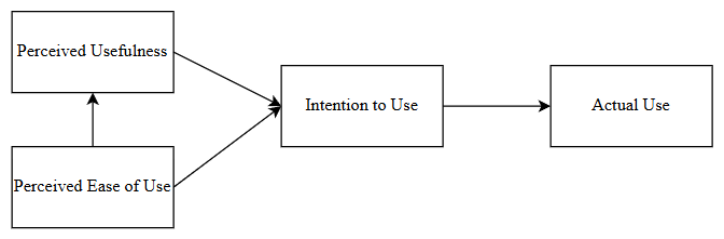
Additionally, although it is not a cognitive belief in the same sense, Behavioural Intention to use (BI) must also be considered (Stengers et al., 2023). BI does not constitute a cognitive belief such as perceived usefulness or perceived ease of use; rather, it represents an intentional or conative cognitive process, as it reflects the individual’s conscious willingness to perform a technology-related behaviour (Davis, 1989; Venkatesh & Davis, 2000). The relationship between these three variables can be seen in Figure 1.
From this perspective, the TAM not only helps interpret potential resistance to the incorporation of CAI tools in the field of interpreting but also serves as a guide for their design. Specifically, maximizing perceived usefulness involves developing a tool that responds to interpreters’ real needs, providing support without increasing the cognitive load associated with their work. Similarly, achieving high perceived ease of use requires an intuitive interface and a short learning curve, thereby avoiding additional attentional overload. Considering PEOU as a precursor to actual use also necessitates considering factors such as trust in the technology, perceived control, and compatibility with existing professional practices.
For all these reasons, TAM does not merely explain technology acceptance; it also informs user-centered design decisions, increasing the likelihood that a CAI tool will be perceived as useful, manageable, and adoptable within the professional environment of interpreting.
Figure 1: Technology acceptance model.
INTERPRETERS AND TECHNOLOGY: NEEDS AND EXPECTATIONS Building on the TAM framework discussed in the previous section, a series of interviews were conducted with interpreters from different professional settings, levels of experience, and age groups. The aim was to obtain expert insight that would help identify the needs to be addressed in the design of the proposed tool.
The interviews were structured around four interpreter profiles: freelance professionals, interpreters employed in private institutions, interpreters employed in public institutions, and interpreters in training or completing internships. This classification is consistent with Rico and Aragón (Rico & Aragón, 2016), who identify the main professional profiles in translation, also applicable to interpreting, as salaried employees (full- or part-time), freelancers, and trainees. In addition to this professional classification, age
Evaluating the Acceptance of Computer-Assisted Interpreting Tools 53 emerged as a relevant variable. In this regard, younger interpreters were observed to show a greater predisposition toward the use of technologies compared to older interpreters.
All participants were asked the following questions:
Q1. What technological competencies do you consider necessary for a professional interpreter today?
Q2. How does an interpreter develop technological competencies?
Q3. Which platforms or tools do you consider most effective for interpreting?
Q4. Which technological tools do you use most frequently in your work as an interpreter?
Q5. What limitations do these tools present?
Q6. How has the use of technology influenced your performance and preparation as an interpreter?
Q7. What technological tools or features would you like to exist to make your work easier?
Among the responses obtained, several particularly noteworthy reflections emerged. One of them, in relation to Q2, states: “Only through practice, curiosity, and the ability to adapt,” underscoring the importance of autonomous and continuous learning as a fundamental trait in an interpreter’s professional development.
Another relevant statement was: “These types of tools are ‘toys’ that can create a glossary, but I need to make the glossary myself, because the problem is that if I don’t make the glossary, I don’t learn it, I’m not acquiring the vocabulary; therefore, it’s not useful to me.” This observation is especially significant, as it highlights the cognitive dimension of both the interpreting process and terminological study. Specifically, it emphasizes that the active creation of one’s own resources not only serves an instrumental function but also constitutes an essential step in the acquisition and consolidation of knowledge that must later be applied in professional practice.
Following the interviews and analysis of the responses, the findings were organized into four main categories:
Technological experience. This dimension once again revealed the influence of age across the different groups. Although all participants reported having some degree of technological experience, in most cases this was limited to general-purpose tools rather than profession- specific ones, such as office applications or communication platforms. Only two participants indicated that they used specialized tools related to interpreting or applications incorporating artificial intelligence. Furthermore, all participants agreed that their technological skills had been acquired in a self-taught manner.
Current needs. Interviewees broadly pointed to a lack of prior training in the use of technologies, highlighting a structural gap in professional preparation in this area.
Technological expectations. Participants agreed on the need for more accurate and intelligent tools capable of adapting to different interpreting contexts. Particular emphasis was placed on features such as real-time transcription and advanced speech recognition, as well as the automatic generation of glossaries and their integration into professional environments. Nevertheless, there was unanimous agreement that artificial intelligence should be conceived as a support resource rather than a substitute for the interpreter’s work.
Limitations of current tools. In this section, interviewees mainly identified the low accuracy of speech recognition systems and transcriptions, as well as latency in performance. In addition, the cognitive overload associated with using such tools during interpreting was highlighted as a particularly relevant concern.
Overall, there is a shared perception of technology as a potentially valuable ally for interpreters, albeit one that remains insufficient in terms of accuracy and reliability, thereby making ongoing training necessary. Moreover, professionals’ level of technological competence plays a decisive role in their evaluation and degree of acceptance of these tools.
In this regard, the findings not only make it possible to identify shortcomings in current technological solutions, but also to establish key criteria for the development of new tools for interpreting. The need for more accurate systems, adaptable to context and designed to minimize users’ cognitive load, emerges as a central axis in future technological design. Likewise, the integration of artificial intelligence–based functionalities should be approached from a complementary perspective, aimed at supporting the interpreter’s work without undermining their professional role. Therefore, any proposal for innovation in this field must consider not only technical advances, but also user training and the alignment of technology with the real dynamics of professional practice.
A PROPOSED TOOL Once the interviews with interpreters had been conducted and the subsequent results analysed, the development of a tool was proposed to address, as far as possible, the various concerns and difficulties identified (Valledor et al., 2025). In addition, several tools currently used by interpreters were examined, such as InterpretBank (Fantinuoli, 2016), InterpreterAssist (Fantinuoli et al., 2022), Lookup (Corpas Pastor, 2018), and CorpusMode (Rütten, 2017), which optimize the workflow from preparation to booth interpreting. These tools provide functionalities such as the creation of customized glossaries, corpus management, transcription of numerical data, term translation, and real-time speech transcription. Such features rely on advanced technologies including ASR, Text-to-Speech (TTS) and other AI-based algorithms.
Building on this analysis, a new tool is being developed with the aim of integrating the various functionalities observed in existing solutions while also addressing the shortcomings identified through the interviews with interpreters. To this end, the tool currently under development is expected to implement the following functionalities:
Collection of contextual information related to the assignment interpreters will be carried out.
Glossary generation, through the extraction of key terms from previously uploaded domain-specific texts. NLP techniques will be used to optimize this process.
Support during interpreting, using ASR and NMT models capable of transcribing and translating speech in real time while maintaining the highest possible level of linguistic coherence. This will provide enhanced support to interpreters via the generated text, with key terms highlighted and particular attention given to numerical expressions and proper names within the context—an aspect that was especially emphasized during the interviews.
Pre-task training, meaning that by leveraging ASR, NMT, and TTS technologies, the system can generate speech based on previously supplied texts that closely resembles what will be encountered in the actual work environment. Special emphasis is placed on delivery and tone of voice to ensure the highest possible level of realism, as highlighted in the interviews.
Overall, the proposed tool not only responds to specific operational needs identified by professionals themselves but also represents a step forward in how technology can complement—rather than replace—the work of the interpreter. By centralizing key functions related to preparation, in-booth support, and pre-task training within a single environment, it promotes a more efficient, contextualized workflow that is better aligned with the real demands of professional practice. In this way, the proposed development lies at the intersection of technological innovation and interpreting practice, with the aim of enhancing the quality, accuracy, and reliability of interpreter performance in increasingly complex and demanding settings.
CONCLUSION
It has been observed that the adoption of CAI tools in professional interpreting presents challenges that go beyond technical development, focusing on cognitive, ergonomic, and training-related aspects. The specific nature of interpreting leads interpreters to approach these tools with caution, prioritizing those that provide genuine support without increasing cognitive load or interfering with their work.
Furthermore, the TAM has proven to be a useful framework for understanding this process, highlighting that PU and PEOU are key determinants of BI. The interview results indicated that interpreters do not reject technology per se, but rather the current limitations in accuracy, reliability, and usability. Additionally, a widespread lack of formal training was identified, as most professionals have acquired their technological competencies through self-directed learning, which affects both their confidence and their willingness to adopt new tools.
The identified needs point toward systems that are more accurate, contextually adaptable, and designed to minimize cognitive load, featuring functionalities such as real-time transcription, advanced speech recognition,
and automatic glossary generation. However, there is consensus that AI should play a complementary role, supporting the interpreter rather than replacing their work.
Accordingly, the proposed tool addresses these requirements through a user-centered approach, integrating preparation, in-booth support, and pre-task training functions within a unified environment. Ultimately, the acceptance of CAI tools will depend on their ability to align with the real dynamics of interpreting work and the competencies of users, highlighting the need to combine technological innovation, empirical validation, and specialized training.
ACKNOWLEDGMENT
This work was supported by the Program “ACTIVIDADES I+D PROCESOS HUMANOS Y SOCIALES” of the Comunidad de Madrid, Spain, under Project PHS2024/PH-HUM-52 and by the contract Programa Investigo ref. 02-UAH-INV-2025 provided by the Comunidad de Madrid.
REFERENCES
Corpas Pastor, G. (2018) Tools for interpreters: the challenges that lie ahead. Fantinuoli, C. (2016) InterpretBank: redefining computer-assisted interpreting tools.
In: Proceedings of Translating and the Computer, vol. 38 Fantinuoli, C., Marchesini, G., Landan, D., Horak, L. (2022) Kudo interpreter assist: automated real-time support for remote interpretation. arXiv preprint arXiv:2201.01800. Marikyan, D.& Papagiannidis, S. (2025) Technology Acceptance Model: A review.
In S. Papagiannidis (Ed), TheoryHub Book. Available at https://open.ncl.ac.uk / ISBN: 9781739604400. M Davis, F.D. (1989). Perceived Usefulness, Perceived Ease of Use, and User Acceptance of Information Technology. MIS Quarterly, 13 (3), 319. Rico Pérez, C., & Aragón, Á. G. (2016) Análisis del sector de la traducción en
España (2014-2015). https://abacus.universidadeuropea.es/bitstream/handle/ 11268/5057/analisis%20sector%20tra duccion%2014-15.pdf?sequence=2&isAllowed=y Rütten, A. (2017) Terminology management tools for conference interpreters-current tools and how they address the specific needs of interpreters. In: Proceedings of the 39th Conference Translating and the Computer, pp. 98–103. Sheppard, B. H., Hartwick, J. & Warshaw, P. R. (1988). The Theory of Reasoned
Action: A Meta-Analysis of Past Research with Recommendations and Future Research. Journal of Consumer Research (15:3), pp. 325–343. Stengers, H. Lázaro Gutiérrez, R. & Kerremans, K. (2023). Exploring the acceptance of supporting tools in public service interpreting: a questionnaire study. In Onomázein, (NEXIII), pp. 102-128. https://doi.org/10.7764/onomazein.ne13.06 Valledor, A., Olmedo, A., Lázaro Gutiérrez, R., Hellín, C. J., Tayebi, A., Alcalde, E. &
Gómez, J. (2025). Human-AI Interaction: Research and Innovation in Real-Time Speech Generation, Interpretation, and Translation. In Degen, H., Ntoa, S (eds) Artificial Intelligence in HCI. HCII 2025. Lecture Notes in Computer Science (), vol. 15820. Springer, Cham. https://doi.org/10.1007/978-3-031-93415-5_25
Evaluating the Acceptance of Computer-Assisted Interpreting Tools 57 Venkatesh, V. & Davis, F.D. (2000). A Theoretical Extension of the Technology
Acceptance Model: Four Longitudinal Field Studies. Management Science, 46 (2), 186–204. Venkatesh, V. (2000). Determinants of Perceived Ease of Use: Integrating Control, Intrinsic Motivation, and Emotion into the Technology Acceptance Model. Information Systems Research, 11 (4), 342–365.
LISTED IN THE AHFE DIGITAL BOOKSTORE CATALOGUE
Explore the complete digital volume
Accessibility, Assistive Technology and Digital Environments
Read this individual research paper free through the original publisher, or explore the full digital proceedings book.
ISBN 978-1-964867-78-6
Explore this ISBN in the AHFE Bookstore ↗Listed in the July 2026 bookstore catalogue; search by ISBN to confirm current availability · Digital book purchase optional