Kelvin Kwakye, Judith Mwakalonge, Barbara Adams, Stanley Ihekweazu, Nana Gyimah (2025). SMART VR for Commercial motor vehicles Safety: A Scalable Virtual Reality Framework with AI-Driven Hazard Simulation and Physiological Monitoring. In: Human Factors in Design, Engineering, and Computing. AHFE Open Access, vol. 199, pp. 924–934. https://doi.org/10.54941/ahfe1006905
Commercial motor vehicles (CMVs) are vital to national logistics but remain disproportionately involved in high-severity crashes, with human factors such as fatigue, distraction, delayed hazard recognition, and cognitive overload contributing significantly to crash risk. Despite advancements in regulation and vehicle technologies, conventional training methods still fall short in preparing CMV drivers for unpredictable, high-risk environments. These approaches often rely on passive instruction or low-fidelity simulation, offering limited realism, adaptability, and behavioral insight. As a result, they struggle to address evolving hazards, monitor physiological states such as fatigue or attentional lapses, support effective skill transfer, or replicate critical scenarios for evaluation and intervention. To address these gaps, we present SMART VR, a scalable and modular virtual reality framework for CMV safety training and human factors research. Built on the CARLA simulator and Unreal Engine, SMART VR provides a unified, high-fidelity platform that integrates immersive simulation, AI-driven hazard generation, and physiological monitoring, supporting deployment through VR headsets and full-scale cockpit hardware with force-feedback steering and operational controls. A configurable scenario engine dynamically injects hazards, from lane incursions, visibility loss, erratic traffic behavior, and auditory distractions, based on predefined or adaptive logic, with each event precisely time-aligned with vehicle telemetry (speed, braking, steering, lane position) and real-time physiological monitoring via wearable sensors capturing eye gaze, heart rate variability, and electrodermal activity. These synchronized data streams enable multidimensional assessments of driver state, including attentional focus, cognitive workload, and stress response, addressing a critical gap in conventional training systems. The framework’s modular design enables the import of custom road environments, integration with external tools such as decision-support systems, and development of targeted training protocols. This flexibility supports the replication of high-risk operational scenarios under controlled conditions and enables repeatable, simulations for validating safety interventions, driver-assist technologies, and human–machine interface designs, advancing CMV training, behavioral evaluation, and intelligent transportation systems.
Commercial motor vehicles (CMVs) play a critical role in national and global logistics, yet they remain overrepresented in high-severity roadway incidents. In the United States alone, CMVs were involved in 4,444 fatal crashes in a single year, contributing to an estimated $55.2 billion in economic losses (FMCSA,2020; NHTSA,2023). Approximately 92% of these incidents are attributed to human factors such as fatigue, distraction, delayed hazard recognition, and cognitive overload (FMCSA,2023a). Despite continuous advances in vehicle design, automation, and regulatory oversight, conventional training programs have not kept pace with the cognitive and perceptual demands of modern driving. The persistent prevalence of human error underscores the urgent need for immersive, adaptive, and data-driven training solutions capable of replicating the complexity and unpredictability of real-world operations while providing objective insights into driver behavior and cognitive state.
Current CMV training methods remain inadequate for preparing operators to manage these challenges. Conventional approaches, such as classroom instruction, static simulation, and limited on-road supervision tend to rely on passive learning and provide minimal exposure to high-risk scenarios, resulting in weak skill transfer and underdeveloped hazard-response capabilities (Mehler et al.,2016; Wintersberger et al.,2019). Moreover, existing systems lack real-time physiological monitoring and synchronized behavioral data, limiting analysis of fatigue, stress, and attentional lapses (Zhang et al., 2022). Overall, CMV training platforms exhibit four critical deficiencies: limited scenario adaptability, absence of integrated physiological monitoring, insufficient realism in vehicle and environmental dynamics, and lack of modular frameworks for custom environment creation and external tool integration.
Several efforts have attempted to address these challenges through virtual reality (VR) technologies, which have emerged as promising tools for high- risk skill acquisition. VR enables safe exposure to dangerous scenarios and supports controlled study of driver behavior. Research has demonstrated VR’s potential to improve hazard perception and decision-making (Horswill et al., 2015). However, current CMV-focused VR systems remain constrained by limited scenario customization, insufficient integration of physiological feedback, and a lack of realism in both vehicle dynamics and environmental interaction (Kouroussis et al., 2021; Riegler et al., 2022). These systems often rely on pre-scripted scenarios that limit adaptability and behavioral authenticity, making it difficult to empirically validate training outcomes or study driver performance under cognitive stress. Thus, despite recent advances in simulation and VR technologies, there remains a clear need for a high-fidelity, adaptive, and data-synchronized platform tailored to CMV safety, such as the SMART VR framework proposed in this study.
To address these challenges, we introduce SMART VR, a simulation-based framework designed to enhance commercial motor vehicle (CMV) safety through immersive and adaptive virtual environments. Developed using the CARLA simulator and Unreal Engine, SMART VR enables the injection
of contextual hazards from sudden weather changes, equipment failures, and unpredictable traffic behaviors, while capturing synchronized streams of vehicle telemetry and physiological data. To support region-specific training and evaluation, the system integrates with RoadRunner for the creation of custom roadway environments. Its modular architecture facilitates the development of targeted interventions, replication of high-risk operational scenarios, and detailed analysis of driver behavior and state. By uniting immersive simulation, AI-driven hazard scripting, and real-time physiological monitoring, SMART VR addresses critical limitations in existing training systems and contributes to improved safety outcomes in commercial vehicle operations.
LITERATURE REVIEW
The commercial driver training industry has long relied on a triad of methods: theoretical instruction, practical skills testing on a closed range, and supervised road driving. While this structure is well-established, its efficacy in cultivating robust situational awareness and hazard mitigation skills is questionable. Classroom learning is often passive and decontextualized, failing to engage the cognitive processes required for real-time decision- making (Hajian, 2019). On-range and on-road training, though practical, are inherently limited in their ability to safely expose trainees to critical, high-stakes scenarios such as jackknifing on ice, sudden tire blowouts, or aggressive behavior from other road users. This creates a “competency ceiling,” where drivers are trained to handle common situations but remain vulnerable to rare, high-consequence events.
Furthermore, the assessment of driver performance in these settings is often subjective, relying on an instructor’s visual observation. This method lacks the granular, quantitative data needed to diagnose subtle but dangerous behaviors, such as delayed braking onset or inadequate visual scanning patterns (Fisher et al., 2011). The transfer of training, the application of learned skills to novel on-the-job situations is therefore weak, a problem that has been documented across various domains of skill acquisition (Baldwin & Ford, 1988).
Virtual Reality in Driver Training Driving simulators offer a compelling solution to many of these limitations by providing a safe environment for experiencing and learning from failures, allowing for precise repetition of scenarios, and enabling the collection of rich behavioral data (Lee Bisantz et al., 2013). Studies have shown that simulator training can lead to improvements in specific skills, such as hazard perception (Horswill et al., 2015). However, the effectiveness of a simulator is contingent on its fidelity and adaptability. Low-fidelity simulators with simplistic graphics and limited physical feedback can fail to induce a sufficient sense of presence, leading to a lack of behavioral validity—trainees may not behave in the simulator as they would in a real vehicle (Mullen et al., 2011).
More critically, most simulators, even high-fidelity ones, rely on pre- scripted scenarios. Trainees can quickly learn the “script,” leading to improved performance in the simulator that does not generalize to the
SMART VR for Commercial Motor Vehicles Safety 927
unpredictable real world. This predictability undermines the development of true situational awareness and adaptive decision-making skills (de Winter et al., 2012).
Physiological Monitoring in Driving Research Human factors research has increasingly turned to physiological measures as objective, continuous, and non-invasive indicators of driver state. Key metrics include eye tracking, which provides direct insight into visual attention and hazard detection through fixation duration and saccadic movements (Recarte & Nunes, 2003); heart rate variability (HRV), a well-validated measure of autonomic nervous system activity strongly associated with mental fatigue, high workload, and stress (Mehler et al., 2009); and electrodermal activity (EDA), which measures changes in skin conductivity due to sweat gland activity and serves as a sensitive, real-time indicator of emotional arousal and stress (Healey & Picard, 2005).
Integrating these physiological measures with driving performance data offers a holistic view of the driver-vehicle interaction system, allowing researchers and trainers to move beyond what the driver did (e.g., braked late) to understand why they did it (e.g., due to a fatigue-induced attentional lapse). Despite its proven value, the integration of comprehensive physiological monitoring into mainstream CMV training simulators remains rare.
PROPOSED METHODOLOGY THE SMART VR FRAMEWORK: SYSTEM ARCHITECTURE
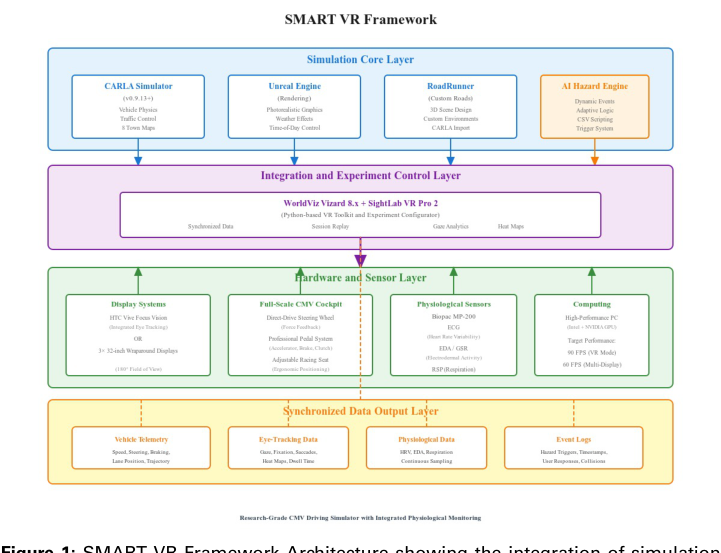
The SMART VR framework is composed of four integrated layers: simulation core, experiment control, hardware and sensor integration, and synchronized data output. Figure 1 illustrates the complete system architecture, showing the flow of information from simulation engines through control software to hardware interfaces and finally to synchronized data streams for analysis.
The simulation core integrates CARLA (v0.9.13+) for vehicle physics, traffic control, and eight base town environments with Unreal Engine for photorealistic rendering and dynamic time-of-day and weather control (Dosovitskiy et al., 2017). RoadRunner enables the import and customization of real-world road environments, supporting region-specific training scenarios (MathWorks, 2023). The AI hazard engine allows for scripted and adaptive injection of hazards using CSV-based logic, enabling precise experimental control while maintaining unpredictability for the driver.
In the experiment control layer, WorldViz Vizard 8.x—a Python-based VR application development toolkit and SightLab VR Pro 2 manage synchronization of data streams, experimental timing, and session replay capabilities. This layer also enables advanced gaze analytics, including fixation analysis, heat map visualization, and dwell time metrics, which are critical for understanding attentional allocation during hazardous events.
Figure 1: SMART VR Framework Architecture showing the integration of simulation core (CARLA, Unreal Engine, RoadRunner, AI Hazard Engine), experiment control layer (Vizard and SightLab), hardware and sensor layer (displays, cockpit, physiological sensors, computing), and synchronized data output (vehicle telemetry, eye tracking, physiological data, event logs.
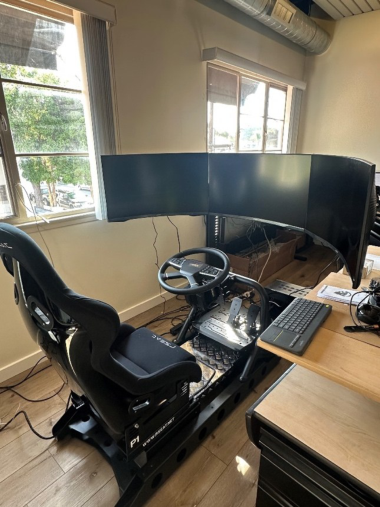
Hardware Configuration The SMART VR framework deploys on a professional-grade simulator platform designed for research and training applications (Figure 2). Each station features a full-scale commercial vehicle cockpit with adjustable seating, mounted on a reinforced sim racing frame. The system supports two display modalities to accommodate different research requirements and user preferences.
The panoramic multi-display setup consists of three 32-inch curved displays arranged in a wraparound configuration, providing an immersive 180
field of view while minimizing VR-induced simulator sickness. This configuration is ideal for extended training sessions and users sensitive to head-mounted displays. Alternatively, the VR head-mounted display option utilizes the HTC Vive Focus Vision with integrated eye tracking, offering fully immersive 360
stereoscopic 3D visualization. This modality enables natural head movements for mirror checks and situational awareness training— critical skills for CMV operators.
The cockpit integrates a direct drive steering wheel system providing realistic force feedback, essential for conveying road surface conditions, vehicle dynamics, and emergency maneuvers such as sudden lane departures or loss of traction. A professional-grade pedal system includes separate accelerator, brake, and clutch pedals, positioned to replicate authentic commercial vehicle ergonomics. The adjustable racing seat allows for proper
SMART VR for Commercial Motor Vehicles Safety 929
driver positioning and comfort during extended evaluation sessions, which is critical for fatigue studies where session duration may exceed 60 minutes.
Figure 2: Physical layout of the SMART VR simulator station featuring three 32-inch wraparound displays providing 180◦. field of view, full-scale CMV cockpit with direct drive force-feedback steering wheel, professional pedal system, and ergonomically adjustable racing seat.
Computing hardware consists of high-performance tower PCs featuring Intel processors and NVIDIA GPUs, capable of maintaining target frame rates of 90 FPS in VR mode and 60 FPS in multi-display configuration. This performance is essential for maintaining immersion and preventing motion-to-photon latency that can induce simulator sickness.
Physiological Monitoring and Data Synchronization SMART VR incorporates the Biopac MP-200 Physiological Data Acquisition Suite for comprehensive biometric monitoring. The system captures three primary physiological signals: (1) electrocardiography (ECG) for heart rate and HRV analysis, providing insight into cognitive workload and stress response; (2) electrodermal activity (EDA/GSR) sensors measuring skin conductance levels and responses, indicating emotional arousal and acute stress; and (3) respiration (RSP) monitoring for respiratory rate and depth, which can indicate anxiety or fatigue states.
Eye tracking is integrated directly into the HTC Vive Focus Vision headset, capturing gaze position, fixation duration, saccadic movements, and pupil diameter at high temporal resolution. The WorldViz SightLab software processes this data in real-time to generate gaze path visualizations, fixation
heat maps, and dwell time analyses—critical metrics for assessing hazard perception and visual attention allocation.
All data streams are synchronized through WorldViz Vizard’s integrated data collection framework using a unified timestamp system with millisecond precision. Vehicle telemetry from CARLA—including speed, acceleration, braking force, steering angle and rate, lane position, heading, and trajectory—is logged at sub-second intervals (typically 10–60 Hz). This temporal alignment enables researchers to correlate specific driver behaviors (e.g., late braking) with physiological states (e.g., decreased HRV indicating fatigue) and visual attention patterns (e.g., gaze fixated away from hazard location) at the exact moment of hazard presentation.
Data are exported in structured CSV/Excel format with aligned timestamps, facilitating post-hoc analysis using standard statistical software. Additionally, SightLab’s interactive session replay capability allows researchers to visualize synchronized behavioral and physiological data streams alongside 3D scenario playback, enabling qualitative assessment and identification of critical incidents.
AI-Driven Hazard Scenario Generation SMART VR’s scenario engine operates on two complementary levels: predefined logic and adaptive AI-driven events. Predefined scenarios are constructed using a CSV-based interface where researchers specify trigger conditions (e.g., “when vehicle reaches waypoint X” or “at timestamp T”) and corresponding hazard actions (e.g., “spawn pedestrian crossing from occlusion” or “reduce visibility to heavy fog”). This approach enables precise replication of known high-risk scenarios such as work zones, railroad crossings, and merging areas.
The adaptive AI logic introduces dynamic hazards based on real- time assessment of driver performance. Non-player vehicle (NPC) agents controlled by CARLA’s traffic manager can exhibit erratic behaviors—sudden lane changes, hard braking, or aggressive merging—triggered by the driver’s actions or deficiencies. For example, if the system detects consistent failure to check blind spots (via eye tracking), the AI may generate scenarios where vehicles linger in blind spot positions just before the driver attempts lane changes. This adaptive training paradigm ensures difficulty scaling matched to individual weaknesses, promoting skill development in areas of greatest need.
Hazard categories include: environmental hazards (sudden fog, heavy rain, sun glare, nighttime conditions); traffic-based hazards (cut-in incidents, jaywalking pedestrians, vehicles running red lights, sudden stops); distraction events (in-cab auditory alerts, simulated cell phone notifications, visual distractors); and vehicle system failures (simulated tire blowouts, loss of braking power, steering resistance changes). Each hazard event is precisely time-stamped and logged, creating a unified data stream that links environmental conditions, vehicle state, driver actions, and physiological responses.
SMART VR for Commercial Motor Vehicles Safety 931
CARLA provides eight default town maps ranging from urban downtown environments to suburban residential areas and highway corridors, each offering 10+ km2 of drivable area. The integration with RoadRunner enables researchers to import custom road networks based on real-world geographic data, supporting region-specific training scenarios that reflect local road geometry, signage, and traffic patterns.
APPLICATIONS AND RESEARCH CAPABILITIES SMART VR enables personalized, competency-based training rather than one-size-fits-all approaches. Trainee performance generates rich multidimensional profiles of behavior and cognitive state across dynamic scenarios, allowing trainers to identify specific deficits—such as cognitive overload in dense traffic indicated by high EDA and narrowed gaze—and prescribe targeted modules. The adaptive AI systematically exposes drivers to weak points until proficiency is demonstrated. By replicating rare but high-consequence events—tire failures, jackknifing, aggressive interactions— the system addresses traditional training’s “competency ceiling,” building life-saving muscle memory and decision-making patterns without physical risk.
The platform enables controlled, repeatable, ethical study of driver behavior in high-risk situations too dangerous to recreate in reality. SMART VR supports ADAS validation by testing driver interactions with lane-keeping assist under fatigue or distraction, HMI design optimization by testing alert modalities while monitoring physiological workload, fatigue studies through long-duration simulated drives, and investigation of individual differences in hazard perception and stress response. Synchronized multi-modal data collection enables predictive crash risk modeling, early warning indicator identification, and real-time driver monitoring system validation before vehicle deployment.
For motor carriers and regulatory agencies, SMART VR data informs evidence-based safety policies and curriculum development. Organizations can establish baseline physiological and behavioral profiles for safe driving, enabling periodic driver requalification after incidents or extended leave. Rich datasets reveal root causes of operational risks within specific fleet contexts. The framework supports pre-post intervention assessment, quantitatively evaluating training programs, fatigue countermeasures, or technology implementations, with transfer of training validated by comparing simulator performance with subsequent on-road safety records.
DISCUSSION AND FUTURE DIRECTIONS SMART VR represents significant advancement in CMV safety by unifying high-fidelity simulation, AI-driven adaptability, and physiological monitoring into a scalable platform. Key advantages include safety and ethical research without physical risk, repeatability and experimental control for rigorous investigation, comprehensive synchronized data collection, adaptability supporting individualized progression, ecological validity
promoting behavioral transfer, and modularity enabling external tool integration. Unlike existing simulators focusing on vehicle control, SMART VR addresses cognitive and physiological dimensions—the human factors responsible for most CMV crashes—representing a paradigm shift from reactive post-incident analysis to proactive risk mitigation.
Several challenges warrant acknowledgment. High-fidelity VR can induce cybersickness, potentially limiting session duration; the panoramic display option mitigates this but reduces immersion. Physiological measure validity requires continual calibration against real-world driving states; individual baseline differences need careful normalization. Definitive evidence for long-term transfer to real-world safety requires longitudinal field studies. Initial capital investment and technical expertise may barrier widespread adoption for smaller organizations, though modular architecture allows scaled implementations.
A key direction is real-time risk intervention system development. The current diagnostic framework will close the loop by detecting imminent risk as it happens. For example, detecting microsleep patterns could automatically trigger in-VR alerts or engage simulated ADAS, transforming the platform into an active safety intervention prototype. Planned enhancements include EEG integration for cognitive state measurement, machine learning for automated driver state classification and error prediction, multiplayer scenarios studying social driving factors, expanded CMV vehicle models with accurate physics, and cloud-based analytics enabling large-scale comparative studies. Longitudinal studies underway will establish correlation between SMART VR performance and real-world safety records, quantifying ROI and validating effectiveness.
CONCLUSION
Commercial motor vehicle safety remains a critical challenge where human factors play the dominant role. Traditional training and assessment methods are no longer sufficient to prepare drivers for the cognitive demands and unpredictable hazards of modern roadways. The SMART VR framework offers a paradigm shift by creating a scalable, modular virtual reality platform that integrates immersive simulation, artificially intelligent hazard generation, and synchronized physiological monitoring.
By enabling safe, controlled, and repeatable practice of critical skills, providing deep objective insights into the cognitive and physiological states underlying driver error, and creating a testbed for next-generation vehicle technologies and safety interventions, SMART VR addresses fundamental limitations in current training systems. The framework’s research-grade data collection capabilities support rigorous scientific investigation of human factors in commercial driving, while its training applications offer practical tools for developing safer, more prepared drivers.
As the system evolves with enhanced AI adaptation, expanded sensor integration, and validated transfer-of-training metrics, it holds the potential not only to transform commercial driver training but also to fundamentally
SMART VR for Commercial Motor Vehicles Safety 933
advance the science of human factors in transportation. Through data- driven, human-centered approaches enabled by platforms like SMART VR, the long-term goal of zero fatalities in commercial vehicle operations becomes increasingly achievable.
ACKNOWLEDGMENT
This work was supported by the Federal Motor Carrier Safety Administration (FMCSA) under Grant No. FM-MHP-0866-24-01-00. The authors gratefully acknowledge South Carolina State University and the Business, Environment, Communication & Transportation (BECT) Institute for their institutional support and resources. The authors also acknowledge WorldViz, Inc. for technical collaboration on system development and integration.
REFERENCES
Baldwin, T. T. and Ford, J. K., 1988. Transfer of training: A review and directions for future research. Personnel psychology, 41(1), pp. 63–105.. Bisantz, A. M., Lee, J. D., Pfautz, J., Burns, C., Elm, W. C. and Pennathur, P. R.,
2013, September. Bridging the gap between cognitive systems engineering analysis, design and practice. In Proceedings of the Human Factors and Ergonomics Society Annual Meeting (Vol. 57, No. 1, pp. 334–338). Sage CA: Los Angeles, CA: SAGE Publications.. De Winter, J., Van Leeuwen, P. M. and Happee, R., 2012, August. Advantages and disadvantages of driving simulators: A discussion. In Proceedings of measuring behavior (Vol. 2012, pp. 28–31). Utrecht: sn. Dosovitskiy, A., Ros, G., Codevilla, F., Lopez, A. and Koltun, V., 2017, October.
CARLA: An open urban driving simulator. In Conference on robot learning (pp. 1–16). PMLR. Federal Motor Carrier Safety Administration (FMCSA). (2020). Large truck and bus crash facts 2020. U. S. Department of Transportation. Federal Motor Carrier Safety Administration (FMCSA). (2023). Commercial motor
vehicle facts. U. S. Department of Transportation. Fisher, D. L., Laurie, N. E., Glaser, R., Connerney, K., Pollatsek, A., Duffy, S. A.
and Brock, J., 2002. Use of a fixed-base driving simulator to evaluate the effects of experience and PC-based risk awareness training on drivers’ decisions. Human factors, 44(2), pp. 287–302. Hajian, S., 2019. Transfer of learning and teaching: A review of transfer theories and effective instructional practices. IAFOR Journal of education, 7(1), pp. 93–111. Healey, J. A. and Picard, R. W., 2005. Detecting stress during real-world driving
tasks using physiological sensors. IEEE Transactions on intelligent transportation systems, 6(2), pp. 156–166. Horswill, Horswill, M. S., Hill, A. and Wetton, M., 2015. Can a video-based hazard perception test used for driver licensing predict crash involvement?. Accident Analysis & Prevention, 82, pp. 213–219. Horswill, M. S., Hill, A. and Wetton, M., 2015. Can a video-based hazard perception
test used for driver licensing predict crash involvement?. Accident Analysis & Prevention, 82, pp. 213–219. Kouroussis, G., Vogiatzis, K. E. and Connolly, D. P., 2018. Assessment of railway ground vibration in urban area using in-situ transfer mobilities and simulated vehicle-track interaction. International Journal of Rail Transportation, 6(2), pp. 113–130.
MathWorks. (2023). RoadRunner: 3D scene design for automated driving simulation. Retrieved from https://www.mathworks.com/products/ roadrunner.html. Mehler, B., Reimer, B. and Coughlin, J. F., 2012. Sensitivity of physiological measures for detecting systematic variations in cognitive demand from a working memory task: an on-road study across three age groups. Human factors, 54(3), pp. 396–412. Mehler, B., Reimer, B., Coughlin, J. F. and Dusek, J. A., 2009. Impact of incremental
increases in cognitive workload on physiological arousal and performance in young adult drivers. Transportation research record, 2138(1), pp. 6–12. Mullen, N., Charlton, J., Devlin, A. and Bedard, M., 2011. Simulator validity: Behaviours observed on the simulator and on the road. In Handbook of driving simulation for engineering, medicine and psychology (pp. 1–18). CRC Press. National Highway Traffic Safety Administration (NHTSA). (2023). Traffic safety
facts 2022: A compilation of motor vehicle crash data. U. S. Department of Transportation. Recarte, M. A. and Nunes, L. M., 2003. Mental workload while driving: effects on visual search, discrimination, and decision making. Journal of experimental psychology: Applied, 9(2), p. 119. Riegler, A., Riener, A. and Holzmann, C., 2021. Augmented reality for future
mobility: insights from a literature review and HCI workshop. i-com, 20(3), pp. 295–318. Wintersberger, P., Riener, A., Schartmüller, C., Frison, A. K. and Weigl, K., 2018, September. Let me finish before I take over: Towards attention aware device integration in highly automated vehicles. In Proceedings of the 10th international conference on automotive user interfaces and interactive vehicular applications (pp. 53–65). Zhang, Y., Kaber, D. B., Rogers, M., Liang, Y. and Gangakhedkar, S., 2014. The
effects of visual and cognitive distractions on operational and tactical driving behaviors. Human factors, 56(3), pp. 592–604.
LISTED IN THE AHFE DIGITAL BOOKSTORE CATALOGUE
Explore the complete digital volume
Human Factors in Design, Engineering, and Computing
Read this individual research paper free through the original publisher, or explore the full digital proceedings book.
ISBN 978-1-964867-75-5
Explore this ISBN in the AHFE Bookstore ↗Listed in the July 2026 bookstore catalogue; search by ISBN to confirm current availability · Digital book purchase optional