Mahtab Eskandar, Wayne Giang, Kenan Carames, Alexandra Kondyli (2025). Participatory Design of Emergency Response Systems for Highly Automated Vehicles: Insights from Older Adults. In: Human Factors in Design, Engineering, and Computing. AHFE Open Access, vol. 199, pp. 379–389. https://doi.org/10.54941/ahfe1006850
Approximately 60 million older adults live in the United States, many of whom face increasing challenges with driving due to age-related declines in sensory, cognitive, and motor functions. As a result, many older adults are forced to modify their driving behavior or stop driving altogether. However, the ability to drive is closely tied to autonomy, independence, and quality of life for this population. Highly Automated Vehicles (HAVs) present a promising solution for maintaining safe mobility for older adults. Yet a persistent concern among potential older users is how HAVs will handle emergency situations. While much of the existing research has focused on preventing road-related incidents, there has been limited exploration into how HAVs should respond once an emergency, whether driving-related or health-related, actually occurs.To address this gap, we designed an emergency response system for HAVs that reflects the specific needs and expectations of older adults. We conducted a series of participatory design (PD) sessions with a diverse stakeholder group, including an older adult, an older adult with cognitive impairment and the care partner, a driver rehabilitation specialist, and members of our human factors research team. Over four remote design sessions conducted via Zoom, we aimed to answer two core questions, one related to our emergency system and the other related to the design of PD sessions. The questions were: (1) What features are essential in an HAV emergency response system to ensure older adults’ safety and comfort in using the technology? and (2) Can online PD sessions effectively support engagement and meaningful contributions from older adults in design?The findings provide promising answers to both. First, the sessions generated several key design recommendations for HAV emergency systems. These included defining a list of emergency events the HAV should respond to, outlining appropriate emergency actions, and establishing a logical sequence for those actions. Participants also emphasized the importance of timely communication with care partners, integration of non-emergency health-supportive features (e.g., hydration, medication, and restroom reminders), and the ability for users to personalize emergency responses through a mobile application with ongoing access to the configuration tool. Additionally, participants provided suggestions for the system’s information architecture and visual design components to enhance usability. Second, participants were able to actively engage in all four remote sessions. Surveys showed strong agreement that Zoom did not limit their ability to contribute, and that the sessions were understandable and meaningful. These results suggest that remote PD can be a viable and effective method for including older adults. Benefits included increased comfort and accessibility, reduced travel burden, and the ability to include diverse perspectives from different geographic areas.Overall, this work contributes to the design of inclusive and responsive HAV systems and demonstrates the potential of remote participatory design as a powerful design tool. Future research should expand this work by including larger and more diverse participant samples, and by evaluating these systems in real-world contexts.
In 2022, the number of traffic deaths involving drivers aged 65 and older was approximately 8,572, the highest since at least 1975 (NHTSA, 2024). This upward trend parallels the continued growth of the older adult population in the U.S., which is expected to increase by about 22% by 2040 (The Administration for Community Living, 2024). Highly Automated Vehicles (HAVs) hold significant promises for supporting safe and independent mobility among older adults (Dickerson et al., 2007). Yet, a consistent theme across studies is older adults’ concern about how HAVs would handle
emergency situations (Asha & Sharlin, 2023; Diepold et al., 2017; Faber & Van Lierop, 2020; Gluck et al., 2020). As such, the adoption of HAVs may hinge on their ability to assist passengers flexibly and safely in emergencies, particularly for those who rely on care partners for mobility support.
The existing literature on HAVs prioritized emergency prevention, focusing on scenarios such as collision avoidance, lane departures, and other traffic- related risks (Wu et al., 2018; Zhang et al., 2022; Zhao et al., 2024). While preventative features are essential, the ability of HAVs to respond effectively to emergencies after they occur is equally important. Previous studies have acknowledged the importance of emergency response systems in AVs, often highlighting the inclusion of basic features such as an emergency help button that connects users to assistance resources like Emergency Medical Services (EMS), care partners, or family members (Asha & Sharlin, 2023; Diepold et al., 2017; Park et al., 2023). However, these discussions typically remain high-level and do not delve into the specific types of emergencies older adults may encounter, the range of actions a vehicle might take in response, or the preferences users may have regarding those responses.
To address this gap, we developed an initial emergency response system for HAVs tailored to older adults, using a user-centred design approach. The system consists of two main components: a mobile application and an in-vehicle interface. Prior to using the vehicle, the older adult and their care partner use the application to customize the vehicle’s emergency actions. Then, during vehicle operation, if the monitoring system and onboard sensors detect an emergency, customized actions would step in. The vehicle would offer customized actions to the user to support them in overcoming emergencies. This effort is part of a broader assistive technology system for HAVs, designed especially for people with cognitive impairment (Kondyli et al., 2024). To ensure the system aligns with older adults’ real- world needs and lived experiences, we employed a participatory design (PD) approach (Muller & Kuhn, 1993). This collaborative process supports the refinement and validation of design decisions, ultimately improving the system’s usability, acceptance, and relevance (Muller & Kuhn, 1993).
Several researchers have identified a gap in directly involving older adults in the design of HAVs through PD sessions, citing challenges in effectively engaging this population due to factors such as accessibility, technological familiarity, and communication barriers (Batbold et al., 2025; Dicianno, 2021; Gluck et al., 2020). While a few studies have begun to explore this space, they do not fully address the key concerns of developing an emergency response system. For instance, Batbold et al. (2025) examined older adults’ learning preferences when interacting with HAVs through PD sessions. However, their work focused on pedagogical needs and ignored the real-world context in which older adults may be alone in the vehicle. Similarly, Gluck et al. (2020) employed a user enactment (UE) method to investigate older adults’ design perspectives for shared autonomous vehicles (SAVs), revealing important concerns around emergency management. Yet, the study did not result in the design or testing of an emergency response system.
Participatory Design of Emergency Response Systems for Highly Automated Vehicles 381
Addressing these gaps, we present an approach for conducting participatory design sessions that engage older adults in co-design of emergency response systems for HAVs. This study aims to address two research questions: (1) What features are essential in an HAV emergency response system to ensure older adults’ safety and comfort in using the technology? (2) How can a remote PD session be structured to support meaningful contributions from older adults? In the following sections, we describe our study design and key findings, which offer design insights for developing emergency response systems for HAVs and for structuring remote PD sessions that effectively support older adults’ contributions.
METHODOLOGY
We conducted four design sessions, each ranging from 1.5 to 2 hours in duration. The initial two sessions were dedicated to designing the in-vehicle system, while the third and fourth sessions centred on the design of the configuration application.
Participants We invited a stakeholder group (N= 7; 4 external members, 3 research team members) that included an older adult without cognitive impairment, an older adult with diagnosed mild cognitive impairment, the care partner, and a driver rehabilitation specialist as a subject matter expert. The participants brought diverse perspectives representing different users across the spectrum, from a healthy older adult to an individual with MCI, to a care partner who may serve as a secondary user of the system. Additionally, the driver rehabilitation specialist contributed broader insights into how older adults interact with HAVs, drawing on clinical and mobility expertise. These stakeholders participated in an earlier set of interviews where we explored user requirements for the design of HAVs for individuals with cognitive impairment (Eskandar et al., 2022). In addition, members from the research team with human factors and AV expertise also participated as facilitators.
Session Procedure Literature suggests that older adults, especially those with cognitive impairment, may require additional time to understand the topic and express themselves during PD sessions; however, they are fully capable of providing meaningful feedback and contributing to the design process (Span et al., 2018). To support the effective participation of our older adult stakeholders, we needed to address potential challenges such as difficulties in understanding complex topics, remembering discussions, and articulating ideas.
Due to the COVID-19 lockdown, our sessions had to be held remotely, which added another layer of challenges to have collaborative design activities. As a result, we designed a remote PD process using Zoom for video conferencing and a digital board called Miro1 for collaborative prototyping 1https://miro.com/
and discussion. Miro served as a shared space or table that was the focus of the design activities. It enabled participants to see sketches, prototypes, and live notes, supporting transparency and immediate feedback.
To further reduce cognitive and technical burden, we implemented a role- based structure involving three researchers: a facilitator, a sketcher, and a note taker. The facilitator guided the conversation by sharing a screen on Zoom and directing the group to relevant information presented in Miro. The sketcher translated participants’ ideas into visual representations and prototypes directly on Miro. Although traditional PD encourages all participants to sketch, we adapted this approach to accommodate technical limitations (e.g., connecting via mobile devices) and participants’ comfort levels. The note taker kept notes publicly on the board enabling participants to track the discussion and reduce memory burden.
One unique challenge when working with cognitively diverse stakeholder groups is that participants may be hesitant to share personal experiences or information. To address this, we introduced a previously developed user persona to serve as a representative user for both participants and researchers during the design process. This persona provided psychological distance, enabling participants, particularly those with cognitive impairment, to express their views more comfortably (Blomquist & Arvola, 2002; Mayer & Zach, 2013).
At the conclusion of each session, participants completed a survey to evaluate the methodology and provide feedback for improving future sessions. This study was approved by the local Institutional Review Board (IRB#: STUDY00147148).
RESULT
This study produced three main outcomes. First, a set of prototypes for both the companion application and the in-vehicle interface were developed. Second, qualitative data from the Miro board, including participants’ comments and researchers’ notes, were exported, and analysed using open coding to identify key themes and design priorities. Finally, quantitative survey responses were analysed using descriptive statistics to evaluate participants’ satisfaction, clarity of the process, and engagement with the online PD sessions.
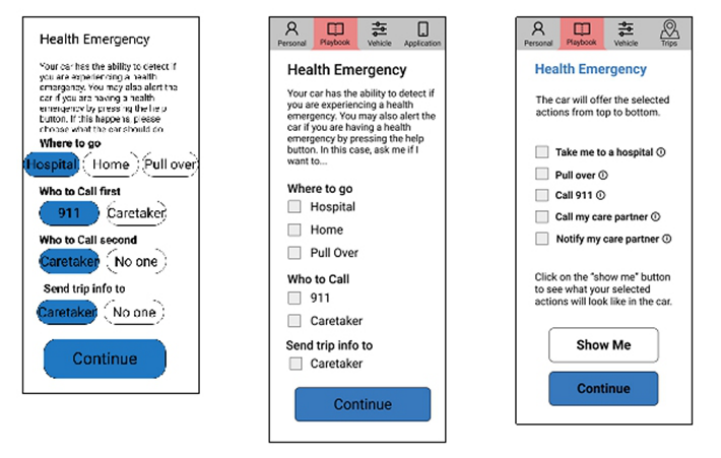
Evolution of Prototypes Overall, participants validated the emergency response system, part of a broader assistive platform designed for individuals with cognitive impairment, while also identifying areas needing further development (Kondyli et al., 2024). Their feedback led to substantial improvements in the information architecture, visual design, and interaction design, especially for the customization application. Key changes included simplifying on- screen text to a third grade reading level, reducing technical terminology, and incorporating informational buttons and walkthrough videos to explain emergency actions and customization steps. Figure 1 illustrates the evolution of the customization application prototypes.
Participatory Design of Emergency Response Systems for Highly Automated Vehicles 383
Figure 1: Evolution of the customization application prototypes across PD sessions. The first prototype reflects our initial design, the second incorporates feedback from the first PD session focused on application, and the third reflects changes following the second PD session focused on application.
Key Themes and Design Priorities To define the emergency scenarios that the vehicle should be prepared to handle, we reviewed literature on driving challenges and assistive technologies for older adults. Based on this review, we generated an initial list of emergency scenarios, which were further refined through PD sessions. Participants expressed that customization should focus only on the most critical scenarios to avoid overwhelming users. As a result, the final list included five core emergency scenarios: (1) the passenger experiences a health emergency, (2) the passenger falls asleep, (3) the passenger feels stress or anxiety during the trip, (4) the vehicle must take a mandatory detour, and (5) the vehicle experiences a mechanical or electrical issue or is involved in an accident. Although the number of emergency scenarios was narrowed, participants recommended the addition of optional reminder prompts for non-emergency needs such as low battery, restroom breaks, drinking water, or taking medications.
Based on the literature review, a set of potential vehicle actions was defined for each emergency scenario, with the primary goal of keeping the passengers safe and ensuring they reach their destination successfully. These actions included calming the user, connecting them to sources of assistance, and modifying the vehicle’s destination if needed. Participants generally validated these actions, particularly emphasizing the importance of connecting to a trusted source of assistance. However, they also recommended significant changes, most notably, refining the sequence in which actions occur. For example, participants preferred being prompted to call their point of contact
before the vehicle initiated a destination change. Additionally, participants identified specific types of information they wanted the vehicle to share with their point of contact during emergencies and emphasized that this information should be customizable based on user preferences. Lastly, participants expressed a desire to view all available emergency response options before the in-vehicle agent initiated its sequence. This would allow them to better understand the full range of possible actions and make more informed decisions when choosing to confirm or veto each step in the sequence.
The core of the discussions around emergency system design centred on the importance of customizing the emergency behaviour of HAVs. All participants supported the idea of customization, viewing it as essential for helping users better understand the vehicle’s capabilities and set realistic expectations. They emphasized that being able to personalize emergency responses makes them feel more confident and in control, an especially meaningful factor during high-stress situations. Participants expressed a preference for customization at two levels: initial setup before using the vehicle, and the ability to confirm or veto actions during an actual emergency. Still, participants acknowledged that because emergencies are infrequent, users might forget their customized settings. To address this, they suggested integrating the customization step into a mobile application, allowing users to easily review and update their preferences as needed.
Finally, participants identified areas for future exploration, such as how personalized emergency operations would accommodate multiple passengers and how control responsibilities might be shared among them.
Reflections on Designed PD Sessions The post-completion survey assessed participants’ satisfaction with the sessions, perceptions of the facilitator roles, and their ability to engage and collaborate in the remote design environment. Each question was rated on a Likert scale between 1 to 5 with 1 being “strongly disagree” and 5 being “strongly agree”.
The first section assessed participants’ overall experience across sessions. Participants were generally satisfied. Responses to “satisfied with my experience”were “strongly agree” or “agree”, with one “disagree”in Session 3 and 4. Responses to “looking forward to future sessions” were mostly positive, with one “neutral” response in Sessions 3 and 4. Participants generally found the sessions easy to understand and follow, though Sessions 1, 2, and 4 each received two “neutral” responses, and Session 3 received one. Table 1 summarizes the questions and average responses for this section.
Participatory Design of Emergency Response Systems for Highly Automated Vehicles 385
Table 1: Mean and standard deviations for survey statements on experience.
Table available in the original PDF paper.
Statements on Experience
Equations and mathematical formulas are available in the original paper PDF.
Satisfied with my experience 4.25 (0.43) 4.25 (0.43) 4 (0.71) 3.67 (0.47) Looking forward to future sessions
3.75 (0.83) 3.75 (0.83) 4.25 (0.83) 3.33 (0.47)
Easy to understand and follow The second section evaluated the facilitators. All participants agreed or strongly agreed that their ideas were captured and reflected across all sessions. Facilitators were also rated as supportive and respectful. Regarding the note-taker’s helpfulness, all responses were positive but one “neutral” response was recorded for Session 1. Feedback on the sketcher was mostly positive, though one “neutral” response was noted in Sessions 1, 2, and 3, and two in Session 4. Importantly, no “disagree” responses were recorded for this section. Table 2 presents the details.
Table 2: Mean and standard deviations for survey statements on facilitators.
Table available in the original PDF paper.
Statements on Facilitators
4.75 (0.43) 4.25 (0.43) 4.75 (0.43) 4.33 (0.47)
Facilitators were supportive 3.75 (0.43) 4 (0.71) 3.75 (0.43) 3.33 (0.47) Sketcher was helpful
Note-taker was helpful The third section addressed the design activities. Participants largely agreed that participating in the design process was easy, with only one “disagree” response in Session 3. Collaboration with other participants received one “neutral” response each in Sessions 1 and 3; otherwise, all were positive. Virtual participation was also reported not to limit contributions, with agreement across all sessions. Table 3 provides a summary of these findings.
Table 3: Mean and standard deviations for survey statements on design activities.
Table available in the original PDF paper.
Statements on Design Activities
Easy to participate in designing 4 (0.71) 4 (0) 3.75 (0.43) 4 (0) Easy to collaborate with other participants
4.25 (0.43) 4 (0) 4.5 (0.5) 4 (0)
Virtual participation did not limit my contribution The survey’s final section invited free form feedback to improve future sessions. After the first session, two participants indicated that the background information was overwhelming and difficult to follow. They recommended receiving preparatory handouts in advance. In response, the research team began distributing handouts containing relevant materials (e.g., personas, prototype designs, agendas) prior to subsequent sessions. After the third session, one participant noted that the handout was sent too close to the meeting time, limiting their ability to prepare fully. They mentioned how they would have been able to be a better participant if they had been able to review the material sooner. This participant’s response was the only recorded disagreement about session satisfaction.
DISCUSSION
This study aimed to explore two research questions: (1) What features should be considered in the design of an HAV emergency response system to support older adults’ safety and comfort? (2) How can a remote PD session be designed to support meaningful contributions from older adults?
In response to the first research question, participants confirmed the need for HAVs to assist with emergencies, aligning with findings from prior research (Asha & Sharlin, 2023; Diepold et al., 2017; Park et al., 2023). However, they emphasized that the emergency response system should be customizable. This emphasis aligns with previous literature demonstrating a general user preference for configurable features in automated vehicles, ranging from control over decision-making processes to interface communication modalities and alert mechanisms (Li et al., 2019; Park et al., 2020). However, our participant articulated this preference specifically in the context of emergency responses. These discussions informed a set of design insights, summarized in Table 4.
Participatory Design of Emergency Response Systems for Highly Automated Vehicles 387
Table 4: Design insights for HAV emergency systems based on PD sessions with older adults.
- Two levels of customization: Pre-selecting preferred responses before emergencies and the ability to confirm or veto actions during emergencies. - Limit the customization to only the most critical emergencies and exclude low-risk issues (e.g., low phone/vehicle battery) to reduce user overwhelm. Include Non-Emergency but Health-Supportive Features
- Integrate features to support well-being during travel, such as restroom break alerts or reminders for hydration, meals, or medications. Provide Ongoing Access to Customization Tools
- Make the initial customization interface available via mobile applications, allowing users to review and update settings outside the vehicle and at their convenience. Design Clear and Logical Sequence of Actions
- Refine the order of emergency interface prompts to align with user priorities (e.g., prompts to contact a caregiver before suggesting changing the destination). - The opportunity to review available options through the in-vehicle agent before selecting an action within a sequence, allowing them to make informed decisions. Support Communication with Care Partners
- Design features that allow the HAV to share key information with caregivers or emergency contacts during or after an emergency. - Allow users to customize what information is shared and when it is shared.
Regarding the second research question, the remote PD session appeared to successfully facilitate the co-design experience for older adults. Notably, participants agreed or strongly agreed that Zoom did not limit their contributions. To support effective remote engagement, we employed several tools and strategies. Personas were introduced to help older adults more easily articulate their preferences and priorities (Blomquist & Arvola, 2002; Mayer & Zach, 2013). We also implemented a “sketcher”role to aid those using less interactive devices (such as mobile phones or tablets) stay engaged without having to perform complex tasks. This approach directly addressed technical limitations identified in previous research, where such devices hindered older adults’ ability to fully participate in online PD sessions (Cerna & Müller, 2021). Additionally, providing handouts before each session allowed participants to build foundational understanding, clarify any confusion, and
reflect on their needs, leading to more meaningful contributions during the sessions. Designing successful remote PD sessions is highly valuable, as they reduce travel burdens, enhance participant comfort, and enable broader participation, leading to more representative design outcomes.
CONCLUSION
The PD sessions resulted in the creation of an emergency response system for HAVs, including both a mobile application and an in-vehicle interface tailored to support older adult users. We also learned insights to improve remote PD sessions for engaging older adults. However, this pilot study involved a very small sample size, which significantly limits the generalizability of the findings. Nonetheless, it offers valuable preliminary insights that can guide future, larger-scale research. While this study focused on designing the emergency system, we did not evaluate the usability of the enhanced prototypes or the effectiveness of the design insights, which should be addressed in future studies.
ACKNOWLEDGMENT
The authors acknowledge the U.S. Department of Transportation for funding this research through the Inclusive Design Challenge, and thank the stakeholders and undergraduate students at the University of Florida for their valuable contributions.
REFERENCES
Asha, A. Z., & Sharlin, E. (2023). Designing Inclusive Interaction with Autonomous Vehicles for Older Passengers. Proceedings of the 2023 ACM Designing Interactive Systems Conference, pp. 2138–2154. Batbold, T., Soro, A., & Schroeter, R. (2025). Driven by Learning: Exploring
Older Adults’ Pedagogical Preferences in Highly Automated Vehicle Interactions. Proceedings of the Human Factors in Computing Systems, pp. 1–7. Blomquist, Å., & Arvola, M. (2002). Personas in Action: Ethnography in an Interaction Design Team. Proceedings of the second Nordic conference on Human-computer interaction, pp. 197–200. Cerna, K., & Müller, C. (2021). Making online participatory design work:
Understanding the digital ecologies of older adults. Proceedings of 19th European Conference on Computer-Supported Cooperative Work. Dicianno, B. E., Sivakanthan, S., Sundaram, S. A., Satpute, S., Kulich, H., Powers, E., Deepak, N., Russell, R., Cooper, R. and Cooper, R. A. (2021). Systematic review: Automated vehicles and services for people with disabilities. Neuroscience Letters, Volume 761, p. 136103. Dickerson, A., Molnar, L., Eby, D., Adler, G., Bedard, M., Berg-Weger, M., Classen,
S., Foley, D., Horowitz, A., Kerschner, H., & Page, O. (2007). Transportation and aging: A research agenda for advancing safe mobility. The Gerontologist, Volume 47, No. 5, pp. 578–590. Diepold, K., Götzl, K., Riener, A., & Frison, A. K. (2017). Automated Driving: Acceptance and chances for elderly people. Proceedings of the 9th International Conference on Automotive User Interfaces and Interactive Vehicular Applications Adjunct, pp. 163–167.
Participatory Design of Emergency Response Systems for Highly Automated Vehicles 389
Eskandar, M., Giang, W. C., Motamedi, S., Devos, H., Koon, L., Akinwuntan, A., & Kondyli, A. (2022). Designing a reminders system in highly automated vehicles’ interfaces for individuals with mild cognitive impairment. Frontiers in Future Transportation, Volume 3, p. e854553. Faber, K., & van Lierop, D. (2020). How will older adults use automated
vehicles? Assessing the role of AVs in overcoming perceived mobility barriers. Transportation Research Part A: Policy and Practice, Volume 133, pp. 353–363. Gluck, A., Huff, E. W., Zhang, M., & Brinkley, J. (2020). Lights, camera, autonomy! exploring the opinions of older adults regarding autonomous vehicles through enactment. Proceedings of the Human Factors and Ergonomics Society, Volume 64, No. 1, pp. 1971–1975. Kondyli, A., Davidson, A., Depcik, C., Haug, J., Koon, L., Motamedi, S.,
Eskandar, M., Giang, W., Hu, B., Jain, E., Yao, H., Zhao, X., Akinwuntan, A., Bhattacharya, S., & Devos, H. (2024). Assistive Technology System for Highly Automated Vehicles to Support People with Mild Cognitive Impairment: A Human-Centered Design Approach. Human Factors in Design, Engineering, and Computing, Volume 159, pp. 2192–2202. Li, S., Blythe, P., Guo, W., & Namdeo, A. (2019). Investigating the effects of age and disengagement in driving on driver’s takeover control performance in highly automated vehicles. Transportation Planning and Technology, Volume 42, No. 5, pp. 470–497. Mayer, J. M., & Zach, J. (2013). Lessons learned from participatory design with and
for people with dementia. Proceedings of the 15th International Conference on Human-Computer Interaction with Mobile Devices and Services, pp. 540–545. Muller, M., & Kuhn, S. (1993). Participatory design. Communication of the ACM, Volume 36, No. 6, pp. 24–28. NHTSA. (2024). Older Drivers. Older Drivers. The US Department of Transportation Website: https://crashstats.nhtsa.dot.gov. Park, J., Zahabi, M., Blanchard, S., Zheng, X., Ory, M., & Benden, M. (2023). A
novel autonomous vehicle interface for older adults with cognitive impairment. Applied Ergonomics, Volume 113, p. 104080. Park, S. Y., Moore, D. J., & Sirkin, D. (2020, April 21). What a Driver Wants: User Preferences in Semi-Autonomous Vehicle Decision-Making. Proceedings of the 2020 CHI conference on human factors in computing systems, pp. 1–13. Span, M., Hettinga, M., Groen-van de Ven, L., Jukema, J., Janssen, R., Vernooij-
Dassen, M., Eefsting, J., & Smits, C. (2018). Involving people with dementia in developing an interactive web tool for shared decision-making: Experiences with a participatory design approach. Disability and Rehabilitation, Volume 40. No. 12, pp. 1410–1420. The Administration for Community Living. (2024). Profile of Older Americans 2023.
The Administration for Community Living Website: https://acl.gov/aging-and- disability-in-america/data-and-research/profile-older-americans. Wu, C., Bayen, A., & Mehta, A. (2018). Stabilizing traffic with autonomous vehicles. Proceeding of the 2018 IEEE International Conference on Robotics and Automation (ICRA), pp. 6012–6018. Zhang, J., Lou, Y., Wang, J., Wu, K., Lu, K., & Jia, X. (2022). Evaluating Adversarial
Attacks on Driving Safety in Vision-Based Autonomous Vehicles. IEEE Internet of Things Journal, Volume 9, No. 5, pp. 3443–3456. Zhao, S., Zhang, J., He, C., Ji, Y., Huang, H., & Hou, X. (2024). Autonomous vehicle extreme control for emergency collision avoidance via Reachability- Guided reinforcement learning. Advanced Engineering Informatics, Volume 62, p.102801.
LISTED IN THE AHFE DIGITAL BOOKSTORE CATALOGUE
Explore the complete digital volume
Human Factors in Design, Engineering, and Computing
Read this individual research paper free through the original publisher, or explore the full digital proceedings book.
ISBN 978-1-964867-75-5
Explore this ISBN in the AHFE Bookstore ↗Listed in the July 2026 bookstore catalogue; search by ISBN to confirm current availability · Digital book purchase optional