Marwan Gomaa, Gabriele Luzzani, Michael Morcos, Rachit Raval, Umberto Saetti (2025). Evaluating the Impact of Haptic Cueing on Training Effectiveness in a Helicopter Roll-Tracking Task. In: Human Factors in Design, Engineering, and Computing. AHFE Open Access, vol. 199, pp. 2120–2135. https://doi.org/10.54941/ahfe1007024
Helicopter control presents significant challenges due to the system’s inherent instability and the high cognitive demands placed on the pilot. This study investigates the effect of haptic cueing on training effectiveness in a VR simulator-based compensatory roll-tracking task. Task difficulty was varied through changes in system dynamics, stability, and task type. Haptic cues, designed using McRuer’s crossover model, were delivered via a vibrotactile suit to provide intuitive feedback on roll-angle errors. Performance was assessed using mean squared error, training time, and Bedford Workload Questionnaire. Results showed improved performance for the haptic-trained group, particularly as task difficulty increased, with minimal impact on training time. Although data variability was high due to the small sample size, findings indicate that haptic cueing enhances training in complex control tasks.
The bare-airframe dynamics of rotorcraft (e.g., helicopters, tilt-rotors) are inherently unstable across a large portion of their flight envelope, and especially in hover and low-speed forward flight (Mcruer, Graham and Ashkenas, 1973). Their flight dynamics are also high-order and characterized by strong inter-axis coupling, which require pilots to actively regulate all four control axes (roll, pitch, yaw, and heave) and demand a high level of attentional and motor coordination. Moreover, rotorcraft have restrictive flight envelopes due to complex power and structural limits. All of these features contribute significantly to pilot mental workload (MWL). Counteracting external disturbances such as turbulence or gusts, or performing maneuvers beyond basic trim-holding tasks, introduces additional challenges that further increase pilot workload. Hence, pilot training is typically a lengthy, challenging, and stressful process designed to enhance pilots’ situational awareness, responsiveness, and familiarity with the helicopter unaugmented response to commands.
Multimodal cueing has been investigated as a potential solution to enhance the training process, specifically in terms of situational awareness, pilot- vehicle performance, flight envelope protection, and task learning rate.
Evaluating the Impact of Haptic Cueing on Training Effectiveness 2121
The principle of inverse effectiveness states that when sensory inputs such as visual, tactile, and auditory cues are combined, the overall pilot–vehicle performance can exceed that of individual cueing modalities (Colonius and Diederich, 2002). However, this multisensory integration must be carefully managed to avoid information overload, which could lead to confusion and an increase in the pilot’s MWL (Brickman et al., 2000).
Among the aforementioned sensory cueing modalities, haptic feedback has emerged as a promising channel for enhancing pilot performance and situational awareness. Haptic feedback consists of the delivery of tactile cues to the human operator through various strategies, namely force- feedback control stick or full-body haptic systems. These cues support the human operator in tracking control inputs and perceiving proximity to flight envelope boundaries, thereby facilitating accelerated skill acquisition in training (Alaimo et al., 2010).
Haptic feedback has been investigated across several research fields, particularly in training and performance evaluation. For instance, an assessment of drivers’ backward-parking training using haptic assistance was presented by Tada and Wada (2015), where participants trained with haptic feedback outperformed the control group during the evaluation phase. Similar principles have been extended to the aerospace domain, where haptics is commonly integrated as force feedback on the pilot’s control stick, given its intuitiveness. Olivari et al., (2014) and Malik et al., (2020) provide further insight into the implementation strategies adopted for such systems. Moreover, haptic cueing has proven effective in improving training for one- and two-degree-of-freedom (1- and 2-DOF) compensatory tracking tasks, where the test group was able to achieve consistent performance early and acquire the control approach more quickly through the use of haptic feedback (D’Intino et al., 2016; 2017). However, pilot stick feedback has a limitation on the amount of information to be cued, and the coupling of pitch and roll inputs on the control stick can introduce confusion, and the coupling of pitch and roll inputs on the control stick can introduce confusion.
Recently, there has been growing interest in full-body haptic as a technique to dissociate feedback from the control stick, decouple cues across different body parts, and enable cueing for additional control inputs such as pedals and collective sticks. Full-body haptics in the form of electrical muscular stimulation (EMS) combined with spatial audio cueing for a roll-tracking task under both good and degraded visual, have demonstrated improvements in pilot–vehicle system performance (Morcos et al., 2025). Furthermore, a similar approach was extended to a position/velocity tracking task using a vibrational full-body haptics suit for both Precision Hover and Slalom scenarios (Morcos et al., 2025). Despite their potential, full-body haptic cueing remains underexplored for training applications.
As such, this study aims to investigate the impact of full-body haptic cueing during training in a helicopter roll-tracking task. The primary objective is to understand how haptic feedback can enhance training effectiveness and control precision under varying levels of task difficulty and dynamic conditions. To achieve this, the study employs a comprehensive training process integrating multiple compensation strategies and difficulty levels
within a virtual reality (VR) simulation environment equipped with a motion- base platform. Performance metrics, training duration, and subjective MWL, assessed using the Bedford Workload Questionnaire (BWQ), are employed to quantitatively evaluate training effectiveness. In addition, physiological signals, including cardiac activity (ECG), electrodermal activity (EDA), skin temperature, respiration, and cerebral hemodynamics (fNIRS), are recorded to investigate their relationship with MWL and to gain deeper insight into the psychophysiological responses of participants during the tests. This experimental setup provides an immersive and realistic training experience that closely replicates real flight conditions.
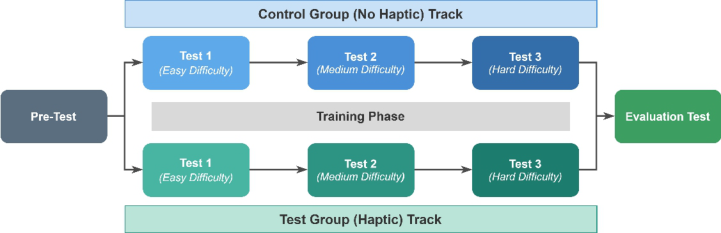
EXPERIMENT OVERVIEW & PROCEDURE The experiment consists of three main phases: pre-test, training, and evaluation. Across and within phases, task difficulty progressively increases to ensure a structured training process. Figure 1 shows a graphical diagram of the process.
Figure 1: Experiment procedure diagram.
In the pre-test phase, all participants perform five trials of a specific task. This phase is aimed at familiarizing participants with the setup and compensatory tracking tasks. Moreover, the initial performance of participants is recorded to obtain a priori knowledge of the baseline skill level of each participant. Haptics are not used in this phase.
Participants are then divided into two independent groups for the training phase: the Control Group (NoHA) is trained traditionally without haptic feedback, while the Test Group (Haptic) is trained using haptics. The training phase consists of three tests corresponding to three levels of difficulty in the tracking/disturbance-rejection task performed (easy, medium, and hard). Task difficulty is adjusted by varying system dynamics, stability, and the input/disturbance profiles. This variation ensures exposure to a broad range of flight-control scenarios and ensures increasing levels of mental workload. Each training milestone is completed once a defined performance metric is achieved. If the metric is not met within ten trials per test, the participant proceeds to the next test, and the attempt is recorded as a failure. Both groups follow identical test conditions and performance criteria.
Evaluating the Impact of Haptic Cueing on Training Effectiveness 2123
In the evaluation phase, participants perform a different, more challenging task without haptic aids. This task is common to both groups and serves to assess the effectiveness of training by evaluating performance under generalized conditions.
After each test phase, participants provided a subjective rating of their perceived MWL using the 10-level BWQ.
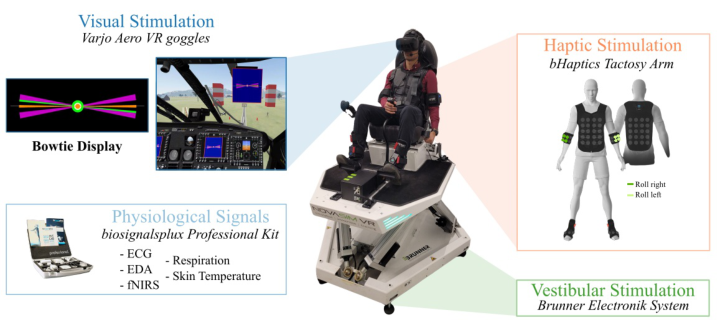
EQUIPMENT The vibrotactile bHaptics Tactosy for Arms was used as a haptic feedback system. It consists of haptic sleeves, each equipped with 6 actuators per arm. The VR motion-base simulator used in these tests was the Brunner Elektronik NovaSim VR/MR system. Visual feedback is provided through Varjo Aero VR goggles. The pilot seat is integrated with a seat shaker for vibration cueing and is mounted on a six-degree-of-freedom motion platform. Visual scenes were rendered using Lockheed Martin’s Prepar3D® software, providing a high-fidelity cockpit and out-the-window view of the environment. The test setup is visualized in Figure 2.
POPULATION To date, sixteen participants (age range = 25 ± 2.5) performed the experiment. Before starting, participants were briefed on all experimental phases, procedures, and objectives. Each participant consented to wear physiological sensors for data collection. The study complied with the American Psychological Association Code of Ethics and was approved by the University of Maryland IRB (ID 2212399-2).
Figure 2: Test setup.
TEST DESIGN Compensatory Tracking Task
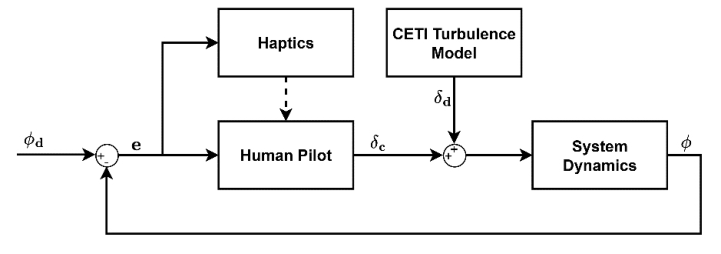
In a compensatory roll-tracking task, the objective is to minimize the tracking error between the desired roll-angle trajectory φd and the actual roll-angle response φ produced by the system dynamics. The pilot perceives
the error (e = φd −φ) visually and commands a stick input that drives the system response. The haptic system also receives the error signal and cues the required stick input to the pilot through variations in vibrational intensity. Disturbances acting on the pilot’s stick input are generated using control equivalent input turbulence model. Figure 3 shows a schematic of the compensatory tracking task.
Figure 3: Pilot vehicle system in a compensatory tracking task.
In this study, a bow-tie display is used for the compensatory tracking task, as shown in Figure 2. The displayed roll angle is represented by a green line, while the desired roll angle is shown by an orange line. The orange line is bounded by magenta lines, which indicate the thresholds for adequate and desirable performance. Specifically, the outer magenta region represents the adequate performance boundary, and the inner region represents the desired performance boundary (Klyde et al., 2020).
Tracking Input As shown in Figure 3, the input function φd(t) is used to generate the desired trajectory for the tracking task. For generating a signal with specific frequency content, the multisine input function is applied. The function used to define the desired roll-angle trajectory is given by:
Equations and mathematical formulas are available in the original paper PDF.
where Ad, ωd, ψ are the amplitude, frequency and phase angle of each sine component, respectively. N is the number of individual sine waves used, which in this study is seven.
The signal is defined to have a second-order amplitude distribution to attenuate signal power at higher frequencies (Zaal et al., 2008). The sinusoidal amplitude at each frequency is defined as:
Evaluating the Impact of Haptic Cueing on Training Effectiveness 2125
2 k j
(2) where Kd is a scaling gain for amplitude adjustment. The frequencies in Eq. (1) are integer multiples of the base frequency ω0 = 2π/T, where T denotes the trial duration, set to 60 seconds. The integer multiples follow the Fibonacci sequence to ensure that the generated input frequency range encapsulates key vehicle dynamics and typical closed-loop control characteristics, spanning frequencies from 0.2 to 3.5 rad/s (Klyde et al., 2020). Finally, the phase angles ψ are selected from a random, uniformly distributed set from 0 to 2π radians.
Disturbance Model To generate a more realistic disturbance for the tracking task, the Control Equivalent Turbulence Input (CETI) model is employed. This model represents gust turbulence as an equivalent disturbance input on the control stick. It is derived from flight-test data collected from real helicopters in hover. Based on these data, a white-noise-driven filter model, resembling a Dryden form, was developed. The model is scalable across different turbulence levels. The filter outputs are disturbance time histories, which are combined with the pilot’s control inputs, as shown in Figure 3, to simulate the effects of air turbulence (Lusardi and Hess, 2004; Lusardi et al., 2004).
In this study, only the lateral disturbance component of the CETI model is considered. The disturbance amplitudes are scaled according to the pilot stick input definition. The white-noise shaping filter’s transfer function for the lateral disturbance is given by:
L
where σwg, L, U0 denote the RMS vertical gust velocity, turbulence scale length, and mean wind velocity, respectively. These parameters vary with turbulence level, and representative values can be found in the referenced works.
Scoring Metrics The scoring metrics define the performance thresholds required to successfully complete a single trial in the training phase, with three consecutive successful trials required to progress to the next difficulty level. This approach ensures that participants can achieve and maintain consistent performance in each task. By keeping the performance metric constant across groups, training time can be compared objectively. The metrics used in this study are adapted from (Klyde et al., 2020).
Performance is evaluated based on the percentage of time (Scoring Time) the tracking error remains within predefined bounds (Error Bounds), representing the Desired and Adequate performance regions. Table 1 summarizes these requirements. A trial is considered successful when both conditions are satisfied. The Desired and Adequate regions are illustrated in the bow-tie display shown in Figure 2, as discussed earlier.
Table 1: Adequate and desired performance scoring metrics.
Table available in the original PDF paper.
Performance Error Bounds (deg) Scoring Time (%) Desired
eφ
<5
eφ
<10
These metrics were used only to define progression during the training phase, ensuring a consistent performance threshold between the Haptic and NoHA groups. For performance comparison, the mean squared error (MSE) of roll-angle tracking was used.
Dynamic Modelling Pre-Test: this initial phase serves the purpose of obtaining baseline performance data for the participants and familiarizing them with the experimental setup and compensatory tracking task. Participants perform five trials of a compensatory tracking task with no external disturbances. This is the least challenging task, and the system dynamics represent a four-state lateral/directional model of a UH-60-like helicopter in hover, which is stable and highly responsive to stick inputs. The system dynamics are described by the following state-space model:
[Equation or mathematical symbol available in the original paper PDF]
where x and u denote the state and control vectors, respectively, and A and B are the system matrices that contain the stability and control derivatives. Only the roll-dynamics states (p and φ) are utilized in the task, while the remaining states are held constant. The system output is the roll angle φ, which is presented to the pilot via the bow-tie display.
Training Phase (Test 1): During each test in the training phase, participants aim to complete three successful trials, as defined by the performance metrics discussed previously. A maximum of ten trials is allowed per participant per test, after which participants proceed to the next test regardless of outcome.
Test 1 in the training phase is also a compensatory tracking task. The system dynamics remain stable but are less responsive compared to the pre- test, requiring participants to adapt their control strategy accordingly. The transfer function of the system dynamics, relating the roll-angle response to the stick input, is given by:
Evaluating the Impact of Haptic Cueing on Training Effectiveness 2127
δlat(s)= K s(s + 1) (5) This configuration maintains system stability while reducing responsiveness, thereby increasing the control challenge for participants.
Training Phase (Test 2): This phase is classified as medium difficulty. In this test, participants perform a disturbance-rejection task. The desired roll angle, and thus the bow-tie reference, are fixed at zero. The system is driven by turbulence disturbances generated using the CETI model, and the system dynamics are unstable. Task difficulty arises from the pilot’s need to both compensate for the disturbance and stabilize the unstable system. The transfer function of the system dynamics, relating roll-angle response to lateral-stick input, is given by:
δlat(s)= K s(s −0.1) (6) The positive real pole at 0.1 rad/s introduces open-loop instability, requiring continuous corrective input and increasing pilot workload.
Training Phase (Test 3): Test 3 in the training phase is classified as high difficulty. In this test, participants return to a compensatory roll- tracking task with no external disturbances. The system dynamics resemble a double-integrator configuration, representing a marginally stable system. Such systems exhibit oscillatory behaviour that can lead to pilot-induced oscillations (PIO). Participants must track the desired roll angle while simultaneously damping these oscillations, thereby increasing the task’s level of difficulty. The transfer function of the system dynamics, relating roll-angle response to lateral-stick input, is given by:
Because the system lacks inherent damping, even small pilot inputs can amplify motion, making control more demanding.
Evaluation Phase: The evaluation test consists of five trials conducted for all participants without the use of haptic feedback. This phase serves to assess the effectiveness of training on performance for both the Haptic and NoHA groups and to evaluate performance retention after training. The evaluation task is more challenging and combines elements of previous tests. Participants perform a compensatory roll-tracking task under turbulence, requiring simultaneous tracking and disturbance rejection. The system dynamics are the same as in the pre-test; however, because these dynamics are highly responsive, they also amplify the effects of turbulence disturbances. This makes the task significantly more demanding and provides an effective means of assessing post-training performance.
HAPTIC AIDS DESIGN Since the goal of this study is training, the haptic cues are designed to elicit realistic pilot responses rather than optimal ones. To achieve this, pilot
models are developed to represent typical human control behaviour. In this case, the crossover model is adopted due to its simplicity and effectiveness. According to McRuer, human pilots performing compensatory tracking tasks adapt their control dynamics such that near the crossover frequency ωc (i.e., where
HpHsd
s e−sτe (8) where YOL, Hp, Hsd denote the open-loop transfer function of the pilot– vehicle system, the pilot transfer function, and the system dynamics transfer function, respectively (see Figure 3). τe represents the effective time delay. The corresponding Hsd for each training test is defined in the previous section.
The simplest pilot describing function consistent with the open-loop crossover model is given by: Hp (s) =Kp (TLs + 1) e−sτe (9)
where Kp, TL are the pilot gain and lead time constant, respectively. These parameters are tuned to match the dynamics of each system configuration according to McRuer’s guidelines.
Once the pilot model is established, the haptic cues are designed to convey the required stick input through a wearable vibrational upper-arm band. A vibration on the right arm indicates a roll to the right, and vice versa. Figure 2 illustrates the vibrational haptic cueing scheme.
PHYSIOLOGICAL SIGNALS ANALYSIS The signal processing of the five selected physiological signals (ECG, EDA, respiration, skin temperature, and fNIRS) followed the pipelines reported in (Luzzani et al., 2025; Luzzani et al., 2025). A total of 81 features were extracted per trial: 10 from heart rate (HR) and heart rate variability (HRV), 8 from EDA including skin conductance level (SCL) and skin conductance response (SCR), 14 from skin temperature, 12 from respiration (breath rate- related), and 38 from fNIRS (temporal, statistical, and spectral domains).
RESULTS AND DISCUSSION
Performance Analysis Participants’ performance was evaluated using the mean squared error (MSE) of the roll-tracking angle, averaged over the last three trials of each test. This was done primarily to avoid the influence of early trials, during which participants were still familiarizing themselves with the system dynamics, and to analyze performance independently from training effects, which are discussed separately. For simplicity, any subsequent mention of MSE refers to the average MSE computed over the final three trials in each test.
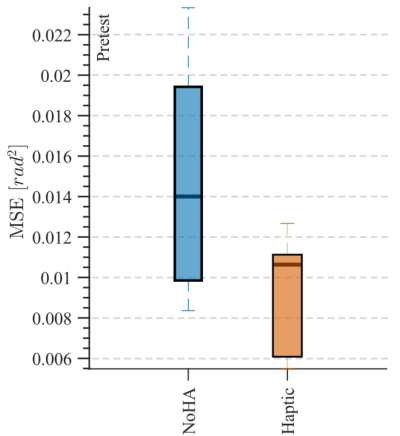
Pre-Test Analysis: The Pre-Test results indicated a bias in the participants’ initial skill levels, as evidenced by the MSE values of the Haptic and NoHA
Evaluating the Impact of Haptic Cueing on Training Effectiveness 2129
groups reported in Figure 4. To account for this bias, all performance metrics were normalized with respect to each participant’s baseline value. This baseline correction was performed by calculating the relative change in performance with respect to the baseline condition, as expressed by the following equation:
All subsequent analyses of training and evaluation performance refer to this relative MSE metric.
Figure 4: Baseline MSE in pre-test.
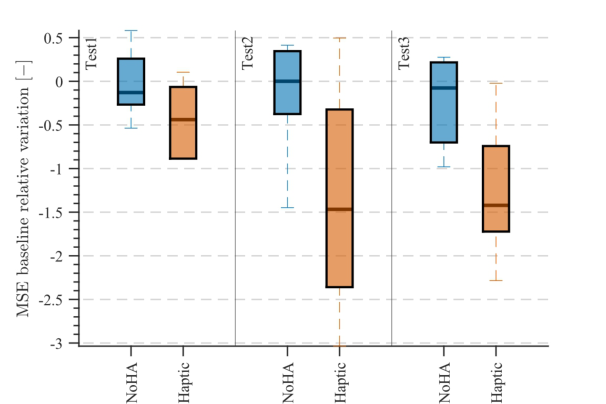
Training Phase Analysis: The performances of both Haptic and NoHA groups across the three training-phase tests are shown in Figure 5. Statistical significance was determined using two-tailed t-tests comparing the two groups. Thresholds were set at p < 0.05 for significance and results are reported in Table 2.
The results indicate a consistent trend of lower relative MSE values compared to the baseline, reflected by the negative changes in relative MSE. The haptic group demonstrates clear improvement relative to its initial baseline performance. The effect in Test 1 is not statistically significant, likely due to the simplicity of the task. However, as task difficulty increases in Tests 2 and 3, the influence of haptic feedback becomes more pronounced, resulting in greater performance enhancement.
Figure 5: Baseline corrected MSE for training phase.Table 2: P-values for training and evaluation phases.
Table available in the original PDF paper.
Test P-Value Significance Test 1 (Easy) 0.0526 Marginally Significant
Test 2 (Medium) 0.0263 Significant Test 3 (Hard) 0.0072 Significant Evaluation Phase 0.3585 Not Significant
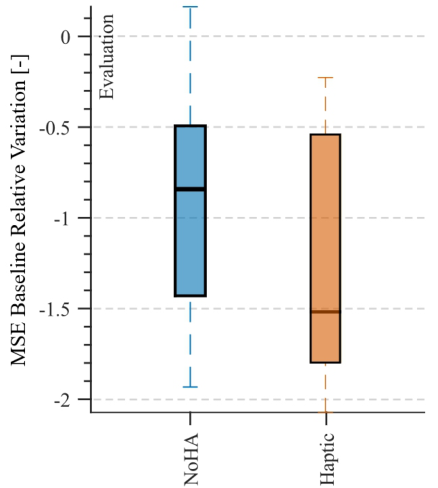
Evaluation Phase Analysis: The evaluation test was designed to assess post-training performance for both the control and test groups, as well as to examine performance retention. Evaluation results are shown in Figure 6.
The data indicate an initial trend of improved performance for the haptic group, as evident from the box plot, however, the difference between groups is not statistically significant. This outcome is likely due to the adaptation period required when haptic assistance is removed. Achieving comparable or slightly better performance than the NoHA group, despite the change in conditions, demonstrates relatively strong performance retention for the Haptic group. A t-test was performed for the evaluation phase, and the corresponding results are summarized in Table 2.
Evaluating the Impact of Haptic Cueing on Training Effectiveness 2131
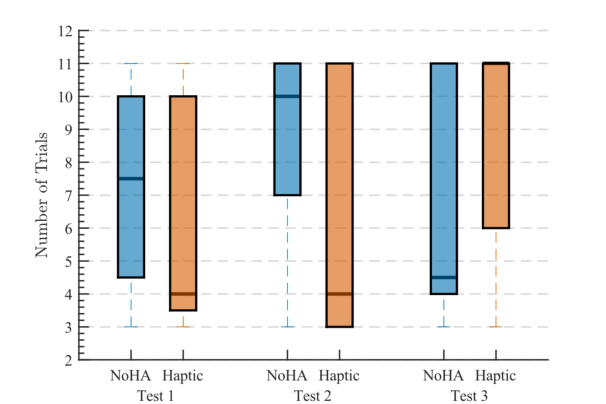
Training Analysis Another metric used to assess training effectiveness was the time required to pass each test during the training phase. Training time was defined as the number of trials needed to achieve the progression criterion, meeting the performance threshold in three consecutive trials, and is reported in Figure 7.
Participants performed a maximum of 10 trials per test. In the boxplot, a value of 11 indicates that the participant was unable to meet the progression requirement within the 10 allowed trials, while values less than or equal to 10 indicate successful completion. The results show no statistically significant effect of haptic feedback on training time. The variability in the data is relatively high due to the small sample size. The trend is more evident in Tests 2 and 3, achieving the goal was subjective and influenced by the participants’ inherent hand–eye coordination skills due to the difficulty of the tasks.
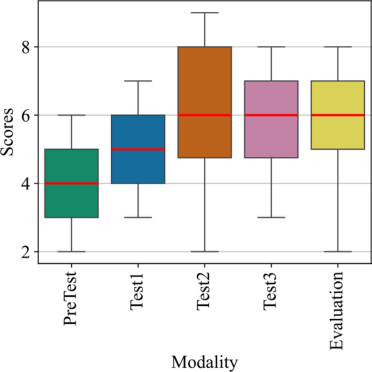
Mental Workload & Physiological Signals Analysis Results of the perceived MWL across sensory modalities, assessed using the BWQ are presented in Figure 8. Consistent with the performance outcomes discussed earlier, the perceived MWL was lowest during the PreTest phase, as expected, and progressively increased during the training and evaluation phases. A consistent rise in both the median score (from 5 to 6) and the variance of the distributions was observed from Test 1 to Test 2, reflecting the same trend identified in the performance metrics shown in Figure 5.
Figure 7: Training time distributions across training phases.Figure 8: Perceived MWL results.
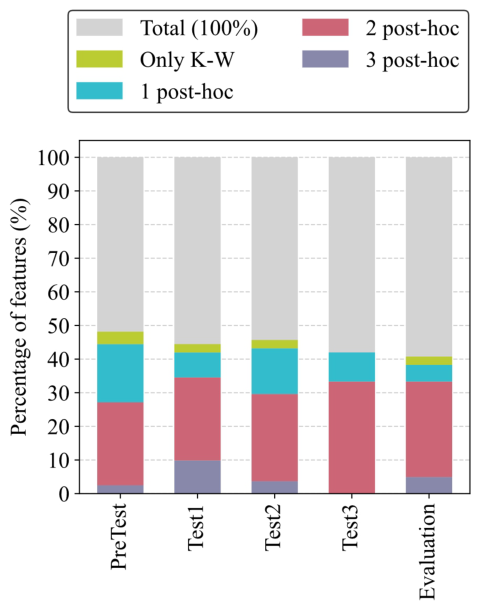
Physiological signals were processed according to the procedure described in (Luzzani, Morcos and Saetti, 2025). This analysis focused on clustering MWL levels based on the overall distribution of results into three categories: baseline, low, and high MWL. Subsequently, a multivariate statistical analysis was conducted using the Kruskal–Wallis (K-W) test, followed by pairwise post-hoc comparisons via the Mann–Whitney U test with Benjamini– Hochberg correction to account for non-normal distributions. The results of this analysis, illustrated in Figure 9, report the percentage of features found to be statistically significant at each step. Notably, more than 20% of the analyzed features were significant in at least two post-hoc comparisons, underscoring the sensitivity of these physiological measures to variations in subjective MWL.
Evaluating the Impact of Haptic Cueing on Training Effectiveness 2133
This study investigated the effect of haptic cueing on training effectiveness in a compensatory roll-tracking task. A comprehensive VR simulator-based experiment was conducted in which task difficulty was systematically varied by manipulating system dynamics, stability, and task type. Haptic cues, designed to replicate pilot responses to tracking errors between the system output and the desired roll angle, were delivered through a vibrotactile suit worn on the arms. The feedback controller was implemented following McRuer’s crossover model to ensure realistic and responsive cueing behavior. The results demonstrated enhanced performance for the haptic-trained group, particularly as task difficulty increased, and a moderate improvement during the final evaluation phase. Although no significant differences in training time were observed, the limited sample size and variability in participants’ initial skill levels introduced substantial variability in the results. MWL assessments indicated higher perceived effort in the medium, hard, and evaluation phases, which resulted in corresponding changes in physiological measures. Overall, these findings provide preliminary evidence supporting the effectiveness of haptic cueing in enhancing performance and adaptive control behavior during roll-tracking tasks. The primary goal of this study was to offer an initial investigation into the effects of haptic cueing
within a controlled experimental framework. Accordingly, future work will aim to address the current limitations, particularly the high inter-subject variability arising from differences in baseline skill levels, by expanding the participant sample to enable more robust statistical validation and a deeper characterization of individual learning profiles.
ACKNOWLEDGMENTS This material is based upon work supported by the National Science Foundation (NSF) under Award No. 2430418. Any opinions, findings, and conclusions or recommendations expressed in this material are those of the author(s) and do not necessarily reflect the views of the National Science Foundation.
REFERENCES Alaimo, S. M. C., Pollini, L., Bresciani, J. P. and Bulthoff, H. H. (2010) “A comparison of Direct and Indirect Haptic Aiding for Remotely Piloted Vehicles,” in 19th International Symposium in Robot and Human Interactive Communication. IEEE, pp. 506–512. Available at: https://doi.org/10.1109/ ROMAN.2010.5598647. Brickman, B. J., Hettinger, L. J. and Haas, M. W. (2000) “Multisensory Interface Design for Complex Task Domains: Replacing Information Overload With Meaning in Tactical Crew Stations,” The International Journal of Aviation Psychology, 10(3), pp. 273–290. Available at: https://doi.org/10.1207/ S15327108IJAP1003_04. Colonius, H. and Diederich, A. (2002) “A Maximum-Likelihood Approach to
Modeling Multisensory Enhancement,” in Advances in Neural Information Processing Systems 14. The MIT Press, pp. 181–188. Available at: https://doi.org/ 10.7551/mitpress/1120.003.0028. D’Intino, G., Olivari, M., Geluardi, S., Venrooij, J., Innocenti, M., Bulthoff, H. H.
and Pollini, L. (2016) “Evaluation of haptic support system for training purposes in a tracking task,” in 2016 IEEE International Conference on Systems, Man, and Cybernetics (SMC). IEEE, pp. 002169–002174. Available at: https://doi.org/ 10.1109/SMC.2016.7844560. D’Intino, G., Olivari, M., Geluardi, S., Venrooij, J., Pollini, L. and Buelthoff, H. H.
(2017) “Experimental evaluation of haptic support systems for learning a 2-DoF tracking task,” in AIAA Modeling and Simulation Technologies Conference. Reston, Virginia: American Institute of Aeronautics and Astronautics. Available at: https://doi.org/10.2514/6.2017–1083. Klyde, D. H., Pitoniak, S. P., Schulze, P. C., Ruckel, P., Rigsby, J., Fegely, C. E., Xin, H., Fell, W. C., Brewer, R., Conway, F., Mulato, R., Horn, J., Ott, L. C. R. and Blanken, C. L. (2020) “Piloted Simulation Evaluation of Tracking Mission Task Elements for the Assessment of High-Speed Handling Qualities,” Journal of the American Helicopter Society, 65(3), pp. 1–23. Available at: https://doi.org/ 10.4050/JAHS.65.032010. Lusardi, J. A., Tischler, M. B., Blanken, C. L. and Labows, S. J. (2004) “Empirically
Derived Helicopter Response Model and Control System Requirements for Flight in Turbulence,” Journal of the American Helicopter Society, 49(3), pp. 340–349. Available at: https://doi.org/10.4050/JAHS.49.340. Lusardi, J. and Hess, R. (2004) Control equivalent turbulence input model for the UH-60 helicopter, ProQuest Dissertations and Theses. Available at: https://www.proquest.com/dissertations-theses/control-equivalent-turbulence- input-model-uh-60/docview/305214331/se-2?accountid=14696. Luzzani, G., Buraioli, I., Guglieri, G. and Demarchi, D. (2025) “EDA, PPG
and Skin Temperature as Predictive Signals for Mental Failure by a Statistical Analysis on Stress and Mental Workload,” IEEE Open Journal of Engineering in Medicine and Biology, 6, pp. 248–255. Available at: https://doi.org/10.1109/ OJEMB.2024.3515473.
Evaluating the Impact of Haptic Cueing on Training Effectiveness 2135
Luzzani, G., Morcos, M. and Saetti, U. (2025) Multimodal Cueing in Precision Hovering Tasks: Predicting Pilot Cognitive Workload via Physiological Measurements. Luzzani, Gabriele, Pogliano, M., Buraioli, I., Colavincenzo, M., Martorana, S., Guglieri, G. and Demarchi, D. (2025) “ECG, Respiration, fNIRS, and Eye Tracking for Stress and Mental Workload Monitoring in Human-Machine Interaction,” IEEE Access, 13, pp. 122726–122741. Available at: https://doi.org/ 10.1109/ACCESS.2025.3588384. Malik, H. A., Rasool, S., Maqsood, A. and Riaz, R. (2020) “Effect of Haptic
Feedback on Pilot/Operator Performance During Flight Simulation,” Applied Sciences, 10(11), p. 3877. Available at: https://doi.org/10.3390/app10113877. McRuer, D. T. and Jex, H. R. (1967) “A Review of Quasi-Linear Pilot Models,” IEEE Transactions on Human Factors in Electronics, HFE-8(3), pp. 231–249. Available at: https://doi.org/10.1109/THFE.1967.234304. Mcruer, D. T., Graham, D. and Ashkenas, I. (1973) Aircraft Dynamics and Automatic
Control. Princeton Univ Press. Morcos, M., Fishman, S., Saetti, U., Berger, T., Bachelder, E. N. and Godfroy-Cooper, M. (2025) “Full-Body Haptic and Spatial Audio Cueing for Augmented Pilot Perception,” Journal of Guidance, Control, and Dynamics, 48(6), pp. 1334–1347. Available at: https://doi.org/10.2514/1.G008722. Morcos, M. T., Saetti, U., Geiger, D. H., Kubik, S. T., Breed, A. R., Crane,
C. J., Luzzani, G., Fischer, M. R., Jun, D. and Gary, E. (2025) “Full-Body Haptic Cueing for Augmented Pilot Perception in Position/Velocity Tracking Tasks,” in Proceedings of the Vertical Flight Society 81st Annual Forum and Technology Display. The Vertical Flight Society, pp. 1–21. Available at: https:// doi.org/10.4050/F-0081–2025-136. Olivari, M., Nieuwenhuizen, F. M., Bülthoff, H. H. and Pollini, L. (2014) “Pilot Adaptation to Different Classes of Haptic Aids in Tracking Tasks,” Journal of Guidance, Control, and Dynamics, 37(6), pp. 1741–1753. Available at: https:// doi.org/10.2514/1. G000534. Tada, S. and Wada, T. (2015) “Effect of skill development of haptic shared control in
backward parking assist,” in 2015 IEEE International Conference on Vehicular Electronics and Safety (ICVES). IEEE, pp. 164–169. Available at: https://doi.org/ 10.1109/ICVES.2015.7396912. Zaal, P., Pool, D., Mulder, M. and van Paassen, M. (2008) “New Types of Target Inputs for Multi-Modal Pilot Model Identification,” in AIAA Modeling and Simulation Technologies Conference and Exhibit. Reston, Virigina: American Institute of Aeronautics and Astronautics. Available at: https://doi.org/10.2514/ 6. 2008–7106.
LISTED IN THE AHFE DIGITAL BOOKSTORE CATALOGUE
Explore the complete digital volume
Human Factors in Design, Engineering, and Computing
Read this individual research paper free through the original publisher, or explore the full digital proceedings book.
ISBN 978-1-964867-75-5
Explore this ISBN in the AHFE Bookstore ↗Listed in the July 2026 bookstore catalogue; search by ISBN to confirm current availability · Digital book purchase optional