Jung Yeh, Xing-wei Liu, Chia-hui Lee, Hsiang-chuan Chang (2025). Evaluating Customer Loyalty and Sustainability Performance of the TPASS Integrated Commuter Pass in Taiwan. In: Human Factors in Design, Engineering, and Computing. AHFE Open Access, vol. 199, pp. 2070–2078. https://doi.org/10.54941/ahfe1007019
This study evaluates the sustainability performance and customer loyalty of Taiwan’s TPASS Integrated Commuter Pass, a national transportation initiative jointly supported by central and local governments to encourage public transport use and reduce private vehicle dependency. The TPASS system, launched in 2023, integrates metro, light rail, intercity and city buses, Taiwan Railways, and public bike services under a region-based flat-rate fare structure. It represents a significant policy effort to improve multimodal integration, enhance accessibility, and promote equitable urban mobility across metropolitan areas. By combining multiple transportation services under a single pass, TPASS seeks to lower commuting costs, simplify transfers, and create a more sustainable and human-centered transport environment.A structured questionnaire survey was conducted among TPASS users in northern Taiwan, where ridership density and intercity commuting are particularly high. The questionnaire, designed through a review of relevant literature, measured perceptions related to sustainable transportation, urban sustainability, and customer loyalty using a five-point Likert scale. The study adopts a mixed quantitative approach combining Importance–Performance Analysis (IPA), the Improvement Coefficient (IC), and regression modeling. IPA was used to identify which attributes users consider both important and underperforming, providing guidance for priority improvements. The IC was applied to quantify the gap between importance and satisfaction, enabling policymakers to rank service attributes objectively. Regression analysis was then used to examine how perceived importance and satisfaction within sustainability dimensions influence users’ continued use and loyalty toward TPASS.The results indicate that TPASS has contributed positively to economic sustainability and system integration, yet several aspects particularly mobility, affordability, and fairness—require improvement. These attributes were located in the “Concentrate Here” quadrant of the IPA matrix, signifying high importance but relatively low satisfaction. Conversely, efficiency and accessibility were categorized in the “Keep Up the Good Work” quadrant, indicating areas of strength that align with user expectations. Regression outcomes further show that perceived performance and fairness exert a significant influence on both satisfaction and continued use intention. These findings underscore the importance of not only operational efficiency and fare integration but also the social inclusiveness and equity of the system.Overall, this study provides empirical insights from the user perspective on how integrated fare policies can advance sustainable urban mobility. By combining IPA, IC, and regression methods, it demonstrates an effective analytical framework for prioritizing improvements in transport policy. The results suggest that enhancing connectivity, maintaining affordable pricing, and ensuring equitable access are essential strategies for achieving both long-term financial viability and human-centered urban sustainability. TPASS thus offers a meaningful reference for other regions seeking to design integrated commuter passes that balance efficiency, inclusiveness, and sustainability.
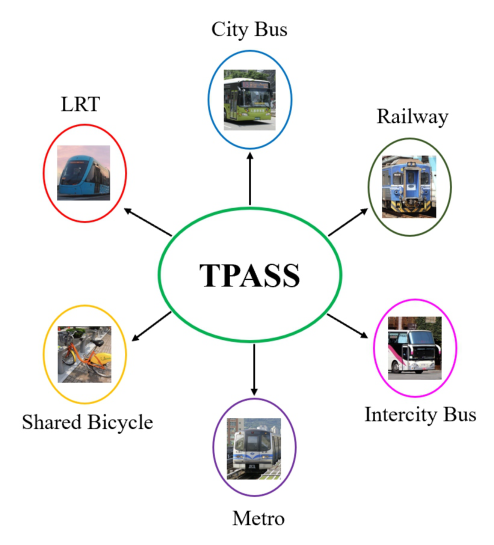
In response to rising transportation demand and environmental challenges, Taiwan introduced the TPASS Commuter Pass Program in 2023 to promote sustainable and people-oriented mobility. Jointly supported by the central and local governments, TPASS integrates multiple modes of public transportation including metro, light rail, intercity and city buses, Taiwan Railways, and public bike-sharing into a single smart card system (see Figure 1). The program aims to reduce private vehicle dependency, lower travel costs, and improve transfer convenience across regions. Beyond its economic and operational benefits, TPASS represents a crucial policy effort toward achieving sustainable urban transport, enhancing accessibility, and fostering equitable mobility for all citizens.
RESEARCH OBJECTIVES This study focuses on the TPASS commuter pass program in Taiwan. Through literature review, theoretical analysis, and indicator evaluation, it aims to establish a sustainability assessment framework for integrated
Evaluating Customer Loyalty and Sustainability Performance of the TPASS Integrated 2071
public transport systems. The research investigates passengers’ perceptions and needs, analyzing their importance and satisfaction levels regarding sustainable transportation and urban sustainability. Additionally, it explores the impact of sustainable transportation levels on customer loyalty and urban sustainability. Finally, this study seeks strategies and opportunities to enhance the attractiveness and sustainability competitiveness of the TPASS system based on regional environmental conditions and travel demands.
Figure 1: Integrated transportation modes under the TPASS commuter pass program.
LITERATURE REVIEW
The concept of sustainable transportation emerged from the Agenda 21 framework introduced at the 1992 United Nations Earth Summit and was later reinforced by the 2012 UN Conference on Sustainable Development. These frameworks positioned mobility and transportation as key elements in achieving sustainability. The 2030 Sustainable Development Goals (SDGs), particularly Goal 11, emphasize affordable, safe, and inclusive transportation systems as fundamental to build sustainable cities. Sustainable transportation thus aims to integrate environmental protection, social equity, and economic efficiency while reducing dependence on private vehicles and promoting low-carbon mobility.
Urban sustainability, closely tied to sustainable transportation, reflects the balance among environmental, economic, and social dimensions (Rogers, 1997; Hassan & Lee, 2015). Scholars have highlighted the importance of equitable access to transportation, housing, and services as essential to inclusive and resilient communities. In this regard, urban transportation systems play a pivotal role in promoting sustainability by reducing emissions,
improving regional connectivity, and fostering economic participation. Studies such as Shiftan et al. (2003) and Houston et al. (2015) demonstrated that rail-based and multimodal systems effectively mitigate congestion and enhance urban livability, while Sekasi et al. (2021) confirmed that integrated transit development advances both economic and social sustainability.
Customer loyalty, as conceptualized by Jacoby and Kyner (1973), represents a consistent preference or commitment toward a product or service. Subsequent research (Oliver, 1997; Oliver, 1999) expanded this idea to encompass both behavioral and attitudinal dimensions, emphasizing that satisfaction and trust are critical to maintaining long-term loyalty. More recent schoolars (Luo & Paulino, 2023) have linked loyalty to perceptions of fairness, social responsibility, and sustainability, suggesting that customer commitment increasingly aligns with values beyond individual benefit.
RESEARCH FRAMEWORK AND QUESTIONS This study focuses on evaluating the performance of the TPASS commuter pass system from the perspective of sustainable and human-centered transportation. Based on literature review and data analysis, the research examines users’ perceptions of TPASS, emphasizing how its integrated fare and multimodal design contribute to urban sustainability and user satisfaction.
First, the study employs Importance–Performance Analysis (IPA) to compare the perceived importance and satisfaction of various service attributes, thereby identifying key areas for improvement. Next, regression analysis is applied to investigate the relationships among sustainable transport performance, urban sustainability, and user loyalty, highlighting factors that influence continued use and policy support.
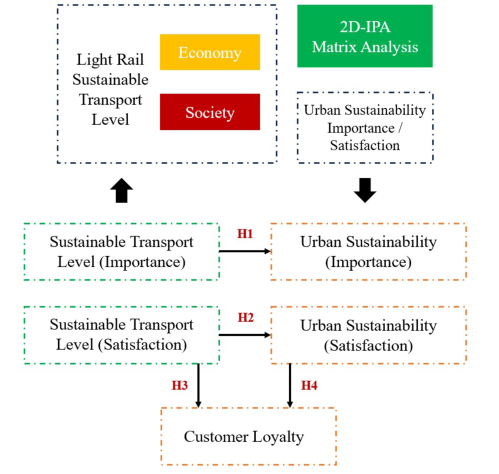
Figure 2: Research framework of TPASS study.
Evaluating Customer Loyalty and Sustainability Performance of the TPASS Integrated 2073
The research framework, illustrated in Figure 2, conceptualizes the interactions between sustainable transport dimensions (economic and social), perceived importance and satisfaction, and customer loyalty. It hypothesizes that (H1) the importance of sustainable transport performance positively affects perceived urban sustainability; (H2) satisfaction with sustainable transport performance enhances urban sustainability; (H3) satisfaction with sustainable transport performance fosters customer loyalty; and (H4) satisfaction with urban sustainability further reinforces customer loyalty.
RESEARCH METHODOLOGY This study adopted a quantitative approach using a structured questionnaire based on a five-point Likert scale developed by Rensis Likert to measure respondents’ levels of agreement. The questionnaire consisted of two parts: demographic information and perception measures regarding sustainable transportation, urban sustainability, and customer loyalty. Each attribute was evaluated in terms of both importance and satisfaction to enable the application of Importance–Performance Analysis (IPA). The questionnaire items were developed based on sub-dimensions identified through a comprehensive literature review to ensure content validity and theoretical relevance.
To ensure the internal consistency of the measurement, Cronbach’s α (Alpha) was calculated for each construct. Cronbach’s α, proposed by Lee Cronbach in 1951, is a reliability coefficient used to assess how closely related a set of items are as a group. A higher α value indicates greater internal consistency. In this study, α ≥0.9 was considered excellent, 0.8–0.9 good, 0.7–0.8 acceptable, and values below 0.7 regarded as marginal or poor. This reliability test ensures that all items within each dimension consistently measure the same underlying concept, thereby supporting the validity of the subsequent analysis.
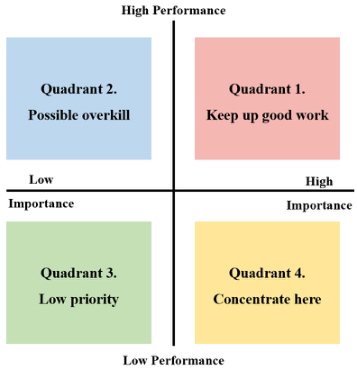
The IPA method, introduced by Martilla and James (1977), was used to identify strengths and improvement priorities by mapping the average importance (X-axis) and satisfaction (Y-axis) of service attributes in a two-dimensional matrix. The four quadrants represent: (1) Keep Up the Good Work, (2) Possible Overkill, (3) Low Priority, and (4) Concentrate Here. The IPA framework applied in this research is illustrated in Figure 3.
To further quantify improvement urgency, this study applied the Improvement Coefficient (IC) proposed by Yang (2003). A more negative IC value indicates a greater gap between satisfaction and importance, implying a higher priority for improvement. In practical terms, the IC is calculated by subtracting the importance score from the performance score and then dividing the result by the importance score. Lastly, regression analysis was used to examine causal relationships among sustainable transportation dimensions, urban sustainability, and customer loyalty.
Figure 3: Importance-performance analysis (IPA).
BASIC ANALYSIS A total of 234 valid questionnaires were collected. Most respondents were students, followed by public servants, reflecting TPASS’s primary role in serving daily commuters and school travelers. In terms of trip purpose, the majority used TPASS for commuting (55.4%) and school travel (41.6%), showing its dominance in regular and essential mobility. Regarding frequency, most participants used TPASS three to five days per week, indicating its importance in routine travel. The main transfer combinations were Metro– Bus, Metro–Intercity Bus, and Metro–Railway, suggesting strong integration across public transport modes.
For reliability, all constructs demonstrated high internal consistency. The Cronbach’s α values were 0.919 for sustainable transport (importance), 0.965 for sustainable transport (satisfaction), 0.870 for customer loyalty, 0.948 for urban sustainability (importance), and 0.966 for urban sustainability (satisfaction). Since all coefficients exceed the standard threshold of 0.7, the questionnaire exhibits excellent reliability, confirming the consistency and credibility of the data for subsequent analysis.
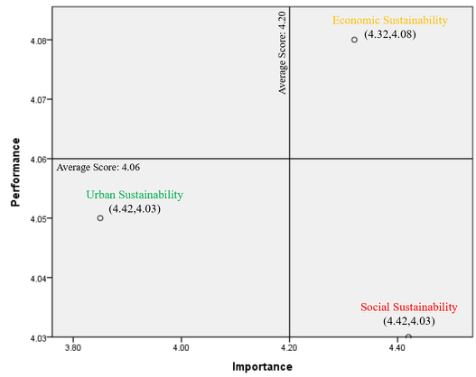
RESULTS OF IPA AND REGRESSION ANALYSIS As shown in Figure 4, Economic Sustainability falls within Quadrant 1 (Keep Up the Good Work), indicating that respondents perceive this dimension as both highly important and well-performing. This suggests that the TPASS policy effectively fulfills users’ expectations in terms of economic aspects such as cost efficiency, value creation, and operational stability, aligning with its intended policy goals. In contrast, Social Sustainability is positioned in Quadrant 4 (Concentrate Here), implying that although it is regarded as important, its performance remains relatively unsatisfactory. This result highlights the need for improvement in areas like social inclusion, fairness, and accessibility for diverse groups of users. Meanwhile, Urban
Evaluating Customer Loyalty and Sustainability Performance of the TPASS Integrated 2075
Sustainability lies in Quadrant 3 (Low Priority), reflecting that respondents perceive it as less important and less satisfactory. This indicates that TPASS has yet to demonstrate a significant contribution to urban connectivity, spatial integration, and environmental resilience suggesting that future enhancements could focus on better linking the system with sustainable urban development objectives.
Figure 4: Results of sustainability dimensions.
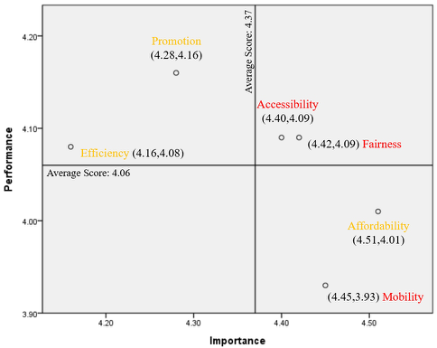
Further analysis presented in Figure 5 explores the sub-dimensions of Economic and Social Sustainability in greater detail. Among these sub-dimensions, Accessibility and Fairness are located in Quadrant 1, representing well-performing areas that should continue to be maintained and reinforced. Promotion and Efficiency are situated in Quadrant 2 (Possible Overkill), meaning that their performance exceeds their perceived importance; this suggests that current resources might be slightly over- allocated and could be redistributed to underperforming areas. Conversely, Affordability and Mobility are placed in Quadrant 4 (Concentrate Here), indicating that these aspects are considered highly important but yield low satisfaction levels. Therefore, improving fare affordability, last-mile connectivity, and travel flexibility should be prioritized to enhance the overall user experience and strengthen the TPASS system’s long-term sustainability.
The Table 1 shows that the Improvement Coefficient reflects the gap between importance and performance, where a more negative value indicates a greater need for improvement. Mobility (–0.118) ranks first, suggesting that enhancing travel convenience and encouraging private vehicle users to shift toward public transportation are the most urgent priorities. Affordability (–0.111) ranks second, indicating that fare levels and cost fairness remain major concerns among users. Fairness (–0.074) and Accessibility (–0.071) rank third and fourth, respectively, implying moderate room for improvement in terms of service equity and accessibility. In contrast, Promotion (–0.028) and Efficiency (–0.021) exhibit the smallest
gaps, ranking fifth and sixth, meaning that current performance in these areas already meets user expectations. Overall, the results suggest that strengthening Mobility and Affordability would most effectively enhance user satisfaction and contribute to the long-term sustainability of the TPASS policy.
Fairness –0.074 3 Mobility –0.118 1 Accessibility –0.071 4 The regression results (Table 2) show that all four hypothesized relationships are statistically significant (p < 0.01), indicating that sustainable transport factors have meaningful effects on urban sustainability and customer loyalty. However, the strength of these relationships, as reflected by the R values, varies across models. Specifically, the importance of sustainability level is positively correlated with urban sustainability importance (R = 0.516), suggesting that when people place higher importance on sustainable transport, they also recognize urban sustainability as a crucial policy objective. Similarly, sustainability level performance has a strong positive influence on urban sustainability performance (R = 0.527), indicating that tangible improvements in transport systems can directly enhance perceptions of a city’s overall sustainability.
Evaluating Customer Loyalty and Sustainability Performance of the TPASS Integrated 2077
Table 2: Regression analysis results.
Table available in the original PDF paper.
Indpependent Variable Dependent Variable R Significant 0.516 P < 0.01 Sustainability Level (Importance)
Urban Sustainability (Importance)
0.527 P < 0.01
Sustainability Level (Performance)
Urban Sustainability (Performance) Customer Loyalty 0.357 P < 0.01
Sustainability Level (Performance)
Customer Loyalty 0.468 P < 0.01
Urban Sustainability (Performance)
In contrast, the relationships involving customer loyalty are slightly weaker (R = 0.357 and R = 0.468), though still statistically significant. This result suggests that while users’ satisfaction with sustainable transport and urban sustainability contributes to loyalty, behavioral outcomes such as continued use and recommendation may also be influenced by other factors—such as convenience, fare structure, or personal travel habits. In summary, these findings confirm that improving both the perception and performance of sustainable transport significantly strengthens urban sustainability outcomes, while loyalty effects, though positive, are somewhat moderated by external or individual-level conditions.
CONCLUSION
Adopting a human-centered perspective, this study evaluated the sustainability performance and customer loyalty of Taiwan’s TPASS Integrated Commuter Pass using Importance–Performance Analysis (IPA), the Improvement Coefficient (IC), and regression analysis. The results reveal that while economic sustainability performs strongly, aspects related to mobility, affordability, and fairness key indicators of social and urban sustainability require further improvement. These findings highlight that users value not only efficiency and cost-effectiveness but also the human experience of transportation whether the system feels accessible, equitable, and supportive of everyday mobility needs.
The analysis further shows that both the perceived importance and performance of sustainable transport contribute positively to urban sustainability and user loyalty. However, the strength of these relationships suggests that loyalty is shaped not only by the system’s operational design but also by human-centered factors such as convenience, emotional connection, and perceived trust in public transport. This emphasizes that users’ sense of belonging, fairness, and comfort can be as influential as infrastructure itself.
Overall, the study underscores that the TPASS program should evolve from an efficiency-driven initiative to a people-oriented sustainable mobility system. Future policy directions should focus on inclusiveness and accessibility, improving last-mile connectivity, ensuring fare affordability, and enhancing user experience through empathetic and responsive service design. By aligning sustainability with human well-being, TPASS can advance not
only environmental and economic goals but also foster a more connected, equitable, and livable urban society.
RESEARCH LIMITATIONS AND FUTURE IMPLEMENTATIONS This study analyzed the sustainability performance and user perceptions of Taiwan’s TPASS Integrated Commuter Pass, providing valuable empirical insights. However, several limitations should be acknowledged. First, the analysis relied on self-reported questionnaire data, which may not fully capture users’ actual behavioral changes or travel frequency. Second, the sample consisted mainly of current TPASS users, limiting the generalizability of results to non-users or potential adopters. Future studies could expand participant groups to better reflect user diversity and latent demand.
From a practical perspective, future TPASS development should emphasize inclusive design and adaptive mobility policies. Integrating real-time data analysis, differential fare mechanisms, and participatory planning can better respond to user needs. Such human-centered innovations not only improve system efficiency but also strengthen emotional connection and social trust between people and sustainable mobility systems.
ACKNOWLEDGMENT
This study wishes to express its sincere appreciation to the Department of Transportation Management at Tamkang University for the valuable guidance, encouragement, and academic support provided throughout the course of this research. We also gratefully acknowledge the financial and research support from the National Science and Technology Council (NSTC), Taiwan, which has made the completion of this study possible.
REFERENCES
Hassan, A. M., & Lee, H. (2015). The paradox of the sustainable city: Definitions and examples. Environment, development and sustainability, 17, 1267–1285. Houston, D., Boarnet, M. G., Ferguson, G., & Spears, S. (2015). Can compact rail
transit corridors transform the automobile city? Planning for more sustainable travel in Los Angeles. Urban Studies, 52(5), 938–959. Luo, Z., & Paulino, A. G. (2023). Correlation of Customer Satisfaction and Loyalty: The Heritage Tourism Site of Dongguan Street in Yangzhou, Jiangsu Province, China. Journal of Service Science and Management, 16(3), 161–191. Oliver, R. L. (1997), Satisfaction–A Behavioral Perspective on the Consumer,
New York: McGraw-Hill. Oliver, R. L. (1999), “Whence Consumer Loyalty,” Journal of Marketing, Vol. 63. Rogers, R. (1997). Cities for a small planet. London: Faber and Faber Limited. Sekasi, J., & Martens, M. L. (2021). Assessing the contributions of urban LRT transit to the sustainable development of addis ababa. Sustainability, 13(10), 5667. Shiftan Y., Kaplan S., Hakkert S. (2003). Scenario building as a tool for planning a
Human Factors in Design, Engineering, and Computing
Read this individual research paper free through the original publisher, or explore the full digital proceedings book.
ISBN 978-1-964867-75-5
Explore this ISBN in the AHFE Bookstore ↗Listed in the July 2026 bookstore catalogue; search by ISBN to confirm current availability · Digital book purchase optional