Alyssa Weakley, Sasha Pimento, Amey Gohil, Payal Hegde, Arveen Kaur, Priyanka Koppolu, Hritvik Agarwal, Preyash Yadav, Tejas Patil, Andrew Weakley, Sarah Tomaszewski Farias (2025). Promoting Autonomy in Older Adults with Cognitive Impairment: Co-Designing an Interactive Calendar for Memory Support. In: Human Factors in Design, Engineering, and Computing. AHFE Open Access, vol. 199, pp. 1616–1627. https://doi.org/10.54941/ahfe1006972
Alzheimer’s disease (AD) remains one of the most distressing public health challenges of our time, creating a critical need for tools that serve both care recipients and caregivers, especially in remote care settings. Interactive-Care (I-Care) is an innovative web-based remote caregiving platform designed to promote independence in AD patients while bridging both the physical and emotional gaps in caregiving. In this paper, we focus on I-Care’s calendar tool, developed to overcome the challenges presented by commonly used digital calendar platforms which impose high cognitive load and cause confusion among individuals with AD. We describe the iterative co-design process through which the calendar evolved, informed by multiple rounds of feedback and refinement.Participants/Methods: First, a calendar prototype was developed based on cognitive rehabilitation guidelines and existing calendar systems for individuals with mild cognitive impairment. The prototype was reviewed by experts in AD and dyads (care receiver and remote caregiver) who provided feedback and suggested modifications. The prototype was iteratively modified using this review-feedback-modification process 3 times. Next, two older adults (ages 84-88) with mild dementia (Montreal Cognitive Assessments of 19-20) participated in an iterative co-design process over the course of several interactions with the Calendar page. To quantitatively evaluate improvements, we conducted counterbalanced A/B testing comparing the pre-co-design and co-designed versions of the Calendar and additionally benchmarked its usability against Google Calendar. Participants also completed a custom Technology Acceptance Model (TAM) questionnaire that included Likert ratings (1-5, 5 being the highest) of Perceived Ease of Use, Perceived Usefulness, and Intention to Use. Results: Successive Calendar design refinements incorporated a shaded column highlighting the current day, step-by-step pop-up workflow for event creation, flashing notifications for new calendar entries, and multiple concomitant alarm options. The co-designed Calendar received high average TAM ratings in terms of Perceived Ease of Use = 5.0, Perceived Usefulness = 4.8, and Intention to Use = 5.0, indicating strong acceptance and usability. A/B testing also demonstrated substantial improvements. In the previous interface, built similarly to Google Calendar, participants were unable to complete key tasks without assistance. In contrast, with the co-designed Calendar, all tasks were completed independently, with a reduction in event creation time from 252 seconds to 94 seconds. Navigation between weeks and selecting today’s date also became faster and more accurate. Participants reported substantially higher satisfaction with co-design Calendar compared to the prior version, citing ease of navigation and clarity of visual cues. In contrast, Google Calendar task completion elicited very poor satisfaction ratings, with one participant refusing to continue using it due to its complexity.Conclusions: The I-Care Calendar design process demonstrates that individuals with cognitive impairment can engage in co-design to good effect resulting in a Calendar they can use independently. High satisfaction ratings highlight its clarity, intuitive design, and accessibility, emphasizing the value of tailoring digital tools to the cognitive needs of older adults. These findings underscore the importance of a co-design approach in developing assistive technologies that support daily routines, autonomy, and overall quality of life for older adults with cognitive impairments.
Alzheimer’s disease (AD) is one of the most distressing public health challenges of our time. There is a critical need for tools that serve both care recipients and their family caregivers, especially those providing care from a distance (i.e., remote care). Individuals with AD are impacted by profound memory impairment and executive dysfunction that result in declines in their
Promoting Autonomy in Older Adults With Cognitive Impairment 1617
ability to manage daily activities. These declines threaten their independence and ability to age-in-place alone, a desire strongly held by a large portion of seniors (Portacolone & Cohen, 2024). Inability to manage daily affairs has serious health consequences including failures to take medication and attend medical appointments, higher healthcare utilization (e.g., avoidable emergency department visits), and increased strain on caregivers (Fonareva & Oken, 2014). Prior research suggests that remote caregivers spend much of their time managing care receiver’s daily affairs (Edwards, 2014). As such, caregivers desire digital applications that integrate multiple functions in a single tool and will engage care recipients in management of their own daily activities (Williamson, Gorman, & Jimison, 2014).
Electronic reminder systems provide timely, structured prompts that can foster independence and reduce anxiety associated with forgetfulness in individuals with dementia (El Haj et al., 2017; Meiland et al., 2017; Pimento et al., 2023). Calendar- based reminder systems have the added benefit of orienting a person to the current time/date/year, assisting with future planning and providing a reminder of completed activities. Indeed, digital calendars have been found to be effective at reminding individuals with cognitive impairment to complete tasks independently. For example, after training, individuals with mild cognitive impairment (MCI) were able to use the Memory Support System (MSS), a multifunction tool including a digital calendar (Greenaway et al., 2013).
Another tool, RemindMe, was developed for older adults involved in cognitive rehabilitation secondary to neurological injury/disease (Andreassen et al., 2021). RemindMe involves scheduling activities in a web-based calendar which sends reminders via Short text Message Service to the user’s phone at a specified time. Over an eight-week intervention, RemindMe participants showed significant improvements in self-reported ability to manage daily activities. They were also more satisfied with memory support than a control group using standard calendars, like Google Calendar. However, authors in this and other studies acknowledge that success depended on hands-on training and caregiver involvement, reducing the likelihood of scalable remote care (Cahill et al., 2007; Di Campli San Vito et al., 2024; El Haj, 2017).
Qualitative research on digital calendaring consistently emphasizes the role of calendar personalization, accessibility, location, and caregiver synchronization in sustaining calendar use in real-world settings (Evans & Collier, 2017; Zubatiy et al., 2023). Holthe & Walderhaug (2010) also suggest message board integration for those who need support structuring their day. Together, literature on digital calendar systems suggests they can improve daily functioning and independence, but their success depends on thoughtful design choices with users and caregivers, personalized feedback, and integration into everyday life.
The literature on co-design with end-users of digital care technology is extensive (for reviews see Cole et al., 2022; Duffy et al., 2025; Kilfoy et al., 2024). Research in this area suggests that individuals with dementia can meaningfully engage and contribute to the co-design process (Leorin et al., 2019). Importantly, end-user participatory involvement may be
key to uncovering usability and perceived usefulness of application features that would otherwise lead to poor uptake and adherence.
Older adults with dementia use non-digital calendars as compensatory strategies, finding them crucially important to their everyday life, and even personifying their supportive nature as friend-like (Evans & Collier, 2017). Despite positive views of calendar systems, individuals with cognitive impairment sometimes feel that their loss of functioning, age, and level of technology familiarity stop them from using digital calendars. To overcome these barriers, a careful co-design process must be undertaken so individuals in the early stages of AD may reap the benefits of electronic features including customizable alarms, artificial intelligence (AI), and remote caregiver support.
In this paper, we focus on the development of the Interactive-Care (I-Care) calendar to address the challenges presented by commonly used digital calendar platforms which impose high cognitive load and cause confusion among individuals with AD. While other digital calendar systems have been developed, they rely heavily on caregiver involvement. Our goal was to address the remote caregiver need of having individuals with dementia actively involved in their own daily activities to the fullest extent they are able to. Thus, for this project, we focus specifically on designing a calendar system that individuals with mild dementia can use independently as a daily reminder system. This system also integrates a remote caregiving interface allowing caregivers to add calendar entries and provide assistance as needed from anywhere in the world. This paper describes the iterative co-design process through which the I-Care calendar evolved, informed by multiple rounds of feedback and refinement.
METHODS
The I-Care calendar tool was developed using modern web technologies selected specifically for their accessibility features, scalability, and ability to support real- time collaboration between individuals with cognitive impairment and their remote family caregivers. The calendar interface is built using Vue.js 2.x, a progressive JavaScript framework known for its reactive data binding and component-based architecture. Vue.js enables efficient state management and dynamic user interface updates, critical for maintaining responsiveness in interactive calendar applications. The framework’s approachable learning curve and excellent documentation facilitated rapid iterative development during the co-design process described below.
System Design and Calendar Architecture Vuetify 2.x served as the primary user interface (UI) component library, providing Material Design-compliant components that are pre-configured with accessibility features. Vuetify’s calendar component (v-calendar) offers built-in support for multiple view types (day, week, month), event rendering, and time-based interactions. The library’s customization options allow for
Promoting Autonomy in Older Adults With Cognitive Impairment 1619
significant modifications to improve usability, including responsive user interface components suitable for older adults with cognitive impairment.
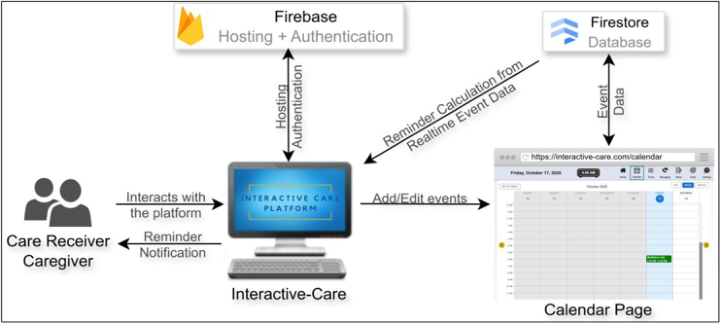
The system leveraged Firebase as the backend infrastructure (see Figure 1) offering: (1) secure user authentication supporting Google OAuth and email/password login methods, enabling secure user management and role- based (caregiver or care receiver) access control; (2) Cloud Firestore, a NoSQL document database for real-time data synchronization and offline support; (3) static web hosting with SSL certification for secure connections; and (4) Firebase analytics for user behavior tracking and engagement metrics. Additional integrated technologies include JavaScript ES6+ for modern and maintainable code; HTML5 and CSS3 for semantic markup and advanced styling; and Babel for JavaScript transpilation ensuring cross- browser compatibility.
The calendar interface supports both care receiver and caregiver views with dynamic role detection. Upon authentication, users are classified based on profile metadata, which determines interface layout, available controls, and data access permissions. This dual-role architecture enables seamless collaboration between care recipients and remote caregivers while maintaining appropriate security boundaries. The codebase is structured using modular JavaScript with separate files for calendar logic, event management, authentication, and utility functions. This separation of concerns facilitates code maintainability and enables multiple team members to work concurrently on different features.
Figure 1: I-Care system design.
Firestore’s real-time listeners propagate immediate changes (e.g., edits, created events) instantly across care receiver and caregiver interfaces. Utility functions handle date calculations, recurrence expansions, and reminder scheduling. The calendar leverages optimized Vue reactivity to ensure minimal re-rendering for performance optimization. Firebase’s managed
infrastructure auto-scales and guarantees high availability, accommodating variable user loads without performance degradation.
Iterative Refinement Process First, taking a user-centered approach, we developed a calendar prototype based on cognitive rehabilitation guidelines for individuals with dementia and existing calendar systems for individuals with MCI and other neurological conditions.
The prototype was reviewed by professionals with expertise in AD (4), older adults living alone with cognitive impairment (6), and remote caregivers (7) who provided Usefulness and Satisfaction ratings on a scale from 1–10 (with 10 being very useful/satisfied) and suggested modifications. The prototype was iteratively modified 3 times using this review-feedback-modify process.
Next, in the evolution of our design process, we moved from a user- centered approach to a co-design approach. To accomplish this aim, we worked closely with two female participants (age 84 and 88) with clinical diagnoses of mild dementia (Montreal Cognitive Assessments scores of 19–20) who were living alone in the community but required assistance in at least one instrumental activity of daily living secondary to cognitive decline. One participant was Hispanic White and Spanish/English bilingual and the other was non-Hispanic White and English speaking. Education ranged from 12–18 years, and they had low-moderate comfort with digital technology. Both participants were supported by their adult children who provided remote care.
Participants were provided with an all-in-one-computer to display I-Care, a multifunction daily management web-app designed for collaborative use by individuals living alone with mild-moderate cognitive impairment and their remote caregivers. I-Care includes 6 main functions, referred to as ‘pages’, and a navigation bar present at the top of each page to provide consistency and ease of use. The navigation bar includes the date and time, buttons to navigate to each page, and personalized user settings. Pages include: (1) a Home page consisting of personal pictures, the current weather, and upcoming events, (2) Calendar page, (3) To-Do page with two customizable lists, (4) Messaging page with simplified synchronous and asynchronous communication options, (5) Notes page for information storage, and (6) Goals page for settings and tracking brain healthy activities (Pimento et al., 2024). Similar to a paper calendar, I-Care calendar is accessible at all times and located in a high traffic area of participants choosing. The computer remains on during the day and displays I-Care in Kiosk mode, specifically on the calendar page. The browser address bar is hidden to prevent users from navigating away from I-Care. This configuration promotes I-Care use, eliminates the need to sign-in/remember passwords, and prevents users from relying on their memory to navigate to I-Care independently.
Following basic training on how to use I-Care, we engaged our lived- experience participants in an iterative, co-design process that occurred over
Promoting Autonomy in Older Adults With Cognitive Impairment 1621
several sessions. During each session, examiners would carefully observe how participants naturally engaged with the different I-Care components. To further elucidate participants’ approach to I-Care, examiners engaged participants in a think-aloud process (Ichsani, 2017). These steps were taken with as little examiner guidance, training, and support as possible given that cognitive deficits would likely interfere with retention of information and thus would not reflect future engagement patterns. In addition to behavioral observation, we requested that participants provide recommendations for modifications. After individual sessions with both participants, a team consisting of software engineers/web developers, examiners, and subject matter experts met to discuss possible modifications/refinements. These were then executed and evaluated by participants in a subsequent session. We repeated this process over the course of several weeks until both users endorsed satisfaction with the I-Care calendar and were observed to consistently use the various functions independently.
Evaluation We conducted counterbalanced A/B testing comparing the prototype to the co-designed calendar. Participants were asked to complete the following tasks in each version: (1) with your mouse, click on the calendar page; (2) with your mouse, point to today on the calendar; (3) create a new event for Friday from 9:00-10:00 am, label the event “test,”set a reminder for 10 minutes before the event; (4) show me where the newly created event is; (5) using your mouse, navigate to next week, and then back to the current week; and (6) delete the Friday “test” event you just created. Instructions could be repeated as many times as needed. Time (in seconds) to complete each task was recorded as well as omissions, inefficiencies, and errors. For additional usability benchmarking, we also requested that participants complete the same tasks in Google Calendar except for “click on calendar.” Rather, examiners navigated to the Google Calendar on behalf of the participants who carried out the remainder of the tasks. Participants also completed a custom Technology Acceptance Model (TAM) questionnaire for the co-designed I-Care calendar that included Likert ratings (1-5, with 5 being the highest) of Perceived Ease of Use, Perceived Usefulness, and Intention to Use (Davis, 1989).
RESULTS
Prototype The prototype was first evaluated by professionals with expertise in neurodegenerative diseases. They rated I-Care as a useful tool both for individuals with cognitive impairment (M = 8.33, SD = 1.53) and remote caregivers (M = 9.33, SD = 1.15). Recommended improvements included minor modifications to the user interface and functionality (e.g., text contrast, medication tracking). These modifications were completed, and I-Care was subsequently evaluated by individuals with cognitive impairment and caregivers who provided high ratings for both usefulness
(M = 10.00, SD = 0.00; M = 9.67, SD = 0.58, respectively) and satisfaction (M = 10, SD = 0.00; M = 9.00, SD = 1.00, respectively). Recommended improvements included the ability to create and collaborate on text documents, which was implemented and evaluated in a final round of reviews. Round 3 care receivers again had high ratings for both usefulness and satisfaction (M = 9.40, SD =1.41). Caregivers provided a perfect 10/10 ratings for caregiver and care receiver usefulness and satisfaction.
Co-Design During the co-design process, the I-Care calendar underwent several enhancements based on user feedback and examiner observation. For example, the prototype presented today’s date with a vertical bar separating time and date that interfered with ease of locating the current time. Following several suggestions, users identified that a familiar alarm clock icon would improve rapid recognition of the current time, while also adding a touch of levity. The calendar also defaults to displaying the time slots from 8:00 AM to 8:00 PM, thus showing the most relevant daytime hours and minimizing the need for scrolling through infrequently used empty time slots. High- contrast styling, enlarged fonts, and increased spacing between words further improved readability, ensuring key interface elements remain prominent and easily distinguishable.
Temporal orientation was also improved to guide users to identifying the current day. We initially followed conventional (e.g., Google calendar) styling by using a blue circle over the current date. However, upon testing, we discovered that users were not able to reliably identify “today” and could not describe what the blue circle indicated. The new co-designed interface highlights the entire current day column in blue, while prior days are greyed out and future days are in white. This modification allowed users to focus their attention on the current day and upcoming events (see Table 1 for additional comparisons).
Table 1: Comparing the I-Care calendar to google’s conventional calendar.
Table available in the original PDF paper.
Feature Google Calendar I-Care Calendar Co-Design Outcomes Current Day Represented by a blue circle on the current date and blue text on day of the week.
Improved identification. Users didn’t know what the unlabeled circle represented.
Full day highlighted with prior days grayed out. Date also present in the navigation bar.
Current Time Represented by a red time line on the current date.
The time line was found to be confusing. Time is clearly labeled in the navigation bar.
Time tracking was simplified with a familiar alarm clock icon - no confusing indicators.
Continued
Promoting Autonomy in Older Adults With Cognitive Impairment 1623
Table 1: Continued Feature Google Calendar I-Care Calendar Co-Design Outcomes
Table available in the original PDF paper.
Calendar View Drop down with multiple options. View automatically adjusts depending on time of day.
Present all options above the calendar and current view is highlighted. View default is 8 AM - 8 PM.
Drop-down options eliminated. Time view default reduced the need for scrolling up/down when creating events.
Time shown when hovering over cell
Time Selection Times are listed to the left of the calendar.
Improved selection of correct event time.
Reduces cognitive load and simplified event creation.
Creating an Event Many concurrent input options (Title, location, guests).
Stepwise questions with minimal inputs. Only one possible flow.
Limited options presented linearly.
Recurring Event Multiple drop-down options.
More intuitive, avoiding unnecessary complexity.
Navigation Buttons
Carousel-style navigation buttons on calendar sides. “Go to Today” button to return to current date.
Buttons located at top among several other controls. Return to today by clicking on the “Today” button.
Carousel navigation eased scrolling between views. Further, “Go to Today” enhanced clarity vs. “Today.”
Video Link Supported. Not Supported. A desired feature.
Syncing and Sharing
Both supported. Caregivers access to view and schedule events.
Calendar syncing is desired, particularly among caregivers.
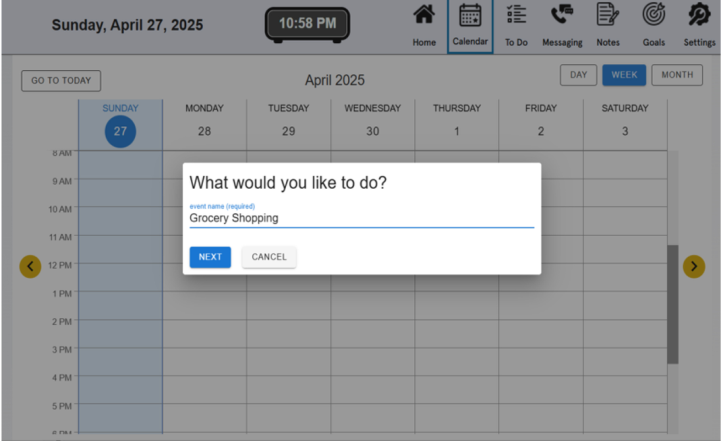
The event creation process underwent significant redesign based on participant feedback and examiner observation. The original implementation presented users with a single-form pop-up containing all input fields simultaneously (e.g., event name, date/time, reminders), which overwhelmed users and caused confusion. Feedback led to the development of a step- by-step guided workflow that breaks complex tasks into manageable components through progressive responses to posed questions, thereby reducing cognitive load (see Figure 2). Date and time are prepopulated based on the calendar cell users clicked on and plain language prompts confirm information (e.g., “you chose May 15, is that correct?”). Once an event is saved, a short flash animation draws immediate attention to the new entry, helping users with memory challenges confirm their action was successful without being overly distracting.
Figure 2: I-Care calender event creation.
The prototype calendar permitted only a single reminder per event, limiting flexibility for users who might need multiple, layered memory cues. The redesigned system now supports multiple reminders. Regarding reminder alarms, the prototype system played a continuous audio alert that persisted until manually dismissed. This approach caused distress and confusion when participants returned from being out of the house. The redesigned alarm system now employs a graduated notification approach: an initial audio alarm rings for 5 minutes, followed by a clear verbal message (i.e., “you have a missed alarm”) every 5 minutes until acknowledged. There is also a 5-minute snooze button feature.
Evaluation Testing revealed improvements in terms of time and ability to complete tasks for the co-designed calendar compared to both the prototype and Google calendars (see Table 2). Of note, the prototype also had clear advantages over the more conventional Google calendar interface but challenges with independent event creation remained. Participants reported substantially higher satisfaction with the co-designed calendar compared to the prior version, citing ease of navigation and clarity of visual cues. In contrast, Google Calendar task completion elicited poor satisfaction ratings, with one participant discontinuing testing due to frustration. Regarding co-design calendar TAM ratings, participants provided exceptionally high average ratings of Perceived Ease of Use = 5.0, Perceived Usefulness = 4.8, and Intention to Use = 5.0. These ratings indicate strong acceptance and usability.
Promoting Autonomy in Older Adults With Cognitive Impairment 1625
Table 2: Calendar evaluation.
Table available in the original PDF paper.
Task Completion Time in Seconds (sd) 13.65 (12.66) 3.69 (2.28) N/A Prototype Co-Designed Google Go to calendar page
11.30 (0.65) 12.87 (0.14) 102
Point to today 15.97 (3.90) 4.24 (1.39) 26.13 Create a new event Unable 78.23 (22.13) 151 (41.01) Navigate to next week and back to today 90.28 (46.70) 15.15 (3.08) 15.51 Delete the new event
Satisfaction
“This wasn’t designed for people like me.” “The font is too small.”
“Today’s day is pleasantly shown.” “Highest I can rate, it’s got everything.”
Rating Average 7 (4.24) 10 (0) 0 (0) Quotes “Gives basic information but doesn’t pinpoint specific stuff.”
DISCUSSION
The development and evaluation of the I-Care calendar, informed by iterative co- design with older adults living alone with cognitive impairment, successfully addressed critical design barriers present in conventional digital calendars. The results strongly support our human-centered approach, demonstrating that purposeful design can drastically reduce cognitive load and enhance independent use of a digital calendar. Importantly, each iteration addressed small but critical usability challenges, demonstrating that even seemingly minor design details can have a substantial impact on user confidence in using the system independently.
The most significant finding is the superior usability of the co-designed calendar over both the initial prototype and Google Calendar. Task completion times were dramatically lower for the co-designed calendar and participants reported higher levels of satisfaction. Further, participants provided exceptionally high TAM ratings of perceived ease of use and intention to use. In stark contrast, participants were unable to complete the crucial task of event creation in the prototype and expressed high frustration with the conventional Google interface, with one participant discontinuing testing.
These findings directly support the cognitive rehabilitation literature, which emphasizes that tools for individuals with cognitive impairment must minimize complexity and ambiguity. Our key design modifications including the progressive event creation workflow, multi-modal notifications, and the use of enhanced visual cues were instrumental. These features worked together to address the cognitive limitations experienced by our participants, proving far more effective than concurrent input models and abstract visual indicators. The final result is a system that allows older adults to perform
complex daily management tasks independently, upholding their strong desire to age-in-place, and remote caregivers need for less oversight of daily activities.
While the co-design process yielded a usable and accepted tool, this study has limitations. Notably, our study was limited to 2 lived-experience participants. That said, this small sample allowed for deep, case study level insights into usability challenges and user preferences. These observations provide a critical foundation tightly aligned with user needs and cognitive accessibility requirements for the next stage of research which include broad testing.
CONCLUSION
The I-Care calendar is a comprehensive reminder system designed to support independence in users with mild-moderate cognitive impairment. The development process demonstrated that individuals with cognitive impairment can effectively engage in co-designing digital tools resulting in a calendar they can use independently. High satisfaction ratings highlight its clarity, intuitive design, and accessibility, emphasizing the value of tailoring digital tools to the cognitive needs of older adults.
ACKNOWLEDGMENT
The authors would like to acknowledge the participants who provided invaluable guidance and suggestions. Funding sources: University of California, Davis Healthy Aging in a Digital World Initiative and NIH/NIA K23AG080152.
REFERENCES
Andreassen, M., Danielsson, H., Hemmingsson, H., & Jaarsma, T. (2022). An interactive digital calendar with mobile phone reminders (RemindMe) for people with cognitive impairment. Scandinavian Journal of Occupational Therapy, 29(4), 270–281. Cole, A. C., Adapa, K., Khasawneh, A., Richardson, D. R., & Mazur, L. (2022).
Codesign approaches involving older adults in the development of electronic healthcare tools: A systematic review. BMJ open, 12(7), e058390. Davis, F. D. (1989). Technology acceptance model: TAM. Al-Suqri, MN, Al-Aufi, AS: Information Seeking Behavior and Technology Adoption, 205(219), 5. Di Campli San Vito, P., McNair, A., & Brewster, S. (2024, June). Discussing
digital calendar input requirements for people with dementia. In Proceedings of PErvasive technologies related to assistive environments (pp. 156–162). Duffy, A., Boroumandzad, N., Sherman, A. L., Christie, G., Riadi, I., & Moreno, S.
(2025). Examining Challenges to Co-Design Digital Health Interventions With End Users: Systematic Review. Journal of Medical Internet Research, 27, e50178. El Haj, M., Gallouj, K., & Antoine, P. (2017). Google calendar enhances prospective memory in Alzheimer’s disease: A case report. Journal of Alzheimer’s Disease, 57(1), 285–291. Evans, N., & Collier, L. (2019). An exploration of the experience of using
calendar reminders for people with dementia and family carers. Dementia, 18(5), 1912–1933.
Promoting Autonomy in Older Adults With Cognitive Impairment 1627
Fonareva, I., & Oken, B. S. (2014). Physiological and functional consequences of caregiving for relatives with dementia. International Psychogeriatrics, 26(5), 725–747. Greenaway, M. C., Duncan, N. L., & Smith, G. E. (2013). The memory
support system for mild cognitive impairment: Randomized trial of a cognitive rehabilitation intervention. International journal of geriatric psychiatry, 28(4), 402–409. Holthe, T., & Walderhaug, S. (2010). Older people with and without dementia participating in the development of an individual plan with digital calendar and message board. Journal of assistive technologies, 4(2), 15–25. Ichsani, Y. (2017, August). Usability performance evaluation of information system
with concurrent think-aloud method as user acceptance testing: A literature review. In International Conference on Science and Technology (pp. 116–121). Atlantis Press. Kilfoy, A., Hsu, T. C. C., Stockton-Powdrell, C., Whelan, P., Chu, C. H., & Jibb, L. (2024). An umbrella review on how digital health intervention co-design is conducted and described. NPJ Digital Medicine, 7(1), 374. Meiland, F., Innes, A., Mountain, G., Robinson, L., van der Roest, H., García-Casal, J. A.,... & Franco-Martin, M. (2017). Technologies to support community-dwelling persons with dementia. JMIR rehabilitation and assistive technologies, 4(1), e6376. Pimento, S. N., Agarwal, H., Minor, B., Karia, S., Cook, D., Schmitter-Edgecombe,
M.... & Weakley, A. (2024, February). Interactive-Wear: An intelligent watch application to aid memory for intentions and everyday functioning in older adults with cognitive impairments. In 2024 IEEE First International Conference on Artificial Intelligence for Medicine, Health and Care (AIMHC) (pp. 145–152). Portacolone, E., & Cohen, A. B. (2024). Living Alone With Dementia: A Reality Check. The American Journal of Geriatric Psychiatry, 32(11), 1322–1324. Zubatiy, T. et al. (2023). A Distributed Cognition Approach to Understanding
Compensatory Calendaring Cognitive Systems of Older Adults with Mild Cognitive Impairment and Their Care Partners. Proceedings of the 15th International Conference on Ubiquitous Computing & Ambient Intelligence, vol. 835. Springer.
LISTED IN THE AHFE DIGITAL BOOKSTORE CATALOGUE
Explore the complete digital volume
Human Factors in Design, Engineering, and Computing
Read this individual research paper free through the original publisher, or explore the full digital proceedings book.
ISBN 978-1-964867-75-5
Explore this ISBN in the AHFE Bookstore ↗Listed in the July 2026 bookstore catalogue; search by ISBN to confirm current availability · Digital book purchase optional