Masami Matsushima, Tomofumi Sakata, Syunpei Kiuchi, Keiichi Watanuki (2025). Visual-Cognitive Profiling Using Eye Movements and Brain Activity: Validation of a Novel Assessment Tool. In: Human Factors in Design, Engineering, and Computing. AHFE Open Access, vol. 199, pp. 1392–1403. https://doi.org/10.54941/ahfe1006951
1 Je respire Co., Ltd. 8-8-10-101 Asakaka, Minato-ku, Tokyo 107–0052 Japan; Graduate School of Science and Engineering, Saitama University 255 Shimo-okubo Sakura-ku, Saitama-shi, Saitama 338–8570 Japan ↗
2 Advanced Institute of Innovative Technology, Saitama University 255 Shimo-okubo Sakura-ku, Saitama-shi, Saitama 338–8570 Japan ↗
3 Graduate School of Science and Engineering, Saitama University 255 Shimo-okubo Sakura-ku, Saitama-shi, Saitama 338–8570 Japan; Advanced Institute of Innovative Technology, Saitama University 255 Shimo-okubo Sakura-ku, Saitama-shi, Saitama 338–8570 Japan ↗
In recent years, a growing number of individuals in educational and workplace settings have experienced non-pathological difficulties, such as fluctuating work efficiency and diminished self-efficacy stemming from an inability to identify learning or working methods that suit their personal cognitive styles. Although these challenges often fall outside the scope of medical or welfare-based support systems, they nonetheless have a substantial impact on daily functioning and performance. Moreover, the persistent cultural notion that “mental care is only for those with illnesses” creates a psychological barrier to seeking help, thereby widening the “support gap” in society. Conventional support systems tend to prioritize individuals with clinical diagnoses, offering limited opportunities for proactive and personalized approaches that empower individuals to optimize performance through self-understanding and cognitive enhancement. To enable such approaches, objective indicators of individual characteristics are essential. Visual-related cognitive functions—such as eye movements, visual field, spatial cognition, and working memory—are known to correlate with learning outcomes, work efficiency, and stress regulation, and are considered trainable. However, no existing framework integrates cognitive assessment, physiological measurement, personalized feedback, and targeted training into a single, practical system. To address this need, we developed and evaluated a tablet-based application, Diabi Eye. This tool assesses user tendencies across four cognitive domains—reading comprehension, memory retention, spatial cognition, and attentional control—by analyzing visual processing and eye movement patterns. Its accuracy was validated through both eye-tracking data and cerebral blood flow measurements. Participants with high reading comprehension scores demonstrated a positive correlation between Diabi Eye performance and activation in the dorsolateral prefrontal cortex (DLPFC), a brain region associated with working memory. In contrast, participants with low spatial cognition scores exhibited a negative correlation in the same region, suggesting distinct neural activation patterns aligned with specific cognitive strengths and weaknesses. Additionally, gaze pattern analysis revealed characteristic eye movement behaviors corresponding to different cognitive profiles, indicating that specific visual behaviors reflect underlying cognitive tendencies. These findings also suggest the potential for improving cognitive weaknesses through targeted visual-cognitive training. Finally, we evaluated pre- and post-intervention outcomes using the app’s built-in training module. Results demonstrated the system’s potential to support the self-optimization of learning and working strategies in everyday life. This study underscores the utility of Diabi Eye as a novel, integrative tool for early, non-clinical cognitive support, bridging gaps between health, education, and occupational performance.
In recent years, an increasing number of individuals in educational and workplace settings have faced “nonpathological difficulties,” such as reduced learning efficiency and diminished self-efficacy. These challenges often fall outside the scope of medical and welfare support, leaving individuals dependent on their own efforts or the understanding of those around them.
Visual-Cognitive Profiling Using Eye Movements and Brain Activity 1393
In Japanese society, the deeply rooted cultural notion that “mental care is only for those who are ill” has hindered access to preventive support.
Previous research has demonstrated that visual-cognitive functions are deeply involved in learning outcomes, work efficiency, and emotional regulation. For example, studies have reported relationships between eye movement patterns and reading comprehension (Rayner et al., 2006), useful field of view and processing speed (Ball et al., 1988), working memory capacity and emotion regulation (Schmeichel et al., 2008), and visuospatial cognition and personality traits (Carbone et al., 2019). From the perspective of attentional control theory, emotional states have been shown to affect the attentional control functions of the prefrontal cortex (Eysenck et al., 2007), and that acute psychological stress reduces working memory-related activity in the dorsolateral prefrontal cortex (DLPFC) (Qin et al., 2009).
However, previous studies have remained limited to single-function approaches that narrowly focus on specific abilities. A comprehensive framework for capturing individual “visual-cognitive styles” has not been sufficiently established. Moreover, methodological challenges remain, including the lack of objective assessment methods, insufficient real-time feedback, and limited practical training tools that can be used in daily life. As a result, conventional assessment methods tended to emphasize “outcomes,” such as task performance or psychological scales, making it difficult to elucidate the underlying cognitive processes.
To address these issues, we employed the tablet-based application DiabiEye, specifically designed to visualize “dominant cognition” (an individual’s preferred cognitive processing style) through visual-cognitive tasks to enable short, objective measurements as well as immediate feedback and training. This study aims to clarify the processing mechanisms underlying dominant cognition styles by integrating DiabiEye task performance with physiological indicators (pupil diameter, autonomic activity, prefrontal hemodynamics, and eye movements).
THE IMPORTANCE OF VISUAL FUNCTION Visual function is the comprehensive ability to process input information from the eyes in the brain and link it to understanding, judgment, and behavior. Its components include visual input (eye movement, peripheral vision, and rapid visual processing), cognitive processing (spatial cognition, working memory, attentional control, and information integration), and output (behavioral and mental regulation).
Visual function serves as the critical foundation that influences a wide range of domains, from learning efficiency and work performance to coping with stress and emotional regulation in daily life and specialized tasks. However, previous studies have focused on single functions (e.g., spatial cognition and working memory), and an integrated framework for capturing the “visual-cognitive processing pathway” has not been sufficiently established. Therefore, this study employed DiabiEye, a tablet- based application designed to comprehensively assess visual cognition.
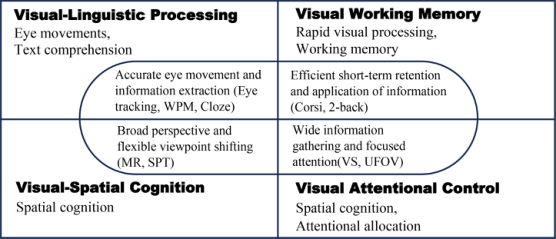
Traditionally, “visual function” has often been described using specialized terms, such as eye movements and spatial cognition, making its impact difficult for nonspecialists to grasp. DiabiEye redefined these functions into four cognitive domains: visual-linguistic processing, visual working memory, visual-spatial cognition, and visual attentional control, to understand them in everyday contexts. This framework enables even nonspecialists to accurately recognize individual strengths and weaknesses in visual cognition.
Each of these four cognitive domains reflects distinct cognitive processes:
1. Visual-linguistic processing: related to eye movements and text comprehension, reflecting the ability to smoothly shift gaze while extracting information accurately and efficiently. 2. Visual working memory: linked to rapid visual processing and working memory capacity, reflecting the ability to briefly retain, process, and flexibly apply information when needed. 3. Visual-spatial cognition: grounded in spatial cognition, reflecting the ability to take a broad perspective and flexibly shift viewpoints. 4. Visual attentional control: associated with peripheral vision and efficient attentional allocation, reflecting the ability to filter information and direct attention toward critical targets.
By combining these domains, an individual’s “visual-cognitive processing pathway” can be captured from multiple perspectives. In DiabiEye, task performance is mapped to reveal the dominant cognitive ability to suggest individualized strategies for learning and skill development. This dominance is defined as “dominant cognition.”
Conventional assessment methods have often been limited to evaluating “outcomes,” such as scores on cognitive tasks or psychological scales, without sufficiently clarifying the underlying processing mechanisms. The present study aims to elucidate the cognitive mechanisms underlying visual cognition by combining DiabiEye task performance with physiological and psychological indicators. This approach enables an understanding of how visual-cognitive processes are linked to performance and psychological traits, and lays the groundwork for future applications in which physiological responses may be used to estimate abilities and mental states for optimizing learning and work performance.
In this study, the four cognitive domains were examined from the following five perspectives:
1. Validity through associations with standardized tasks 2. Visual input characteristics (eye movements) 3. Neural and physiological bases (NIRS, pupil diameter, and autonomic activity) 4. Psychological adaptation (resilience and other psychological scales) 5. Interpretability through machine learning (SHAP)
Visual-Cognitive Profiling Using Eye Movements and Brain Activity 1395
Figure 1: Classification of visual-cognitive domains by DiabiEye.
METHOD
Participants Ten healthy males in their twenties took part in the study.
Experimental Tasks To examine the construct validity, established comparison tasks were selected for each of the four cognitive domains assessed by DiabiEye (Table 1).
Table 1. Comparison tasks used for validating the DiabiEye.
Table available in the original PDF paper.
Cognitive Domains Comparison Tasks Visual-linguistic processing Words Per Minute (WPM) Test Cloze Test Visual working memory Corsi Block-Tapping Task 2-Back Task Visual-spatial cognition Mental Rotation Task Spatial Perspective-Taking Task Visual attentional control Visual Search Task Useful Field of View (UFOV) Test
Psychological Scales The psychological scales are as follows.
Procedure The experimental procedure is as follows.
1. Attachment of physiological measurement devices (eye tracking, cerebral blood flow, finger photoplethysmography, and skin conductance) 2. Answering the DiabiEye test
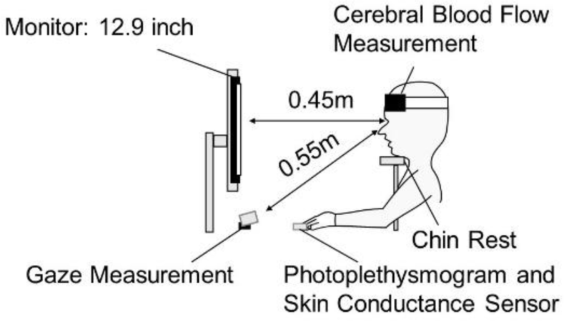
3. Answering the comparison tasks for validating the DiabiEye 4. Answering the questionnaires for assessing psychological characteristics The total duration was 50 min. The order of presentation and environment (lighting, noise, and desk height) was standardized (Fig. 2).
Figure 2: Experimental setup.
Analysis Methods The analysis methods are as follows.
1. For the analysis, behavioral indices (performance on comparison tasks and DiabiEye tasks), psychological scale scores, and physiological indices were used: eye tracking (Tobii Pro Fusion), near-infrared spectroscopy (NIRS; WOT-220), and pulse wave/skin conductance (NeXus10 Mark II). Validation: Correlations (Spearman’s ρ) between DiabiEye scores and the corresponding task performance and psychological scales were calculated. 2. Physiological associations: Point-biserial correlations between the binary accuracy (1 = correct, 0 = incorrect) and physiological indices. 3. Machine learning: A binary classification model was built to predict the DiabiEye accuracy from representative physiological indices, interpreted using the SHapley Additive exPlanations (SHAP). 4. Eye movements: Brunner–Munzel tests comparing total eye movement distances between full- and lower-score responses.
RESULTS
1. Validation of DiabiEye
Correlation analyses demonstrated that the four cognitive domains of DiabiEye exhibited selective validity with corresponding standardized tasks. Notably, visual-linguistic processing was positively associated with the performance on the WPM task (r = 0.62), while visual attentional control showed moderate to strong correlations with the UFOV task (r = 0.44–0.82).
Visual-Cognitive Profiling Using Eye Movements and Brain Activity 1397
In contrast, the visual working memory and visual-spatial cognition did not show consistent associations across tasks.
2. Eye-tracking
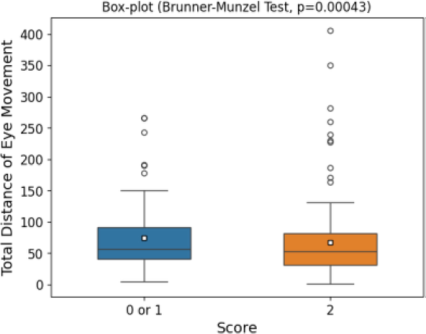
To further examine visual information processing during DiabiEye tasks, the total distance of eye movements was analyzed using the Brunner–Munzel test. As shown in Fig. 3, participants who achieved full scores exhibited significantly shorter total eye-movement distances compared to those with lower scores (p = 0.00043).
Figure 3: Eye movement distance and performance score.
3. Examination of the Relationship Between Cognitive Functions Measured by the DiabiEye and Physiological Indices a. Pupil diameter
Task accuracy on DiabiEye (1 = correct, 0 = otherwise) was binarized, and associations with physiological indices were examined using point-biserial correlations. Significant negative correlations were observed between the accuracy and left pupil diameter (r = −-0.16, p = 0.016) as well as right pupil diameter (r = −-0.14, p = 0.037). These results indicate that smaller pupil diameters were associated with correct responses.
b. Cerebral blood flow Among the 22 channels, seven showed significant negative correlations between deoxygenated hemoglobin activation and task accuracy (mean r = −0.14, mean p = 0.027). This suggests that correct responses were associated with lower levels of deoxygenated hemoglobin activation.
c. Oxygenated hemoglobin activation A one-way ANOVA was conducted on oxygenated hemoglobin activation in three regions: the left DLPFC, dorsomedial prefrontal cortex (DMPFC),
and right DLPFC, across the four cognitive domains of DiabiEye (visual- linguistic processing, visual working memory, visual-spatial cognition, and visual attentional control). Significant differences among the three regions were found for visual-spatial cognition (p = 0.035) and visual-linguistic processing (p = 0.028). Trends were also observed for visual working memory (p = 0.055) and attentional control (p = 0.070). These findings indicate that the three prefrontal regions exhibited distinct activation patterns in visual-spatial cognition and visual-linguistic processing.
4. Psychological scales
A significant negative correlation was found between the DiabiEye visual- linguistic processing score and CD-RISC (r = −-0.57).
5. Analysis using SHAP
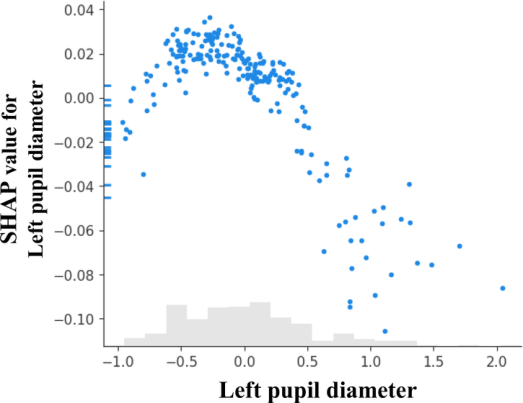
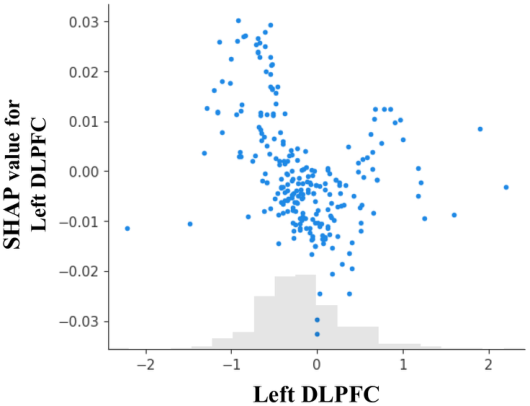
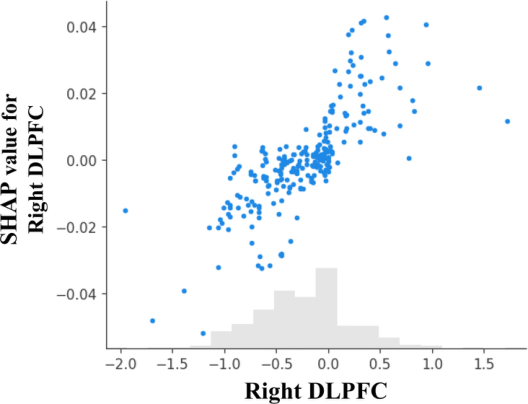
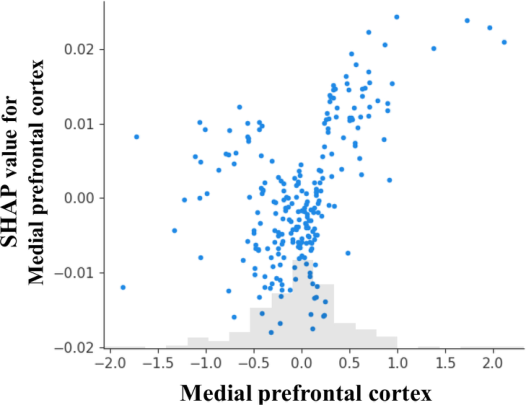
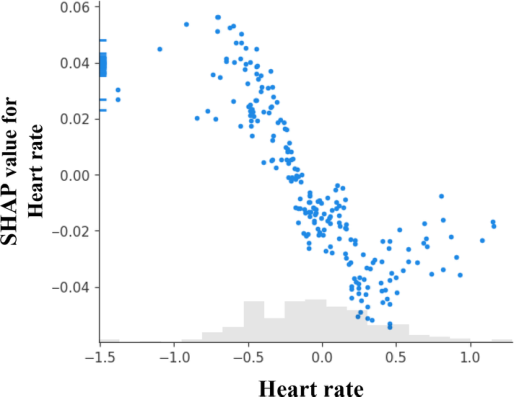
To further examine the contribution of physiological indices, we constructed a binary classification model with DiabiEye response accuracy as the target variable. Representative features were selected to avoid multicollinearity, including left pupil diameter, oxygenated hemoglobin activation in the left DLPFC, DMPFC, and right DLPFC, as well as indices of skin conductance and finger photoplethysmography. SHAP was then applied to this model to interpret the feature importance, with predictive accuracies of 0.672 and 0.667 for the training and test sets, respectively (Fig. 4).
Figure 4: Left pupil diameter and SHAP values score.
The SHAP plots revealed a nonlinear relationship between the pupil diameter and response accuracy. Errors occurred when the pupil was either excessively constricted or dilated. This finding was consistent with the earlier correlation analysis supporting the validity of the SHAP-based model. Furthermore, increased oxygenated hemoglobin activation in the
Visual-Cognitive Profiling Using Eye Movements and Brain Activity 1399
right DLPFC was associated with a higher likelihood of correct responses, while the DMPFC showed a V-shaped relationship with accuracy. Finally, elevated heart rates were associated with more frequent incorrect responses, suggesting that participants were more prone to errors when in a state of heightened arousal.
Figure 5: Left DLPFC and SHAP values values.Figure 6: Right DLPFC and SHAP values.Figure 7: Medial prefrontal cortex and SHAP values.Figure 8: Heart rate and SHAP values.
Figures plotting the relationships between the three brain regions (left DLPFC, DMPFC, and right DLPFC) and the target variable (DiabiEye response accuracy) are presented below.
Figures 5–7 confirmed that the machine learning model predicted correct responses as the oxygenated hemoglobin activation in the right DLPFC increased. In addition, we observed a V-shaped relationship between the dorsomedial prefrontal cortex and response accuracy.
Figure 8 shows that higher heart rates are associated with more frequent incorrect responses. As heart rate is an indicator of arousal, this suggests that participants were more likely to be in a heightened state of arousal during incorrect responses.
Visual-Cognitive Profiling Using Eye Movements and Brain Activity 1401
DISCUSSION
Validity of the DiabiEye Check (Dominant Cognition) This study examined the associations between the four cognitive domains of DiabiEye and standardized tasks, confirming their selective validity. Visual attentional control was consistently related to the UFOV task, while visual-linguistic processing was correlated with WPM tasks, reflecting their intended functions. Visual working memory showed a reversal in the direction of correlations as the task progressed, suggesting that it may reflect adaptive learning ability rather than simple memory capacity. In contrast, visual-spatial cognition exhibited limited associations with the mental rotation task, possibly because of ceiling effects and task-specific differences.
Overall, DiabiEye demonstrated partial alignment with standardized tasks while also capturing individual differences in cognitive processing that conventional tasks may fail to reveal.
Eye-Tracking The high performers in this study exhibited shorter total eye movement distances, which allowed for two possible interpretations: either they maintained a broad visual field, enabling global processing with minimal movement, or they fixated narrowly to process information with high precision. Therefore, combining eye-tracking results with physiological indicators, such as pupil diameter, autonomic activity, and prefrontal blood flow, is critical to clarify “processes that enable efficient performance.” Future studies that incorporate visual field measurements and detailed fixation time distribution analyses may allow for even more refined interpretations.
These patterns raise the question of whether eye movement efficiency reflects the underlying physiological mechanisms examined in the following analyses.
Associations With Physiological Indicators In this study, pupil constriction was observed during correct responses. This suggests that miosis, traditionally regarded as a sign of low arousal, may indicate a state of efficient focused attention. Furthermore, the relationship between the pupil diameter and task performance followed a U-shaped pattern, showing that both excessively large and small pupil sizes were associated with lower performance, while intermediate pupil sizes yielded the highest performance. This finding highlights the existence of an optimal arousal level.
The NIRS results further revealed that high performers exhibited smaller changes in prefrontal activity during correct responses. In other words, they were able to complete tasks without consuming excessive neural resources, consistent with the neural efficiency hypothesis, which posits that individuals with higher cognitive ability achieve better performance with fewer resources.
Significant differences in oxygenated hemoglobin activity were observed in the left DLPRC, DMPFC, and right DLPFC during visuospatial cognition and verbal processing tasks. Similar trends were observed in visual working memory and attentional control tasks.
These findings support the prefrontal specialization theory and indicate that the four cognitive styles defined by DiabiEye are not merely psychological constructs but are grounded in distinct neural mechanisms.
Taken together, these results demonstrate that DiabiEye is not only a tool for measuring behavior or performance outcomes, but also a framework that reflects underlying neural processes. This highlights its potential as a practical system for tailoring learning and support to individual needs in educational and occupational contexts, as well as for contributing to the prevention of mental health difficulties.
Associations With Psychological Indicators The results indicated that individuals with higher visual-linguistic processing scores tended to show lower resilience. One possible explanation is that a style emphasizing accuracy in text processing, while advantageous in typical learning contexts, may hinder flexible responses and rapid adaptation under stress. This suggests that cognitive styles can influence psychological adaptation. We then analyzed the physiological and neural processes that may underlie such differences in cognitive style.
SHAP-Based Analysis The results of SHAP analysis and clustering suggest that dominant cognition styles cannot be explained by a single feature but are supported by multiple neurophysiological patterns. Specifically, clustering based on prefrontal activation patterns divided participants into three groups, each showing different biases across cognitive domains. In addition, nonlinear associations between task performance and physiological measures (pupil diameter, prefrontal blood flow, and autonomic activity) revealed processing patterns that could not be detected by simple correlations. These findings indicate that dominant cognition styles can be understood in a more concrete and evidence-based way. Integrating DiabiEye with physiological measures makes it possible to uncover individualized cognitive profiles beyond psychological scales or performance outcomes.
LIMITATIONS AND FUTURE DIRECTIONS This study was limited by its exploratory design, small sample of university students, and technical constraints in physiological measurements. Future research should extend these findings by applying the framework to larger and more diverse populations, employing longitudinal designs, and integrating with other methodologies.
CONCLUSION
Taken together, these findings suggest that DiabiEye provides a comprehensive framework for linking cognitive performance with physiological, neural, and behavioral processes. The study demonstrated
Visual-Cognitive Profiling Using Eye Movements and Brain Activity 1403
that the efficient allocation of neural resources is associated with higher performance, suggesting that understanding dominant cognition styles may provide important insights into their underlying mechanisms. This highlights the potential of DiabiEye as a practical system for tailoring learning and support for individual needs in educational and occupational contexts, as well as for contributing to the prevention of mental health difficulties.
REFERENCES
Ball, K. K., Beard, B. L., Roenker, D. L., Miller, R. L., & Griggs, D. S. (1988). Age and Visual search: Expanding the useful field of view. Journal of the Optical Society America A, 5(12), 2210–2219. Carbone, E., Meneghetti, C., & Borella, E. (2019). The influence of personality
traits and Facets of visuospatial task performance and self-assessed visuospatial inclinations young and older adults. PLOS ONE, 14(8), e0220525. Eysenck, M. W., Derakshan, N., Santos, R., & Calvo, M. G. (2007). Anxiety and cognitive performance: Attentional control theory. Emotion, 7(2), 336–353. Grabner, R. H., Fink, A., Stipacek, A., Neuper, C., & Neubauer, A. C. (2004).
Intelligence and working memory systems: Evidence of neural efficiency of alpha-band ERD. Cognitive Brain Research, 20(2), 212–225. Krawczyk, D. C. (2012). The cognition and neuroscience of relational reasoning.
Brain Research, 1428, 13–23. Neubauer, A. C., & Fink, A. (2009). Intelligence and neural efficiency: Measures of brain activation versus measures of functional connectivity in the brain. Intelligence, 37(2), 223–229. Qin, S., Hermans, E. J., van Marle, H. J. F., Luo, J., & Fernández, G. (2009). Acute
Psychological stress reduces working memory-related activity in the dorsolateral prefrontal cortex. Biological Psychiatry 66(1), 25–32. Rayner, K., Chace, K. H., Slattery, T. J., & Ashby, J. (2006). Eye movements as reflections comprehension processes during reading. Scientific Studies of Reading, 10(3), 241⣓255. Schmeichel, B. J., Volokhov, R. N., & Demaree, H. A. (2008). Working memory
capacity and self-regulation of emotional expressions and experiences. Journal of Personality and Social Psychology 95(6), 1526–1540.
LISTED IN THE AHFE DIGITAL BOOKSTORE CATALOGUE
Explore the complete digital volume
Human Factors in Design, Engineering, and Computing
Read this individual research paper free through the original publisher, or explore the full digital proceedings book.
ISBN 978-1-964867-75-5
Explore this ISBN in the AHFE Bookstore ↗Listed in the July 2026 bookstore catalogue; search by ISBN to confirm current availability · Digital book purchase optional