Dongyuan Wang, Pingying Zhang, Vamsi Sai Kalasapudi (2025). The Effect of Rear-lighting system Design on Preventing Rear-end Collisions in a Simulated Distracted Driving. In: Human Systems Engineering and Design (IHSED2025): Future Trends and Applications. AHFE Open Access, vol. 198, pp. 447–457. https://doi.org/10.54941/ahfe1006798
Rear-end collisions account for approximately 29% of all vehicular accidents. While various cues can inform drivers of a lead vehicle’s stopping behavior, brake lights remain the primary and most critical signal for indicating deceleration. The concept of redundant signaling—well-supported by both basic and applied research—suggests that additional visual cues can enhance driver response times. This study examined the effect of incorporating a redundant pictorial stop cue into rear brake light configurations on driver reaction times during a cognitively distracted, simulated car-following task. Forty-eight drivers participated, responding to three rear light configurations which depicted three different taillight-to-brake lights transitions—Traditional without additional pictorial stop cue, the 2023 Jeep Renegade model with an “X”-shaped motif, and a Redundant Pictorial Signal—while concurrently performing a math-based cognitive distraction task. Results showed that the redundant rear light configuration significantly reduced braking reaction times compared to the traditional setup and demonstrated potential for reorienting driver attention back to the driving task. These findings suggest that integrating redundant visual stop cues into rear light designs may help prevent rear-end collisions or reduce their severity and associated fatalities.
Rear-end collisions are the most common type of vehicular accident, accounting for approximately 29% of all crashes (Traffic Safety Factors, 2022). These collisions are typically caused by inattention, distraction, following too closely, and delayed braking due to fatigue or impaired driving (Knipling et al., 1992; Lee et al., 2007; Lee et al., 2002). It is estimated that half of these collisions could be avoided if drivers were given just an additional half-second to react (Andrum, 1992). Over the years, significant efforts have been made to reduce the incidence of rear-end collisions through various technological advancements and safety measures. One approach has focused on the rear-lighting system as countermeasures to reduce this type of crash (Lee et al., 2002; Gail et al., 2001).
One of the most influential efforts with this approach is the installation of the high-mounted center brake lights, also known as Center High Mounted Stop Lights (CHMSL). The CHMSL have been shown to reduce rear-end accidents (Voevodsky, 1974). These lights became a mandated feature for all cars in 1986 and for light trucks in 1994 in the United States. The CHMSL enhance the visibility of brake lights and attract the attention of following drivers, thereby improving safety. However, the effectiveness of CHMSL has declined from its initial levels (Kahane et al., 1998).
Another initiative that also concentrated on the rear-lighting system involved examining the type of light bulb used in brake lights (Sivak et al., 1994; Palaniappan, 2022). More recent approach on the rear-lighting system has explored the effectiveness of additional feature with the brake light which will flash as brake. Studies indicate that flashing brake lights significantly reduce accident rates, and they have become a mandatory feature in the European Union (Hseih et al., 2022; Li et al., 2014; Isler & Starkey, 2009; Neurauter et al., 2009). However, this feature is not used in the United States due to potential confusion with blinking turn signals and hazard lights in the current rear-lighting system (see 49 CFR 571.108). More recent innovations in vehicle safety include forward collision warning (FCW) and autonomous emergency braking (AEB) systems, which have been shown to significantly reduce the incidence of rear-end collisions and related injuries (Cicchino, 2017; Najm, 2006). However, the additional costs associated with these systems, along with issues like false alarm, compensatory risk- taking (to follow more closely or drive less attentively with these system) and insufficient sensitivity to certain obstacles, may compromise the effectiveness of these systems and may lead to user dissatisfaction/non-acceptance and discourage manufacturers from making them standard features (Mueller et al., 2024; Shinar, 2000).
Despite these advancements, brake lights on the leading vehicle remain the most critical communication signal to alert the driver of the following vehicle to a stopped lead vehicle. Although pictorial cues can effectively communicate messages when there is a strong association between the symbol and its meaning—like how red signals a stop—the cross-icon “X” could convey the same message and prompt a stop action. However, pictorial codes have not been utilized in rear-light design.
The Redundant Signal Effect (RSE) refers to the phenomenon where reaction times are faster when multiple signals indicate the same response (Todd, 1912; Diederich & Colonious, 2004). This effect has been observed across different modalities in laboratory psychological research and has also been applied in various real-life situations to enhance safety. The high-mounted center brake light is an additional cue to improve braking performance, indicating a RSE effect on improve braking response. RSE has been observed in enhancing drivers’ response time, decreasing red-light running rate at intersections (Dechaus et al., 2022; Isler & Starkey, 2010; Hussain at al., 2020). Inspired by the Jeep Renegade’s rear light cover design, which features a redundant stop signal in the rear light cover with a “X”- shape motif, Wang et al., (2023) conducted a pilot study where participants responded to the onset of brake lights by pressing a button. This study found
The Effect of Rear-Lighting System Design on Preventing Rear-End Collisions 449
a RSE effect, indicating a faster reaction time with the redundant signal than the traditional rear light condition. However, Wang’s study was conducted with participants who were fully attentive and responded using their hands or fingers. In real driving scenarios, drivers often engage in activities that divert their attention from the driving task. Out of the three major types of distractions (visual manual, and cognitive) in NHTSA (2010), cognitive distraction, where drivers look at the road but are not attentive or processing relevant cues, is particularly hard to catch and most deceptive. This type of distraction has been strongly associated with rear-end crash and calls for “additional salient cues may be needed to alert drivers to the onset of lead-vehicle braking events” (Lee et al., 2007, p. 22).
The aim of this study is to evaluate the effect of incorporating an additional signal from the lead vehicle into the rear-signaling system to capture attention and improve braking behavior under cognitive distraction. Specifically, the study will compare braking performance between conditions with redundant signals and traditional signals, both in the presence and absence of cognitive distractions. We hypothesize that braking response times will be quicker with the Redundant Signal Effect (RSE) signal compared to the traditional rear light condition. Additionally, we hypothesize that the rate of missed signals will be lower under redundant signal conditions than under traditional rear light conditions, indicating superior attention-gathering capability. Since hand responses differ from foot responses due to distinct neural pathways, participants will respond to stimuli with their feet, as they would in a driving task, in this study.
METHOD
Participants Forty-eight undergraduate students (32 female; 44 right-handed; Mean age = 22.3 years old with SD = 5.6, ranging from 18–46 years old; with normal or corrected to normal vision and hearing) were recruited through SONA, an online system, and participated in this experiment in exchange for class credit. All participants possessed a valid driver’s license. This research was approved by University’s Institutional Research Board
Stimuli, Apparatus, & Materials The experiment used a Dell XPS computer connected with a 27 Dell monitor. The experimental program ran E-Prime 3.0 software (Psychology Software Tools) along with Chronos Response Box connected with Chronos dual foot pedals, a Chronos Microphone. The Logitech game wheel was presented in front to the participant. Participants sit 60 cm in front of the monitor, placing their hands on the Logitech wheel. Visual stimuli consisted of four rear light images based on the 2023 Jeep Renegade model like those used in Wang et al., (2024), see Table 1 for details. Audio stimuli were four sound file (.wav) which play three math questions at 55 dB and a file with white noise. Three simple math questions are three plus four; three plus five; three plus six; and the fourth is a white noise sound file which was created with Audacity
with only white noise function. The auditory file will be played through the speaker of the computer.
Table 1: Simulated trials from combinations of different rear-light transformation and distractions conditions.
Table available in the original PDF paper.
These were five taillights-to-brake light transitions: three involved a change from taillights to brake lights simulating the front car is breaking suddenly, while the remaining two, no transition occurred simulating that no braking action which served as catch trials to eliminate the tendency that participant start preparing the response at the end of the math question. Transition from Traditional taillights to Traditional brake lights (no additional visual cues signaling stop action)–TT configuration; Traditional taillights (no additional visual cues signaling stop action) to Redundant brake lights configuration (with a X-shaped motif integrated into the rear light like the Jeep Renegade 2023)–TX configuration; Jeep Renegade taillights (with a X-shaped motif) to Jeep Renegade brake light (with a X-shaped motif)–XX configuration; No braking with traditional taillights (T: Catch trial 1); No braking with rear lights condition similar to the Jeep Renegade taillights (X: Catch trial 2). All transition types were presented under two distraction conditions, with-distraction condition (with one of three verbally presented match questions) or without-distracted condition (with white noise file). Combining the five types of trials from different taillights to brake light transformations and distraction conditions, there were 20 unique trials. To ensure an equal number in both distraction conditions, the trials without math condition (which with a white noise) were repeated three time (see Table 1). In the practice section, there were all 20 different combination once. In the test section, there were three test blocks, each with 60 trials (30 with
The Effect of Rear-Lighting System Design on Preventing Rear-End Collisions 451
distraction, 30 without distraction), totally there are 180 trials in the test section.
Each trial starts with an instruction page and participants were instructed to press and hold down the right (accelerator) pedal to start the trial, then a rear image of the car with only taillights will be presented for 3000 msec. During this 3000msec, for the cognitive distraction condition, participant will hear a math question along with the rear image of the car, the verbal question was completed about 300 msec before the end of the visual stimuli presentation of the car. This ending point of the 300 msec was selected to make sure that participants are cognitively occupied because previous research showed that it takes about 900 msec to answer a math question (Metcalfe & Campell, 2011). The task is to respond verbally to the math question, e.g., by saying 7 for the question “three plus four” and at the same time, they need to respond to the brake lights signal if it is turned on which simulating the front car brakes suddenly. The verbal response was captured by the microphone. In the no-distraction condition, there is no math question played but just a white noise sound. Participants need to respond within 3 sec to the brake lights by releasing the right pedal and pressing the left pedal to simulating a brake response to the sudden stop of the front car. This perception-reaction time frame of 3 sec was selected based on the recommendation of the American Association of State Highway and Transportation Officials (AASHTO, 2018) that a perception-reaction time of 2.5 sec ensures that virtually every driver will manage to react within that time. For the no brake lights on trials, no brake action should be taken that participant should keep pressing down on the gas pedal until the end of the trial. Verbal response was collected by the microphone and pedal responses were collected by the dual pedal connected to the E-Prime software. Each participant’s data was saved in a E-Prime data format. Original data is available upon request to the corresponding author.
Procedure The experiment took place in a well-lit laboratory room. Upon arrival, participants were asked to sign an informed consent form. They then sat in front of the wheel and placed their hands on the wheel. Instructions were displayed on the screen. Participants first completed the practice section, during which they could ask questions to ensure they understood the procedure and task. Following this, they began the test section. The entire experiment lasted approximately 30 minutes
RESULTS
The research hypothesis was to investigate the gas pedal release time and brake pedal pressing time under different conditions of distraction and rear lights configuration. Trials of interest required pedal responses when the taillights transformed into brake lights. Correct responses involved three actions: releasing the gas pedal, pressing the brake pedal, and providing a verbal response to a math question if present. Math question accuracy for each participant was reviewed, and participants with more than 10% error
in math questions (four participants) were excluded from further analysis. For each trial, although the order of the three responses (release gas pedal, press brake pedal, and verbal response) varied, releasing the gas pedal always preceded pressing the brake pedal, as each trial started with a car following simulation with taillight status. Prescreening identified three types of errors: missing trials, where pedal responses were not recorded because participants either did not respond or responded too late, outside the response window; not ready, where participants did not start with the gas pedal pressed down as instructed or released the gas pedal before the taillights transformed into brake lights; and wrong response, where participants released the gas pedal first but then pressed it down again after the transformation occurred. Mean reaction times for releasing the gas pedal (RT_G) and pressing the brake pedal (RT_B) were calculated based on correct trials. If the number of correct trials in each combination of distraction and taillights-to-brake light transition (Brake Lights Type) was lower than 50%, that participant’s data was excluded from the RT_G and RT_B analysis. Consequently, data from 20 participants were included in the RT_G and RT_B analysis.
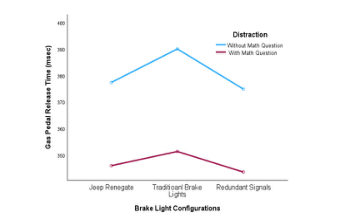
Gas Pedal Release Time A 2 (Distraction) x 3 (Brake Lights Type) repeated-measure ANOVA was conducted on gas pedal release time (RT_G). The main effect of Distraction was significant, Wilkey’s lambda = .702, F (1, 19) = 8.05, p = .01, partial η2 = .298, indicating that reaction time without distraction (381 msec) was 34 msec slower than the reaction time with distraction (347 msec). There is no main effect of Brake Lights Type, F (2, 38) = 2.076, p = .14, or interactions between the two variables, F (2, 38) = .182, p > .84. However, the mean reaction time was slightly shorter for the TX (redundant signal, M = 359 msec) and XX (Jeep Renegade type, M = 362 msec) than the TT (traditional condition, M = 371 msec). See Figure 1 left panel.
Figure 1: Gas pedal release time as a function of brake light configurations and distraction (left panel); brake pedal pressing time (brake reaction time) as a function of brake light configurations and distraction (right panel).
The Effect of Rear-Lighting System Design on Preventing Rear-End Collisions 453
Brake Pedal Pressing Time A 2 (Distraction) x 3 (Brake Lights Type) repeated-measure ANOVA was conducted on brake pedal pressing time (RT_B). The main effect of Distraction was not significant, Wilky’s Lambda = .865, F (1, 19) = 2,966, p = .10, but with the same tendency was observed as in the RT_G, with the reaction time for the without distraction condition (M = 722 msec) was lower than that with distraction (M = 697 msec). The main effect of Brake Lights Type was marginal significant, Wilky’s Lambda = .764, F (2, 18) = 2,966, p = .088, in which the mean brake reaction time was significantly shorter for the TX (redundant signal, M = 701 msec) than the TT condition (traditional condition, M = 719 msec), p = .05. See Figure 1 right panel.
Reaction Time Comparison for Conditions of Brake Light Configurations and Distractions Gas pedal release times and brake reaction times in TX and XX condition were further compared with traditional brake light configurations to assess the RSE effect. All results showed that participants’ RTs in both redundant signal conditions (i.e., TX or XX conditions) were significantly shorter than the RT in the TT condition, p <.001, indicating a redundant signal effect (see Table 2).
Table 2: Mean gas pedal release time and brake pedal pressing time under different combinations of distraction and brake light configurations.
Table available in the original PDF paper.
Gas Pedal RT Brake Pedal RT
Distraction Brake Light Configuration 390 375* 377* No Math Question TT TX XX
704 691* 696*
351 344* 346*
734 710* 721* Math Question TT TX XX *p <=.001, indicating this RT in this condition is significantly different from the RT in TT condition
DISCUSSION
This study successfully replicated previous findings that demonstrated faster reaction times under redundant signal conditions, confirming the presence of a redundant signal effect. Specifically, the results suggest that when the rear light configuration includes an additional pictorial cue signaling the stop action, the response time to these signals is significantly shorter. The inclusion of multiple features in rear light system may have enhanced the visibility and recognizability of braking signals, leading to quicker driver responses. This has important implications for the design of future brake lights. The reduction in both gas pedal release time and brake time with redundant signals can be crucial in preventing rear-end collisions and enhancing overall road safety. The RSE effect or the reduction in reaction time may appear modest, its impact on road safety could be significant given
rear-end collisions often occur on highways and in congested urban traffic during peak commuting hours. In such condition, vehicles are closely spaced – often shorter or within 10 feet of each other. In such conditions, even a slight delay in a driver’s reaction can lead to a rear-end collision. Therefore, a rear light design that enhances visual salience and reduces reaction time, even by just 10 milliseconds, can play a meaningful role in improving road safety and preventing rear-end collisions.
More importantly, compared to other advanced technologies such as Forward Collision Warning (FCW) systems that rely on radar or sensors— often associated with higher installation and repair costs—implementing a redundant pictorial stop cue within the rear light cover incurs virtually no additional cost. This is exemplified by the Jeep Renegade, which already integrates such a feature into its design. By adopting brake light configurations that incorporate redundant visual signals, manufacturers can enhance vehicle safety without imposing significant financial burdens. This approach supports the broader goal of improving road safety standards while maintaining cost-effectiveness and accessibility.
The distraction manipulation involved introducing a math question to mentally engage participants, diverting their attention from the driving task and consequently influencing their driving performance. The expectation was that the cognitive load from solving the math problem would interfere with their ability to respond promptly to driving cues, such as the onset of brake lights. However, the results revealed an unexpected outcome. Although two out of five trials were catch trials (with a math question but no transformation), the math question appeared to function as a warning signal, alerting participants to the onset of the brake lights. Both reaction time data and the number of missed trials indicated that this auditory or cognitive cue might have heightened participants’ awareness and refocused their attention on the driving task. Rather than slowing down their reaction times, the math question may have acted as a prompt, alerting them to the need for increased vigilance and quicker responses.
Though no significant redundant signal effect was found in the missing trials data, the tendency of decreased missing trials with the redundant signal compared to the traditional rear-light system showed the potential of this additional stop cue to draw attention back or alert drivers to the onset of the brake lights. This tendency was observed in both distraction conditions. Cognitive distraction has been identified as a common underlying cause of rear-end collisions. Cicchino (2017) found that in 40% of rear-end crashes, the driver “was looking out the front windshield ahead at the time of lead-vehicle braking onset” (pp. 18–19). There is no regulation on brake light shape/configuration, and very few studies have examined how different brake light configurations may increase vigilance or draw attention back from cognitive daydreaming (looked but did not see). This tendency across different distraction conditions suggests that this approach with redundant brake signals might counteract the impact of cognitive distractions on driver performance.
Future studies could utilize driving simulators or real-world driving conditions to gain a more comprehensive understanding of how secondary
The Effect of Rear-Lighting System Design on Preventing Rear-End Collisions 455
tasks or distractions influence reaction times under different brake light configurations. Driving simulators offer a controlled environment where researchers can systematically manipulate variables and closely monitor participants’ responses to various distractions. This method allows for precise measurement of reaction times and the ability to replicate scenarios consistently. On the other hand, comparing real-world rear-end collision rate between Jeep Renegade with other similar vehicles would provide valuable insights into how drivers behave in natural settings, where numerous unpredictable factors come into play.
In conclusion, this study found that incorporating additional features in brake light configurations enables drivers to recognize and respond to braking signals more quickly, which is crucial for preventing rear-end collisions. This has significant implications for automotive safety design. Implementing brake light configurations with redundant signals can serve as a cost-effective measure to enhance vehicle safety without imposing additional financial burdens on manufacturers. By improving reaction times, this design can help decrease the frequency and severity of rear-end collisions, ultimately contributing to safer roadways. Future research should continue to explore the optimal features and configurations that maximize the effectiveness of redundant signals. There is potential for redundant signals to enhance the attention-drawing capability of brake lights, which may counteract cognitive distractions. Studies using driving simulators or real-world driving conditions can provide further insights into how these configurations perform under various distraction scenarios. This ongoing research will be essential in developing more effective interventions and safety measures that leverage the benefits of redundant signals to enhance driver response times and reduce collision risks.
REFERENCES
American Association of State Highway and Transportation Officials. (2018). A policy on geometric design of highways and streets (7th ed.). Washington, DC: AASHTO. Ankrum DR. Smart Vehicles, Smart Roads: Will the back-seat driver become
obsolete? Traffic Safety. 1992, 6–9. Cicchino J. B. Effectiveness of forward collision warning and autonomous emergency braking systems in reducing front-to-rear crash rates. Accid Anal Prev. 2017, 99, 110–116. doi: 10.1016/j.aap.2016.11.021. Diederich A, Colonius H. Bimodal and trimodal multisensory enhancement: Effects
of stimulus onset and intensity on reaction time. Atten Percept Psychophys. 2004;66(8):1388–1404 Dechaux A, Haytam Mahsoub M, Kitazaki M, Lagarde J, Ganesh G. Multisensory feedback improves spatially compatible sensori-motor responses. Sci Rep. 2022;12:20253. Gail JC, Lorig M, Gelau C, Heuzeroth D, Sievert W. Optimization of Rear
Signal Pattern for Reduction of Rear-End Accidents during Emergency Braking Maneuvers. Federal Highway Research Institute; 2001. Hsieh MC, Chen LX, Lee YC, Liu QM. A Simulation-Based Study of the Effect of Brake Light Flashing Frequency on Driver Brake Behavior from the Perspective of Response Time. Behav Sci (Basel). 2022;12(9):332. doi: 10.3390/bs12090332.
Hussain I, Alhajyaseen WK, Brijs K, Pirdavani A, Brijs T. Innovative countermeasures for red light running prevention at signalized intersections: A driving simulator study. Accid Anal Prev. 2020;134:105349. doi: 10.1016/j.aap.2019.105349. Isler RB, Starkey NJ, Drew MA. Evaluation of a sudden brake warning system: Effect
on the response time of the following driver. Appl Ergon. 2010;41(4): 569–576. Kahane C, J, Hertz E, S. The Long-Term Effectiveness of Center High Mounted Stop Lamps in Passenger Cars and Light Trucks. Washington, DC: National Highway Traffic Safety Administration; 1998. Report No. DOT HS 808 696. Knipling RR, Hendricks DL, Koziol JS, Allen JC, Tijerina L, Wilson C. A front-end
analysis of rear-end crashes. In: Proceedings of the IVHS America 1992 Annual Meeting. Vol. 2. Washington, DC: IVHS America; 1992: 733–745. Lee S, E, Llaneras R. E, Klauer S. G, Sudweeks J. D. Analyses of Rear-End Crashes and Near-Crashes in the 100-Car Naturalistic Driving Study to Support Rear- Signaling Countermeasure Development. Washington, DC: National Highway Traffic Safety Administration; 2007. Report No. DOT HS 810 846. Lee SE, Wierwille WW, Klauer SG. Enhanced Rear Lighting and Signaling Systems:
Literature Review and Analyses of Alternative System Concepts. National Highway Traffic Safety Administration; 2002. Li G, Wang W, Li S. E, Cheng B, Green P. Effectiveness of flashing brake and hazard systems in avoiding rear-end crashes. Adv Mech Eng. 2014;2014: Article ID 792670. doi: 10.1155/2014/792670. Najm WG, Stearns MD, Howarth H, Koopmann J, Hitz J. Evaluation of an
automotive rear-end collision avoidance system. National Highway Traffic Safety Administration; 2006. Mueller, A., Cicchino, J., Zuby, D., & Calvanelli, Jr. J., 2024. Consumer experience with crash avoidance feature repairs. Journal of Safety Research, Vol. 88, pp. 8–15 and IIHS (Insurance Institute for Highway Safety). Neurauter ML, Llaneras RE, Wierwille WW. The Design and Assessment of
Attention-Getting Rear Brake Light Signals. In: Proceedings of the Fifth International Driving Symposium on Human Factors in Driver Assessment, Training and Vehicle Design; June 22–25, 2009; Big Sky, MT. Iowa City, IA: Public Policy Center, University of Iowa; 2009, 529–535. doi: 10.17077/ drivingassessment.1367. National Highway Traffic Safety Administration. Traffic Safety Facts 2022: A Compilation of Motor Vehicle Traffic Crash Data. Washington, DC: US Department of Transportation; 2024. Report No. DOT HS 813 656. National Highway Traffic Safety Administration. (2010). Overview of the National Highway Traffic Safety Administration’s Driver Distraction Program (DOT HS 811 299) [PDF – 36 pages]. U. S. Department of Transportation, Washington, DC. National Highway Traffic Safety Administration. (2018). CORE participant manual
(SMD). U. S. Department of Transportation. Palaniappan R, Mouli S, Bowman H, McLoughlin I. Investigating the Cognitive Response of Brake Lights in Initiating Braking Action Using EEG. IEEE Trans Intell Transp Syst. 2022, 13878–13883. doi: 10.1109/TITS.2021.3091291. Sivak M, Flannagan MJ, Sato T, Traube EC, Aoki M. Reaction times to neon, LED,
and fast incandescent brake lamps. Ergonomics. 1994;37(6): 989–994. Shinar D. Fleet study evaluation of an advance brake warning system. Hum Factors.
2000;42(3): 482–489. Todd, J. W. (1912). Reaction to multiple stimuli (Archives of Psychology, No. 25).
New York: Science Press.
The Effect of Rear-Lighting System Design on Preventing Rear-End Collisions 457
Voevodsky J. Evaluation of a deceleration warning light for reducing rear-end automobile collisions. Journal of Applied Psychology. 1974, 59(3): 270–273. doi: 10.1037/h0036778. Wang D, Wilborn A, Miller V. Redundant brake lights design: Impact on reaction
times of the following driver. In: Praetorius G, Sellberg C, Patriarca R, eds. Advances in Human Factors of Transportation. AHFE Open Access; 2023: 560–566. doi: 10.54941/ahfe100524.
LISTED IN THE AHFE DIGITAL BOOKSTORE CATALOGUE
Explore the complete digital volume
Human Systems Engineering and Design (IHSED2025): Future Trends and Applications
Read this individual research paper free through the original publisher, or explore the full digital proceedings book.
ISBN 978-1-964867-74-8
Explore this ISBN in the AHFE Bookstore ↗Listed in the July 2026 bookstore catalogue; search by ISBN to confirm current availability · Digital book purchase optional