Dongyuan Wang, Ashley Wilborn, Vanessa Miller (2024). Redundant Brake Lights Design: Impact on Reaction Times of the Following Driver. In: Advances in Human Factors of Transportation. AHFE Open Access, vol. 148, pp. 560–566. https://doi.org/10.54941/ahfe1005247
This study investigated whether redundant vehicle braking light configurations reduce brake response time (RT). Brake lights play a crucial role in enhancing visibility and are instrumental in preventing rear-end collisions. Previous research conducted in laboratory and practical settings consistently highlights the effectiveness of redundant signals. Some modern car models feature a cross-configuration for their brake lights, forming an 'X' shape when the brake pedal is applied, intuitively signifying to stop. The study assessed the effectiveness of brake light configurations between traditional braking signals with a brighter red appearance and redundant signals (with an additional ‘X’ shape). Participants viewed a rear-end picture of a vehicle (either a schematic-car or real-car picture) with different brake light configurations simulating a car-following condition. They were instructed to press a right-side button to model the use of a gas pedal in a car-following condition. However, they were to release the right-side button and press the left-side button when the brake lights illuminated from the car in front. The results revealed that participants exhibited quicker reactions in the real-car picture condition than the RT in the schematic-car condition, indicating a more immediate response and a heightened sense of urgency associated with the real-car representation. More importantly, both release RT and stop RT in the simultaneous redundant brake lights condition were faster than in the traditional single-signal brake lights condition. Additionally, this advantage of the redundant effect was noticeable only when two redundant signals were simultaneously presented and were larger in the schematic-car condition. The findings suggest that incorporating redundant signals in brake light design can reduce braking response times and, consequently, lower the risk of rear-end collisions. Future research should examine this redundant effect in high-fidelity simulators or real driving conditions.
Rear-end collisions are the most frequently occurring type of crashes, con- stituting approximately 28 percent of all car accidents nationwide in 2020 (Traffic Safety Facts, 2020). Brake lights are a critical safety feature, enhanc- ing visibility in adverse conditions and playing a crucial role in preventing rear-end collisions. When activated, the bright red appearance signals to the following driver that deceleration is occurring, providing a crucial 0.5-second early warning time that could prevent around 60% of rear-end collisions (Ankrum, 1992).
Redundant Brake Lights Design: Impact on Reaction Times of the Following Driver 561
Evolutionary research on brake light systems has persisted over the years, aiming to improve visibility, capture attention, and enhance safety. The most impactful solution in brake light systems is the center high-mounted stop light (Voevodsky, 1974), which became a standard safety feature for all passenger vehicles in the 1990s. Subsequent proposals and evaluations have included systems that illuminate when the driver releases pressure from the accelerator (Shinar, 1995; Shinar, 2000) or utilize flashing brake lights with increasing luminance or flickering rate corresponding to the deceleration rate (Li et al., 2014; Gail et al., 2001; Isler & Starkey, 2010). Studies have shown that flash- ing brake lights can reduce reaction time by 10–20 percent (Li et al., 2014) and effectively capture drivers’ attention when they are looking away from the road (Wierwille et al., 2009). However, the effectiveness of center high- mounted stop lights has diminished over the years (Kahane & Hertz, 1998). Despite flashing stop lights being mandated across the European Union, the U.S. Department of Transportation (USDOT) does not permit flashing brake lights to warn of heavy braking.
Researchers have explored how information from different sensory sys- tems is combined and how responses/actions change in response to stimuli. The redundancy gain or redundant signal effect (RSE), observed frequently in experimental psychology, indicates that redundant stimuli tend to evoke quicker and more accurate responses than a single stimulus (Forster et al., 2004). In driving conditions, multiple studies have indicated RSE. For exam- ple, Biondi et al. (2014) found redundancy gains in a simulated driving task, resulting in faster braking time with redundant warnings. Hussain et al. (2020) identified a red LED ground light integrated with a traffic sig- nal as the most effective solution for improving red light running. Polanis (2002) observed a 33% decline in crashes with a T-shaped traffic light display featuring double red signals over standard yellow and green indications.
This study investigated whether redundant vehicle braking light configu- rations reduce brake response time (RT). We will compare the effectiveness of traditional braking signals with a brighter red appearance to redundant signals, incorporating an additional ‘X’ shape in the configuration, similar to the rear lights of the Jeep Renegade 2023 model.
METHOD
Participants Twenty-four undergraduate students (18 female, 6 males; all right-handed) at the University of North Florida were recruited through an online system (SONA) and participated in this experiment in exchange for extra class credit. The mean age of participants was 20 (SD = 4). All participants possess a valid driver’s license. Participants had normal or corrected to normal vision.
Stimuli, Apparatus & Materials The experiment utilized a Dell XPS computer equipped with a 27” Dell monitor. The experimental platform ran E-Prime 3.0 software (Psychology
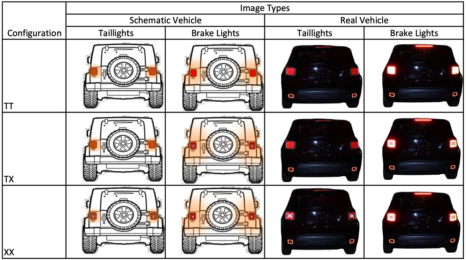
Software Tools) and incorporated a Chronos response box to collect demo- graphic information and behavioral data, specifically reaction times. Visual stimuli consisted of two types of rear vehicle images of a: A pair of schematic car images and a pair of real car images, with each pair including a rear car picture with taillight and a rear car picture with brake light picture. For each type of image, there are three light configurations: the first has traditional taillights transforming to traditional rear lights with the rear lights appear- ing a brighter red to indicate the front car is braking (condition TT); the second has traditional taillights transforming to the rear lights with a redun- dant “X” configuration integrated in (condition TX), the third has taillights with the “X” configuration transforming to rear lights with the “X” config- uration, with the rear lights appearing a brighter red to indicate the front car is braking (condition XX).Please see Figure 1 for details.
Figure 1: Pairs of rear light configurations: real and schematic images (adapted from the-blueprints.com, 2007).
Half of the participants ran the schematic car block first, and then the real car condition; the other half of the participants ran the real car condition first. With each stimulus type block, the configuration type was randomly selected, and each trial was repeated 1–3 times in the practice trials and 20 times in the experimental trials. In each trial, participants first saw an instruction page and were instructed to press and hold down the right-button on the Chronos box to simulate a car following condition. Participants then released the but- ton and pressed down on the left-button on the box, simulating a braking action, when the taillights displayed are changed to brake lights as the simu- lated front car suddenly stops. Feedback and accuracy were displayed after each trial. The taillights were displayed for various durations (range from 2500 ms to 3500 ms) to eliminate anticipation. Then, the brake lights picture replaced it, and participants were prompted to respond to the brake lights.
Procedure Upon arrival, participants were asked to review and sign an informed consent form to confirm voluntary participation. Participants were then instructed to sit in front of the monitor about 60 cm away. The participants started with a practice trial consisting of 14 trials; they could ask questions during this
Redundant Brake Lights Design: Impact on Reaction Times of the Following Driver 563
time. Once the practice trial was completed, participants were then tasked with the real trials. The examiner asked the participants to keep track of the accuracy average after the trials to be recorded at the end of the experiment. Participants used the Chronos box to record their answers. The far-right but- ton simulated the gas pedal, and the far-left button served as the brake pedal as it would in a real car. At the end of the experiment, the participants were instructed to tell the examiner the accuracy score signifying the trial is over.
Design A 2 (Image type) x 3 (Configurations) within-subjects factorial design was employed in this study. The Image type factor has two levels, schematic car pictures and real car pictures. There are three levels for the brake light Configuration variable: TT, TX, or XX.
RESULTS
Two response performances were analyzed: the releasing reaction time on the right-button simulating releasing the gas pedal and the pressing down reaction time on the left-button simulating braking response (see Table 1).
Table 1. Summary of response performance data analysis.
Table available in the original PDF paper.
Type Configuration Release RT Pressing RT Mean Std. Error Mean Std. Error
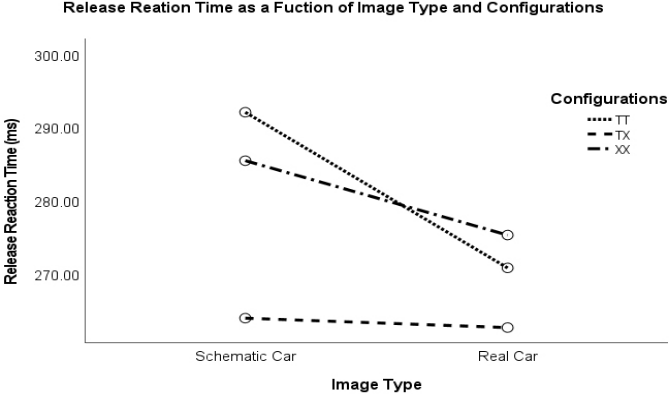
Releasing RT: A 2 (Image type) x 3 (Configurations) ANOVA was con- ducted on the releasing reaction time of the right button with Image Type and Configuration as within-subject variables. The two main effects were significant, Wilks’ Lambda = 0.73 and 0.17, F (1, 23) = 8.64 and F (1, 22) = 54.94, ps <0.05, partial eta squared = 0.28 and 0.83, indicating reac- tion time (RT) in the real car image was significantly faster than the RT in the schematic car condition (Ms = 270 and 280 ms); and the RT in the three light configuration conditions were significantly different. A pairwise com- parison showed that the TX configuration yields the quicker response to the braking lights than the other two configurations (Ms = 281, 263, 280 ms for the TT, TX, and XX configurations). More important, the interactions between the two variables were also significant, Wilks’ Lambda = 0.36, F (2, 22) = 19.99, p <0.001, partial eta squared = 0.65, indicating a larger RT difference drawing car image than that in the real car image condition (see Figure 2).
Pressing RT (braking RT): A similar 2 (Image type) x 3 (Configurations) ANOVA was conducted on the pressing reaction time of the left button with Image Type and Configuration as within-subject variables. The main effect
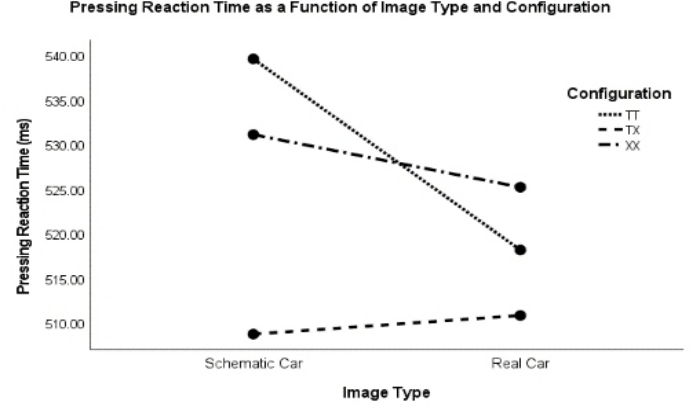
of Configuration TX was significant, F (2, 22) = 32.39, p <0.001, partial eta squared = 0.59, indicating the pressing reaction time for the three config- urations significantly different. A pairwise comparison showed that the TX configuration yield the quicker response to the braking lights than the other two configurations (Ms = 529, 510, and 528 ms for the TT, TX, and XX configurations). More important, the interactions between the two variables were all significant, Wilks’ Lambda = 0.49, F (2, 22) = 11.63, p <0.001, partial eta squared = 0.51, indicating a larger RT difference in drawing car image than that in the real car image condition (see Figure 3).
Figure 2: Prelease reaction time as a function of image type and configuration.Figure 3: Pressing reaction time as a function of image type and configuration.
Redundant Brake Lights Design: Impact on Reaction Times of the Following Driver 565
CONCLUSION
We tested and compared three different brake lights configurations in a sim- ulated following car condition. The results demonstrated that participants exhibited quicker reaction times in the real-car picture condition than the reaction time in the schematic-car condition, indicating a heightened sense of urgency associated with the real-car representation. More importantly we detected both releasing reaction time and pressing reaction time were faster in the simultaneous redundant rear light configuration than the traditional rear light configuration indicating a redundant signal effect (RSE). The current study replicated previous research showing that performance is enhanced by redundant signals compared to single signal. The present findings extend the literature on rear light design warnings. However, it is worth noting that to be effective, these redundant signals must be presented simultaneously to see the redundant gain from the responses. This design (XX) is a replication of the current model of a Jeep renegade, this condition did not show an RSE, according to our study, there was no redundance gain because the redun- dant rear light signals must be presented simultaneously to observe the RSE. However, it may attract more attention; some customers report that seeing this stimulus shocked them enough to stop (Eric Keller, 2016).
Based on experience, the symbol X normally signals stopping and dis- suades individuals from going forward or beyond the designated safety area. X-symbols are commonly seen on “keep-out” warning signs as well “no” signs. The colloquial significance of “X” having inhibitory and terminating implications was taken into consideration regarding the current study.
It is worth mentioning that our study had notable limitations. In the study, participants were prompted to anticipate the transformation that is going to occur even though manipulation was used to randomize intervals for how long brake lights would change. In future studies, it is recommended to test with either a high-fidelity driving simulator or to test with real cars on a test track. We noticed that some people may not like the “X” signal, presenting another dimension of stimuli/another signal in different modality, for exam- ple auditory (tire screech sound), to fulfil the requirement of redundant signal presentation to reduce reaction time.
ACKNOWLEDGMENT
We gratefully acknowledge the financial support provided by the Jim Van Vleck Research Funding and the Shared RSCA Instrumentation Grant (SRIG) from the University of North Florida (UNF) for this research. Additionally, we extend our thanks to the UNF Hicks Honors College Fellows Award for sponsoring one student-author’s research in the Driving Safety and Trans- portation Research Laboratory(DSTR). We also appreciate the reviewers’ comments, which contributed to the enhancement of this paper.
REFERENCES
Ankrum, D. R. (1992). IVHS - SMART VEHICLES, SMART ROADS. Traffic safety,
92.
Biondi, F., Strayer, D. L., Rossi, R., Gastaldi, M., Mulatti, C. (2014). Advanced Driver Assistance Systems: Are They Really Safe? Measuring and Reducing the Impact of Warnings on Drivers’ Distraction. In: 28th International Congress of Applied Psychology, Paris, July 8–13. Blueprints > Cars > Jeep > Jeep Wrangler Unlimited (2007). (2007). Retrieved from www.the-blueprints.com website: https://www.the- blueprints.com/blueprints/cars/jeep/20702/view/jeep_wrangler_unlimited/. Forster, B., Cavina-Pratesi, C., Aglioti, S. M., Berlucchi, G. (2002). Redundant
target effect and intersensory facilitation from visual-tactile interactions in sim- ple reaction time. Exp. Brain Res. 143 (4), 480e487. https://dx.doi.org/10.1007/ s00221-002-1017-9 Gail J., et al., (2001) Optimization of rear signal pattern for reduction of rearend accidents during emergency braking manoeuvres, Federal Highway Research Institute, http://www.bast.de/htdocs/veroeffentlichung/report.pdf. Hussain, Q., Alhajyaseen, W. K. M., Brijs, K., Pirdavani, A., & Brijs, T. (2020). Inno-
vative countermeasures for red light running prevention at signalized intersections: A driving simulator study Elsevier BV. doi: 10.1016/j.aap.2019.105349. Isler, R. B. & Starkey, N. J. Evaluation of a Sudden Brake Warning Systerm: Effect on the Response Time of the Following Driver. Applied Ergonomics, 41, 569–576. Kahane, C., & Hertz, E. (1998). The Long-Term Effectiveness of Center Mounted StopLamps in Passenger Cars and Light Trucks. NHTSA. Technical Report Dot HS808 696. Keller, E. (2016, October 4). Renegade Tail Lights: A Tale of Two Xx. Eric Keller
Design. https://erickellerdesign.com/blog/renegade-tail-lights-a-tale-of-two-xs/ Li, G., Wang, W., Li, S. E., Cheng, B., & Green, P. (2014). Effectiveness of Flashing Brake and Hazard Systems in Avoiding Rear-End Crashes. Advances in Mechanical Engineering, 6, 792670. https://doi.org/10.1155/2014/792670 National Center for Statistics and Analysis. (2022, October). Traffic safety facts
2020: A compilation of motor vehicle crash data (Report No. DOT HS 813 375). National Highway Traffic Safety Administration. Polanis, S. F. (2002). Improving intersection safety through design and operations.
In Today’s Transportation Challenge: Meeting Our Customer’s Expectations Institute of Transportation Engineers (ITE) (No. CD-016). Shinar, D. (1995). Field evaluation of an advance brake warning system. Human Factors, 37(4), 746–751. https://doi.org/10.1518/001872095778995643 Shinar, D. (2000). Fleet Study Evaluation of an Advance Brake Warning System. Human Factors, 42(3), 482–489. https://doi.org/10.1518/001872000779698141 Voevodsky, J. (1974). Evaluation of A deceleration warning light for reducing rear-
end automobile collisions. Journal of Applied Psychology, 39(3), 270–273. Wierwille, W. W., Llaneras, R. E., Neutauter, M. L. (2009). Evaluation of Enhanced Brake Lights Using Surrogate Safety Metrics Task 1 Report: Further Characteri- zation and Development of Rear Brake Light Signals. NHTSA. Technical Report Dot HS811 127.
LISTED IN THE AHFE DIGITAL BOOKSTORE CATALOGUE
Explore the complete digital volume
Advances in Human Factors of Transportation
Read this individual research paper free through the original publisher, or explore the full digital proceedings book.
ISBN 978-1-964867-24-3
Explore this ISBN in the AHFE Bookstore ↗Listed in the July 2026 bookstore catalogue; search by ISBN to confirm current availability · Digital book purchase optional