Emma Pietrafesa, Sergio Garbarino, Simone Russo, Donatella Vasselli, Antonella Polimeni, Agnese Martini (2024). Digital gamification as action to reduce road accidents: the videogame SLEEP-RO@D. In: Advances in Human Factors of Transportation. AHFE Open Access, vol. 148, pp. 480–490. https://doi.org/10.54941/ahfe1005239
1 The National Institute for Insurance against Accidents at Work (Inail), Department of Occupational and Environmental Medicine, Epidemiology and Hygiene (Dimeila), Rome, Italy ↗
2 University of Genova, Department of Neurology, Rehabilitation, Ophthalmology, Genetics, Maternal and Child Health (DINOGMI), Genova, Italy ↗
3 Sapienza University, Department of Oral and Maxillo-facial Sciences (SOMF), Rome, Italy ↗
Global, European, and national data show that road accidents (RA) are an increasingly important cause of injuries, disability and deaths. Our workday is significantly impacted by the road: in Europe up to 40% of road deaths are work-related. The causes of road injuries work-related and traffic accidents are the same and the excessive daytime sleepiness (EDS), usually caused by insufficient and inadequate sleep quality and/or quantity, is considered an important factor of RA. Digital serious game, with an explicit and defined educational purpose, are emerging as new tools to promote psychological growth, well-being, and training. The aim of this study is to illustrate the development of a videogame on the knowledge, promotion, and education about sleep hygiene (SH) and RA, its perception and impact on occupational safety and health (OSH). Starting from a literature analysis on scientific articles about “sleep, health, and driving” topics (databases PubMed, Web of Science, Scopus), the SLEEP-RO@D game dynamic combined the literature results with the main RA causes to create an educational-participatory intervention as innovative tool for changing bad sleep hygiene behaviours and habits. At the end of the game cycle the player receives feedback and suggestions for enhancing sleep quality and general well-being, reducing the risk of RA increasing awareness, and promoting a good sleep hygiene in workplaces too. The videogame was tested on a convenience sample of 154 subjects (44.4% women, 55.6% men) with the average age of 33.6 years. The 63.0% of the participants report being unfamiliar with serious games and the 87% claim to have a very good and pleasurable user experience. Gamification can be a methodology directly aimed at increasing involvement, creating a perfect balance between learning and entertainment, where educational elements integrated into the gameplay, could be subconsciously acquired by the players.
Digital Gamification as Action to Reduce Road Accidents: The Videogame SLEEP-RO@D 481
INTRODUCTION
The issue of road accidents (RA) is still getting worse, partly due to the notable rise in road traffic that has been observed in the last few years following the pandemic’s peak severity (WHO, 2023). The European Com- mission published data on deaths caused by RA in 2022: with traffic levels returning to pre-pandemic levels, the number of road fatalities is predicted at 20,600, a 3% rise from 2021. The average number of deaths in the European Union (EU) was 46 per million people; 52% of victims died on extra-urban roads, 39% in urban areas, and 9% on motorways. For every 4 road fatal- ities, 3 were men (78%) and of the total road victims, 45% were drivers or passengers of cars, 18% pedestrians, 19% users of two-wheeled motor vehi- cles (motorcycles and mopeds) and 9% cyclists (EC, 2022). An important aspect of RA is its correlation to work: many people use the road for work and to travel to and from work. Road trips for work might involve riding a bicycle or walking, as well as driving a car that is either privately or publicly owned or hired. Furthermore, a lot of individuals work beside or on the street. Therefore, work-related road trips include commuter travel, business travel, and travel for work-related purposes. Even if there is a lack of systematic monitoring of work-related road deaths and serious injuries, work-related car accidents are a major cause of death and long-term injury in the work- place and in work-related driving. In EU it is estimated that between 40% and 60% of all fatal workplace accidents are road accidents while using the road for work and commuting. In Italy the year 2022 has been marked by a return to mobility and a greater use of personal transportation, even though smart working is still widely used. This has undoubtedly decreased the num- ber of people making regular trips from home to work and vice versa, but the percentage of daily trips made in one’s own vehicle is still rising (ACI-ISTAT, 2022). RA represent a problem of absolute priority for public health, due to the still high number of deaths and permanent and temporary disabilities caused significant economic, social, and human costs are estimated corre- lated with road safety (RS), which makes it a critical issue for all European countries’ preventative departments and health systems. The same factors, or similar ones always cause or contribute to RA issues in both personal and professional contexts are: driving behaviour and psychophysical state; road traffic; conditions and transportation system safety and risks related to transporting hazardous materials. Aggression, social status, inappropriate drug and alcohol use, diseases, poor vision, use of psychotropic substances, excessive daytime sleepiness, fatigue, drowsiness, using mobile devices while driving, and disregarding traffic laws are just a few of the many risks associ- ated with human factor, which has a predominant influence (Martini et al., 2022). Health institutions of different countries have always insisted on the impor- tance of prevention as well as on the need to implement measures aimed at creating a “culture of safety”within a “safety system”. In particular to realize effective training/information, aimed at conveying messages that directly and profitably guide the adoption of functional behaviours to make the driving
experience safe for all road users, a new learning method has been developed for over a decade, still potentially innovative and extremely engaging, as well as of strategic value precisely due to the characteristic of particular involvment and positive reinforcement of behaviour with which it is intrinsi- cally endowed. It consists of applying typical game mechanisms (points and rewards, levels, rankings, goals etc.) to non-gaming experiences to make par- ticipation more active and interesting. Italian legislation recognises a strategic role for information, education and training processes as fundamental pre- vention measures for the occupational safety and health (OSH) conditions. Communication and training are considered as a strategic tool for improving knowledge and empowerment, fostering health-promoting attitudes, promot- ing changes in social norms, facilitating access to and adherence to prevention and treatment programs in compliance with the National Prevention Plan 2020–2025 and the Guidelines of the Italian Ministry of Health.
MATERIAL AND METHODS The aim of this study is to present a videogame named “SLEEP-RO@D” on the knowledge, promotion, and education about sleep hygiene (SH), its per- ception and impact on OSH. This is the first output of the research call in collaboration between Inail, Sapienza University of Rome and University of Genoa (BRIC 2022 – ID 06 - OSH-RO@D).
Data study: A first analysis on the causes of injuries and RA was con- ducted through global, European, and Italian datasets combined with some person-related determinants, according to the Italian National Prevention Plan 2022–2025, including age, gender, health status, drug and psychoactive substance intake, and distraction.
Literature analysis: A search was carried out for scientific articles on the topic of ‘sleep and driving’ by consulting the online databases PubMed, Web of Science, Scopus using the following mesh terms: a) terms related to sleep: e.g. ‘sleep’, ‘nap’, ‘awake’, etc. b) descriptions of sleep quality/quantity: e.g., “extended”, “restricted”, “duration”, “deprivation”, etc.; c) terms related to driving: e.g., “driving”, “automobile”, “motor vehicle”, “road traffic”, etc. d) terms related to driving performance/compromise: e.g., “accident”, “crash”, “injury”, “speeding”, “lane position”, etc.
Multidisciplinary working group: A multidisciplinary team made up of professionals with different backgrounds was created (a neurology doctor with expertise in sleep disorders, an occupational physician with expertise in accidents and road injuries, a digital designer with expertise in communica- tion and gamification, and an expert in digital technologies) to focus the data and literature analysis on distraction, which is brought on by exhaustion and excessive daytime sleepiness and lowers driver performance.
Evaluation Questionnaire: Using Microsoft Forms, an ad hoc question- naire was created to assess and validate the digital serious game realised. The assessment tool consists of 28 items that gather data on: a) user’s personal and professional information, in anonymous form (gender, age, nationality, educational background, and region of residence), working or non-working status, ATECO sector, and whether or not work organization with night
Digital Gamification as Action to Reduce Road Accidents: The Videogame SLEEP-RO@D 483
shifts) (no. 9 items); b) evaluation of serious games knowledge (item no. 1); c) assessment of the game using questions with a dichotomous answer format (Yes/No answers) or a scale of values between 1 and 5, where 1 indi- cates “completely disagree”and 5 indicates “completely agree”about: overall and summary judgment on the game, perception of boredom during the game, motivation to try again or not, ease of use in the game, identification with the game role, loss of sense of time passing during the game, immer- sion in the game, identification with the character, evaluation of the game tutorial, and evaluation of the game’s graphics (item no. 10); d) perception of sleep, regarding its impact on health and safety (item no. 2); e) evalua- tion of sleep, including through the inclusion of 4 validated items belonging to the anamnestic instrument of the Pittsburgh Sleep Quality Index (PSQI), with dichotomous response (Yes/No answers) or questions with a scale of values between 1 and 5 or between 1 and 4, in particular: time needed to fall asleep, overall duration of night sleep, possible snoring symptoms, over- all sleep assessment, daytime tiredness/sleepiness, use of sleeping medication (item no. 6).
Testing: Participants in game sessions on PCs and smartphones were asked to complete an assessment and survey form (questionnaire).
RESULTS
SLEEP-RO@D was tested during the Maker Faire 2023 Rome exhibition (an international event dedicated to innovation), on a convenience sample of 154 subjects: 44.4% women, 55.6% men. The 98.7% of respondents are Italian, and 1.3% Spanish and English. The average age is of 33.6 years (SD ± 15.0). 68.2% participants report being workers, whose main occupational sectors: Professional, scientific, and technical activities (25.5%); Public administra- tion and defence (16.7%); Information and communication services (13.7%); Health and social work (9.8%); Manufacturing and transport and storage (4.9%); Trade, accommodation and catering (4.9%); Education (3.9%).
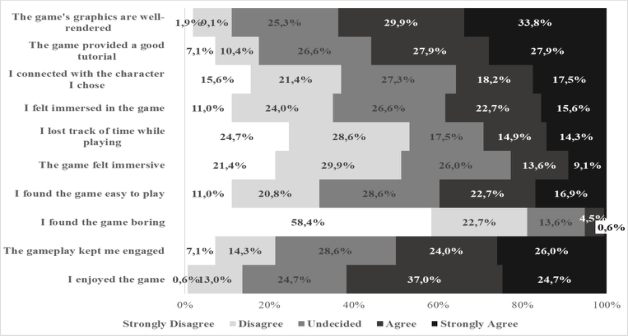
The 29.9% of the total sample of respondents report being familiar with serious games and the 63.0% report being unfamiliar with them. SLEEP- RO@D was rated as having a very good and pleasurable user experience by the 87% of the participants. Figure 1 shows the answers relating to the distribution of agreement/disagreement related to gaming.
The 62% of the participants report not sleeping satisfactorily: the aver- age number of hours of sleep per night reported is around 6 hours, and the 20% of the sample even assert sleeping less than 6 hours per night. The aver- age number of hours of sleep reported by the sample is therefore below that recommended for all ages by the National Sleep Foundation (minimum 7–8 hours per night). Based on the respondents’ answers, thinking of the last period (the last 4 weeks), the duration of sleep at night averaged is 6 hours (DS ± 1.8). The distribution of the sample according to hours of sleep is shown in the Table 1.
Figure 1: Percentage distribution of agreement/disagreement questions related to gaming.Table 1. Distribution of the sample according to hours of sleep (absolute values and percentages).
Considering the challenges associated with obtaining a good night’s sleep, the statistics highlight the importance of paying close attention to sleep hygiene practices. More than 60% of the sample are not completely satis- fied with their sleep. The respondents, thinking about the last period (the last 4 weeks), report snoring during sleep with a frequency of 26.0%. The answers relating to the question “Are you generally satisfied with the qual- ity of your sleep?” show the following percentage distribution: 38.3% often, 42.2% sometimes, 16.2% rarely and 3.2% never. The answers relating to the question “How sleepy do you feel during the day?” show the follow- ing percentage distribution: 10.4% not at all sleepy, 42.9% not very sleepy, 32.5% quite sleepy, 13.0% very sleepy and 1.3% completely sleepy. 18% of the sample report the use of sleeping medication, also taken at an early age. Of the 27 subjects reporting taking sleeping medication ‘rarely’, ‘some- times’ and ‘often’, 14 were male (51.9%) and 13 were female (48.1%), with a mean age of 36.2 years (SD ± 11.9; range 16–56 years). Road acci- dents are a public health and occupational safety and health critical issue and more than 90% of RA are associated to human error (psycho-physical condition, vigilance, and incorrect behaviour). Driver/worker performance is often affected by fatigue and excessive daytime sleepiness. Sleep is in fact a necessary element for health and safety at work as well. “Teach- ing health” is a fundamental point for a total worker health and to be
Digital Gamification as Action to Reduce Road Accidents: The Videogame SLEEP-RO@D 485
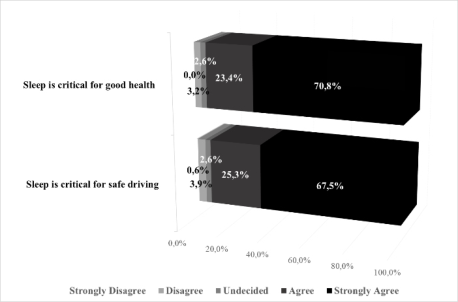
effective it must be integrated, innovative and participative. Figure 2 shows the responses to the agreement/disagreement questions related to the state- ments: ‘Sleep is important for driving safety’ and ‘Sleep is important for health’.
Figure 2: Percentage distribution of the agreement/disagreement questions related to sleep.
DISCUSSION
Digital technologies have occasionally been considered as a legitimate sup- port and a helpful tool for the implementation of information and training initiatives. When combined with traditional learning programmes, these ini- tiatives enable learners in general, and workers in particular, to gain new skills and knowledge while enhancing their abilities and overall personal and professional development. (Bentivenga et al., 2023). The current state of research on motivational technologies related to RS in Europe identi- fies two areas of developing investigation: person-centred technologies and system-focused technologies, for which there is still promising data of suf- ficient interest to infer the possibility of future broadening and deepening. The emphasis of both strategies is on human error and on the potential for managing it, either in advance of an incident or after the aftermath. Accord- ing to a recently published review motivational technologies aim to reduce the likelihood of accidents and mitigate their consequences overall through preventive action (Wallius et al., 2022). These devices, which are all based on gamification and entertainment, are even though they are described differ- ently, tools that engage positive psychological changes in people and improve learning, though there is currently little research on long-term benefits and potential drawbacks. Regardless of the mode of transportation, the individ- ual approach to error management is prevalent, except for a small number of studies that are devoted to air and sea travel (59 studies). Most of these studies are still centred around RS, with the main objective being to increase the safety of bikers, walkers, and vehicles.
Road safety studies have mostly used the person-based approach to focus on the pre-event phase with the goal of preventing accidents. This entails both encouraging safe behaviours, like crossing the street safely, and reducing dan- gerous individual actions, like speeding. While accident investigations usually try to enhance safety rules, practices, and conditions by discovering the causes of accidents or to involve people in data collecting to create safer cities, some studies concentrate on the post-event phase reporting a systemic approach to error management. The primary goal of gamified road research has been to decrease risky behaviours by influencing users’ psychological states to promote safe driving. Serious road games aim to teach safe behaviours and safety-related skills (e.g., crossing the road safely, situational awareness on a bicycle). Thus, challenges or goals, simulations or virtual worlds, textual, graphic, or audio feedback, points or scores, and challenges were the most often used motivational affordances. The affordances that were used in road settings the most were points or scores (24 studies), challenges or goals (24 studies), and feedback (31 studies). Design concepts are discussed in some research-in-progress articles (22%). Most studies of them evaluated the out- comes through empirical approaches that described a design, followed by an empirical evaluation, either qualitative (3 studies), quantitative (20 studies), or mixed (18 studies). A total of 22 quantitative or mixed-approach stud- ies used data to make assumptions about an entire population and examine relationships between variables (i.e., inferential). Most of the research looks at psychological outcomes like fun or enjoyment, perceived usefulness or usability, engagement, flow, or motivation. Only serious games were used to study a few psychological outcomes, such as risk awareness, perception or terror, locus of control, or self-efficacy. The results of the literature analy- sis also vary by transportation domain. The most frequently assessed factors in the roadway domain are perceived usefulness or usability (13 research), enjoyment (14 studies), and engagement, flow, or motivation (6 studies). Additionally, many research documented behavioural consequences, partic- ularly in relation to learning or acquiring knowledge through serious games (including learning effects measured by performance over time, interviews, and questionnaires).
In this perspective the serious game SLEEP-RO@D was created as a digital info-training intervention with the goal of changing people’s and employ- ees’ behaviour and habits regarding the quantity and quality of sleep. Based on scientific principles, the videogame incorporates data and info into the game dynamics to improve comprehension and promote the avoidance or modification of detrimental practices that worsen sleep deprivation. Char- acteristics and variables have been chosen to influence sleep and allow the player to personalise the avatar from the outset of the game based on findings from the literature. Upon showcasing the avatar he selected during charac- ter creation, the user can then elicit empathy, identification, and persuasion. Since the avatar serves as the basis for the game mechanics, the following variables should be considered when defining the avatar: a) Gender (man/- woman: given that two genders are included in the literature data); b) Age (young, adult, mature); c) Figure (average, obese); d) Chronotype (owl or
Digital Gamification as Action to Reduce Road Accidents: The Videogame SLEEP-RO@D 487
lark based on biorhythm, i.e., serotinous or morning behaviour); e) Occupa- tion (car driver, taxi driver, car transporter, courier, emergency vehicle driver, tractor driver, urban transport). According to the literature findings and fol- lowing the characterisation of the avatar the player is asked to answer a few simple questions that will better define the game character in particu- lar in relation to his/her night sleep: 1) working at night or not; 2) number of sleep hours at night; 3) snoring and/or breathing interruptions; 4) falling asleep time; 5) night awakenings; 6) excessive daytime sleepiness (EDS). Some habits and behaviours that can be chosen by the character the night before a workday that involves driving and that affect sleep and game mechanics, were selected based on the analysis of literature data and the guidelines of the National Association of Sleep Medicine (AIMS) concerning sleep hygiene norms (smoking habit; consumption exciting drinks; drinking alcohol; taking sleeping medication). Moreover, in order to condition the avatar’s sleep and the game mechanics, the player is asked to select two avatar actions to carry out the night before the working day. These actions can include playing sports right before bed, studying and working tirelessly, using electronic devices (like a PC), eating a large dinner, reading a book, going out with friends and drinking alcohol, playing a board game, or unwinding while watching social media. Lastly, a few elements of the sleeping environment that the player can select, and which affect both game mechanics and sleep quality were chosen between keeping the room at a high temperature, leaving a courtesy light on, using audio/video devices, opening the window. SLEEP-RO@D features eye- catching graphics that are reminiscent of the storytelling of the real patient case “Mario’story” (www.sleeposas.it).
In literature studies the motivational technologies are used for accident pre- vention (pre-event) and trauma reduction (during and post-event) in the event of an unintentional occurrence, based on the results reported. Because road users’ psychological and behavioural states are crucial in the development of RA, more than 90% of road accidents are caused by human error, preventing them—that is, intervening before an incident occurs—is a sensible strat- egy for motivational technology interventions in the transportation industry. Using affordances like feedback, challenges, and points to gamify driving and intervene in drivers’ psychological states (like boredom or fatigue) and mitigate risky behaviours (like speeding and lane departure), gamify driv- ing has been the subject of numerous studies with the aim of improving safe driving. For example, by increasing the cognitive load, gamification might reduce monotony and injury risk. Affordances that are outcome- and progression-based, like challenges and feedback, are the most widely used when considering all modalities. This is because opportunities for achieve- ment and advancement can be effortlessly applied to everyday tasks and practices, like driving (Mekler et al., 2017), as well as simulations and vir- tual worlds that try to fully immerse the user in the game world (Koivisto and Hamari, 2019). Moreover, as roadway gamification involves day-to-day scenarios (i.e., gamified driving), feedback and challenges are suitable affor- dances as they can be provided real-time through ambient colours or audio, avoiding distractions and excess cognitive effort, which might detriment safe driving (Xie et al., 2016).
In this framework, SLEEP-RO@D is developed as a single-player game: the role played in the game is that of a worker who is chosen by the player and who, before getting behind the wheel of a car or company vehicle, makes a series of choices that have an impact on the dynamics of the game and condition the feedback they will receive at the end of the journey. The player wants to feel what it’s like to be sleep deprived because it is linked to a higher risk of car accidents because it impairs cognitive and motor abilities. Because of this, by entering and selecting bad behaviours through the digital serious game, one can adversely affect the avatar’s abilities, such as by making him fall asleep at the wheel and cause an accident. The player makes experience of the effects of the previous choices during the play turn and due to the previous choices could improve or worsen the indicators of sleep recovery and well-being. There are two difficulty settings in the game, and gaming lasts for about five to ten minutes. In addition, there are also three bonuses that can be used during the game: 1) coffee consumption; 2) quick break; and 3) driver’s snooze to assist the player in reducing the effects of excessive sleepiness while driving. At the end of the game cycle, the levels reached, and the decisions taken, feedback and recommendations are provided using different communication tools (text, storytelling, short graphic videos).
Most of the evaluated studies address the design of a motivational inter- vention followed by an empirical evaluation and are mixed or quantitative in nature. This methodology aligns with the larger body of current research on motivational technology (gamification, for example). Therefore, the corpus primarily focuses on determining whether or not motivational technologies meet their predefined, measurable objectives. The topic is also explored in terms of design recommendations/indications: designers should consider the injury prevention phase to find a suitable motivational intervention type; they should choose the motivational affordances according to the applied safety improvement measures, and should consider the cognitive demand of the transportation task, the trade-off between distraction and potential safety benefits, and provide the feedback in a way that takes little attention away from the task itself. Due to the growing levels of automation, monotony is becoming an increasingly prevalent issue in transportation safety, whereas motivational technologies can reduce the accident risk by increasing the cog- nitive demand in monotonous transportation tasks, such as driving long distances (Bier et al., 2019). In addition to practical indications, studies also identify guidelines and actions to improve research on this topic: first of all future research should go beyond the person approach to error management and explore how these technologies can support citizens and workers engage- ment in improving transportation infrastructures safety and work practices alike, as well as consider social aspects in design and evaluation; also future research should cover a broader scope of transportation modes, and inves- tigate the learning effect of the motivational intervention when compared to the traditional approach, and in this last regard address the long-term effects of motivational interventions. Further examination is also needed on how the feedback should be presented in different contexts as, e.g., auditory, and visual information can influence behavioural patterns differently (Wang et al., 2020).
Digital Gamification as Action to Reduce Road Accidents: The Videogame SLEEP-RO@D 489
CONCLUSION
SLEEP-RO@D is the first video game dedicated to raising awareness and promoting sleep hygiene in workplaces too. Based on scientific principles, the video game incorporates data and literature studies results into game dynamics to improve comprehension and promote the avoidance or mod- ification of detrimental practices that worsen sleep deprivation. Since lack of sleep is associated with an increased risk of motor vehicle accidents due to impairments in cognitive and motor abilities, the player wants to experi- ence what it’s like to be sleep deprived. Through the digital serious game, one might negatively impact the avatar’s skills by choosing and entering poor behaviours. For example, one could make the avatar fall asleep at the wheel and cause an accident. Feedback and suggestions are given at the conclusion of the game cycle after taking into account the outcomes, the lev- els attained, and the choices made. These are intended to enhance general wellbeing and sleep quality and lower the risk of RA, including at work. Recent studies have shown that gamification can be a methodology directly aimed at increasing involvement, creating a perfect balance between learning and entertainment. Games have a special quality of social bonding provid- ing context and motivational aspects that can be used to improve dynamics and solutions, and educational elements can be integrated into the game- play, which will be subconsciously acquired by the players during gaming. By focusing primarily on the simulation expedient, various outcomes can be attained: games are developed that accurately mimic real-world scenarios and practices, requiring players to hone their skills in a virtual competition; or, as is increasingly common in educational institutions, games are designed to enhance users’ academic and didactic knowledge, to enhance human perfor- mance in a particular behaviour, or, in other words, to teach road users how to act appropriately by training them in an environment that is not real but is quite similar to the one to which the experience will be applied (Pietrafesa et al., 2023). According to our study and testing, playing digital serious games offers possibilities to experiment while working and explore, practice, and interact with digital content, allowing players to learn about risk and inse- curity in a secure setting. Learning subjects’ active behaviour develops a new “mental habit,” social and emotional skills, and a positive, safe attitude.
REFERENCES
ACI-Istat “Incidenti stradali Anno 2022”. Website: www.aci.it/laci/studi-e- ricerche/dati-e-statistiche/incidentalita/la-statistica-istat-aci/2022.html. Bentivenga, R., Pietrafesa, E., Martini, A., De Angelis, L., Mariconte R., Palomba R., Simoncelli G. (2023). “Il ruolo delle tecnologie innovative nel contesto della cultura in materia di salute e sicurezza sul lavoro”, in: Quaderni di Comu- nità: persone, educazione e welfare nella società 5.0 Vol. 1. Eurilink, Rome, pp. 221–262. Bier, L. Emele, M. Gut, K. Kulenovic, J. Rzany, D. Peter, M. Abendroth, B. (2019) Pre-
venting the risks of monotony related fatigue while driving through gamification. Eur Transp Res Rev; 11:44.
EC, Mobility and Transport “Road Safety Statistics 2022”. Website: https://transp ort.ec.europa.eu/background/road-safety-statistics-2022-more-detail_en. Koivisto, J. Hamari, J. (2019) The rise of motivational information systems: a review
of gamification research. Int J Inf Manag; 45:191–210. Martini, A., Pietrafesa, M., Luzzi, V., Guaragna, M., & Polimeni, A. (2022) La Sindrome Delle Apnee Ostruttive Nel Sonno: Una Lettura Interdisciplinare Del Fenomeno, ARACNE (Ed.), Rome. Mekler, ED. Brühlmann, F. Tuch, AN. Opwis, K. (2017) Towards understand-
ing the effects of individual gamification elements on intrinsic motivation and performance. Comput Hum Behav; 71:525–34. Pietrafesa, E., Martini, A., Bentivenga, R., Luzzi, V., & Polimeni, A. (2023). OSAS Virtual Reality Lab: An Experience in OSH Training. In: International Confer- ence in Methodologies and intelligent Systems for Technology Enhanced Learning pp. 136–143. Cham: Springer Nature Switzerland. Xie, JY. Chen, HYW. Donmez, B. (2016) Gaming to safety: Exploring feedback gami-
fication for mitigating driver distraction. Proc Hum Factors Ergon Soc Annu Mee; 60:1884–8. Wallius, E., Klock, A. C. T., & Hamari, J. (2022). Playing it safe: A literature review and research agenda on motivational technologies in transportation safety. Reliability Engineering & System Safety, 223, 108514. Wang, M. Liao, Y. Lyckvi, SL. Chen, F. (2020) How drivers respond to visual vs.
auditory information in advisory traffic information systems. Behav Inf Technol; 39: 1308–19. WHO. “Global status report on road safety 2023” Website: https://www.who.int/te ams/social-determinants-of-health/safety-and-mobility/global-status-report-on- road-safety-2023.
LISTED IN THE AHFE DIGITAL BOOKSTORE CATALOGUE
Explore the complete digital volume
Advances in Human Factors of Transportation
Read this individual research paper free through the original publisher, or explore the full digital proceedings book.
ISBN 978-1-964867-24-3
Explore this ISBN in the AHFE Bookstore ↗Listed in the July 2026 bookstore catalogue; search by ISBN to confirm current availability · Digital book purchase optional