Dongyuan Wang, Jacqueline Miller, Pingying Zhang (2025). Decision Making in Driving Moral Dilemmas: A Driving Simulator Study. In: Advances in Human Factors of Transportation. AHFE Open Access, vol. 186, pp. 323–331. https://doi.org/10.54941/ahfe1006521
Understanding how humans make decisions in dangerous driving situations, such as moral dilemmas, can provide valuable insights for assessing autonomous vehicles (AVs) and bridging the gap between AV algorithms and human morality. It is generally assumed that drivers will make utilitarian choices if given enough time, meaning their chosen actions align with their preferred actions. However, previous research has shown mixed results, especially under time and outcome pressure. This discrepancy between actual and preferred actions may be due to limited processing of the related events or reflexive reactions, such as turning to the right, particularly when data is collected from a single scenario. This study utilized a driving simulator to explore whether drivers make ethical decisions in programmed crash scenarios, collecting data from multiple scenarios. Thirty-one undergraduates participated using a STISM driving simulator to respond to driving moral dilemmas. The results indicated that allowing more time to process driving environments led to a higher percentage of utilitarian choices. Additionally, participants showed a preference for responding right over left. Impulsiveness did not affect utilitarian choices. These findings have potential implications for the regulation of driver assistance technologies and AVs.
Motor vehicle crashes pose a public health issue both within the United States and internationally. Within the United States, these crashes stand as one of a primary cause of mortality, claiming the lives of more than 100 individuals daily. Despite the promise of enhanced safety in automated vehicles, more time and data are needed to claim automated vehicles perform better than human drivers (Goodall, 2020). As of December 14, 2023, California reported 676 accidents involving AVs (Autonomous Vehicle Collision Reports, n.d.). Besides safety concerns, there are moral and ethical concerns on how autonomous vehicles (AVs) make decisions in inevitable situations and what ethical principles should guide AV decision making algorithms (Awad et al., 2018; Bonnefon et al., 2016). Automated vehicles rely on preprogrammed algorithms, and the outcomes generated by these algorithms can pose more risk to certain road users than others. Imagine
that on a two-lane road, a school bus is to your left and in the lane beside you, driving in the opposite direction. Suddenly, a truck behind the school bus pulls into the same lane as you, presumably attempting to pass the school bus. Barriers limit the ability to easily respond off the road, and it’s imperative to quickly bring your car to a stop. Your vehicle is now on a collision course with the bus, and you are forced to make a choice: swerve to avoid hitting the truck in front of you but sacrifice yourself and the truck driver or swerve to hit the bus and potentially sacrifice more people inside the bus (Pradhan et al., 2019). If you were programming autonomous vehicles (AVs), what would you instruct them to do? Scenarios like this may seem improbable. However, the more vehicles involved, the more inevitable it becomes that an event with low probability will occur (Bonnefon et al., 2016; Gao et al., 2020; Greene, 2016). Although the majority of crashes are claimed to be caused by incautious human drivers, human error poses a challenge for AVs developers as long as AVs share roadways with human drivers (Goodall, 2014; Schwall et al., 2020). AVs’ algorithms are not developed to perfectly avoid collisions for all driving scenarios and may not eliminate collisions in the near future as long as AVs share roads with other users (Lin et al., 2008; Lin, 2016; Nasim et al., 2022; Nunes et al., 2018). If a collision is unavoidable, then what we crash into and how we crash matters (Lin, 2016), and the decision made quickly becomes an ethical issue for AVs to determine the most appropriate way to crash (Goodall, 2014). The development of AV algorithms is still in progress, and the absence of consensus on ethical standards is a big challenge in developing AVs with ethical standards equal to or higher than humans. Therefore, AV algorithms necessitate research on human decision-making in moral dilemmas. This research aims to comprehend how individuals respond to driving dilemmas, with the goal of providing a valuable reference for AV assessment and bridging the gap between AV algorithms and human morality (Gao et al., 2020). This line of research focusing on ethical decision making can also contribute to developing socially acceptable principles for AV ethics (Goodall, 2020; Lucifora et al., 2021, 2020).
One of the first ethical principles is utilitarianism, also known as consequentialism, which are choices that lead to the greatest overall good (Lin, 2016). Much previous research showed that humans favor more utilitarian outcomes (minimize harm and maximize overall outcome) in driving moral dilemma scenarios (e.g., Faulhaber et al., 2018: consistently utilitarian preferences across conditions; Gao et al., 2020: 73% utilitarian; Pradhan et al., 2019: 68.75% utilitarian survey responses). However, Bonnefon et al. (2016) showed that in certain situations, even this ethically sound principle may not apply. For example, in Samuel et al.’s (2020) study, 57% chose inaction and only 43% chose the utilitarian response. In other words, the majority failed to make utilitarian decisions with a time pressure of about 2 s. Similarly, in Pradhan et al.’s (2019) simulator study, only 43.75% chose the utilitarian response, which is lower than the percentage in other similar studies (e.g., Faulhaber et al., 2018; Gao et al., 2020; Navarrete et al., 2012).
Decision Making in Driving Moral Dilemmas: A Driving Simulator Study 325
The lower percentage of utilitarian choices in Samuel et al.’s (2020) and Pradhan et al.’s (2019) studies may be due to limited processing of the environment or response preferences or reflexes triggered in these scenarios as proposed by Pradhan et al. (2019). When given enough time, participants would be more likely to make utilitarian choices (Navarrete et al., 2012). However, if there was not enough time to process the event related information, that could lead to lower utilitarian choices results. In this study the time to event time was manipulated to assess impact of available processing time on ethical decision making. Additionally, this study will investigate the possible bias or their instincts (preferred response direction) to steer a car to a certain side of the road. Both studies only exposed participants to one scenario, thus no way to test whether their response is a reflexive reaction or lower utilitarian choices may be due to decision-making biases (Frank et al., 2019) or the reflexive response in that scenario (Pradhan et al., 2019). In this study, simulator experiments were carried out to capture more natural and realistic driving behaviour with more than one scenario in which the response direction associated with utilitarian and non-utilitarian choices were varied. Also, we investigated whether participants would make utilitarian choices under time pressure with varied available processing time of the potential crash target/event.
METHOD
Participants Thirty-one undergraduate students (25 females, 4 males, 2 others) participated in this study who had a driver’s license or were eligible for licenses. The mean age was 20.42 years with a minimum age of 18 and a maximum age of 46. Participants were recruited using an online participant recruiting system (SONA). Some students were compensated with extra credit. Participants who were under 18, were unable to receive a drivers’ license, had photosensitive epilepsy, had a history of major car accidents, or had a history of video induced motion sickness were suggested not to participate due to concerns about potential harm to these individuals. The experiment lasted less than an hour. The Institutional Review Board (IRB) approved the study.
Materials
This study used the STISIM-Model 100 driving simulator, and two surveys presented via Qualtrics. The STISIM simulator included a Logitech steering wheel, a brake pedal and throttle, and a Dell 17-inch monitor. Variables collected via the STISM simulator included the following: distance from start, steering parameters, crash number and details, time from start, and pedal information. A practice run used normal simulation parameters to familiarize participants with the simulator. The experimental run used cruise mode, so brakes and throttle did not work for the experimental simulation. In the experimental run, vehicle speed was set to a constant 51.34 ft/s, which is about 35 mph.
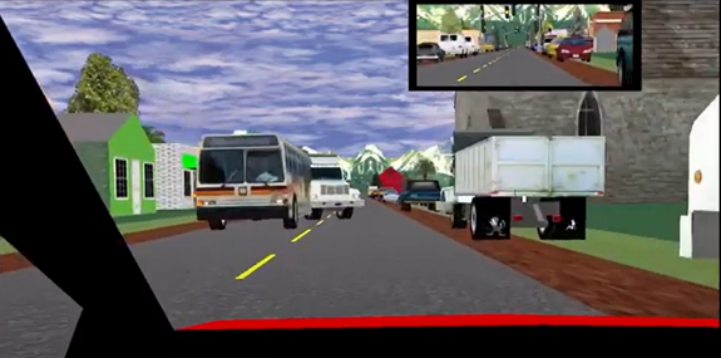
Design All driving in the current study occurred on a two-lane undivided suburban road. Participants completed a practice run and an experimental run. The collision scenarios were classified into two types (six pedestrian-type scenarios and six vehicle-type scenarios). The interval between scenarios varied from roughly 700 feet to 2700 feet. This paper only reports results from vehicle-type scenarios. Vehicle-type scenarios were modelled after Pradhan et al.,’s (2019) scenario. The scenario occurred on a two-lane road, and the target vehicles were a bus and a truck in the left lane. To manipulate the direction of utilitarian turns, in three scenarios, the bus is behind the truck (the truck-bus scenarios), so turning to the left would be a utilitarian choice according to Pradhan et al. (2019). In the other three, the truck is behind the bus (the bus-truck scenarios) and turning to the right would be coded as a utilitarian choice (Figure 1). The two target vehicles were presented approximately 4, 5, or 7 seconds away from the driver (time to vehicle, TTV), and when the driver was 2 seconds away, the vehicle behind would move unexpectedly into the right lane to overtake the front vehicle to create a potential head-on collision with the participant’s vehicle. This manipulation was to test impact of available processing time of the target event and eliminate any anticipation of the event.
Figure 1: Vehicle scenario with bus in front of truck (similar to Pradhan et al., 2019). Turning to the right without harming the bus would code as a utilitarian choice. However, in scenario with truck in front of bus, turning to the left avoiding harming the bus would code a utilitarian choice.
Procedure Participants first signed the consent form, then completed a brief practice simulation, the impulsiveness or demographics survey on Qualtrics, the experimental simulation run, and the un-started impulsiveness or demographic survey. Participants were randomly assigned to complete one of the two surveys first. Collision scenarios within the experimental simulation
Decision Making in Driving Moral Dilemmas: A Driving Simulator Study 327
were presented in the following order: bus-truck (Figure 1B), 4 s TTV à truck-bus (Figure 1A), 5 s TTV à bus-truck (Figure 1B), 5 s TTV à truck-bus (Figure 1B), 7s TTV à truck-bus (Figure 1A), 4 s TTV à bus-truck (Figure 1B), 7 s TTV Data Organization
For each scenario, data recording started 2 seconds before the collision vehicle began moving into the right lane. Based on the raw data collected with the simulator, participants’ responses were reviewed to determine what kind of response was made i.e., utilitarian/non-utilitarian and turning direction (left, right, or straight). Participants’ reaction time to the collision vehicle was also derived from the raw data. For each participant, we calculated the total proportion of utilitarian choices, the proportion of utilitarian choices and reaction time under each TTV condition, and the number of left/right choices for each scenario. If a participants’ steering wheel turned less than 25 degrees in a scenario, the response was classified as a moving straight-type response. If a clear response was made, the direction (left or right) was determined by the steering wheel angle. Utilitarian choices were defined as occurring when participants responded by driving off the road, hitting a stopped vehicle, or moving as if to hit the truck
RESULTS
To investigate whether participants made utilitarian choices, the percentage of participants who made utilitarian choices in each scenario was summarized in Table 1. The results showed that the mean percentage of participants that made utilitarian choices was about 60% across all scenarios. However, in some scenarios, the percentage of participants who made utilitarian choices was less than 50%. For example, in the 4 s TTV truck-bus scenario, the mean percentage of participants who made utilitarian choices was only 22.58%. The percentage of utilitarian choices across all six scenarios was calculated for each participant. A one-sample t-test showed that the percentage of utilitarian choices (59.68%) was higher than 50 percent, t(30) = 2.89, p =.004, Cohen’s d = .19.
Table 1: Number and percentage of participants who make u-choices in each vehicle scenario and mean percentage of participants who make u-choices in each combination of time to vehicle and scenario type.
Table available in the original PDF paper.
Time to Vehicles
Bus-Truck Location Mean% of
(TTV) U-Choices Bus-Truck (n%) Truck-Bus (n%) Veh 4 s 20 (64.52%) 7 (22.58%) 27 (43.55%) Veh 5 s 26 (83.87%) 20 (64.52%) 46 (74.20%) Veh 7 s 28 (90.32%) 10 (32.26%) 38 (59.68%) %Scenario Type 79.57%a 39.79% 100%
Processing Time and Utilitarianism To answer the question of whether TTV influences decision making, a one- factor within-subjects ANOVA was conducted to test the effects of TTV on the percentage of utilitarian choices. There was a significant main effect of TTV level on the percentage of utilitarian choices, F (2, 60) = 8.75, p <.001, η2 = .23, Ms = 44%, 74%, & 61% for 4 s, 5 s, & 7 s. An ad hoc analysis showed that the percentage of utilitarian choices was significantly different across all three TTV levels, and the highest percentage of utilitarian choices was observed at 5 s TTV.
Preferred Response Direction and Utilitarianism To examine whether drivers rely on reflexive or instinctive reactions in a driving dilemma, only participants’ responses that could be categorized as a left or right turning response were included in the following analysis. The directional response numbers for each scenario for each participant were obtained. A repeated measure ANOVA with the type of scenario (bus-truck or truck-bus scenario) and swerve response (swerve left/right) as two within- subject variables was conducted on the number of responses. The main effect of the swerve response was significant, F (1, 30) = 12.36, p = .001, η2 = 0.29, indicating participants were more likely to swerve to the right than to the left (Ms = 0.62 & 1.33 for left and right responses respectively). In the United States, driving occurs on the right side of the road, and when the left and front of the way are occupied, it seems people choose to swerve to the right to minimize the imminent danger. The main effect of the scenario was also significant, F (1, 30) = 6.53, p = .016, η2 = 0.18, indicating the swerve responses in the bus-truck scenarios was lower than that in the truck- bus scenarios (Ms = 0.89 & 1.08). Furthermore, results indicated that less participants reacted with a swerve and instead reacted with a moving straight- type response in the bus-truck scenario than the truck-bus scenario. This result provided further support that the ethical decision “moving straight” is a utilitarian choice as it avoided colliding with the bus in the left lane in the bus-truck scenario, but not in the truck-bus scenario because it would lead to a head-on collision with the bus. The interaction of these two variables was not significant, F (1, 30) = 2.16, p = .067.
CONCLUSION
The current driving simulator study explored drivers’ decision-making in unavoidable collisions under time pressure. Key findings are summarized in two main points. First, many participants opted for utilitarian choices in unavoidable collisions. In the bus-truck scenario, as time to process the events increased, utilitarian choices increased from 64% to 90%, supporting the idea that more time to process the environment leads to utilitarian decisions. Pradhan et al. (2019) did not specify the time duration for targeted vehicles in that study, but our results suggest this factor is important. In the truck-bus scenario, however, utilitarian choices decreased as time to vehicles increased from 5 to 7 seconds. This unexpected result aligns with Tinghög et al. (2016), who found that lower time pressure decreased utilitarian responses
Decision Making in Driving Moral Dilemmas: A Driving Simulator Study 329
in certain situations. The preference for non-utilitarian choices in potential head-on collisions with the bus may relate to study limitations, such as using a city bus instead of a school bus and the absence of visible passengers. City buses may carry different connotations for Southeast metro area U.S. participants, impacting decision-making as city buses typically have fewer, lower income, and mostly older passengers. This awareness may impact the outcomes of decision-making. Further exploration is necessary to understand why participants opted for their chosen responses, and scenario variances’ effect on responses merits closer scrutiny in future studies.
Secondly, this study observed a tendency for participants to favour swerving to the right. This outcome reinforces the ethical nature of decision- making. In scenarios where participants drive in the right-lane, participants faced with potential danger from the left and front, opted to swerve right to avoid the imminent threat. This instinctive behaviour may stem from a learned risk analysis. In summary, when considering all these findings collectively, they affirm the notion that participants’ decision-making in these unavoidable collision conditions was not arbitrary, at least within the study’s 4–7 second timeframe. Future studies could delve into scenarios that involve more self-sacrificial decisions or situations where participants must decide whether to intervene in an incident where they would otherwise be uninvolved. For instance, a scenario might present participants with the choice of colliding with a presumed drunk driver or allowing that driver to hit a group of pedestrians— a situation akin to an incident reported in a news article (Henning, 2022). The study’s results are also constrained by technical limitations. Notably, participants’ vehicles are in cruise mode, that disables the brake and throttle. To overcome this limitation, future research could adopt an approach like Samuel et al. (2020), wherein the speed limit was set too high for participants to stop in time, thus addressing the constraints associated with cruise mode.
The present research highlights the prevailing trend of individuals generally opting for utilitarian choices. There is a clear tendency to swerve to the right, consistent with the right-side driving norm in the U.S. when faced with obstacles from the left and front, drivers tend to veer right even though that response may not be the utilitarian choice. These findings can help drivers understand their decision-making biases. And ask questions of whether AI algorithm can take over and make that choice which is more consistent with what we would do when we have enough time to process the event.
REFERENCES
Autonomous Vehicle Collision Reports. n.d. California DMV. Retrieved Dec 1, 2023, from https://www.dmv.ca.gov/portal/vehicle-industry-services/ autonomous-vehicles/autonomous-vehicle-collision-reports/. Awad, E., Dsouza, S., Kim, R., Schulz, J., Henrich, J., Shariff, A., Bonnefon, J., & Rahwan, I., 2018. The Moral Machine experiment. Nature. 563, 59–64. https:// doi.org/10.1038/s41586-018-0637-6
Biçaksiz, P., & Özkan, T., 2016. Impulsivity and driver behaviors, offences and accident involvement: A systematic review. Transportation Res. Part F: Traffic Psychology and Behaviour, 38, 194–223. https://doi.org/10.1016/ J. TRF.2015.06.001 Bonnefon, J., Shariff, A., & Rahwan, I., 2016. The social dilemma of autonomous
vehicles. 352(6293), 1573–1577. https://doi.org/10.1126/science.aaf2654 Faulhaber, A. K., Dittmer, A., Blind, F., Wächter, M. A., Timm, S., Sütfeld, L. R., Stephan, A., Pipa, G., & König, P., 2018. Human Decisions in Moral Dilemmas are Largely Described by Utilitarianism: Virtual Car Driving Study Provides Guidelines for Autonomous Driving Vehicles. Science and Engineering Ethics, 25(2), 399–418. https://doi.org/10.1007/s11948-018-0020-x Frank, D., Chrysochou, P., Mitkidis, P., & Ariely, D., 2019. Human decision-making
biases in the moral dilemmas of autonomous vehicles. Scientific Reports, 9. Gao, Z., Sun, Y., Hu, H., Zhang, T., & Gao, F., 2020. Investigation of the instinctive reaction of human drivers in social dilemma based on the use of a driving simulator and a questionnaire survey. Traffic Injury Prevention, 21(4), 254–258. https:// doi.org/10.1080/15389588.2020.1739274 Goodall, N. J., 2020. Potential Crash Rate Benchmarks for Automated Vehicles. Transportation Res. Record, 2675(10), 31–40. https://doi.org/10.1177/ 03611981211009878 Goodall, N. J. 2014. Pre-print version. Meyer, G., Beiker, S. (Eds.), Road Vehicle
Automation, Springer, pp. 93–102. https://doi.org/10.1007/978 Greene JD., 2016. Our driverless dilemma. Science. 352(6293):1514–1515. https:// doi.org/10.1126/science.aaf9534 Henning, A., 2022. ‘I knew it was me:’ Hero trooper who stopped drunk driver talks
about crash. https://www.wfla.com/news/local-news/trooper-who-risked-life-to- stop-drunk-driver-to-speak-for-first-time-since-crash/?fbclid=IwARSnQKwl_vp2 1uPFYDesqyKleyCvlorIsYIvgPSbg4VUySLStfOpZR_UB-M Lin P., 2016. Why ethics matters for autonomous cars. Maurer M, Gerdes J, Lenz B, Winner H, (Eds.) Autonomous driving. Springer Berlin, Heidelberg. pp. 69–85. https://doi.org/ 10.1007/978-3-662-48847-8_4 Lin, P. G., Bekey, K., & Abney, M. A., (2008). Autonomous Military Robotics: Risk,
Ethics, and Design. California Polytechnic State University. Lucifora, C., Grasso, G. M., Perconti, P., & Plebe, A., 2021. Moral reasoning and automatic risk reaction during driving. Cognition, Technology and Work. 23(4), 705–713. https://doi.org/10.1007/s10111-021-00675-y Lucifora, C., Grasso, G, M, Perconti, P., & Plebe A., 2020. Moral dilemmas in self-
driving cars. Rivista internazionale di Filosofia e Psicologia 11(2), 238–250. Navarrete, C. D., McDonald, M. M., Mott, M. L., & Asher, B., 2012. Virtual morality: Emotion and action in a simulated three-dimensional “trolley problem”. Emotion 12(2), 364–370. https://doi.org/10.1037/a0025561 Nasim, S. F., Ali, M. R., & Kulsoom, U., 2022. Artificial intelligence incidents & ethics a narrative review. International J. of Technology, Innovation and Management (IJTIM) 2(2), 52–64. Nunes, A., Reimer, B., & Coughlin, J. F. (2018). People must retain control of
autonomous vehicles: Legislation on the testing of self-driving cars does not address liability and safety concerns, warn Askey Nunes, Bryan Riemer and Joseph F. Coughlin. Nature. 556(169), 169–171.
Decision Making in Driving Moral Dilemmas: A Driving Simulator Study 331
Pradhan, A. K., Jeong, H., & Ross, B., 2019. Is driving simulation a viable method for examining drivers’ ethical choices? An exploratory study. Proc. of the Tenth International Driving Symposium on Human Factors in Driver Assessment, Training an Vehicle Design, 106–112. https://doi.org/10.17077/ drivingassessment.1682 Samuel, S., Yahoodik, S., Yamani, Y., Valluru, K., & Fisher, D. L., 2020.
Ethical decision making behind the wheel – A driving simulator study. Transportation Res. Interdisciplinary Perspectives 5, 100–147. https://doi.org/ 10.1016/j.trip.2020.100147 Sütfeld, L. R., Ehinger, B. V., König, P., Pipa, G., 2019. How Does the Method Change What we Measure? Comparing virtual reality and text-based surveys for the assessment of moral decisions in traffic dilemmas. https://doi.org/10.31234/ osf.io/h2z7p Tinghög, G., Andersson, D., Bonn, C., Johannesson, M., Kirchler, M., Koppel, L., &
Västfjäll, D., 2016. Intuition and Moral Decision-Making – The Effect of Time Pressure and Cognitive Load on Moral Judgment and Altruistic Behavior. PLOS ONE 11(10), e0164012. https://doi.org/10.1371/journal.pone.0164012
LISTED IN THE AHFE DIGITAL BOOKSTORE CATALOGUE
Explore the complete digital volume
Advances in Human Factors of Transportation
Read this individual research paper free through the original publisher, or explore the full digital proceedings book.
ISBN 978-1-964867-62-5
Explore this ISBN in the AHFE Bookstore ↗Listed in the July 2026 bookstore catalogue; search by ISBN to confirm current availability · Digital book purchase optional