Lotte Wagner-douglas, Emma Höfer, Regina Linke, Stefan Ladwig (2025). Enhancing the Viability of Battery-Electric Trucks in Long-Distance Freight Transport: Assessing the User Acceptance of Overhead Line Technology. In: Human Interaction and Emerging Technologies (IHIET-FS 2025): Future Systems and Artificial Intelligence Applications. AHFE Open Access, vol. 196, pp. 43–51. https://doi.org/10.54941/ahfe1005953
The impacts of climate change are becoming increasingly noticeable, highlighting the need for the transport sector to minimize CO₂ emissions. Battery-electric trucks (BEVs) offer a promising solution for reducing emissions in heavy-duty road transport. However, their limited range and long charging times reduce their overall attractiveness and usability. Dynamic charging via overhead line technology addresses these challenges by enabling trucks to additionally charge while driving, extending their range and reducing reliance on stationary charging. The “BEV Goes eHighway” (BEE) project investigates user acceptance and technical feasibility of this technology, focusing on retrofitting pantographs to existing BEVs. To integrate perspectives from decision-makers and users, an expert survey (N = 12 logistics specialists) and a pilot field study (N = 7 truck drivers) were conducted. Over 80% of experts supported integrating pantograph-equipped trucks into their fleets, with purchase price, operating costs, and maintenance costs being key factors. The field study tested two pantograph-equipped trucks—one battery-electric and one hybrid—revealing overall ease of use, but also optimization potential. Challenges include pantograph connection in poor weather and increased cognitive workload due to precise lane keeping. Users suggested improvements such as auditory and visual feedback and automated pantograph control. The results emphasize the dependence of a successful implementation on technological and infrastructural advancements as well as user acceptance. Future efforts should focus on improving pantograph reliability, automating key processes, and expanding field studies to validate scalability and usability.
trucks (BEVs) offer a significant potential to reduce CO2 emissions in long-distance freight transport compared to traditional diesel vehicles (Lundström & Lindén, 2023). However, their adoption remains limited due to critical barriers such as reduced range and extended charging times (Higueras-Castillo et al., 2020; Steinhilber et al., 2013). Dynamic charging through overhead lines (OL) presents a promising solution to these challenges (Linke et al., 2022), by enabling trucks equipped with pantographs to charge their batteries while driving. OL technology effectively increases vehicle range and reduces dependence on stationary charging infrastructure (Plötz et al., 2019). Despite advances in technical development, research on OL systems has predominantly focused on factors such as performance under variable conditions, energy efficiency, and maintenance demands (Zenith et al., 2020; Linke et al., 2024). The perspectives and requirements of stakeholders, particularly users and decision-makers, remain underexplored. Understanding these human-centered aspects is crucial, as neglecting them could impede the successful integration of the technology into existing transport systems. Studies on technology acceptance emphasize the importance of involving stakeholders early in the development process to align technological solutions with practical needs and expectations (Burghard et al., 2024; Davis, 1989; Venkatesh & Davis, 2000).
The “BEV Goes eHighway” (BEE) project aims to address these gaps by investigating the acceptance of OL technology and identifying the key requirements of decision-makers and end users. To this end, two studies were conducted: an online study with decision-makers and a pilot field study with end users. The findings from this research are intended to support the development and use of solutions that meet the requirements of real freight transport.
STUDY 1 – REQUIREMENTS OF DECISION-MAKERS Procedure
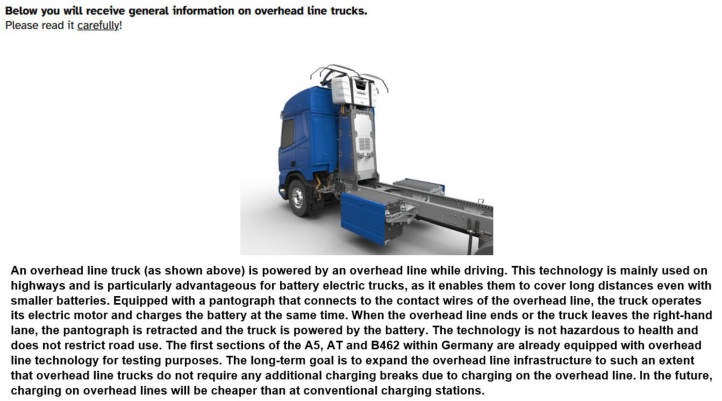
An exploratory online study was conducted between June 25, 2024 and January 3, 2025 to determine the requirements of decision makers for trucks with OL technology. The focus of the survey was to identify and assess potential purchase criteria. After a welcome message and informed consent, participants first answered questions about their company’s fleet characteristics (number of trucks, propulsion types, areas of operation) and their knowledge of OL technology for trucks. To ensure a common understanding, the participants were then presented with a short informational text about OL trucks (see Figure 1) before being asked to indicate whether such a purchase was conceivable for their fleet. In the main part of the survey, participants listed and ranked all the criteria they would consider when making a purchase.
Enhancing the Viability of Battery-Electric Trucks in Long-Distance Freight Transport 45
Figure 1: General information on overhead line trucks presented to the participants in the online study.
Sample A total of N = 12 participants with insights into purchasing decisions for truck fleets (≥12 tons) completed the online survey (n = 11 in German, n = 1 in English). The fleets of the companies, for which the participants worked or had insight into the purchasing decision, had an average of M = 193 trucks (SD = 162.22, min = 5, max = 450). The majority of these fleets was comprised of internal combustion engine trucks, with an average share of 98% (SD = 3%, min = 90%, max = 100%), while battery- electric trucks accounted for an average of 2% (SD = 3%, min = 0%, max = 10%). The utilization of these fleets was predominantly allocated to regional distribution transport, with an average percentage of 70% (SD = 4%), followed by domestic long-haul transport at 36% (SD = 36%) and international long-haul transport at 21% (SD = 31%).
Results
The majority of participants (n = 10) expressed a positive outlook on the adoption of OL technology for their fleets, assuming favorable infrastructural conditions were in place. Two participants expressed concerns about the international compatibility of the technology, the high cost of infrastructure development, the lack of a market for used vehicles, and the limited applicability of OL technology in urban-only operations specific to their companies. Key factors influencing purchase decisions were ranked as follows: the purchase price was the most critical factor, followed by operational costs, maintenance costs, maximum payload capacity, and the frequency of required charging breaks. Training requirements were considered the least significant factor. Only one participant was unfamiliar with OL technology prior to the survey.
STUDY 2 – REQUIREMENTS OF END-USERS Design
To determine user requirements, an exploratory field study was conducted between December 5 and 6, 2024, in which participants experienced and evaluated two different OL trucks.
Material The test vehicles used were: 1) a BEV retrofitted with a pantograph, herein referred to as a BEE truck (the system was developed as part of the project, BEV Goes eHighway, 2025), and 2) a hybrid truck equipped with a factory- installed pantograph, hereafter referred to as a Commercial truck.
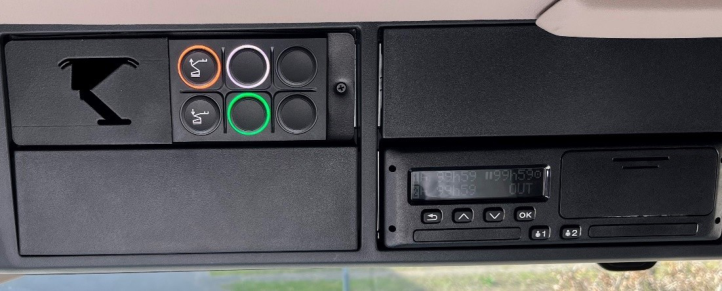
In the BEE truck, the pantograph controls are located above the windshield near the tachograph. The interface includes buttons for extending and retracting the pantograph, with status changes indicated through blinking lights and the current pantograph state conveyed using a color-coded scheme (see Figure 2).
Figure 2: Pantograph control element of the BEE truck. Current status: system ready, pantograph retracted.
In the Commercial truck, the controls are integrated as toggle switches behind the steering wheel. Additionally, a display mounted near the right side mirror provides a continuous video feed of the pantograph to support monitoring during operation.
To measure participants’ affinity for technology, the Affinity for Technology Interaction Scale (ATI-S; Wessel et al., 2019) with a 6-point Likert scale was used (1 - completely disagree to 6 - completely agree). Distraction and cognitive workload were assessed using the NASA Task Load Index (NASA-TLX; Hart et al., 2006), in which participants had to rate different demands (such as perceived mental demand) on a scale from 0 to 20, with 0 being low and 20 being high. System acceptance was assessed using the System Acceptance Scale (Van der Laan, 1997), which captures nine semantic differentials, each with 5 levels, divided into two factors: Usefulness and Satisfaction. Higher scores indicate higher levels of usefulness
Enhancing the Viability of Battery-Electric Trucks in Long-Distance Freight Transport 47
and satisfaction, respectively. The usability of the system was measured using the System Usability Scale (SUS; Gao et al., 2020), in which the responses are aggregated so that the final score ranges from 0 (no usability) to 100 (highest usability). Additionally, qualitative questions were asked including perceived environmental benefits and adoption preferences, overall interaction with the pantograph, comprehensibility and usefulness of displayed information, and perceived safety when driving with and without a pantograph.
Procedure After an introduction to the test’s purpose and completion of necessary formalities (e.g., consent forms), participants filled out a preliminary questionnaire capturing demographic data and technology affinity. Participants were then introduced to the first of the two test vehicles. The order in which participants experienced the vehicles was randomized. If the participants were unfamiliar with the vehicle, an accompanied initial contact with the stationary vehicle was conducted. Here the participants were first asked to familiarize themselves with the vehicle, in particular with the operation of the pantograph system, by verbalizing their thoughts using the “thinking aloud” method. The aim of this method was to record the intuitiveness of the operation of the system. To ensure that all participants could use the system in road traffic, they were then given technical instructions on how to operate it by the research team before starting the actual test drive. Each driving session lasted approximately 60 minutes and followed a predefined circular route (approx. 33 km), including a segment of the OL equipped German highway A5 (Schöpp et al., 2025). The route was driven twice per session, with a maximum speed of 80 kph. During the first lap (familiarization lab), participants followed standardized instructions to perform specific maneuvers, such as lane changes with and without manually disengaging the pantograph and engaging/disengaging the pantograph during straight-line driving. During the second lap, participants were instructed to drive as they would during a typical workday, deciding independently when to engage or disengage the pantograph and performing any maneuvers they deemed necessary, such as overtaking. They were asked to apply the “thinking-aloud” method throughout the ride. During the test drive, a member of the research team was present in the passenger seat to ensure safety and document observations. Interaction with the participants was limited to safety-critical situations. After completing the first test drive, participants underwent a 15-minute post-drive interview. This assessed their acceptance of the system, perceived safety, distraction levels, mental workload, and suggestions for improvement. Participants then took a 60 to 90-minute break before repeating the procedure with the second test vehicle, resulting in a total duration of approximately four hours per participant, including breaks.
Sample The study included N = 7 male participants aged 36 to 65 years (M = 52.43, SD = 10.52), with professional truck driving experience ranging from 5 to
40 years (M = 27.14, SD = 11.7). Of the participants, six had prior experience driving diesel trucks, three had driven hybrids, four had driven hybrids with OL systems (same model as the Commercial truck), and three had driven BEVs. None had experience with BEVs equipped with OL systems or fuel-cell vehicles. Experience with OL technology varied: Two participants reported 1,000 to 5,000 km, one reported 5,001 to 10,000 km, and one reported 50,001 to 100,000 km. The average score on the ATI-S was M = 4.89 (SD = 1.45), indicating a high affinity for technology interaction in the sample.
Results
Perceived Environmental Benefits and Adoption Preferences Regarding the environmental impact, six participants agreed or strongly agreed that pantograph equipped trucks would play a significant role in achieving climate protection goals. Three participants valued retrofitting options for existing vehicles, three supported OL technology regardless of retrofitting, and one preferred OL technology only if retrofitting was excluded. Four participants expressed a desire for full automation of the pantograph’s connection and disconnection processes. In addition, the quiet operation of the BEV was emphasized by three people.
Usability Assessment Participants rated the usefulness of the pantograph control system with a mean score of M = 1.20 (SD = 0.78), while satisfaction with the controls received a slightly higher mean score of M = 1.10 (SD = 0.88). The overall interaction experience was described as rather positive. Furthermore, three participants rated the information presented in both trucks as understandable or very understandable, and six rated it as helpful or very helpful, with no participants finding the information confusing or unhelpful. The SUS indicated a moderate to high usability with a mean score of M = 70.83 (SD = 17.92).
Safety and Demands Participants indicated that they felt safe both with and without using the pantograph. However, error messages in the cockpit caused moderate unease, and sparking from the pantograph was described as mildly concerning. Concerning demands, the NASA-TLX had the following average scores across dimensions: mental demand with M = 7.57 (SD = 4.89), physical demand with M = 4.86 (SD = 4.19), temporal demand with M = 5.93 (SD = 4.86), performance with M = 3.93 (SD = 2.84), effort with M = 6.29 (SD = 4.70), and frustration with M = 5.07 (SD = 4.64).
DISCUSSION
The findings of this study indicate a generally positive attitude toward the integration of OL technology in heavy-duty road transport among both decision-makers and end users. While economic factors – particularly purchase price, operating costs, and maintenance expenses – were identified
Enhancing the Viability of Battery-Electric Trucks in Long-Distance Freight Transport 49
as key determinants for adoption, the field study results highlight the importance of user-friendly human-machine interaction to ensure widespread acceptance and seamless usability.
Decision-makers expressed strong interest in adopting OL technology, provided that adequate infrastructure is in place. This finding aligns with prior research emphasizing the role of financial and infrastructural feasibility in the adoption of new transport technologies (Plötz et al., 2019; Willke, 2024). Without a clear policy framework, the widespread adoption of OL technology may face delays due to economic and logistical uncertainties.
From a user perspective, the field study revealed that truck drivers generally perceived the pantograph as easy to use, but also highlighted areas requiring optimization. One key challenge was the increased cognitive workload due to precise lane-keeping requirements, which has also been identified as a critical factor in other studies on semi-automated driving technologies (Endsley, 2017). The additional mental demand suggests that automation of the pantograph control system could enhance usability and reduce driver strain. Participants’ preference for automated connection and disconnection supports findings from research on driver workload management, which emphasize the benefits of reducing manual interventions in complex driving environments (de Winter et al., 2021). Safety perceptions were generally positive, with drivers feeling secure while using the pantograph system. However, cockpit error messages (which were unrelated to the system itself, but rather due to the nature of the BEE truck as a research vehicle) and sparking from the pantograph caused moderate unease among some participants. Previous research on trust in automated vehicle systems suggests that clear and intuitive feedback mechanisms are essential to maintaining user confidence and preventing cognitive overload (Hancock et al., 2019). The implementation of auditory and visual feedback systems, as suggested by participants, could address these concerns by providing timely and comprehensible information about the system’s status. The study also underlines the significance of prior experience with technology in shaping user acceptance. Drivers who had previously operated hybrid trucks with OL technology reported lower cognitive workload and higher acceptance rates compared to those encountering the system for the first time. This aligns with technology acceptance models that emphasize the role of familiarity and self-efficacy in reducing perceived effort and increasing adoption willingness (Venkatesh & Davis, 2000). Consequently, targeted training programs and gradual exposure to the technology could facilitate smoother integration into existing fleets.
While these findings provide valuable insights, the study had some limitations. The small sample size, particularly in the field study, limits the generalizability of results. Additionally, the study was conducted under controlled conditions, and long-term effects on driver behavior and fatigue remain unknown. Furthermore, two vehicles with different Technology Readiness Levels were used in the study: A research prototype and a production vehicle. Due to the prototypical nature of the BEE truck, some error messages occurred during the test drives that, although not related to the operation of the system itself, may have influenced the participants’ ratings.
Future research should include larger-scale studies with extended observation periods to assess long-term usability and acceptance trends. Expanding the study to include different driving conditions and a more diverse sample of users would further enhance the robustness of the findings.
CONCLUSION
This study demonstrates that OL technology for BEV and/or hybrid trucks is both technically feasible and generally well-received by key stakeholders. Decision-makers acknowledge its potential for emission reduction and cost savings but remain concerned about infrastructure development and long-term investment security. End users found the system easy to operate but identified challenges related to cognitive workload and lane-keeping precision, highlighting the need for further automation and improved feedback mechanisms. Successful implementation will require technological refinements, infrastructure expansion, and user-centered design improvements. Automating pantograph operations and enhancing feedback systems could improve usability and trust. Future research should focus on long-term user adaptation and large-scale field studies to validate scalability. Collaboration between policymakers, manufacturers, and transport companies will be essential to integrating OL technology into existing logistics networks and advancing sustainable freight transport.
ACKNOWLEDGMENT
This project is funded by the German Federal Ministry for Economic Affairs and Climate Action (BMWK). The authors would like to express their gratitude to Gordon Witham, Maren Klatt, and Autobahn GmbH for their invaluable contributions to the project.
REFERENCES
BEV Goes eHighway. (2025) Integration der Oberleitungstechnologie in batterieelektrische Serien-Lkw für den straßengebundenen Schwerlastverkehr. Verfügbar unter: https://www.bee-ehighway.de/ [Zugriffsdatum: 26. März 2025]. Burghard, U., Scherrer, A., Helferich, M. and Breuer, M. (2024) ‘Are overhead catenary trucks perceived as legitimate and accepted? Evidence from Germany’, Transportation Research Part D: Transport and Environment, 134, p. 104323. Davis, F. D. (1989) ‘Perceived Usefulness, Perceived Ease of Use and User Acceptance
of Information Technology’, MIS Quarterly. Demir, E., Bekta¸s, T. and Laporte, G. (2014) ‘A review of recent research on green road freight transportation’, European Journal of Operational Research, 237(3), pp. 775–793. Endsley, M. R. (2017) ‘Autonomous driving systems: A preliminary naturalistic study
of the Tesla Model S’, Journal of Cognitive Engineering and Decision Making, 11(3), pp. 225–238. Gao, M., Kortum, P. and Oswald, F. L. (2020) ‘Multi-language toolkit for the system usability scale’, International Journal of Human–Computer Interaction, 36(20), pp. 1883–1901.
Enhancing the Viability of Battery-Electric Trucks in Long-Distance Freight Transport 51
Hancock, P. A., Nourbakhsh, I. and Stewart, J. (2019) ‘On the future of transportation in an era of automated and autonomous vehicles’, Proceedings of the National Academy of Sciences, 116(16), pp. 7684–7691. Hart, S. G. (2006) ‘NASA-task load index (NASA-TLX); 20 years later’, Proceedings of the Human Factors and Ergonomics Society Annual Meeting, 50(9), pp. 904–908. Higueras-Castillo, E., Kalinic, Z., Marinkovic, V. and Liébana-Cabanillas, F. J.(2020)
‘A mixed analysis of perceptions of electric and hybrid vehicles’, Energy Policy, 136, p. 111076. Linke, R., Öztürk, Ö., & Kassens-Noor, E. (2024). Analysis of Technical and Operational Requirements of Alternative Drive Systems by Transport Companies: The Case of the Overhead Contact Line Truck. Sustainability, 16(8), 3276. Linke, R., Wilke, J. K., Öztürk, Ö., Schöpp, F., & Kassens-Noor, E. (2022). The
future of the eHighway system: A vision of a sustainable, climate-resilient, and artificially intelligent megaproject. Journal of Mega Infrastructure & Sustainable Development, 2(sup1), 51–64. Lundström, A. and Lindén, G. (2023) Identification and evaluation of solutions for long-haul electric road freight. Plötz, P., Gnann, T., Jochem, P., Yilmaz, H. Ü. and Kaschub, T. (2019) ‘Impact of
electric trucks powered by overhead lines on the European electricity system and CO2 emissions’, Energy Policy, 130, pp. 32–40. Schöpp, F., Öztürk, Ö., Wilke, J., Linke, R., & Kaßens-Noor, E. (2024). Impact of an eHighway on the directly emitted greenhouse gases by road freight transport. Transport Policy, 155, 300–308. Steinhilber, S., Wells, P. and Thankappan, S. (2013) ‘Socio-technical inertia:
Understanding the barriers to electric vehicles’, Energy Policy, 60, pp. 531–539. Van Der Laan, J. D., Heino, A. and De Waard, D. (1997) ‘A simple procedure for the assessment of acceptance of advanced transport telematics’, Transportation Research Part C: Emerging Technologies, 5(1), pp. 1–10. Venkatesh, V. and Davis, F. D. (2000) ‘A theoretical extension of the technology
acceptance model: Four longitudinal field studies’, Management Science, 46(2), pp. 186–204. Wessel, D., Attig, C. and Franke, T. (2019) ‘ATI-S – an ultra-short scale for assessing affinity for technology interaction in user studies’, Proceedings of Mensch und Computer 2019, pp. 147–154. Wilke, J. K., Schöpp, F., Linke, R., Bremer, L., Scheyltjens, M. A., Buggenhout, N.,
& Kassens-Noor, E. (2024). Availability of an Overhead Contact Line System for the Electrification of Road Freight Transport. Sustainability, 16(15), 6459. Zenith, F., Isaac, R., Hoffrichter, A., Thomassen, M. S. and Møller-Holst, S. (2020) ‘Techno-economic analysis of freight railway electrification by overhead line, hydrogen and batteries: Case studies in Norway and USA’, Proceedings of the Institution of Mechanical Engineers, Part F: Journal of Rail and Rapid Transit, 234(7), pp. 791–802.
LISTED IN THE AHFE DIGITAL BOOKSTORE CATALOGUE
Explore the complete digital volume
Human Interaction and Emerging Technologies (IHIET-FS 2025): Future Systems and Artificial Intelligence Applications
Read this individual research paper free through the original publisher, or explore the full digital proceedings book.
ISBN 978-1-964867-72-4
Explore this ISBN in the AHFE Bookstore ↗Listed in the July 2026 bookstore catalogue; search by ISBN to confirm current availability · Digital book purchase optional