Julia Pelzer, Matthis Hötter, Claus Bertram Bonerz, Torben Böddeker, Lutz Eckstein, Stefan Ladwig (2023). Converting Driving Time to Leisure: Subjective Evaluation of Innovative Seating Positions. In: Human Factors in Transportation. AHFE Open Access, vol. 95, pp. 489–499. https://doi.org/10.54941/ahfe1003834
One of the current challenges of the automotive industry is the launch of automated vehicles. At SAE Level 4 (SAE J3016, 2021), the automation performs the entire driving task, including monitoring the environment on predefined ODDs. Thereby, the driver becomes a passenger who can use the driving time to pursue non-driving-related activities (NDRAs). While previous research gives insights into the anticipated needs of future users regarding the performance of activities (Gold et al. 2015; Pfleging et al., 2016), there is still a lack of research in terms of future vehicle interiors to enable high comfortability while performing these activities. Next to various design aspects, human factors play an important role: Which seating positions are acceptable while carrying out NDRAs? Are seating positions and constructs such as trust or perceived safety correlated? Since the thematic breadth of these questions requires a systematic approach, we conducted a literature review and interviews in preparation of the actual participant study. Based on literature, we selected work and leisure trips as relevant scenarios for the subsequent qualitative interviews. Here, n = 30 people were asked which NDRAs they would like to carry out during those trips. Based on the results, we defined two scenarios for the participant study in a highly dynamic driving simulator: “Relaxing” on the way to work and “Chatting” during a leisure trip. A total of n = 36 participants experienced different relaxing positions or seating rotations and evaluated the subjective comfort, perceived safety, suitability and trust in automation. The results point to a conflict of objectives between the perceived safety and the utility of seating positions for performing NDRAs. Following, in order to enable future passengers to use the full potential of Highly Automated Vehicles interior configurations this large field of research touched by this study needs further exploration and elaboration.
Highly automated driving is one of the automotive industry’s most important R&D topics. By introducing the UN Regulation No. 157, automated driving regarding SAE Level 3 has become legal on an international level (UN, 2021). National efforts for legal frameworks currently aim at SAE Level 4 (BRD, 2021). SAE Level 4 is regarded as a major change since the driver becomes a passenger when the vehicle drives automated in its ODD. The driver does not need to act as a fallback and can fully engage in NDRAs. To realize the full
potential of SAE Level 4 passengers must be able to use the gained time as they want. This leads to research topics focusing on which passenger needs exist, how to fulfil them and which implications arise from these needs for the interior design of highly automated vehicles. Some research regarding these topics already exists (Becker and Herrmann, 2018; Yang et al. 2018). Experimental studies in static environments have been conducted and concept cars have been shown (Köhler et al. 2018). However, there is little scientific research on how passengers assess an automated ride under dynamic driving influences experiencing novel interior designs which enable further degrees of freedom, e.g. in the form of seating positions. Accordingly, the research questions arise how passengers would experience such situations in terms of acceptance, trust and perceived usability. This research will contribute to answer these questions using a systematic approach that leads from an online interview, over a Co-Creation Study (Satrio et al. 2022) to a user study under dynamic driving influences.
STUDY 1: ONLINE INTERVIEWS In preparation for the actual user study, we pursued a systematic approach aiming to reduce complexity and breadth of possible application scenarios. We addressed two main objectives: Defining trip purposes that are frequen- tly covered by private vehicles and defining activities that are most likely to be carried out during these trips. Literature on frequency and relevance of trip purposes shows that trips to work and leisure trips account for a large part of german mobility made by private car (Nobis and Kuhnimhof, 2019). Since current mobility needs serve as estimators of future needs, we focused our research on these two trip purposes. In order to identify the related desi- red activities, we conducted qualitative interviews with potential users. Since research has already addressed the issue of future NDRAs (Gold et al. 2015; Pfleging et al. 2016) we supplemented literature by focusing on their weigh- ting according to relevance and probability of execution as well as on their specification according to different trip purposes.
Method
The interviews (N = 30) were conducted online in January and February 2022. Data was recorded through a semi-structured interview divided into different sections: relevance of given activities (trip purpose independent), activities on a trip to work, activities on a leisure trip (both trip purpose dependent), and sociodemography. To weight different activities already identified in literature, we asked if participants could imagine performing NDRAs of nine activity clusters regardless of the trip purpose: Using a laptop, Relaxing/Sleeping, Using Smartphone/Tablet, Eating/Drinking, Analogue Working, Interaction with other Passengers, Doing arts, Personal Hygiene, Watching TV/Videos. For each cluster, participants could name concrete acti- vities they would like to perform. They then indicated on a five-point scale their relevance (1 = not important at all, 5 = very important) and the antici- pated frequency of performing this activity (1= rarely, 5 = on every trip). The following interview sections on trip purposes were designed analogue. In a
Converting Driving Time to Leisure: Subjective Evaluation of Innovative Seating Positions 491
first step, we asked participants to empathize with the respective scenario of a trip in a highly automated vehicle. The driver becomes a passenger and can hence fully engage in other activities. Participants were asked to state desired activities in this scenario. The N = 30 participants (40% female, 60% male) were on average M = 32.77 years (SD = 15.57, 20 - 65 years). All partici- pants held their driving license, on average for M = 14.31 years (SD = 14.22, 2-47 years).
Results
The qualitative data analysis of the interviews reveals a multitude of NDRAs both in the trip purpose dependent and independent interview sections. Regardless of the trip purpose, all participants could imagine to engage in the activity clusters “relaxing / sleeping” or “interacting with other passengers”. In addition, a majority would like to use their mobile phone/tablet (97%), eat or drink (97%), watch films/videos (97%) or use their laptop (90%). Results show a mixed pattern for the remaining clusters. Only 60% can imagine analogue work, 30% personal hygiene and 23% doing arts. The subsequently rated concrete activities of the clusters mentioned are shown in Table 1.
Depending on the trip purpose, the frequencies of the mentioned activities differ (see Table 2). A large number of participants could imagine working or relaxing on their way to work. However, reading and listening to music are the two most frequently mentioned activities on leisure trips. While acti- vities that can be carried out alone are mainly mentioned for the trip to work (e.g. using a smartphone, sleeping, reading), interactions with other passengers are also conceivable on a leisure trip (e.g. chatting, playing games).
Table 1. Relevance and anticipated frequency of execution of NDRAs.
Table available in the original PDF paper.
Activity cluster Concrete activity (named by n participants)
Relevance Anticipated Frequency
Relaxing / Sleeping
Equations and mathematical formulas are available in the original paper PDF.
Table 2. Desired activities during trips to work and leisure trips.
Table available in the original PDF paper.
Trips to work Leisure trips Working (laptop) (n = 14) Reading (n = 15) Relaxing (n = 10) Listening to music / radio (n = 14) Using smartphone (n = 9) Eating (n = 9) Sleeping (n = 9) Watching TV (n = 9) Reading (n = 8) Chatting with other passengers (n = 8) Listening to music / radio (n = 8) Sleeping (n = 8) Making phone calls (n = 8) Using smartphone (n = 8) Drinking (n = 7) Looking out of the window (n = 7) Eating (n = 7) Relaxing (n = 6) Thinking / Planning / Organizing (n = 5) Playing games (n = 6) Watching TV (n = 5) Drinking (n = 5) Looking out of the window (n = 2) Working (laptop) (n = 4) Other (n = 5) Other (n = 18)
Discussion
The interview results are in line with previous research findings on desired NDRAs for highly automated driving. Additionally, they provide information on how relevant specific activities are for users and how often they will be performed. Data shows indications for a dependency of desired NDRAs and trip purpose.
Following our systematic approach, we used these results to determine the NDRAs considered in the subsequent user study. Due to its high relevance ratings in both interview sections, the activity “Relaxing” was chosen for the trip to work. For the leisure trip, we chose “Chatting with other passengers”. Though it was not mentioned most frequently for the specific trip purpose, participants indicated a high general relevance and probability of execution in comparison. Based on these findings, we conducted a user study in a highly dynamic driving simulator (HDDS) to close the gap between activities and associated geometric vehicle interior design.
STUDY 2: USER STUDY Based on the interviews the following general research question has guiding character for the user study: How should an interior be designed geome- trically to maximise user acceptance and to foster the usage of NDRAs? While there has been research regarding interior design for NDRAs from stu- dies conducted in a static environment (Köhler et al. 2018), further research considering vehicle dynamics is necessary (Detjen et al. 2020). However, acce- ptance models for autonomous driving suggest that user acceptance depends on many factors (Garidis et al. 2020), which induces the need for a high immersion in testing environments. Therefore, we used the HDDS and an interior vehicle mock-up to facilitate transferability to real conditions.
Many vehicle interior parameters could affect the user’s acceptance. For a systematic variation within the scope of an experimental study, we chose to focus on the factor of seating positions. Next to its high influence on the interior package the seat plays a major role as a permanent contact point
Converting Driving Time to Leisure: Subjective Evaluation of Innovative Seating Positions 493
with the user. Research has revealed that for relaxation, a reclined posture provides an improved user experience (Parida et al. 2019). Since the proje- ction length of the seat is also an important factor in the interior packaging, the torso angle as well as the leg rest position were defined as indepen- dent variables for the NDRA “Relaxing”. For the NDRA “Chatting”, a Vis-a-Vis arrangement of the seats is discussed in literature (Yang et al. 2018). This places considerable demands on the interior packaging (Golowko et al. 2017) raising the question if users will accept seat rotations under dynamic conditions.
In his CTAM model on user acceptance, Osswald et al. (2012) discuss various constructs that influence the intention to use technical systems in the automotive context. A key factor is perceived safety, which is frequently exa- mined in the context of trust in automated driving. Previous findings show that the ability to monitor traffic is important for perceived safety (Park and Park, 2021). In the context of innovative seating positions monitoring is not equally possible in all positions. The following hypotheses were formulated: Perceived safety during a SAE Level 4 ride differs depending on the seating rotation while chatting / the seating position while relaxing. As a conseque- nce, one can assume that the intention to use seating rotations or positions differ as well (The intention to use a seating rotation while chatting / a seating position for relaxing during a SAE Level 4 ride differs.). Next to theoretical frameworks, empirical research already exists in the context of NDRAs and seating positions. Fiorillo et al. (2019) investigated the quality of communica- tion as well as comfort depending on the seat rotation in a static environment. Parida et al. (2019) investigated the dependence of the NDRA on the seating position in a static environment regarding user experience. Different favored seat settings result in this user study. We assumed that general comfort during a SAE Level 4 ride differs depending on the seating rotation while chatting / the seating position while relaxing and that suitability of seating rotati- ons for chatting / seating positions for relaxing during a SAE Level 4 ride differs.
Method
The user study (N = 36) took place in November 2022 using the HDDS at the Institute for Automotive Engineering, RWTH Aachen University. The HDDS makes it possible to simulate driving scenarios replicable and in a realistic way. Its hexapod and lateral rail offer seven degrees of freedom with accelerations of up to 11 m/s2. A 360
projection in the dome provi- des visual feedback. Acoustics like engine noise, passing vehicles or wind are also simulated.
The participants were randomly assigned to one of two scenarios: One half should put themselves in the scenario of relaxing while driving highly automated on a trip to work, while the other half were asked to chat with another passenger on an imaginary leisure trip. Both groups experienced the same highly automated motorway ride at a speed of 120 km/h, moderate traffic and automated lane changes. Using a within-subject design, the partici- pants experienced different positions or rotations of the seat for three minutes
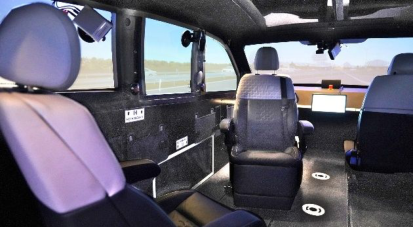
each. After this time, we measured their subjective evaluation. A custom-built interior mock-up, offering an interior area of 1.80 by 3.30 meters with four individual seats, realized the different seating positions. Each seat is electri- cally operated and has different degrees of freedom in terms of longitudinal and lateral position, height, backrest and seat pan angle, armrest, headrest and leg rest as well as seat orientation (see Figure 1).
For both scenarios, we defined a basic seating arrangement as a result of our Co-Creation (Satrio et al. 2022). In this basic arrangement, we only varied individual degrees of freedom of the driver’s seat to test their effects experimentally. We chose the driver’s (front left) seat, as this cor- responds to today’s standard position for manual driving in right-hand traffic.
In the basic arrangement for chatting on a leisure trip, the driver’s seat and both rear seats faced each other. The co-driver’s seat moved aside to allow for the rotation of the driver’s seat. Participants sat in the driver’s seat while an instructed assistant sat on the left rear seat acting as a second passenger. We defined the seat rotation as an independent variable since SAE Level 4 will allow physical turn away from the driving task. The orientation varied clockwise in 30
intervals from 0
(direction of travel) to 180
in randomized order. Consequently, each participant experienced seven rotations for three minutes as described above while chatting to the instructed assistant. In the basic arrangement for relaxing on a trip to work, we also focused on the driver’s seat. To give this seat maximum space, all other seats moved aside. Participants were placed alone in the vehicle in the driver’s seat. During the experiment, two degrees of freedom were varied systematically: four different torso angles (30
/40
/50
/60
) and the presence or absence of the leg rest. Each participant experienced eight different seating positions in randomized order while relaxing in each position for three minutes.
As dependent variables, we collected the participants’ subjective evaluati- ons of the respective seating position in terms of perceived comfort, perceived safety, suitability and the intention to use this position. In order to take into account the test economy in a repeated-measures design, all constructs were measured using single items. On a ten-point Likert scale, participants answered the following questions: “Please rate the general comfort you feel in this seating position for the activity.” (General comfort, 1= no comfort
Figure 1: Mock-up used for the realization of the user study.
Converting Driving Time to Leisure: Subjective Evaluation of Innovative Seating Positions 495
to 10 = extremely comfortable); “Please rate how safe you feel in the cur- rent seating position.” (Perceived safety, 1 = very unsafe to 10 = very safe); “Please indicate how well you can perform the activity in this seating posi- tion.” (Suitability, 1 = very poor to 10 = very good). A qualitative item asking for the reasons for the respective rating supplemented all items. The intention to use was measured with a single item (“Assuming I had the opportunity to sit in this position, I would intend to use it for this activity.”) on a seven-point Likert scale (1 = Strongly disagree at all to 7 = Strongly agree).
The sample (n = 18) of the scenario chatting on a leisure trip (50% female, 50% male) was on average M = 39.72 years old (SD = 13.75, 18–58 years). 77.8% of the participants held a driving license for an average of M = 21.78 years (SD = 13.55, 2 - 37 years). Regarding height, the sample had a distri- bution between 156cm and 195cm (M = 176.72, SD = 10.95). The relaxing on a trip to work sample (n = 18) showed a comparable age (M = 37.67, SD = 14.33, 18 - 57 years) and gender distribution (44.4% female, 55.6% male). 94.4% of the participants held a driving license for an average of M = 19.53 years (SD = 14.98, 1 - 40 years). Height distribution ranged from 154cm to 197cm (M = 175.98cm, SD = 12.83cm).
Results
Data analysis aims to test the hypotheses that the subjective ratings concer- ning the four constructs general comfort, perceived safety, suitability and intention to use differ depending on the seating rotation adopted during a conversation on a leisure trip. For this, a repeated measures ANOVA was car- ried out in each case. In addition, we analyzed the mentioned explanations qualitatively.
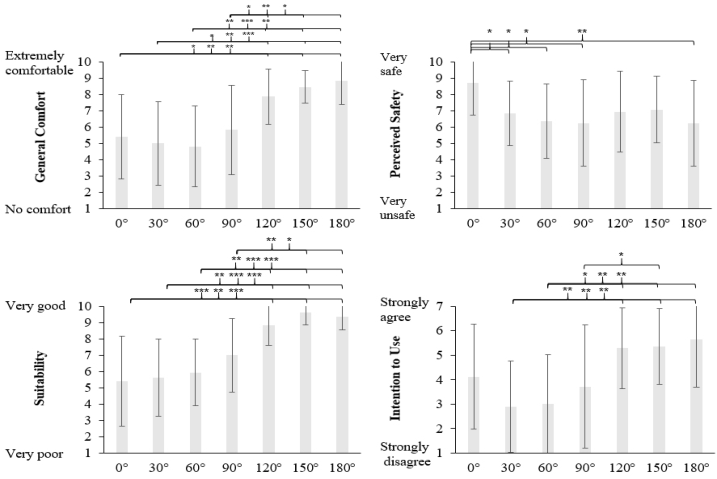
The descriptive trends shown in Figure 2 are matched by the inferential sta- tistics. Repeated measures ANOVA determined that mean subjective ratings in terms of general comfort (F(3.7, 59.24) = 16.85, p < .001, partial η2 = .52), perceived safety (F(6, 96) = 5.58, p < .001, partial η2 = .26), suitability (F(2.83, 45.28) = 24.6, p < .001, partial η2 = .61) and intention to use (F(6, 96) = 9.79, p < .001, partial η2 =.38) differ significantly between seat rotations.
A Bonferroni-adjusted post-hoc analysis revealed significantly higher gene- ral comfort and suitability ratings (p < .001 - p < .05) for the backward facing rotations (120
/150
/180
). This was mainly justified by the fact that eye con- tact with the interlocutor is possible in these positions without dislocating the body. In contrast, participants felt safest in the familiar forward-facing position, especially in comparison to the 30
, 60
, 90
(p < .05) and 180
(p < .01) position. One crucial factor for the safety ratings was the possibi- lity to monitor traffic. Furthermore, the post-hoc tests showed a significantly lower intention to use the 30
and 60
rotations compared to the backward facing rotations (p < .01 - p < .05).
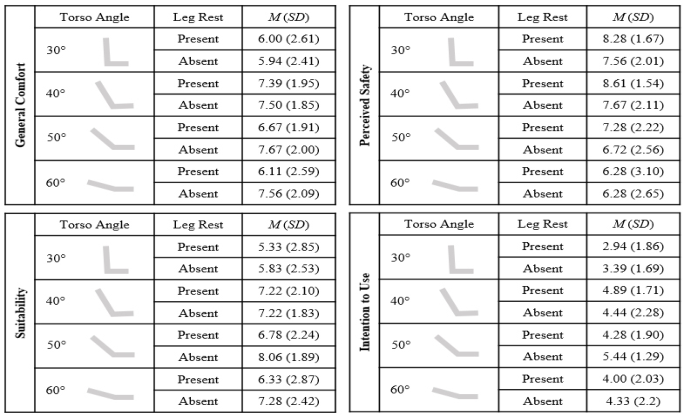
For the scenario relaxing on a trip to work, two-way repeated measures ANOVAs were conducted to test the hypotheses, that subjective ratings on relaxing positions differ depending on the torso angle and leg rest position. Figure 3 shows the descriptive statistics for each construct measured. Infe- rential statistical analysis showed no significant main effects of torso angle
Figure 2: Ratings of different seat rotations while chatting on a leisure trip. Significance levels of Bonferroni-adjusted post-hoc tests are indicated (* < .05, ** < .01, *** < .001).Figure 3: Subjective ratings of different seating positions while relaxing on a trip to work. (F(1.73, 29.38) = 2.68, p = .09) and leg rest position (F(1, 17) = 2.38, p = .14) concerning general comfort. Furthermore, there is no significant inte- raction of both factors (F(3,51) = 1.66, p = .18). Nevertheless, the qualitative statements indicate that the torso angle of 30◦is perceived as too upright for relaxing. In terms of perceived safety, data analysis showed a significant main effect of the torso angle (F(1.5, 25.48) = 7.67, p < .001, partial η2 = .31).
Converting Driving Time to Leisure: Subjective Evaluation of Innovative Seating Positions 497
Bonferroni-adjusted post-hoc analysis offered that perceived safety is signifi- cantly higher with a 40
torso angle than in the 50
or 60
position (p < .01). Furthermore, there was a significant main effect of the leg rest position on the participants’ perceived safety (F(1, 17) = 4.99, p = .039, partial η2 = .23). Participants felt safer if the leg rest was absent (p < .05). The analysis showed no significant interaction effect (F(3, 51) = 1.34, p = .271). The participants’ comments suggest, that the possibility to monitor traffic and to be able to intervene in an emergency influences perceived safety ratings.
Asking for the suitability, data analysis showed neither a significant main effect of the leg rest position (F(1, 17) = 2.71, p = .12) nor an interaction between both factors (F(1.89, 32.17) = 0.95, p = .39). However, the torso angle has a main effect on suitability ratings (F(1.91, 32.49) = 3.58, p = .041, partial η2 = .17). Even if descriptive data indicates a higher suitability for the 40
and 50
torso angle, post-hoc tests showed no significant differences. Here, the open comments indicate that a reclined position is more comfor- table for relaxing. In line with this finding, the torso angle has a main effect on the intention to use (F(3, 51) = 5.12, p = .004, partial η2 = .23). Post- hoc tests showed a significantly higher intention to use 40
(p < .01) and 50
(p < .05) position in comparison to the 30
position to relax in future highly automated vehicles. There was no significant main effect of leg rest position (F(1, 17) = 1.71, p = .21) and no significant interaction (F(3, 51) = 1.54, p = .22).
DISCUSSION
The results show that subjective ratings of general comfort, perceived safety, suitability and intention to use differ between different seat rotations during the NDRA “Chatting”. Data supports that backward-facing positions are being perceived as more comfortable and more suitable for chatting scena- rios. The subjective perception of safety seems to be highest when seated in a forward-facing position. This could be due to the fact, that this position exhibits the best precondition for traffic monitoring activities, which in turn may foster the experience of feeling safe. The results of the relaxing scena- rio show no effect regarding the torso angle’s influence on general comfort and usability. We observed an effect on perceived safety and usage inten- tion ratings. Participants would rather use more reclined positions to relax. Concurrently, they feel less safe in these positions due to the limited possibi- lities to intervene and monitor. Taken together, the results show a trade-off between different user needs that may affect the subsequent acceptance and use of highly automated vehicles. Further studies need to investigate the chan- ges in this trade-off caused by situations that previous research has already identified as trust-critical. When interpreting the results, limitations of the present study must be considered. The data does not provide any informa- tion about long-term effects, since the assessments were made after short time periods. Furthermore, habituation through prolonged use of an automated vehicle can have positive effects on perceived safety. Other influencing factors like motion sickness, switching activities and a variety of other variable inte- rior components were not considered. Various questions arise at this point for
further research. This includes researching other relevant NDRAs as well as investigating possible solutions for emerging safety concerns and trust issues.
CONCLUSION
A systematic approach with high content stringency for the development of parameters for the interior design of SAE Level 4 vehicles was presen- ted. Relevant NDRAs for frequent trip purposes were identified in an online interview. The emerging question concerning the effects of innovative sea- ting positions were tackled using a static Co-Creation approach as well as a user study under dynamic and realistic driving conditions. Results show, that extended degrees of freedom of the seat exhibit the potential to benefit passenger needs. This creates innovative requirements for interior packaging and development of highly automated vehicles. The procedure can be exten- ded to other NDRAs or variables and offers potential for answering relevant questions on the design of autonomous vehicles.
ACKNOWLEDGMENT
The authors would like to acknowledge the consortium of the research pro- ject KAI and the Federal Ministry for Economic Affairs and Climate Action of the Federal State of Germany for support and funding.
REFERENCES
Becker, Thomas and Herrmann, Florian (2018). Enabling the Value of Time.
Implikationen für die Innenraumgestaltung autonomer Fahrzeuge. BRD (2021). Gesetz zur Änderung des Straßenverkehrsgesetzes und des Pflichtversicherungsgesetzes – Gesetz zum autonomen Fahren. Detjen, Henrik. Pfleging, Bastian and Schneegass, Stefan (2020). A Wizard of Oz
Field Study to Understand Non-Driving-Related Activities, Trust, and Acceptance of Automated Vehicles. Fiorillo, Iolanda. Piro, Silvana. Anjani, Shabila. Smulders, Maxim. Song, Yu.
Naddeo, Alessandro and Vink, Peter (2019). Future vehicles: the effect of seat configuration on posture and quality of conversation. Ergonomics 62 (11), 1400–1414. Garidis, Konstantin. Ulbricht, Leon. Rossmann, Alexander and Schmäh, Marco (2020). Toward a User Acceptance Model of Autonomous Driving. In: Procee- dings of the 53rd Hawaii International Conference on System Sciences. Gold, Christian. Berisha, Ilirjan and Bengler, Klaus (2015). Utilization of Drivetime –
Performing Non-Driving Related Tasks While Driving Highly Automated. Golowko, Kai. Mugele, Petra and Zimmer, Dirk (2017). Neue Möglichkeiten der Innenraumgestaltung. ATZextra 22 (S3), 42–45. Köhler, Anna-Lena. Depner, Nico. Schwalm, Maximilian and Gatzweiler Holz,
Alexandra (2018). Identifying Customer Insights for Autonomous Urban Shuttles - A Methodological Approach. Nobis, Claudia and Kuhnimhof, Tobias (2019). Mobilität in Deutschland – MiD.
Ergebnisbericht. Studie von infas, DLR, IVT, im Auftrag des BMVI. Bonn, Berlin. Osswald, Sebastian. Wurhofer, Daniela. Trösterer, Sandra. Beck, Elke and Tscheligi, Manfred (2012). Predicting information technology usage in the car, 51–58.
Converting Driving Time to Leisure: Subjective Evaluation of Innovative Seating Positions 499
Parida, Sibashis. Mallavarapu, Sai. Abanteriba, Sylvester. Franz, Matthias and Gruener, Wolfgang (2019). Seating Postures for Autonomous Driving Secondary Activities 145, 423–434. Park, Do Eun and Park, Su-E (2021). Factors affecting perceived safety and
enjoyment based on driver experience. Transportation Research Part F: Traffic Psychology and Behaviour 83, 148–163. Pfleging, Bastian. Rang, Maurice and Broy, Nora (2016). Investigating user needs for non-driving-related activities during automated driving. SAE J3016, 2021. Taxonomy and Definitions for Terms Related to Driving Automa-
tion Systems for On-Road Motor Vehicles, 2021. Satrio, Dwi Achmad. Bonerz, Claus Bertram. Hötter, Matthis. Brezing, Alexander.
Böddeker, Torben and Eckstein, Lutz (2022). User-Interaction Experiments for the Design of Interiors for SAE-Level 4 Automated Vehicles. UN (2021). Addendum 156 - UN Regulation No. 157 E/ECE- /TRANS/505/Rev.3/Add.156. United Nations. Yang, Yucheng. Klinkner, Jan Niklas and Bengler, Klaus (2018). How Will the Driver Sit in an Automated Vehicle? – The Qualitative and Quantitative Descriptions of Non-Driving Postures (NDPs) When Non-Driving-Related-Tasks (NDRTs) Are Conducted.
LISTED IN THE AHFE DIGITAL BOOKSTORE CATALOGUE
Explore the complete digital volume
Human Factors in Transportation
Read this individual research paper free through the original publisher, or explore the full digital proceedings book.
ISBN 978-1-958651-71-1
Explore this ISBN in the AHFE Bookstore ↗Listed in the July 2026 bookstore catalogue; search by ISBN to confirm current availability · Digital book purchase optional