Haya Elbadawy, Wi-Suk Kwon (2025). Beyond the Response: How Timing and Context Shape Empathy, Responsiveness, and Social Presence in AI Conversations. In: Human-Computer Interaction & Emerging Technologies. AHFE Open Access, vol. 195, pp. 241–248. https://doi.org/10.54941/ahfe1006242
This study investigates how conversational artificial intelligence (CAI) agents’ response delay and context awareness influence users’ perceptions of social presence, empathy, and responsiveness, and engagement, in the context of stress management and wellness for college students. Grounded in social response theory and social presence theory, this research focuses on the conceptual mechanisms through which these design features shape human-like interactions in CAI. Response delay refers to the intentional pause between a user’s input and the agent’s reply. Social response theory suggests that pauses reflect “thoughtfulness,” which aligns with human expectations of social interaction and thus foster trust and engagement. A short delay (e.g., 2 seconds, accompanied by a visual indicator) may signal CAI’s humanlike cognitive effort and deliberation, enhancing users’ perceptions of social presence or sense of being with an intelligent, socially engaging entity. Context awareness refers to CAI’s ability to recall and integrate conversational history. A context-aware CAI references prior user interactions, ensuring coherence, personalization, and emotional resonance in its interaction with users. Social presence theory suggests that the ability to build on prior interactions enhances social presence. The increased social presence through CAI’s thoughtful delay and personalized responses based on context awareness may create a relationally engaging interaction, fostering user engagement with the CAI. This study will employ a 2 (response delay: yes vs. no) × 2 (context awareness: aware vs. unaware) between-subjects experiment. Four versions of CAI, as a virtual wellness counselor for college students, will be designed to manipulate the four experimental conditions, and their impacts on users’ social presence, empathy and responsiveness perceptions, as well as engagement will be examined. Findings will provide theoretical and practical insights into optimizing CAI design for human-like interactions in wellness contexts.
interactions (D’Alfonso, 2020). These CAIs are often designed to exhibit human-like qualities, creating the perception of authentic interactions and enhancing user experiences. According to Epley et al. (2007), humans are predisposed to attribute human-like traits and intentions to non-human entities, particularly when these entities exhibit behaviors that align with social interaction cues, fulfilling psychological motivations for understanding and connection.
Vaidyam et al. (2019) highlight the growing role of empathic chatbots in reducing stress and offering emotional support. Empathic chatbots are designed not only to respond to user inputs but also to engage with emotional intelligence, helping users navigate personal challenges effectively. A critical component of these interactions is engagement, defined as a user’s behavioral and emotional investment in interacting with the agent (Fredricks et al., 2004). Engagement reflects the depth of emotional connection and willingness to return to the agent for continued use. Despite the increasing adoption of CAIs in stress management and other domains, significant gaps remain in understanding how CAI design factors influence user perceptions (e.g., perceived empathy, responsiveness, and social presence) and behaviors (e.g., engagement), particularly for CAI use in the mental health and stress management domain.
In this study, we propose two CAI design factors—response delay and context awareness—which may impact human-like interactions with CAI in mental health and stress management contexts. Response delay, defined as the intentional pause between a user’s input and the CAI’s reply, simulating thoughtful processing. Response delay has been known to influence user perceptions of the CAI’s intelligence and empathy (Gnewuch et al., 2022). Context awareness, which refers to the CAI’s ability to understand and utilize conversational history, enables the CAI to provide personalized and coherent responses (Liu et al., 2023). Existing research often has examined response delay and context awareness in isolation, overlooking their potential combined effects. Therefore, this paper will propose a conceptual model of the effects of these two design factors on user perceptions of empathy and responsiveness of a CAI in college students’ mental health and stress management contexts, which in turn affecting user perceptions of social presence—the degree to which a user feels they are interacting with a human- like entity (Van Der Goot, 2022)—and user engagement (Tsai et al., 2021). This study is grounded in social response theory (Nass & Moon, 2000) and social presence theory (Short et al., 1976). The proposed conceptual model will offer critical insights to expand both theoretical understanding and practical optimization of CAIs, especially in applications like stress management and wellness support, where fostering human-like interactions is essential (Concannon & Tomalin, 2024).
THEORETICAL FRAMEWORK This study integrates social response theory (Nass & Moon, 2000) and social presence theory (Short et al., 1976) to examine how users interact with CAIs as social actors. Social response theory posits that humans mindlessly apply
Beyond the Response 243
social rules and expectations to computers and other media, treating them as social actors. According to Nass and Moon (2000), users anthropomorphize technology, attributing human-like traits to non-human entities. This occurs particularly when these entities exhibit behaviors that align with social interaction cues, such as responsiveness and personalization. Social presence theory (Short et al., 1976) emphasizes the importance of the feeling of being with another entity in mediated communication. Social presence as the degree to which a person feels socially present in a communication medium (Short et al., 1976). According to social presence theory, higher levels of social presence can enhance emotional and relational connections between users and the entity they are interacting with. Garrison and Arbaugh (2007) further explain that social presence is crucial for effective communication as it fosters a sense of intimacy and immediacy, making interactions feel more personal and engaging.
CAI design features such as response delay and context awareness play a crucial role in shaping user perceptions of social presence by facilitating a sense of empathy and responsiveness from the CAI. Response delay, as a subtle anthropomorphic cue, may enhance user perceptions of empathy and responsiveness by mimicking thoughtful processing, consistent with the principles of social response theory (Nass & Moon, 2000). Context awareness, by enabling the recall and personalization of prior interactions, fosters emotional attunement and interactional coherence, which are critical for enhancing perceived empathy and responsiveness in CAIs (Papneja & Yadav, 2024; Liu et al., 2023). Together, these features enhance the social presence of AI agents, making them appear more human-like and relationally engaging.
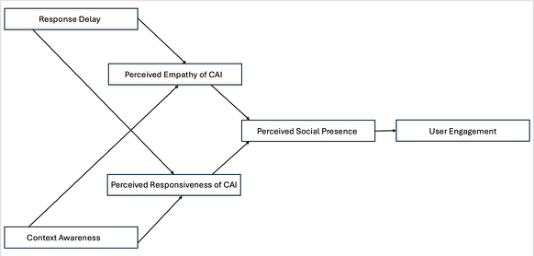
We, therefore, propose a conceptual model (see Figure 1) which delineates how the two design factors, response delay and context awareness, independently and in combination, influence user perceptions of empathy and responsiveness, which in turn facilitates perceived social presence and eventually engagement. In next three sections, the propositions constituting the conceptual model are proposed along with a discussion of literature supporting them.
Figure 1: A conceptual model of effects of CAI response delay and context awareness on user engagement.
244 Elbadawy and Kwon
RESPONSE DELAY Response delay refers to the intentional pause before an AI agent generates a response, simulating cognitive effort. Perceived empathy, or the degree to which users feel understood emotionally, is significantly influenced by these delays. Deliberately and appropriately timed delays enhance perceptions of thoughtful processing, fostering empathy and attentiveness (Gnewuch et al., 2018) and making interactions feel more relational and human-like (Gnewuch et al., 2022). These findings align with social response theory (Nass & Moon, 2000), which posits that users interpret behavioral cues, such as timing, as indicative of human cognitive effort.
Furthermore, response delays also enhance perceived responsiveness, defined as the user’s perception of appropriate and prompt reactions from the CAI. Epley et al. (2007) emphasized that pauses signal deliberation, which users associate with attentiveness and meaningful engagement. Studies highlight that dynamic response delays, tailored to conversational context, improve perceived responsiveness by creating a natural flow of interaction (Gnewuch et al., 2018). Together, these findings emphasize the critical role of response delay in fostering user perceptions of empathy and responsiveness.
This leads to the following propositions: Proposition 1: CAIs’ deliberate response delay positively impacts users’ perceived empathy.
CONTEXT AWARENESS Context awareness refers to an AI agent’s ability to recall and integrate information from prior user interactions (see Table 1), ensuring coherence and personalization. This design feature is integral to enhancing perceived empathy, as demonstrated by Sharma et al. (2023), who showed that contextually relevant feedback improves emotional resonance. Similarly, Raamkumar and Yang (2023) emphasized that conversational agents capable of leveraging historical user data are perceived as more empathetic. Personalized interactions foster emotional attunement, reinforcing users’ trust and engagement with the CAI (Concannon & Tomalin, 2024).
Context awareness also significantly impacts perceived responsiveness. Verhagen et al. (2014) found that tailored interactions based on prior user inputs create a sense of attentiveness and adaptability. Xu et al. (2017) also highlighted that context-aware chatbots deliver timely and accurate responses, enhancing user perceptions of responsiveness by meeting specific needs. These findings suggest that context-aware CAI capability effectively aligns with user expectations, fostering seamless and engaging interactions. Thus, the following propositions are developed: Proposition 3: CAIs’ context awareness positively impacts users’ perceived empathy.
Table 1: Example interaction with a context-aware and context-unaware virtual counsellor CAI.
Table available in the original PDF paper.
Condition Sample CAI-User conversation Context Aware CAI: Hi [User Name]! You mentioned stress last time. How are you feeling now? User: I am a little stressed. CAI: What’s causing your stress? Is it still about assignments? User: Yes, it’s still about assignments. CAI: …. User: …. … CAI: Perfect! I’ll remember this conversation so that next time you check in, I can pick up where we left off. I’m here whenever you need to talk or try more wellness tips together. Remember, you’re not alone in this! Context Unaware CAI: Hi. How may I help you? User: I am a little stressed. CAI: What’s causing your stress? Is it about assignments, exams, or classes? User: It’s about assignments. CAI: … User: … … CAI: Perfect! I’m here whenever you need to talk or try more wellness tips together. Remember you’re not alone in this!
Note. Bold-face part of the conversation script in the context-aware condition show the context awareness of the CAI.
MEDIATING ROLE OF EMPATHY AND RESPONSIVENESS Empathy serves as the emotional bridge between design features and the user’s perception of interacting with a human-like entity. Nass and Moon (2000) emphasized that human-like behaviors, such as thoughtful response delays and personalized interactions, elicit perceptions of empathy by mimicking social norms. Empathy is a critical component of social presence because it fosters relational depth and engagement in mediated interactions (Short et al., 1976). De Melo et al. (2015) demonstrated that empathetic behaviors in AI systems strengthen perceptions of human- likeness, enhancing users’ sense of social presence. Sharma et al. (2023) found that AI agents capable of delivering contextually relevant and emotionally sensitive feedback enhance both empathy and relational presence. These findings suggest that perceived empathy is a key mediator through which response delay and context awareness influence the user’s perception of social presence in CAIs. Thus, we propose the following:
246 Elbadawy and Kwon
Proposition 5: Perceived empathy mediates the effects of CAIs’ (a) response delay and (b) context awareness on users’ perceived social presence.
Gnewuch et al. (2018) demonstrated that thoughtfully calibrated response delays signal attentiveness and cognitive effort, enhancing social presence by making interactions feel relational and human-like. Similarly, Biocca et al. (2003) emphasized that timing fosters immediacy, a key driver of social presence. Context awareness strengthens social presence through coherence and personalization. Luger and Sellen (2016) found that agents capable of referencing prior interactions were perceived as more socially present due to their ability to tailor responses. Raamkumar and Yang (2023) further highlighted that context-aware agents enhance relational depth by maintaining conversational continuity, key to social engagement. Therefore, we propose that perceived responsiveness, enhanced through CAI’s response delay and context awareness, would promote the sense of social presence, which leads to the following proposition: Proposition 6: Perceived responsiveness mediates the effects of CAIs’ (a) response delay and (b) context awareness on users’ perceived social presence.
SOCIAL PRESENCE AND USER ENGAGEMENT Social presence fosters relational engagement, enhancing users’ willingness to interact with the CAI. Tsai et al. (2021) identified social presence as a critical driver of user engagement in AI-mediated interactions. When users perceive CAI as socially present, they are more likely to establish relational connections, encouraging sustained interactions. The following proposition expresses this idea:
Proposition 7: Users’ perceived social presence positively impacts their engagement with a CAI.
FUTURE RESEARCH DIRECTION Based on the seven propositions and the conceptual model, we aim to collect data through a between-subjects experimental design to evaluate the impact of CAIs’ response delay and context awareness on user perceptions of social presence, empathy, and responsiveness and user engagement. The study will involve college students interacting with a CAI agent designed as a virtual wellness counsellor. Participants will be randomly assigned to one of four experimental conditions, manipulating response delay (response delay: yes vs. no) and context awareness (context awareness: aware vs. unaware). Data will be gathered using a combination of self-reported surveys, measuring the perception variables, and behavioral metrics, such as interaction duration and frequency, to operationalize the user engagement variable. This approach will ensure a robust understanding of how the two CAI design factors influence user perceptions and behavior in wellness applications.
CONCLUSION
This conceptual paper advances the theoretical understanding of human- like AI interactions by integrating response delay and context awareness
Beyond the Response 247
into the study of social presence. The proposed framework provides a foundation for future empirical research. Findings of research that tests the proposed framework will provide actionable guidelines for CAI developers to enhance user experience by designing CAIs that effectively foster human-like interactions, particularly in stress management and wellness applications.
ACKNOWLEDGMENT
This work was supported by the Alabama Agricultural Experiment Station and the Hatch program of the National Institute of Food and Agriculture, U.S. Department of Agriculture.
REFERENCES
Biocca, F., Harms, C., & Burgoon, J. K. (2003). Toward a more robust theory and measure of social presence: Review and suggested criteria. Presence: Teleoperators and Virtual Environments, 12(5), 456–480. Concannon, S., & Tomalin, M. (2024). Measuring perceived empathy in dialogue
systems. AI & Society, 39(5), 2233–2247. D’Alfonso, S. (2020). AI in mental health. Current Opinion in Psychology, 36, 112–117. De Melo, C. M., Gratch, J., & Carnevale, P. J. (2015). Humans versus computers:
Impact of emotion expressions on people’s decision making. IEEE Transactions on Affective Computing, 6(2), 127–136. Epley, N., Waytz, A., & Cacioppo, J. T. (2007). On seeing human: A three-factor theory of anthropomorphism. Psychological Review, 114(4), 864–886. Fredricks, J. A., Blumenfeld, P. C., & Paris, A. H. (2004). School engagement:
Potential of the concept, state of the evidence. Review of Educational Research, 74(1), 59–109. Garrison, D. R., & Arbaugh, J. B. (2007). Researching the community of inquiry framework: Review, issues, and future directions. The Internet and Higher Education, 10(3), 157–172. Gnewuch, U., Morana, S., Adam, M., & Maedche, A. (2018). Faster is not always
better: Understanding the effect of dynamic response delays in human-chatbot interaction. Gnewuch, U., Morana, S., Adam, M. T. P., & Maedche, A. (2022). Opposing effects of response time in human–chatbot interaction: The moderating role of prior experience. Business & Information Systems Engineering, 64(6), 773–791. Liu, S., Cho, H., Freedman, M., Ma, X., & May, J. (2023). Recap: Retrieval-
enhanced context-aware prefix encoder for personalized dialogue response generation. Proceedings of the 61st Annual Meeting of the Association for Computational Linguistics (Volume 1: Long Papers), 8404–8419. Luger, E., & Sellen, A. (2016). “Like having a really bad pa”: The gulf between user expectation and experience of conversational agents. Proceedings of the 2016 CHI Conference on Human Factors in Computing Systems, 5286–5297. Nass, C., & Moon, Y. (2000). Machines and mindlessness: Social responses to
computers. Journal of Social Issues, 56(1), 81–103. Papneja, H., & Yadav, N. (2024). Self-disclosure to conversational AI: A literature review, emergent framework, and directions for future research. Personal and Ubiquitous Computing.
248 Elbadawy and Kwon
Raamkumar, A. S., & Yang, Y. (2023). Empathetic conversational systems: A review of current advances, gaps, and opportunities. IEEE Transactions on Affective Computing, 14(4), 2722–2739. Sharma, A., Lin, I. W., Miner, A. S., Atkins, D. C., & Althoff, T. (2023). Human–
AI collaboration enables more empathic conversations in text-based peer-to-peer mental health support. Nature Machine Intelligence, 5(1), 46–57. Short, J., Williams, E., & Christie, B. (1976). The social psychology of telecommunications. Wiley. Tsai, W.-H. S., Liu, Y., & Chuan, C.-H. (2021). How chatbots’ social presence
communication enhances consumer engagement: The mediating role of parasocial interaction and dialogue. Journal of Research in Interactive Marketing, 15(3), 460–482. Vaidyam, A. N., Wisniewski, H., Halamka, J. D., Kashavan, M. S., & Torous, J. B.
(2019). Chatbots and conversational agents in mental health: A review of the psychiatric landscape. The Canadian Journal of Psychiatry, 64(7), 456–464. Van Der Goot, M. J. (2022). Source orientation, anthropomorphism, and social presence in human-chatbot communication: How to proceed with these concepts. Publizistik, 67(4), 555–578. Verhagen, T., Van Nes, J., Feldberg, F., & Van Dolen, W. (2014). Virtual customer
service agents: Using social presence and personalization to shape online service encounters. Journal of Computer-Mediated Communication, 19(3), 529–545. Xu, A., Liu, Z., Guo, Y., Sinha, V., & Akkiraju, R. (2017). A new chatbot for customer service on social media. In Proceedings of the 2017 CHI conference on human factors in computing systems.
Read this individual research paper free through the original publisher, or explore the full digital proceedings book.
ISBN 978-1-964867-71-7
Explore this ISBN in the AHFE Bookstore ↗Listed in the July 2026 bookstore catalogue; search by ISBN to confirm current availability · Digital book purchase optional