Raymond Freth Lagria, Lorelie Grepo (2025). Understanding student experiences in remote learning setup: Qualitative analysis of causes and coping mechanisms for workload, stress and fatigue. In: Training, Education, and Learning Sciences. AHFE Open Access, vol. 193, pp. 84–94. https://doi.org/10.54941/ahfe1006649
Department of Industrial Engineering and Operations Research, College of Engineering, University of the Philippines Diliman, Quezon City, Philippines ↗
This paper explores the factors contributing to students’ perceived workload, stress and fatigue in the remote learning setup and their coping mechanisms. A semester-long study was conducted during the remote learning setup in the University of the Philippines Diliman where 66 third year Industrial Engineering students participated. A total of 17 weekly online surveys were administered to measure students’ perceived workload, stress and fatigue, as well as open-ended items asking what contributed to their experiences and how they coped. This paper reports on the qualitative data collected in the longitudinal study. Simple descriptive analytics methods were used to analyze the qualitative data. Initial results showed that the top most frequent factors that affect workload and stress revolve around the given academic requirements as well as external events such as the national elections. As for fatigue, factors that were cited by students was lack of sleep. There were also observed trends on the responses – such that during the first few weeks, students were more concerned with student organizational work and completing their internships. Afterwards, these factors tend to decrease. Towards the end of the study period, the academic requirements, exams, and finals week factors were observed to be increasing.
College students experience stress and fatigue which may affect their well- being (Kizhakkeveettil et al., 2017; Aldiabat et al., 2014; Palmer, 2013). Studies have shown increased stress and poorer well-being of students due to the changes in the learning setup brought about by the COVID-19 pandemic (Son et al., 2020). In the Philippines, schools were forced to adopt a fully remote learning setup in 2020 during the lockdowns. It took about 2 years for universities to return to an in-person or face-to-face learning setup.
Understanding student workload is important as it is one of the major stressors for students (Dy et al., 2019; Britz & Pappas, 2010) and has been shown to correlate with their perceived stress (Yang et al., 2021) and
Understanding Student Experiences in Remote Learning Setup 85
fatigue, both physically and mentally (Aldiabat et al., 2014; Sy et al., 2022). Filipino students in one university indicated that stress significantly affected their performance in the remote setup (Cahapay & Rotas, 2022) during the pandemic. Studies revealed a significant difference in the reported perceived experiences, particularly stress, of male and female students. In the University of the Philippines Diliman, for Industrial Engineering (IE) students, the same was found with female students experiencing higher stress and fatigue levels in the remote setup (Grepo, 2023). High stress and fatigue levels were correlated with negative consequences, including poor well-being, unhealthy behaviours, poor performance, poor mental health, and poor general health (Kizhakkeveettil et al., 2017; Britz & Pappas, 2010; Yang et al., 2021; Koch, 2018; Canillo et al., 2022; Lee et al., 2013). To minimize negative consequences resulting from the students’ experiences, there is a need to understand the factors that contribute to the high perceived workload, stress and fatigue so that these may be addressed at the source and necessary support may be put in place to help them manage and positively cope.
In addition to academic factors, extracurricular activities, social factors such as relationships and family concerns, financial issues, daily commute and other factors trigger student stress (Beall et al., 2015). Given individual differences, students vary in their appraisal of stimuli in their environment which leads to different coping strategies used. Lazarus & Folkman (1984), in their transactional theory of stress and coping, emphasize the importance of these two aspects: cognitive appraisal (of the situation) and coping (Biggs et al., 2017).
Previous studies have identified common coping mechanisms and categorized them. Lazarus & Folkman (1984) identified 2 main categories: problem-focused and emotion-focused, with the former “aimed at altering the person-environment transaction” (Latack & Havlovic, 1992, p. 491) and the latter “aimed at regulating the emotions” (Latack & Havlovic, 1992, p. 491). Other frameworks further classified stress coping strategies into more specific categories. Skinner et al. (2003) compared coping strategies from 4 empirically tested systems. Many classification of coping strategies have been proposed. These are used as guides in describing what specific coping strategies IE students use, as some coping strategies, such as problem- focused approaches, were shown to be more effective. Since remote learning was new to the University at the time, this study aims to describe its impact on the students’ workload, stress and fatigue by identifying the factors that contribute to these, and the coping mechanisms used.
LITERATURE REVIEW
This research paper intends to utilize modern quantitative techniques in analyzing qualitative data. As such, it is determined that a simple examination of different methods on related studies should be conducted.
A study conducted by (Galvin et al., 2015) focused on qualitative one- on-one interviews with mental health nursing students during their training years by using thematic analysis. The results showed three key stressors
86 Lagria and Grepo
including demands/control/support, attitudes toward students, and stress and coping mechanisms. Specifically, students reported unreasonable demands from their assigned staff and placement, lack of support during training, negative attitudes from staff, and high levels of stress leading to mental health problems. Robinson et al. (2023) performed a secondary data analysis of qualitative responses from a teacher survey in the Great Plains region of the USA. The study used a phenomenological approach and a modified social- ecological framework to examine the lived experiences of elementary school teachers as they transitioned from in-person to remote learning during the COVID-19 pandemic. While this research focused on elementary teachers’ perspective, the interrelationships of the lived experiences also affect their students. The results indicated that teachers experienced stressors related to personal and professional roles, concerns for students’ well-being, and frustrations with administration regarding COVID safety measures.
Focus group discussions have been known to elaborate on qualitative responses. Using the same qualitative responses from 68 medical students, a qualitative study approach was used to investigate (1) interrelationships between demands related to academic studies and other domains of life (Bergmann et al., 2019) and (2) students’ perceived stressors related to academic studies, resources for coping with stress and suggestions for reducing stress (Weber et al., 2019). Major stressors identified were organizational factors, exams, teaching quality, social interactions and time/performance pressure.
Khamsuprom and Arin (2024) conducted a study using a quantitative methodology with a sample size of 345 individuals and a qualitative methodology using focus groups consisting of 12 participants. The study explored coping mechanisms for managing fatigue. The results showed five distinct coping strategies: focusing on the roots of the problem, seeking a mental refuge, consulting a professional when required, taking a break to relax, and avoiding the problems.
Most of the related research pertaining to perceived academic (student or teacher) workload, fatigue, and stress utilized manual qualitative approaches such as thematic analysis and expert discussions. This research attempts to emphasize the use of modern techniques for quantifying and analyzing qualitative or textual data.
METHODS
This research employed a mixed methods approach. A repeated-measure design evaluated student experiences on a week-to-week basis through online surveys, complemented by qualitative data to describe their experiences and the factors contributing to it, and their coping mechanisms. This paper reports on the results of the qualitative data, particularly the responses to the open-ended questions about workload, stress and fatigue in the weekly surveys. Results from the quantitative data for the 2022 study is reported in Grepo (2023).
Third year-standing Industrial Engineering students taking the IE 163 (Cognitive Ergonomics) course during the Second Semester of Academic
Understanding Student Experiences in Remote Learning Setup 87
Year 2021–2022 (remote learning setup) participated in the study. Those who signified their interest to participate were asked to sign consent forms. Students who completed the study over the entire semester were given extra credits in IE 163.
Multiple measures were obtained to describe students’ experiences in the remote learning setup. For each of the three factors, workload, stress and fatigue, students were asked to answer two open-ended questions:
1. What factors contributed to the <factor> you experienced this week? 2. What did you do to cope with the <factor> you experienced this week?
At the end of the weekly surveys, students were asked to provide additional information to provide context for their answers in the survey. This last question was optional, so not all participants provided additional information about their experience for that week.
Data were collected weekly from the students through online surveys administered through Qualtrics. A pre-study survey was given to the participants to collect demographic information and to establish a baseline measure for the variables of interest in the study. Participants were asked to rate their perceived workload, stress and fatigue weekly, including open- ended questions to provide context to their answers. The remote setup consisted of 17 weekly surveys. Throughout the semester, the survey link is emailed to the students every Saturday, with reminders (up to 3 times) the following week for them to complete it. The last survey included questions for an overall evaluation of the semester in the remote/blended learning setup. Weeks during the breaks (e.g., Lenten) were included in the study.
The output qualitative data were analyzed using content analysis by employing semi-automated approaches. These were conducted in R and visualization outputs were generated using R base packages. Each response to the open-ended questions were manually coded first to identify the factor or coping mechanism employed by the student for that week. Then, semi- automated descriptive analytics methods were used to process the following term frequency from factors and coping strategies, term changes from stressors per week and co-occurrences of terms between factors and coping strategies.
The processing steps of the qualitative data were done in R and output visualizations were generated using base packages. To validate findings from semi-automated approaches, the codes generated were then grouped into themes that describe the factors and coping mechanisms more broadly. The themes established for the coping mechanisms were guided by existing frameworks that classify coping mechanisms as well as the results from studies investigating coping mechanisms employed by college or university students (Alkhawaldeh et al., 2023; Amirkhan, 1990; Biggs et al., 2017; Deasy et al., 2014; Folkman & Lazarus, 1998; Latack & Havlovic, 1992).
RESULTS AND DISCUSSION
To simplify the discussion, this section is divided into five (5) parts with the first four (4) figures presenting some snippet outputs discussed in the previous
88 Lagria and Grepo
section. The last part of this section features discussion and validation of the results.
Frequency of Terms From Coded Factor Responses The most frequently mentioned workload factor is academic requirements, followed by academic workload, exams, and internships. The results suggest that work and obligations related to their academics are the primary perceived drivers for workload. It is also notable that some responses are none, meaning students have answered that there are no factors during the week that they have responded.
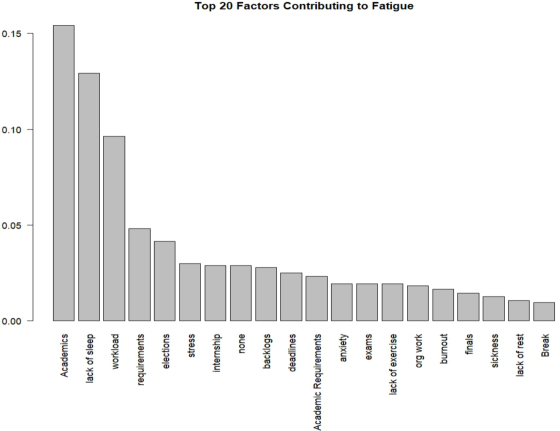
Based on Figure 1, Internships appear as the most common stressor for students likely due to the timing of the study period. Third year IE students are required to take an internship during the midyear of their 3rd year in the program. As such, they are given 5 months before the internship period starts to apply in a company.
Figure 1: Frequency of terms from coded factor responses.
Understanding Student Experiences in Remote Learning Setup 89
Personal factors also contribute to stress such as household responsibilities, personal problems, and anxiety indicating that stress is not just academic but also personal. The top factors that contribute to perceived fatigue include academics, lack of sleep, and workload. Other factors such as lack of exercise, anxiety, and org work suggests that physical and mental aspects contribute to fatigue.
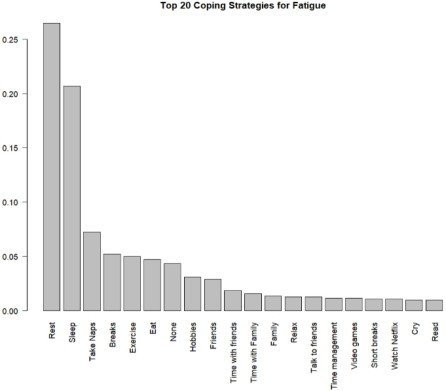
Frequency of Terms From Coded Coping Strategy Responses Time management remains a dominant strategy for coping with workload. Time with friends and eating are within the top 5 coping strategies for stress which can indicate social interactions and food-related stress relief. Evidently, taking naps is explicitly highlighted as a coping strategy for fatigue which relates highly to rest and sleep. These strategies emphasize the role of recovery for fatigue. Across all three components, the ranking of coping strategies slightly shifted with social and entertainment-based approaches appearing more prominently.
Figure 2: Frequency of terms from coded coping strategy responses.
90 Lagria and Grepo
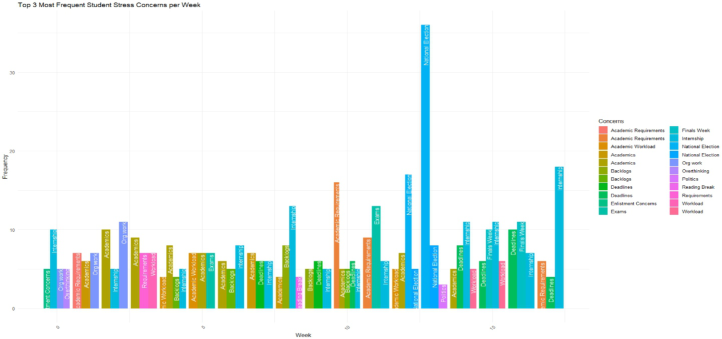
Frequency of Term Changes From Stressors Per Week Additionally, the dataset was further processed to summarize the top 3 factors that contribute to stress per week seen in Figure 3. Academic workload, requirements, and deadlines are dominant stressors throughout the semester, especially in the early to mid-weeks.
Figure 3: Top 3 most frequent student stressors per week.
This suggests that students consistently face challenges in managing coursework and meeting deadlines. Notably, a significant spike of stressors occurred during the National Elections, indicating that external events can momentarily overshadow academic concerns. As the semester progresses, stress shifts from general academic concerns to time-sensitive pressures like finals week and internships.
Co-Occurring Terms From Factors and Coping Strategies
Table 1 shows results from processing multi-factor and multi-coping attributes of the dataset. The table details the top 10 co-occurring terms from the factors and coping strategies. Similar to the previous analysis, sleep and rest are the dominant coping mechanisms for workload, stress, and fatigue. Academic demands (requirements and deadlines) consistently contribute to stress and fatigue.
The factors contributing to workload, stress and fatigue were related. The workload itself consisting of different tasks, activities and requirements the students must do consistently ranked first among the factors contributing to workload, stress and fatigue, reflecting the same results from studies on students’ top stressors (Deasy et al., 2014; Beall et al., 2015). Generally, in addition to workload, extracurricular activities, health and well-being and schedules and deadlines belonged to the top contributors to workload, stress and fatigue. Health and well-being that includes concerns over physical and mental aspects, were similarly identified for pharmacy students (Beall et al., 2015), while nature of the tasks or activities, particularly the academic difficulty was also reported in a study of Filipino college students in university
Understanding Student Experiences in Remote Learning Setup 91
(Dy et al., 2019). Many other contributors were identified from the open- ended responses of the students in the weekly online surveys administered.
Table 1: Top 10 factors and coping strategies.
Table available in the original PDF paper.
n
ID Workload Factors
Coping for Workload
n Stress Factors Coping for Stress
n Fatigue Factors Coping for Fatigue Sleep 21 Academics Sleep 21 Lack Of Sleep Rest 28
1 Academic Workload
Sleep 19 Internship Rest 19 Lack Of Sleep Sleep 27
To cope with their experiences during the semester, students used different strategies. The results from the semi-automated approaches were compared to the coded responses and grouped themes. Generally, the top 3 strategies used to cope with the workload, stress and fatigue experienced are problem- solving, rest, sleep and naps, and social support. Problem-focused coping has been associated with positive effects while emotion-focused coping has been described as ineffective (Folkman and Moskowitz, 2004; O’Driscoll, Brough, and Kalliath, 2009; Taylor and Stanton, 2007, c.f. Biggs et al., 2017). Many students employed problem-solving strategies, which tackle the problem/issue/concern directly and involve planning and adjustment to be able to address them. Taking time to rest, sleep and nap also belonged to the top 3 strategies, which were also reported as stress coping mechanisms by pharmacy (Beall et al., 2015) and teacher education students (Tully, 2004). While not directly addressing the situation or problem, this strategy helps students recover and recuperate from what they do and experience. Finally, social support, which has been shown as a positive strategy (Gardner, 2010; Murray-Harvey, 2001) was also reported as a top stress coping mechanism. Students took time to talk with people in their social circle and spend time with them to cope with the workload, stress and fatigue they experience. Other coping mechanisms reported included eating, taking breaks, breathing and relaxation exercises, watching and spending time for self-care also appeared on top of the list.
CONCLUSION
This paper tries to explore the use of semi-automated approaches to analyzing qualitative data related to perceived factors on student workload,
92 Lagria and Grepo
stress, and fatigue. The study confirms that sleep and rest are the most frequently used coping mechanisms, with time management and social interactions also playing a crucial role. Additionally, the shift in stressors over time, particularly during major events like the National Elections, suggests that academic concerns are sometimes overshadowed by external factors. Understanding these patterns is essential for implementing interventions to support students’ well-being.
ACKNOWLEDGMENT
The authors would like to acknowledge Dr. Aura C. Matias for the Renato Bernales Matias Professorial Chair in Industrial Engineering through the College of Engineering, University of the Philippines Diliman, which made this study possible. The authors would also like to thank the IE 163 students Batch 2022 for their participation in the study.
REFERENCES
Aldiabat, K., Matani, N., Le Navenec, C. (2014). Mental Health among Undergraduate University Students: A Background Paper for Administrators, Educators and Healthcare Providers. Univ Jour of Public Health, 2(8), 209–214. Alkhawaldeh, A., Al Omari, O., Al Aldawi, S., Al Hashmi, I., Ballad, CA, Ibrahim, A., Al Sabei, S., Alsaraireh, A., Al, Qadire, M., ALBashtawy, M. (2023). Stress Factors, Stress Levels, and Coping Mechanisms among University Students, The Scientific World Journal, 2023, 2026971. https://doi.org/10.1155/2023/2026971 Amirkhan, J. (1990). A factor analytically derived measure of coping: the Coping
Strategy Indicator,” Journal of Personality and Social Psychology, vol. 59, no. 5, p. 1066, 1990. Beall J., DeHart R., Riggs R., Hensley J. (2015) Perceived Stress, Stressors, and Coping Mechanisms among Doctor of Pharmacy Students. Pharmacy. 2015; 3(4): 344–354. https://doi.org/10.3390/pharmacy3040344 Bergmann, C., Muth, T., & Loerbroks, A. (2019). Medical students’ perceptions
of stress due to academic studies and its interrelationships with other domains of life: a qualitative study. Medical Education Online, 24(1). https://doi.org/10.1080/ 10872981.2019.1603526 Biggs, A., Brough, P. and Drummond, S. (2017). Lazarus and Folkman’s Psychological Stress and Coping Theory. In The Handbook of Stress and Health (eds C. L. Cooper and J. C. Quick). https://doi.org/10.1002/9781118993811.ch21 Britz J. & Pappas E. (2010). Sources and Outlets of Stress among University Students: Correlations between Stress and Unhealthy Habits. URJHS, 9, 1. Cahapay, M., & Rotas, E. (2022) Remote Learning Stress, Adaptive Coping
Strategies, and Academic Performance of Filipino University Students amid COVID-19 Crisis. Computers and Children, 1(1). Canillo, G., Cantos, R., Catamio, J., Diola, D., Duque, E., Espiritu, E., Pantaleon, A.
& Distor, J. (2022) PM is the Key: Perceived Stress and Mental Health as the Key Indicator of Wellbeing of Selected College Online Students in the Philippines During COVID-19 Pandemic. Psychology and Education. Deasy, C., Coughlan, B., Pironom, J., Jourdan, D., & Mannix-McNamara, P.
(2014). Psychological distress and coping amongst higher education students: a mixed method enquiry. PloS one, 9(12), e115193. https://doi.org/10.1371/ journal.pone.0115193
Understanding Student Experiences in Remote Learning Setup 93
Dy, M., Espiritu-Santo, K., Ferido, M. & Sanchez, R. (2019). Stressors and Stress Responses of Filipino College Students. Folkman S., Lazarus R. (1988). Manual for the Ways of Coping Questionnaire.
Palo Alto, CA: Consulting Psychology Press. https://prevention.ucsf.edu/sites/ prevention.ucsf.edu/files/uploads/tools/surveys/pdf/Ways%20of%20coping.pdf Folkman, S., and Moskowitz, J. (2004). Coping: Pitfalls and promise. Annual Review of Psychology, 55, 745–774. doi: 10.1146/annurev.psych.55.090902.141456. Galvin, J., Suominen, E., Morgan, C., O’Connell, E-J., Smith, A. P. (2015). Mental
health nursing students’ experiences of stress during training: A thematic analysis of qualitative interviews. Journal of Psychiatric and Mental Health Nursing doi: 10.1111/jpm.12273. Gardner, S. (2010). Stress among prospective teachers: A review of the literature.
Austral J Teacher Educ doi: 10.14221/ajte.2010v35n8.2. Grepo, L. (2023). Students’ perceived workload, stress, fatigue and performance during the remote learning setup: A semester-long study. In: Salman Nazir (eds) Training, Education, and Learning Sciences. AHFE (2023) International Conference. AHFE Open Access, vol 109. AHFE International, USA. http:// doi.org/10.54941/ahfe1003161 Khamsuprom, P. (n.d.). Coping Strategies and Fatigue Among Undergraduate
Students. The Asian Conference on Psychology & the Behavioral Sciences 2024 Official Conference Proceedings www.iafor.org. Kizhakkeveettil, A., Vosko, A. M., Brash, M., Ph, D., & Philips, M. A (2017).
Perceived stress and fatigue among students in a doctor of chiropractic training program. The Journal of chiropractic education, 31(1), 8–13. Koch, A. (2018). How Academic and Extracurricular Workload and Stress Impacts the Mental & Physical Health of College Students. Honors Theses. 165. Latack, J. & Havlovic, S. (1992). Coping with Job Stress: A Conceptual Evaluation
Framework for Coping Measures. Journal of Organizational Behavior, 13(5), 479–508. http://www.jstor.org/stable/2488399 Lazarus, R. & Folkman, S. (1984). Stress, Appraisal, and Coping, Springer Publications, New York. Lee, S., Wuertz, C., Rogers, R., & Chen, Y. (2013) Stress and sleep disturbances in
female college students. Am J of Health Behavior, 37(6), 851–858. Murray-Harvey, R. (2001). How teacher education students cope with practicum concerns. Teach Educ 37: 117–132. O’Driscoll, M., Brough, P., & Kalliath, T. (2009). Stress and coping. In S. Cartwright
and C. Cooper (Eds.), The Oxford Handbook of Organizational Well-Being (pp. 237–266). Oxford: Oxford University Press. 10.1002/9781118993811.ch21. Palmer, L. (2013) The Relationship between Stress, Fatigue, and Cognitive Functioning. College Student Journal, 47(2), 312–325. Robinson, L. E., Valido, A., Drescher, A., Woolweaver, A. B., Espelage, D. L., LoMurray, S., Long, A. C. J., Wright, A. A., & Dailey, M. M. (2023). Teachers, Stress, and the COVID-19 Pandemic: A Qualitative Analysis. School Mental Health, 15(1), 78–89. https://doi.org/10.1007/s12310-022-09533-2 Skinner, E. A., Edge, K., Altman, J., & Sherwood, H. (2003). Searching for the
structure of coping: A review and critique of category systems for classifying ways of coping. Psychological bulletin, 129(2), 216–269. https://doi.org/10.1037/ 0033-2909.129.2.216 Son C., Hegde, S., Smith, A., Wang, X., Sasangohar, F. (2020). Effects of COVID-19 on College Students’ Mental Health in the US: Interview Survey Study, J Med Internet Res 22(9).
94 Lagria and Grepo
Taylor, S. & Stanton, A. (2007). Coping resources, coping processes, and mental health. Annual Review of Clinical Psychology, 3, 377–401. doi: 10.1146/ annurev.clinpsy.3.022806.091520. Tully, A. (2004). Stress, sources of stress and ways of coping among psychiatric
nursing students. J Psychiatr Ment Health Nurs 11: 43–47. Weber, J., Skodda, S., Muth, T., Angerer, P., & Loerbroks, A. (2019). Stressors and resources related to academic studies and improvements suggested by medical students: A qualitative study. BMC Medical Education, 19(1). https://doi.org/ 10.1186/s12909-019-1747-z Yang, C., Chen, A. & Chen, Y. (2021). College students’ stress and health in the
COVID-19 pandemic: The role of academic workload, separation from school, and fears of contagion. PLoS ONE 16(2).
LISTED IN THE AHFE DIGITAL BOOKSTORE CATALOGUE
Explore the complete digital volume
Training, Education, and Learning Sciences
Read this individual research paper free through the original publisher, or explore the full digital proceedings book.
ISBN 978-1-964867-69-4
Explore this ISBN in the AHFE Bookstore ↗Listed in the July 2026 bookstore catalogue; search by ISBN to confirm current availability · Digital book purchase optional