Sharline Cole, Tashane Haynes-Brown, Lamoine Samuels-Lee (2025). Exploring Jamaican Students’ Readiness using the Grade One Cognitive Skills Assessment: A Psychometric Analysis. In: Training, Education, and Learning Sciences. AHFE Open Access, vol. 193, pp. 170–182. https://doi.org/10.54941/ahfe1006658
Children who are starting primary school (first grade) are described as being at a transitional phase characterized by a shift in their mental development. As part of the entry requirements to grade one, schools generally require students to participate in some sort of assessment. In the Jamaican context, entry to grade one requires students to participate in the Grade One Individual Profile (GOILP), however some students are not able to take the assessment because of the timing of the assessment. In such cases the GOILP cannot be considered a readiness assessment for those students. Having an alternative assessment - Grade One Cognitive Skills Assessment (GOCSA) could help teachers to determine students’ cognitive skills relevant to what should be learned at grade one. The purpose of this study was to examine the relationship, construct and concurrent validity between the GOILP and the GOCSA that was developed as an alternative for use with grade one students. A cross-sectional design was utilized that assessed 238 students who were selected based on the consecutive sampling of their parents. Exploratory factor analysis was conducted for the constructs within the GOILP and the GOCSA. The results showed one component solution loading (.72 - .92) accounting for 74% of the total variance, while the GOCSA indicated four components solution (loadings .56–.89) accounting for 25% of the explained variance. Concurrent validity was established by testing the relationship between students’ scores on both instruments which found to both assessments had a moderate positive relationship (r = .58, p = .01). The findings suggest that the GOCSA measure can be used as an equivalent assessment to the GOILP.
Many developed countries perform readiness assessments of children in pre- school. These assessments serve not only as tools to determine readiness for entry to grade one, but they are also used for the purpose of identifying those children who need additional support and intervention (Samms-Vaughn, 2015). Jamaica has four criterion-referenced and one norm-referenced assessment at the primary level, two of which are formative and three are used as summative assessments. As a result of high stakes testing in
Exploring Jamaican Students’ Readiness Using the Grade One Cognitive Skills Assessment 171
Jamaica, attention is focussed on the summative assessments. The formative assessments that provide educators with information about students’ level of readiness for grades one and three are at times taken for granted because schools’ success at the primary level is determined by the Primary Exit Profile (PEP) assessments that are administered at the grade four, five and six levels.
The Grade One Individual Learning Profile (GOILP) started in 2008 is a validated instrument that is standardised to assess students’ proficiency in the form of readiness for grade one. The items on the assessment measure students’ academic readiness by looking at reading, number concepts, oral language, writing and drawing. It is administered in such a way that the teacher administers some of the items individually and then there are also items that the teacher responds to, by observing the children in the classroom situation during the first couple of weeks at school. While it is good that the assessment focusses on several areas appropriate for Grade One students, the validity and the interpretation of the results depend on how teachers administer the assessments. Further, there is no standardization of the materials and instructions across schools and the assessment periods. In addition, some students starting grade one perform exceptionally well based on their early exposure to the assessment prior to entering grade one. There are also other students who perform below national average because they enter grade one without prior schooling (National Education Inspectorate Report, 2010). Not to mention, an increasing number of students who are said to have achieved proficiency are discovered to be less than ready. In fact, some teachers contend that some students who transition into Grade One may not display the competencies and skills they need to carry out cognitive tasks due to gaps in their preparation at the pre-school level (Kinkead-Clark, 2015). There are also instances where children’s performance on the assessment is negatively affected by the fact that they are in a new environment. Children who are being assessed at the beginning of Grade One are sometimes unfamiliar with the setting and the teacher conducting the assessment. A lack of familiarity between the teacher conducting the assessments and the young student, and a lack of understanding of the ways children display their knowledge could negatively affect the reliability of the results. A true picture of the student’s level of readiness may not result from this situation. Not having a true picture of students’ level of mastery or level of development can impact how teachers plan for their students.
The intent of the GOILP is for teachers to be able to use the results of the different components to identify students’ strengths and weaknesses. This assessment should provide information on students’ intellectual, physical and social readiness for Grade One. The GOILP that is used in Jamaica focusses on the assessment of literacy and numeracy and does not assess students’ overall cognitive skills based on their developmental milestones. As a result of the gaps identified in the GOILP, a new instrument - Grade One Cognitive Skills Assessment (GOCSA) – was developed and implemented as part of a doctoral study that was conducted by the lead author.
An important consideration in the development of the Grade One Cognitive Skills Assessment (GOCSA) instrument is the addition of other components measuring the cognitive skills assessment. The inclusion of
these additional components provides a more comprehensive assessment of students’ readiness for Grade One. Having an alternative assessment comparable with the GOILP with the added skills required for problem solving and critical thinking can benefit teachers in identifying the competence level in the different skills and in planning appropriate instructions according to the needs and proficiency levels of the students.
The purpose of this paper is twofold. First, this paper examines the suitability of the GOCSA as an alternative to the GOILP based on a comparison of the psychometric properties. Secondly, it provides the results of the assessment of students’ readiness for grade one based on the 10 components of the GOCSA within the Jamaican context.
Objectives
1. To assess the relationship between the GOILP and GOCSA. 2. To assess the internal validity of the added components of the GOCSA. 3. To examine the students’ readiness for Grade One based on the 10 components of the GOCSA.
Importance and Purpose of Entry Readiness Assessments The emphasis on providing high quality education has resulted in a focus on early childhood development because “developmental research suggests that the preschool years represent a critical period for the development of the mental processes that support effective, goal-oriented approaches to learning, particularly working memory and attention control” (Welch et al., 2010, p. 44). There is growing consensus among researchers that when well-designed high-quality assessments are implemented, they can provide important information on children’s competencies on entry at the early childhood level that informs instruction and supports children and families (Yun et al., 2021). It is not surprising therefore that assessing children’s achievement and progress is an important part of the role of teachers working at the EC level (Clausen et al., 2015).
Teachers working at the EC level must be able to identify students’ skills relating to physical and language development, their cognition, and their social and emotional development because children who enter kindergarten with low levels of these skills and abilities have a proclivity to fall behind and struggle to catch up to their peers (Daily & Maxwell, 2018). Assessments of children’s skills and abilities conducted at the start of Grade One can better determine the support and services that young children need to set them on a trajectory of success in school (Daily & Maxwell, 2018). The measures used to determine students’ readiness for entry to Grade One has frequently referred to as kindergarten entry assessment (KEA). KEAs are generally used for two common purposes—informing instruction and identifying the need for additional testing related to learning problems (Shields et al., 2016).
Critical Components of Readiness Assessments In the research literature the concept of “readiness,” has no obvious unit of measurement and consequently, researchers have used a range of tests to
Exploring Jamaican Students’ Readiness Using the Grade One Cognitive Skills Assessment 173
measure different dimensions of the skills and behaviours that they believe would make a child “ready”to enter school (Rock & Stenner, 2005). There is the readiness for learning and school (Lumaurridlo et al., 2021) and readiness for entry to Grade One has been frequently referred to as kindergarten entry assessment (KEA). KEA assessment activities, include formal standardized cognitive assessments and observational assessments and detailed diagnostic assessments of individual children’s strengths and weaknesses in cognitive development (Saluja et al., 2000).
Generally, there are seven fundamental domains of child development identified for measurement: fine motor skills, language (expressive and receptive), non-verbal reasoning, information processing, executive functioning, socio-emotional development and task orientation (Harris- Mortley, 2019). Tools designed to measure important aspects of children’s development often include, for example, the ability to problem solve; complete tasks; communicate thoughts and emotions effectively; and recognize, comprehend, and use letters, sounds, words, and numbers in the right context (Daily & Maxwell, 2018). It is clear from research that students’ academic success in school is dependent on their cognitive skills (Fin et al., 2014; Nesayan et al., 2019; Samms-Vaughan, 2004). Assessment of the cognitive skills of students can provide critical insights into how children think, process information and solve problems. Expected levels of cognitive development are based on typical gains in language, thinking and understanding observed in children and play an important role in predicting future success (Rao et al., 2014). Optimal cognitive development in early childhood involves the emergence and growth of cognitive abilities in multiple domains including: the language domain, memory domain and spatial domain (Carson et al., 2015).
The Validity and Reliability of Readiness Assessment Child development experts and early educators are also concerned about EC assessments that narrowly focus on reading and math skills to the exclusion of other essential developmental domains (Yun et al., 2021). This suggests that the interpretation of the scores may not provide sufficient evidence of the students’ overall readiness for Grade One. However, Rock and Stenner (2005) point out that cognitive tests of kindergarten readiness are widely used. Therefore, a key consideration when developing or selecting an assessment tool is the extent to which its items appear to be appropriate for generating sufficient evidence for a specific purpose and population (Ackerman, 2018). The type of activity that is being assessed and how that relates to children’s achievement and performance also raise validity concerns (Clausen et al., 2015) and point to the importance of ensuring that instruments are being used for intended purposes. There may be unintended consequential validity of assessments, particularly if test results are being used for important decisions beyond their original purpose (Wylie, 2017).
Coupled with this, Fink and Zuilkowski (2015) contend that most of the measurement tools being used internationally were developed in the United States or other developed countries, and these instruments are unlikely to be
culturally appropriate and representative of the world’s children. They argue that these assessment tools may not be appropriate for use in developing countries – such as Jamaica – because they can result in uncertain validity and may lead to poor psychometrics and inability to precisely estimate the effects of an intervention or policy on child development. Consideration must be given to the population as the inferences made from these scores can be valid depending on the population for which inferences are made (Ackerman, 2018). It is important therefore to ensure that the assessment is reliable and valid for use with children from different racial/ethnic, linguistic, cultural, and socioeconomic backgrounds (Daily & Maxwell, 2018).
There have been concerns that readiness tests may not be reliable for very young children because of their short attention spans, but individualized test assessment typically retains the attention of younger children (Rock & Stenner, 2005). Additionally, the degree to which teachers are—or are not— prepared to administer and use the results of classroom assessments also raise concerns (Campbell, 2013). We rely heavily on the teacher’s administration of these entry tests to make claims about the status of the development of skills and knowledge in young children (Ackerman, 2018). It is therefore important that teachers are trained to administer these tests and interpret the results.
METHODS
Participants This cross-sectional study included 238 six-year-old children; 116 males and 122 females, who were selected from public and private schools located in rural and urban locations in Jamaica. The students were in Grade One and were selected based on consecutive sampling of their parents. The sample included children from different developmental levels and included families of different educational levels, family structures that are reflective of the Jamaican demographical distribution. The students were not repeating Grade One and were all exposed to the same grade one and similar pre-school curriculum.
Instrument Two assessments were used: the Grade One Individual Learning Profile, which is considered the Gold Standard of early testing in Jamaica and the Grade One Cognitive Skills developed based on the GOILP and the curriculum for Grade One.
Grade One Individual Learning Profile – Gold Standard The Grade One Individual Learning Profile was developed by the Student Assessment Unit of the Ministry of Education, Youth and Information. The profile has six sub-tests that focus on the social, cognitive and interpersonal skills of the children entering Grade One. For this paper only the cognitive components were utilized. The GOILP is a standardized instrument that is administered to all Grade One students in Jamaica to assess their’ level of readiness for Grade One. The Profile provides teachers with information on
Exploring Jamaican Students’ Readiness Using the Grade One Cognitive Skills Assessment 175
students’ level of readiness and is organised in four categories: Proficient, Developing, Beginning and Not Yet. The cognitive skills component has five subtests:
1. General Knowledge – this looked at the children’s knowledge about colour, themselves and basic concepts. 2. Number Concepts – this assessed their ideas of numbers and determined if there was intrinsic motivation towards counting, investigating numbers, shapes, puzzles and patterns as they play and explore the world (p. iv). 3. Oral Language – this assessed students’ ability to communicate and carry out instructions, which is important for learning to take place. 4. Reading – this evaluated students’ ability to identify letters, letter sounds, words and reading simple sentences, these are a predictor of the reading process. 5. Writing – examined children’s eye and hand coordination and the manipulation of pencils in making the basic stroke formation.
Grade One Cognitive Skills Assessment The Grade One Cognitive Skills Assessment (GOCSA) was a concurrent assessment to the Grade One Individual Learning Profile. Components of the instrument were based on the gold standard and integrated with the Grade One Integrated Curriculum, National Standards Curriculum and the Jamaica Early Childhood Education Guide. The instrument has a total of 80 questions and is divided into 10 sub-tests. The instrument covered gross and fine motor skills, reading, writing, number concepts and verbal language similar to the GOILP with advance levels added where students are allowed to continue beyond what would have been assessed with GOILP. Two components were added to assess thinking processes through comprehension and visual spatial thinking.
Initial Understanding – assessed children’s listening, reading and their ability to follow instructions by identifying who, what, where, how many, beginning and ending of story.
Interpretation – examined how children locate details, make inferences, identify the main idea and make predictions after reading a story.
Validity and Reliability The validity and reliability of the GOCSA was examined based on the ratings on the GOILP, the input of specialist in child development and assessed with Grade One children. The instrument was developed with the help of a school psychologist, an educational psychologist, a literacy specialist, early childhood educators and special education teachers. To ensure face, content and construct validity of the assessment in relation to what is being taught to all Grade One students it was assessed by an Educational Psychologist, a School Psychologist, a Language/Literacy specialist, Occupational Therapist, Early Childhood Education teacher and Special Education teachers. The Grade One teachers and specialists who contributed to the development of the assessments expressed satisfaction with the assessments and felt that it
covers critical aspects of the Grade One curriculum and necessary cognitive skills that children should have. The cognitive skills instrument was piloted with 10 students with mixed abilities to ascertain reliability. The reported c-alpha was 0.70 and standardized alpha was 0.77.
Procedure The instrument was developed with added components, with permission from Pearson Education Inc. to use the picture provided for spatial concepts and from the authors, Fearon, McLean, Miles and Campbell (2009), of the Integrated Reader 1. After obtaining permission from the schools, teachers and parents, the assessment was piloted with the Grade One students.
The assessment was conducted over the period of two months. Children participated in the assessment in groups and individually. The assessments started out with the individual administration to the students for them to provide general knowledge about themselves, draw shapes and participate in activities that assessed their gross motor skills.
Fine motor skills, sorting by size, sorting and classification were administered in small groups, while visual discrimination, spatial awareness, auditory discrimination, locating details and making inferences were assessed individually. The assessment was not timed; the assessor observed for frustration in the completion of the different tasks and will then move to the next test.
RESULTS
To Assess the Relationship Between the GOILP and GOCSA To determine the feasibility of the GOCSA as an alternative to the GOILP, regression analysis was conducted. The results revealed a moderate positive relationship between the GOCSA and the GOILP, r = .583, p<.05. This is an indication that the GOCSA is a suitable alternative to the GOILP. To further assess the GOCSA as an alternative the effect of the GOILP on the GOCSA was assessed. This assessment of the regression model indicated that 23.1% of the GOCSA can be attributed to the GOILP. The regression also showed that there is a significant interaction between the two assessments with every improvement in the scores of the GOCSA, the GOILP decreases by 5.814. This is an indication that the added components of the GOCSA enhanced the overall performance of the test, thus suggesting that the GOCSA offers a better assessment of Grade One students than the GOILP.
To Assess the Internal Validity of the Added Components of the GOCSA Since the GOCSA was developed from the GOILP we decided to do a comparison of the internal validity of the components of both assessments to assess the extent that the different components were measuring what they were designed to measure. Two models were generated to assess the model fit for the factors in both assessments. The results of the Confirmatory factor analysis (CFA) for model 1 indicated a model fit for both the factors
Exploring Jamaican Students’ Readiness Using the Grade One Cognitive Skills Assessment 177
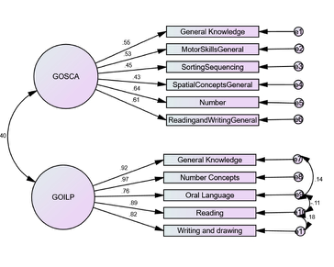
associated with the GOCSA and GOILP. The assessment of fit is relative to the different indices used to assess the goodness of fit of the model as established by Leach et al. (2008). All measures of fit (CFI, IFI, TLI GFI, NFI) that were assessed suggested very good model fit surpassing the benchmark. Additionally, the score of the RMSEA indicated a good model fit of .051 falling significantly below the benchmark. Overall model 1 shows a good representation of the factors associated with both assessments of students’ proficiency. Overall, model 1 revealed that the components that were common to both the GOILP and the GOCSA measure what they were designed to measure thus establishing validity of those components. Figure 1 shows the components that were comparable on both assessment instruments.
Figure 1: Showing the standard estimates for the model 1 representation of the assessments GOILP and GOCSA.
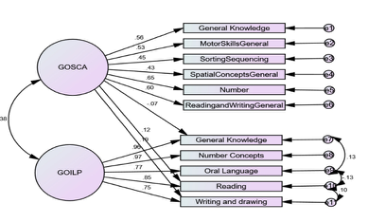
While validity was established for the components in both assessments, another model was developed to assess in greater details whether the additional items that were included for each component of the GOCSA had in fact improved overall model fit. To achieve model 2, the suggestions from modification indices were used to guide the improvement of the model to make it more efficient and fitting. The combination of the factors from GOILP being added to the GOCSA resulted in an even more satisfactory goodness of fit with almost perfect score for the CFI and IFI at .999 and TLI at .998, the other indices (NFI and GFI) were still very good fit with higher indicators. The results of the assessment for model are shown in Figure 2.
Figure 2: Showing the standard estimates of model 2 representing the assessments GOILP and GOSCA.
The RMSEA was a better representation of the goodness of fit of the model with the score of .016, significantly lower than the benchmark of .080 and of the previous model of .051. These results suggest that the GOSCA is a good alternative to the GOILP (see Table 1).
Table 1: Model fit.
Table available in the original PDF paper.
Fit Index Model 1 Model 2 Cited Benchmark CMIN 66.193 39.251 NA DF 60 37 NA CFI .983 .999 > .93 NFI .958 .975 > .93 GFI .955 .972 > .93 TLI .976 .998 > .93 IFI .983 .999 > .93 RMSEA .051 .016 <.08 AIC 118.193 97.251 NA
Note: CMIN (Chi square); DF (Degree of Freedom), CFI (Comparative Fit Index); NFI (Normed Fit Index); GFI (Goodness of Fit Index); TLI (Tucker Lewis Index); IFI (the Incremental Fit Index); RMR (Root Mean Square Residual); RMSEA (Root Mean Square of Approximation); AIC (Akiake Information criterion).
To Examine the Students’ Readiness for Grade One Based on the Components of the GOCSA In examining the level of proficiency of the student using the GOSCA, the results indicated that for general knowledge and motor skills majority of the students were proficient representing 81% and 83% respectively, while 79% were proficient in reading and writing.
On the contrary 61% of the students were developing in the areas of sorting and sequencing, with only 20% considered proficient and 16% deemed as beginners. In measuring the level of proficiency in numbers 45% of students were proficient, while 44% was developing. For level of proficiency in spatial concepts, 35% of students were proficient, 29% were beginners and 24% were developing.
Comparison of the GOCSA with the GOILP revealed similar proficiency level for writing and drawing on the GOILP and reading and writing on the GOCSA. There were also similarities in proficiency level for general knowledge. There was a decline in the competence level for number concepts, where the GOILP had 86% proficiency while the GOCSA had 45% proficiency and 44% developing (Tables 2 & 3). The data therefore suggest that the development of the GOCSA had similar results for general knowledge and reading and writing. However, there were some levels of difficulty in number concepts (Tables 2 & 3).
Table 2: Competency level on GOCSA.
Table available in the original PDF paper.
Not Yet Beginning Developing Proficient
Level of Proficiency in General
1% 9% 9% 81%
Knowledge
Continued
Exploring Jamaican Students’ Readiness Using the Grade One Cognitive Skills Assessment 179
Table 2: Continued
Table available in the original PDF paper.
Not Yet Beginning Developing Proficient Level of Proficiency in Motor Skills 7% 10% 83% Level of Proficiency in Sorting and
3% 16% 61% 20%
Sequencing Level of Proficiency in Spatial
12% 29% 24% 35%
Concepts Level of Proficiency in Number
2% 9% 44% 45%
Concepts Level of Proficiency in Reading and
2% 5% 14% 79%
Writing
Table 3: Competency level GOILP.
Table available in the original PDF paper.
Not Yet Beginning Developing Proficient
Level of Proficiency in General
3% 12% 85%
Knowledge Level of Proficiency in Oral
1% 3% 13% 83%
Language Level of Proficiency in Number
1% 4% 9% 86%
Concepts Level of Proficiency in Reading 2% 5% 8% 85% Level of Proficiency in Writing and
3% 8% 16% 73%
Drawing
DISCUSSION
The moderate positive relationship between the GOILP and the GOCSA suggest that the GOCSA can be used as an alternative assessment. In addition, the negative association between both assessment with the GOILP being a predictor of the GOSCA suggests that the GOCSA is an advancement of the GOILP. As the results revealed with every increase in the efficiency of the GOCSA the efficiency in the GOILP decreased by 5.814. This finding supports the recommendation of Rock and Stenner (2005) for the use of various tests in assessing students’ readiness. Further, having a valid locally developed assessment is also supported in the literature and addresses concerns raised by Fink and Zuilkowski (2015) that most of the measurement tools being used in developing countries were developed in the United States or other developed countries, and these instruments are unlikely to be culturally appropriate and representative of the world’s children. Additionally, considering that students in the Jamaican context do not all enter grade one at the same time of the year which means that some of the students would have missed the GOILP assessment, the GOCSA is a possible alternative that teachers can use to determine students’ readiness and diagnose students’ cognitive skills. With the important role that assessing children’s achievement and progress play for teachers working at the EC level having an alternative available locally can strengthen decision making as teachers plan for their students (Clausen et al., 2015).
The confirmatory factor analysis suggests that there is a good model fit for both the GOILP and the GOCSA. In addition, there are some factors from the GOILP that were improved on in the GOCSA. Information was taken from the GOILP to create the GOCSA which makes it a better model fit. Therefore, the model fit based on the added component makes the GOCSA a strong alternative. This instrument not only focussed on math and reading skills, but also on other domains that include sequencing, sorting and spatial concepts. This addresses a concern raised in the literature by child development experts and early educators regarding the design of assessments that narrowly focus on reading and math skills to the exclusion of other essential developmental domains (Yun et al., 2021). Furthermore, based on the constructs and their alignment with the GOILP it is appropriate for the Jamaican Grade One population. With this broadened assessment available through the GOCSA, teachers can better determine the supports and services that young children need to set them on a trajectory of success in school (Daily and Maxwell, 2018). Students’ readiness for Grade One based on the components of the GOCSA suggests that most students are proficient in general knowledge, motor skills and reading and writing. The findings are reflective of the basic skills required based on the GOILP. However, they have lower performance in skills that promote problem solving which is reflective of the multiple domains proposed by Carson et al. (2015). The GOILP is administered earlier which captures basic readiness skills for Grade One. The GOSCA added components would capture content that they would learn in Grade One. Therefore, the GOSCA is a more efficient measure of proficiency at Grade One. The GOCSA is reflective of Dailey and Maxwell’s (2018) who suggest that tools designed to measure cognitive skills should look at ability to solve problems. In addition, six of the components of the GOCSA are among the seven components that capture the fundamental domains of child development as proposed by Harris and Mortley (2019). The findings also suggest that some students enter Grade One with the basic general, reading and numeric knowledge. However, skills such as spatial reasoning, sorting and sequencing are developed later in Grade One.
CONCLUSION
In this paper we sought to examine the appropriateness of the GOCSA as an alternative assessment to the GOILP. Based on the findings the GOCSA is associated with the GOILP and it is a good alternative. In addition, the added components of the GOCSA provide a level of difficulty for students who are exposed to Grade One content. Such an assessment can provide teachers with a clear assessment of students’ proficiency levels at all the fundamental domains of child development that would help teachers to plan for students that will contribute to their future success in school.
REFERENCES
Akerman, D. J. (2018). Real world compromises: Policy and practice impacts of kindergarten entry assessment-related validity and reliability challenges. Research Report Series No. RR-18-13. Princeton, NJ: Educational Testing Service. Available from https://onlinelibrary.wiley.com/doi/epdf/10.1002/ets2.12201.
Exploring Jamaican Students’ Readiness Using the Grade One Cognitive Skills Assessment 181
Campbell, C. (2013). Research on teacher competency in classroom assessment.
In J. H. McMillan (Ed.), Sage handbook of research on classroom assessment (pp. 71–84). Thousand Oaks, CA: Sage. Carson, V., Hunter, S., Kuzika, N., Wiebe, S. A., Spence, J. A., Friedman, A., Tremblay, M. S., Slater, L. & Hinkley, T. (2015). Systematic review of physical activity and cognitive development in early childhood. Journal of Science and Medicine in Sports. http://dx.doi.org/10.1016/j.jsams.2015.07.011 Clausen, S. B., Guimaraes, S., Howe, S. & Cottle, M. (2015). Assessment of young
children on entry to school: Informative, formative or performative? International Journal for Cross-Disciplinary Subjects in Education (IJCDSE), 6 (1). 2120–2132. Daily, S. & and Maxwell, K. (2018). Frequently asked questions about kindergarten entry assessments. Washington, DC: Alliance for Early Success and Child Trends. Fearon, L., McLean, M, Miles, M. & Campbell, C. (2009). Integrated reader 1. Mid
Island Educators. Fink, G. & Zuilkowski, S. S. (2015). Measuring child development across cultures.
The State of the World’s Children 2015: Reimagine the future. UNICEF. https:// sowc2015.unicef.org/stories/innovations-in-assessment/ (accessed 05/03/23). Finn, A. S., Kraft, M. A., West, M. R., Leonard, J. A., Bish, C. E., Martin, R.
E., Sheridan, M. A., Gabrieli, C. F. O. & Gabrieli. J. D. E. (2014). Cognitive skills, student achievement tests, and schools. Psychological Science, 6, 1–9, doi: 10.1177/0956797613516008. Harris-Mortley, S. H. (2019). Jamaican kindergarten and first grade teachers’ expectations for readiness skills. Walden University Dissertation and Doctoral Studies https://scholarworks.waldenu.edu/cgi/ viewcontent.cgi?article=9561&context=dissertations. Kinkead-Clark, Z. (2015). Ready for big school’: Making the transition to primary school-a Jamaican perspective. International Journal of Early Years Education, 23(1), 67–82. doi. 10.1080/09669760.2014.999027, http://dx, doi.org. Leach, C. W., van Zomeren, M., Zebel, S., Pennekamp, S. F., Doosje, B., Vliek,
M. L. W. & Spears, R. 2008. Group-level self-definition and self-investment: A hierarchical (multicomponent) model of in-group identification. Journal of Personality and Social Psychology, 95(1): 144–165. http://doi.org/10.1037/0022- 3514.95.1.144 Lumaurridlo, H. R., Kistoro, H. C. & Putranta, H. (2021). School readiness assessment: Study of early childhood educator experience.” Elementary Education 20 (1): 468–478. doi: 10.17051/ilkonline.2021.01.041. National Education Inspectorate Report. (June, 2010). Craighton primary inspection report. https://www.mona.uwi.edu/cop/sites/default/files/resource/files/ Craighton%20Primary.pdf (accessed 05/03/23). Nesayan, A., Malahat, A & Gandomani, Roghayeh, A. (2019). Cognitive profile
of children and its relationship with academic performance. Basic and Clinical Neuroscience, 10(2), 165–174. http://dx.doi.org/10.32598/bcn.9.10.230 Rao, N., Sun, J., Wong, J. M. S., Weekes, B., Ip, P., Shaeffer, S., Young, M., Bray, M., Chen, E. & Lee, D. (2014). Early childhood development and cognitive development in developing countries: A rigorous literature review. Department for International Development. [2014 September] Accessed from http://eppi.ioe.ac.uk/cms/Portals/0/PDF%20reviews%20and%20summaries/ ECD%202014%20Rao%20report.pdf?ver=2014-10-02-145634-017. Rock, D. A. and Stenner, A. J. (2005). Assessment issues in the testing of children at
school entry. The future of Children, 15(1), 15–34.
Saluja, G., Scott-Little, C. & Clifford. R. M. (2000). Readiness for school: A survey of state policies and definitions. Early Childhood Research & Practice, 2(2), 1–55. http://eric.ed.gov/?id=ED446875 Samms-Vaughan, M. (2004). The Jamaican pre-school child: The status of early
childhood development in Jamaica. Kingston: Planning Institute Of Jamaica (PIOJ). Samms-Vaughan, M. (2015). The Jamaica school readiness assessment report of the phase 1 pilot in the parish of Westmoreland. Early Childhood Commission. Retrieved from: https://www.unicef.org/jamaica/media/486/file/ TheJamaicaSchoolReadinessAssessment-2015.pdf. Shields, K. A., Cook, K. D. & Greller, S. (2016). How kindergarten entry assessments
are used in public schools and how they correlate with spring assessments (REL 2017–182). Washington, DC: U.S. Department of Education, Institute of Education Sciences, National Center for Education Evaluation and Regional Assistance, Regional Educational Laboratory Northeast & Islands. Retrieved from http://ies.ed.gov/ncee/edlabs. Shonkoff, J. P. & Phillips, D. A. (Eds.). (2000). From neurons to neighbourhoods: The science of early childhood development. Washington, DC: National Academies Press. Snow, C. E. & Van Hemel, S. B. (Eds.). (2008). Early childhood assessment: Why,
what, and how. Washington, DC: National Academies Press. Unpublished thesis. 2013. An investigation into the impact of parental involvement on the cognitive and social skills of grade one students in Jamaica. [Unpublished doctoral Thesis] University of the West Indies, Mona. Welsh J. A., Nix, R. L., Blair, C., Bierman, K. L. & Nelson, K. E. (2010).
The development of cognitive skills and gains in academic school readiness for children from low-income families.” J Educ Psychol.102(1): 43–53. doi: 10.1037/ a0016738. Wylie, E. C. (2017). WinsightTM assessment system: Preliminary theory of action (Research Report No. RR-17-26). Princeton, NJ: Educational Testing Service. https://doi.org/10.1002/ets2.12155 Yun, C., Melnick, H., & Wechsler, M. (2021). High-quality early childhood
assessment: Learning from states’ use of kindergarten entry assessments. Learning Policy Institute. https://learningpolicyinstitute.org/product/high-quality- kea (accessed 05/03/23).
LISTED IN THE AHFE DIGITAL BOOKSTORE CATALOGUE
Explore the complete digital volume
Training, Education, and Learning Sciences
Read this individual research paper free through the original publisher, or explore the full digital proceedings book.
ISBN 978-1-964867-69-4
Explore this ISBN in the AHFE Bookstore ↗Listed in the July 2026 bookstore catalogue; search by ISBN to confirm current availability · Digital book purchase optional