Zenija Roja, Henrijs Kalkis, Marwan Babiker (2025). Interaction of Physical and Mental Strain for Surgeons and Nurses in Operating Theatre in Latvia. In: Social and Occupational Ergonomics. AHFE Open Access, vol. 190, pp. 50–55. https://doi.org/10.54941/ahfe1006596
Health care is one of the leading sectors of the national economy in Latvia, where employees according to the official statistics make up 6.7% of all employees in the country. In 2022. Today, physical load and stress at work are an integral part of everyday life in various professions. It places a heavy burden on workers` mental and physical abilities. Work related musculoskeletal disorders (WRMSD`s) are the most common causes of occupational diseases, injuries, and disabilities for various professions, including staff in the operating block. When cognitive demands increase and are not balanced with employees' abilities, employees' health suffers (Bakker & Demerouti, 2007; Johnson & Hall, 1988; Karasek, 1979). The aim of this study was to investigate the interaction of physical and mental strain for surgeons and nurses in operating theater.Methods and materials. The research was performed at one of the hospitals in Latvia. Altogether participated 8 operating surgeons (7 males, 1 female) and 10 surgery nurses (2 males, 8 females). Interaction of mental and physical load was determined using subjective and multidimensional assessment tool: The NASA Task Load Index (NASA-TLX) (Hart, 2006). This method is a multidimensional rating system for assessment of general or total workload based on results of the six sub scales: mental demands, physical demands, temporary demands, task performance, effort and frustration. Psychosocial aspects were considered when assessing mental strain, including working hours, work content, work team interrelations.ResultsThe results of NASA-TLX analysis show that highest degree of total workload considering mental and physical load interaction was identified for physicians surgeons (75 points). Surgeons have a very high responsibility on the executable work, and they have been involved in responsible decision making, for example, saving the patient's life. Physical demands of the surgeons are mainly based in connection with postural load (prolonged standing on legs, forced working postures) and repetitive hand-arm movements. As work of surgery nurses is characterized with prolonged standing on legs and compulsive posture, load on upper limbs, the NASA-TLX analysis shows that physical load of surgery nurses is evaluated up to 78 points, but temporal load indicator for surgery nurses resulted in 83 points (highest degree), work performance conforms to 80 points, which indicates a high level of responsibility. Conclusion The interaction of a mental and physical load using NASA-TLX method allowed to estimate the total workload and compare the significance in percent (or weight scores) of different demands (stress at work, an effort, frustration, quality of performance, a.o.). The physical workload is higher for surgery nurses than for operating surgeons, as according to the NASA-TLX analysis psycho-emotional workload (responsibility for the patient's life, time pressure, decision making) is higher than physical workload for operating surgeons. Physical workload (frequent arm movements, standing, lifting and carrying) for surgery nurses significantly influences their total workload.Acknowledgment: This research has been supported by the project “Work Related Musculoskeletal Disorders and Psychosocial Risks for Operating Room Health Care Staff”, Agreement No. LU-BA-PA-2024/1-0044, UL registration No. ESS2024/465.
Human In today’s rapidly changing work environment, operating theatre staff are exposed to many occupational hazards, the most important of which are psychosocial and physical risks at work. Surgeons and operating theatre nurses face a lot of emotional and physical stress at work. Nurses report high workloads, ongoing stress, and being exposed to negative influences (Tomaszewska, Majchrowicz, 2020). Of theatre nurses, 75% say they have been personally harassed by surgeons, with low pay, demanding schedules, and encounters with surgeons being the main sources of stress for these nurses. (Munthali et al., 2008).
Nurses experience stress because of musculoskeletal strain, exposition to chemicals, occupational exposure, and handling of patients (Tomaszewska et al., 2020). According to Sonoda et al. (2018), 30–40% of surgical nurses
Interaction of Physical and Mental Strain for Surgeons and Nurses in Operating Theatre 51
have experienced psychological stress during surgery, although many of them work well in teams. Surgical aspects are the main source of stress for nurses, while teamwork performance is the main source of nurses’ circulation.
Common physical hazards include unsuitable physical environments, heavy manual work, lifting and handling activities, frequent bending and turning, static working postures, shift work, etc. (Walts et al., 1975; Azizo˘glu et al., 2018; Memon et al., 2016). Researchers have shown that work- related neck and upper limb symptoms and back health problems have a multifactorial origin and that potential risk factors could be of both physical and psychosocial origin (Bongerset al., 2006; van den Berg-Dijkmeijer et al., 2011). The literature describes nurses and surgeons as more susceptible to work related muscular skeletal disorders (WRMSD-s) due to repetitive movements and prolonged standing (Amirthanayagam et al., 2024). Physical strain is often compounded by non-ergonomic working postures, which are more commonly observed in operating theatre nurses and surgeons (Kant et al., 1992). For complex surgeries, such as endovascular treatment, the physical demands are particularly significant. The risk of musculoskeletal disorders has been shown to increase dramatically for surgeons and others in association with prolonged forced work postures during surgery (Gerbrands et al., 2004; Stomberg et al., 2010).
A positive psychosocial working environment is known to improve the drive, resilience, awareness, and job satisfaction of operating theatre staff, while negative stress has an impact on performance that cannot go unnoticed. High cognitive workload makes it difficult for surgical team members to adapt to unexpected situations during surgery or contributes to strain at the start of surgery when assessing workload (Koh et al., 2014, Keller, 2020). Psychosocial risks are increased by the fact that operating theatres are closed environments in which life-threatening situations for patients often occur. In such situations, the long working hours restrict the operating theatre staff from meeting personal needs such as rest, lunch, short breaks, etc., which can result in stress-related health problems in the longer term. Studies have shown that after a surgical accident, operating theatre staff may experience emotional distress similar to the symptoms of post-traumatic stress disorder (Pinto et al., 2014; Giurgiu et al., 2015; Chard, 2009). This condition not only affects surgeons and their families but may also have a negative impact on patient care delivery, clinical performance, and patient safety (Serou et al., 2017; 2021). Recent research using biomechanics, psychophysics, and observational methods has shown a link between psychosocial risks and physical demands at work. A study using the NASA-TLX questionnaire investigated residents’ workload during laparoscopic skills training to determine workload and its impact on task performance. The results demonstrated that human factors and ergonomic tools can be used to relate surgical skills performance to workload, stress, and work posture risks (Yu et al., 2015). This suggests that there may be interactions between physical and psychosocial risk factors at work. An ergonomic prevention strategy aimed at reducing the risk of work-related disease symptoms should target not only physical but also psychosocial risk factors at work.
The aim of this study was to investigate the interaction of physical and mental strain for surgeons and nurses in operating theatre. Inclusion criteria were at least 1 year of professional experience and voluntary participation in the study. Exclusion criteria were a confirmed occupational disease related to WRMSD and a diagnosed psychosocial risk disease according to mandatory health examination data. The study was authorised by the Ethics Committee of the University of Latvia under No. 71-35/154, 11.23.2024.
METHODS AND MATERIALS The research was performed at one of the hospitals in Latvia. A total of 8 surgeons (7 male, 1 female) and 10 surgical nurses (2 male, 8 female) participated. See Table 1 for background factors of the research participants.
Table 1: Background factors of research participants, length of service, mean age, standard deviation (SD), mean height, mean body mass index (BMI).
Table 1 shows physical characteristics among surgeons and surgery nurses. The mean age of surgeons was 45 years (±17.6), while for surgery nurses the mean age was 42 years (±14.11). Surgeons had a mean height of 170.13 cm (±7.41) and a mean weight of 77.75 kg (±5.2), compared with surgery nurses, who had a mean height of 174.7 cm (±7.07) and a mean weight of 78.3 kg (±8.93).
Interestingly, the average Body Mass Index (BMI) for surgeons was 26.95 (±2.47), indicating that surgeons on average fall into the overweight category according to World Health Organisation (WHO) standards. Surgery nurses had a mean BMI of 25.59 (±1.71), which also places them in the overweight category. This highlights the importance of monitoring and promoting healthy lifestyle practices among surgeons and surgery nurses.
The interaction of mental and physical load was determined using a subjective and multidimensional assessment tool: The NASA Task Load Index (NASA-TLX) (Hart, 2006). This method is a multidimensional rating system for assessment of general or total workload based on results of the six subscales: mental demands, physical demands, temporary demands, task performance, effort, and frustration. Psychosocial aspects were considered when assessing mental strain, including working hours, work content, and work team interrelations.
Interaction of Physical and Mental Strain for Surgeons and Nurses in Operating Theatre 53
RESULTS AND DISCUSSION
The mental workload assessment took into account not only the NASA- TLX software questionnaires but also the psycho-emotional risks at work. A checklist was used that included the following information: information about the interviewee, aspects of working time, job content, interpersonal relations within the work team and with management, organisational and working conditions, the impact of psychosocial factors in the work environment, and opportunities to maintain and improve the psychological health of employees.
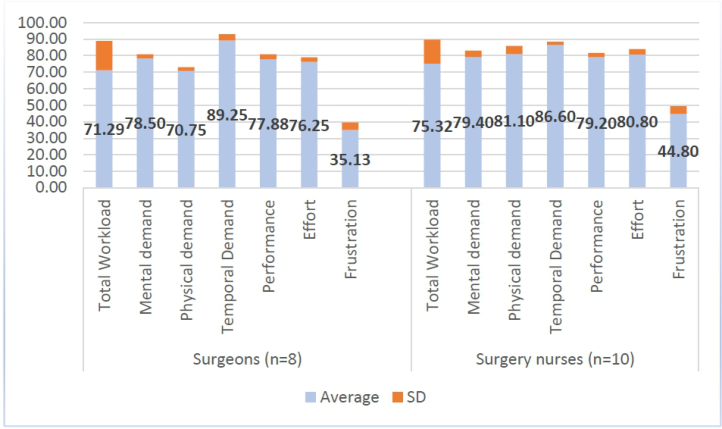
The interaction between mental and physical workload using the NASA- TLX software allowed determining the total workload and comparing the importance of different demands (job stress, effort, dissatisfaction, quality of performance, etc.) in percentages according to a scale of values provided by the software. The results obtained are presented in Figure 1, where the total workload is shown as the interaction of all the requirements defined by NASA-TLX.
Figure 1: NASA-TLX method results surgeons (n = 8) and surgery nurses (n = 10).
The results of the NASA-TLX analysis showed that the degree of total strain, taking into account the interaction between mental and physical strain, was higher for nurses, which accounted for 75.32 ± 17.53 points, and for surgeons, which accounted for 71.29 ± 17.53 points. For surgeons, higher scores were for mental (78.5 ± 2.45) and temporal strain (89.25 ± 3.77), and effort (76.25 ± 2.76). This is due to fact that surgeons have a very high responsibility for the work they perform and are often involved in making responsible decisions, for example, to save a patient’s life. Surgeons’ physical workload is mainly related to postural strain (prolonged standing, forced postures) and frequent, repetitive arm movements. This is also consistent with
other authors’ studies on surgeons’ workload (Amirthanayagam et al., 2024; Yu et al., 2015). Similar results were found in surgical nurses due to prolonged standing and restricted upper limb postures.
Surgical nurses have a total workload score of 75.32 ± 14.40, which is higher than that of surgeons. The temporal load score is 86.60 ± 1.78 (highest grade). Mental demands and physical demands at work were 79.40 ± 3.75 and 81.10 ± 4.84, respectively, which is considered relatively high. The job performance score is also high at 79.20 ± 2.44. This indicates a high level of responsibility. Our results contradict other authors’ studies on intraoperative workload of surgical team members, which showed that surgeons and residents had, on average, 14 to 22 points higher physical demands at work than operation nurses did, and residents had 19 to 24 points higher mental workload than nurses (Yu et al., 2016).
Future research will analyse physical and mental workload with objective assessment methods that will provide a more qualitative and reliable overview of the interaction between physical and mental workload for operating theatre staff.
CONCLUSION
The interaction of a mental and a physical load using the NASA-TLX method allowed us to estimate the total workload and to compare the importance in percentages (or weight scores) of different requirements (work stress, an effort, frustration, quality of performance, etc.). The general workload is higher for operating theatre nurses than for operating surgeons. It was concluded that, according to the Nasa-TLX analysis, psycho-emotional workload (responsibility for the patient’s life, time limit, decision- making) is high for operating surgeons and affects physical workload, while for operating theatre nurses, physical workload (frequent arm movements, standing, lifting, and carrying) affects mental workload.
ACKNOWLEDGMENT
This research has been supported by the project “Work Related Musculoskeletal Disorders and Psychosocial Risks for Operating Room Health Care Staff”, Agreement No. LU-BA-PA-2024/1-0044, UL registration No. ESS2024/465.
REFERENCES
Amirthanayagam, A., O’Neill, S., Goss, C. and Moss, E. L., (2024). Physical and psychological impact of surgery on the operating surgeon. International Journal of Gynecologic Cancer. Azizo˘glu, F., Köse, A. and Gül, H., (2019). Self-reported environmental health risks of
nurses working in hospital surgical units. International nursing review, pp. 87–93. Bongers, P. M., Ijmker, S., van den Heuvel, S. and Blatter, B. M., (2006). Epidemiology of work related neck and upper limb problems: Psychosocial and personal risk factors (part I) and effective interventions from a bio behavioural perspective (part II). Journal of occupational rehabilitation, pp. 272–295. Chard, R., (2010). How perioperative nurses define, attribute causes of, and react to
intraoperative nursing errors. AORN Journal, pp. 132–145.
Interaction of Physical and Mental Strain for Surgeons and Nurses in Operating Theatre 55
Gerbrands, A., Albayrak, A. and Kazemier, G. (2004). Ergonomic evaluation of the work area of the scrub nurse. Minimally Invasive Therapy & Allied Technologies, pp. 142–146. Giurgiu, D. I., Jeoffrion, C., Grasset, B., Dessomme, B. K., Moret, L., Roquelaure, Y.,
Caubet, A., Verger, C., Laraqui, C. E. H., Lombrail, P. and Geraut, C. (2015). Psychosocial and occupational risk perception among health care workers: A Moroccan multicenter study. BMC research notes, pp. 1–10. Kant, I. J., de Jong, L. C. G. M., van Rijssen-Moll, M. and Borm, P. J. A. (1992). A survey of static and dynamic work postures of operating room staff. International archives of occupational and environmental health, pp. 423–428. Keller, S., Yule, S., Smink, D. S., Zagarese, V., Safford, S. and Parker, S. H. (2020).
Episodes of strain experienced in the operating room: Impact of the type of surgery, the profession and the phase of the operation. BMC surgery, pp. 1–11. Koh, R. Y., Park, T. and Wickens, C. D., (2014). An investigation of differing levels of experience and indices of task management in relation to scrub nurses’ performance in the operating theatre: Analysis of videotaped caesarean section surgeries. International Journal of Nursing Studies, pp. 1230–1240. Van den Berg-Dijkmeijer, M. L., Frings-Dresen, M. H. and Sluiter, J. K. (2011). Risks
and health effects in operating room personnel. Work, pp. 331–344. Memon, A. G., Naeem, Z., Zaman, A. and Zahid, F., (2016). Occupational health related concerns among surgeons. International journal of health sciences, p. 279. Munthali, J., Bowa, K. and Odimba, B. F. K. (2008). Stress and harassment among
theatre nurses at the University Teaching Hospital in Zambia. East and Central African Journal of Surgery, pp. 34–36. Pinto, A., Faiz, O., Bicknell, C. and Vincent, C. (2014). Acute traumatic stress among surgeons after major surgical complications. The American Journal of Surgery, pp. 642–647. Serou, N., Sahota, L., Husband, A. K., Forrest, S. P., Moorthy, K., Vincent, C., Slight,
R. D. and Slight, S. P. (2017). Systematic review of psychological, emotional and behavioural impacts of surgical incidents on operating theatre staff. BJS open, pp. 106–113. Serou, N., Slight, S. P., Husband, A. K., Forrest, S. P. and Slight, R. D. (2021). Surgical incidents and their impact on operating theatre staff: Qualitative study. BJS open, p.zraa007. Stomberg, M. W., Tronstad, S. E., Hedberg, K., Bengtsson, J., Jonsson, P.,
Johansen, L. and Lindvall, B. (2010). Work-related musculoskeletal disorders when performing laparoscopic surgery. Surgical Laparoscopy Endoscopy & Percutaneous Techniques, pp. 49–53. Tomaszewska, K. and Majchrowicz, B. (2022). Harmful factors at the workplace of an operating nurse. Journal of Education, Health and Sport, pp. 286–300. Walts, L. F., Forsythe, A. B. and Moore, J. G. (1975). Critique: Occupational
disease among operating room personnel. The Journal of the American Society of Anaesthesiologists, pp. 608–610. Yu, D., Lowndes, B., Thiels, C., Bingener, J., Abdelrahman, A., Lyons, R. and Hallbeck, S. (2016). Quantifying intraoperative workloads across the surgical team roles: Room for better balance? World journal of surgery, pp. 1565–1574. Yu, D., Abdelrahman, A. M., Buckarma, E. H., Lowndes, B. R., Gas, B. L.,
Finnesgard, E. J., Abdelsattar, J. M., Pandian, T. K., El Khatib, M., Farley, D. R. and Hallbeck, S. (2015), September. Mental and physical workloads in a competitive laparoscopic skills training environment: A pilot study. In Proceedings of the human factors and ergonomics society annual meeting (Vol. 59, No. 1, pp. 508–512). Sage CA: Los Angeles, CA: SAGE Publications.
LISTED IN THE AHFE DIGITAL BOOKSTORE CATALOGUE
Explore the complete digital volume
Social and Occupational Ergonomics
Read this individual research paper free through the original publisher, or explore the full digital proceedings book.
ISBN 978-1-964867-66-3
Explore this ISBN in the AHFE Bookstore ↗Listed in the July 2026 bookstore catalogue; search by ISBN to confirm current availability · Digital book purchase optional