Anne Wambui Mumbi, Karl Behrendt, Eric Siqueiros (2025). The Impact of Renewable Energy on a Grass-Based Biorefinery: Sustainability Assessment of Grass-Derived Proteins. In: Sustainable Construction in the Era of the Fourth Industrial Revolution. AHFE Open Access, vol. 187, pp. 99–108. https://doi.org/10.54941/ahfe1006564
The increasing global demand for sustainable protein sources has driven interest in grass protein as an alternative to conventional animal- and plant-based proteins. This study evaluates the environmental impacts of grass protein production using an attributional Life Cycle Analysis (LCA) approach. The analysis employs the Pasture-to-Plate (P2P) mechanochemical process, which integrates multiple unit operations to optimize protein extraction and processing efficiency. The LCA follows a cradle-to-gate system boundary, assessing key environmental impact categories such as global warming potential, land use, water consumption, acidification, eutrophication, and human toxicity. Results indicate that producing 1 kg of grass protein is associated with 0.546 kg CO2-eq, with feedstock production contributing the most significant share of the environmental burden. The study identifies critical process inefficiencies and proposes strategies for optimization, including improved agricultural practices, energy-efficient drying methods, and circular resource utilization. By enhancing production sustainability, grass protein can emerge as a viable alternative to conventional protein sources, supporting the development of resilient and eco-friendly food systems.
Sustainable protein production is emerging as a crucial field of study due to the growing world population and increased protein demand (Nirmal et al., 2024). According to Gerber et al. (2013) and Searchinger et al. (2018), traditional protein sources such as livestock and soy have a significant negative impact on the environment by emitting greenhouse gases, promoting deforestation, and depleting water supplies. Consequently, efforts to find alternative protein sources have been heightened by issues relating to food security, efficiency of resources, and environmental sustainability (Zhao et al., 2021). Proteins, derived from forage crops such as grasses, represent a promising alternative with a lower environmental footprint compared to conventional protein sources. Here in termed as grass proteins.
Grass protein can be made from underutilized grass resources leading to reduced competition with food crops and the need to expand arable land (Foley et al., 2011). Additionally, by exploiting underutilised land, enhancing soil health, and integrating with current farming techniques, grass protein production can improve circular agricultural systems. There are numerous protein extraction methods that exists however, they present certain limitations (Cilia et al., 2009). For example, conventional protein extraction processes such as solvent-based separation or alkaline extraction followed by acid precipitation, usually demand large energy inputs, chemical consumption, and waste generation (Gaffey et al., 2024; Wedgwood, 2024). These methods also result in large wastewater volumes and are energy- intensive with low recovery efficiencies which have negative environmental impacts. For example, manufacturing soy protein isolate necessitates a variety of heating, neutralizing, and centrifuging steps, all of which increase water and carbon footprints (Thrane, Ma et al., 2017). Similarly, membrane filtration and organic solvents are widely employed to extract pea or canola protein, which causes membrane fouling and reduces sustainability (Castro-Munoz et al., 2020). To address these limitations the Pasture-to- Plate (P2P) proposes the use of Mechanochemical Assist (MEA) that has been proven to be less energy and resources intensive. P2P seeks to increase grass protein production efficiency while reducing environmental trade-offs by utilizing cutting-edge processing methods. The P2P method allows for effective grass protein extraction with minimal environmental impacts by lowering the need for harsh chemicals and energy-intensive drying processes. However, the broader sustainability implications especially related to energy use of this approach remain underexplored. A commonly recognized tool for assessing the sustainability implications and environmental impact from production systems of food such as that of P2P is the Life Cycle Analysis (LCA).
According to ISO 14040 (2006), LCA is a well-known method for evaluating the environmental effects of food production systems due to its detailed breakdown and analysis of resource use and emissions along a system. LCA offers a thorough analysis a systems resource and emissions along a production chain by identifying various environmental hotspots. Through the identification of environmental hotspots, LCA enables process enhancements that promote sustainability as well as provision of a detailed profile of the environmental impacts of the biorefinery.
LCA has been employed in biorefineries studies particularly focusing on energy systems to determine the importance and need for the integration of renewable energy sources. For example, as outlined by Cherubini and Ulgiati (2010) that a major factor influencing environmental performance is the choice of energy source, namely the substitution of renewable energy sources for fossil fuels. In their investigation of several energy scenarios in the manufacturing of bioethanol ˇCuˇcek et al. (2012) highlighted how integrating renewable energy greatly lowers the carbon footprint. Similarly, Li et al. (2021) emphasized the role of bioenergy and waste heat recovery in protein biorefineries, demonstrating that cleaner energy inputs significantly reduce
The Impact of Renewable Energy on a Grass-Based Biorefinery 101
resource depletion and the potential for global warming. Building on these insights, this research applies an attributional LCA methodology to examine the environmental impacts of producing of grass proteins, and the consequent impact that different energy systems have on the process. Specifically, the study focuses primarily on the global warming potential, eutrophication, acidification, land use changes impacts, water use, and the toxicity of the biorefinery as highlighted by Meier et al. (2021) these are key impact factors in biorefineries. Further, the study aims to address a key gap in the current literature by focusing on energy systems and potential optimization processes of biorefinery especially those utilizing novel methods such as the P2P method. Additionally, the study will identify various environmental hotspots of the biorefinery and present potential optimization strategies that can enhance energy efficiency and overall sustainability. A key gap in current research. Further, this research seeks the significant environmental hotspots within the biorefinery and discusses possible mitigation measures that can increase sustainability. Building on these insights, this study applies an attributional LCA approach to examine the environmental impacts of grass protein production via the P2P method. Special emphasis is placed on energy use within the biorefinery and its influence on critical impact categories, including global warming potential, eutrophication, acidification, land occupation, water use, and human/ecotoxicity, as identified by Meier et al. (2021).
METHODOLOGY
The LCA was carried out using the ISO 14040/14044 framework (ISO, 2006) and covered the whole process from grass production to protein extraction and processing. The environmental impact assessment was conucted using the ReCiPe 2016 methodology, using data from primary sources, literature reviews, and databases such as Ecoinvent (Huijbregts et al., 2017).
The goal of the LCA was define as: to assess the environmental effects of electricity use during the Protein-to-Powder (P2P) production process with an emphasis on the impact of electricity in the biorefinery. A cradle- to-gate system boundary is applied, focusing on the energy systems. The Functional Unit (FU) for the study was defined as 1 kg of grass protein produced with all inputs related to electricity-related impacts calculated relative to the FU. Key environmental impact categories accounting for the Global Warming Potential, Acidification Potential, Eutrophication Potential, Water Consumption and Human Toxicity and Ecotoxicity were considered. Throughout, the study made significant assumptions. firstly, grass protein extraction is assumed to be 100% efficient, with no byproducts. Secondly, conventional grass farming data is utilized to compute typical fertilizer application rates, and standard agricultural impact factors are employed to estimate nitrogen and phosphorus runoff of grass farming. Thirdly, approximately 20% of the energy mix used in processing comes from renewable sources, and it is based on an average industrial electrical grid. Fourthly, the study assumes that a typical diesel truck is used with the estimated distance for the transportation of raw materials from farm to
processing facility being 10 km. These assumptions allow for the study to draw conclusions specific to the proposed biorefinery plant.
Process Flow and Unit Operations The P2P Process is divided into four stages: i.e. silage production and preparation, hydro cyclone separation, membrane filtration, and spray drying described further. (i) Silage production and preparation this step is essential as it enhances the efficiency of protein extraction. Italian grass mixes are grown and harvested and then subjected to anaerobic fermentation before ensiling the grass. These steps ensure that grass can be supplied throughout the year to the biorefinery meeting the supply requirements. The silage is then dried and ready for the biorefinery. (ii) Hydro cyclone separation. Following silage preparation, the silage is broken down in the extruder and mixed with water then passed through to the hydro cyclone which centrifuges the slurry component separating the protein stream. Before additional processing, effective separation at this point reduces contamination and improves protein purity (Ortega-Rivas, 2011). (iii) Membrane Filtration is an essential purification and concentration step that removes contaminants selectively according to molecule size and charge. Two membranes are used and the protein retentate is passed through each membrane. This repetition increases the amount of protein being separated. The ultimate protein yield, solubility, and organoleptic properties of the protein concentrate are all directly impacted by membrane filtering (Zydney, 1998). Finally, the semi liquid protein concentrate is passed through (iv) a spray dryer. Here the concentrated protein solution is atomized into a hot air stream, rapidly converting it into a fine, free-flowing powder. Spray drying is widely recognized as the most effective method for turning liquid protein into a powder that is both functionally and nutritionally superior and can be stored on the shelf (Mirlohi & Ali, 2022).
RESULTS
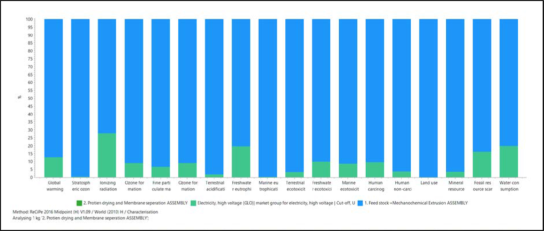
Figure 1 depicts the environmental impact of producing grass proteins. Feedstock production has the greatest environmental impact in almost every evaluated category, accounting for more than 80% to 95% of the total impact. This shows that the raw material used in the biorefinery and processing steps of the process such as mechanochemical extrusion, are the key contributors to the impact categories in the biorefinery. Categories such as global warming, terrestrial and freshwater ecotoxicity, fine particulate matter formation, and human toxicity are overwhelmingly influenced by the feedstock stage. This dominance indicates that upstream supply chain improvements, such as using more sustainable raw materials, reducing energy-intensive preprocessing, or optimizing feedstock conversion methods, could significantly lower the overall environmental footprint of the process.
Protein drying and membrane separation also play a noticeable role in certain impact categories, particularly ionizing radiation, water consumption, and fossil resource scarcity. While its contribution is lower than that of feedstock, it still accounts for roughly 10% to 30% of the environmental
The Impact of Renewable Energy on a Grass-Based Biorefinery 103
burden in these areas. These findings imply that implies that the drying and separation processes in the biorefinery are energy-intensive and resource- demanding, potentially resulting in water and fossil resource depletion. Which can be countered by process optimization such as using energy- efficient drying technologies, low-impact membrane materials, or creating circular water reuse systems, to reduce the environmental impact. Further a reduction in the reliance on traditional fossil-based energy sources will lead to a reduction on the impact on fossil resource depletion from the biorefinery.
Figure 1: Environmental impacts of grass protein production.
Electricity consumption, from the machinery used in the process contributes to all impact categories but stratospheric ozone. An indication that electricity use in the process has some contributions to the environmental burden. This suggests a switch to renewable energy. Although switching to renewable energy could provide additional benefits, its overall impact reduction potential is limited compared to addressing feedstock and process emissions. However, for categories like water consumption and fossil resource scarcity, even a small contribution from electricity suggests that increasing energy efficiency and integrating low-impact power sources, such as solar or wind energy, could further improve the sustainability of the production process.
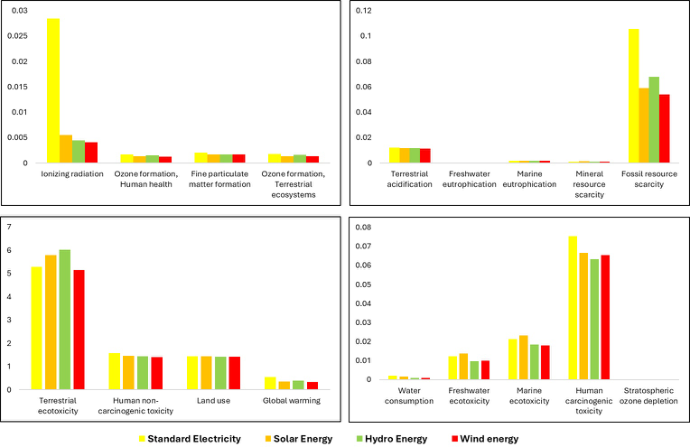
To understand the impact of renewable energy in the process, four electricity scenarios were modelled, i.e. standard electricity, solar energy, hydro generated energy and wind energy. As illustrated in Figure 2, Standard electricity accounts for the highest emissions in most impact categories. It accounts for the greatest impact in the global warming category that are significantly higher than the other energy systems. Wind energy has the lowest impact in the global warming category with emissions reductions of over 70% compared to the other energy systems. These findings are consistent with previous research showing that the carbon intensity of energy-intensive food processes is driven by grid electricity, especially that which is dominated by fossil fuels (Tuomisto et al., 2012; Roy et al., 2009). Underscoring its importance. Wind energy also accounts for the lowest emissions in acidification and eutrophication potential among the energy systems. This finding is consistent with previous literature, hydro energy accounts for the highest impact on water resources due its water intensive nature (Zhao et al.,
2021). Similarly, solar energy contributes the most to land use, consistent with literature that depicts the spatial demands that it brings with especially in large scale farms (Gerbinet et al., 2014).
Figure 2: Environmental performance of different energy systems of the P2P process for producing 1 kg of grass protein assessed across various impact factors.
DISCUSSION
The results show massive contributions of the biorefinery to global warming. These are largely accounted for by CO2 emissions from the use fertilizers in grass production, as well as energy used in the drying and processes (Gerber et al., 2013). The carbon footprint associated with these operations is driven by the combustion of fossil fuels for energy and the production of nitrous oxide (N2O), which is a powerful greenhouse gas that arises from fertilizer applications. The biorefinery’s acidification potential is primarily caused by NH3 and SO2 emissions from energy and fertilizer inputs (Mandal et al., 2022). These then leads to the formation of acid rain, which deteriorates the soil quality and impacts aquatic ecosystems. The eutrophication potential of the biorefinery is accounted for by Phosphorus and Nitrogen runoff from agricultural inputs (Nemecek et al., 2016). Excess nutrients in aquatic ecosystems can cause algae blooms, hypoxia, and biodiversity loss.
Land use impacts could result from massive land requirements compared to lab-grown protein and microbial alternatives (Searchinger et al., 2018). Although, production of grass for the biorefinery may require considerable amounts of agricultural area, there should be innovations in production methods applied such as exploring additional feedstock sources. The high impacts on water use stem from the extensive usage of water in processing
The Impact of Renewable Energy on a Grass-Based Biorefinery 105
and biomass cultivation (Mekonnen & Hoekstra, 2011). Advanced irrigation techniques, wastewater recycling, and closed-loop processing systems can all help to increase water use efficiency. Human Toxicity and Ecotoxicity is accounted for from the effects from agrochemical application and wastewater emissions (Reijnders & Soret, 2003). These effects are caused by pesticide residues, heavy metals, and chemical discharge into water bodies, which calls for greater waste treatment and less usage of chemical in these innovative technologies.
The findings from analysing different energy systems underscore the influence of energy on the biorefinery. The standard electricity mixes which dominated most impact categories complements previous findings that highlighted the environmental impact of fossil-based energy systems (Cherubini et al., 2011; Tuomisto et al., 2012). It was most significant for global warming. Scenarios analysing renewable energy sources showed significant reduced environmental impacts, however, there were distinctive trade-offs among them. Wind energy had the lowest impact in all the impact categories, positioning it as the most environmentally friendly choice for the biorefinery to adapt. The low greenhouse gas emissions, water consumption, and land use make it ideal for sustainable food system integration (Gaffey et al., 2023). Hydropower, albeit low in GHG emissions and energy demand, demonstrated a significant increase in water depletion potential. This impact is predominantly caused by reservoir-induced evaporation and is consistent with results from large-scale hydro studies (Zhao et al., 2021). Despite these limitations, hydro is still a feasible choice in water-rich areas when environmental flow constraints are addressed. Solar energy reduced GWP and acidification, but it associated with increased land occupation and cumulative energy consumption, owing primarily to infrastructure and manufacturing inputs (Gerbinet et al., 2014). These limitations can be addressed by improvements in the solar panel efficiency and their placement on non-arable or constructed surfaces to reduce land use changes. The study, thus, recommends, the use of wind energy in the biorefinery which can be achieved through direct supply agreements, on-site generation, or participation in green power markets. Furthermore, hybrid systems that include wind, solar, and hydropower may improve resilience while also improving environmental outcomes, depending on regional resource availability.
Compared to other proteins the production of grass proteins results in a lower carbon footprint compared to traditional livestock-based proteins, making it a promising alternative (Tilman & Clark, 2014). Grass proteins have a lower carbon footprint than traditional protein sources from animals, making them an attractive option (Tilman & Clark, 2014). This is because livestock production contributes significantly to greenhouse gas emissions through enteric fermentation, manure use, and land used to grow animal feeds. This compared to grass protein production which reduces methane emissions from ruminants and deforestation pressure. It is important to that, the environmental benefits of grass protein are dependent on process optimization, specifically in terms of fertilizer use and energy efficiency (Nijdam et al., 2012). Precision agriculture, improved nutrient management,
and renewable energy sources can significantly mitigate these effects with the use of methods such as biological nitrogen fixation which offer options to reduce dependency on synthetic inputs in farms.
CONCLUSION
This study highlights the potential for producing grass protein using the Pasture-to-Plate (P2P) technique, which offers a sustainable substitute for traditional protein sources with a significantly smaller environmental impact. Using Life Cycle Assessment (LCA), it is clear that although producing grass protein has clear sustainability benefits, especially in terms of lowering greenhouse gas emissions when compared to animal-based proteins, there are still major environmental effects, mostly related to feedstock cultivation and energy-intensive processing steps like drying and membrane filtration. The most significant contributors to eutrophication, acidification, and the potential for global warming among the environmental hotspots found were fertilizer application and energy use. A key factor is the energy source utilized in the biorefinery; of all the assessed energy systems, wind energy offers the greatest environmental benefits, followed by hydro and solar, each of which has unique trade-offs. These results highlight how crucial it is to optimize agricultural inputs and strategically integrate renewable energy sources in order to improve sustainability overall. The P2P approach has the ability to completely transform sustainable protein production when paired with renewable energy and better farming techniques like nutrition management and precision farming. Upgrading cyclical resource systems, increasing feedstock diversity, and improving energy integration techniques should be the main goals of future research. Realizing the full environmental benefits of grass proteins and securing their place in creating robust, low-impact food systems will depend on such developments.
REFERENCES
Castro-Muñoz, Roberto, et al. “Membrane technologies assisting plant-based and agro-food by-products processing: A comprehensive review.” Trends in Food Science & Technology 95 (2020): 219–232. Cherubini, F., & Ulgiati, S. (2010). Crop residues as raw materials for biorefinery
systems—A LCA case study. Applied Energy, 87(1), 47–57. Cilia, M., Fish, T., Yang, X., McLaughlin, M., Thannhauser, T. W., & Gray, S. (2009).
A comparison of protein extraction methods suitable for gel-based proteomic studies of aphid proteins. Journal of biomolecular techniques: JBT, 20(4), 201. ˇCuˇcek, L., Varbanov, P. S., Klemeš, J. J., & Kravanja, Z. (2012). Total footprints-based multi-criteria optimisation of regional biomass energy supply chains. Energy, 44(1), 135–145. Foley, J. A., et al. (2011). “Solutions for a cultivated planet,” Nature, 478, 337–342. Gaffey, J., Matinez, A. A., Andrade, T. A., Ambye-Jensen, M., Bishop, G., Collins, M. N., & Styles, D. (2024). Assessing the environmental footprint of alternative green biorefinery protein extraction techniques from grasses and legumes. Science of the Total Environment, 949, 175035.
The Impact of Renewable Energy on a Grass-Based Biorefinery 107
Gaffey, J., Rajauria, G., McMahon, H., Ravindran, R., Dominguez, C., Ambye-Jensen, M.,... & Sanders, J. P. (2023). Green Biorefinery systems for the production of climate-smart sustainable products from grasses, legumes and green crop residues. Biotechnology Advances, 66, 108168. Gerber, P. J., et al. (2013). Tackling climate change through livestock: A global assessment of emissions and mitigation opportunities. Food and Agriculture Organization of the United Nations (FAO). Huijbregts, M. A., Steinmann, Z. J., Elshout, P. M., Stam, G., Verones, F., Vieira,
M.,... & Van Zelm, R. (2017). ReCiPe2016: A harmonised life cycle impact assessment method at midpoint and endpoint level. The international journal of life cycle assessment, 22, 138–147. ISO 14040:2006, “Environmental management—Life cycle assessment—Principles and framework,” International Organization for Standardization, 2006. Li, C., Wu, X., Wang, X., Yin, J., Zheng, A., & Yang, X. (2021). Ecological
environment and socioeconomic factors drive long-term transmission and extreme outbreak of dengue fever in epidemic region of China. Journal of Cleaner Production, 279, 123870. Mandal, A., Majumder, A., Dhaliwal, S. S., Toor, A. S., Mani, P. K., Naresh, R. K.,...
& Mitran, T. (2022). Impact of agricultural management practices on soil carbon sequestration and its monitoring through simulation models and remote sensing techniques: A review. Critical Reviews in Environmental Science and Technology, 52(1), 1–49. Meier, H., et al. (2021). “Comparative life cycle assessment of protein sources for food,” International Journal of Life Cycle Assessment, 26, 1934–1951. Mekonnen, M. M., & Hoekstra, A. Y. (2011). The green, blue and grey water
footprint of crops and derived crop products. Hydrology and Earth System Sciences, 15(5), 1577–1600. Mirlohi, M., Manickavasagan, A., & Ali, A. (2022). The effect of protein drying aids on the quantity and quality of spray dried sugar-rich powders: A systematic review. Drying Technology, 40(6), 1068–1082 Nemecek, T., Jungbluth, N., i Canals, L. M., & Schenck, R. (2016). Environmental
impacts of food consumption and nutrition: where are we and what is next? The International Journal of Life Cycle Assessment, 21, 607–620. Nijdam, D., Rood, T., & Westhoek, H. (2012). “The price of protein: Review of land use and carbon footprints from life cycle assessments of animal food products and their substitutes.” Food Policy, 37(6), 760–770. Nirmal, N., Anyimadu, C. F., Khanashyam, A. C., Bekhit, A. E. D. A., & Dhar,
B. K. (2024). Alternative Protein Sources: Addressing Global Food Security and Environmental Sustainability. Sustainable Development. Ortega-Rivas, E., & Perez-Vega, S. B. (2011). Solid-liquid separations in the food industry: Operating aspects and relevant applications. Journal of Food & Nutrition Research, 50(2). Perry, S., Klemeš, J., & Bulatov, I. (2008). Integrating waste and renewable energy to
reduce the carbon footprint of locally integrated energy sectors. Energy, 33(10), 1489–1497. Poore, M., & Nemecek, T. (2018). “Reducing food’s environmental impacts through producers and consumers,” Science, 360(6392), 987–992. Reijnders, L., & Soret, S. (2003). Quantification of the environmental impact of
different dietary protein choices. The American Journal of Clinical Nutrition, 78(3), 664S–668S.
Roy, P., et al. (2009). A review of life cycle assessment (LCA) on some food products.
Journal of Food Engineering, 90(1), 1–10. Searchinger, Tim, et al. “Creating a sustainable food future: A menu of solutions to feed nearly 10 billion people by 2050. Final report.” (2019). Thrane, M., Paulsen, P. V., Orcutt, M. W., & Krieger, T. M. (2017). Soy protein:
Impacts, production, and applications. In Sustainable protein sources (pp. 23–45). Academic press. Tilman, D., et al. (2002). “Agricultural sustainability and intensive production practices,” Nature, 418, 671–677. Tuomisto, H. L., et al. (2012). Environmental impacts of cultured meat production.
Environmental Science & Technology, 46(14), 6117–6123. Wedgwood, C. (2024). Assessing the sustainability of emerging green biorefinery technology. Introductory paper at the Faculty of Landscape Architecture, Horticulture and Crop Production Science, (2024: 5). Zhao, H., Chang, J., Havlík, P., Van Dijk, M., Valin, H., Janssens, C.,... &
Obersteiner, M. (2021). China’s future food demand and its implications for trade and environment. Nature Sustainability, 4(12), 1042–1051. Zhao, Y., Dong, N., Li, Z., Zhang, W., Yang, M., & Wang, H. (2021). Future precipitation, hydrology and hydropower generation in the Yalong River Basin: Projections and analysis. Journal of Hydrology, 602, 126738. Zydney, A. L. (1998). Protein separations using membrane filtration: new opportunities for whey fractionation. International Dairy Journal, 8(3), 243–250.
LISTED IN THE AHFE DIGITAL BOOKSTORE CATALOGUE
Explore the complete digital volume
Sustainable Construction in the Era of the Fourth Industrial Revolution
Read this individual research paper free through the original publisher, or explore the full digital proceedings book.
ISBN 978-1-964867-63-2
Explore this ISBN in the AHFE Bookstore ↗Listed in the July 2026 bookstore catalogue; search by ISBN to confirm current availability · Digital book purchase optional