Naohisa Hashimoto, Yanbin Wu, Masaki Masuda, Toshihisa Sato (2025). Investigation and Analysis of Necessary Tasks and Responses for Unmanned Automated Bus in Trouble Situations. In: Advances in Human Factors of Transportation. AHFE Open Access, vol. 186, pp. 459–465. https://doi.org/10.54941/ahfe1006535
1 Intelligent Systems Research Institute, National Institute of Advanced Industrial, Science and Technology (AIST), 1-1-1 Umezono, Tsukuba-shi, Ibaraki-ken, 305-8568, Japan ↗
2 Human Informatics and Interaction Research Institute, National Institute of Advanced, Industrial Science and Technology (AIST), Japan ↗
The bus driver shortage has become a social issue, particularly escalating in rural areas due to the labour shortage outside of urban regions. In order to solve these issues, Level 4 automated buses are expected. One of the key advantages of Level 4 automated buses is their potential for unmanned operation. To realize no drivers on a bus, remote surveillance is mandatory. For the introduction of level 4 automated bus service, the necessary tasks in both typical and emergency situations should be clear and the responses for these tasks should be defined. We already investigated the tasks typically performed by bus drivers by observing their actions from when a passenger boards and analysed the task by using bowtie analysis. By using these results, we discussed with bus driver and bus operation company about how to respond these tasks by considering the role, user acceptance and feasibility of the bus service because these three points should be considered for the introduction of automated bus service. In addition, the responses should be discussed with not only engineers in automated vehicles but also real bus driver and bus operation company staff. It is highly expected that these results and knowledge are important and beneficial for companies and local governments who would like to consider the introduction of level 4 automated bus services.
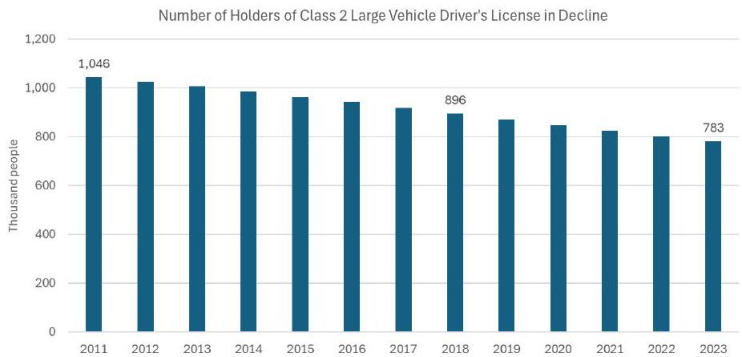
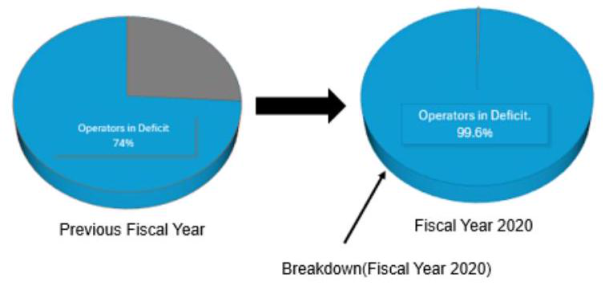
Due to the concentration of population in urban areas, maintaining regional transportation has become increasingly difficult. Especially, in the field of transportation, the bus driver shortage has become a social issue, particularly escalating in rural areas due to the labour shortage outside of urban regions. Fig. 1 shows the tendency of decrease of the number of drivers who have class 2 large motor vehicle license in Japan. In Japan, those who drive bus as commercial service need to hold class 2 large motor vehicle licence. In addition, the percentage of bus operators with general route bus business in
deficit is about 99.6% in 2020 in Japan as shown in Fig. 2. This means that bus operators cannot afford to hire extra bus drivers. These problem results in the decreased number of buses and the suspended operation for bus public transportation.
In order to solve these issues, Level 4 automated buses are expected. One of the key advantages of Level 4 automated buses is their potential for unmanned operation. To realize no drivers on a bus, remote surveillance is mandatory. In typical situations, the tasks of the remote surveillance for level 4 automated bus service are sorely to only passenger safety because the level 4 system can manage the controlling the bus. Hence, in trouble situations, the remote surveillance needs to handle the different tasks. For the introduction of level 4 automated bus service, the necessary tasks in both typical and emergency situations should be clear and the responses for these tasks should be defined. We already investigated the tasks typically performed by bus drivers by observing their actions from when a passenger boards and analysed the task by using bowtie analysis in 16th International Conference on Applied Human Factors and Ergonomics. The planned course for L4 automated bus is almost same as the commercialized one. With the results, we discussed with bus driver and bus operation company about how to respond these tasks by considering the role, user acceptance and feasibility of the bus service because these three points should be considered for the introduction of automated bus service. In addition, the responses should be discussed with not only engineers in automated vehicles but also real bus driver and bus operation company staff. It is highly expected that these results and knowledge are important and beneficial for companies and local governments who would like to consider the introduction of level 4 automated bus services.
Figure 1: Tendency of decrease of the number of holders of class 2 large vehicle driver’s license in Japan from 2011 to 2023.
Investigation and Analysis of Necessary Tasks and Responses 461
Figure 2: Percentages of bus operators with general route bus business in deficit in 2019 and 2020.
CURRENT FUNCTIONALITY OVERVIEW FOR SYSTEM DEVELOPMENT The service and regulatory requirements to ensure that the system requirements are adequately satisfied were summarized in Table 1.
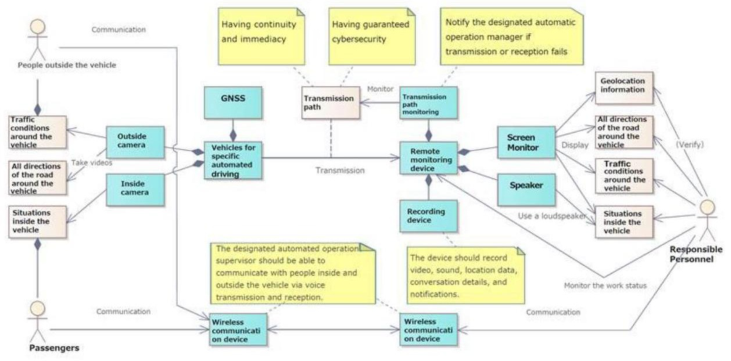
The remote and operation system were organized to meet regulatory requirements, and Fig. 3 illustrated one example in a diagram. In the future, whether these regulatory requirements are met will need to be discussed with relevant government agencies after the construction of the automated system.
Table 1: Summarized to ensure that the system satisfied requirements of service and role in Japan
Table available in the original PDF paper.
COMPILATION OF INTERVIEWS AND RESPONSES FROM TRANSPORTATION OPERATORS REGARDING SYSTEM THAT MEET REGULATORY REQUIREMENTS Based on the previously compiled task list for bus drivers, responses from the bus operator regarding the tasks anticipated in their service were summarized.
From these responses, we have organized the driver tasks that require automation as current plan in 2024.
Figure 3: Proposed system diagram based on regulatory requirements.
Crew tasks based on “Certainty Level” for consideration were classified.
Requires Investigation and Consideration Tasks that require examination of social background and operational constraints of transportation operators, such as the feasibility of installing cameras at major intersections as infrastructure, and tasks that need investigation into technical feasibility and reliability.
Requires Confirmation from Equipment Manufacturers Tasks that are considered to have a low difficulty of implementation but require confirmation from manufacturers regarding their support.
High Certainty Level Tasks for which it is currently clear whether the system or personnel of the transportation operator will handle them.
# Tasks requiring investigation and consideration.
The following three points require investigation and consideration.
Necessity of response Assisting wheelchair users, stroller users, and visually impaired passengers with boarding and alighting requires human assistance and is a task that conflicts with automation. At this stage, it is considered difficult to implement, so further consideration is necessary. Regarding last-minute boarding or alighting requests after the doors have closed, if the stop button is pressed before departure, the doors can be opened. This also requires further consideration.
Status of equipment (including infrastructure) installation Once the final infrastructure is determined, the utilization methods must be updated accordingly.
Investigation and Analysis of Necessary Tasks and Responses 463
Technical feasibility The presence of passengers waiting at stops and the determination of whether a bus has passed a stop require further investigation regarding feasibility and reliability.
# Tasks Requiring Confirmation from Equipment Manufacturers.
It is necessary to confirm the following three points.
Fare collection It is necessary to confirm whether it is possible to install and operate unmanned gates like those used in railways, and whether it can be realized reasonably considering the cost.
In-vehicle announcements Automatic announcements can be implemented by transportation operators determining the timing and frequency, but functionality and performance must be confirmed.
Confirmation of passengers inside the bus – Safety status To ensure that the maximum capacity is not exceeded, it is necessary to determine the number of passengers boarding and alighting. Although this is already possible with commercially available systems, further confirmation is required. – Safety status It is necessary to confirm whether it is possible to automate the verification of the status near the doors during opening/closing, passenger seating, and standing passengers holding onto handrails to ensure safe departure. – Hazardous incidents It is necessary to confirm whether it is possible to automate the detection of passenger movement inside the vehicle during operation, vehicles passing alongside during alighting, and pinching during door closing.
# High Certainty Tasks The following are tasks with a high certainty level, where either the system or personnel will handle them.
Response by system The system automatically announces. For example, the system announces in order to confirm if there is anyone who still needs to get off.
Response by human operator
Response on-site: In case of on-site measures, for vehicle damage such as glass breakage due to flying stones that the system may not detect, passengers should press the emergency stop button or let remote operator knows the situation. After that, onsite responsible personnel will go there and handle the situation. For incidents that the system can detect, such as
fare box malfunctions or door failures, onsite responsible personnel need to respond based on system detection.
Remote operator communicates with passengers individually When, if they are unable to pay the fare due to insufficient IC card balance or lack of cash, the remote operator and the passenger will discuss and arrange for the passenger to pay the outstanding amount next time.
Passenger guidance When a responsible personnel guide passenger after MRM, the remote operator initially response for reducing anxiety of passenger. Once the on-site responsible personnel arrive, they will safely guide the passenger.
CONCLUSION
This paper proposed the responses of responsible personnel for the introduction of level 4 automated buses. The role, user acceptance and feasibility were considered by discussing with bus driver and bus operation staff for proposing the responses. Although it has not yet received official Level 4 certification in Japan, we believe that the organization of the proposal results is valuable for the development of a system that complies with the required specifications in the future.
As future work, we will proceed the introduction of remote monitoring and operation system with a bus operation company.
ACKNOWLEDGMENT
This research has been supported by the Ministry of Economy Trade and Industry in Japan.
REFERENCES
A. A. Dakare, Y. Wu, N. Hashimoto, T. Kumagai, T. Miura, “Fall Detection Inside An Autonomous Driving Bus:-Examination of Image Processing Algorithms”, 2023 IEEE International Conference on Consumer Electronics (ICCE), 1–4. D. Li, L. Cui, “Study on Flight Risk Assessment Method Based on Bow-Tie and
Bayesian Networks,” 2020 International Conference on Urban Engineering and Management Science (ICUEMS), 2020, pp. 736–739. Federal Transit Administration, Safety Performance Targets Guide, Public Transportation Agency Safety Plan Regulation (49 CFR Part 673), Version 2 (June 2021). General guidance and supervision implementation manual (in Japanese), https://www.mlit.go.jp/jidosha/anzen/03safety/resourse/data/bus_honpen.pdf, accessed on 15th April 2024. H. Shi, Y. Y. Lu, “Analyzing bowtie structures by a vertical mode expansion method,” 2017 IEEE International Conference on Computational Electromagnetics (ICCEM), 2017, pp. 282–283. Japan plans new driver’s license system for elderly as accidents surge, https://www.japantimes.co.jp/news/2019/06/11/national/japan-plans-new-driver s-license-system-elderly-accidents-surge/, accessed on 15th April 2024.
Investigation and Analysis of Necessary Tasks and Responses 465
Ministry of Land Infrastructure of Transportation and Tourism in Japan: Report on Current status of local transportation, https://www.mlit.go.jp/policy/shingikai/content/001612741.pdf, accessed on May 9th 2025. Ministry of Land Infrastructure of Transportation and Tourism in Japan: Report on Regarding the demonstration experiments and practical implementation of autonomous driving, https://www.mlit.go.jp/report/press/jidosha07_hh_000504.html, accessed on May 9th 2025. Ministry of Land, Infrastructure and Transport “Process Safety (in Japanese)”, https://www.mlit.go.jp/maritime/content/001412558.pdf, accessed on 15th April 2024. N. Hashimoto, W. Yanbin, M. Masuda, Analysis of Bus Driver Actions for
Development of Automated Bus Passenger Safety System - Bowtie Analysis-, the 16th International Conference on Applied Human Factors and Ergonomics, 2024. Road to the L4 website, https://www.road-to-the-14.go.jp/activity/guideline/, accessed on May 9th 2025. TDB report: Nationwide “major route bus” operation status survey, 2023. United Nations (2019), World Population Ageing. Van Nunen Karolien, Swuste Paul, Reniers Genserik et al., “Improving Pallet Mover Safety in the Manufacturing Industry: A Bow-Tie Analysis of Accident Scenarios”, Materials, vol. 11, no. 10, 2018. Vehicle Standard (Australian Design Rule 68/00 - Occupant Protection in Buses)
2006. Y. Wu, N. Konishi, K. Kihara, M. Kimura, Y. Takeda, N. Hashimoto, “Passenger’s Preference on Internal Interface Design in Automated Buses: A Survey”, Proceedings of the 15th International Conference on Automotive User Interface, 2023.
LISTED IN THE AHFE DIGITAL BOOKSTORE CATALOGUE
Explore the complete digital volume
Advances in Human Factors of Transportation
Read this individual research paper free through the original publisher, or explore the full digital proceedings book.
ISBN 978-1-964867-62-5
Explore this ISBN in the AHFE Bookstore ↗Listed in the July 2026 bookstore catalogue; search by ISBN to confirm current availability · Digital book purchase optional