Graduate School of Communication Arts and Management Innovation, National, Institute of Development Administration, 148 SeriThai Rd., Klong-chan, Bangkapi, Bangkok 10240, Thailand ↗
Virtual reality (VR) gaming has seen significant advancements in immersive technologies, yet many current systems still rely on handheld controllers that limit full-body interaction and realistic tactile feedback. This paper presents an enhanced version of the Haptic Gamer Suit (H-Suit), a wearable haptic feedback system designed to improve user immersion in VR environments. The upgraded H-Suit features advanced actuators for precise tactile feedback, as well as smart textiles embedded with sensors for pressure, temperature, and motion to provide real-time environmental responses. Key innovations include an expanded glove interface with additional buttons and motion sensors, enabling more intuitive interactions and seamless integration with AR/VR smartglasses for gesture recognition and real-time visual feedback. The enhanced H-Suit offers a comprehensive, full-body sensory experience, bridging the interaction gap between the physical and digital worlds and enhancing the overall immersion and emotional resonance of VR gaming. This work represents a step in the development of wearable haptic technologies for next-generation virtual reality and extended reality (XR) applications.
Virtual reality (VR) gaming has emerged as a dynamic domain within the broader spectrum of immersive technologies, offering users the ability to engage with computer-generated environments through audiovisual and interactive stimuli. While the integration of advanced graphics and spatial audio has significantly increased realism, the role of tactile feedback—or haptics (Maimani and Roudaut, 2017)—remains a crucial component in delivering fully embodied experiences.
Haptic feedback technologies aim to simulate the sense of touch using mechanical stimuli such as vibration, force, or motion (Hildebrandt et al., 2023). In the context of VR gaming, haptics is employed to provide users with sensory cues that mimic physical interactions—grabbing objects, feeling textures, or experiencing impact. Existing haptic systems are often divided into handheld controllers, glove-based interfaces (Tong et al., 2025), and full-body suits, each with varying degrees of immersion and user interaction (Bouzbib et al., 2024).
Enhancing Virtual Reality Gaming Through Wearable Haptic Feedback 19
Handheld VR controllers, such as those offered by Oculus Quest or PlayStation VR, utilize vibration motors and limited gesture recognition. While these devices are widespread and relatively affordable, they limit full-body interaction and realistic tactile feedback.
To address these limitations, researchers have explored wearable haptic devices that align more closely with the body’s natural movement. Projects such as the Teslasuit (Hepp et al., 2023), HaptX Gloves (Perret and Poorten, 2018), and bHaptics TactSuit (Schmücker et al., 2023) have demonstrated the feasibility of combining tactile feedback with motion capture, temperature modulation, and spatial awareness.
Despite these advancements, several limitations remain, including:
Lack of interoperability with AR/VR smartglasses.
Limited modularity and customization.
High cost and bulkiness.
Reduced comfort during long gaming sessions.
Minimal integration of environmental sensing (e.g., pressure or temperature).
VR GAMING THROUGH WEARABLE HAPTIC FEEDBACK Despite rapid technological progress in VR graphics, motion tracking, and spatial audio, many commercial VR systems still rely predominantly on handheld controllers as the primary mode of interaction (Kang et al., 2023). While effective for basic navigation and gameplay, these controllers present several limitations: they restrict natural full-body movement, reduce the sense of realism, and limit tactile feedback, all of which can detract from the overall immersive experience.
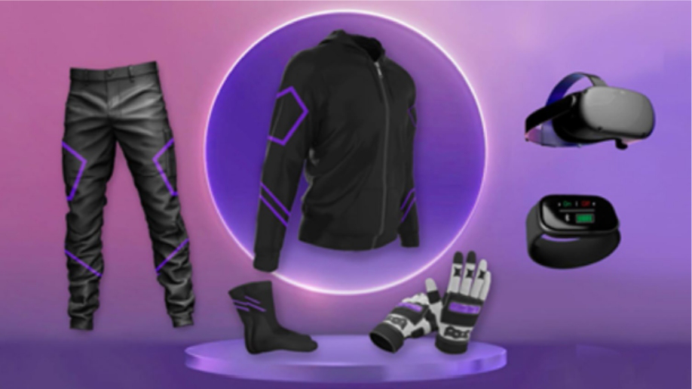
Figure 1: Our existing haptic gamer Suit (H-Suit) was presented in (Saladtook et al., 2025).
20 Kerdvibulvech
To address these shortcomings, prior work introduced the Haptic Gamer Suit (H-Suit) (Saladtook et al., 2025), a wearable system designed to enrich VR gameplay by incorporating body-based haptic feedback, as shown in Figure 1. Developed through interdisciplinary research in human-computer interaction, cognitive ergonomics, and virtual environment design, the original H-Suit included five main components—jacket, pants, belt, gloves, and socks—interfaced with a VR headset to provide localized tactile stimuli. While the initial version demonstrated promising improvements in user immersion and interaction, it featured a limited set of VR functionalities and a glove interface that constrained complex hand-based inputs.
Table 1: Comparison between existing systems and our presented work.
Table available in the original PDF paper.
System/Project Components Haptic Smartglass
Sensors Strengths Limitations
Feedback Integration
Included
Suit + Gloves Electro-
No Motion, Full-body
High cost,
Teslasuit
Temperature
(Hepp et al., 2023)
stimulation, Vibration
coverage, biometrics
Gloves only Microfluidic
No Pressure, Precise tactile
Not scalable
complex setup HaptX Gloves
pressure
Position feedback
(Perret and Poorten, 2018) Vest,
Vibration Limited (via Basic
Affordable, No gloves or
for full-body use Haptics
PC)
Arm/Face Gear
positional sensors
gaming integrations
TactSuit (Schmücker et al., 2023) Suit + Gloves
Vibration, Yes (AR/VR
Pressure, Full
Prototype
advanced control interfaces Proposed
smartglasses)
H-Suit
Force Feedback
Motion, Temperature
+ Belt + Socks + Glasses Interface
integration. glove interactivity. modular
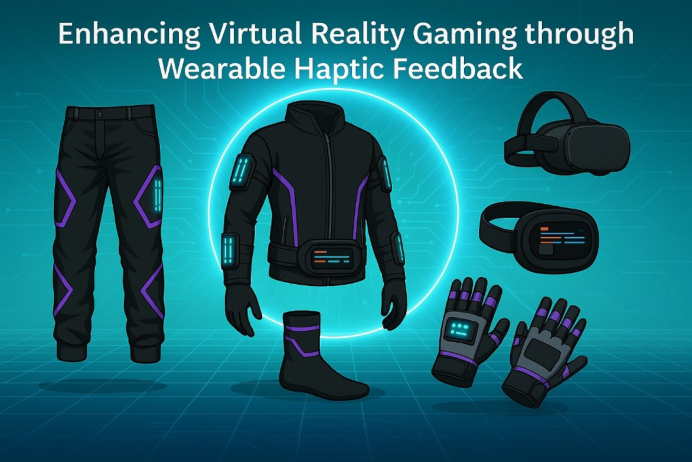
phase. further testing needed In this paper, we present an enhancement to the H-Suit prototype, expanding its capabilities as a comprehensive, full-body haptic feedback system tailored for next-generation VR gaming, as illustrated in Figure 2. The newly upgraded H-Suit incorporates advanced actuators for more precise and dynamic tactile feedback, as well as smart textiles embedded with pressure, temperature, and motion sensors to enable real-time environmental responsiveness. One of the core upgrades lies in the glove interface, inspired by (Chauvette et al., 2024), which now includes an extended array of buttons and motion sensors, enabling more intuitive and expressive interactions with virtual objects. These gloves also feature seamless integration with AR/VR smartglasses, allowing users to manipulate virtual content through gesture recognition and real-time visual feedback. Table 1 compares prominent haptic systems used in VR gaming with the proposed Enhanced H-Suit.
By offering a more holistic sensory experience, the enhanced H-Suit closes the interaction gap between the physical and digital worlds, allowing users to feel, respond to, and interact with virtual environments in a more natural and emotionally resonant way. This work not only advances the field of wearable haptics but also underscores the growing importance of embodied interaction in shaping the future of immersive gaming and extended reality (XR) applications.
Handheld VR controllers typically use vibrations and limited gesture recognition to simulate physical interactions. While these methods provide
Enhancing Virtual Reality Gaming Through Wearable Haptic Feedback 21
some tactile sensation, they fail to offer the full range of sensory feedback needed for a truly immersive experience. Haptic technology, which involves simulating the sense of touch using forces, vibrations, or motions, offers a promising solution to this limitation. Prior research in this field has developed various wearable prototypes, including gloves, vests, and full suits, but these often lack interoperability, scalability, or adequate VR feature integration.
Figure 2: Our new prototype enhances VR gaming through wearable haptic feedback.
The H-Suit concept was originally introduced as a modular haptic feedback system aimed at synchronizing with VR gameplay. In this extended research, we enhance the H-Suit by incorporating additional VR features, optimizing sensory mapping, and ensuring real-time responsiveness across all wearable components. Special focus is given to the redesign of the gloves, which now include multiple interactive buttons and sensor nodes that interface directly with smartglasses for in-game actions and augmented input capabilities.
SYSTEM ARCHITECTURE The enhanced Haptic Gamer Suit (H-Suit) has been redesigned as a fully integrated, modular haptic feedback system that responds to a wide range of virtual stimuli and player actions in real time. This section describes the major components of the system and how they function together to create a seamless immersive experience.
22 Kerdvibulvech
Smart Gloves The smart gloves serve as the primary interface for user interaction within the VR environment. Each glove is embedded with a network of pressure- sensitive but-tons strategically positioned on the fingers, palm, and dorsal side of the hand. These tactile buttons allow users to perform fine-grained control actions, such as grasping, pulling, and menu navigation. The gloves also include flexible motion sensors and inertial measurement units (IMUs) to detect hand orientation, gestures, and finger movements with high accuracy. All sensing and actuation components are layered within stretchable, breathable textiles to maintain ergonomic comfort. A key innovation in this generation of the H-Suit is the Bluetooth integration with AR/VR smartglasses, which enables real-time gesture-based interaction with virtual elements without requiring separate handheld controllers.
Full-Body Suit The core suit comprises modular garments—jacket, pants, and embedded actuator zones—designed to target major muscle groups. The full-body suit is equipped with an array of vibration motors and force feedback actuators, providing dynamic tactile responses such as directional impact feedback, body hits, environmental texture sensations, and even wind simulation. Embedded orientation sensors track user posture and body movement, allowing the system to adapt haptic feedback based on virtual interactions and terrain. This component ensures a high degree of spatial awareness, facilitating synchronized feedback across the body for immersive game-play experiences.
Haptic Footwear Each shoe integrates pressure sensors, force actuators, and terrain simulation elements that respond to various surface types (e.g., gravel, sand, water). The sensors detect foot pressure distribution and motion, enabling realistic replication of loco-motion and physical strain. The actuators deliver localized haptic cues such as vibration intensity or resistance to simulate effects like running uphill or stepping on a hard object. This adds a critical dimension to immersive movement within the VR space.
Smart Belt Module Functioning as the system’s central processing and communication hub, the smart belt module gathers data from all connected components and relays commands to the actuators. It includes a lightweight embedded processor that performs real-time signal processing and synchronization, ensuring low- latency feedback delivery. The module communicates wirelessly with the VR headset or gaming system using Wi-Fi or a dedicated low-latency VR communication protocol, maintaining system modularity and reducing cable clutter.
Enhancing Virtual Reality Gaming Through Wearable Haptic Feedback 23
Smartglasses Interface The final key component is the direct integration with AR/VR smartglasses, which creates a unified interface for input and feedback. By linking the smart gloves to smartglasses via Bluetooth or proprietary protocols, users can interact with virtual objects through gesture recognition and spatial input, enhancing the precision and intuitiveness of the experience. The smartglasses also serve as a visual display unit, allowing for augmented overlays, in-game menus, and immersive HUD (Heads-Up Display) experiences to be controlled via haptic gestures.
DISCUSSION
The enhanced H-Suit prototype introduces several significant improvements in the domain of VR gaming, with a particular focus on embodied interaction, modular wearability, and real-time haptic responsiveness. In this section, we reflect on the potential impact of the proposed system and compare its performance against existing VR haptic technologies.
Advancing Immersive Interaction One of the primary goals of VR is to blur the boundary between the virtual and physical worlds. Traditional systems relying solely on handheld controllers fall short in simulating full-body interaction and the natural engagement of users’ limbs and gestures. The H-Suit’s comprehensive design allows for more holistic sensory integration, where movement, tactile feedback, and gesture control occur seamlessly. This has implications beyond gaming—applications in physical therapy, virtual training, and remote collaboration may benefit from such a multi-sensory platform.
System Responsiveness and Modularity A key strength of the H-Suit lies in its real-time responsiveness and distributed architecture. By decentralizing the sensor-actuator logic across the body and integrating a smart belt as the core processing unit, the system minimizes latency and ensures synchronized responses to virtual stimuli. This makes it adaptable for various game genres, from fast-paced action to puzzle-solving and exploration. Furthermore, the modular nature of the suit—comprising detachable gloves, suit pieces, footwear, and optional smartglasses—supports scalability and customization based on user preferences or application needs.
Comparative Strengths and Limitations Compared to leading haptic systems like Teslasuit or HaptX, the H-Suit stands out due to its integrated smartglasses interface, multi-sensory capabilities (including temperature and pressure sensing), and its user- friendly modular design. While systems like HaptX provide highly accurate touch replication at the hand level, they lack the full-body immersion or AR/VR synchronization offered by the H-Suit. However, the current version remains in the prototype stage, with certain areas requiring further
24 Kerdvibulvech
refinement—particularly in optimizing energy consumption, enhancing battery life, and expanding software compatibility with major VR platforms.
By building upon the current prototype, the H-Suit has the potential to redefine standards for immersive and embodied VR experiences, pushing the boundaries of how users interact with and feel virtual environments.
CONCLUSION AND FUTURE WORK This paper demonstrates the potential of wearable haptic feedback to enhance virtual reality gaming beyond the limitations of traditional controllers. The integration of smart gloves, a full-body suit, and direct smartglasses interaction creates a more immersive, responsive, and emotionally engaging gaming experience. Future work will explore miniaturization of components, extended battery life, and machine learning integration for adaptive haptic responses. Moreover, collaboration with game developers will be crucial to designing VR content that fully leverages the capabilities of the H-Suit system.
The success of this research indicates a promising direction for the evolution of VR gaming, where full-body interaction and realistic feedback become standard components of digital play.
REFERENCES
Ahmed Al Maimani, Anne Roudaut: Frozen Suit: Designing a Changeable Stiffness Suit and its Application to Haptic Games. CHI 2017: 2440–2448. Carl Hildebrandt, Wen Ying, Seongkook Heo, Sebastian G. Elbaum: Mimicking Real
Forces on a Drone Through a Haptic Suit to Enable Cost-Effective Validation. ICRA 2023: 10518–10524. Dae Seok Kang, Chang-Gyu Lee, Ohung Kwon: Pneumatic and acoustic suit: Multimodal haptic suit for enhanced virtual reality simulation. Virtual Real. 27(3): 1647–1669 (2023). Elodie Bouzbib, Marc Teyssier, Thomas Howard, Claudio Pacchierotti, Anatole
Lécuyer: PalmEx: Adding Palmar Force-Feedback for 3D Manipulation With Haptic Exoskeleton Gloves. IEEE Trans. Vis. Comput. Graph. 30(7): 3973–3980 (2024). J. Perret and E. Vander Poorten, “Touching Virtual Reality: A Review of Haptic Gloves,” ACTUATOR 2018; 16th International Conference on New Actuators, Bremen, Germany, 2018, pp. 1–5. Jacob Hepp, Michael Shiraishi, Michelle Tran, Emmy Henson, Mira Ananthanarayanan, Rahul Soangra: Exploring Teslasuit’s Potential in Detecting Sequential Slip-Induced Kinematic Changes among Healthy Young Adults. Sensors 23(14): 6258 (2023). Loonan Chauvette, Éliane Leprohon, Louis-Philippe Perron-Houle, Valentin Pintat,
Aidin Delnavaz, Jérémie Voix, Andréanne Sharp: Multichannel Vibrotactile Glove: Vali-dation of a New Device Designed to Sense Vibrations. IEEE Trans. Haptics 17(4): 913–923 (2024). Qianqian Tong, Wenxuan Wei, Yuan Guo, Tianhao Jin, Ziqi Wang, Hongxing Zhang, Yuru Zhang, Dangxiao Wang: Distant Handshakes: Conveying Social Intentions Through Multi-Modal Soft Haptic Gloves. IEEE Trans. Affect. Comput. 16(1): 423–437 (2025).
Enhancing Virtual Reality Gaming Through Wearable Haptic Feedback 25
Saladtook, S., Rujirotthamrong, P., Eiwaroon, C. et al. Haptic Gamer Suit for Enhancing VR Games Experience. Augment Hum Res 10, 6 (2025). https:// doi.org/10.1007/s41133-024-00079-3 Schmücker, Vanessa, Jakob, Rebekka, Grensing, Florian, Brück, Rainer and Eiler,
Tanja. “Extension of an Existing VR Memory Training with Haptic Impressions due to a Haptic Vest” Current Directions in Biomedical Engineering, vol. 9, no. 1, 2023, pp. 186–189. https://doi.org/10.1515/cdbme-2023-1047
LISTED IN THE AHFE DIGITAL BOOKSTORE CATALOGUE
Explore the complete digital volume
Metaverse, Virtual Environments and Game Design
Read this individual research paper free through the original publisher, or explore the full digital proceedings book.
ISBN 978-1-964867-54-0
Explore this ISBN in the AHFE Bookstore ↗Listed in the July 2026 bookstore catalogue; search by ISBN to confirm current availability · Digital book purchase optional