UX Design has been consolidated over the last thirty years around the development of interfaces for digital technologies such as computers and smartphones. Techniques, heuristics, and concepts created for the development of interfaces by pioneers like Don Norman and Jakob Nielsen (Norman, 1998; Nielsen, 2024), and Robert Reimann (Reimann et al. 2014), have evolved towards experiences related to the devices mentioned above. The emergence of the Extended Reality (XR) market (Hillmann, 2021) has led designers to encounter the limits of processes and conceptualization techniques aimed at 2D technologies. As an emerging technology, XR is a great promise in various areas such as education, health, industry, and entertainment (Chuah, 2018). XR devices are in a phase of transformation and experimentation where fundamental UX definitions, such as affordance, usability, interactions, and other topics, are not yet consolidated. There is a lack of UX design processes (Santos et al. 2024) that consider intrinsic aspects like users' spatial behaviors, the use of spatial dimensions for object manipulation, and the development of contextualized interactions for user experiences. The article discusses the limitations identified by designers and researchers in the development of XR applications and the strategies created by them to build interactions and 3D interfaces based on the study of two research cases. Conclusively, the article seeks to raise the debate about updating and renewing UX design processes considering the consolidation of new technological platforms, such as extended reality devices, while sharing with the academic audience some successful explorations carried out at our institute.
The emerging Extended Reality (XR) platform still needs to overcome certain market bubbles to present consistent use cases to users. Recent studies (Nilsson et al., 2006; Santos et al., 2024; Santos et al., 2023; Pimentel et al., 2023) demonstrate the persistence of market difficulties in offering coherent experiences to users, allowing them to adapt the technology to their daily tasks, as repeatedly reported by technology evangelists, but not very efficient in users’ real lives. There is still a vast horizon of discoveries to be explored regarding the creation of graphical interfaces, and the challenge of user experience design lies in developing better interaction methods in immersive environments (Santos et al., 2024), to convince users of the value of Mixed Reality experiences in everyday use scenarios. The Mixed Reality
UX Design for XR Experiences: Creating Interactions in Three Dimensions 477 (MR) platforms offer a variety of innovations compared to common digital platforms such as smartphones and personal computers. They bring new forms of interaction with objects, new auditory and visual elements, and voice commands to the user experience. These differences create an open field for explorations focused on understanding the spatial and interactive aspects of the experience.
The XR market seeks to expand by proposing new use cases for applications and devices, particularly in scenarios such as remote work and household tasks, where the consumption of Head-Mounted Displays (HMDs) and applications is not yet consolidated. As demonstrated by the Beyond Reality report conducted among American families (National Research Reality, 2022) regarding the user population profile and the ways in which HMDs are used by this population. The study shows that interest in this technology is already established among American consumers, although they have not yet conceived ways to use their HMDs outside of gaming situations. From our perspective, this context demonstrates that UX Design still needs to develop practices and processes that enable the advancement of these technologies in a user-centered manner (Hillman, 2021).
The article presents a discussion of research that aimed to explore users’ relationship with the real environment to verify the rituals present in the daily routine of object manipulation and activity execution, as well as the meanings constructed from these relationships. The first case addresses the gestural universe of sewing studio professionals in their work environment, with the objective of observing forms of interaction and direct manipulation with real environments and objects. The second case explores the context of productivity and remote work, aiming to observe different behaviors in the construction of workstations, especially the use of screens and practices for prioritizing activities.
METHODS AND MATERIALS The methodological tools used highlight the importance of qualitative research processes during the discovery phase in the development of digital products. These tools allow us to observe users’ routines and practices in their relationship with the environment, generating fundamental knowledge for the development of experiences in mixed reality platforms.
The first case narrates the study conducted with a focus on the observation and mapping of gestures and forms of interaction performed by professionals in carrying out their activities in sewing workshops. Based on the Double Diamond methodology (Design Council, 2004), we conducted an exploratory process divided into two phases. Initially, through Research Desk (Azarova, 2022; Henriques et al., 2022), we conducted a reference search across various media platforms, followed by visits to local sewing workshops. We developed an encyclopedia of gestures and interfaces to assist designers in conceptualizing new gestures for the immersive experience.
The question used as a starting point for conducting the research in the second case was the analysis of workstations created by people, aiming to map the behavior related to the processes of structuring and organizing
478 Silbermann and Correa individual workspaces. The study was also divided into two phases, the first of which was to carry out an ethnography (Geertz, 1973; Mariampolski, 2006) in work environments, followed by semi-structured interviews (Gil, 2021; Gil, 2002) with individuals recruited on-site. The ethnography initially took place in a controlled corporate environment, in a technology company, and then we sought to expand our references by visiting a less controlled environment organized in the form of coworking. Additionally, we conducted interviews with individuals present in the observed environments to deepen our perception of the axes assisted during the ethnography.
DISCUSSION: LOOKING AT THE USER, SPACE AND THREE- DIMENSIONAL OBJECTS: EXPLORATORY RESEARCH FOR MIXED REALITY EXPERIENCES The experiences in XR have the particularity of offering users interactions with space and three-dimensional objects. This specificity differentiates it from experiences carried out through common screens, such as personal computers (PCs) and smartphones. This emerging technological platform opens a new and wide scope of possibilities to conceptualize the ways in which users interact with three-dimensional objects and occupy immersive spaces, while highlighting the common UX development processes consolidated from the aforementioned technological platforms. We are still in an early stage of development for experiences and products on the mixed reality platform, especially when it comes to the processes and principles of UX used to conceptualize these experiences. As referenced in the introduction, these products have already proven to be valuable for users, particularly in specific areas such as gaming, professional training, and heavy industry (Schmalstieg et al., 2016), where mixed reality offers an economical, comfortable, and precise way for conducting training and learning. However, the XR technology market still faces persistent difficulties in proposing intuitive and meaningful experiences for users in other scenarios, so they can be integrated into the users’ daily life flow.
The proposal of productivity experiments on these devices presents itself as a promise of consumer market expansion and consolidation of this technological platform. In 2021, Meta (Meta, 2025) launched Horizon Workrooms, striving to convince the public that XR devices will soon be a key piece in work dynamics, offering users a greater sense of presence in remote work and the integration of an important layer of virtuality, which would help optimize tasks and enrich the user experience. From our UX perspective, we understand that there is still a vast horizon for process experimentation and the discovery of new principles and heuristics for the construction and evaluation of these experiences. The differential aspects of the XR experience, such as movement and manipulation of virtual objects in a 3D environment, must be a central part of new UX processes, formulated to think about how space is used by users, as well as being completely linked to their behavior.
The exploratory research (Reimann et al., 2014) takes the designer to the field and to invest in the daily lives of users to understand how user behaviors
UX Design for XR Experiences: Creating Interactions in Three Dimensions 479 and habits are built, and from this knowledge, develop relevant products. It is not just a way to create an empathetic relationship between those who develop and conceptualize the user experience, as the research removes epistemological biases by reversing the technological development work, bringing the user’s universe to the center of digital solution development. This process inversion proposed by exploratory research performs a kind of bias removal, shifting the conception of user experience to the perspective of their daily needs and difficulties, rather than looking at the experience through the eyes of those who develop the technology. In the context of developing mixed reality experiences, field research allows us to observe the subjective aspects of user behavior with space and its dimensionality, as well as the affordances and gestures involved in the direct manipulation of real objects.
RESULTS
Case I: Analysis of Work Routines in Workshops: Discovering Gestures for Immersive Experiences This research was developed in the context of a project, which aimed to explore experiences of customization of three-dimensional avatars, reproducing a scenario of production of clothing and accessories for avatars. In the search for interactions which could serve as a reference for the application in immersive reality, we proposed the collection of data on the work routine in sewing workshops and architectural offices on the manual gestures and tools used by these professionals. The collected data and analyzed material were presented in full at the HCI International 2024 Conference (Santos et al., 2024).
The structured methodology for conducting this research combined the search for primary references in media content about routines and workflows present on the internet, collected through Desk Research (Azarova, 2022; Gil, 2021), complemented by visits to workplaces such as sewing studios. The objective was to build a kind of compendium of gestures and interactions, highlighting how these professional activities involve a variety of physical gestures and how these gestures and interactions are inserted in practical contexts of these professionals.
We elaborate a list of professional profiles linked to creative activities that use tools. Such as the direct handling of tools like brushes and pens. In this context, we selected reference images to develop an analysis of the environments and gestures used. The analysis allowed us to identify a wide range of manual gestures and modes of interaction between the professionals in question, the environment and the objects with which they interact. We developed an analytical process to develop XR interactions based on the following steps: We highlighted the gestures and movements performed by professionals in carrying out activities in the environment and using their tools, identified the structure and arrangement of furniture and objects in the scene, related these interactions to the moment and the tool used, and grouped the interactions into two moments, Creative Phase and Preparation Phase for future proposition of interactions for XR experiences. By observing the professionals in action, we identified a set of interactions and forms of direct manipulation:
480 Silbermann and Correa When pressing pens or brushes against a surface, the professional creates a drawing. The act of drawing can be performed using tools such as pencils, papers, and erasers directly. In the combination of movements to manipulate fabrics, the professional performs various forms of hand manipulation. Holding an object with hands, such as paint pots and spatulas, can also be considered a form of interaction that was mapped.
We identify the arrangement of objects and users’ movement in the three axes of the cartesian plane x, y and z. Space is segmented into layers and this reflects how users interact with the environment and surrounding objects. In this context we observe that the X-axis is explored in the use of support surfaces, such as tables, for objects to be distributed. The Y-axis is used as a concentration zone for devices and elements that users use in creative phases, such as tablets and smartphones. Finally, the Z-axis, represents the depth layer of the experience, where are positioned objects in which the user wants to keep the focus, such as computer and monitor. Our next step was to categorize the spaces by the type of activity that is carried out in it we divided them into three categories: a) Creative space, used for processes that involved essentially processes that sought to explore the creative capacity of the professional; b) Creative and practical space, this type is focused on collective creation activities accompanied by the production of pieces; c) Practical space, this model of space is focused on the production or adjustment of parts.
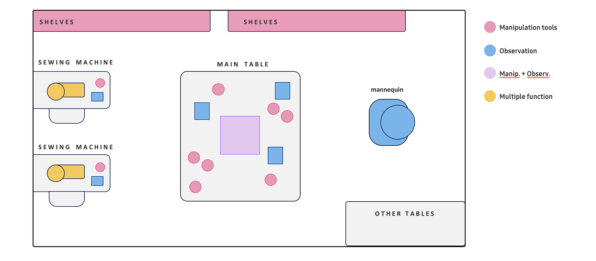
Based on the previous analysis we built a generic layout, a wireframe of immersive scenes, which works as a tool to relate the activities performed with the immersive space. This tool is important to help in the conceptualization of types of direct interaction with three-dimensional objects with the movement that the user will do in the immersive environment. This tool is inserted below and identifies points of the environment relating them to the type of interaction that is carried out. Marked in pink we can see the places where professionals find materials such as papers and fabrics and use direct manipulation tools such as scissors, pens, brushes and measuring tapes. In blue, are marked the places where the main activity is observation as tables where there is the presence of panels and references or the space dedicated to the mannequin. The space marked in lilac refers to places that merge two activities such as tool handling and observation. Finally, the space marked in yellow reveals locations that fulfil multiple functions.
UX Design for XR Experiences: Creating Interactions in Three Dimensions 481 We divided the professionals’ journey into two phases composed by different interactions and different work instruments. The first phase, called Creative Phase, involves the initial process of professionals where the main activity is to exercise creativity through the search for references and materials for the construction of an idea. At this time the professional performs activities related to painting, drawing, grouping materials using tools such as brushes, pens, and tapes. The second phase of the professional’s journey is a phase that we call the Making Phase, the moment when the professional sews the models designed, in this phase the person uses new gestures and materials different from the first phase such as fabrics, scissors, and needles. From the division of the professionals’ journey, we were able to list a set of verbs and specific gestures for each of these phases to determine the forms of direct manipulation involved and which tools were used.
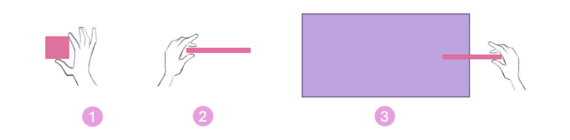
As a result of all the exploratory process carried out, we have made sketches of the gestures related to the activities mapped for the immersive experience. In the context of the project our main reference was Meta Quest 2 (Meta, 2025), so it was necessary that the gestures drawn pass through the applicability assessment based on the direct manipulation gestures described in the Meta documentation (Meta, 2025) to verify the possibility of application of such in the immersive experience. As an example of the interactions drawn, we can cite the selection of tools, an action performed with the hands to select one or more objects, can be carried out through the interaction of Grab or Pinch. The Pinch is a gesture performed by joining the index finger to the thumb, usually used to “hold” or select small or thin objects. The Grab refers to the gesture of holding with all fingers a larger object, such as paint pots. When selecting a tool, such as brushes or pens, the user can perform the painting interaction similarly to how it is performed in the real world.
Figure 2: Grab and pinch sketches respectively, in direct object manipulation, and sketch of pinch gesture for performing the painting activity. (Author’s compilation, 2026).
The field research and observations performed played a central role in understanding the experiences from the user’s point of view. The understanding of the stages of the creative process, the activities performed with greater frequency, the objects used and the forms of interaction carried out in real contexts constituted the starting point for the conceptualization of new interactive proposals in the scope of the project. The data collected are therefore fundamental to support decisions within the scope of the project, as they reflect practices and concrete needs of users. Contributing to the construction of meaningful, functional and user-centered experiences.
482 Silbermann and Correa Case II: Ethnography of Workstations: Spatial Behavior Space Models for Immersive Productivity Experiences
The second case of using experimental research for the development of experiences and interactions in mixed reality, presents the structuring of a methodological strategy focused on the relationships between user behavior and three-dimensional space. The research was proposed, which aimed to explore experiences of use in productivity scenarios in search of opportunities for technological solutions that dialogue with the demands for remote work arising during the pandemic (Wu et al., 2024). Forms and workflows are objects commonly studied from ethnographic approaches, we can cite classics such as Paul Willis (1978), José Leite Lopes (2013) and Pierre Bourdieu (1963) to reference studies that have demonstrated how ways of organizing work are traversed by a variety of social and cultural processes, which also constitute the physical gesture and behavior of workers. This approach directs the structuring of this research, which proposed to collect data on how workstations materialize people’s behaviors and are continuously modified according to day-to-day needs. In this case, the specificity proposed by this approach consisted of the observation of the workstations as a space under construction, which overlaps with the functional guidelines of the workflow, personal and collective behaviors, that users find to structure their space and the materiality of technological devices utilized by the worker.
One of the main challenges of this research was to build tools capable of apprehending a wide variety of spatial configurations of productivity and forms of organization of workstations. The initial objective was to observe workers during their working hours, map repeated forms of organization and asking workers to talk about their workstations and how the adequacy of space is related to their personal tastes and purposes relating to their workflow. This research was structured in two moments, marked by the application of an ethnographic process (Oliveira, 1996; Geertz, 1973) and complemented by semi-structured interviews (Gil, 2021). During the research process, we decided to increase the number of places visited, diversifying contexts so that we can compare differences and reduce analytical biases. The ethnographic field built for this research had the overlap of different work environments, such as corporate work in a technology company and a coworking space. This overlapping of environments was necessary to apprehend different forms of work expressed in environments with greater or lesser control over the workers. The ethnography was followed by the application of eight interviews. The in-depth, semi-structured interviews helped us to collect information about behaviors, mental models, values and pain experienced by the participants. During the interviews, we asked participants to bring photographs and images representing their workstations and adaptations made at their station during working hours. From these records we ask that they could explain in depth what motivated the way in which each participant organizes their space and what are the factors that influenced the adaptations carried out.
The result of our field incursions was the production of a set of new concepts aimed at describing how workstations are built through specific forms of behavior and how from these insights we can conceptualize experiences of
UX Design for XR Experiences: Creating Interactions in Three Dimensions 483 productivity for XR devices. We abandon the search for behaviors based on professional profiles to focus on ways of organizing workspaces and consequently deepen in their operational logics and subjective senses built from the experience of productivity. We developed a concept called Spatial Arrangement Behaviors to address the variety of factors that make up the experience of productivity tied to space. These behaviors present different organizational mechanisms, which consider the user’s profile, the types of tasks performed and how the user responds in situations of stability and pressure at work. These Spatial Arrangement Behavior are always mobilized by the users according to the use scenario in which they are involved, but above all demonstrate how space is constituted in productivity scenarios. Understand the existence of these variables helped us in the discovery and development of modes of interaction for the immersive experiences we were designing.
We observed how productivity scenarios are formed by small rituals, in which users perform practices and work methods articulated by physical gestures. The following elements brought because of the research show the importance of practices and rituals of prioritization of activities in daily life, ways of using the spatial axes in this type of experience, use of analog materials to complement the multiscreen experience with attention to the practices of customization of workstations. In this context, we identified the use of the axes X, Y and Z of the Cartesian plane as prioritization layers. In two-dimensional experiences such as the use of smartphones and computers, users interact essentially horizontally and vertically, X and Y axes. In mixed reality experiences, the three axes are explored, counting with the exploration of the Z-axis, which is related to the depth of experience (Santos et al., 2023). The Z-axis is used as a tool to prioritize activities with some urgency. The users use walls and objects at eye level, to draw attention to activities that must be performed urgently, such as having sticky notes on their monitors to avoid forgetting certain activities. The use of analog resources such as notebooks, sticky notes and calendars is involved in users’ prioritization logic becoming an important indicator for building remote work experiences for extended reality products. The study participants’ workstations are occupied by numerous pieces of paper, like sticky notes, notebooks and calendars. More than a material resource the paper is integrated into the users’ gestural vocabulary and participates in their rituals of memorization and prioritization of activities. The use of analog resources works as a means of fixing and controlling information, in addition to building levels of activity prioritization. The sticky notes for example, is used as a reminder that has the power to help the user in remembering some tasks to be performed. One of the interviewed participants, who work as a developer of digital products and uses sticky notes in their daily work stated: “I use stick notes on the monitor. You can see the evolution, because I take them out and crumple them” (Participant 5).
In contexts built around a variety of devices, both analog and digital users end up developing specific forms of transition between different devices. Transitions are fundamental to understand how flows between devices are established by users, as well as reveal how new meanings and functionalities are transformed into use scenarios. This is observed in an interview: “I’m here
484 Silbermann and Correa working and glide, I usually say that I slide between them [the screens], as if they were sheets of paper. (...) I think of these canvases as if I were actually moving from one sheet to another.” (Participant 3). In this context, there are different ways to relate the screens that make up each workstation. Certain hierarchies relate to the screen size, the type of task performed and the user’s main activity. Most users use three or four screens, considering monitors, smartphones, tablets and smartwatches, plus objects like notebooks and calendars to create new layers of attention and priority. The incorporation of physical elements in the participants’ routine is essential beyond digital. Users feel the need to have tactile feedback, whether in the environment, or in the use of physical elements.
As well as the use of personal devices or “noise screens”, that are, screens dedicated to the consumption of music, series and podcasts during work, which fulfill the decompression function in contexts of anxiety and high demand work. Decompression means can be understood not only as resources to relax, but also as a way of activating concentration or inspiring certain activities through music, visual elements or audiovisual resources. According with the idea proposed by Baldry (1997), we realized that users seek ways to build their workstations in a way that they feel comfortable in space. The stations are a space for users to express themselves in the standardized context of corporate work. When we talk about customizing workstations, we are referring to the use of the space to demonstrate personality traits and cultural consumption styles. In this sense, the elements that make up the workstation refer to pop culture figures, musical artists and lifestyles. In another model of customizing stations, users fill the space with elements that recall different moments and people from their life. We identify travel souvenirs, photos of family and friends, as well as gifts offered by co-workers. Such objects have the role of reminding the user about its trajectory in that environment. Other participants understand personalization of their workstations to improve and incorporate the features of work they are currently. Thus, the workstation is composed of elements that reinforce the “mood” of the work to be performed and bring different sensations as a way of dramatizing the experience.
The findings revealed by user-centered exploratory research demonstrate the limits of mixed reality product development carried out solely from a technology point of view. The exploratory research revealed for the elaboration of concepts of UX a level of detail very deep of the experience of use, which oppose the simple virtualization of working environments in 3D scenario. The findings presented here highlight the need for observation and detailing of people’s behavior in space as well as the exploration of spatial axes by users to achieve higher levels of specificity according to each use scenario.
CONCLUSION
In our current context of corporate development, in which the horizon points to trends of automation of design work, investment and dedication to exploratory research processes has become scarce. The article reinforced the relevance of the exploratory approach to the development of user
UX Design for XR Experiences: Creating Interactions in Three Dimensions 485 experiences, especially in the context of emerging technology platforms such as XR. A field still quite limited regarding the consolidation of heuristics and UX parameters focused on users’ needs. The cases presented in this paper brought cases of UX research best practices developed specifically for experiences in XR. The novelty of these cases is in the structured research designs with the objective of collecting insights on fundamental aspects of the experience of using this technological platform, such as the spatial experience of users, with its behavioral bias. The space is built symbolically, elaborating and defining the experience or as forms of manipulation of objects, which can confer greater realism and efficiency to interactions in immersive environments. The process of exploratory research, as well as in our projects, has the potential to help people involved in building applications in extended reality to think the experience through the user’s perspective, beyond the technological bias. Therefore, it is essential to continuously experiment with methods of exploratory research in the recognition of scenarios for the current XR content.
ACKNOWLEDGMENT
This paper was presented as part of the results of the project “SIDIA-M_ VSTPLATFORM_AND_APPLICATIONS”, carried out by the Institute of Science and technology – SIDIA, in partnership with Samsung Eletrônica da Amazônia LTDA, in accordance with the Information Technology Law n.8387/91 and article ate the.39 of Decree 10,521/2020.
REFERENCES
Anton, K.: History of the office. Milan : Faculty of Architecture Politécnico di Milano, 2015. Azarova, M.: Secondary Research in UX. Norman Nielsen Group, 2022. https://
www.nngroup.com/articles/secondary-research-in-ux/. Last accessed 02/02/2025 Baldry, C.: The social construction of office space. International Labour Review, Vol. 136(3), pp. 365–378. Geneva, 1997 Bourdieu, P.: Work and workers in Algeria. Paris : Mouton & Co, 1963. Chuah, S.: Why and Who Will Adopt Extended Reality Technology? Literature
Review, Synthesis, and Future Research Agenda. SSRN. 2018. https://papers.ssrn. com/sol3/papers.cfm?abstract_id=3300469. Last accessed 03/02/2025 Design Council. Framerwork to Innovation. Design Council, 2004. https://www.
designcouncil.org.uk/our-resources/framework-for-innovation/. Last accessed 07/01/2025 Geertz, C.: The Interpretation of Cultures: Selected Essays. New York, Basic Books,
1973. Gil, Antonio C.: How to prepare research projects. s.l. : Atlas, 2002. Gil, Antonio C.: How to conduct qualitative research. s.l. : GEN Atlas, 2021. Vol. I. Henriques, C; Pilar, D; Ignacio, E.: UX Research with a Brazilian Accent: Or about how to conduct user research in Brazil without academic constraints or market mistakes. s.l. : Casa do Código, 2022. Hillman, C.: UX for XR. Berkeley : Apress, 2021. Hine, C.: Ethnography for the Internet: Embedded, Embodied and Everyday. s.l. :
Routledge, 2015.
486 Silbermann and Correa Lopes, J.: Work as viewed by Social Anthropology. Revista Ciências do Trabalho.
2013, Vol. 1. 2013 Mariampolski, H.: Ethnography for markerters A guida to consumer immersion.
California, Sage, 2006. Meta: Learn about Hand and Body Tracking on Meta Quest. 2025. https://www.
meta.com/help/quest/290147772643252/. Last accessed 19/04/2025 Meta: Meta Horizon Workrooms. 2021. https://www.meta.com/pt-br/experiences/ meta-horizon-workrooms-beta/2514011888645651/?srsltid=AfmBOoo5jqnFRy sglQtHk8zP9MS4rUhxkJlVY4LnyLIq5d4ICAA0Psg1. Last accessed 16/02/2025 Meta: Meta Quest 2: Immersive All-In-One VR Headset. 2025. https://www.meta.
com/quest/products/quest-2/?srsltid=AfmBOoqXDNQfGDVpsCU4G5EMmuu6 Yodt7gB4-RCTb2zahNl7t7fA9POO. Last accessed 04/04/2025 Meta: This is Meta Quest. 2025. https://www.meta.com/quest/. Last accessed 02/04/2025 National Research Reality. Beyond Reality: Is the long awaited VR revolution finally
on the horizon? s.l. : National Research Reality, 2022. Nielsen, N.: 10 Usability Heuristics fo User Interface Design. NN/g. 2024. https:// www.nngroup.com/articles/ten-usability-heuristics/. Last accessed 12/03/2025 Nilsson, S; Johansson, B.: User experience and acceptance of a mixed reality system
in a naturalistic setting - a case study. IEEE/ACM International Symposium on Mixed and Augmented Reality (ISMAR). IEEE, 2006 Norman, D.: The Design of Everything. s.l. : Basics Books, 1988. Oliveira, R.: O trabalho do Antropólogo: olhar, ouvir, escrever. Revista de Antropologia. Vol. 39. São Paulo, USP, 1996 Pimentel, F; Inhamuns, Y; Silbermann, M.: Exploring new futures in Video See-
Through: experience-es and scenarios using XR Technologies. HCI International 2023. Vol. 1836, pp. 277–283. Cham, Springer, 2023 Reimann, R; Cronin, D; Noessel, C; Cooper, A.: About Face: The Essentials of Interaction Design. s.l. : Wiley, 2014. Santos, A; Correa, H; Silbermann, M.: Digital ethnography in online mixed reality
(MR) communities: searching new usage scenarios. [ed.] Margherita Antona, et al., HCI International 2023. Vol. 1835, pp. 28–38. Cham, Springer, 2023 Santos, A; Correa, H; Silbermann, M.: UX and UI Fundamentals for Mixed Reality: Research and Categorization of Interactions. HCI International 2023. Vol. 1836, pp. 289–299. Cham, Springer, 2023. Santos, A; Paixão, N; Silbermann, M.: Process of identifying and conceptualizing
gestures for creating experiences of use in mixed reality (XR). HCI International 2024. Vol. 2320, pp. 43–53. 978-3-031-78530-6. Cham, Springer, 2024. Schmalstieg, D; Hollerer, T.: Augmented Reality: Principles and Practice. s.l. : Addison-Wesley Professional, 2016. Shibata, T.: Head Mounted Display. Displays, Vol. 23, pp. 57–64. 2002 United States Census Bureau.: Statistical Abstract of the United States: 1998. United
States Census Bureau. 1998. Willis, P.: Learning to Labour: How Working Class Kids Get Working Class Jobs.
s.l. : Routledge, 1978. Wu, S, Stendal, K; Thapa, D.:Emerging Trends in XR-mediated Virtual Team Collaboration in Digital Workspaces: A Systematic Literature Review. Advances in Information Systems Developement. Vol. 67. Cham, Springer, 2024.
Read this individual research paper free through the original publisher, or explore the full digital proceedings book.
ISBN 979-8-950676-09-3
Explore this ISBN in the AHFE Bookstore ↗Listed in the July 2026 bookstore catalogue; search by ISBN to confirm current availability · Digital book purchase optional