Su Wang, Yuelin Liu, Yue Zhang (2025). Optimization application and user experience evaluation system of knee brace. In: Human Dynamics, Product Evaluation and Quality. AHFE Open Access, vol. 172, pp. 88–99. https://doi.org/10.54941/ahfe1006273
The term UX is usually applied in the software field, but it is also important for the hardware product at present. The construction of the UX evaluation system in the healthcare devices field is not perfect enough, and there is no exclusive, flexible, and universal evaluation system. To enhance and quantify the user experience of knee brace, a comprehensive evaluation system is developed. Specifically, key evaluation indicators for ergonomic performance during use are identified. Subsequently, an evaluation method integrating objective data with subjective feedback is proposed, grounded in human factors experiment, and reality test carried out using three types of knee braces, the results from four objective experiments and subjective evaluations-motion displacement, constraint stabilization force, joint support, and thermal comfort-are combined to assess their strengths and weaknesses and explore the relevance of design elements to user experience indices. Based on it, one knee brace is then selected for optimization application, an improvement scheme is proposed focusing on dynamic stability, patellar stability, joint support, and adjustability, followed by validation of the proposed improvements. Compared to the original design, the evaluation indicators of the improved knee brace show significant enhancement 0.2-0.6 score. The evaluation system effectively assesses and informs the user experience design of knee brace.
The knee joint plays a crucial role in lower limb movement and is the most frequently injured part of the body. Knee braces are commonly used for post-injury, post-operative or injury prevention, play a role in stabilizing, braking, correcting the force line and rehabilitation of wearable medical aids, knee protection products are of various types and forms, due to its complex structure and form are in close contact with the human knee joints, it is necessary to analyse the individual’s joint movement patterns, leg morphology, somatosensory state, etc. It is necessary to analyse from the individual joint movement pattern, leg shape, body feeling state and other aspects to make reasonable planning for the functional structure and shape of knee braces to ensure the ergonomic and comfortable performance of
Optimization Application and User Experience Evaluation System of Knee Brace 89
wearing. Yu (2023) obtained 3D printing personalized fixed brace procedures by constructing logical relationships between the parameter variables of the brace to support the design of the brace morphology and improve the design efficiency; Zhang (2020) used the VICON dimensional motion capture system, the ATMI three-dimensional force measurement table, and the Pedar-X plantar pressure testing system to obtain lower limb motion data, and evaluated the performance of three types of typical knee braces from young people and elderly people, respectively; Duan (2022) utilized three-dimensional forming and weaving technology to design targeted density and elasticity for different protection areas of the knee braces to achieve the functional requirements of different parts. However, the comprehensive evaluation system of knee brace has not yet been constructed from the user experience process to enhance the user experience of the braces, and previous research relies more on the user’s experience and intuition, with a slight lack of objectivity of the data.
Therefore, to establish a user experience evaluation index system for knee brace, and propose a subjective-objective combination of evaluation methods, according the quantitative evaluation results of the three typical knee braces as the research samples, and to explore the correlation between the design elements and the user experience, and then to propose the optimization design scheme further, aiming to provide a reference basis for the design of knee brace.
CONSTRUCTION OF USER EXPERIENCE EVALUATION SYSTEM FOR KNEE BRACE Analysis of User Experience Evaluation Indicators
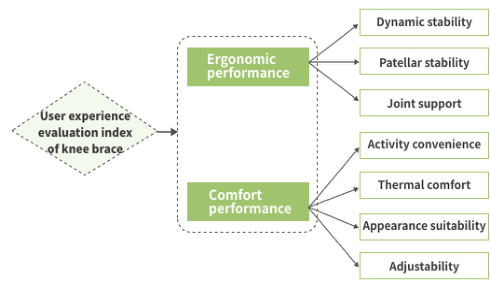
Through 4 rounds of solicitation from a focus group consisting of 8 users, 5 doctors and 5 rehabilitation medical industry experts, and combined with the existing AKS comprehensive knee scoring criteria proposed by The American Knee Society (Caplan and Kader, 2014), including mobility, stability and motor function and other evaluation elements, the knee brace user experience evaluation indexes were determined as shown in Figure 1.
Figure 1: User experience evaluation index of knee brace.
As a functional wearable medical product, knee braces are made of a combination of flexible, semi-rigid and rigid materials, and the impact on user experience is mainly reflected in the ergonomics and comfort performance, of which the ergonomics performance mainly includes the performance of the brace in the execution of strengthening the support of the knee joint part and improving the stability of human movement, involving stability performance and safety performance; the comfort performance mainly includes The comfort performance is mainly the subjective degree of adaptation between the user and the equipment during the use process, including thermal comfort, activity convenience, adjustability and appearance suitability.
Ergonomic Performance. The degree of displacement in both the horizontal and vertical directions of the knee brace have a direct impact on dynamic stability of knee brace. It has been shown that contact pressure improves the relative slip problem of a brace (Gemperle, Kasabach et al., 1998), but this can lead to a significant reduction in the pressure comfort of knee brace; knee brace performs the safety and protection function under the combined effect of restraint pressure and joint support. Flexible-elastic materials provide stabilizing constraining pressure according to the protection needs of different parts of the knee joint to reduce the risk of knee joint loading and ligament injuries; Semi-rigid and rigid materials constrain the range of knee motion angles, stabilize and increase joint impact resistance, enhance the activation and contribution of muscle activity.
Comfort Performance. Knee braces that are improperly sized or weighted can restrict movement, and affect ease of movement, such as brace length, joint fit, and range of motion. Because knee braces are in close contact with the skin, prolonged wear can cause discomfort due to friction and poor breathability. The extent of leg coverage and the breathability of materials influence the micro-environmental temperature, leading to a gradual decrease in comfort as temperatures rise. The primary users of knee brace include elderly individuals with knee degeneration, patients in postoperative rehabilitation, and those requiring daily sports protection. Adjustability is critical for achieving an optimal fit. Additionally, the aesthetic appeal of the product directly impacts long-term comfort and user satisfaction.
User Experience Evaluation Model of Knee Brace The user experience evaluation comprises both subjective and objective experimental evaluations. It can enhance the accuracy and reliability of the overall evaluation system. Given the inherent ambiguity in comprehensively evaluating the user experience of knee brace, a two-level analysis of evaluation indicators is conducted, assessing the weight of each indicator’s impact on the overall evaluation of the knee brace. The expert scoring method is adopted, whereby 20 industry experts score the weights of the evaluation indexes without being interfered with by external factors, and the statistical averaging method is used to calculate the weights of the various indexes (Table 1).
Optimization Application and User Experience Evaluation System of Knee Brace 91
Table 1: Average weights of user experience evaluation metrics for knee brace.
Table available in the original PDF paper.
Level 1 Evaluation Average Weight Level 2 Evaluation Subitem Average Weight Ergonomic performance 0.56 Dynamic stability 0.24 Patellar stability 0.37 Joint support 0.39 Comfort
EVALUATION METHOD OF KNEE BRACE USER EXPERIENCE Objective Evaluation Based on Human Factors Experiment
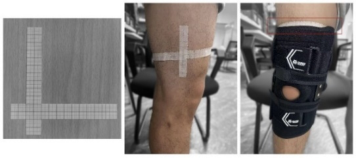
Motion Displacement Experiment. Combining the experimental methods of previous studies (Yu, Cao et al., 2021), a sticker with a 1-mm coordinate grid size scale was designed and firmly pasted on the upper edge of the subject’s brace on the thigh to determine the relative displacement of the brace under the wearer’s locomotion state, as shown in Figure 2. The absolute value of displacement (AVD) data was collected after the subject walked at a constant speed for 20 minutes wearing the brace. The AVD is the average of the absolute value of the difference between the initial and final position of the brace relative to the user’s leg.
Figure 2: Record the position of the sample of the protective gear on the subject’s leg.
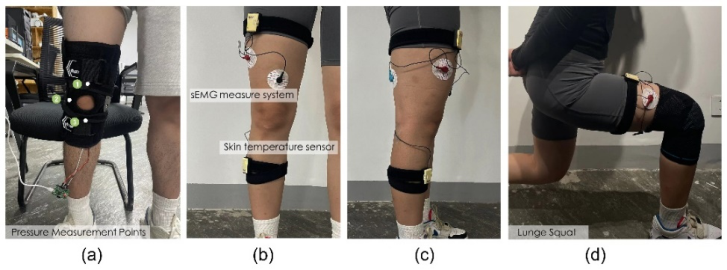
Constraint Stabilization Force Experiment. The constraint and stabilization force of the braces was evaluated by distributed pressure acquisition. The subjects wore three types of braces in standing position, and the pressure sensing component pads were placed at three measurement points between the human skin surface of the subjects’ knee joint and the braces to measure the constraint and stabilization force of the braces on the patella. The pressure values were recorded when they were relatively stable, and each experiment was repeated three times.
Knee Joint Support Experiment. The joint support degree of the knee braces was evaluated by sEMG, which was carried out in the state of not wearing and wearing the control group of braces. The three regional muscles that are highly related to the movement of the knee joint were selected as the test muscles, as shown in Figure 3. The EMG signal data of the relevant muscles of the right lower limb in the state of uniform jogging (5 minutes) and lunge squatting (20 sets) were obtained from the same subjects respectively,
and a total of 4×2 groups were tested. In order to avoid the influence of the wearing order of the protective gear and the experimental results, the wearing order was randomized in each group of experiments, and the subjects were given a rest time between each group of experiments for 15∼30 min.
Microenvironmental Thermal Comfort Experiment. As the microenvironment temperature rises, the comfort level gradually decreases. The skin surface temperature values and elevated values of the three knee braces were measured by skin temperature sensors in the microenvironment before and after the two time periods of the experiment (the experiment was conducted at the same time as the motion displacement experiment), as shown in Figure 3.
Figure 3: The experimental procedure ((a) pressure measurement point acquisition (b) (c) leg muscle electrode sheet paste position (d) sEMG signal acquisition).
Subjective Evaluation After the subjects completed each sample experiment, the experimental staff asked the subjects about their subjective feelings, the subjective evaluation scale of knee brace has 9 questions, Q1Q2 is the basic information, Q3∼Q9 corresponds to the subjective evaluation index. The scoring of subjective evaluation was based on a 5-point system, with a scoring interval of 1 point, and the better the user experience of the knee brace, the higher the score. 3 knee braces were experienced separately, and scored according to their subjective feelings after completing the specified actions. Evaluation method are summarized in Table 2.
Table 2: Evaluation method of knee brace user experience.
Table available in the original PDF paper.
Evaluation Index Evaluative Dimension Experiment Measurement
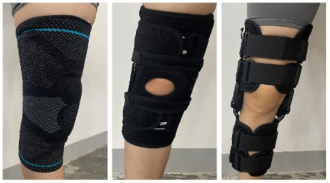
In order to exclude the influence of gender differences, 20 young healthy male volunteers were selected as subjects. The measurement experiment used pressure sensing acquisition components, ErgoLAB skin temperature sensor and ErgoLAB surface electromyography test system. According to the force distribution, relative slip and material, the three most widely used types of knee braces were selected, i.e., No. 1 (high elastic one-piece with full wrap), No. 2 (high elastic one-piece with semi-closed) and No. 3 (Single-layer Velcro tape with semi-closed), as shown in Figure 4. The sizes of the braces worn by all subjects in the experiment matched the length of their respective bilateral leg circumferences.
Figure 4: Sample of 3 different types of knee brace.
User Experience Evaluation Results of Knee Brace Motion Displacement Experiment. Statistical analysis showed that the fixation mode and fixation position of the knee brace significantly affected their relative displacement in the vertical and horizontal directions (p < 0.05); and that the AVD of the knee brace could significantly affect the subjective perception of the subjects (p < 0.05). The data showed (Table 3) that the AVD of the No. 2 to the subject’s leg was at a minimum of 0.32 cm in the horizontal direction, and the AVD of the No. 1 to the subject’s leg was at a minimum of 0.34 cm in the vertical direction. It indicates that the straps (one-piece and crossed fixation) can maximize the friction around the subject’s leg, under the premise of ensuring the comfort of pressure.
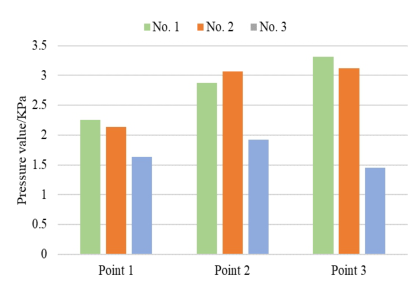
Constraint Stabilization Force Experiment. Combined with the subjective scores, No. 1 has a stronger sense of binding on the human knee brace than the other two braces, the three measurement points pressure values between 1.45∼3.31kPa (see Figure 5), and even the pressure of the measurement point 3 part of the pressure is close to the blood pressure of the capillaries on the surface of the human skin, prolonged wear may impede the flow of blood. The distribution of pressure values at the three measurement points conform to the pressure demand required by each functional region of the knee brace (Haitao, 2007; Tan, 2024), No. 2 and No. 1 provides protection for the core knee joint region, but the pressure change amplitude changes are small, and the distribution is not sufficiently distinctive; The subjective scores of the No. 3 are too small, it indicates an irrational design of the semi-open, semi-rigid structure. Therefore, combining the design of partitionable elastic fabrics and rigid body fixation parts under could ensure the flexibility of knee joint movement, to balance the constraint stabilization and comfort performance, and the elastic fabric should be selected according to the functional area zoning with appropriate density and elasticity.
Table 3: Relative displacement of different knee braces after movement.
Table available in the original PDF paper.
Samples 10min 20min Subjective score Horizontal Direction
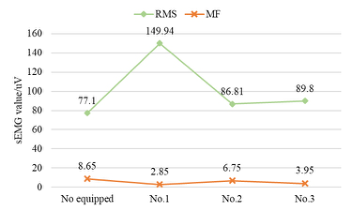
Knee Joint Support Experiment. According to the literature (Wang, 2022), three surface EMG signals, root mean square (RMS), median frequency (MF) and integrated EMG (iEMG), were selected, which can assess the degree of muscle fatigue and the degree of loading the muscles are subjected to during the active exercise state of wearing knee brace. In jogging and squatting states, the RMS and MF values of the leg EMG increased and the MF decreased in the wearing of the knee braces compared to the wearing of the non-braced knee braces (Figure 6(a)). The maximum increase in the RMS of the No. 1 was 77.1–149.94 µV, indicating that the increase of flexible material pressure of the protective gear can increase the working efficiency of the leg muscles, and the knee brace should choose the high elastic material and the designed fixation strap to increase the working efficiency of the leg muscles. The iEMG values were shown in Figure 6(b). The range of iEMG amplitude decreased significantly when wearing No. 2 versus No. 1, with the increase in amplitude of No. 2 being most pronounced during the squatting. This indicates that the rigid and slidable support structure on the left and right sides of the No. 2 provides an auxiliary and powerful support for the joint activities.
Dynamic Thermal Comfort Experiment. The resting heart rate of the subjects was monitored by a smart bracelet, and the reserve heart rate (from 124 to 163 BPM) was considered as the appropriate exercise intensity for the
Optimization Application and User Experience Evaluation System of Knee Brace 95
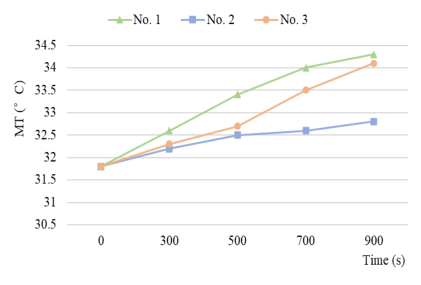
subjects (She, Nakamura et al., 2015). The exercise state of all subjects was maintained for 20 minutes until the end of the experiment. The skin surface temperature changes within the microenvironment of the three knee braces corresponding to different time periods were measured by skin temperature sensors, and the data of 15 subjects were averaged as shown in Figure 7, the MT of No. 2 was significantly lower than that of the other two groups after 500 s, and the MT of the other two groups was similar. According to literature (Dotti, Ferri et al., 2016), it has been shown that for the exercise condition, reducing the coverage area of the brace can improve the heat dissipation and breathability of the product, and help.
Figure 5: Pressure measuring point changes.Figure 6: Change curves of leg muscles ((a) RMS and MF (b) iEMG).
Subjective Evaluation Results A total of 20 scales were distributed for subjective evaluation. Testing the reliability and validity of the subjective evaluation scale by SPSS. The KMO was 0.749, and the sig was 0.001, indicating that the reliability of the questionnaire meets the requirements of data analysis.
After using the weighted average method, converted to a percentage system, the subjective comprehensive evaluation scores of the three types of braces were obtained, as shown in Table 4. It was found that the overall
Figure 7: Microenvironment endothelial surface temperature value.
rating of the No. 2 brace was higher, so it was selected as the sample for optimization. The design optimization focused on the poor comfort index of No.2 (dynamic stability and patellar stability), supplemented by other indexes.
Table 4: Subjective composite evaluation scores for the 3 braces.
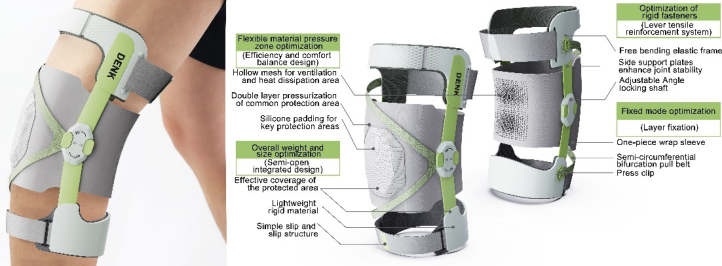
Based on the results of the above 4 objective experiments and subjective evaluation, this paper carries out the optimization design (Figure 8). The improved knee brace has 4 points of advantages compared with the current braces.
Figure 8: Optimized design solution for the knee brace.
Optimization Application and User Experience Evaluation System of Knee Brace 97
(1) Optimization of flexible material pressure zoning. According to the force characteristics of the knee joint, silicone pads are embedded in the key protection area to achieve shock absorption protection, the pads are designed to fit the joints according to the shape of the patella, and the hollow mesh holes are designed in the breathable and heat dissipation area, i.e., the sensitive popliteal fossa, it can achieve the effective increase of the tie force and increase air permeability. (2) Optimization of rigid fixation parts. A reinforcement system combining the flexible fabric and the rigid fixation parts is adopted to solve knee joint insufficient support by the flexible fabric. With reference to the dimension parameters of the parts in direct contact with the knee brace, such as the knee flexion and extension angles and the length legs, the designed elastic frame can be freely bent according to the curvature of the joint, realizing the adjustment of multi-angle and multi-length; the angularly adjustable reinforcing shaft is used to limit the angle of extension bending to prevent further strains. The angle adjustment of 0
, 20
, 45
, 60
, 75
and 90
can be realized by squeezing the button to the inner side. (3) Optimization of fixation mode. The one-piece combined with the forked double-layer strap structure design, the high-elastic sleeve to the core of the knee 360
pressure, while avoiding the excess area caused by the stuffy discomfort, the design of the semi-surrounding stabilize the patella to the outside of the slip, combined with the unidirectional tensioning structure design of the press type buckle to fix the joint without slipping. (4) Overall weight and size optimization. The semi-open one-piece structure of the brace consists of the upper and lower elastic frames and fully wrapped fabrics, which can be put on and taken off by the user through the strong Velcro, making it easy to wear. At the same time, according to the principle of knee joint injury (Nian, 2021), the elastic frame design of the upper and lower ends realize the lightweight and portability of the brace.
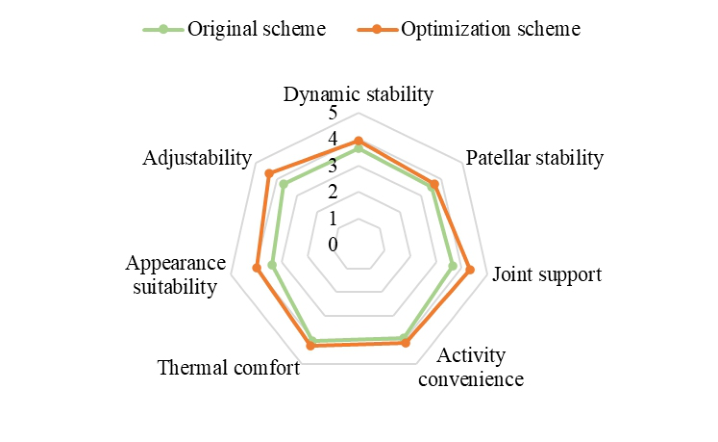
Verification The same subjects were invited again to fill in the subjective evaluation scale to obtain the evaluation comparison results, as shown in Figure 9. Compared to the original design, the evaluation indicators of the improved knee brace show significant enhancement 0.2–0.6 score. Among them, the degree of adjustability and constraint stabilization force increased the most due to the design of the brace’s free-flexing elastic frame and angle-adjustable reinforcement shaft.
Figure 9: Comparison of subjective evaluation results.
CONCLUSION
In this study, the user experience evaluation indexes of knee brace are proposed from the perspectives of ergonomic performance and comfort performance, and objective measurement experiments are integrated into the whole evaluation system as objective factors, to construct a subjective- objective integrated knee brace user experience evaluation system, which increases the accuracy and reliability of the evaluation system of knee brace. Through the experimental measurement and subjective evaluation of stability performance, safety performance, activity convenience, microenvi- ronmental thermal comfort, and adjustability degree during wearing and using, we analyse the correlation between the design elements and ergonomic performance and comfort performance, and then get the deficiencies of the current design of the existing knee brace, and put forward a feasible design solution by focusing on improving ergonomic performance and comfort performance as a key point to improve the design.
ACKNOWLEDGMENT
We thank all participants for their contributions.
REFERENCES
Bai Yu, W. K. (2023). “Research on the design of 3D printing personalized external fixation support based on parameterization.” Journal of Graphics 44(05): 1050–1056. Caplan, N. and D. F. Kader (2014). Rationale of the Knee Society Clinical Rating
System. Classic Papers in Orthopaedics. P. A. Banaszkiewicz and D. F. Kader. London, Springer London: 197–199.
Optimization Application and User Experience Evaluation System of Knee Brace 99
Dotti, F., A. Ferri, M. Moncalero and M. Colonna (2016). “Thermo-physiological comfort of soft-shell back protectors under controlled environmental conditions.” Applied Ergonomics 56: 144–152. Duan Jiejie, S. X. (2022). “Design and development of knitting process for three-
dimensional molding knitted knee pads.” Journal of Clothing Research 7(03): 218–222. Gemperle, F., C. Kasabach, J. Stivoric, M. Bauer and R. Martin (1998). Design for wearability. Digest of Papers. Second International Symposium on Wearable Computers (Cat. No. 98EX215). Haitao, L. (2007). Design and research of fully molded medical compression
bandage. Master, Tianjin University of Technology. Nian, Q. (2021). Research on the protective performance of knee pads based on surface electromyography, Tianjin University of Science and Technology. She, J., H. Nakamura, K. Makino, Y. Ohyama and H. Hashimoto (2015). “Selection
of suitable maximum-heart-rate formulas for use with Karvonen formula to calculate exercise intensity.” International Journal of Automation and Computing 12(1): 62–69. Tan Kun, W. X., Zhao Jiaxin, Huang Yuzhe, Li Xu, Li Jiachen (2024). “Design of knee joint protectors with variable stiffness based on the biomechanical properties of the lower limb.” Journal of Graphics 45(05): 1084–1095. Wang Guangli, F. L. (2022). “Pressure comfort analysis of basketball arm guards
based on surface electromyography.” Journal of Clothing Research 7(03): 227–234. Yu, R., Y. Cao, X. Li, H. Wang and R. He (2021). The Stability of Headphones.
Advances in Ergonomics in Design, Cham, Springer International Publishing. Zhang Jun-xia, Z. Z.-q., Shao Yang-yang, Liu Ze-long, Gao Kun (2020). “Evaluation of Kneepad Design Based on Sports Biomechanics.” Packaging Engineering 41(24): 1–7.
LISTED IN THE AHFE DIGITAL BOOKSTORE CATALOGUE
Explore the complete digital volume
Human Dynamics, Product Evaluation and Quality
Read this individual research paper free through the original publisher, or explore the full digital proceedings book.
ISBN 978-1-964867-48-9
Explore this ISBN in the AHFE Bookstore ↗Listed in the July 2026 bookstore catalogue; search by ISBN to confirm current availability · Digital book purchase optional