Aosi Wang, Rong Liu (2025). Dynamic Analysis of Skin Deformation for Ergonomic Design of Compression Leggings. In: Ergonomics In Design and Kansai Engineering. AHFE Open Access, vol. 170, pp. 65–74. https://doi.org/10.54941/ahfe1006168
This study investigates the dynamic deformation of human skin during running using a 4D scanning system, capturing detailed spatiotemporal changes across five critical gait phases: initial contact, mid-stance, toe-off, mid-swing, and late swing. Six participants were analysed to track and quantify skin deformation (displacement). Results reveal the posture-dependent variations in skin deformation in running. The anterior knee and posterior hip regions consistently exhibited skin elongation, whereas the posterior knee and anterior hip regions showed skin contraction. Transitional boundary lines between these opposing deformation regimes were mapped, providing novel biomechanical insights into skin behaviour during dynamic motion. These findings advance the understanding of cutaneous mechanics in sports science and offer empirical guidelines for optimizing compression garment design, particularly for running-related compression legging applications.
In recent years, sports compression garments (CGs) have gained significant attention in sports science and textile engineering for their ability to provide appropriate pressure, support muscles, reduce fatigue, and enhance athletic performance (Brown et al., 2022; Williams et al., 2021). Designing these garments effectively requires understanding skin deformation during movement, particularly in activities like running. As one of the typical examples of sports apparel, the comfort and functionality of compression leggings (CLs) are closely tied to both structural design and precise selection of materials. Skin deformation patterns serve as a crucial foundation, providing the key basis for optimizing these aspects (Hatch et al., 2024).
Various methods have been employed to study skin deformation. Luo et al. (2017) applied gel impressions and Photoshop to calculate skin deformation, Choi and Hong (2015) used three-dimensional (3D) scanning of a static human model marked with reference points. Song et al. (2022) applied
a surface-painting-line method to measure skin deformation rates for enhancing the performance of work pants for delivery personnel. These studies introduced certain innovations, while some limitations still exist. For example, the gel impression method may cause deformation due to external forces, static body scanning cannot accurately capture skin changes during movement, and a limited number of marking lines may not adequately reflect skin displacement variations over larger areas of a dynamic body. Therefore, this study proposes improvements to address these limitations in existing methods.
EXPERIMENTAL Subjects and Equipment
Six healthy male participants were recruited for this study, with a mean age of 28.67 ± 2.34 years, a height of 178.5 ± 4.68 cm, a weight of 82.52 ± 6.25 kg, and a body mass index (BMI) of 25.89 ± 1.6 kg/m2. Participants were advised to avoid intense physical activity before the experiment to minimise fatigue effects. All participants signed informed consent forms, acknowledging the trial’s purpose, procedures, and risks, and voluntarily agreed to participate. A four-dimensional (4D) scanning system (3dMD Ltd., Atlanta, U.S.) was used to capture dynamic skin deformation during running. This system integrates 3D scanning with time, utilizing six camera groups and 360-degree scanning technology to track skin, muscles, and joints at 120 frames per second with 0.7 mm accuracy. The 3D point clouds and texture data were processed using dedicated software. A portable treadmill (Xiaomi Ltd., China) simulated running conditions, featuring a compact design with a 120 × 41.5 cm2 conveyor belt and speeds ranging from 0.5 to 6 km/h, allowing for smooth transitions and minimal interference during data collection.
Landmarks In this study, to facilitate more efficient data collection and analysis, the dominant leg of each participant was chosen as the focus for examining lower limb skin deformation. The dominant leg typically refers to the leg a person is more inclined to use during physical activities or daily tasks (Schorderet et al., 2021). According to Schneiders et al. (2010), the dominant leg is identified using a kicking test, where the leg chosen by the participant to kick the ball is determined to be the dominant leg. After testing, it was found that the dominant legs for all 6 participants were the right legs; thus, all markers were placed on the right legs.
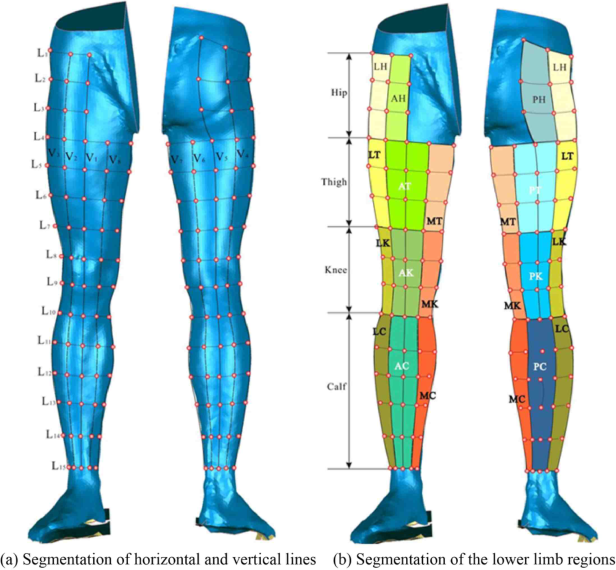
To record skin deformation, 108 markers were placed on the right lower limb of each participant. The vertical dimension was divided into 15 horizontal lines (L1 to L15) from top to bottom, and the horizontal dimension into 8 vertical lines (V1 to V8) in a clockwise direction starting from the anterior midline, forming a grid of 100 segments, as shown in Figure 1(a). Due to occlusion, in the inner thigh region, lines L1 to L3 do not intersect with lines V6 to V8. The vertical dimension was divided into four anatomical
Dynamic Analysis of Skin Deformation for Ergonomic Design of Compression Leggings 67
sections: hip, thigh, knee, and calf, and the lower limb into four orientations: anterior, lateral, posterior, and medial, as detailed in Figure 1(b) and Table 1.
Figure 1: Distribution of lower limb landmarks and anatomical regional segmentation.Table 1: Nomenclature and distribution of lower limb regions.
Table available in the original PDF paper.
Location and
V8 ∼V2 V2 ∼V4 V4 ∼V6 V6 ∼V8 Code Lateral Hip Posterior Hip L1 ∼L4 Anterior Hip
Experimental Procedure Before the experiment began, participants underwent a 30-second warm-up on the treadmill to familiarise themselves with the equipment settings and alleviate any potential discomfort. Subsequently, the participants ran on a treadmill at a constant speed of 6 km/h, during which the 4D scanner was activated to capture motion at a frame rate of 60 frames per second (fps).
68 Wang and Liu
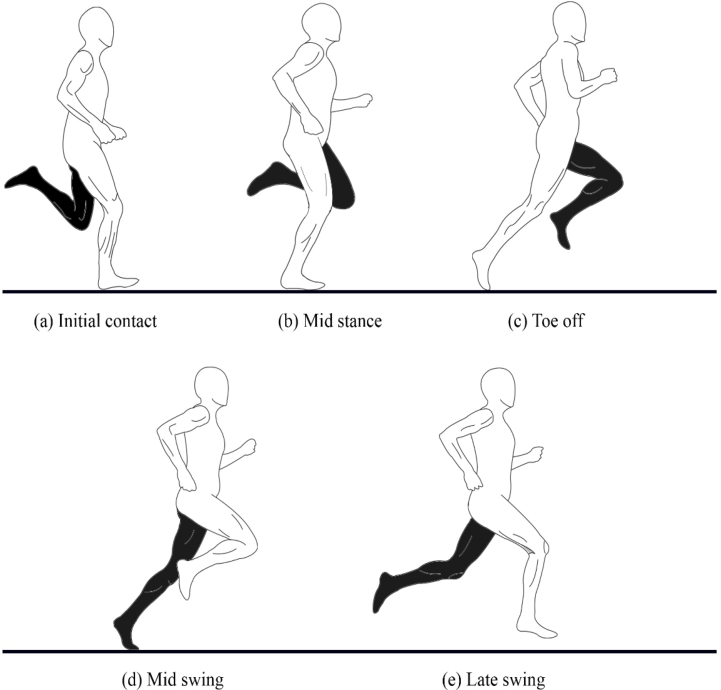
During running, the lower limbs undergo multiple complex dynamic posture changes throughout the running gait cycle (RGC). To simplify the experimental design and reduce complexity while still capturing the dynamic skin deformation characteristics at different stages, this study selected five key dynamic phases in the gait cycle as research subjects: initial contact, mid- stance, toe-off, mid-swing, and late swing. Figure 2 shows the postures at these five key phases.
Figure 2: Typical running postures in RGC
RESULTS
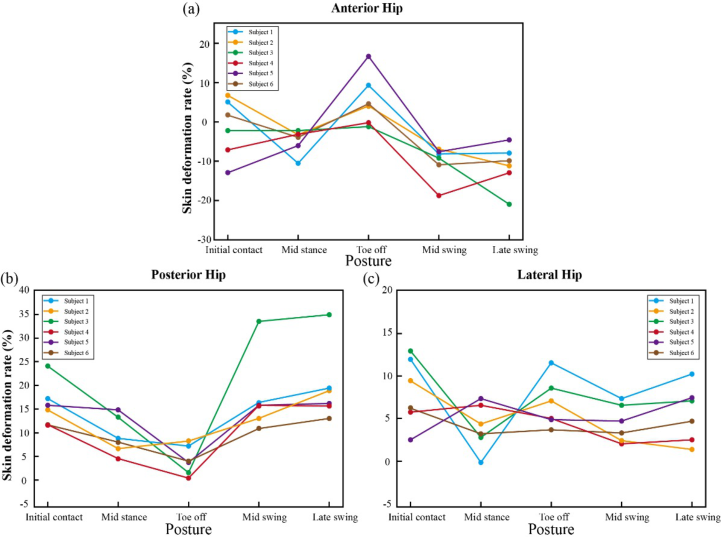
Figure 3 illustrates the skin deformation at the hip region for various subjects across different postures. In the AH region, most subjects exhibited similar patterns, with the skin showing a ‘W’ shaped deformation. The two key stages of skin deformation in this region are mid-stance and toe-off. Mid- stance marks the support phase, during which the lower limb transitions from absorption to propulsion (Hu et al., 2022). At this stage, the body’s centre of mass shifts forward, and the supporting leg moves backward, leading to hip extension (Hamner & Delp, 2013), which is the primary factor driving
Dynamic Analysis of Skin Deformation for Ergonomic Design of Compression Leggings 69
this change. Subsequently, toe-off marks the transition between the support and swing phases, where the hip joint reaches its maximum angle, and the swing leg moves forward, resulting in hip flexion. Consequently, the skin deformation in the AH region decreases and becomes negative. In contrast, the PH region shows an opposite trend to the AH. At toe-off, the deformation rate in the PH region is minimal, approaching zero, but during the swing phase, this rate increases. Throughout the entire gait cycle, the PH region consistently shows skin elongation. Meanwhile, the LH region does not exhibit significant deformation patterns, and for most subjects, changes in this region remain relatively stable.
Figure 3: Rate of skin deformation changes among six subjects at (a) AH, (b) PH, and (c) LH at the hip across different postures.
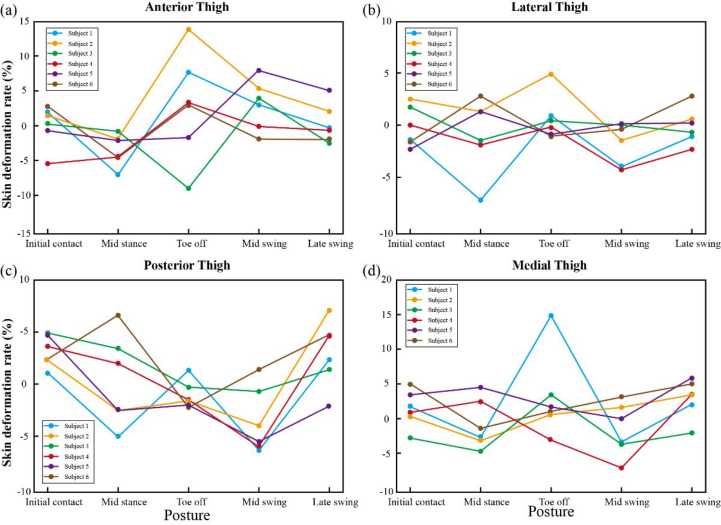
Figure 4 illustrates the skin deformation patterns in the AT region, where some participants showed similar patterns. The skin deformation rate in the AT region increased after mid-stance, peaked during propulsion, and decreased after toe-off as the swinging leg moved forward. For most participants, the deformation rate in this region remained around 0% from late swing to mid-stance. In contrast, the PT region showed an opposite trend, with most participants exhibiting an increase in deformation rate only after the mid-swing. The LT and MT regions showed no clear patterns, with changes mostly between 5% and −5%, indicating mild variation.
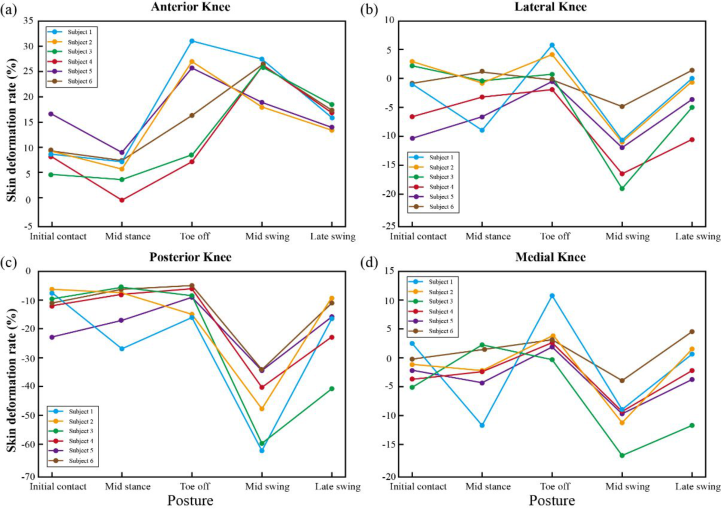
The knee region experienced the highest skin deformation rate among all lower limb areas throughout the running cycle. The AK region consistently
70 Wang and Liu
exhibited skin elongation, with the least elongation observed during mid- stance, followed by an increase in deformation thereafter, though individual variations were noted. Some participants peaked at toe-off, while others reached a maximum deformation rate of about 25% during mid-swing. In contrast, the PK region consistently exhibited skin contraction, with the greatest contraction occurring during mid-swing, as shown in Figure 5(c).
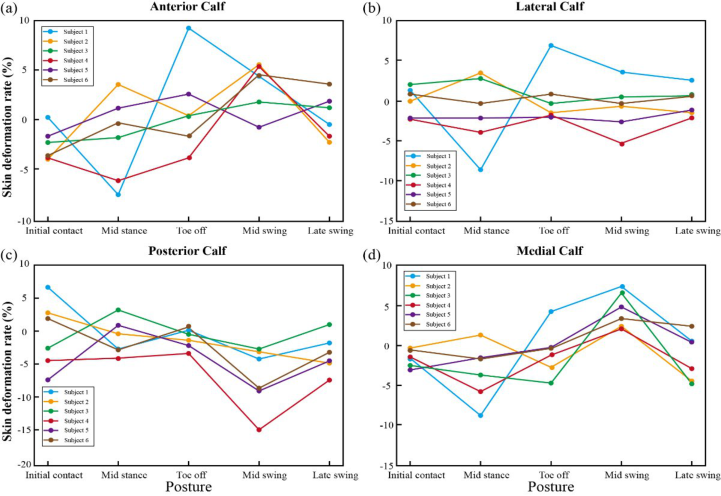
Figure 6 shows that the skin area on the AC of most subjects increased from initial contact to mid-swing, while the PC decreased significantly between toe-off and mid-swing. The lateral and medial calf regions exhibited stable changes, with variations between −5% and 5% throughout the RGC.
Figure 4: Skin deformation change rates at (a) AT, (b) LT, (c) PT, and (d) MT of the thigh among six subjects across different postures.
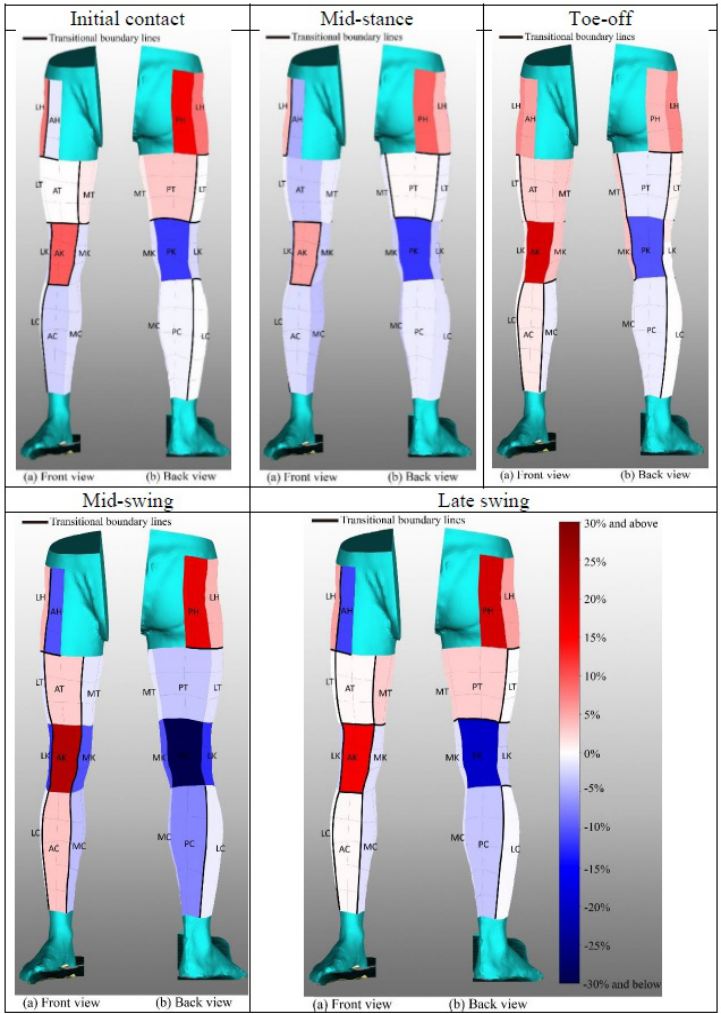
To visualise skin deformation across different postures, a mapping was created based on area change rates observed in each region. As shown in Figure 7, red regions indicate areas of skin elongation, while blue regions indicate skin contraction, with darker shades representing greater degrees of deformation. During the RGC, the anterior and posterior joint regions exhibited consistent trends: the PH and AK regions exhibited skin elongation, indicating an increase in local skin strain, while the AH and PK regions showed a reduction in skin strain. In contrast, other lower limb areas, such as the AT, LT, and LC, showed minimal skin area change, suggesting stable deformation throughout the cycle.
Dynamic Analysis of Skin Deformation for Ergonomic Design of Compression Leggings 71
Figure 5: Skin deformation change rates at (a) AK, (b) LK, (c) PK, and (d) MK of the knee among six subjects across different postures.Figure 6: Skin deformation change rates at (a) AC, (b) LC, (c) PC, and (d) MC of the calf among six subjects across different postures.
72 Wang and Liu
Figure 7: Skin deformation mapping of the lower limbs of six subjects during the RGC.
DISCUSSION AND CONCLUSION This study employed a 4D scanning method to investigate skin deformation in the lower limbs during running, aiming to inform the design of compression leggings for athletic use. Unlike traditional methods that rely on static measurements or limited 2D scans, the 4D approach captures dynamic skin
Dynamic Analysis of Skin Deformation for Ergonomic Design of Compression Leggings 73
deformation in real-time, considering movement and changing skin surfaces throughout the running cycle. Our results revealed that the posterior hip (PH) and anterior knee (AK) regions primarily experienced skin extension, while the anterior hip (AH) and posterior knee (PK) regions underwent contraction, consistent with findings by Wessendorf and Newman (2012). The thigh and calf regions showed more variability, with skin stretching or contracting depending on posture, indicating complex deformation patterns.
These findings are significant for the zoned design and fabric selection of compression garments. Areas like the AK and PH, which undergo substantial stretching, require fabrics with high elasticity and excellent recovery properties. For other regions, fabrics with varying elasticity levels can be selected based on observed skin deformation. The degree of deformation informs compression design to balance comfort and support without restricting movement. Although elongation and contraction regions are evident, the skin forms a continuous surface with transitional areas of minimal and stable deformation throughout the gait cycle. These transitional boundary lines—found at the interface between red and blue regions in deformation heatmaps or within light-coloured regions—could serve as ideal locations for clothing seam placement if needed, where typically experience low skin deformation that can reduce friction between the skin and fabric for enhancing comfort in movements. This study examined skin deformation across 15 lower limb regions, laying a foundation for understanding deformation patterns. Future studies could benefit from more detailed segmentation of the lower limbs, capturing nuanced deformation patterns and providing insights for improving compression garment design and optimizing fit and functionality.
ACKNOWLEDGMENT
Rong Liu (Corresponding Author) and authors would like to thank the Laboratory for Artificial Intelligence in Design through project RP1-5, Innovation and Technology Fund through project PRP/011/25TI, and the School of Fashion and Textiles, the Hong Kong Polytechnic University for supporting this study.
REFERENCES
Brown, F., Jeffries, O., Gissane, C., Howatson, G., van Someren, K., Pedlar, C., Myers, T., & Hill, J. A. (2022). Custom-fitted compression garments enhance recovery from muscle damage in rugby players. Journal of Strength and Conditioning Research, 36(1), 212–219. https://doi.org/10.1519/ jsc.0000000000003408 Choi, J., & Hong, K. (2015). 3D skin length deformation of lower body during knee joint flexion for the practical application of functional sportswear. Applied Ergonomics, 48, 186–201. Hamner, S. R., & Delp, S. L. (2013). Muscle contributions to fore-aft and vertical
body mass center accelerations over a range of running speeds. Journal of biomechanics, 46(4), 780–787.
74 Wang and Liu
Hatch, K., McDonald, C., Klepser, A., Brubacher, K., & Gill, S. (2024). Analysis of lower-body dimensions and their implementation in compression garment development. Communications in Development and Assembling of Textile Products, 5(2), 187–194. Hu, Z., Ren, L., Wei, G., Qian, Z., Liang, W., Chen, W., Lu, X., Ren, L., &
Wang, K. (2022). Energy flow and functional behavior of individual muscles at different speeds during human walking. IEEE Transactions on Neural Systems and Rehabilitation Engineering, 31, 294–303. Luo, S., Wang, J., Yao, X., & Zhang, L. (2017). A novel method for determining skin deformation of lower limb in cycling. The Journal of The Textile Institute, 108(9), 1600–1608. Schneiders, A. G., Sullivan, S. J., O’Malley, K. J., Clarke, S. V., Knappstein, S. A.,
& Taylor, L. J. (2010). A valid and reliable clinical determination of footedness. Pm&r, 2(9), 835–841. Schorderet, C., Hilfiker, R., & Allet, L. (2021). The role of the dominant leg while assessing balance performance. A systematic review and meta-analysis. Gait & Posture, 84, 66–78. Song W., Ye Y., Huiming H., Chai L., Chen Z. Improving ergonomic performance of work pants for delivery personnel based on skin deformation measurement. Journal of Engineered Fibers and Fabrics. 2022;17. doi: 10.1177/ 15589250221138546 Wessendorf, A. M., & Newman, D. J. (2012). Dynamic understanding of human-
skin movement and strain-field analysis. IEEE Transactions on Biomedical Engineering, 59(12), 3432–3438. Williams, E. R., McKendry, J., Morgan, P. T., & Breen, L. (2021). Enhanced cycling time-trial performance during multiday exercise with higher-pressure compression garment wear. International Journal of Sports Physiology and Performance, 16(2), 287–295.
LISTED IN THE AHFE DIGITAL BOOKSTORE CATALOGUE
Explore the complete digital volume
Ergonomics In Design and Kansai Engineering
Read this individual research paper free through the original publisher, or explore the full digital proceedings book.
ISBN 978-1-964867-46-5
Explore this ISBN in the AHFE Bookstore ↗Listed in the July 2026 bookstore catalogue; search by ISBN to confirm current availability · Digital book purchase optional