Marie Ottilie Frenkel, Jana Strahler (2025). Virtual reality meets the police badge: Qualitative findings on attention, decision-making, and action. In: Cognitive Computing and Internet of Things. AHFE Open Access, vol. 165, pp. 103–113. https://doi.org/10.54941/ahfe1006094
Police officers are expected to perform reliably under stress, yet stress responses are highly individual and can impair performance. As theoretical knowledge alone is insufficient to mitigate these effects, the understanding of acute psychophysiological stress reactions and associated attentional, decision-making and behavior is essential. This field study examines scenario-based police training in immersive virtual reality (iVR) as a method for controlled stress exposure. Based on a modification of the Integrated Model of Anxiety and Perceptual-Motor Performance (Nieuwenhuys and Oudejans, 2017), we hypothesized an increase of psychophysiological stress reactions and a decrease of attention, decision-making and action quality.Methods: N = 59 German police officers (Mage = 34.16 years; SD = 7.79; Mwork experience = 11.33 years; SD = 9.04) completed a 3-hour training session in iVR with three increasingly stressful scenarios. Semi-structured, brief qualitative interviews were conducted directly after each scenario to assess attention, decision-making, and action. The interview questions were shown on a poster. Then participants, standing apart, recorded their oral answers via a tablet.Results: A total of 1,116 data units were extracted. Most responses referenced attention (n = 562), followed by action (n = 291) and decision-making (n = 263). Officers focused primarily on situational features, involved parties, and human factors that evoke stress. Decisions were often described as intuitive, with little reference to prior training content.Conclusion: The qualitative data offer unfiltered insights into officers’ immediate experiences and enrich the theoretical model. Combined with police guidelines, the findings help evaluate whether officers relied on task-relevant or irrelevant information during high-stress decision-making.
The police profession is often boldly referred to as the “most stressful job in the world.” At the same time the credo applies, that police should be the “voice of authority, calm and guidance” (Brito et al., 2009, p. 1).
Officers on duty are expected to behave responsibly and operate faultlessly – even in the presence of severe stressors. To prepare them effectively for such high-pressure situations, specific stress-training programs are essential (Giessing et al., 2019; Frenkel et al., 2021a; Frenkel et al., 2021b; Voigt and Frenkel, 2023). The first step is to gain a deeper understanding of how psychological and contextual factors influence officers’ decisions and behavior during stressful, high-risk operations. Based on these insights, the next step is to develop an effective, research-based training curriculum that helps police officers maintain effective self-regulation under stress. Given the significant impact of stress on both performance (Nieuwenhuys and Oudejans, 2017) and health (McEwen and Stellar, 1993), it is crucial to support police officers in managing stress effectively. One way to achieve this is by strengthening their coping resources to reduce strain and safeguarding their functioning, well-being, and overall health (Giessing et al., 2020; Frenkel et al., 2021a; Voigt et al., 2024). Since theoretical knowledge alone is insufficient to shield officers from the effects of acute stress, a deeper understanding of psychophysiological stress responses—along with related attentional, decision-making, and behavioral processes—is essential. This qualitative study aimed to address this gap by exploring the relationship between stress, attention, decision-making and action during a scenario- based police training.
In police research, there is broad consensus on the presence of occupational stressors (Voigt and Frenkel, 2023; Violanti et al., 2016). To date, police research has generally adhered to a stimulus-oriented definition of stress. This approach involves compiling lists of various stressors—environmental demands that increase the likelihood of stress occurring in “a reasonable proportion of individuals”—and assessing their frequency and intensity. A distinction is typically made between operational stressors (e.g., critical missions, especially those involving violent experiences) and organizational stressors (e.g. shift work, overtime, inadequate equipment, and frustrations with administrative processes; Violanti et al., 2016). This perspective, however, often neglects the role of coping resources. Police officers must be prepared to deal with crises. Transactional stress models such as that of Lazarus and Folkman (1984) assume that the cognitive evaluation of the environment and one’s own resources occurs interactively. Stress arises not only due to existing stressors, but also when coping resources are perceived as insufficient. Since stress is an idiosyncratic process, it is crucial to take a differentiated approach when assessing stress in police officers on duty. Not only must different stressors be considered, but also individual variation in stress perception and response. As stress reactions are highly individual and can lead to performance decrements, a deeper understanding of acute psychophysiological stress reactions, as well as the associated attentional, decision-making, and behavioral processes, is necessary.
Police training generally prepares officers for complex, stressful situations they may face on duty. Simulation-based training is an effective way to practice real-life scenarios, allowing officers to experience the perceptual, cognitive, and motor demands associated with high-stress encounters. However, to improve learning and transfer to operational settings, training should follow a learner-centered approach. Immersive Virtual Reality (iVR)
Virtual Reality Meets the Police Badge: Qualitative Findings on Attention 105 can enhance current training methods by providing opportunities to practice scenarios otherwise hard to simulate realistically, such as tactical skills and safety procedures (Wrzus et al., 2024).
This current work was part of the 3.5-year European Horizon 2020 project SHOTPROS (Grant Agreement No. 833672, https://shotpros.eu/, accessed on 11 April 2025). The primary objective of the project was to explore how psychological and contextual human factors (HFs) affect police officers’ decision-making and actions in stressful and high-risk operational scenarios (DMA-SR).The Conceptual Human Factors Model of Decision-Making and Acting under Stress and in High-Risk Situations (DMA, Hutter et al., 2022, adapted from Nieuwenhuys and Oudejans, 2017) was chosen as the theoretical foundation. The DMA model is a causal framework that explains how stress experienced during police operations can lead to changes in attention, decision-making, and actions of a police officer. Specifically, the model consists of three main elements that interact directly following exposure to a stressor—that is, a stimulus capable of triggering a stress response—prior to observable changes in attention, decision-making, or behavior. These three elements are categorized as “human factors,” “stress response,” and “extra effort.” In brief, human factors interact with potential stressors (e.g., a police training scenario) to either evoke or buffer against a stress response. This stress response may then lead to increased mental effort. Together, the stress response and the additional effort contribute to changes in attentional processes, which in turn influence the decisions made by the police officers and ultimately determine the actions taken.
To address this, we conducted a field study to evaluate the potential of scenario-based police training in iVR for stress exposure. Based on the DMA model, we hypothesized an increase of psychophysiological stress reactions, as well as a decrease of attention, decision-making and action quality. The results presented here represent the qualitative part of a larger, multi- method study. Given the distinct methodological approaches - standardized questionnaires versus semi-structured interviews- and the resulting need for different analytical strategies, the findings are reported in two separate publications. Moreover, the scope and depth of each dataset require focused and detailed reporting to do justice to the respective methodologies and interpretations. The quantitative results will be presented in a separate paper (Frenkel and Strahler, in preparation).
METHODS
The study was approved by the ethics committee of the Faculty of Behavioral and Cultural Studies, Heidelberg University, Germany (AZ Fre 2022 2/2). All police officers provided written informed consent. The training sessions were part of the EU’s Horizon 2020 project “SHOTPROS”. The assessment of data was piloted during the Romanian field trial in Bucharest with 9 police officers. The study includes data from two German field trials in Selm and Berlin. We have reported interim results to the EU (pp. 24–34,) in the public report D7.4 (Hutter et al.,
106 Frenkel and Strahler
2022, https://shotpros.eu/wp-content/uploads/2023/01/D7.4-SHOTPROS- Final-Evidence-based-HF-Model-for-DMA-SR_v1.0.pdf, accessed on 16 April 2025).
Participants: The sample consisted of N = 59 police recruits. Participants were aged 20 to 54 years (Mage = 34.16 years; SD = 7.79) and had between 0 to 38 years work experience (Mwork experience = 11.33 years; SD = 9.04). The recruits performed typical riot police tasks, including patrol car operations, radio car operations, response operations, patrol duties, and civil assignments.
Study Setup: Field trials were conducted in 30 × 30 m police sports halls, where the iVR system BLUESUIT (RE-liON, Netherlands) was installed to create a pre-programmed virtual environment. The BLUESUIT system includes a binocular head-mounted display with a microphone for sound effects and communication, a full-body SmartVest with sensors on the arms, torso, and legs, a portable backpack computer, and a tactical belt with police gear (pistol, baton, pepper spray, handcuffs). The SmartVest sensors connect to the VR system to track participants’ positions and movements in real time. Participants could see their own hands and feet synchronized with their actual movements, as well as those of other participants wearing the BLUESUIT.
Officers conducted testing in teams of three or four, with training scenarios developed in collaboration with experienced police trainers. These scenarios were designed to reflect realistic and common operations specific to each police organization. Different scenarios were created for Selm and Berlin due to their distinct operational contexts, including population size, geography, and socio-demographics. Each scenario began with a radio message from the trainer outlining the situation. All scenarios included one or more non-playing characters (NPCs), which were pre-programmed and non- adaptive. To enhance realism, a role player in a BLUESUIT, acting as a perpetrator, was added. This role player, always the same trained police instructor, followed a detailed script and was trained in advance. NPC civilians were present but non-interactive. Stress levels in the scenarios (for the stress assessment see Giessing & Frenkel, 2020, https://shotpros.eu/wp- content/uploads/2021/01/SHOTPROS_D4.3_Physiological_Measurement_ Suite_v1.0.pdf, accessed on 16 April 2025) increased by adding more perpetrators, civilians, or aggression, resulting in low-stress (LS), medium-stress (MS), and high-stress (HS) levels for Selm and Berlin. Scenarios followed a fixed order, with stress gradually increasing in accordance with ethics committee guidelines, to prevent early overload.
Measures: The link between officers’ attention and subsequent decision- making was explored through semi-structured qualitative interviews, conducted immediately after each scenario while officers remained on the training surface and before interacting with others or trainers. The interview questions were displayed on a poster, and participants, standing apart, recorded their responses via a tablet.
Virtual Reality Meets the Police Badge: Qualitative Findings on Attention 107
Additional qualitative data on attention, decision-making, and actions were gathered using three self-drafted questions: “What did you pay attention to during the scenario?”, “How did that influence your decision-making?”, and “How did you act accordingly?” Interviews were conducted after each scenario and lasted between 7 seconds and 2 minutes 44 seconds. Participants used iPads to record their answers without leaving the training environment.
Procedure: Each police recruit participated in a three-hour iVR training session. After completing a manipulation check, participants out on the iVR BLUESUIT. Following system calibration, they underwent a 45-minute familiarization period, learning to navigate the virtual world, interact with objects, and use equipment. This was supervised by a police trainer and VR operator to ensure accurate and relevant instruction. After each scenario, participants completed a stress manipulation check and recorded semi-structured interviews on their attention, decision-making, and actions during the scenario. An after-action review (AAR) on team performance was conducted with the police trainer. After the final scenario, participants took off their BLUESUITS gear and participated in a detailed AAR across all three scenarios. Following the last AAR, participants filled out several questionnaires. They were debriefed about the study goals and thanked for their participation.
Analysis: Audio-recorded interviews were transcribed and analyzed using qualitative content analysis (Mayring, 2004). Participants’ statements were categorized into one-word topics, grouped thematically into superordinate categories, and a deductive category system was developed. Data were analyzed separately for the three interview questions on attention, decision- making, and action to identify relevant and irrelevant cues and human factors at different phases of the DMA process, integrating them into the overall model. Each data unit represented a distinct content component. For example, one officer said, “[I paid attention] usefully safeguarding my colleagues, observing the involved persons and watching their hands,” which was split into three units: Safety hazards, unclear parties, and hands.
RESULTS & DISCUSSION Interviews ranged from 10 to 124 seconds, with 1116 data units extracted. Officers most frequently referenced attention cues (n = 562), followed by actions (n = 291) and decision-making (n = 263). For reasons of space, the main categories with the most frequent mentions are discussed below, along with explanations of the subcategories and illustrative quotes.
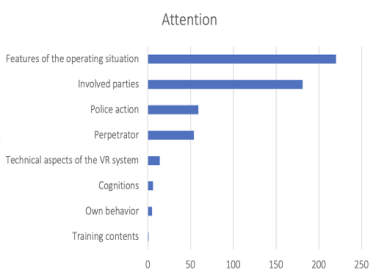
Data units concerning attention covered the following main categories: Features of the operational situation, involved parties, police action, perpetrator, teamwork, technical aspects of the VR system, cognitions, own behavior and training contents (see Fig. 1).
108 Frenkel and Strahler
Figure 1: Main categories and number of data units for attention.
Officers’ attention during the scenarios was mostly focused on features of the operational environment (n = 220). They observed spatial features like houses, house numbers, rooms, walls, windows or open doors. The positioning of colleagues was also important, as officers frequently reported to adjust their own position to ensure the best possible line-up for the task ahead: “[I paid attention] to my colleagues, to where they were standing, so we could create a good V-position.” Safety hazards, such as dangerous persons or objects, firing lines, escape routes and avenues of attack, were frequently noted and counted as features of the operational situation. Visual cues, especially the position and movement of hands, were considered critical for identifying potential threats, as were weapons or ambiguous objects: “You always wanna see the hands first to get some feeling of security!” Officers also mentioned noticing blood stains on doors and walls: “I noticed blood stains and followed them along.” Acoustic cues were less frequently observed and included background music, party sounds, or shooting. Such auditory information helped officers interpret the mood of the crowd, e.g. anticipating drunken behavior when hearing party noises. The least frequently mentioned focus was pre-known or contextual information, such as background details about the scenario or the perpetrator, received either before or during the scenario. Officers also referred to available resources such as weapons, pepper spray, or tasers.
Overall, police officers most commonly focused their attention features of the operational situation. By carefully observing the environment, including objects and individuals, they were able to assess risk and danger levels in the given situation. Human factors, such as the perpetrator and their own team, also frequently attracted their attention.
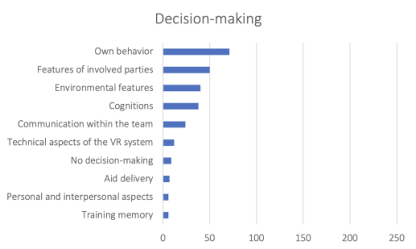
Regarding decision-making, comparatively fewer mentions (n = 263 data units) were extracted. This question asked officers how their decision- making was influenced by the cues they focused on during the scenarios. The main categories were: own behavior, characteristics of involved parties, environmental features, cognitions, team communication, technical aspects of the VR system, aid delivery, personal and interpersonal factors, and training memory (see Fig. 2).
Virtual Reality Meets the Police Badge: Qualitative Findings on Attention 109
Most frequently, officers’ decision-making was influenced by their own behavior (n = 71), primarily involving weapon use. Officers described preparing to shoot, selecting appropriate weapons, and in some cases, using them: “I saw the person, he was approaching me with a dangerous object in his hand and didn’t wanna remove it, so I shot at the person.”
Officers’ movements were another key factor. They adjusted their position or direction based on perceived cues, for instance, avoiding hazards while maintaining visual contact. One officer described slowing down due to what he saw: “That kind of paralyzed my movements, my running, a bit. I think we were just standing there unnecessarily for too many seconds.” Behavior related to the perpetrator also shaped decision making, including communication, confrontation, or identification: “Well, yeah, that kind of influenced my decision-making in a way that I now actually wanted to find the perpetrator and wanted to kill him. I wanted to fight him.” Defensive behavior was also reported. Officers described acting more cautiously, slowing down, and staying calm. In some cases, this led to aborted planned actions, for example, withdrawing from an arrest when the situation seemed inappropriate or unsafe: “It just didn’t make sense to execute the arrest warrant here and now, in front of all these people, and it also wouldn’t have been possible. The situation just wasn’t right to reach my goal in the end.” In part, this was also due to perceived restrictions in available options, as one officer reported. Overall, this category illustrates the close link between decision-making and action, with behavior itself shaping decisions.
Figure 2: Main categories and number of data units for decision-making.
Decision-making was most often influenced by officers’ own behavior and real-time assessments of the other involved parties and environmental features. The decisions seemed to be guided primarily by relevant situational cues that were vital to finding a suitable conclusion. Weapon readiness, movement adjustments, and caution-based decisions were frequently reported. Officers responded to perceived threats with strategic restraint or escalation, demonstrating how situational cues directly shaped their internal evaluations. Some decisions reflected stress-induced hesitation or reassessment of planned actions.
110 Frenkel and Strahler
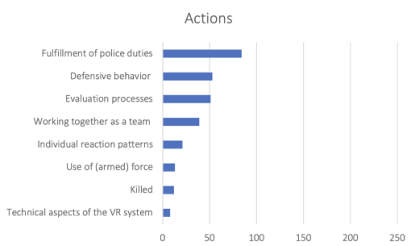
Finally, regarding action, 291 data units were extracted. Officers were asked how their decision-making influenced their subsequent behavior. The data covered main categories such as duty fulfillment, defensive behavior, evaluation processes, teamwork, individual response patterns, use of (armed) force, and technical aspects of the VR system (see Fig. 3).
Most officers (n = 84) were primarily engaged in duty fulfillment, including situation management tasks like securing the scene, assessing the situation, identifying involved parties, and distinguishing between perpetrators and victims. De-escalation was often prioritized, such as communicating with everyone involved rather than using force: “I mainly took on backup tasks. Later, when the perpetrator was on the ground, I focused on securing the area.” One officer mentioned supporting the victim directly. Interaction with the perpetrator was also part of the duties, whether through physical confrontation or verbal engagement: “I approached the perpetrator first and managed to talk him down. He did exactly as I asked.” Officers also reported arresting the perpetrator or maintaining distance: “I stood next to my colleague and kept him at a safe distance.” Communication duties involved speaking with involved parties, such as requesting IDs or talking the perpetrator down: “We clearly communicated our request for his ID with determination.” One officer also called for backup.
Figure 3: Main categories and number of data units for actions.
Officers’ actions were closely tied to prior decisions and shaped by their operational roles within the team. While many took on role-appropriate duties such as backup, communication, or area security, others deferred more offensive action to designated leaders. Defensive and passive behavior was common, with officers orienting themselves by the behavior of teammates. Verbal de-escalation was frequently preferred over armed force, which only a few ultimately used. These differences also reflected variations in perceived stress levels among participants. These findings underscore the functional link between cognitive appraisals and role-consistent behavior under stress, highlighting the efficacy of scenario-based training in activating procedural knowledge and self-regulatory strategies.
Virtual Reality Meets the Police Badge: Qualitative Findings on Attention 111
SUMMARY AND CONCLUSION Officers most frequently mentioned cues related to their attention, followed by actions and decision-making. Attention was mainly drawn to the operating situation, involved parties (including the perpetrator, as a separate category), and relevant features for police behavior. Interestingly, training content was barely mentioned, possibly because the interview focused on physically present cues during the scenario, rather than those considered mentally.
Overall, officers were able to identify cues they focused on, but struggled to articulate how these influenced their decision-making. The fewest data units were recorded for decision-making, with some officers stating that there was no connection between their attention and decisions. Others attributed their decisions to personal behavior, supporting the DMA model’s assumption that decision-making and action are closely intertwined and should not be artificially separated. Surprisingly, training memory played little role in decision-making. Some officers reported relying primarily on intuition, possibly due to the stressful nature of the scenarios and the overwhelming number of cues.
Regarding actions, officers predominantly engaged in typical police behavior to resolve the scenarios, but armed force was seldom mentioned, even in the third, most stressful scenario, which often required shooting. One officer reported an inhibition to shoot, while few mentioned accidentally killing innocent bystanders. More often, officers described specific police actions (e.g., communication, securing the area) than individual response patterns, which was unexpected – especially since training was rarely mentioned as an influence on behavior. Notably, officers often evaluated their own actions while describing them, reflecting a realistic and critical approach to the situation, including technical aspects of VR.
The qualitative interviews provide valuable first-hand insights into how police recruits perceive and act under stress, relatively unaffected by memory biases. The officers showed a clear awareness of environmental cues, yet had more difficulty expressing how these cues shaped their decisions. This supports the assumptions of the DMA model, which posits that decision- making and action are often inseparable in practice. The findings also suggest that intuition and non-explicit training memory guide behavior under stress. This raises further questions about the role of implicit knowledge, emotional responses, and sensemaking in operational performance. Finally, the realistic self-assessment expressed by the participants points to the potential of iVR as both a diagnostic and development tool in police training. The results underline the importance of structured reflection phases and decision- oriented training components into high-fidelity simulation programs to better prefer officers for real-life complexity.
To move forward, future training programs should not only replicate operational complexity through immersive scenarios but also create space for guided reflection, scenario-based decision drills, and debriefs that link attention, decision, and action. Especially under stress, officers rely on intuitive processes shaped by experience and implicit learning. Training
112 Frenkel and Strahler
should therefore aim to surface and shape this implicit knowledge, making it accessible, discussable, and trainable. The findings underscore the urgent need to systematically integrate human factor awareness, stress resilience, and decision-making reflection into police curricula—not just as add-ons, but as core components of professional competence. Only then can simulation- based training truly prepare officers for the dynamic, uncertain realities of the field.
ACKNOWLEDGMENT
We acknowledge the willing cooperation of all participating officers. We would like to thank the responsible police officers in each participating department for their support: Timo Hartmann, Ivo Engelmann and Manfred Strzeletz (Police Berlin, Germany), Alexander Schäfer †[2025], (Police NRW, Germany), Lauren¸tiu Ciupitu, and Gabrieal Iancu (Romanian Gendarmerie and Ministry of Internal Affairs Bucharest, Romania). We also acknowledge the invaluable support provided by our 11-member team during the field trials.
FUNDING RESOURCES This work was supported by the European Union’s Horizon 2020 Research and Innovation Programme (grant number: 833672). The content reflects only SHOTPROS consortium’s view. Research Executive Agency and European Commission is not liable for any use that may be made of the information contained herein.
REFERENCES
Brito C.S., Luna A.M., Sanberg E.L. US Department of Justice: Bureau of Justice Assistance; 2009. Benchmarks for developing a law enforcement pandemic flu plan. Available at: https://www.publicsafety.gc.ca/lbrr/archives/cnmcs- plcng/cn34974-eng.pdf (Accessed: 11 April 2025). Frenkel, M. O., Giessing, L., Jaspaert, E., & Staller, M. (2021a). Mapping demands:
How to prepare police officers to cope with pandemic-specific stressors. European Law Enforcement Research Bulletin, 21, 11–22. Frenkel, M. O.∗ Giessing, L.∗ Egger-Lampl, S., Hutter, V., Oudejans, R. R. D., Kleygrewe, L., Jaspaert, E., & Plessner, H. (2021b). The impact of the COVID-19 pandemic on European police officers: Stress, demands, and coping resource. Journal of Criminal Justice, 72, 101756. doi: 10.1016/j.jcrimjus.2020.101756. These authors contributed equally to this work. Frenkel, M. O., Strahler, J. (in prep.). VR (we are) on duty - The potential of scenario-based police training in virtual reality for improving officers’ attention, decision-making and acting under stress. Journal on Human-Intelligent Systems Integration. Giessing L., Frenkel M.O., Zinner C., Rummel J., Nieuwenhuys A., Kasperk
C.…Plessner H. (2019). Effects of coping-related traits and psychophysiological stress responses on police recruits’ shooting behavior in reality-based scenarios. Frontiers in Psychology, 10:1523. doi: 10.3389/fpsyg.2019.01523. Giessing L., Oudejans R.R.D., Hutter V., Plessner H., Strahler J., Frenkel M.O.
(2020). Acute and Chronic Stress in Daily Police Service: A Three-Week N-of-1 Study. Psychoneuroendocrinology, 122. doi: 10.1016/j.psyneuen.2020.104865.
Virtual Reality Meets the Police Badge: Qualitative Findings on Attention 113
Giessing L., Frenkel M.O. (2020). D4.3 Concept for Physiological Measurement Suite for Stress Assessment. Available at: https://shotpros.eu/wp-content/ uploads/2021/01/SHOTPROS_D4.3_Physiological_Measurement_Suite_v1.0.pdf (Accessed: 16 April 2025). Hutter, R. I. (V.), Koedijk, M., Schäfer, A., Maetzing, O., Kleygrewe, L.,
Uhlenbrock, F., Frenkel, M. O. & Oudejans, R. R. D. (2022). D7.4 SHOTPROS final training curriculum for DMA-SR. Deliverable to the European Commission in the H2020 project SHOTPROS. Available at: https://shotpros.eu/wp-content/uploads/2025/07/D7.4-SHOTPROS-Final-Evidence- based-HF-Model-for-DMA-SR_v1.1_final_adaptionsJune2025.pdf (Accessed: 21 July 2025).). Lazarus, R. S., Folkman, S. (1984). Coping and adaptation. In W. D. Gentry (Ed.), The handbook of behavioral medicine (pp. 282–325). Guilford. Mayring, P. (2014). Qualitative content analysis: Theoretical foundation, basic procedures and software solution. Available at https://nbn- resolving.org/urn:nbn:de:0168-ssoar-395173 (Accessed: 11 April 2025). McEwen B.S., Stellar E. Stress and the individual. Mechanisms leading to disease. Archives of Internal Medicine, 153(18), 2093–2101. doi: 10.1001/archinte.1993.00410180039004. Nieuwenhuys A., Oudejans R.R.D. Anxiety and performance: Perceptual-motor
behavior in high-pressure contexts. Current Opinion in Psychology, 16:28–33. doi: 10.1016/j.copsyc.2017.03.019. Voigt, L. Hill, Y., & Frenkel, M. O. (2024). Testing the hormesis hypothesis on motor behavior under stress. Applied Ergonomics 115, [104161]. doi.org/10.1016/j.apergo.2023.104161 Voigt, L., & Frenkel, M. O. (2023). How officers perform and grow under stress:
Police training in virtual reality. In: M. Staller, B. Zaiser, & S. Koerner (Eds.), Police Conflict Management. Palgrave Macmillan. Violanti J.M., Fekedulegn D., Hartley T.A., Charles L.E., Andrew M.E., Ma C.C., Burchfiel C.M. Highly rated and most frequent stressors among police officers: Gender differences. American Journal of Criminal Justice, 41(4):645–662. doi: 10.1007/s12103-016-9342-x. Wrzus, C., Frenkel, M. O.∗& Schöne, B.∗(2024). Current opportunities and
challenges of immersive virtual reality for psychological research and application. Acta Psychologica 249(11): 104485. doi: 10.1016/j.actpsy.2024.104485 These authors contributed equally to this work
LISTED IN THE AHFE DIGITAL BOOKSTORE CATALOGUE
Explore the complete digital volume
Cognitive Computing and Internet of Things
Read this individual research paper free through the original publisher, or explore the full digital proceedings book.
ISBN 978-1-964867-41-0
Explore this ISBN in the AHFE Bookstore ↗Listed in the July 2026 bookstore catalogue; search by ISBN to confirm current availability · Digital book purchase optional