Ichen Lo, Muting Rau (2025). Beyond Chatbots: Athlete AI as an Emotional Support Agent for Adolescents. In: Affective and Pleasurable Design. AHFE Open Access, vol. 164, pp. 269–276. https://doi.org/10.54941/ahfe1006084
In this study, we explored incorporating athlete personality traits into AI-based emotional support agents. We developed an athlete AI through a personality training process. A user study was conducted with four adolescents to compare athlete AI with traditional AI interactions. Our findings revealed that athlete AI successfully demonstrated distinctive personality traits and increased user willingness to share personal concerns, transforming from an information tool to a personality-driven support agent. While this approach showed promise, balancing personality expression with natural conversation emerged as a key challenge. This late-breaking work offers insights into designing specialized AI personalities for adolescent emotional support.
Adolescents today experience significant pressures from academic performance, peer relationships, and identity development. Increasingly, they turn to online platforms and mobile devices for emotional support and understanding (Hughes et al., 2021). This trend prompts us to explore innovative approaches to better address their emotional needs. We propose an athlete-inspired AI agent for emotional support, which integrates athletic traits into conversational agent. This approach builds on two key insights. First, athletes serve as widely recognized role models for youth, offering valuable experiences in overcoming challenges. Second, advances in AI technology enable the creation of conversational agents with distinct personality traits. By combining the accessibility of AI technology with the inspirational qualities of athletes, we developed a prototype agent tailored for emotional support. This exploratory study investigates three research questions:
How can athletic traits be effectively incorporated into AI agents for adolescents’ emotional support?
How do adolescents perceive and experience support from athlete AI versus traditional AI agents?
What key mechanisms influence adolescents’ emotional well-being through support from athlete AI?
Through these investigations, we aim to contribute new insights to the design of AI-based emotional support agents for adolescents.
RELATED WORK
Emotional Support For Adolescents Adolescence is a critical developmental period during which pressures significantly impact mental health. Beyond academic stress, research emphasizes that interpersonal relationships, teacher-student dynamics, and career uncertainty collectively contribute to psychological challenges (Schulte-Körne, 2016; Zhou et al., 2023). These multiple stressors frequently lead to complications such as sleep deprivation and impaired concentration.
Traditional mental health support approaches, including school-based programs and cognitive behavioral therapy, have demonstrated effectiveness in supporting adolescent well-being (Caldwell, 2024; Kieling et al., 2011). However, these methods face challenges in scalability and personalization. This gap has led to the development of AI-driven conversational agents that offer accessible and personalized emotional support (Haque and Rubya, 2023). Recent studies demonstrate that conversational agent interventions provide an acceptable solution for supporting young people (Fitzpatrick et al., 2017). These AI agents can help users feel understood, provide emotional support, and reduce negative emotions (Li et al., 2024; Yin et al., 2024). Research indicates that users appreciate human-like AI interactions (Haque and Rubya, 2023; Kettle and Lee, 2024), suggesting the value of anthropomorphized chatbots in enhancing engagement.
PERSONALITY DESIGN IN AI AGENTS The trainability of large language models (LLMs) has enabled the development of conversational agents with anthropomorphic personalities. Anthropomorphism, defined as attributing human characteristics, emotions, and intentions to non-human entities (Epley et al., 2007), enables AI to engage in more natural emotional interactions with users. This approach has evolved into systematic frameworks for AI personality design.
Effective AI personality implementation requires structured design approaches. Some studies construct profiles by collecting background information and extracting contextual data from specific scenarios (Shao et al., 2023). Others combine persona descriptions and behavioral demonstrations (Chen et al., 2024). Since personality develops through socialization, comprehensive personality construction should incorporate both static attributes (identity, values, experiences) and dynamic elements (language patterns, emotional expression, interaction styles) (Zeng et al., 2024; Zhou et al., 2023). Combining these basic characteristics with interactive behaviors helps create AI agents with consistent and believable personalities.
Beyond Chatbots: Athlete AI as an Emotional Support Agent for Adolescents 271
LLMs enable the creation of AI agents with customizable personalities that can facilitate open emotional discussions (Seo et al., 2024). Research shows that users respond positively to chatbots that demonstrate proactive and encouraging traits (Kraus et al., 2021). Building on these findings, we chose athletes as personality templates for our emotional support agent. Athletes exhibit characteristics such as resilience, goal orientation, and teamwork - qualities that can inspire young people and provide examples for handling challenges (Gibson, 2004; Ronkainen et al., 2019). These athletic traits, when integrated into AI personality design, may help create more effective emotional support interactions for adolescents.
METHODOLOGY
To address our research questions, we developed an AI agent with athletic personality traits and conducted a preliminary user study to evaluate its effectiveness.
ATHLETE AI BUILDING We developed the athlete AI model based on public data from renowned NBA basketball stars, aiming to create a positive athletic AI persona. To personalize the large language model, we collected and structured 32,000 words of text data from public sources including Wikipedia, autobiographies, and media interviews. The training process consisted of three stages:
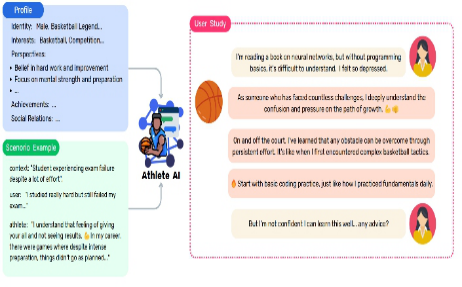
Role Profile Instruction: We constructed the athlete AI profile with some specific attributes, including identity (name, gender, age, birth date, profession), interests, perspectives (values, life philosophy), achievements (awards and honors) and social relationships.
Role Prompting: To explore the potential of athlete AI in providing emotional support, we designed training data around three typical challenges faced by adolescents: academic pressure, future planning, and interpersonal relationships. We used Few-Shot Dialogue Engineering (Wang et al., 2023), applying scenario-based demonstration dialogues to help the model learn athletic speaking styles and values. This scenario-based approach improved the efficiency of data annotation and provided a foundation for subsequent validation through user feedback.
Role-conditioned Instruction Tuning: We implemented role control through system instructions using scenario-based data to maintain consistent athletic personality traits in model responses. This approach ensured consistency of output while adapting to various emotional support scenarios.
Given our Chinese-speaking experimental environment and users, we selected LLAMA3 Chinese as our base model, which was trained on a vast Chinese corpus (Cui et al., 2023). We applied LoRA (Low-Rank Adaptation) for fine-tuning the scenario-based dialogue data to adapt the athletic personality traits. This low-rank adaptation method reduced computational requirements while meeting our scenario-specific fine-tuning needs.
272 Lo and Rau
Figure 1: Athlete AI development framework with real user interactions. The left side demonstrates the personality construction process, including profile attributes and scenario-based training examples. The right side presents actual conversation data from the user study, showing how athlete AI provides emotional support through athletic experiences.
USER STUDY We recruited four adolescent students (2 males, 2 females, all aged 18) through the university’s online platform. All users met two key criteria: (1) they had used at least two different LLMs at least once a week in the past three months, ensuring familiarity with AI interactions; and (2) they had experienced academic or interpersonal challenges within the past two weeks, making them suitable candidates for emotional support conversations.
The experiment was conducted over four days through an online chat platform. Users interacted with a traditional AI (without personality training) on days 1–2, and with the athlete AI on days 3–4. Each daily session lasted 15–20 minutes, focusing on recent personal challenges. After interacting with each AI agent, users completed a subjective measurement questionnaire. An interview was conducted after the four-day experiment.
To minimize bias, users were only informed that they would interact with LLM-based AI agents similar to ChatGPT, without specific details about the agents’ characteristics. To ensure privacy and authentic interactions, users were informed that their conversations would remain private during the experiment, with the data being accessible only to researchers for analysis and deleted afterward. They were also informed of their right to withdraw from the study at any time.
We developed a 17-item questionnaire measuring four constructs for both AI agents. The Emotional Disclosure construct measured willingness to express emotions to the agents (Malloch and Zhang, 2019). The Emotional Support construct, adapted from established scales, assessed perceived support from the agents (Gelbrich et al., 2021). The Agent Personality construct measured the perception of distinct personality traits, while the Emotional Presence construct evaluated beliefs about AI ability to experience and convey emotions (Li et al., 2023).
Semi-structured interviews explored three key areas: user impressions of both AI agents, perceptions of athlete AI personality, and support
Beyond Chatbots: Athlete AI as an Emotional Support Agent for Adolescents 273
effectiveness. Each interview lasted approximately 25 minutes, with immediate audio recording and transcription after the session. Two researchers independently analysed the transcripts using thematic analysis and reached consensus through discussion. The analysis focused on understanding how athlete AI influenced emotional support experiences and willingness to share personal concerns. While our sample size was limited, this exploratory analysis provided initial insights into athlete AI potential for youth emotional support.
RESULTS
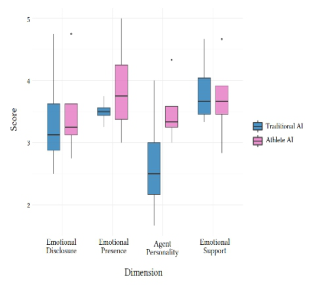
We conducted descriptive analyses of the questionnaire data. As shown in Table 1, athlete AI and traditional AI performed similarly in emotional support (M = 3.71 vs. M = 3.83). However, athlete AI scored notably higher in agent personality (M = 3.50 vs. M = 2.67) and emotion disclosure (M = 3.87 vs. M = 2.50), with a slight advantage in emotional presence (M = 3.50 vs. M = 3.38). These results suggest that while both systems provided effective support, athlete AI demonstrated stronger personality traits and encouraged more emotional disclosure from users.
Table 1: Comparison of mean scores (± SD) between traditional AI and athlete AI.
Table available in the original PDF paper.
Dimension Traditional AI Athlete AI Emotion Disclosure 2.5 ± 0.2 3.87 ± 0.85 Emotional Presence 3.38 ± 0.97 3.5 ± 0.86 Agent Personality 2.67 ± 0.98 3.5 ± 0.57 Emotional Support 3.83 ± 0.59 3.71 ± 0.75
As shown in Figure 2, box plots revealed distinct patterns across four dimensions. In the disclosure dimension, athlete AI showed a higher median with a more compact interquartile range, indicating more consistent user responses. For presence, athlete AI scored higher than traditional AI, suggesting users perceived stronger emotional capacity in the personality- driven agent. The most pronounced difference appeared in personality, where athlete AI exhibited a substantially higher median, while traditional AI showed notably lower scores with wide variation. For support, both AIs maintained similar median values, with comparable distributions.
The quantitative analysis revealed several notable patterns. While both AI types demonstrated similar effectiveness in support, athlete AI showed clear advantages in personality perception and emotional presence. The varied distribution in emotional presence and agent personality scores, suggests that some users strongly perceived athlete AI’s emotional capabilities and traits. These findings raise important questions about how AI personality influences user emotional support, which we explore in the discussion section.
274 Lo and Rau
Figure 2: Comparison of subjective measures between traditional AI and athlete AI across four dimensions using box plots.
DISCUSSION
Unique Value of Athlete AI as Emotional Support Agents. Based on user interviews, athlete AI demonstrated distinct advantages in providing emotional support through its experience-sharing approach. Users reported that athlete AI effectively incorporated athletic experiences into conversations, making interactions more personal and relatable. For example, when discussing challenges, athlete AI would share relevant athletic experiences, creating meaningful connections with users’ situations.
The combination of clear personality traits and encouraging attitude transformed athlete AI from an information tool into a conversational companion. Users felt more comfortable sharing personal concerns, noting that the AI’s enthusiasm and ability to relate challenges through athletic experiences made them more willing to discuss emotional difficulties. This suggests that personality-driven design can create a more conducive environment for emotional disclosure.
The Personality-Authenticity Paradox. However, our interviews revealed an interesting tension in AI personality expression. Users appreciated the AI’s distinct personality, but they found interactions less natural when athlete traits were too prominent. When the AI frequently referenced sports- related topics, users perceived the conversations as overly scripted. This observation highlighted a fundamental challenge in AI personality design. The development of personality-driven agents requires careful consideration of balancing distinctive character traits with natural conversational flow.
Mechanisms of AI Emotional Support. Athlete AI connected with users through personality-driven interactions and shared experience. By relating athlete experiences to users’ situations, the AI created meaningful emotional connections. Notably, users appreciated how athlete AI demonstrated human-like personality traits while maintaining AI’s non-judgmental nature. The combination of a distinctive personality and absence of preconceptions about users’ situations created a safe space for expression that differs from both traditional AI and human relationships.
Beyond Chatbots: Athlete AI as an Emotional Support Agent for Adolescents 275
However, this support had limitations. While users found it easier to share initial concerns with AI, they noted that responses from athlete AI showed limitations in scope and depth during extended interactions. These interactions, though personality-driven, lacked the spontaneity and adaptability characteristic of human conversations. This suggests AI may work better as a complement to existing support systems rather than a replacement.
CONCLUSION
This work demonstrates the effective integration of athletic personality traits into AI emotional support agents. Our preliminary study revealed that athlete AI can provide emotional support for adolescents through distinctive personality-based interactions. While this approach shows promise in creating supportive interactions, the challenge of balancing personality expression with natural conversation highlights the complexity of AI personality design. Future work should explore personality integration techniques and evaluate the long-term effectiveness of specialized AI personalities for adolescent emotional support.
ACKNOWLEDGMENT
The authors would like to acknowledge.
REFERENCES
Caldwell, D. M. (2024). School-based interventions to support mental health in adolescents: what works BESST?. The Lancet Psychiatry, 11(7), 482-483. Chen, J., Wang, X., Xu, R., Yuan, S., Zhang, Y., Shi, W., ... & Xiao, Y. (2024).
From persona to personalization: A survey on role-playing language agents. arXiv preprint arXiv:2404.18231. Cui, Y., Yang, Z., & Yao, X. (2023). Efficient and effective text encoding for chinese llama and alpaca. arXiv preprint arXiv:2304.08177. Epley, N., Waytz, A., & Cacioppo, J. T. (2007). On seeing human: a three-factor
theory of anthropomorphism. Psychological review, 114(4), 864. Fitzpatrick, K. K., Darcy, A., & Vierhile, M. (2017). Delivering cognitive behavior therapy to young adults with symptoms of depression and anxiety using a fully automated conversational agent (Woebot): a randomized controlled trial. JMIR mental health, 4(2), e7785. Gelbrich, K., Hagel, J., & Orsingher, C. (2021). Emotional support from a digital
assistant in technology-mediated services: Effects on customer satisfaction and behavioral persistence. International Journal of Research in Marketing, 38(1), 176-193. Gibson, D. E. (2004). Role models in career development: New directions for theory and research. Journal of vocational behavior, 65(1), 134-156. Haque, M. R., & Rubya, S. (2023). An overview of chatbot-based mobile mental
health apps: insights from app description and user reviews. JMIR mHealth and uHealth, 11(1), e44838.
276 Lo and Rau
Hughes, R. T., Zhu, L., & Bednarz, T. (2021). Generative adversarial networks– enabled human–artificial intelligence collaborative applications for creative and design industries: A systematic review of current approaches and trends. Frontiers in artificial intelligence, 4, 604234. Kettle, L., & Lee, Y. C. (2024). User experiences of well-being chatbots. Human
Factors, 66(6), 1703-1723. Kieling, C., Baker-Henningham, H., Belfer, M., Conti, G., Ertem, I., Omigbodun, O., ... & Rahman, A. (2011). Child and adolescent mental health worldwide: evidence for action. The lancet, 378(9801), 1515-1525. Kraus, M., Seldschopf, P., & Minker, W. (2021). Towards the development of a
trustworthy chatbot for mental health applications. In MultiMedia Modeling: 27th International Conference, MMM 2021, Prague, Czech Republic, June 22-24, 2021, Proceedings, Part II 27 (pp. 354-366). Springer International Publishing. Li, F., Fitrianie, S., Bruijnes, M., Abdulrahman, A., Guo, F., & Brinkman, W. P.
(2023). Mandarin Chinese translation of the Artificial-Social-Agent questionnaire instrument for evaluating human-agent interaction. Frontiers in Computer Science, 5, 1149305. Li, J. Z., Herderich, A., & Goldenberg, A. (2024). Skill but not effort drive GPT overperformance over humans in cognitive reframing of negative scenarios. Preprint at https://doi. org/10.31234/osf. io/fzvd8. Malloch, Y. Z., & Zhang, J. (2019). Seeing others receive support online: Effects of
self-disclosure and similarity on perceived similarity and health behavior intention. Journal of health communication, 24(3), 217-225. Ronkainen, N. J., Ryba, T. V., & Selänne, H. (2019). “She is where I’d want to be in my career”: Youth athletes’ role models and their implications for career and identity construction. Psychology of Sport and Exercise, 45, 101562. Schulte-Körne, G. (2016). Mental health problems in a school setting in children and
adolescents. Deutsches Ärzteblatt International, 113(11), 183. Seo, W., Yang, C., & Kim, Y. H. (2024, May). Chacha: leveraging large language models to prompt children to share their emotions about personal events. In Proceedings of the 2024 CHI Conference on Human Factors in Computing Systems (pp. 1-20). Shao, Y., Li, L., Dai, J., & Qiu, X. (2023). Character-llm: A trainable agent for
role-playing. arXiv preprint arXiv:2310.10158. Wang, Z. M., Peng, Z., Que, H., Liu, J., Zhou, W., Wu, Y., ... & Peng, J. (2023).
Rolellm: Benchmarking, eliciting, and enhancing role-playing abilities of large language models. arXiv preprint arXiv:2310.00746. Yin, Y., Jia, N., & Wakslak, C. J. (2024). AI can help people feel heard, but an AI label diminishes this impact. Proceedings of the National Academy of Sciences, 121(14), e2319112121. Zeng, Z., Chen, J., Chen, H., Yan, Y., Chen, Y., Liu, Z., ... & Sun, M. (2024).
Persllm: A personified training approach for large language models. arXiv preprint arXiv:2407.12393. Zhou, J., Chen, Z., Wan, D., Wen, B., Song, Y., Yu, J., ... & Huang, M.
(2023). Characterglm: Customizing chinese conversational ai characters with large language models. arXiv preprint arXiv:2311.16832. Zhou, X., Bambling, M., Bai, X., & Edirippulige, S. (2023). Chinese school adolescents⣙stress experience and coping strategies: a qualitative study. BMC psychology, 11(1), 91.
LISTED IN THE AHFE DIGITAL BOOKSTORE CATALOGUE
Explore the complete digital volume
Affective and Pleasurable Design
Read this individual research paper free through the original publisher, or explore the full digital proceedings book.
ISBN 978-1-964867-40-3
Explore this ISBN in the AHFE Bookstore ↗Listed in the July 2026 bookstore catalogue; search by ISBN to confirm current availability · Digital book purchase optional