Lingyue Li (2025). Technology Innovation of Artificial Intelligence in Building Sector: Present Status and Challenges. In: Human Interaction and Emerging Technologies (IHIET-AI 2025): Artificial Intelligence and Future Applications. AHFE Open Access, vol. 161, pp. 284–289. https://doi.org/10.54941/ahfe1005920
As one of the least digitalized industries in the world, the building and construction sector has faced great challenges in sustainable growth. The high-fragmented structure and high threshold for R&D investment has prevented the building and construction industry from swift technological innovation. In many industries, artificial intelligence (AI) is producing revolution, e.g., retail, telecommunications, and helps make profits, improve efficiency, security and safety. But application of this advanced technology to building sector seems largely fall behind. AI is considered able to assist waste reduction by decision making on complexity, assist energy management (e.g., identify the black hole of energy consumption during operation, and data mining and machine learning of big data to optimize scenario for sustainability or enable real-time feedback and regulation during operation) in building and construction industry. Earlier research on technological innovation in Yangtze River Delta has revealed that AI has less than 10 records of patent filing in the dataset and has rarely mixed with other technologies so far. Different from other technologies that state owned enterprises more or less have a role in the knowledge production, applicant in the field of AI is mainly private in nature – the known companies are from Zhejiang. In view of these inadequacies, a broader look at how this technology is being used at greater geographic sphere is in need. This research broadens the search of patent applications in AI in the field of building construction to reveal the panorama of how this technology has been applied across the globe. It generates insights into the potential of AI in building industry and opens discussing forum for future.
Artificial intelligence (AI) is now revolutionizing industries such as manufacturing, finance, retail, social media and telecommunications (Berdiyorova, Akhtamova, & Ganiev, 2021; Chui & Francisco, 2017; Gilner, Galuszka, & Grychowski, 2019; Paschen, Pitt, & Kietzmann, 2020), but its application in the building and construction sector fell far behind (Li, Wang, & Zhang, 2022; Sacks, Girolami, & Brilakis, 2020). In the urbanizing world, building industry has been facing sophisticated challenges due to e.g., labour shortage, safety construction, health maintenance, and overrun of cost and time, preventing it from sustainable growth (Abioye et al., 2021). The high-fragmented structure and high threshold for R&D investment are considered the main reason for the slow progress of technological
Technology Innovation of Artificial Intelligence in Building Sector 285
innovation in the building sector. As one of the least digitalized industries on earth, building and construction are overly manual in many aspects. In academia and professional field, artificial intelligence is viewed having the potential to improve automated construction and business operation, thus enhance productivity and efficiency (Chui & Francisco, 2017). In manufacturing industry, for instance, the renowned industrial 4.0 embracing automation is in favour of data-driven, advanced AI technologies in recent years (Wang et al., 2021). There are many branches or subfields of AI, e.g., natural language processing, robotics, computer vision, optimisation, machine learning, automated planning and scheduling, which can deal with complicated, real-world problems and assist the application of AI to building sector. Examples include the assistance of waste reduction by decision making on complexity, assistance in energy management (e.g., identify the black hole of energy consumption during operation, and data mining and machine learning of big data to optimize scenario for sustainability or enable real-time feedback and regulation during operation). Earlier research on technological innovation in Yangtze River Delta, China has revealed that AI has less than 10 records of patent filing in the dataset and has rarely mixed with other technologies so far (Li et al., 2022). Different from other technologies that state owned enterprises more or less have a role in the knowledge production, applicant in the field of AI is mainly private in nature – the known companies are from Zhejiang. It is, however, unknown how this technology is being used at greater geographic sphere. This research thus broadens the search of patent applications in AI in the field of building construction to reveal the panorama of application of this technology across the globe.
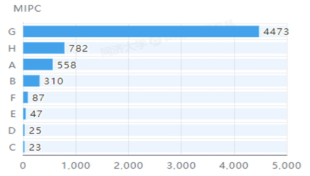
TECHNOLOGY INNOVATION OF ARTIFICIAL INTELLIGENCE IN BUILDING SECTOR: A VIEW OF PATENT APPLICATION Patent application is one of the main proxies to measure technology innovation. This research sorts out patents in the field of artificial intelligence to unravel the progress of technology innovation and application. Data search of patent application in 2023 indicates that among all the eight sections, AI is disproportionately concentrated in Physics (section G), followed by electricity (section H), human necessity (section A), performing operations and transporting (section B). The rest four sections share very few applications, fixed construction (section E) only accounts for less than 0.74% of the total (Figure 1).
Figure 1: Application of AI in 8 sections (2023).
286 Li
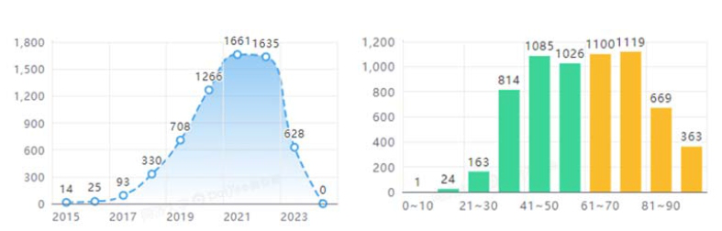
The trends analysis indicates that application of AI has been increasing since 2015 and the applicants are mainly from United States, South Korea and Japan. Most of the patents’ values are between 40–90, implying that patents in this field might have good commercial potential (Figure 2).
Figure 2: Trend and values of AI applications.
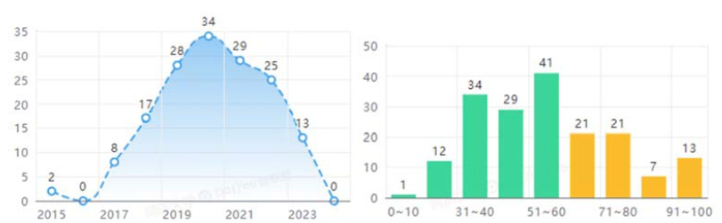
To further look into the building sector, this research identifies patent applications in section E. Preliminary observation suggests that the trend of AI application in section E overall copes with the general trend, increasing since 2015, but the distribution of patent values is more dispersed (Figure 3). United States, South Korea and Japan remain the three application giants, accounting 32.5%, 29.7% and 12.9% of the total, followed by Australia, India, Canada, Russia and European Union (Table 1).
Figure 3: Trend and values of AI application in building sector.
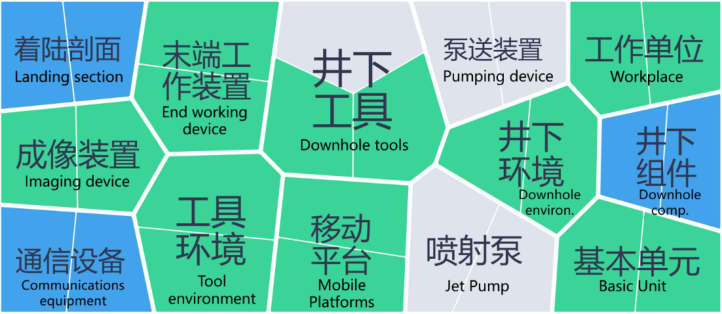
Patent landscape unveils the focus of artificial intelligence technology in building industry (Figure 4). Innovations are distributed in automation and information transmission related working equipment, e.g., landing section, end working device, downhole tools, pumping device, workplace, downhole component, basic unit, tool environment, downhole environment, imaging device, mobile platforms, jet pump, communication tools etc. Most of the applications are related to the work of construction and operation phase, which aims to improve security and efficiency of the work.
Technology Innovation of Artificial Intelligence in Building Sector 287
Figure 4: Patent landscape of AI in building sector.Table 1. Ratio of AI patent applications from different countries.
Table available in the original PDF paper.
Code Country Ratio KR REPUBLIC OF KOREA 32.5% US UNITED STATES OF AMERICA 29.7% JP JAPAN 12.9% AU AUSTRALIA 4.3% IN INDIA 3.8% CA CANADA 3.3% RU RUSSIAN FEDERATION 3.3% EP EUROPEAN PATENT OFFICE (EPO) 3.3% FR FRANCE 1.0% GB UNITED KINGDOM 1.0% MA MOROCCO 1.0% BR BRAZIL 0.4% NL NETHERLANDS 0.4% MY MALAYSIA 0.4% DE GERMANY 0.4% EA EURASIAN PATENT ORGANIZATION (EAPO) 0.4% AT AUSTRIA 0.4% LU LUXEMBOURG 0.4% SA SAUDI ARABIA 0.4%
CHALLENGES OF APPLYING ARTIFICIAL INTELLIGENCE IN BUILDING AND CONSTRUCTION INDUSTRY In view of the aforementioned review on patent applications of AI, it is clear that development of building and construction industry is falling short of AI technologies and is constrained by sophisticated problems. Currently, the main challenges prevent building sector from broadly applying AI include security concern, cultural issues, ethical considerations, talent resources, high threshold for initial investment and the strength of computility and web connectivity (Babiˇc & Rebolj, 2016; Oyedele et al., 2015). For instance, internet connectivity often faces the threats of privacy intrusion, cybercrimes
288 Li
and exploitation of hackers, which is detrimental for building sectors as small errors may lead to huge loss in construction process, either time or economic costs. If use AI to carry out the process of construction activities, there shall be minimal, or at best, no security risks. Moreover, typical AI approaches such as machine learning is often black-box in nature, which barely explains to the public and leaves crisis of trust between the providers and users. This is especially important for the building sector that for such large-scale structures, transparency is in need to avoid any mistakes and better deliver the project. The initial high cost as a major barrier for AI entering the building market shall be noted, and proper mechanisms are expected to build so that investment risks can be reduced and more entities are able to join.
CONCLUSION
In view of the inadequate application of AI technology in building sector, this research provides a broader look at how this technology is being used at greater geographic sphere. It reveals the panorama of how this technology has been applied across the globe and generates insights into the potential of AI in building industry, opening a discussing forum for future.
ACKNOWLEDGMENT
The authors would like to acknowledge the National Key R&D Program of China (No. 2023YFC3804001) for funding this research.
REFERENCES
Abioye, S. O., Oyedele, L. O., Akanbi, L., Ajayi, A., Delgado, J. M. D., Bilal, M.,...
Ahmed, A. (2021). Artificial intelligence in the construction industry: A review of present status, opportunities and future challenges. Journal of Building Engineering, 44, 103299. Babiˇc, N. ˇC., & Rebolj, D. (2016). Culture change in construction industry: From 2D toward BIM based construction. Journal of Information Technology in Construction (ITcon), 21(6), 86–99. Berdiyorova, I., Akhtamova, P., & Ganiev, I. M. (2021). Artificial intelligence in
various industries. Development Issues of Innovative Economy in the Agricultural Sector, 750–757. Chui, M., & Francisco, S. (2017). Artificial intelligence the next digital frontier.
McKinsey and Company Global Institute, 47(3.6), 6–8. Gilner, E., Galuszka, A., & Grychowski, T. (2019). Application of artificial intelligence in sustainable building design-optimisation methods. Paper presented at the 2019 24th International Conference on Methods and Models in Automation and Robotics (MMAR). Li, L., Wang, L., & Zhang, X. (2022). Technology innovation for sustainability in
the building construction industry: An analysis of patents from the Yangtze River Delta, China. Buildings, 12(12), 2205. Oyedele, L. O., Jaiyeoba, B. E., Kadiri, K. O., Folagbade, S. O., Tijani, I. K., & Salami, R. O. (2015). Critical factors affecting construction quality in Nigeria: Evidence from industry professionals. International Journal of Sustainable Building Technology and Urban Development, 6(2), 103–113.
Technology Innovation of Artificial Intelligence in Building Sector 289
Paschen, U., Pitt, C., & Kietzmann, J. (2020). Artificial intelligence: Building blocks and an innovation typology. Business Horizons, 63(2), 147–155. Sacks, R., Girolami, M., & Brilakis, I. (2020). Building information modelling,
artificial intelligence and construction tech. Developments in the Built Environment, 4, 100011. Wang, B., Tao, F., Fang, X., Liu, C., Liu, Y., & Freiheit, T. (2021). Smart manufacturing and intelligent manufacturing: A comparative review. Engineering, 7(6), 738–757.
LISTED IN THE AHFE DIGITAL BOOKSTORE CATALOGUE
Explore the complete digital volume
Human Interaction and Emerging Technologies (IHIET-AI 2025): Artificial Intelligence and Future Applications
Read this individual research paper free through the original publisher, or explore the full digital proceedings book.
ISBN 978-1-964867-37-3
Explore this ISBN in the AHFE Bookstore ↗Listed in the July 2026 bookstore catalogue; search by ISBN to confirm current availability · Digital book purchase optional